This post contains affiliate links. We may earn a small commission when you buy through our links — at no extra cost to you.
It’s 3 a.m., the baby has finally gone back down, and you’re at the sink holding a bottle in one hand and a brush in the other, trying to get curdled formula out of a nipple that seems engineered to trap it. A bottle brush is a small purchase with an outsized job: reaching the bottom corners, scrubbing the vent slits, and surviving three or four soapy rounds a day without shedding bristles into the thing your baby drinks from. The right one turns that into thirty seconds of work; the wrong one leaves a film you can still smell an hour later.
Bristle softness is where most first-time buyers guess wrong. Too soft and the brush just smears the fat in formula around; too stiff and it scuffs the inside of plastic bottles until they go cloudy. The best ones land in between and add a few things you only notice after a week: a tip narrow enough for nipples, a handle long enough to reach the bottom without dunking your knuckles, a base that stands up in a wet cup instead of sliding in sideways. I’ve spent the last three months washing bottles with 14 different brushes, and the ones that survived daily sink duty earned it on scrubbing power and how long they held their shape.


Best for Everyday Sink Setup
OXO Tot Bottle Brush
Key Features
- Stand: Drip-catching with pour spout
- Handle: Silicone, nonslip
- Bristles: Soft and firm
- Nipple cleaner: Built into handle
- Price: Midrange
The stand is why this brush sits out on our counter instead of face-down in the sink. It has a well that catches what drips off the head and a spout at the corner for tipping it out, so the base isn’t sitting in a puddle by the end of the day. That reads like a small thing on a listing and feels like a real one when you’re the person wiping the counter.
The head does the actual work, and it’s split between soft outer bristles and firmer inner ones. The firm ones bite into dried formula at the bottom; the soft ones flex into the shoulder of a narrow bottle without us worrying about hazing plastic. A flexible neck lets the head follow a contoured bottle instead of jamming at the curve, and the silicone handle still feels secure with soap on it.
The detail cleaner is the part we didn’t expect to use as often as we do. It stows inside the handle, flexes into the tip of a nipple, and clicks back into an open-sided slot that lets it air-dry rather than sit damp in a tube. Between that and the stand, there’s nothing else to keep by the sink for a standard bottle wash.
Pros
- Stand catches drips and pours them out
- Nipple cleaner stows in the handle
- Soft and firm bristles in one head
- Silicone handle grips when wet
Cons
- Can break at the neck with daily use
- Nipple cleaner is stiff to pull free
Our default pick: the stand catches drips and the nipple cleaner hides in the handle, so one tool handles the bottle and the teat.
Best for Tight Budgets
Munchkin Bristle Brush
Key Features
- Base: Suction cup
- Neck: Flexible
- Bristles: Soft nylon, scratch-free
- Nipple brush: Stored in handle
- Price: Budget
This is the least expensive brush in this guide, and it’s the one we point at second sinks, diaper bags and grandparents’ kitchens. One brush, a suction cup on the base, a flexible neck and a nipple brush that slides down into the handle — nothing extra to store and nothing to assemble.
The suction cup is what lifts it above other cheap brushes. Pressed onto a clean, flat counter it holds, so the brush stands beside the sink instead of rolling around in it, and we stopped hunting for it within a week. It’s a plain design doing the unglamorous thing well, which is most of what you want from something you’ll replace in a couple of months.
The bristles run firm. That’s how it gets dried formula off the bottom of a wide-mouth bottle, but a hard shove sends water back up out of the neck and onto your hand. Slower strokes fix it, and the flexible neck means you don’t have to force the head around a curve to begin with.
Pros
- Suction cup holds it upright by the sink
- Firm bristles scrub dried formula
- Least expensive brush in this set
- Flexible neck reaches bottle curves
Cons
- Nipple brush can work loose from the handle
The budget pick we keep reaching for: it sticks to the sink, scrubs hard, and costs the least of anything covered here.
Best for Narrow Bottles
Philips Avent Brush
Key Features
- Head: Curved
- Bristles: High density
- Nipple cleaner: Molded tip in handle
- Dishwasher-safe: Yes
- Price: Budget
No stand, no suction cup, no holder: the Avent is a single brush with a curved head and a molded nipple tip on the end of the handle. On paper it’s the barest option in this guide, and it’s the one we expected to lose track of first.
In the sink it doesn’t feel bare. The head is slim enough to slide into narrow bottles and pump bottles, and the curve follows a rounded base so you’re not chasing the last of the milk around the corner. The high-density bristles hold their shape wash after wash, and it’s dishwasher-safe — which is where the missing stand stops mattering, because it goes in the basket with everything else and comes out clean.
The molded tip is the one piece we’re mixed on. On a silicone nipple it works, and it’s always there because it can’t get lost in a drawer. On the inner curve of a pump shield it can’t reach, so those still want a small separate brush.
Pros
- Slim head fits narrow bottles
- Curved head follows rounded bases
- Molded nipple tip can’t get lost
- Dishwasher-safe
Cons
The simplest brush here, and our pick for narrow bottles: slim, dishwasher-safe, and quick to rinse clean.
Best for Countertop Display
Boon Cacti Set
Key Features
- Holder: Drip-catching vase
- Bristles: Nylon
- Set contents: Bottle, nipple, detail and straw brushes
- Price: Premium
Four cacti standing in a little vase is what this looks like on the counter, and that’s the honest reason it stays out instead of going in a drawer. The vase catches drips, the brushes stand upright in it, and the whole thing reads as decoration rather than cleaning equipment.
The set is a bottle brush, a nipple brush, a detail brush and a straw brush. The small ones earn their place — the straw brush gets through pump valves and sippy straws, the detail brush into lid threads. The big bottle brush is the weakest of the four: it’s the widest head here, so it won’t go into narrow pump bottles, and we leave it for wide-mouth bottles.
This is the priciest set in this guide, and that premium buys the vase and the cactus handles rather than better cleaning. The scrubbing itself is no different from a plain brush’s. What you’re deciding is whether the set stays on display; if it does, the money is well spent.
Pros
- Vase catches drips and holds the set upright
- Four brushes cover straws and nipples
- Looks good enough to stay on the counter
Cons
- Bristles wear faster than the rest of the set
Buy it if your brushes live on the counter: four brushes and a drip-catching vase that look good enough to stay out.
Best for on the Go
Momcozy 7-in-1 Set
Key Features
- Storage: Zip case and portable bag
- Brush head: Boil-safe
- Bottle brush: Silicone
- Kit includes: Nipple brush, straw brush, drying rack, soap dispenser
- Price: Premium
Everything in this kit zips into a case about the size of a pencil box: a silicone bottle brush, a nipple brush, a straw brush, a small soap dispenser and a fold-out drying rack. It’s the only set here built to leave the house.
The rack is what makes it work. Folded out beside a hotel sink or a relative’s kitchen tap, it holds bottles upright while they dry instead of leaving you to arrange them on a towel, and it folds flat again while everything is still damp rather than waiting for a full air-dry.
As a travel kit this is the best of the ones here, and it’s what goes in our bag for a weekend away. It isn’t the brush we reach for at home: the silicone head is gentle and rinses clean, but dried formula takes a second pass where a nylon brush takes one. For a trip, that’s a fair trade for a wash station that fits in a changing bag.
Pros
- Packs into a small zip case
- Fold-out rack dries bottles anywhere
- Silicone head rinses clean quickly
Cons
- Bristles can break off with heavy use
- Fold-out rack feels light
The travel kit we pack: everything for a bottle wash, a fold-out rack and a case that keeps it out of the diaper bag’s depths.
Best for Complete Starter Kit
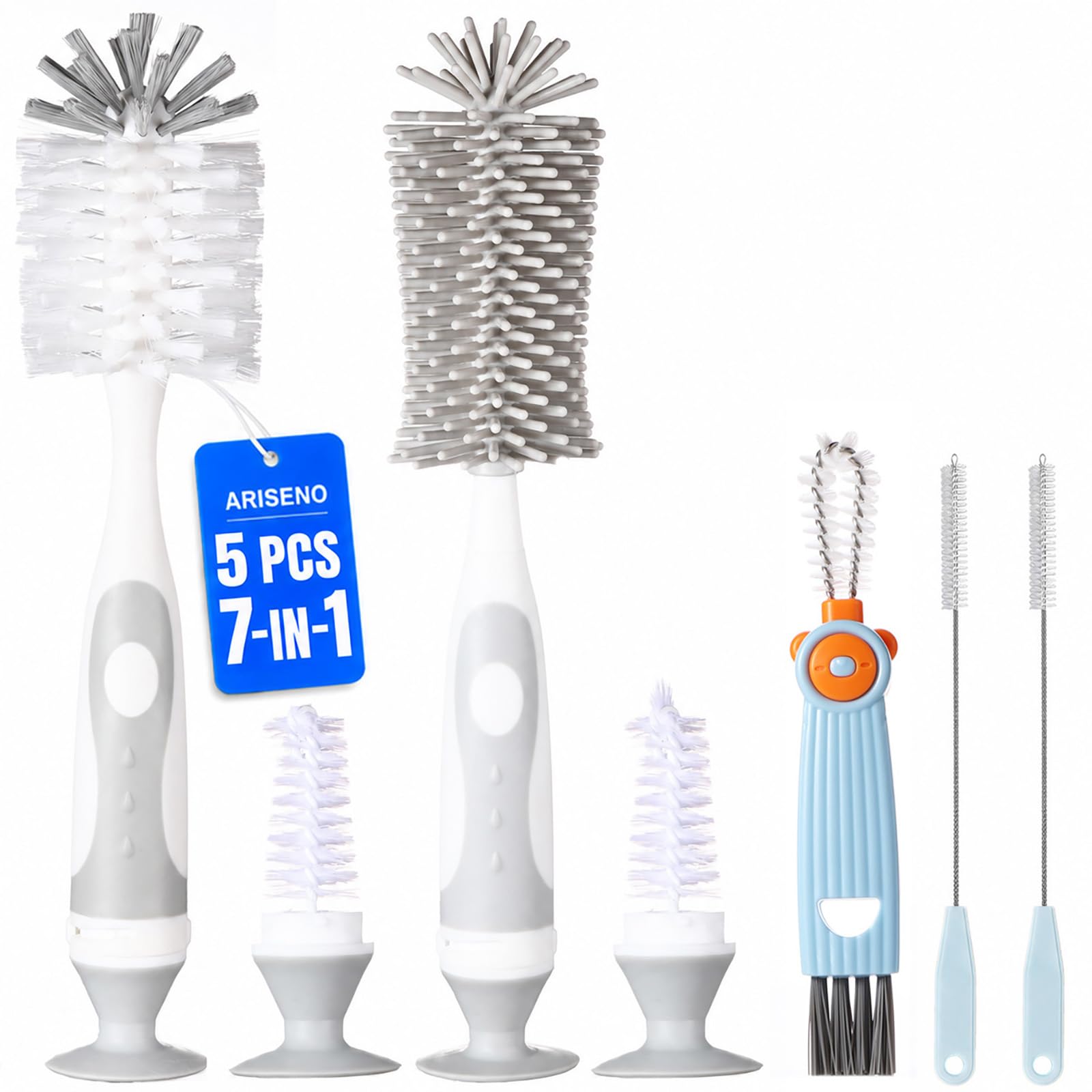
Ariseno 7-in-1 Set
Key Features
- Base: Suction cup
- Material: BPA-free
- Bottle brushes: Nylon and silicone
- Detail brushes: Nipple, cap and straw
- Price: Midrange
Two full-size bottle brushes come in this set — one nylon, one silicone — along with a cap brush, two straw brushes and two nipple brushes that twist out of the suction-cup base.
Having both brush materials is more useful than it sounds. The nylon head does the scrubbing on milk film, while the silicone one is what we hand over for a plastic bottle we want to keep clear, and it rinses faster besides. The base stands on the counter, and tucking the nipple brushes inside it keeps them out of the cutlery drawer, where small things go to disappear.
For the money this covers more of the washing-up than anything else here, and it’s the set we suggest to someone starting from nothing: bottles, teats, caps and straws all have a brush that fits. Two things to know before you buy. The small brushes are bendy enough to deform if you lean on them, and the packaging itself notes that bristles can arrive bent from shipping and explains how to reset them.
Pros
- Two full-size brushes in different materials
- Nipple brushes hide in the suction base
- Covers caps, straws and teats
Cons
- Small brushes bend out of shape
The most complete inexpensive set here: two bottle brushes in different materials, plus the small brushes you’ll actually use.
Best for Straws and Lids
Munchkin Details Set

Key Features
- Extras: Sealing-ring pick
- Storage: Detachable clip ring
- Set contents: Straw, spout, lid and detail brushes
- Price: Budget
A big brush can’t clean a straw, a sippy spout or the threads inside a lid, and that’s the gap this four-piece set fills.
The brushes — straw, spout, lid and threads, and a small detail brush — live on a detachable clip ring, so they stay together in a drawer instead of scattering across it. The ring also carries a pick for lifting sealing rings out of lids, and the handles have a finger recess that keeps them steady when everything is soapy.
It is not a bottle brush. There’s no full-size head here, so it works alongside something like the OXO Tot rather than replacing it. If you’re buying one thing, buy the big brush first.
Where it earns its place for us is a house with a toddler in it. Straws, sippy spouts and the sealing rings that trap milk inside a lid are exactly the parts a bottle brush skips, and the four small brushes reach them.
Pros
- Reaches straws, spouts and lid threads
- Clip ring keeps the set together
- Sealing-ring pick for awkward lids
Cons
- Bendy shafts on the smallest brushes
Worth adding to a full-size brush: it reaches straws, spouts and lid threads that a bottle brush can’t touch.
How We Tested Baby Bottle Brushes
We built the shortlist from brushes that keep reappearing in nursery forums and registry lists, then narrowed by head shape, handle length, whether the base stands on its own, and cost per brush — 14 made the cut, from drugstore basics to pricier silicone sets.
Testing ran for three months of ordinary, unglamorous bottle washing: overnight feeds, the morning sink backlog, and day-care bottles that sat in a bag for eight hours before anyone got to them. To make the comparison fair, we let formula dry overnight in identical bottles, then timed how many strokes each brush needed to clear the shoulder and the bottom corner, checking by running a finger around the inside and holding the bottle up to the light. Nipples and vent slits got their own pass — we squeezed water through each one afterward to see whether anything had been left behind.
Bristle hardness got judged against the palm first, then against plastic: we pressed each brush head into a bottle for a week and looked for scuff marks and clouding. Every brush spent time standing in a cup on a wet counter, and we nudged each one to see whether it tipped or slid in sideways. After three months we lined the used brushes up next to fresh ones and checked for splayed tips, bent bristles, rust at the wire core, and handles that had gone cloudy or picked up stains, since a brush that lives on the counter has to look presentable too. Value came down to usable weeks rather than sticker price.
How to Choose a Baby Bottle Brush
A bottle brush is a consumable, so the question isn’t which one lasts forever — it’s which one makes the wash you do three times a day quicker, and how often you’re willing to replace it.
Match the head to the bottles you own
Bristle material changes how the brush behaves. Nylon scrubs dried formula off the bottom fastest; silicone and sponge are gentler on plastic but need a second pass on anything stubborn. What actually disqualifies a brush is width — the widest part of the head has to pass through the narrowest neck you wash. Narrow bottles and pump bottles punish a fat head, and no amount of good bristle design fixes a brush that won’t go in.
If your cabinet is a mix, buy for your narrowest bottle. The Philips Avent head is the slimmest of the ones here, while the Boon set’s large brush is the widest and is the one we keep for wide-mouth bottles.
Decide where it lives between washes
A brush that stands up dries faster and stops leaving a ring on the counter. Suction cups are the simplest version, but they need a smooth, flat, clean surface; on a textured counter or a wet laminate edge they let go, and then it’s a brush on the floor. A weighted stand with a drip well is the sturdier answer, and a holder that keeps a whole set together suits a kitchen with more than one brush in rotation.
Look closely at the nipple cleaner
Nipples are where milk residue hides and where a big brush can’t follow. There are three approaches here: a small brush stowed in the handle, a molded tip on the end of the handle, and separate small brushes held in a base. Built-in versions can’t get lost, which matters more than it sounds at two in the morning. Whatever the design, check that the small brush can dry — an open slot drains, a closed tube stays damp between uses.
Buy the kit you’ll use, not the brush count
Sets look like good value per brush, but extra brushes only pay off if they do jobs the main brush can’t. Brushes that clean straws, spouts and lid threads are worth having; a fourth brush that duplicates the first is just another handle you paid for. One good bottle brush plus one small detail brush covers most kitchens, and a travel kit is a separate purchase — the Momcozy set earns its spot because it folds into a case, not because it has more pieces.
Frequently Asked Questions
Do I really need a bottle brush, or will a sponge do?
A sponge can’t reach the bottom of a tall bottle, and milk film collects in the shoulder and around the neck where your hand won’t go. A brush’s handle puts the head down there and the bristles flex into the corners. If you’re washing by hand, the brush is the tool that actually contacts the whole interior, which is why nearly every one here is ten inches or longer.
How often should I replace a baby bottle brush?
The Munchkin brushes here carry a recommendation of every 30 to 45 days, and that’s a sensible rhythm for something used several times a day. Replace sooner if the bristles splay outward, the sponge tears away from the head, or the brush starts leaving a film behind. A worn brush stops scrubbing before it looks finished, so don’t wait for it to fall apart.
Can I put a bottle brush in the dishwasher?
Only if the maker says so — the Philips Avent brush is the one here that lists it. Otherwise, rinse it, shake it out and stand it upright to air-dry. A brush left sitting in the sink or in a pool of water in a closed holder is the one that starts to smell and grow cloudy, whatever it’s made of.
Do I need a separate brush for pump parts?
For the small bits, yes. A full-size bottle brush handles the bottle and the wide flange, but valves, membranes and the inner curve of a shield need something narrow. Small spout and straw brushes reach those, and a slim bottle brush like the Philips Avent one slides into narrow pump bottles. If you pump daily, budget for one small detail brush alongside your main brush.
Final Verdict
Start with the OXO Tot. A stand that catches drips and a nipple cleaner that lives in the handle mean one tool covers the whole wash, and nothing cheaper here duplicates both. The Munchkin Bristle is the pick when a suction cup and a lower price matter more than the stand, and the Momcozy kit is the one to pack when the washing happens somewhere other than your kitchen.
