This post contains affiliate links. We may earn a small commission when you buy through our links — at no extra cost to you.
Many parents find that sterilizer-dryers promise convenience but often deliver rusted heating plates or half-dried bottles after a few months. The real challenge is finding a unit that balances fast drying with long-term reliability – and that means looking past flashy features like 12-bottle capacity to how the heating element holds up. Our guide focuses on models that actually finish the job without leaving moisture or corrosion, helping you choose between larger capacity for twins or a proven track record for daily sanity.
The close call here isn’t about brand loyalty but about a fundamental trade-off: do you prioritize maximum bottles per cycle or the peace of mind that comes from thousands of consistent reviews? For most households, the answer leans toward proven drying performance and a non-toxic interior, but heavy users may find the extra capacity worth the slight risk of scale buildup. Either way, using distilled water from day one is the single best way to extend the life of any steam sterilizer.



Best for Proven Drying
Papablic Sterilizer Pro
With over twelve thousand reviews confirming high drying performance, the Papablic Pro is the category’s most tested option. Its steam cycle sterilizes and dries up to ten bottles in 36 minutes, while the CeraCare ceramic coating avoids the chemical leaching risk of uncoated units. Parents consistently report that bottles emerge completely dry, pacifiers stay odor-free, and the universal tray accommodates most standard brands without trial-and-error. The 36-minute auto cycle runs largely unattended, and the control panel uses a simple dial rather than finicky touch buttons.
This model suits households that value proven results over headline features. If you use multiple bottle brands or want a single machine that reliably dries after sterilization, the Papablic fits best. The trade-off is durability: the heating plate can rust or burn out after months of use, especially if tap water is used instead of distilled. Regular descaling and using filtered water mitigates this, but heavy daily users may need a replacement sooner than expected.
Pros
- Steam sterilization kills bacteria effectively across all accessories
- Simple dial operation and clear cycle indicators reduce fumbling
- Bottles and pump parts come out thoroughly dry after each cycle
Cons
- Heating plate may corrode or burn out after months, especially with tap water
Buy this if you want a thoroughly tested sterilizer-dryer with strong drying performance and a non-toxic interior. Skip it if you plan heavy daily use or need a unit that handles tap water without occasional maintenance.
Best for Compact Budget
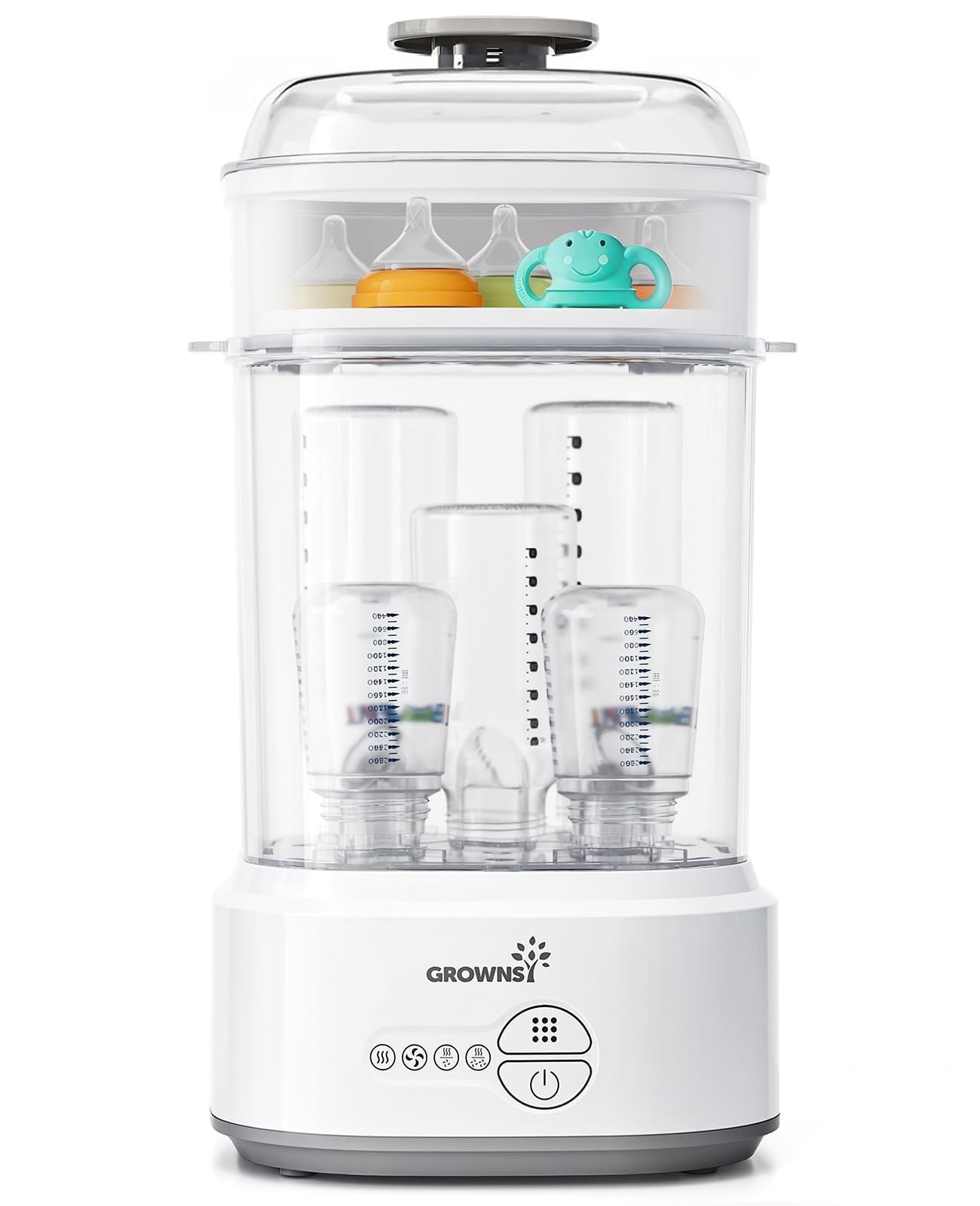
GROWNSY Sterilizer Dryer
With a footprint smaller than most competitors and an 8-minute sterilization cycle, the GROWNSY earns top marks for ease of use and value — 98% of reviewers found it simple to operate. That speed and convenience come at the cost of capacity: it holds only 4–5 standard bottles, making it best for single-baby homes or as a travel/backup unit. For families with twins or heavy pump-part use, a larger model like the Papablic will avoid multiple daily cycles.
Pros
- Fast 8-minute sterilization cycle saves time on each batch
- Compact design fits easily on small countertops
- Strong value for the price – quality and drying are well-regarded
Cons
- Limited to 4–5 bottles; multiple cycles needed for larger families
Buy this if you need an affordable, compact sterilizer for a single baby or occasional use. Skip it if you have twins or need to sanitize many bottles at once.
Best for Time-Saving Auto
Momcozy KleanPal Pro
The Momcozy KleanPal Pro is the sole automatic bottle washer in this roundup, using 26 spray jets and HEPA filtration to eliminate hand scrubbing entirely. For parents feeding multiple babies or pumping regularly, that translates to roughly two hours saved each day. However, the premium price tag and reports of plastic rack cracking or incomplete drying after months of use mean it’s a convenience investment rather than a long-term workhorse. Papablic offers better drying reliability at half the cost, but only the Momcozy handles the scrubbing step. Best suited for bottle-heavy households where time savings outweigh the potential for occasional maintenance.
Pros
- Eliminates hand-washing with 26 spray jets and HEPA filtration
- Simple controls make daily operation effortless
- Multiple cleaning modes adapt to different bottle loads
Cons
- Premium price requires budget commitment
- Occasional quality variances with plastic racks and drying performance
Buy this if you want to stop hand-washing bottles entirely and have the budget for a premium convenience device. Skip it if you prefer a lower-cost sterilizer-dryer with more consistent long-term performance.
Best for Large Capacity
Momcozy 3-Layer Sterilizer
The three-tier design fits twice as many bottles as the top pick, making it a clear choice for families with twins or multiple babies. Sterilization finishes in 9 minutes, and the drying timer adjusts from 10 to 60 minutes. The main trade-off is the larger footprint — it needs more counter space than most competitors. A few users also note that using tap water can lead to scale buildup, which is easy to manage with periodic cleaning or distilled water.
Pros
- Intuitive controls and simple operation out of the box
- Consistently kills bacteria with fast steam sterilization
- Fits a full day of bottles for twins or heavy use
Cons
- Large footprint takes up significant counter space
- Occasional scale buildup if tap water is used; regular cleaning needed
Buy this if you need to sterilize a full day’s worth of bottles for twins or multiple babies in one cycle and have room on the counter. Skip it if counter space is tight or you prefer a more compact unit.
How to Choose
Using distilled water from day one is the single most effective way to prevent rust and extend the life of any steam sterilizer.
Capacity
Larger capacity means fewer cycles per day, which matters for twins or heavy pump-part use. But bigger units take up more counter space and may cost more. A 4-5 bottle sterilizer works for single-baby households; 10+ bottles suits families who need to run it once or twice daily.
Cycle Time
Sterilization alone is fast – typically 8-10 minutes – but drying can add 20-60 minutes. Look for models with adjustable drying timers so you can choose faster cycles for light loads or full drying for complete peace of mind. A combined cycle under 40 minutes is a good benchmark.
Drying Performance
Incomplete drying is the top usability complaint. Even strong dryers can leave moisture if the unit is packed too full or the fan is weak. Check reviews specifically for drying completeness, and avoid models where users frequently report wet bottles after a full cycle.
Durability and Safety
Heating plate rust and melting are the most common failure modes. Units that use a non-toxic ceramic coating or stainless steel heating element resist corrosion better. Using distilled water drastically reduces mineral buildup. Avoid any model with multiple reports of melted plastic or burning smells.
Price vs Value
Budget models (under $50) offer basic sterilization but may struggle with drying and longevity. Mid-range units ($60-$100) typically provide reliable drying, better build quality, and a non-toxic interior. Premium washer-sterilizer combos ($300) eliminate hand-washing but have their own reliability quirks.
FAQ
Why does my bottle sterilizer have rust on the heating plate?
Rust typically comes from using tap water, which contains minerals that deposit on the heating element. Switching to distilled water prevents new rust from forming. For existing rust, clean with a vinegar solution (1:1 water and white vinegar) and run an empty cycle. If the plate is severely pitted, replace the unit – it can compromise sterilization.
How do I clean limescale from a baby bottle sterilizer?
Limescale builds up from hard tap water. Run an empty cycle with a 1:1 mixture of distilled water and white vinegar, then follow with two plain distilled water cycles to remove the vinegar taste. Do this monthly. Some models have a self-clean mode. Avoid abrasive pads that can scratch the heating plate.
Does the Momcozy KleanPal wash bottles or just sterilize them?
The KleanPal Pro washes, sterilizes, and dries automatically – you load dirty bottles and it scrubs them with 26 spray jets and HEPA-filtered air. It replaces hand-washing entirely. Standard sterilizer-dryers require you to pre-wash thoroughly before loading.