This post contains affiliate links. We may earn a small commission when you buy through our links — at no extra cost to you.
The morning I gave up on jars, I was at the counter at 6:40, scraping the last of one into a bowl while my daughter yelled from the high chair and the daycare bag sat unzipped by the door. A pouch is one hand and four seconds. That trade — convenience for control — is what you’re really weighing in the pouch aisle, and the gap between a good one and a bad one is wider than the squeeze.
Over four months, we worked through 18 pouches from 11 brands, and the pattern held: the ones we’d buy again taste like the fruit on the label rather than syrup, open with fruit or a vegetable instead of juice concentrate, and sit as easily on a small stomach as they do in a diaper bag. We also learned to weigh cost per ounce against how much of the pouch actually gets eaten — the cheap one your kid abandons halfway is the expensive one. The picks below cleared all of it, plus a stroller, a diaper bag, and one memorable flight.


Best for Everyday Variety
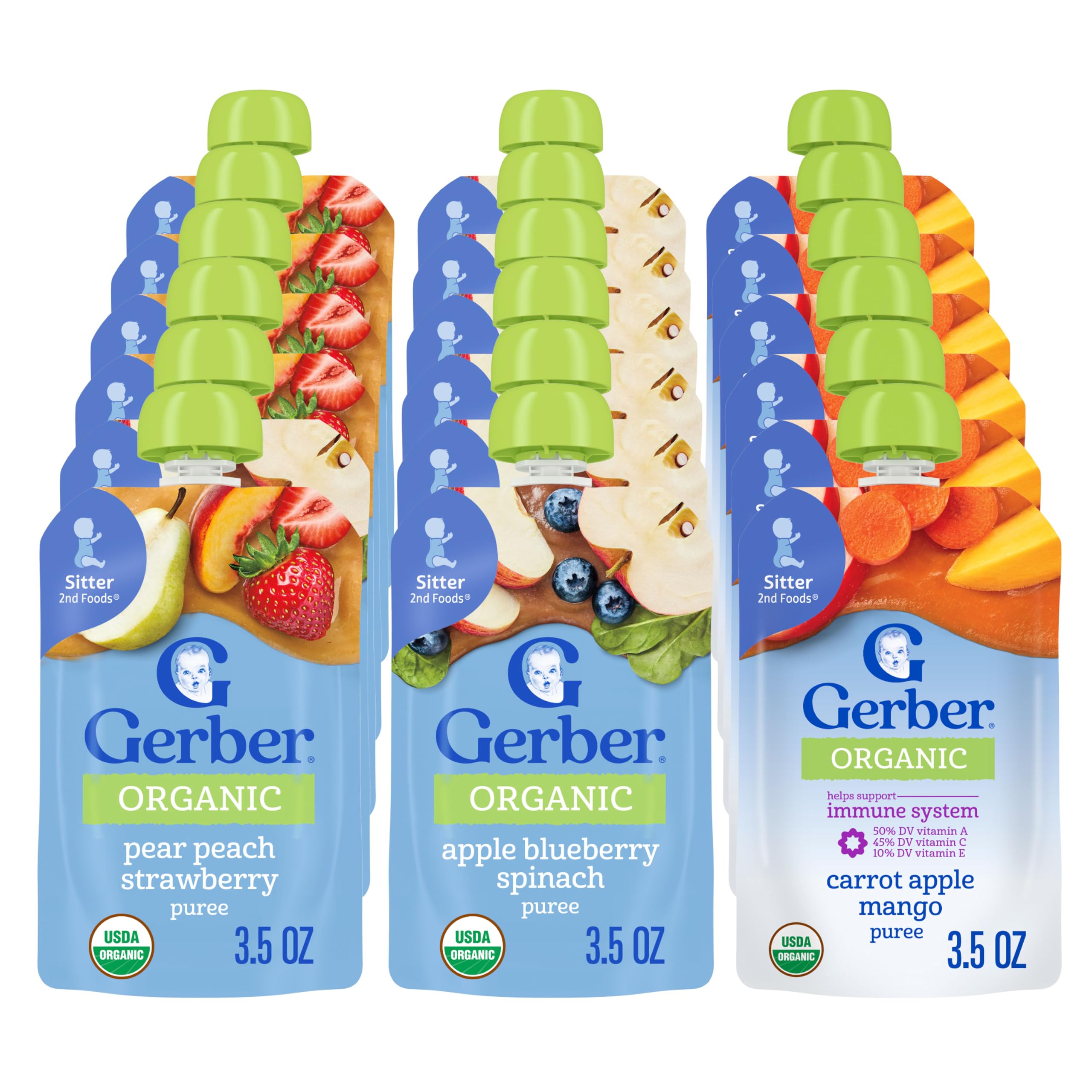
Gerber Organic 2nd Foods Variety Pack
Key Features
- Stage: Stage 2
- Organic: Yes
- Pouch size: 3.5 oz
- Pouches per pack: 18
- Price: Midrange
Three blends, eighteen pouches, and an organic label: this is the box we tell people to buy before they have worked out what their baby likes. Stage 2 means it is built for a baby who is sitting up and has moved past single-ingredient purees, so each pouch pairs fruit with a vegetable instead of handing over straight apple. That is the part we care about most. A baby who meets spinach early, blended with blueberry, does not learn that every pouch tastes like dessert.
The three blends are apple blueberry spinach, peach pear strawberry and carrot apple mango. The first two carry 45% of the daily value of vitamin C, and the blueberry-spinach pouch claims two servings of fruit and veg — more than most pouches at this stage bother to promise. They are thin enough to move through the spout without a fight and thick enough to sit on a spoon, which matters on the days you are feeding in a parking lot with one hand.
Two things to know before you commit to a box. There are only three blends, and eighteen pouches is a lot of one rotation — if peach turns out to be a hard no, you will be working through it. And two of the three are fruit-led, so this is not the vegetable set; Beech-Nut’s blends are the ones we point to for that. Buy this first, then add a greener box and a prune box once you know what your baby actually eats.
Pros
- Three organic fruit-and-vegetable blends
- Eighteen pouches in a single order
- Two servings of fruit and veg in some pouches
- Resealable spout holds up in a bag
Cons
- Only three blends in an 18-pouch box
- Fruit leads two of the three blends
We recommend the Gerber organic pack as the default first order: three fruit-and-veg blends at stage 2, in a box big enough that you are not reordering every week.
Best for Constipation Relief
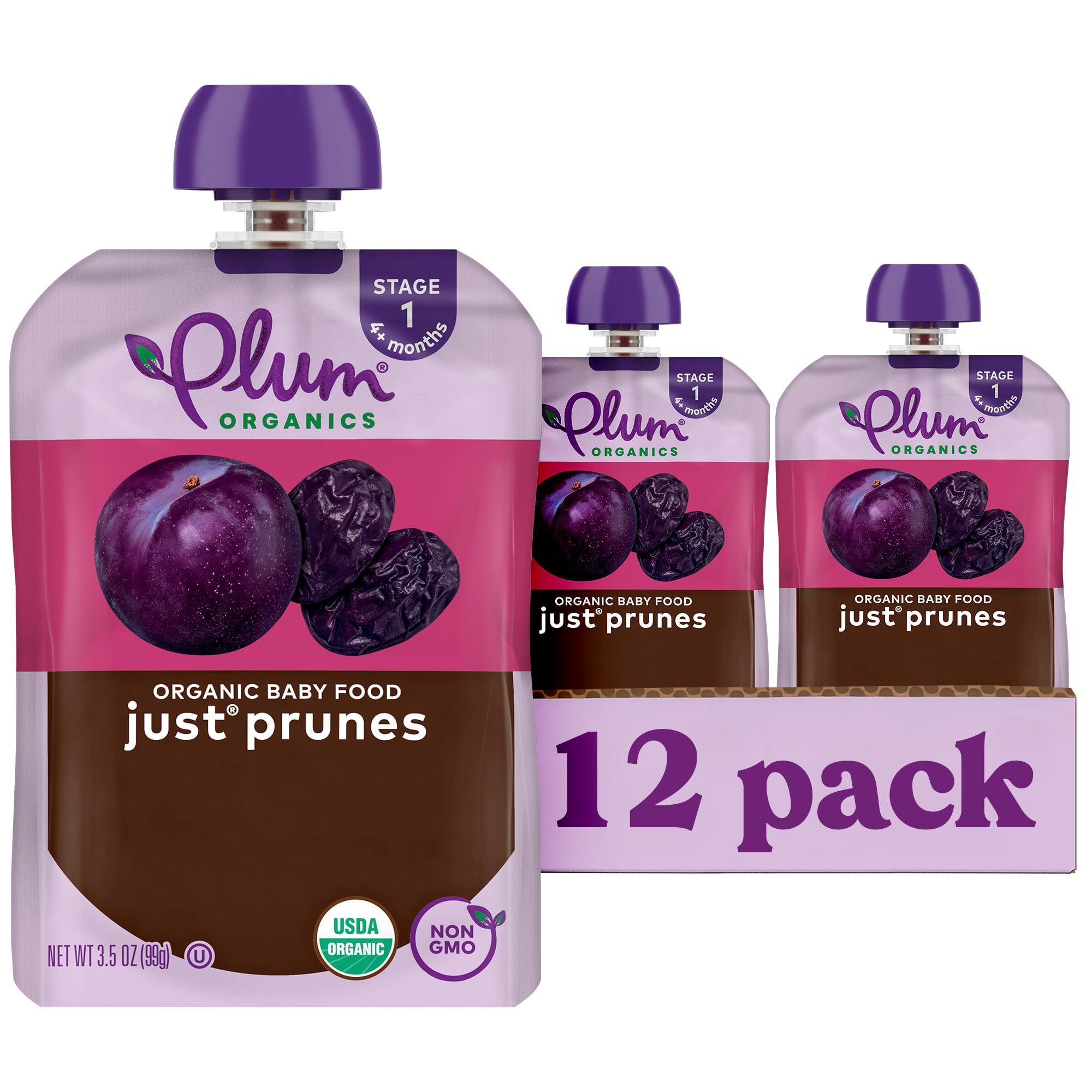
Plum Organics Just Prunes
Key Features
- Stage: Stage 1
- Pouch size: 3.5 oz
- Ingredients: Organic prunes
- Pouches per pack: 12
- Price: Budget
Prunes, and nothing else. Plum’s Stage 1 pouch is a single-ingredient puree for the afternoons when nothing has moved in a couple of days and you have started doing arithmetic about it. It is certified organic and Non-GMO Project verified, unsweetened and unsalted, and it comes in non-BPA packaging with a recyclable cap.
The format is why it works. Twelve 3.5-ounce pouches, each resealable, none of them needing a fridge, so one can live in the diaper bag until the day it is needed. It is also the easiest pouch here to hand to a grandparent or a sitter, because there is no decision attached to it — it is prunes, in the quantity you want, at the moment you want it.
We keep a box in the cupboard the way we keep children’s fever reducer in the cupboard: not because we expect to use it weekly, but because the day it is needed, nobody wants to drive to a store. That is the honest way to buy it. It is not a snack to rotate and twelve is a lot of one flavor, but as a targeted backup rather than part of the daily menu, it earns its shelf space.
Pros
- One ingredient: organic prunes
- No refrigeration, resealable 3.5 oz pouches
- Twelve pouches keeps a backup on hand
Cons
Buy this one for the days nothing has moved — a single-ingredient prune pouch we keep on hand rather than a snack to rotate.
Best for Veggie-First Blends
Beech-Nut Veggie Variety Pack
Key Features
- Stage: Stage 2
- Blends: 3 vegetable blends
- Pouch size: 3.5 oz
- Pouches per pack: 18
- Price: Budget
Same shape as our top pick — eighteen pouches, 3.5 ounces each, stage 2 — with one structural difference that changes who should buy it: the vegetables come first. Squash, peas and pears; zucchini, spinach and banana; pumpkin, zucchini and apple. In all three, the vegetable is the lead ingredient and the fruit is there to make it drinkable.
That order is why we rate this set so highly. Babies are born liking sweet, and a shelf built on apple and pear trains the preference instead of challenging it — a spinach pouch that tastes mostly of banana does less than it appears to. These taste green, which means a toddler already hooked on fruit may refuse them. Start early, or stir one into something familiar. It is also the highest-rated set in this guide, and the one we hand to parents who are not shopping organic.
The catch is on the label: non-GMO, no added sweeteners, no artificial colors or flavors, dairy-free, gluten-free, nut-free and soy-free, but not certified organic. If organic is a hard line for your family, take the Gerber box instead. If it is not, this is the vegetable pouch we buy.
Pros
- Vegetables lead in all three blends
- Highest buyer rating in this guide
- No added sweeteners or artificial preservatives
- Eighteen stage 2 pouches, no fridge needed
Cons
- Not certified organic
Our pick when you want vegetables rather than fruit: three vegetable-led blends, no added sweeteners, and the strongest buyer rating in this guide.
Best for Protein and Savory
Serenity Kids Meat & Veggie Pouches
Key Features
- Organic: Yes
- Protein: 5 g per pouch
- Pouch size: 3.5 oz
- Pouches per pack: 24
- Price: Premium
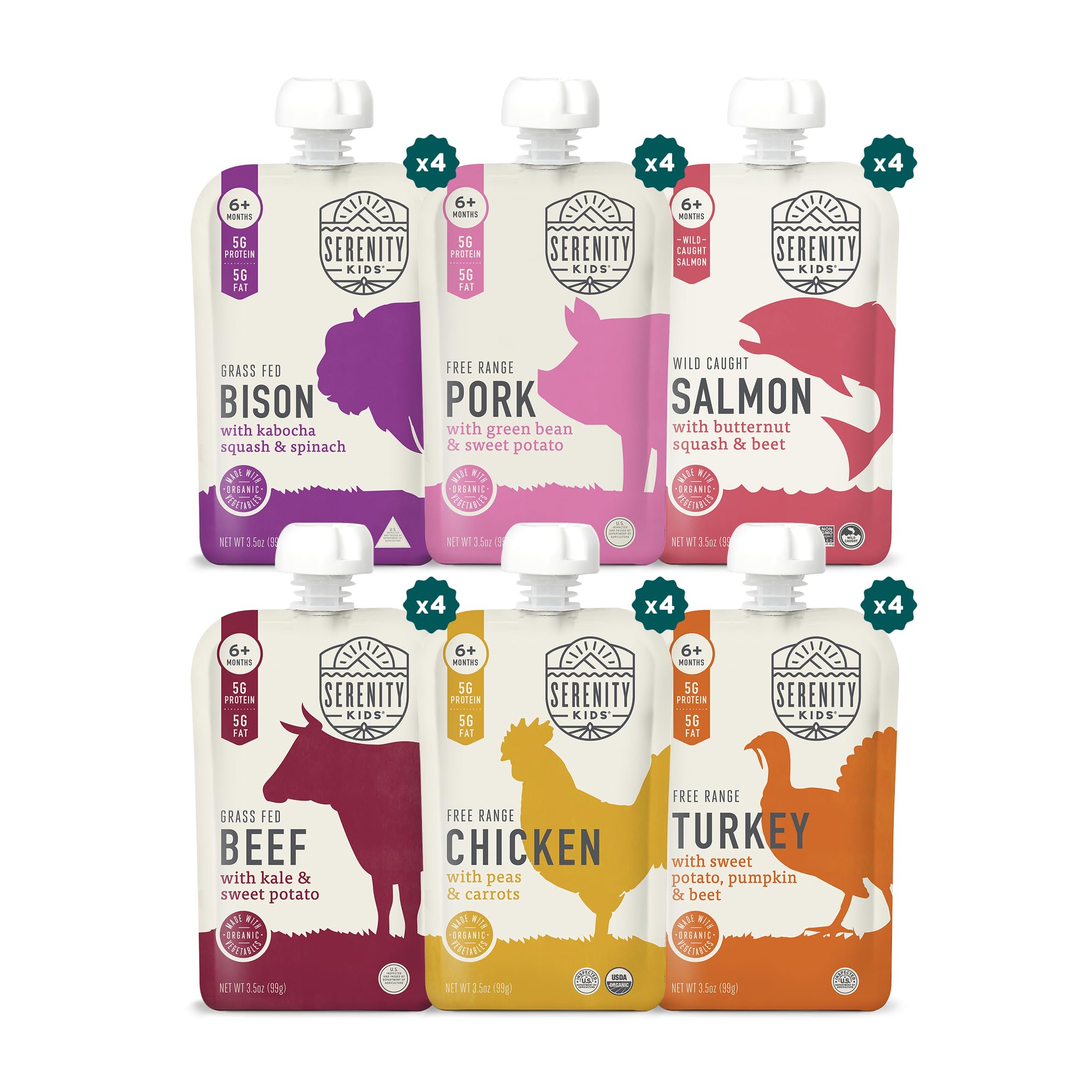
Almost every pouch in this guide is a fruit. Serenity Kids’ are meat. The blends are built on grass-fed beef, salmon and organic vegetables, six to a box, with five grams of protein in each 3.5-ounce pouch and no added sugar anywhere in the line.
The point of that is flavor training. A baby who only ever gets apple, pear and banana learns one direction, and the savory pouch is the correction — it is how you find out whether your child will eat a vegetable that is not sweet before the toddler years decide the question for you. We like these for babies who have already turned their nose up at greens, and for parents who do not want every snack to be a dessert.
They are also the only pick here that reads as part of a meal rather than a snack between them. Protein and a savory base is closer to lunch than to a teething biscuit, and a 24-pouch box is built for a child eating one most days. One caution: the heavier meats sit differently, and a baby new to beef or salmon can be burpier afterwards, so introduce them on a day you are home.
Ours go in the bag for the afternoons when lunch has to happen in a parking lot and a fruit pouch will not carry a toddler to dinner. Buy one box alongside a cheaper fruit pack rather than replacing the whole shelf with it, and the protein gap closes without the pantry going premium.
Pros
- Five grams of protein per pouch
- Savory blends with no added sugar
- Grass-fed beef and organic vegetables
- 24-pouch box, no refrigeration needed
Cons
- Premium price for a 24-pouch box
The pouch we buy when a child needs to eat something savory — five grams of protein, no added sugar, and a premium price to match.
Best for First Solids
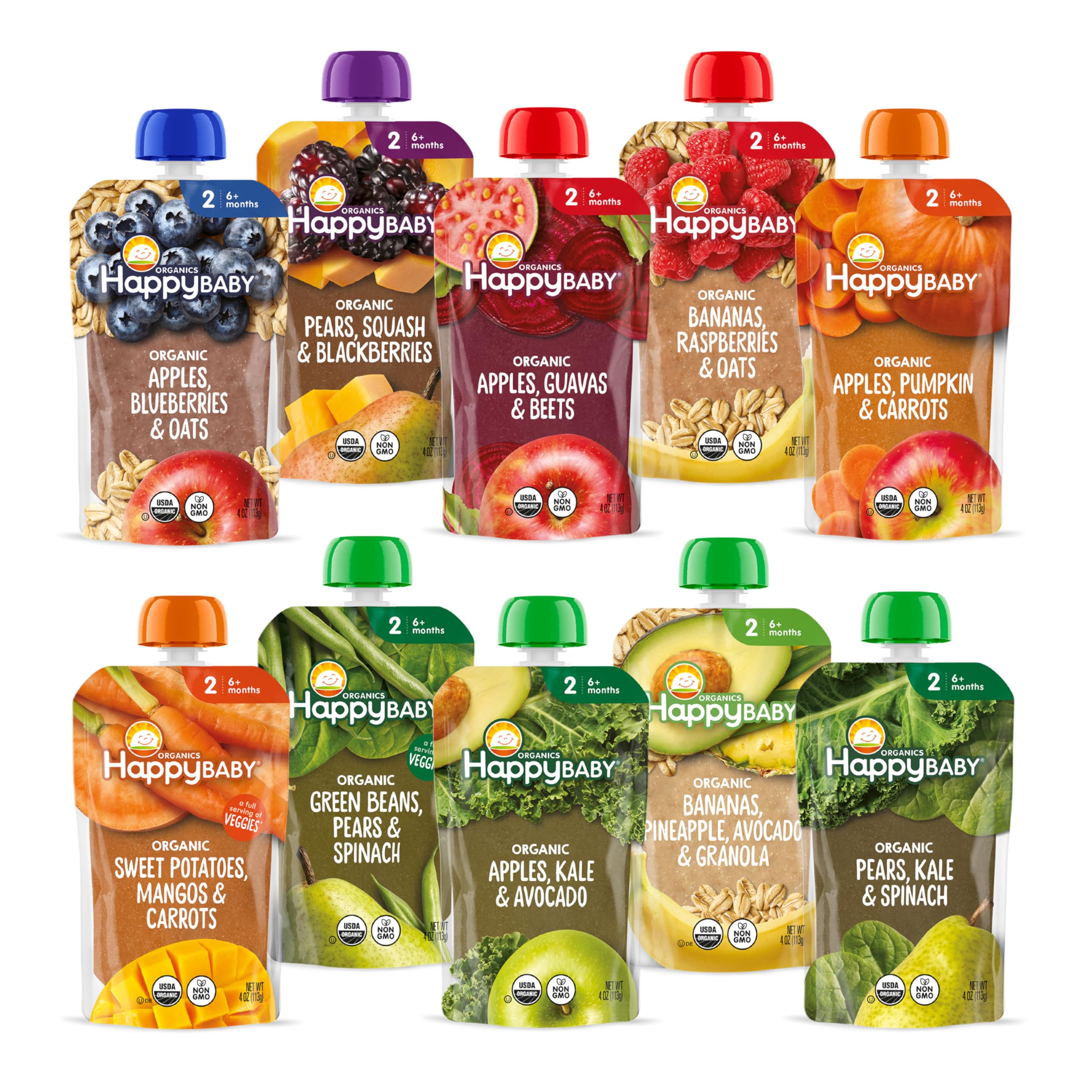
Happy Baby Clearly Crafted Stage 2
Key Features
- Stage: Stage 2
- Packaging: Clear pouch
- Pouch size: 4 oz
- Pouches per pack: 10
- Price: Premium
The pouch is clear, and that is the whole argument. Happy Baby packs this line in transparent film, so you can see the puree — its color, its texture, whether it separated in the box — before you open anything, and the ingredient line tells you how much of each fruit, vegetable and grain went in. We have opened plenty of pouches that stayed a mystery until the first squeeze. This is not one of them.
The blends range across fruit, vegetables and grains in combinations that go well beyond applesauce, which is what makes it a good first-solids buy for a baby working through new textures. The catch is volume: ten 4-ounce pouches to a box, the smallest count among the stage 2 picks here, so you are paying for the transparency and the range rather than for a month of snacks. Watch the number on the pack, too — the 2 is the stage, not a count, and the box holds ten, not twenty.
Pros
- Clear pouch shows the puree
- 4 oz pouches, larger than most here
- Fruit, vegetable and grain blends
Cons
- Only ten pouches in a box
Choose this if you want to see what you are feeding; the clear pouch and varied blends are worth the smaller box.
Best for Breakfast Pouches
Earth’s Best Fruit & Grain Pouches
Key Features
- Age: 6+ months
- Organic: Yes
- Pouch size: 3.5 oz
- Pouches per pack: 12
- Price: Budget
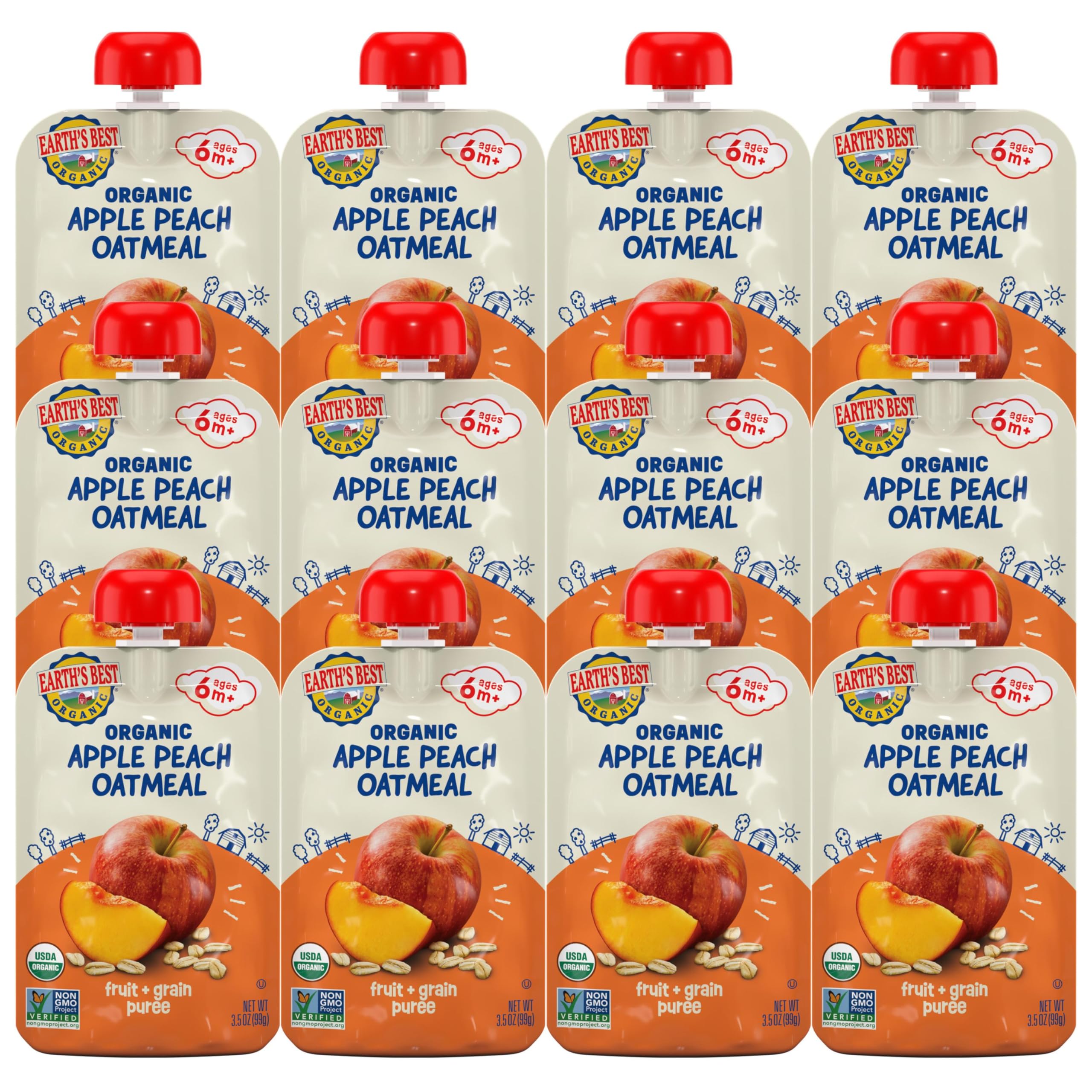
There is oatmeal in this one, which puts it in a different slot of the day from everything else here. Earth’s Best blends organic apple and peach puree with oats, so a 3.5-ounce pouch lands closer to breakfast than to a snack — and it means one less bowl, spoon and saucepan before eight in the morning.
We reach for this on daycare mornings, when something has to be in a bag and eaten in a car. It is the pouch that behaves most like food rather than a treat: the oats give it body on a spoon and the peach keeps it from tasting like dessert, and the flavor is mild enough to suit a baby still deciding about texture.
Two honest notes. The oats are a minor ingredient, so this is fruit puree with grain in it rather than a bowl of oatmeal — a hungry toddler will want something alongside it. And the box is twelve pouches of one flavor. Buy it as your breakfast pouch next to a variety pack, not as the only thing on the shelf.
Pros
- Fruit and oats in one pouch
- Organic and resealable
- Breakfast without bowls or prep
Cons
- Oats are a small part of the blend
Our breakfast pouch: organic apple, peach and oats in a resealable pouch that needs no bowl, no spoon and no cleanup.
Best for Toddler Snacks
Earth’s Best Yogurt Smoothie Pouches
Key Features
- Age: 24+ months
- Type: Fruit yogurt smoothie
- Pouch size: 4.2 oz
- Pouches per pack: 12
- Price: Midrange
Read the age before anything else: 24 months and up. These yogurt smoothies are toddler food, not baby food, and that is not caution for its own sake — the dairy, the portion and the texture are built for a child who is already eating table food. If you are shopping for a nine-month-old, skip this one and pick a stage 2 puree.
For the child it is meant for, it is a good pouch. Organic strawberry banana yogurt with calcium and vitamins C and D, in a 4.2-ounce squeezable pouch that does not need a cooler — which is the detail that makes it work as a daycare or back-seat snack. The flavor is mild, the texture is smooth enough for a two-year-old to finish without help, and the resealable cap means a half-finished pouch survives the ride home.
We keep these for the toddler snack slot rather than as a stand-in for yogurt at the table. Twelve pouches, one flavor, and the convenience is the product — what you are buying is a dairy snack that travels. For a family whose afternoons happen away from a fridge, that is the whole job, and it does it.
Pros
- Yogurt pouch that travels without a cooler
- 4.2 oz pouches sized for toddlers
- Organic with calcium and vitamins C and D
Cons
- One flavor in a 12-pouch box
For toddlers past their second birthday, we like this as the bag snack that does not need a cooler — one flavor, twelve pouches.
Best for Refrigerated Freshness
Once Upon A Farm Kale & Apples
Key Features
- Organic: Yes
- Storage: Refrigerated
- Pouch size: 3.2 oz
- Ingredients: Kale, apple, hemp seeds
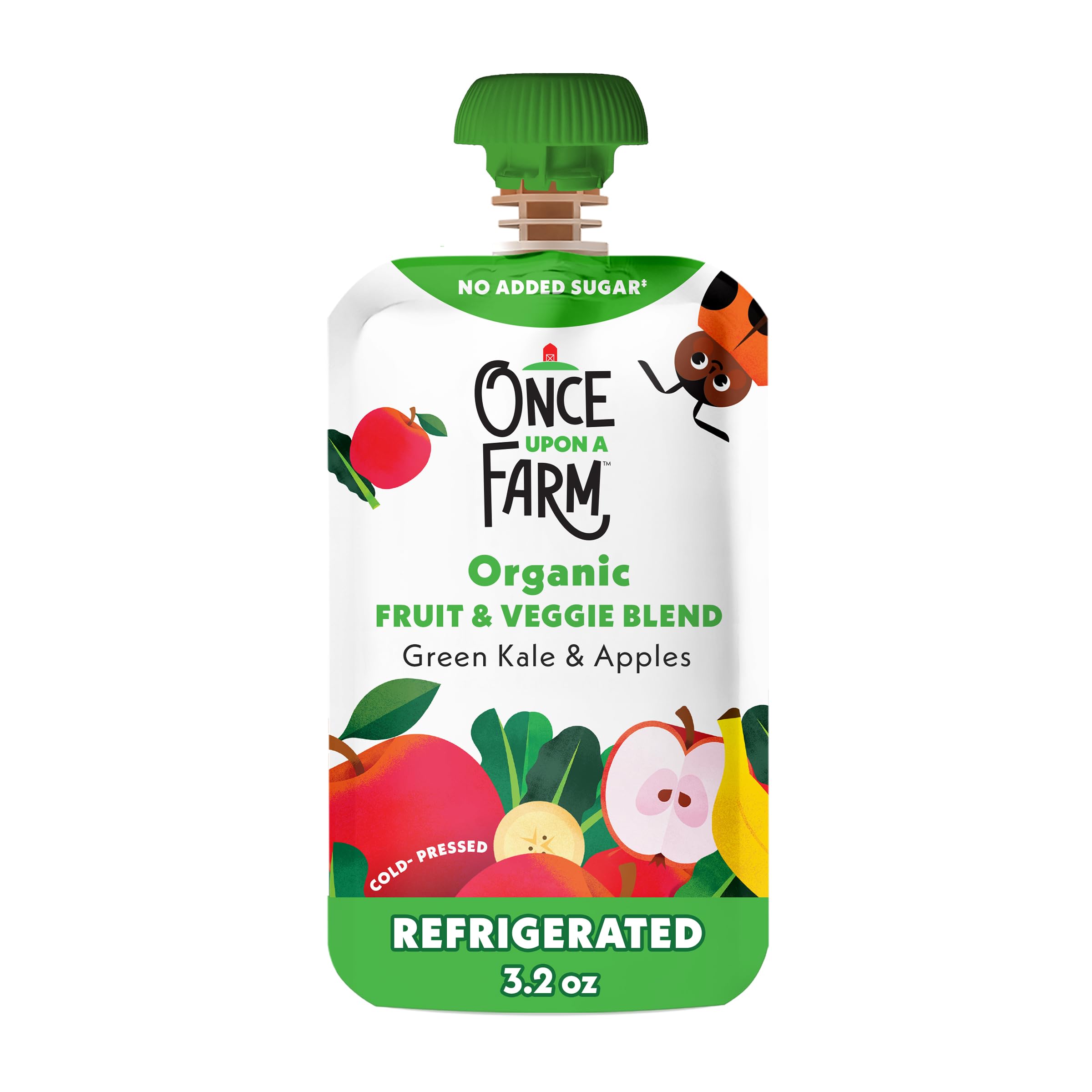
This is the one that lives in the fridge. Once Upon A Farm cold-presses its pouches and sells them refrigerated, which rules it out of a diaper bag for a long day and rules it in for a household that already keeps a shelf for kid food. Apples and kale, no added sugar, no preservatives.
The ingredient list is the pitch: organic kale and apples with hemp seeds, which bring protein and the kind of fats most pouches here do not carry at all. It tastes less sweet than a fruit-only pouch and the kale is present rather than decorative — a green vegetable in a category that mostly avoids them.
It is also the smallest pouch here at 3.2 ounces, and it comes as a single pouch rather than a pack, so this is a top-up-the-fridge purchase rather than the box you keep in the cupboard. Buy three or four for the week, not a case for the month.
Our read is that this is a lovely pouch with a narrow job. If your child already eats greens and you want something that tastes fresher than a shelf-stable box, it is the best version of that here — and if pouches mostly live in your bag, it is the wrong buy.
Pros
- Kale and apple with no added sugar
- Hemp seeds add protein and fats
- Cold-pressed for a fresher taste
Cons
- Must stay refrigerated; not a bag snack
A fresher-tasting, kale-forward pouch we recommend for the fridge at home, not for the diaper bag.
How We Tested the Best Baby Food Pouches
We started with a shelf-wide scan instead of a favorites list: every pouch we could find in national grocery aisles, big-box stores, and baby specialty shops, then we cut the field by reading nutrition panels. Anything with added sugar, a juice concentrate listed first, or a vegetable blend that was mostly apple didn’t make the shortlist. That left 18 pouches from 11 brands, spanning single-ingredient fruit and vegetable blends, grain-and-protein combinations, and the thicker, spoonable blends.
Testing ran four months, in the high chair at home, in diaper bags and stroller pockets, in a cooler on a day trip, and on one flight. Adults tasted every pouch first, both straight from the spout and spooned into a bowl, because if a blend reads as sweetened applesauce no matter what the label promises, a baby picks up on it too.
We squeezed each pouch onto a spoon at normal feeding pace and noted whether the puree came out in a controlled ribbon, spurted across the tray, or clogged at the spout on the thicker grain blends, then checked again ten minutes later to see which ones separated and needed a knead. Caps and seams got the abuse test: every pouch rode in a bag with keys and a water bottle, and we opened and resealed them one-handed with a baby on a hip to see which caps actually clicked back on. Our own kids ate them over several days, and we kept notes on gassiness, stool changes, and how much of each pouch got finished before it was abandoned. Last, we weighed cost per ounce against what actually got eaten.
How to Choose Baby Food Pouches
The pouch you buy matters less than the order you buy them in: a stage-appropriate variety box first, then a vegetable-led blend, a protein pouch and a prune backup to fill the gaps.
Start with the stage, not the flavor
Stage 1 is a single-ingredient puree for a baby just starting solids. Stage 2 blends fruit with vegetables for a baby who is sitting up and handling texture. Stage 3 and 4 add grains and thicker blends for self-feeders. Get this wrong and the pouch is either too thin to be useful or too textured to be safe for the mouth it is going into.
The number on the front of the pouch is the stage, not the pouch count — a 2 means stage 2, and a box of ten holds ten. Check the age floor as well: toddler yogurt pouches are labeled 24 months and up, so they are not a baby purchase however convenient they look next to the purees.
Fruit-first or vegetable-first
Most pouches taste like apple because apple is cheap and babies like it. That is a fine base and a poor whole diet: a shelf built on apple and pear trains the sweet tooth you will spend the toddler years undoing.
Look for blends that list the vegetable first — squash, zucchini, pumpkin, spinach, kale — and offer them early, before a baby has decided that green means no. A fruit-led pouch still earns its place; just do not let it be the only thing in the cupboard.
Shelf-stable or refrigerated
Shelf-stable pouches are the reason the category exists. They live in a cupboard for months and in a diaper bag for a day, and they are what you want at the bottom of a bag on a hot afternoon. Cold-pressed, refrigerated pouches taste fresher and often carry better fats, but they need a fridge and a plan.
Buy refrigerated ones only if they will be eaten within the week. For travel, daycare and the glovebox, pack the shelf-stable kind.
Pouch size, pack count and the division that matters
Pouches run from roughly 3.2 to 4.2 ounces and packs from ten to twenty-four, so compare total ounces before you compare boxes. Eighteen pouches at 3.5 ounces is 63 ounces of food; ten at 4 ounces is 40. Neither is better — a bigger box suits a child eating a pouch most days, and a smaller one suits a baby still trying flavors.
Then look at the serving itself. At 3.5 ounces a fruit-and-veg pouch is a snack, while a pouch carrying five grams of protein is closer to part of a meal.
What to read on the ingredient line
Four labels are worth scanning: certified organic, Non-GMO Project verified, no added sweeteners, and no artificial colors or flavors. They do not always arrive together — the best-value vegetable blends here are non-GMO but not organic, a trade plenty of families happily make.
Then judge what the pouch delivers rather than what it excludes. A fruit puree is a snack; a meat-and-vegetable pouch with real protein can hold a child until dinner.
Frequently Asked Questions
Can my baby suck straight from the pouch?
For a baby just starting solids, squeeze the puree onto a spoon instead. It slows the feed down, lets you see how much is going in, and keeps the spout out of a mouth that is still learning to work a swallow. Once your child is confidently self-feeding, the pouch is fine as it is — just make sure the cap is seated before it goes back in the bag.
Is a pouch a meal or a snack?
Usually a snack. A 3.5-ounce fruit-and-veg pouch covers a serving or two of produce, which is genuinely useful, but it will not hold a toddler until dinner on its own.
Look for a pouch with protein when you need it to do more: the meat-based options carry five grams, which makes them closer to lunch. Otherwise pair the fruit pouch with something else rather than serving three in a row.
What should I do if a pouch arrives damaged?
Check the seals when you unpack rather than when you are rushing out of the door. A pouch that has leaked, is puffed up, or has a cap that will not seat should not be fed to a child even if the puree inside looks fine.
Contact the seller for a replacement and leave it out of the cupboard. Then check the rest of the box before you stock it.
Final Verdict
Start with the Gerber organic variety pack. It is organic, it is stage appropriate, it puts a vegetable in front of a baby alongside fruit, and it arrives in a box large enough that you are not reordering every week. That is what most families need from a first order.
Change the answer when the requirement changes: Beech-Nut if you want vegetables rather than fruit, Serenity Kids if protein is the gap you are trying to close, and a box of Plum prunes for the days that need one specific thing. That is a pantry, not a collection.