This post contains affiliate links. We may earn a small commission when you buy through our links — at no extra cost to you.
Store-bought baby food pouches are the one baby convenience I never argued with, until I counted the empties in our recycling bin and did the math on a week’s worth. Reusable pouches promise the same squeeze-and-go ease for a fraction of the cost and none of the waste, but they come with a tradeoff: the wrong one leaks applesauce across the inside of a diaper bag at exactly the wrong moment. What fixes that is simpler than it sounds — a pouch that seals flat, holds a real serving, and rinses clean in under a minute.
Over the past four months, my team and I have filled, frozen, squeezed, dropped, and washed 14 reusable pouches, and most of the differences live in details you can’t see in a product photo. One nobody mentions: puree expands as it freezes, so the fill line isn’t decoration, and a seal set too shallow will bulge open overnight. The picks below are the ones that survived my kitchen, my diaper bag, and two very determined toddlers.


Best for Everyday Purees
Squooshi Reusable Pouches
Key Features
- Closure: Double zipper
- Capacity: 5 oz
- Cleaning: Top-rack dishwasher safe
- Pack Size: 12 pouches
- Price: Midrange
The shape is the first thing you notice: four inches wide, seven tall, and gently curved, which is not a cosmetic choice. A five-ounce pouch full of yogurt is heavy for a baby, and that curve puts the weight back over the palms instead of letting the whole thing pivot out of a one-handed grip. We watched ours get waved around, dropped on the kitchen floor, and picked back up, and it held its shape better than the straight-sided pouches here.
The bottom zip is where a pouch like this lives or dies, and Squooshi’s is the best of the ones we filled. Two tracks, a wide opening you can get a bottle brush into, and a seal that held thin puree and full-fat yogurt without weeping at the fold. The catch is the grab: the zip runs close enough to the edge that there is not much tab to pinch, so with wet hands and a full pouch it takes two tries. Leave some headroom and it drops to a minor annoyance.
Twelve pouches is the practical part — that is a daycare week for one child with a few left in the freezer, so Sunday’s batch session doesn’t turn into a Wednesday-night scramble. Against the Simple Modern set, this is the better seal and the better grip; against the ChooMee, it is four more pouches for roughly the same money each and a curved body instead of a flat one. The one case it loses is a genuinely hungry toddler who would rather have the Baby Brezza’s seven ounces.
Pros
- Double zip holds thin puree and yogurt
- Wide bottom opening reaches every corner
- Curved body suits small hands
- Twelve pouches cover a daycare week
Cons
- Zip tab is hard to pinch with wet hands
- Runs small for a hungry toddler
The pouch we reach for first: a double zip that holds yogurt, a bottom opening wide enough to rinse clean, and a curved body a nine-month-old can actually grip.
Best for Daycare and Travel
Simple Modern Reusable Pouches
Key Features
- Closure: Zipper
- Capacity: 5 oz
- Cleaning: Top-rack dishwasher safe
- Pack Size: 10 pouches
- Price: Midrange
Ten pouches in assorted prints, each with a clear strip down one side, and that window is the detail we used most: you can see whether half a pouch of applesauce is left without opening anything. The bottom zip is the part that decides whether you like them. It is a press-shut track, and the way it fails is always the same — a little puree in the channel, one corner that doesn’t quite bite, and a slow weep onto the fridge shelf. Wipe the track with a fingertip and seat both corners before you close it and it behaves, but that is a habit you have to build, and it is the one thing a new buyer should know.
At five ounces these sit at the snack end of the range, and the tall, narrow body slides into a bottle pocket without bulging. Top-rack dishwasher, freezer safe, BPA-free, and the plastic stays limber after washing — which matters more than it sounds, because a stiff pouch is a pouch that cracks along the fold. Filling is the weak spot at the other end: thick puree goes in slowly through the top, and a small funnel earns its keep with sweet potato or a dense bean puree.
Where that leaves them is the set to buy when you want volume and variety without spending much per pouch, and you don’t mind checking a zip each time. If you want a seal you can stop thinking about, the Squooshi’s double zip is more forgiving. If filling is the chore you dread, the ChooMee’s three-and-a-half-inch mouth is the fix. For a daycare bag where pouches come home empty and unidentified, the ten prints and the clear window do more work than they sound like they do.
Pros
- Ten pouches in ten different prints
- Clear strip shows what is left
- Top-rack dishwasher and freezer safe
Cons
- Narrow fill opening slows thick puree
A generous, cheerful set with a clear strip for spotting leftovers and a low cost per pouch — just treat the bottom zip as something that needs a two-second check.
Best for Thick Homemade Puree
ChooMee Reusable Pouches
Key Features
- Closure: Double zipper
- Capacity: 5 oz
- Pack Size: 8 pouches
- Fill Opening: 3.5 inches
- Price: Budget
Three and a half inches across the bottom is the number to remember here, because it is the difference between spooning a thick puree straight in and standing at the counter with a funnel and a bad attitude. The zip runs the full width of that opening, so you load the pouch like a bag rather than squeezing food through a spout, and the big clear window tells you how much is left without a squeeze test.
The closure is the strong, tight kind, and it takes a real pinch to open — reassuring in a lunch bag, less so at the sink with wet hands. Rinse and top-rack it and the corners come clean, because the flat panel means there is no fold for yogurt to hide in. Nothing here has needed special care beyond that, and a tight zip that eases slightly with use is the right way round; a loose one that gets looser is not.
Eight pouches is a smaller set than the Squooshi’s twelve, and that is the honest trade: you give up four pouches and the curved grip, and you get the easiest filling mouth in this group for less outlay. For thick homemade puree — sweet potato, lentil, anything you would otherwise push through a funnel — that is the right way round. For yogurt and applesauce, where filling was never the problem, the extra four pouches on the Squooshi buy you more.
Pros
- 3.5-inch bottom opening takes a spoon
- Clear window and flat panel clean easily
- Holds up over repeated washes
Cons
- Zip is stiff to open with wet hands
The one to buy if you cook thick purees: a wide bottom mouth that takes a spoon, a tight double zip, and a clear window — in a smaller eight-pouch set.
Best for Bigger Toddler Meals
Baby Brezza Reusable Pouches
Key Features
- Capacity: 7 oz
- Included: Filling funnel
- Pack Size: 10 pouches
- Fill Opening: Wide side opening
Seven ounces is a different category of pouch. A four-ounce jar of vegetables plus a three-ounce jar of meat goes in with room to spare, so lunch is one pouch instead of two and there is less to wash at the end of it. Next to the five-ounce sets here, this is a meal rather than a snack.
The filling design is the part we appreciate most. The pouch stands up on its own with a wide side opening, so you can hold a jar in one hand and scrape with the other, and the included funnel holds the whole thing open when you are decanting a blender full of puree. It also works as a stand while the pouch dries, which is more than we expected from a piece of plastic in the box. Capacity plus a mouth you can genuinely fill through is what puts this near the top of the set for batch cooking.
The caveat is cleaning. The side opening gives a brush straight access to the body, but the sealed end is where a half-finished pouch goes wrong — leave yogurt sitting in it overnight and you will be scraping a corner. Rinse it when it comes home and it is a two-minute job. And seven ounces only pays off if your child eats seven ounces; a grazer will leave a third of it in the fridge, and a five-ounce pouch would have been the smarter buy.
Pros
- Seven ounces fits a jar and a half
- Stands up on its own while filling
- Funnel holds the pouch open
Cons
- Sealed end traps food if left overnight
Seven ounces that swallow a jar and a half, a side opening that stands up while you fill, and a funnel in the box — the pouch for a child who actually eats.
Best for Smoothies and Liquids
Squeasy Snacker Silicone Pouch
Key Features
- Lid: Screw cap with no-spill insert
- Capacity: 6 fluid ounces
- Material: Food-grade silicone
- Pack Size: 1 pouch
- Price: Premium
There is no zipper anywhere on a Squeasy Snacker, and after enough dishwasher cycles that starts to look like the smartest design decision in this group. Every other pouch here seals with a press-shut track that eventually stops biting; this one screws on. The body is a single piece of food-grade silicone that flips inside out, so cleaning is a rinse and a wipe rather than a bottle brush and a prayer.
The lid carries a removable no-spill insert: leave it in for water, juice and thin smoothies, take it out for thick yogurt or a dense puree, because otherwise you are sucking rather than squeezing. Six fluid ounces is a proper portion, the silicone is soft enough that a baby can help themselves, and it is the one pouch here we trust with an actual liquid in a diaper bag — applesauce is one thing, a smoothie is another.
Two things to know. It is sold one at a time, so building a week’s rotation costs considerably more than a multipack of zip pouches, and the screw lid takes a firm grip to seat squarely. Neither is a dealbreaker; both are why this is an addition to a set rather than a replacement for one. If your kid drinks smoothies more often than they eat puree, one of these plus a multipack covers everything.
Pros
- Silicone body turns inside out to clean
- No-spill insert handles thin liquids
- No zipper to wear out
Cons
- Sold singly, so a week’s stash adds up
No zip to wear out: a silicone body you can turn inside out, a no-spill insert that handles thin liquids, and one pouch per purchase.
Best for Stocking Up Cheaply
Hippypotamus Reusable Pouches
Key Features
- Closure: Double zipper
- Capacity: 5 fluid ounces
- Cleaning: Top-rack dishwasher safe
- Pack Size: 12 pouches
- Price: Budget
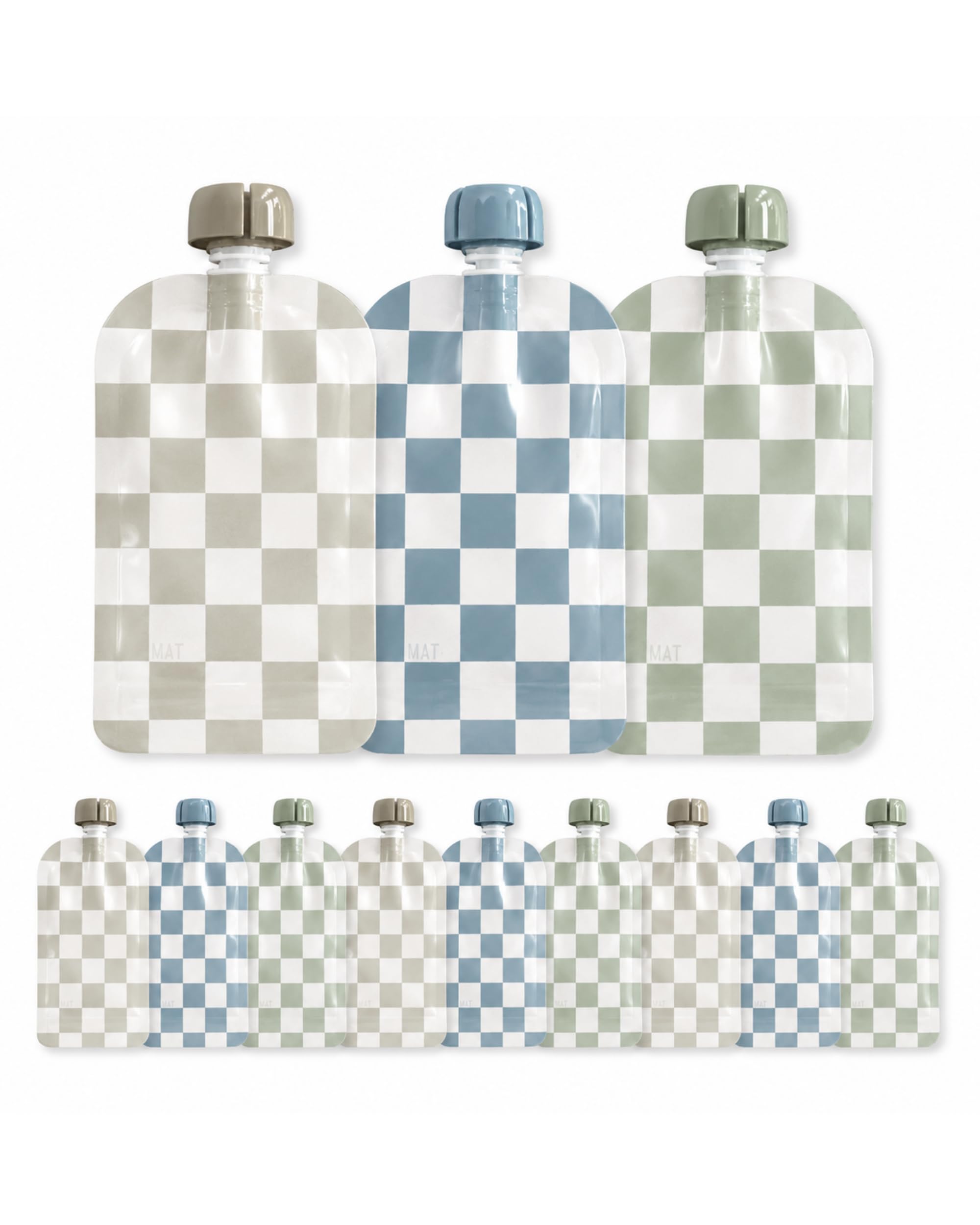
Twelve five-ounce pouches with a double zip, a clear window and a fill line, at the lowest cost per pouch in this group. If the goal is a drawer that is always stocked — one in the diaper bag, one at grandma’s, three in the freezer — this is the least expensive route to it, and the checkered prints are aimed at older kids rather than babies, which matters more than it sounds once a four-year-old starts refusing anything that looks like toddler gear.
The fill line is worth obeying. It sits below the zip by design, and pushing puree up into the track while you close it is how a pouch ends up weeping in a lunch bag. Fill to the line, wipe the track, and the double zip holds. Where these age is the closure itself: the corners of the zip are the first thing to go, and a pouch that tears there is done. Hand-washing the zip stretches the useful life well beyond what the dishwasher gives you, which is an annoying thing to ask of a product that advertises being dishwasher safe.
So this is the budget pick, with a shorter working life than the Squooshi or the ChooMee and a genuinely useful capacity for the money. If you want twelve pouches in the drawer tomorrow and don’t mind retiring a few over the year, it is the value play. If you want a set that comes out the other side of a second child, pay more per pouch for the ChooMee and get the tighter closure.
Pros
- Lowest cost per pouch here
- Clear window and max-fill line
- Dishwasher and freezer safe
Cons
- Closure corners can tear after repeated washes
- Holds less than the five-ounce label suggests
The cheapest way to fill a drawer with pouches: twelve in a pack, a double zip and a clear window, with the closure as the part that gives out first.
Best for Self-Feeding Practice
haakaa Yummy Pouch

Key Features
- Capacity: 4.5 oz
- Included: Removable straw
- Material: Food-grade silicone
- Pack Size: 2 pouches
- Price: Premium
Two pouches, four and a half ounces each, in soft food-grade silicone with a wide neck that stands up on the counter while you pour. The body is a single piece with no seam at the base, so there is no zip to wear out and nothing to trap a smear of sweet potato — you squeeze it, it goes back to shape, and it takes a pour straight from a blender jug. If you have had a plastic pouch split along a fold, this is the design that explains why people pay for silicone.
The lid is where haakaa has done something different: a one-piece stopper and cap with a variable-flow opening, plus a removable straw for older kids. For a baby learning to self-feed, the soft spout is gentler than a hard plastic nozzle and the flow responds to how hard they squeeze rather than dumping a mouthful. That is the sort of detail you appreciate after watching a baby lose half a pouch down their chin.
It is not the most forgiving pouch here. The stopper has to be seated fully or a firm squeeze will push the lid off, and the silicone is soft enough that an enthusiastic toddler can add to the mess. The body is also the part that fails — a split at the top or a separation at the base ends the pouch — and with only two in the pack, that stings more than losing one from a twelve-pack.
Which is why our recommendation is narrow. Buy these for a baby starting solids, or for a child who drinks smoothies and wants a straw, and accept that you are paying a premium for two pouches rather than a drawerful. If you need a stash to get through a week, the Squooshi’s twelve are the better spend. If silicone appeals but you want a shape that takes a thicker puree, the Squeasy is the more practical buy.
Pros
- 100% food-grade silicone body
- Variable-flow spout plus removable straw
- Wide neck stands upright for filling
Cons
- Lid can pop off with a firm squeeze
- Premium price for only two pouches
Soft silicone with a variable-flow spout and a straw for older kids — the most pleasant pouch here to use and the most expensive way to buy capacity.
How We Chose and Tested the Best Reusable Baby Food Pouches
We started with more than 40 pouches on the market and narrowed by capacity, seal design, material, dishwasher-safe claims, and price per pouch, then bought 14 to live with at home for four months.
The leak test eliminated the most contenders. We filled each pouch with a deliberately thin applesauce-and-water mix, sealed it, and laid it upside down inside a diaper bag wedged under a stroller for an hour, then checked the seams, the zip track, and the cap threads for beads of moisture. We also tugged and twisted caps on purpose and tossed pouches into a bag next to a set of keys to see which lids stayed put and which popped loose in transit.
To judge how easily each one refills, we loaded every pouch two ways — spooned from a bowl and poured from a pitcher — and timed both; wide openings that took a spoon without a funnel did best. Filled pouches went into the freezer overnight and thawed in the fridge the next day, which is where shallow seals gave out. We washed everything by hand at the kitchen sink at 9 p.m., then ran pouch after pouch through the dishwasher to watch whether seams stayed tight and zip tracks still gripped. Finally, we measured real capacity against the stated ounces and priced each pouch against a week of store-bought ones.
How to Choose Reusable Baby Food Pouches
Almost every pouch complaint comes down to two things — the closure and the size of the hole you fill it through — so settle those first and the rest of the shopping gets easy.
The closure decides how long the pouch lasts
A plastic pouch lives or dies at its zip. The track collects food, one corner stops biting, and the pouch starts weeping onto a fridge shelf. Double zips give you two chances at a seal, and a wide bottom opening lets you wipe the channel properly. Rinse the zip before it dries rather than after, and skip the heated dry cycle — heat is what turns a limber track brittle.
If you want to remove the failure point entirely, buy silicone with a screw lid. There is no track to wear out, which is the Squeasy’s whole argument, and the trade is a higher price for a single pouch.
Five ounces or seven?
Capacity is a portion decision, not a spec-sheet one. Five ounces matches a yogurt or a snack and stops a toddler from leaving half of it behind; seven ounces, as on the Baby Brezza, swallows a four-ounce jar of vegetables plus a three-ounce jar of meat and replaces two pouches with one at lunch.
Watch the fill line. It always sits below the seam, so a five-ounce pouch holds a little less than five ounces of food, and pushing puree past the line forces it into the closure while you seal it — the most common way these pouches leak.
Filling and cleaning are the same design problem
The wider the opening, the easier both jobs get. A 3.5-inch bottom zip takes a spoon straight down into the body. A side opening that stands up on its own frees a hand while you scrape out a jar, and the funnel that comes with the Baby Brezza holds the pouch open for a blender full of puree. A wide silicone neck takes a pour without any of it.
All of these are top-rack dishwasher safe, but a dishwasher does not reach inside a zip channel. Rinse that by hand, and dry the pouch fully before it goes back in the drawer, because trapped moisture in a sealed pouch turns sour fast.
Silicone or zip pouch?
Silicone turns inside out, has no closure to wear, and handles thin liquids like smoothies better than any zip. It costs more per pouch, feels heavier in a bag, and usually comes in ones and twos. Plastic zip pouches arrive in tens for the price of a couple of silicone ones, weigh almost nothing, and are what a daycare bag actually wants.
Our advice is not to choose: a multipack for the daily rotation, plus one or two silicone pouches for smoothies and for the baby learning to hold their own food.
How many do you actually need?
Count days, not pouches. A child in daycare five days a week needs five a week, plus a couple in the freezer and one rolling around the bottom of the diaper bag. Ten to twelve covers one child comfortably, which is the size most sets here come in — buy fewer and you will be washing a zip at ten at night, buy more and you will find something alarming at the back of the cupboard in March.
Frequently Asked Questions
Can you freeze reusable baby food pouches?
Yes, on any pouch listed as freezer safe, which covers most of the zip sets here. Fill below the max line rather than to it, because puree expands, then freeze them flat on a tray or standing in a container so they keep a shape that stacks. Thaw overnight in the fridge, not on the counter.
How long do reusable baby food pouches last?
The closure goes before the body does. A zip pouch is finished once the track stops biting or the corners tear at the seal; a silicone pouch is finished when it splits at the neck or the lid stops seating. Test a suspect pouch with water and a hard squeeze over the sink, and retire anything that weeps at the seam.
Can a toddler use a reusable pouch without help?
From around six months, yes — a soft spout or a squeezable body lets a baby feed themselves, which is the main reason to own these at all. Most zip pouches here are opened by an adult and squeezed by the child. If you want one a three-year-old can manage alone, the haakaa’s straw and screw lid is the closest thing in this group.
Final Verdict
The Squooshi set is the one we recommend first: twelve pouches, a double zip that holds yogurt, a bottom opening wide enough to clean properly, and a curve that fits a small hand. If your child eats a full jar and then some, the seven-ounce Baby Brezza replaces two pouches with one at every meal.
And if you want to skip zips altogether, add a Squeasy for smoothies — the silicone body has nothing to wear out.
