This post contains affiliate links. We may earn a small commission when you buy through our links — at no extra cost to you.
A stroller that starts as a single and grows into a double sounds like a compromise — heavier than a single, bulkier than a dedicated double, and more expensive than either. For families adding a second child, though, it solves a specific problem: one frame that carries a newborn and a toddler without buying two separate strollers. The best ones earn their garage space by folding small enough for a trunk, steering through a grocery aisle with one hand, and keeping both kids comfortable enough to nap.
Over nine months, I tested seven single-to-double strollers with my two kids and a crew of toddlers. We loaded baskets until they bulged, folded and lifted each into a trunk, clipped infant car seats in and out, and pushed over sidewalks and gravel to judge the ride. We also checked how fabric and frame held up and looked after washes and curb hops, and whether converting from one seat to two felt intuitive or a puzzle. A good convertible should feel like one stroller, not two compromises bolted together — the picks below came closest.



Best for Everyday Two-Child Use
UPPAbaby Vista V3
Key Features
- Configurations: 30+
- Basket capacity: 30 lb
- Stroller weight: 27 lb
- Children accommodated: Up to 3
- Price: Premium
Two children aboard is the test that matters, and the Vista V3 is the stroller here that still feels like a single once the second seat goes on. The 11.3-inch rear wheels and the suspension built into the frame roll over curb cuts and cracked sidewalk without the rattle you get from lighter frames, and the reversible seat flips front to back one-handed while the other hand is holding the baby. That combination is why it is our default recommendation.
The 30-plus configurations are real rather than arithmetic: the frame takes a second toddler seat, a bassinet or a car seat in either position, and the toddler seat is rated to 50 pounds, so the older child keeps riding long after the baby has left the carrycot. The magnetic buckle is the detail we appreciated most at the end of a long day, because it clicks shut instead of needing two hands and a wiggle. Underneath, the 30-pound basket has the largest capacity of anything here and swallows a diaper bag plus a grocery run.
The All-Weather seat has integrated mesh for summer and a seasonal liner for winter, and the fabric carries GREENGUARD Gold certification, which is the sort of thing you notice when a toddler naps in it for an hour in July. Families who use a stroller every day, with a newborn and a preschooler at once, feel that on every walk. Families whose stroller mostly rides in a trunk should look at the Mockingbird instead.
Pros
- Smoothest push with two children aboard
- 30+ configurations from one child to three
- Magnetic no-rethread harness clicks shut fast
- 30-pound basket, the largest here
Cons
- Premium price, with the second seat on top
- 27 pounds to lift into a trunk
Our pick for most families: the Vista V3 is the stroller here that pushes like a single with two children aboard, and it has the range to carry a third.
Best for Budget-Conscious Families
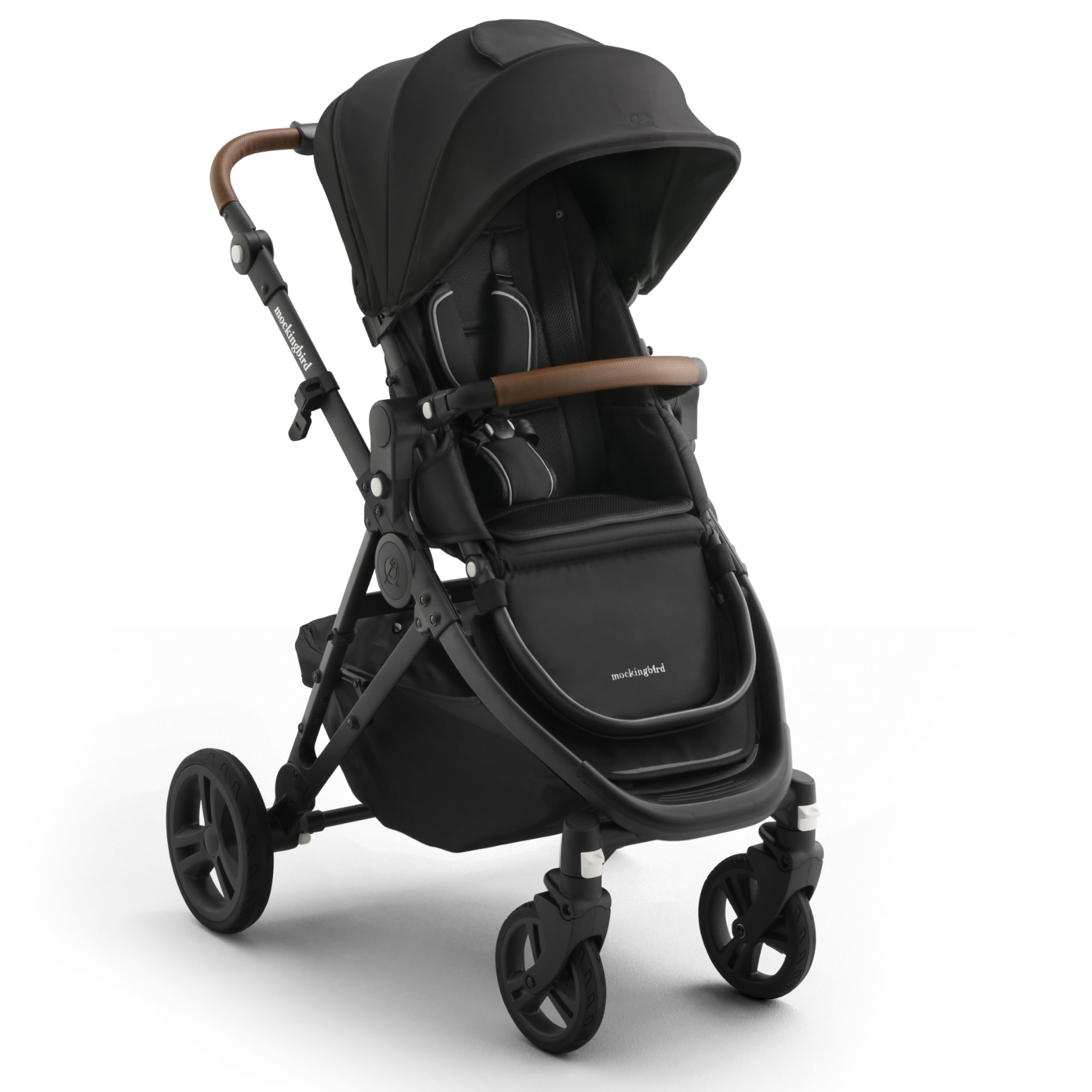
Mockingbird 3.0
Key Features
- Configurations: 44
- Stroller weight: 27 lb
- Children accommodated: Up to 3
- Car seat compatibility: 40 infant car seats
- Price: Midrange
The fold is what sold us: one hand, one motion, and the frame stands on its own while you pick up the baby with the other arm. Loading two children into a car is a sequence of small fumbles, and the Mockingbird removes one of them.
For noticeably less than the Vista V3, the Mockingbird 3.0 does the same job: one seat, two seats, three children with a board, and 44 configurations in between. We were ready to find the cheaper frame flexing under a preschooler, and it does not. The aluminum frame with all-wheel suspension tracks straight and steers one-handed, and the never-flat tires mean no pump in the trunk. The ride is a shade less plush over broken pavement than our top pick, which is the honest difference between them.
Storage is where it surprises people: the basket under the seat is enormous and open from both sides, so you can reach a diaper bag from the sidewalk without walking around the stroller. The FullShade setup adds a LegShade to the canopy, covering a child’s legs as well as their head, and the reflective accents on the harness straps are the small detail we noticed on evening walks. Mockingbird lists compatibility with 40 infant car seats through its own adapters, and the warranty runs for the life of the stroller.
Pros
- One-handed fold that stands on its own
- 44 configurations, up to three children
- Lifetime limited warranty
Cons
- Second seat and car seat adapters cost extra
- 27 pounds, with a long folded frame
Forty-four configurations, a one-handed fold and a lifetime warranty for a lot less than the top pick: this is where we point families watching the budget.
Best for Newborn Plus Toddler
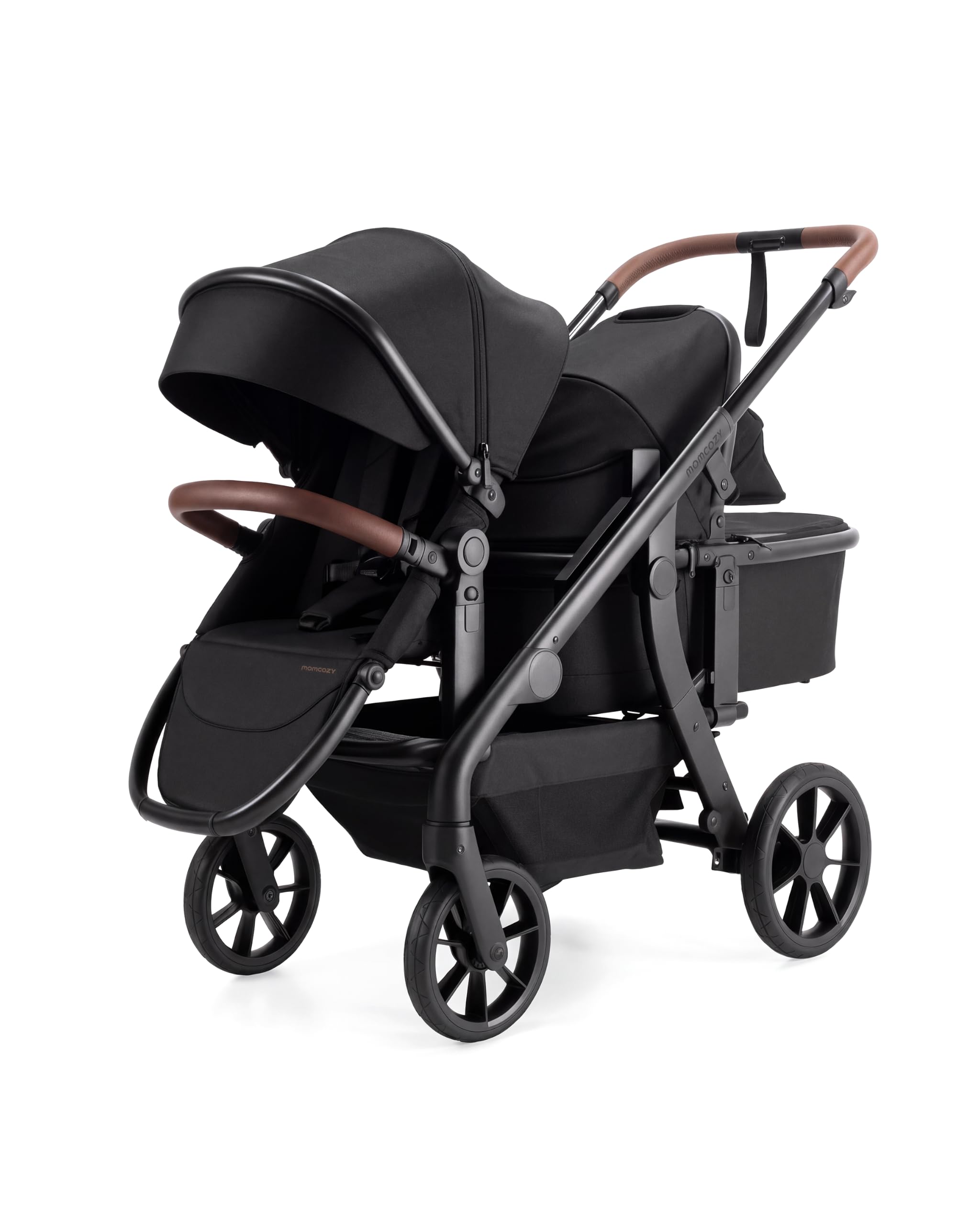
Momcozy ChangeGo
Key Features
- Modes: Single, double, wagon
- Included: Carrycot, toddler seat, rain cover, travel bag
- Configurations: 23
- Front and rear wheels: 10 and 12 inches
- Price: Midrange
The box is the argument. A carrycot, a toddler seat, a rain cover and a travel bag all come with the ChangeGo, which means a newborn and a toddler ride together from day one without a second purchase. That single fact puts it ahead of the other convertibles here for anyone whose second child is already on the way.
The wheels explain the ride: 10-inch swivels at the front and 12-inch rears, the largest on anything here, with suspension at all four corners. Bigger wheels do the boring, valuable work. They roll over tree roots and curb lips instead of stopping dead, and they are why this one covers ground on a gravel path that smaller-wheeled strollers shudder through. Assembly is a snap-in job for the carrycot and the seat, and the pieces stay attached to the frame so they do not get left at home.
What keeps it in the roundup after the baby years is the wagon mode: the same frame converts, and 23 configurations carry you through the stages in between. If both children are past the carrycot stage, you are adding a second toddler seat, which is true of most of these. It is the most flexible stroller in this group by a distance, and the one we reach for when a trip involves anything rougher than a sidewalk.
Pros
- Carrycot included, so newborn and toddler ride now
- Converts to a wagon as children grow
- 10- and 12-inch wheels, largest here
Cons
- Folded frame needs a large trunk
- Basket rated to only 19.8 pounds
We send newborn parents here: a carrycot and a toddler seat arrive together, so it is a true two-child stroller from the first week.
Best for Tall Toddlers
Baby Jogger City Select 2
Key Features
- Folded size: 34.8 x 20.6 x 32.4 inches
- Configurations: 24
- Stroller weight: 26.8 lb
- Maximum child weight: 45 lb
- Price: Premium
Seat spacing is the number nobody prints, and Baby Jogger puts a claim on it: more room between the upper and lower seats than the Vista V2 with a second seat attached. You can see where it comes from, because the lower seat sits far enough forward that a tall child is not breathing on the back of the one in front. That is the reason we point families with a 3-year-old and a newborn this way, since legroom is what makes a convertible double bearable for the child in the bottom seat.
The third-child claim is real but conditional: the frame takes a glider board, so a walking 5-year-old can hop on for the long walk home, and 24 configurations cover the arrangements in between. The one-step fold is 20% smaller than the Vista V2’s by the listing’s own comparison, and at 26.8 pounds the frame lifts into a hatchback without theatrics.
The seat fabric is a Tencel blend that machine washes on gentle, which we appreciate more than any claim about luxury, because a stroller used daily gets spilled on daily. The thing to sort before you order is the adapter bar for your infant car seat, which is brand-specific and easy to get wrong. Price the whole system rather than the stroller alone and there are no surprises.
Pros
- Glider board adds a third child
- Compact one-step fold
- Washable Tencel seat fabric
Cons
- 45-pound seat limit, the lowest here
- Second seat and glider board sold separately
Our pick when the older child is already tall: more room between the seats than anything else here, though the 45-pound limit arrives sooner.
Best for Tight Budgets
Baby Trend Morph
Key Features
- Seat: Converts to carriage
- Riding modes: 25+
- Second rider: Built-in bench and standing board
- Stroller weight: 17.4 kg (38 lb)
- Price: Budget
The frame has a bench and a standing board built into it, and that changes the arithmetic of a second child entirely. Your 4-year-old hops on at the playground gate and off again at the swings, and you have not bought a second seat, a board, or anything else. For a family with a walking toddler and a baby, it is the least expensive real two-child ride in this group.
Everything else is more conventional than the bench suggests. The modular seat converts to a carriage for a newborn, 25-plus riding modes cover forward and rear facing, the seat is rated to 50 pounds, a car seat adaptor comes in the box, and the footrest adjusts as your child grows. That is a lot of stroller for the money, and it meets the JPMA stroller standard, which is the reassurance worth having on a frame this big.
At 17.4 kg it is the heaviest here by a wide margin, and that shapes how you will use it: this is a stroller that stays assembled in a garage or a hallway rather than going into a trunk for errands. Against that, nothing else here puts two children aboard without a single add-on, and for a family on a budget that trade is the whole deal.
Pros
- Built-in bench and board for a second child
- Seat converts to a carriage for a newborn
- Car seat adaptor in the box
Cons
- Wide footprint with both children aboard
Our budget pick, and a clever one: a toddler rides the built-in bench while the baby sits in the seat, with nothing extra to buy.
Best for Second Stroller
Graco Modes Nest2Grow

Key Features
- Modes: 4-in-1
- Stroller weight: 22 lb
- Front and rear wheels: 6.5 and 7.5 inches
- Seat height positions: 3
- Price: Midrange
Twenty-two pounds is the number that matters if you lift a stroller in and out of a car several times a day, and nothing else here comes close, with the next lightest nearly five pounds heavier. It is also the only one of these that lifts the toddler seat, or an infant car seat, into one of three height positions, which is the difference between a newborn at your hands and a newborn down by your knees.
We think of it as the sensible second stroller: the one for a grandparent’s house, the car you do not use every day, or a household already invested in Graco’s car seats. Four modes and a self-standing one-step fold make it easy to live with, and assembly needs no tools, so it is out of the box and usable the same afternoon.
The 6.5-inch front wheels are the smallest here, and with two children aboard that is what you feel: cracked pavement and tree roots stop it where the Vista rolls through. On smooth sidewalk, which is most of what a suburban or city-block walk actually is, it steers fine and the height adjustment earns its keep. It is the wrong stroller for a park with unpaved paths and the right one for a paved daily loop.
Pros
- Three seat heights for face-to-face use
- Deep under-seat storage
- Self-standing one-step fold
Cons
- One-year warranty, shortest here
The lightest stroller here at 22 pounds, and the only one that raises the seat to three heights. We like it most as a second stroller.
How We Tested the Best Single-to-Double Strollers
We started with the convertibles that come up most often in parent forums and retail listings, then narrowed by price, folded size, seat configurations, and whether each accepted a major infant car seat without an adapter. That left seven strollers, which we used for nine months as the only strollers in our test homes — on school runs, grocery trips, pediatrician visits, and long neighborhood walks. Each had to switch between one and two seats repeatedly, because that conversion is where most models reveal their compromises.
We weighed each on a luggage scale, timed the fold, and lifted it into and out of a car trunk at least a dozen times. We loaded baskets with a diaper bag, a gallon of milk, and a toddler’s snack bag to see whether the weight dragged on the frame or blocked access to the second seat. On walks, we pushed over cracked pavement, gravel, and curbs, noting whether one hand on the handlebar was enough and whether a napping toddler stayed asleep. We clipped infant car seats in and out, checked recline and leg rest for a newborn, and watched how fabric and stitching held up after spot cleaning.
By the end, we judged each stroller the way a shopper would: whether it felt solid or flexed over bumps, whether the second seat was easy to reach and comfortable for a toddler, and whether the price matched the frame, fabric, and brake quality. We noted which ones still looked good after months of spills and scuffs, and which conversions were simple enough to do with a baby on one hip. The winners stayed functional and comfortable as both a single and a double — not just one or the other.
How to Choose a Single-To-Double Stroller
The decision comes down to how soon a second child arrives and whether both will ride at once, and every other choice follows from that.
What comes in the box, and what the second child adds
A stroller that converts to a double does not always arrive ready to carry two. The City Select 2 states it plainly, with the second seat, car seat and glider board sold separately, while the Momcozy ChangeGo ships with a carrycot and a toddler seat, which is already a two-child setup for a newborn and a toddler. The Baby Trend Morph sidesteps the question by building a bench and a standing board into the frame.
The trap is the phrase up to three children. It usually means two seats plus a board, and the board is nearly always extra. Count the seats, carrycots and adapters you need before you compare anything else.
Push quality: wheels and suspension
Push quality is what decides whether you still like a stroller in month six, and it is not one number. Wheel size is the quickest proxy: the Momcozy ChangeGo runs 12-inch rear wheels and the Vista V3 runs 11.3-inch rears, while the Graco’s 6.5-inch fronts are the smallest in this group. Bigger wheels roll over curb lips and tree roots instead of stopping dead, and suspension keeps the frame from chattering over both.
If your daily route is smooth sidewalk, small wheels are fine and the lighter stroller wins. If it is broken pavement, park paths or winter slush, pay for the wheels.
Seat room, recline and the weight limit nobody checks
Legroom between the two seats decides whether the older child tolerates the arrangement, and the lower seat is where convertibles get cramped. Reversible seats and multi-position recline matter for a baby; each seat’s maximum weight decides how long the older child stays in it. Here the range runs from 45 pounds on the City Select 2 to 50 on the rest, which sounds academic until you are lifting a solid 5-year-old.
Weigh your older child now and compare against that number, and if they are already tall, sit them in the lower seat before you commit.
Weight and folded size
Most of these live in a trunk or a hallway, and the spread between 22 and 38 pounds is the difference between lifting a stroller one-handed and leaving it at home. The Graco is the lightest at 22 pounds; the Baby Trend Morph is 17.4 kg. Folded size matters just as much: the Vista packs to 16.3 by 25.7 by 33.8 inches and the Momcozy to 37.4 by 23.23 by 18.5.
Measure your trunk floor before ordering. If the stroller will live in a garage and only fold for the odd trip, buy for the push instead.
Frequently Asked Questions
Can I use a single-to-double stroller with only one child?
Yes, and all six here run fine as a single, which is how most people start. The price of the flexibility is frame weight: a convertible carries the hardware for a second seat whether or not one is attached, so it feels heavier and bulkier than a dedicated single.
If a second child is more than two years away, buy the lighter single you actually want now and revisit when you are expecting.
Can I take one of these on a plane?
Not into the cabin. Every one of these folds to at least 16 inches on its shortest side, past what an overhead bin takes, so plan on gate-checking it in a padded travel bag. The Momcozy ChangeGo includes one.
If you fly more than a few times a year, keep a cheap umbrella stroller for trips and leave the convertible at home.
When can a baby move from the carrycot to the seat?
Once head and neck control arrives, which usually lands around three months; Mockingbird’s own guidance puts it there, with the seat reclined. Before that, a carrycot is the appropriate place for them.
If you are buying for a newborn, count the carrycot as part of the purchase rather than an optional extra. On the Momcozy it is in the box, which is much of the reason it earns a place here.
Final Verdict
Buy the UPPAbaby Vista V3 if you want one stroller to see you through a second child without changing how it pushes. It is the most settled with two children aboard, the most configurable of these, and it has the strongest record on build quality in this group.
If the budget will not stretch that far, the Mockingbird 3.0 does almost all of the same work and folds with one hand. Starting from newborn, look hard at the Momcozy ChangeGo, where the carrycot arrives with the stroller. And if you already have a toddler who walks everywhere, the Baby Trend Morph puts a second child on board for the least money here.
