This post contains affiliate links. We may earn a small commission when you buy through our links — at no extra cost to you.
A newborn stroller has to solve a contradiction: it should feel like a steady, secure bed for a baby who can’t yet support their head, yet it also has to fold small enough to fit in a trunk alongside groceries. That tension explains most of the decisions you’ll weigh — weight, stability, how the seat reclines, whether an infant car seat clicks in without a fight. What you’re actually buying is a smoother first year: naps on the go, one-handed folds while you’re holding the baby, and a frame that doesn’t flex when you bump a curb.
I’ve spent the past six months pushing 11 newborn strollers through everyday life — school drop-offs, grocery runs, and a lot of sidewalks with cracked pavement — and the differences show up fast. The ones I kept reaching for got the basics right: comfortable padding, a fold I could manage with a baby on my hip, a build that felt solid without weighing 30 pounds, and a price that made sense for what you got. The list below is where that testing landed.




Best for Newborn to Preschool
Mompush Wiz 2-in-1
Key Features
- Folded size: 43.4 x 24.4 x 14.2 in
- Newborn mode: Lie-flat pramette
- Stroller weight: 23.1 lb
- Max child weight: 50 lb
- Price: Midrange
A newborn cannot sit up, cannot hold their head, and spends most of a walk asleep, so what you actually need in the first months is a flat surface that moves. The Wiz gets there by converting its own seat into a pramette, without tools and without a second piece of hardware to store in the hall. That conversion is the whole reason it tops this list: you get a genuine newborn stroller and a toddler stroller in one frame, and you do not have to decide today which one you needed.
Then there are the numbers that decide how long you keep it. The seat is rated to 50 lb, with a 32-inch rear-facing height limit, which is the most generous combination in the affordable half of this group. It reverses, so a newborn can face you and a curious one-year-old can face the world, and the recline runs through multiple positions in both directions. We paid close attention to that limit because it is the difference between a stroller you use for eighteen months and one you are still using when your child can climb in unaided.
On the pavement it feels more expensive than it is. The rear wheels are 9.4 inches and the fronts 6.3, with suspension that soaks up brick sidewalks and park paths, and the whole thing tracks straight with one hand on the bar. Six infant car seats are listed as compatible, including the Chicco KeyFit 30 and Zip, the Cybex Aton and Aton 2, and the Maxi-Cosi Mico Luxe and Mico Max 30, which matters enormously if you already own one of them or inherit one. The underseat basket is rated for 10 lb, enough for a diaper bag and a folded blanket rather than a grocery run.
What we keep coming back to is that there is no part of the newborn year this stroller cannot handle. Naps on the go, a car seat transfer in a parking lot, a wriggling toddler who wants to face forward, a second baby three years later. It is not the lightest thing here and it will not suit a household with a tiny trunk, but as a single answer to a complicated question, it is the one we point people toward.
Pros
- Tool-free lie-flat pramette from day one
- 50 lb limit outlasts most of this group
- Reversible seat plus six compatible infant seats
- Smooth ride on 9.4 in rear wheels
Cons
- Won’t fold with the bassinet attached
- 43 in folded length needs trunk space
We think this is the newborn stroller most families should buy: it lies flat from day one, faces either way, and keeps going until preschool.
Best for One-Box Travel System
Graco Modes Pramette
Key Features
- Modes: 3-in-1 with car seat
- Stroller weight: 20.9 lb
- Included car seat: SnugRide 35 Lite DLX
- Car seat fit range: 4 to 35 lb
- Price: Premium
One box, three jobs. Graco ships the stroller, the pramette mode and the SnugRide 35 Lite DLX infant car seat as a single purchase, and the car seat is rated from 4 to 35 lb and up to 32 inches, which covers the newborn stage with room to spare. For a first-time parent staring down a registry, that consolidation is worth more than any individual feature, because it removes a compatibility question you would otherwise spend a weekend on.
The stroller underneath is better than bundled travel systems usually are. At 20.9 lb it is genuinely light for something designed to carry a car seat, and it still takes a child to 50 lb. The seat reverses, the canopy is large with a peekaboo window, the child tray comes off for loading, and the fold is a one-hand affair once you find the rhythm. On pavement the 7.5-inch rear and 6.5-inch front wheels roll cleanly and quietly, and the whole thing converts from bassinet to toddler seat without a fight. We were struck by how little the package asks of you on a normal Tuesday.
The honest caveat is frame flex. In pramette mode there is a bit of bounce in the structure, and it does not feel as planted as the Mompush when you push it one-handed along a cambered sidewalk. Check on arrival that the toddler seat and the car seat both latch firmly, and use the included base in your car rather than relying on a seatbelt install for daily drop-offs. If you want one purchase and one learning curve, this is the simplest start here.
Pros
- Stroller, pramette and car seat in one buy
- 20.9 lb is light for a travel system
- 4 to 35 lb car seat range
- One-hand fold and removable child tray
Cons
- Noticeable frame flex in pramette mode
- Fold takes practice to latch
If you want to be ready for the hospital with one purchase, we point you here: stroller, pramette and infant car seat arrive together.
Best for Growing Families
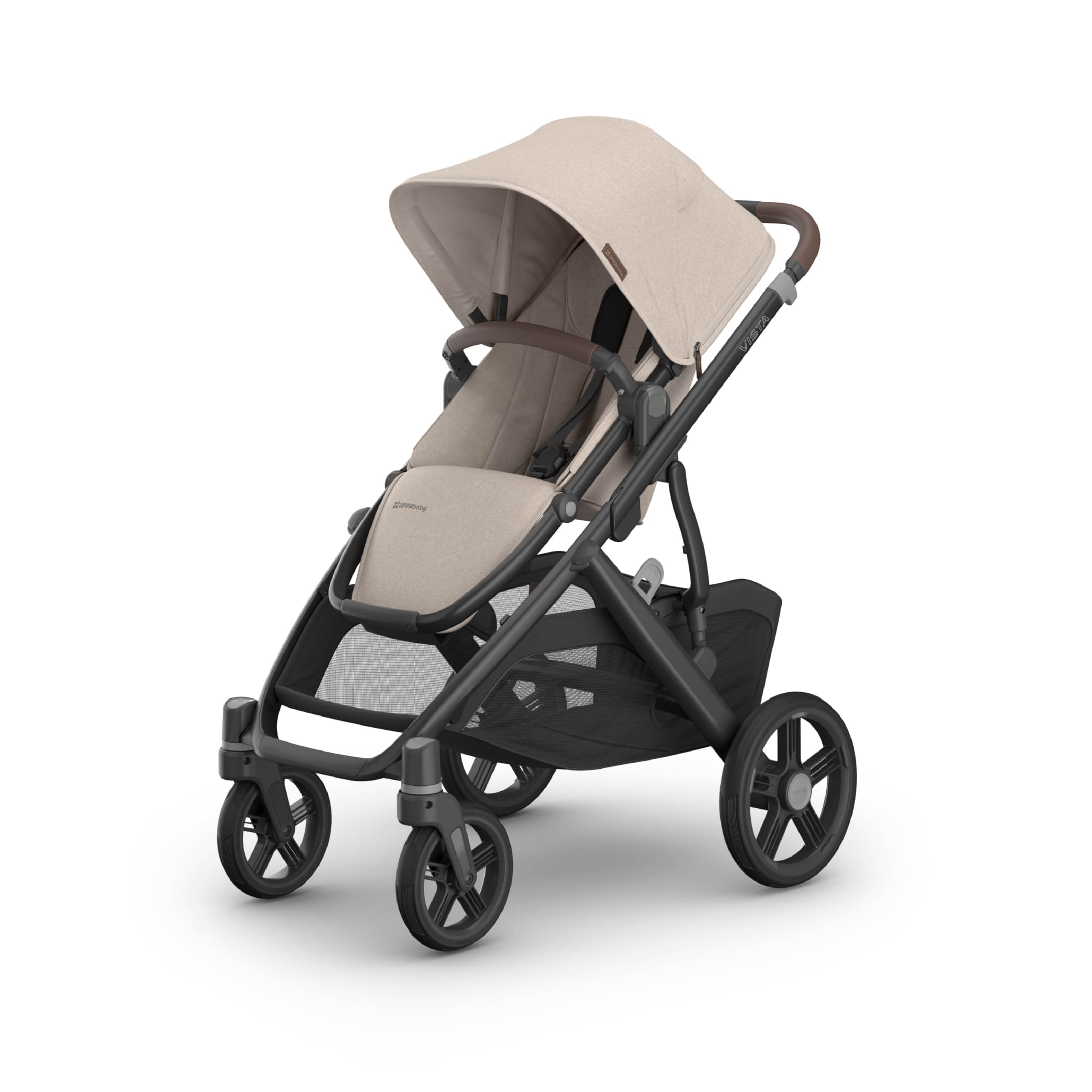
UPPAbaby Vista V3
Key Features
- Seating: Single to double
- Configurations: 30+
- Basket capacity: 30 lb
- Stroller weight: 27 lb
- Price: Premium
Most strollers on this page assume one baby. The Vista V3 assumes the next one: more than thirty configurations, single to double on the same frame, and a manufacturer claim of carrying up to three children across the setup. If you are buying for a newborn now and expect another within two or three years, that math changes what a stroller is worth to you, because the alternative is buying twice.
For a newborn specifically, the route in is the car seat. The frame takes the UPPAbaby Aria, Mesa V2 or Mesa V3, and the toddler seat that ships in the box takes over after that, reversing between parent-facing and forward-facing and rated to 50 lb. There is no bassinet in the box, so a lie-flat carrycot is a separate consideration rather than part of the price you see, and that is worth knowing before you compare it with a pramette stroller.
The details are where the money goes and, mostly, where it earns its keep. The magnetic harness buckle is the sort of thing you stop noticing because it never fights you, and the no-rethread harness means adjustment takes seconds on a growing baby. All-wheel FlexRide suspension lives in the frame, the seat has breathable mesh with a seasonal liner for cold weather, and the underseat basket holds 30 lb, which is the largest here by a wide margin and the reason this one does the weekly shop. At 27 lb and 33.8 inches folded, though, it is the heaviest thing we recommend, and it wants a garage or a big trunk. Register it, because the warranty runs three years.
So: the wrong buy for one child and a compact hatchback, and close to ideal for a family who will hand it down through siblings. That is a narrow recommendation stated plainly, and we are comfortable making it.
Pros
- Grows from one child to two on one frame
- 30 lb basket is the largest here
- Magnetic buckle and no-rethread harness
- Three-year warranty when registered
Cons
- 27 lb is the heaviest stroller here
- No bassinet in the box
Our pick for a family planning a second child: it starts as a newborn car-seat frame and ends as a double.
Best for Car-First Errands
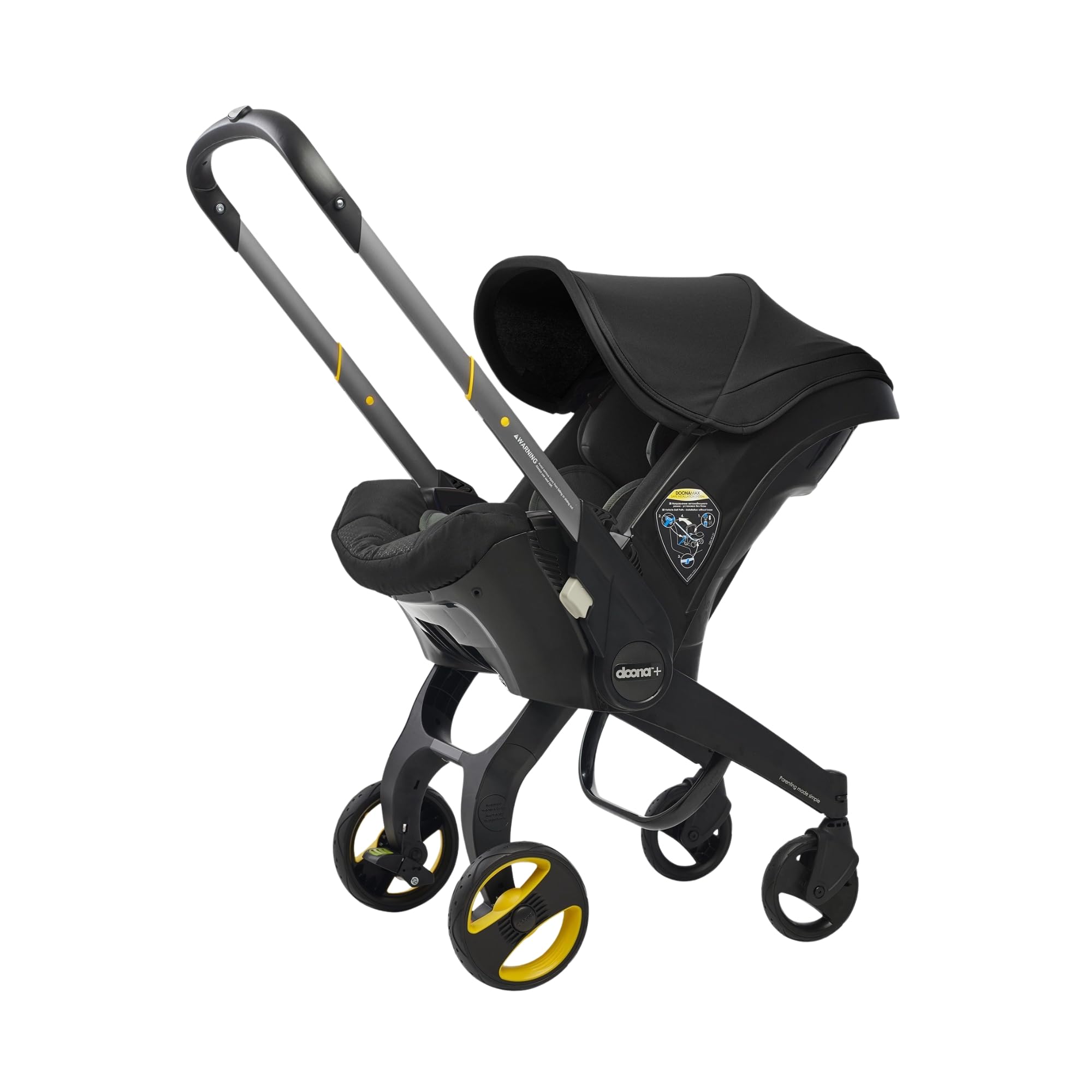
Doona Car Seat & Stroller
Key Features
- Modes: Car seat and stroller
- Air travel: FAA approved
- Folded size: 26 x 17.4 x 22.4 in
- Minimum weight: 4 lb
- Price: Premium
Picture arriving at a store with a sleeping newborn. With a normal travel system you either wake them to move them across, or you wrestle a car seat onto a separate frame in the rain. The Doona deletes that moment: you lift the seat out, squeeze the handle, the wheels drop, and the thing you drove in is the thing you push. We think that single trick is worth more in the first six months than any amount of suspension.
The safety and travel kit is complete rather than optional. It is rear-facing from 4 lb, with three-layer side impact protection, an anti-rebound bar and a five-point harness, and the box includes the infant insert and head support, the LATCH base and a vehicle seat protector. It is FAA approved, so it can go on the plane with you rather than being gate-checked and hoped for. The canopy is water-repellent with UPF 50+, and folded it measures 26 by 17.4 by 22.4 inches.
What it is not is a bassinet. This is a car seat on wheels, so the ride is firm and the front wheels are five inches, which is fine on a mall floor, a sidewalk and an airport concourse, and a chore on gravel or broken pavement. It is also an infant-stage product by design: once your baby outgrows the seat, the stroller goes with it, and you are shopping again. For car-first days and travel, though, there is nothing else here that saves you the transfer.
Pros
- No transfer of a sleeping baby
- FAA approved for air travel
- Base, insert and head support included
- Rear-facing from 4 lb
Cons
- Small wheels struggle on gravel
- Only lasts the infant stage
For errands and air travel, nothing here removes a step like it: the car seat you drove in becomes the stroller.
Best for Quick Car Errands
Baby Trend Snap N Go EX
Key Features
- Type: Car seat frame
- Cup holders: 2
- Folded size: 7.52 x 31.26 x 17.78 in
- Stroller weight: 14.1 lb
- Price: Budget
The cheapest sensible way to move a newborn is not to buy a stroller at all. It is to buy a frame that carries the infant car seat you already have, and that is exactly what this is: 14.1 lb, folding to 7.52 by 31.26 by 17.78 inches, with a one-hand collapse, two cup holders, a covered parent tray and an underseat basket that swallows a diaper bag. Four twelve-inch wheels mean it rolls over sidewalk cracks instead of catching on them.
For the first months it does almost everything a full stroller does, and it does it with one hand while you hold a baby in the other. Errands, pediatrician visits, airport concourses, the second-floor walk-up: this is the one you can carry up the stairs folded. It accepts infant seats from several brands, ships with straps to secure the seat, and has foot-operated rear brakes that are easy to catch without looking.
The catch is the fit, and the fit is the whole product. Seats vary: some click in positively, others sit in the tray and rely on the straps to hold them. Test your car seat on the frame at home before you trust it on a slope, and use the straps even when it clicks. What you give up is any seat of your own, so once your baby moves out of the infant car seat, this goes into the closet alongside it.
Pros
- 14.1 lb with a one-hand fold
- Accepts infant seats from several brands
- Large basket, two cup holders, covered tray
- The least expensive option here
Cons
- Needs a compatible infant car seat
- Seat-to-frame fit varies by car seat
We recommend it if you already own an infant car seat: it is the lightest and least expensive way to move a newborn, for the months before a real stroller.
Best for Second Stroller
Hagaday 2-in-1 SK20
Key Features
- Folded size: 40 x 22 x 13.5 in
- Newborn mode: Bassinet conversion
- Stroller weight: 21.2 lb
- Max child weight: 40 lb
- Price: Midrange
The Hagaday costs about what our top pick does and does the same basic trick, converting a bassinet into a seated stroller with a reversible seat, so the useful question is where the two split. Three places: the weight limit, the folded package, and what comes in the box. On the first, this one stops at 40 lb where the Mompush goes to 50, which is roughly a year of use if you have a sturdy child.
The box is where it wins. Bassinet, seat, canopy, sun visor, storage basket, foot cover, mosquito net and cup holder all ship together, and those last two are the sort of thing you only appreciate at seven in the evening in July. Most strollers at this level make you buy the net separately, and then you never do. The canopy is UPF 50+ with a skylight, which is more useful than it sounds when you are pushing and cannot see whether your baby is asleep.
The ride is a pleasant surprise: 9.5-inch rear and 7-inch front PU wheels on an aluminum frame, with a push that feels smooth on pavement and manageable on grass. At 9.6 kg it is light enough to lift into a trunk without thinking about it, and assembly is a short job rather than an evening.
Where that leaves us: this is an excellent second stroller, for the grandparents’ house or the car you do not want to unload every day, and a perfectly good first one if you expect to hand it down. If it will be your only stroller and you plan on more than one child, the 50 lb limit on the top pick buys you more time.
Pros
- Bassinet mode plus a reversible seat
- Mosquito net and foot cover included
- Smooth PU wheels and aluminum frame
- 9.6 kg is easy to lift
Cons
- 40 lb limit arrives sooner than the top pick’s
- Long folded package for its weight
A genuinely well-equipped bassinet stroller for the money, and our favorite second stroller — just don’t expect it to last as long as the top pick.
Best for Tight Storage
INFANS 2-in-1

Key Features
- Folded size: 22.5 x 13.5 x 30 in
- Frame weight: 10 lb
- Included extras: Cup holder, foot cover, tote bag
- Max child weight: 50 lb
- Price: Budget
This one packs smaller than anything else here that still gives a newborn a flat place to lie: 22.5 by 13.5 by 30 inches folded, with a frame listed at 10 lb. If the stroller lives in a closet and comes out for weekend walks, that shape is worth more than a bigger basket or a longer canopy, and it is the reason we kept it on the list.
It is a proper 2-in-1, with the sleeping basket adjusting through lie-flat to sitting, a 50 lb limit, JPMA certification, 360-degree front wheels with lockable rears, shock absorption and a removable foot cover for cold mornings. A cup holder, underseat basket and tote bag come in the box. On paper it is the most stroller for the least money in the budget group, and it looks better made than the price suggests.
Two things to know. The fold is awkward and takes two hands and a bit of a knack, so it is not the one to buy if you collapse a stroller eight times a day. And the hardware is the wear point: straps and small fittings are what give first, so check them periodically and treat the frame gently rather than loading it to its limit on rough ground. For occasional use and a small apartment, that trade is fine.
Pros
- Folds to 22.5 x 13.5 x 30 in
- 50 lb limit at a budget price
- Cup holder, foot cover and tote bag included
- JPMA certified and shock-absorbing wheels
Cons
- Straps and small fittings wear first
- Awkward two-hand fold
We like it for tight storage and light use — a lie-flat newborn seat and a 50 lb limit, with the caveats that come with the price.
Best for Style on a Budget
PEARLOVE 2-in-1

Key Features
- Folded size: 8 x 17 x 33.5 in
- Frame material: Carbon steel
- Stroller weight: 20 lb
- Max child weight: 45 lb
- Price: Budget
Looks are the reason this one gets picked, and that is not a shallow reason when the thing parks in your hallway for three years. The brown Oxford fabric and carbon-steel frame read as considerably more expensive than they are, and the finish is the single most consistent thing about it. If you want a newborn stroller you are happy to be seen pushing, this is the budget answer.
Underneath the finish there is a real stroller: 20 lb, a 45 lb limit, bassinet and seated positions, front-wheel springs and a double damping system at the rear, folding to 8 by 17 by 33.5 inches. Assembly is straightforward, and it handles an elevator and a narrow shop aisle without drama. We found the ride comfortable enough that a baby will fall asleep in it, which is the only test that matters on a long walk.
The release button is the part to keep an eye on, since a stiff one turns folding into a two-minute job at the worst possible moment. Otherwise this is a sensible, good-looking newborn stroller for neighborhood walks and errands, and a sound choice if the budget is firm and the priority is a flat seat rather than a lifetime purchase.
Pros
- Best-looking option in the budget group
- Bassinet and seated positions
- 45 lb limit on a 20 lb frame
- Springs and rear damping smooth the ride
Cons
- Release button can stick when folding
We recommend it to anyone who wants a lie-flat newborn stroller that looks far better than its price bracket suggests.
How We Tested Newborn Strollers
To build our shortlist, we started with strollers that explicitly support newborns — either a flat-reclining seat or a bassinet attachment — then filtered by price, folded dimensions, and the availability of a compatible infant car seat. From that pool we bought 11 models and used them for six months. We didn’t test them in a lab; we used them the way a parent would, from the first pediatrician visit through daily walks and errands.
Each stroller went through the same routine: a solo fold-and-lift into and out of a car trunk, a five-minute walk on broken sidewalk to check whether the frame rattled or the baby’s head jostled, and a car seat attachment test where we clicked and unclicked the seat ten times in a row. We noted how much effort the fold took with one hand, whether the stroller stood on its own when folded, and how much trunk space it ate. For comfort, we checked the seat padding and recline mechanism, and watched whether a newborn could lie flat without sliding forward.
Stability got its own test: we loaded the basket with a diaper bag and a gallon of water, hung a tote on the handlebar, and pushed over a curb to see if the stroller tipped. Durability came from six months of real use — scuffed wheels, fabric stains, a wobbly handle after repeated folding. And we tracked weight not just on a scale but on the tenth lift of the day, because a stroller that’s lightweight on paper can feel like an anchor when you’re tired. Value was the last filter: we asked whether the price matched the quality of the parts and the ease of the daily routine.
How to Choose a Stroller for a Newborn
The newborn decision comes down to one question, where the baby lies, and everything else follows from how you answer it.
Start with where the baby lies
A newborn can’t sit up or hold their head, so a stroller is only newborn-ready if the baby is flat or in a car seat. There are three routes: an infant seat clicked onto a frame, a stroller whose own seat converts to a lie-flat pramette, or a separate carrycot. The frame is lightest and cheapest but lasts only as long as the infant seat; the pramette is one purchase and nothing extra to store.
The trap is marketing shorthand. A listing that says from birth often means with a car seat you supply, and a seat that reclines is not the same as one that goes flat. Before you assume a newborn can ride in it, check what actually ships in the box.
Weight, the fold, and the trunk you really have
The two figures that shape daily life are the weight you lift and the length of the folded package. A frame stroller at fourteen pounds comes out of the car with one hand; a double-ready stroller at twenty-seven pounds is a deliberate two-hand lift with a baby on your hip.
Folded length varies wildly in this group, from a couple of feet to nearly four, so measure your trunk before you fall for a bassinet. And find out whether it folds with the bassinet or parent-facing seat attached, because on several of these it does not, which means taking the seat off in a parking lot.
Seats, harnesses and facing direction
A reversible seat is worth having for the first year: parent-facing lets you see a newborn’s face and settle them without stopping, and forward-facing gives a toddler the world. Look for a seat that reclines through several positions rather than two, so a baby who falls asleep mid-walk is not left propped upright.
The harness matters more than the cushioning. A five-point harness with adjustment that doesn’t require rethreading the straps is easier to get right on a wriggling newborn, and a no-rethread design is the difference between a snug fit and a loose one. Padding and a boot cover are comfort, not safety, but they do keep a small baby from slumping.
Buy for the second year, not the first
Newborn gear is easy to over-buy. The number that decides how long a stroller lasts is the maximum child weight, and in this group it runs from thirty-three pounds to fifty. A lower limit arrives around age two for many children; a fifty-pound seat is still in service at preschool.
Then count the whole purchase rather than the stroller alone: the car seat, a second base for the second car, a carrycot if you want one. A stroller plus a separate infant seat can come out ahead of a bundled travel system, or behind it, depending on what you already own. Work that total out before you compare anything else.
Frequently Asked Questions
Can a newborn sleep overnight in a stroller?
No. A pramette or bassinet stroller is for walks and for naps you are watching, not overnight sleep, because the sides are shallow and the base is not a mattress. Use it to get out of the house, then move a sleeping baby to a crib or bedside bassinet. That holds for every stroller here, including the ones with a genuinely flat seat.
How do I stop a stroller tipping when a bag hangs on the handle?
Put the weight low and centered instead. A diaper bag on the handlebar raises the center of gravity, and a light frame with a bassinet mounted high is the easiest kind to tip. Load the underseat basket and stay inside its rating, which ranges from ten pounds to thirty across these picks. If you routinely carry more, a bigger basket is the fix, not a hook.
What should I check on a hand-me-down newborn stroller?
The harness first: all five points present, webbing not frayed, buckle clicking positively. Then the frame, which should lock open and closed without a wobble, and the recline, which has to reach genuinely flat if a newborn is going in it. Check the model against the manufacturer’s recall notices, and skip anything missing bassinet clips or canopy hardware.
Final Verdict
Buy the Mompush Wiz. It covers the whole newborn year without a second purchase: flat from day one, reversible, compatible with six common infant car seats, and rated to 50 lb, so it is still the stroller you reach for when your baby is a preschooler. For midrange money that is the best value in this group.
If you want to arrive at the hospital with everything sorted, the Graco Modes Pramette bundles a stroller and an infant car seat. And if a second child is likely within a couple of years, the Vista V3 is the one that grows with you.
