This post contains affiliate links. We may earn a small commission when you buy through our links — at no extra cost to you.
The first time my toddler wrestled the spoon out of my hand, I thought it was a cute milestone. Then I watched her stab at a pile of rice with a long-handled teaspoon and send it flying across the kitchen. A good toddler utensil isn’t just a smaller version of yours—it’s designed so a 15-month-old can actually get food into their mouth, not onto the floor. Over the past six months, my team and I have tested 14 toddler utensil sets with our own kids, and the differences are not subtle.
The biggest surprise? Price doesn’t predict performance. Some of the cheapest sets had the most thoughtful grips, while a few pricier ones had handles too bulky for little fists. Below are the ones that survived daily use, dishwasher cycles, and a few throws across the room.




Best for Everyday Self-Feeding
PandaEar Toddler Utensil Set
Key Features
- Fork: Rounded tines
- Safety: Anti-choke silicone barrier
- Cleaning: Dishwasher safe
- Material: Stainless steel, silicone
- Price: Budget
The anti-choke silicone handle is the reason the PandaEar set is our top pick. It puts a soft, grippy barrier between the hand and the stainless tip, so a toddler can bear down on the handle without the fork disappearing into their mouth. The metal end matters just as much: the rounded tines spear soft food instead of skating over it the way blunt plastic forks do. It suits the child who has the hang of aiming but still needs a forgiving grip.
The proportions are friendly to small hands. The handle is thick enough to palm, and the silicone stays easier to hold than bare stainless when yogurt or applesauce gets everywhere. It is dishwasher safe, which matters more than any design detail in this category. Against the all-metal sets here, the PandaEar asks less of a toddler’s grip; against the plastic sets, the fork actually picks up food.
The limitation is that it feels like a learning tool. The anti-choke barrier and soft handle are exactly what a 1- or 2-year-old needs, but a 4-year-old who wants the same flatware as everyone else may resist. That is the right trade for the main buyer here: someone equipping a toddler for everyday meals, not a child who has already graduated.
Pros
- Stainless fork picks up soft food
- Anti-choke silicone barrier
- Grippy handle for small hands
- Dishwasher safe
Cons
Our everyday pick for a toddler learning to self-feed is the PandaEar set, where a stainless fork meets a grippy, anti-choke silicone handle.
Best for Older Toddler Upgrade
Elk and Friends Kids Silverware
Key Features
- Fork: Narrow tips
- Rest: Heart-shaped rest
- Spoon: Deep scoop
- Material: 18/0 stainless steel, silicone
- Price: Premium
For the toddler who has started refusing the chunky plastic set and wants what everyone else at the table is using, the Elk and Friends set is the grown-up-looking option. The pieces are stainless steel with silicone sleeves, and the fork gets narrow tines while the spoon has a genuinely deep scoop.
We think this is the most refined set here, and the little heart-shaped rest on the back is a detail we appreciate more than we expected: it keeps the tip off the table without asking a toddler to balance the utensil. The silicone handle gives enough grip for a 2-year-old, and the stainless end gives the fork enough bite for peas and pasta. It is the set we reach for when we want a toddler to feel trusted with real cutlery.
The steel and finish are the reason to choose it over the budget stainless sets. The spoon is deeper, the fork feels more precise, and the silicone sleeves are neatly finished rather than bulky. This is the set that looks good enough to give as a gift and refined enough for a child who notices the difference.
Pros
- Deep spoon holds a real bite
- Narrow fork tines spear food
- Heart rest keeps tip off table
- Silicone grip suits small hands
Cons
- Premium price for a six-piece set
We rate the Elk and Friends set as the upgrade for an older toddler ready for real-feeling cutlery; the deep spoon and heart rest justify it.
Best for First Self-Feeding Set
Munchkin Raise Fork & Spoon Set
Key Features
- Age: 12 months+
- Feature: Rest keeps tips off table
- Cleaning: Top rack only
- Material: Plastic
- Price: Midrange
Compared with the stainless sets here, the Munchkin Raise is a deliberately simple utensil: plastic fork and spoon, thick handles, and a raised base that keeps the tips off the table. It is sold for 12 months and up.
The base is the useful part. A toddler can set the spoon down between bites without painting the table with yogurt, and the thick plastic handle is easy to palm. The fork is not going to spear a grape the way a metal fork will, but it is enough for soft foods and early practice. The pieces are BPA-free.
What we do not love is the long-term feel. The plastic is light and forgiving, but it can stain from tomato sauce, and hard daily use can eventually wear the surface. That makes it a sensible first set rather than an heirloom; if you want a set that still looks new after hundreds of washes, the stainless picks are the better bet.
Pros
- Built-in rest keeps tips off table
- Thick plastic handle is easy to palm
- Light enough for early self-feeders
- BPA-free plastic
Cons
- Top-rack dishwasher only
For a first self-feeding set where less mess matters most, the Munchkin Raise is the one we choose, thanks to its built-in table rest.
Best for Durable Plastic Option
Re-Play Toddler Forks & Spoons
Key Features
- Size: 5.8" x 1.2" x 0.2"
- Made in: USA
- Cleaning: Dishwasher, microwave safe
- Material: Recycled plastic
- Price: Midrange
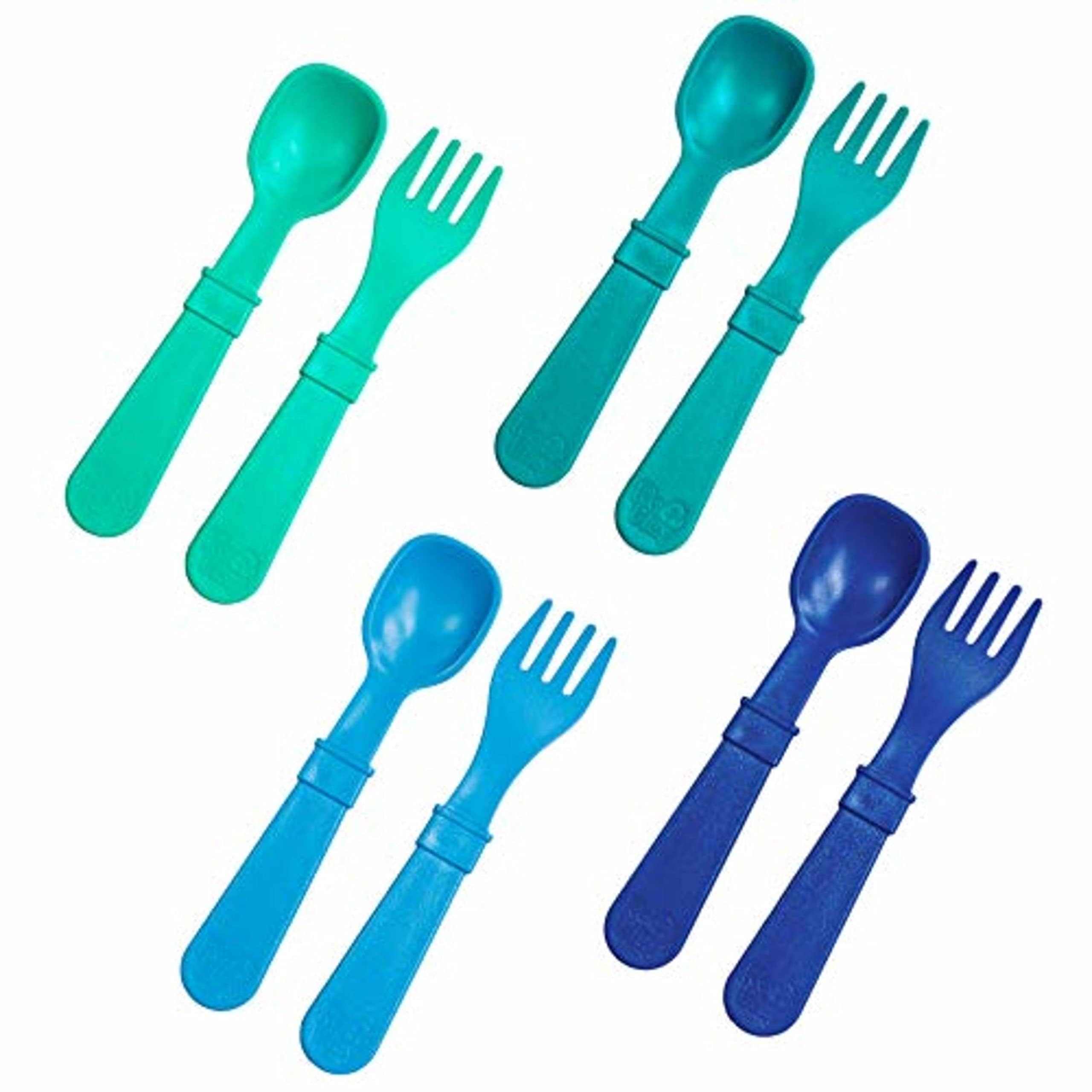
The Re-Play set feels like the plastic option that was designed to survive a toddler rather than just sell to one. The pieces are thick, hard-textured plastic with squared-off edges, and the set is made in the USA from recycled milk jugs. The fork and spoon are shorter and chunkier than the stainless sets here, which is a plus for a child still learning to load a spoon.
We think it is the toughest plastic set in this group. It handles drops, dishwasher cycles, and the microwave without fuss, and the thick handle is easy for a 2-year-old to hold. The trade-off is precision: the fork tines are dull enough that they struggle with firmer foods. For yogurt, oatmeal, rice, and practice, that is fine. For a child who wants to spear chicken, it is not.
The recycled material and bright colors are nice, but the real appeal is that you can stop worrying about it. Send it to daycare, run it through the dishwasher, and do not treat it like fine flatware. If you want a set that feels more grown-up and spears better, pay for stainless; if you want a set that can be dropped on the floor ten times before breakfast, this is the one.
Pros
- Durable recycled plastic
- Dishwasher and microwave safe
- Thick handle easy for toddlers
- Bright, fun colors
Cons
- Spoon bowl is broad for small mouths
The Re-Play set is our pick for families who want a tough, microwave-safe plastic utensil that shrugs off drops and daily washing.
Best for Older Toddler Transition
Munchkin Splash Fork Knife Spoon Set
Key Features
- Age: 18 months+
- Pieces: 2 forks, 2 knives, 2 spoons
- Cleaning: Top rack only
- Material: Plastic
- Price: Midrange
Once your toddler starts reaching for the knife you are using, the Munchkin Splash set is the one that makes sense. It is the right step for older toddlers rather than first-timers: it has longer, thinner handles and includes two forks, two knives, and two spoons, all aimed at 18 months and up.
The knife is the headline. It cuts soft food like banana or buttered toast without being a real blade, and the longer handle gives a 2- or 3-year-old more control than the stubby first sets. The fork is shaped to pick up food, and the handles are long enough for a child moving toward adult flatware. The pieces feel sturdier than the average plastic toddler set.
The spoon is the weak point. It is shallow, so soup and loose cereal slide off before they reach the mouth, and a hungry toddler can get frustrated. It is fine for yogurt and oatmeal. If your child is not ready for a knife, the Splash is more set than you need; if they are, the extra utensils are worth the step up.
Pros
- Two toddler-safe knives included
- Longer handles for older toddlers
- Fork shaped to pick up food
- Good step-up for 18 months+
Cons
- Top-rack dishwasher only
We like the Splash for a toddler past 18 months who is ready to practice with a knife; it is not the place to start, though.
Best for Diaper-Bag Travel
Kirecoo Toddler Utensils with Case
Key Features
- Travel: 2 carrying cases
- Cleaning: Dishwasher safe
- Material: Stainless steel, plastic
- Set contents: 2 forks, 2 spoons
- Price: Budget
A pair of toddler utensils that lives in a diaper bag needs a case more than it needs a fancy handle. Kirecoo supplies two stainless-tipped sets, each with its own travel case, so you can keep one in the bag and one in the car without wrapping a fork in a napkin.
The pieces are compact and light, with stainless tips and smooth plastic handles. The spoon is a good size for a toddler’s mouth, and the case keeps the dirty end away from everything else in the bag. They are dishwasher safe, and the whole package feels tidy in a way that loose utensils do not.
The fork is closer to a spork than a proper fork. It will pick up soft food, but it does not have the narrow tines of the Elk and Friends or PandaEar forks, so peas and slippery pasta are more of a challenge.
The Kirecoo set earns its place for travel, daycare, and restaurant bags, not as the only set in the drawer. It is the one that keeps a clean spoon available when you are out, and that is a narrow but genuinely useful job.
Pros
- Two travel cases included
- Compact stainless-tipped sets
- Easy to keep clean in a bag
- Dishwasher safe
Cons
- Plastic handles lack a silicone grip
Keep the Kirecoo sets in the diaper bag: we rate their two compact cases and stainless tips for clean meals away from home.
Best for Older Kids’ Set
DRKIO 12-Piece Toddler Silverware

Key Features
- Finish: Mirror polished
- Pieces: 6 forks, 6 spoons
- Cleaning: Dishwasher safe
- Material: 18/0 stainless steel
- Price: Budget
Twelve pieces is a lot of cutlery for one toddler, and that is the first thing to understand about the DRKIO set. You get six forks and six spoons in 18/0 stainless steel, all with the same mirror finish and small animal motifs on the handles.
The all-metal construction is the appeal. These feel like real silverware, not a toy, and the fork tines are shaped to pick up food without the bulk of a silicone handle. The animal designs give a toddler something to choose at the table, and the pieces are dishwasher safe. They are a good fit for a 3- or 4-year-old who has moved past the learning grips.
It makes most sense as a value-minded set for older kids, or for a family with more than one child using the same drawer. It is not the set we choose for a 1-year-old; the pieces are scaled for children who already have a steady grip. If you need a first set, the PandaEar’s silicone handle is the more forgiving choice.
Pros
- Twelve pieces for multi-child homes
- Real-metal feel
- Animal motifs make eating fun
- Dishwasher safe
Cons
- Bare metal handles are slick in wet hands
For older toddlers and multi-child homes, the DRKIO set gives you a full drawer of real-feeling stainless, and we appreciate the animal motifs.
Best for Compact Stainless Set
FUNNUO Stainless Toddler Set

Key Features
- Cleaning: Top-rack dishwasher safe
- Material: 18/10 stainless steel
- Fork length: 5.9"
- Spoon length: 4.9"
- Price: Budget
The spoon is 4.9 inches and the fork is 5.9 inches, which puts the FUNNUO set in a useful middle ground between a baby spoon and adult flatware. It is small enough for a toddler’s mouth but long enough to reach the bottom of a yogurt cup.
The material is the reason to consider it. It is 18/10 stainless steel, with rounded tines and a polished finish, and the giraffe etched onto the handle gives it a bit of personality without a cartoon face. These feel more like real cutlery than the plastic-handled sets, and they are top-rack dishwasher safe. For a child who has a steady grip and wants what the adults are using, that is appealing.
The all-steel handles ask more of a toddler than a silicone grip, so this is not the first set we hand to a 1-year-old. It is the set we choose when the child is ready to practice with real-feeling flatware. The compact size is also a good match for a small lunch bag.
FUNNUO makes the most sense for the toddler who has outgrown chunky handles and for families who want a small, good-looking stainless set rather than a drawer full of plastic. It is not the most forgiving pick here, but it is one of the most grown-up.
Pros
- 18/10 stainless steel
- Rounded fork tines
- Toddler-sized spoon and fork
- Top-rack dishwasher safe
Cons
- Only four pieces, so fewer backups
Our choice for a confident toddler who wants compact, real-feeling stainless flatware is the FUNNUO set, not a chunky first utensil.
How We Tested Toddler Utensils
We started by pulling together more than 60 sets from brands we trust and reader favorites, then narrowed to 14 based on size, material, and price. For six months, my team and I rotated those 14 sets through real meals with our own toddlers—breakfast oatmeal, lunchtime peanut butter sandwiches, and dinner spaghetti—plus snack time on the go and at least 20 trips through the dishwasher.
At each meal, we watched how easily a toddler could scoop yogurt or stab a blueberry without help. We noted whether the handle fit a small palm and stayed put when wet or greasy, and whether the tip was rounded enough to be safe but still functional. We also paid attention to size: a spoon that’s too long tips out of the bowl, and a fork with tines too close together won’t pick up anything.
After each wash, we checked for cracks, discoloration, and loose handles. We compared the price of each set to how it held up—some cheaper sets outperformed pricier ones—and asked whether a parent would feel okay losing one at a restaurant. The sets that made our list passed every test without a single mealtime meltdown (from us, anyway).
How to Choose Toddler Utensils for Self-Feeding
The right toddler utensil is the one your child can hold, aim, and clean up after without a fight, so grip and fork geometry matter more than a matching color scheme.
Start With the Grip
The handle decides whether a toddler can use the utensil at all. A child who still palms the handle needs a thick, grippy shape; a child using a pincer grip can handle a slimmer stainless handle. Silicone sleeves are the most forgiving on wet hands, plastic is light but can get slick, and bare metal gives the most grown-up feel but asks for more control. If your child is still learning, prioritize grip over metal. Our advice: choose silicone or thick plastic first, then move to bare stainless when your child can keep the utensil upright without a fist.
Look at the Fork and Spoon
Look at the tines and the bowl, not just the length. A fork needs enough point to catch soft food, but rounded tips are safer for a toddler aiming at their mouth. A spoon needs a scoop deep enough to hold yogurt or rice; a shallow bowl frustrates a hungry child. The best sets here have narrow, rounded tines and a spoon that holds a real bite without being too wide. Test a fork on a pea or a piece of pasta; if it slides off, it will slow mealtime. A deeper spoon is worth more than a decorative handle.
Check the Safety Details
Anti-choke barriers and rounded edges are not gimmicks. A barrier between the handle and the tip limits how far a utensil can go into the mouth, which is useful for a child who still explores with their teeth. Age labels matter too: most first toddler sets start at 12 months, while sets with a knife are usually aimed at 18 months and up. Supervision still decides safe use. Check the tines and edges with your finger before the first meal, and retire any piece that chips or peels.
Choose the Material
Plastic is light, inexpensive, and microwave-friendly, but it can stain from tomato sauce and wear with hard daily use. Stainless steel is easier to keep clean and gives a fork more bite, though it is heavier and can feel slick without a grip. Silicone handles add grip and a softer feel, but they make the utensil bulkier. Our preference for a first set is stainless tips with a silicone handle, because it combines the fork performance of metal with the forgiveness of a soft grip. For a daycare or travel set, plastic still makes sense.
Plan for Set Size and Travel
Buy for the way you actually run the dishwasher. Four to six pieces is enough for one toddler if you wash regularly; a 12-piece set is better for multiple children or for families who let the drawer run low. A travel case earns its place if utensils leave the house, especially in a diaper bag where loose forks get lost. We like a dedicated travel pair even when the main set stays home. If you are choosing one set for everything, prioritize grip and fork performance over piece count.
Frequently Asked Questions
What is the difference between toddler utensils and baby spoons?
Baby spoons are usually soft-tipped and long-handled for assisted feeding from a jar. Toddler utensils have shorter, thicker handles, rounded fork tines, and a spoon sized for self-feeding. If your child is still mostly being fed, a soft-tip spoon is the better tool. Once they grab the spoon and try to load it themselves, move to a toddler set with rounded edges and a grip they can hold.
Are stainless steel utensils safe for toddlers?
Yes, provided the tines are rounded and the edges are smooth. The bigger issue is weight and grip: bare stainless can be slick in wet hands, so a silicone or plastic handle helps a beginner. Run your finger along the fork tines before use, and choose a smaller spoon and fork rather than adult flatware. Supervise the first few meals.
Why do some toddler utensils rust?
Rust usually comes from lower-grade steel or from utensils staying wet. 18/10 stainless, like the FUNNUO set, resists corrosion better than 18/0, but no steel is immune if it sits in a wet dishwasher or a damp diaper bag. Dry the pieces promptly, and do not store them in a closed case while still wet. If rust appears, stop using that piece.
Final Verdict
Start with the PandaEar set. The stainless fork gives a toddler enough bite to pick up real food, while the silicone handle and anti-choke barrier make the learning stage more forgiving. It is the best balance of function and safety in this group.
If your child is older and wants a knife, the Munchkin Splash is the better step-up; for a diaper bag, the Kirecoo cases are the practical choice. The Elk and Friends set is the upgrade if you want a more refined feel and do not mind paying for it.
