This post contains affiliate links. We may earn a small commission when you buy through our links — at no extra cost to you.
The day your toddler trades the bottle for a big-kid cup should feel like a milestone, not a hunt for the one lid that doesn’t leak into the diaper bag. You know the drill: the cup looks adorable, your kid takes one sip, and suddenly the straw is too stiff, the valve is a cleaning nightmare, or the whole thing tips over in the stroller basket. A good transition cup fixes all of that — it’s leak-proof enough to toss in a bag, simple enough to clean that you’ll reach for it, and drinkable enough that your toddler forgets they ever had a bottle.
I’ve spent the past four months testing 16 of them with my own toddler and a rotating crew of test families, and the differences are real: size, valve design, and whether a cup fits a stroller or car-seat holder separate the keepers from the cabinet clutter. The winners weren’t always the prettiest or the priciest — value came down to how many dishwasher cycles they survived without getting funky. The ones below earned their spot.


Best for Bottle-To-Cup Transition
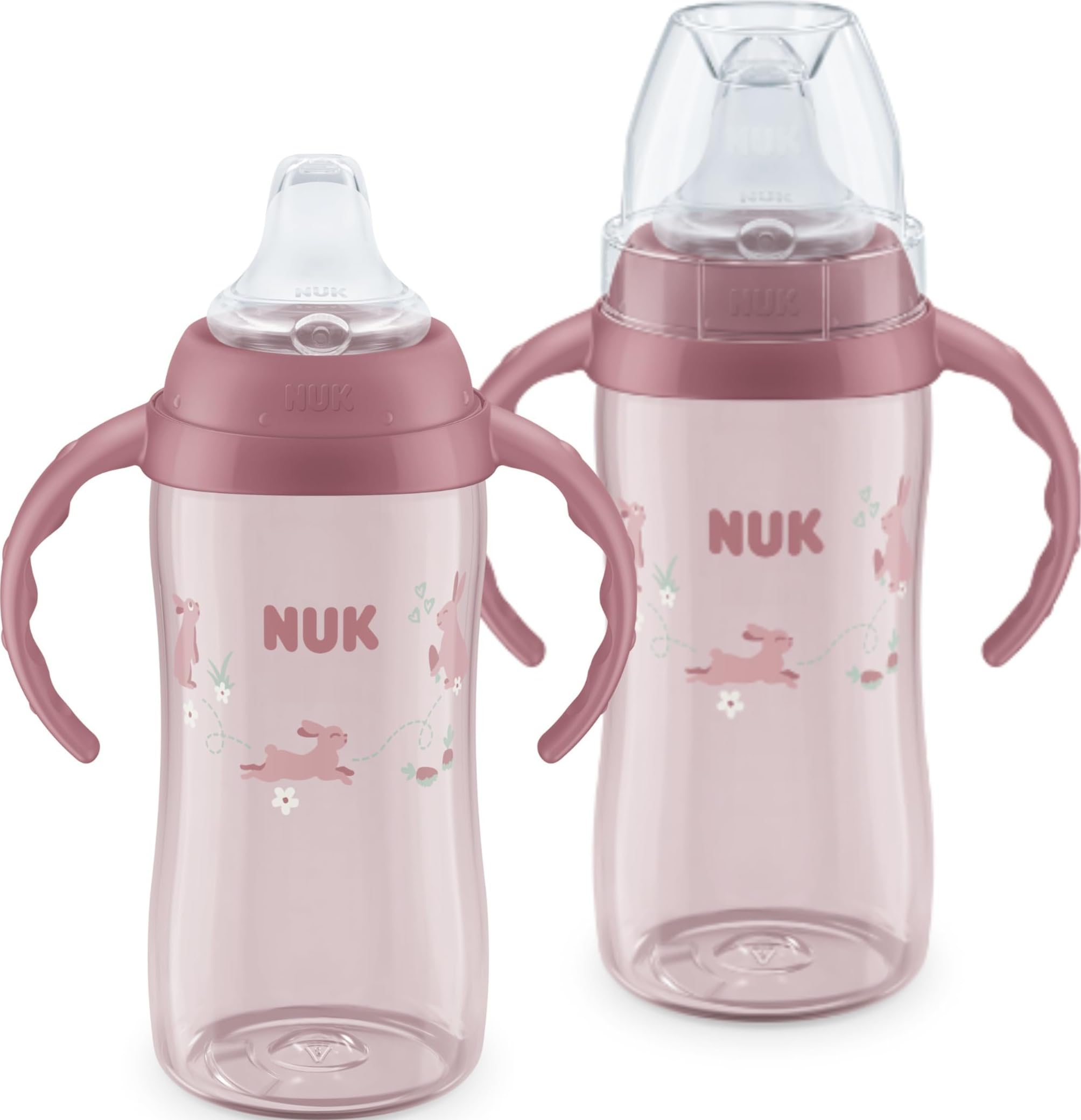
NUK First Choice Learner Cup 2.0
Key Features
- Spout: Soft silicone spout
- Handles: Removable anti-slip handles
- Capacity: 10 fl oz
- Age range: 8 months and up
- Price: Midrange
Eight months is the earliest starting point of anything here, and that’s the reason this NUK is the cup we reach for first. The spout is soft silicone that gives under a bite the way a bottle nipple does, so a baby who has only ever bottle-fed doesn’t have to relearn the whole mouthfeel in one afternoon. The handles clip on for the two-handed stage and come off once your toddler grips the body like a big kid, which means the cup grows with the skill instead of being outgrown in a month.
Leak control is where it earns the top spot. The valve tucks under the spout and closes when the cup is set down, and its record on that front is one of the better ones in this group — good enough that a filled cup can go into the diaper bag without a second bag around it. Cleaning is a top-rack job with a handful of parts, and the wide neck means you can reach inside rather than hoping the water got there.
The soft spout is also the part that ages. Biting is what these cups are for, and a chewed-through spout is where drips start; run a thumb over the tip each week and retire the top at the first tear. What’s left is a cup that begins as a two-handled trainer and ends as a plain ten-ouncer your toddler carries to the table.
Pros
- Soft silicone spout is gentle on gums and teeth
- Removable handles stretch it across two stages
- Better leak record than most spout cups here
- Comes apart for easy cleaning
Cons
- Handles rotate on the collar instead of locking
- Drips if left sitting upside down
The one we hand a bottle-fed baby first: soft spout, handles that come off, and the surest leak control among the spout cups here.
Best for Learning Open-Cup Skills
Munchkin Miracle 360 Trainer Cup
Key Features
- Pack: 2 cups
- Capacity: 10 fl oz
- Age range: 12 months and up
- Drinking edge: Spoutless 360° rim
- Price: Midrange
There’s no spout on this one at all. The lid is a silicone disc with a drinking edge that runs all the way around, and liquid only comes out when a child seals their lips anywhere on the rim and sucks; set the cup down and the valve shuts. It’s the closest thing here to drinking from an open cup without the puddle, and it’s the reasoning behind the dentist-recommended label.
We think of it as the second cup, not the first. The rim asks for a real suck, and that’s the dividing line: some toddlers take one sip and never look at a spout again, others chew the edge in protest for a week. Offering it alongside a cup they already trust works better than swapping it in cold. Once the idea lands, this is the best open-cup rehearsal in the group, and the ten-ounce body is the same size as everything else here.
The housekeeping is easy — three parts, top rack, no small valve to fish out of a drain — and the two-pack means one can be in the wash while the other is in use. Twelve months and up is the rating, so there’s no rush: a child still happy on a soft spout has time before this one makes sense to them.
Pros
- Teaches rim drinking with no spout at all
- Three parts, top-rack dishwasher
- Two cups per pack for rotation
Cons
- Leaks when overfilled or left on its side
We buy it as the step after a spout cup: the rim teaches open-cup drinking, as long as it stays upright and isn’t overfilled.
Best for Gentlest First Step
MAM Trainer Sippy Cup
Key Features
- Handles: Non-slip handles
- Capacity: 8 oz
- Age range: 4 months and up
- Included tops: Spill-free nipple and soft spout
- Price: Budget
Two tops come in the box: a spill-free nipple and a soft silicone spout. That’s the argument for this cup, and it’s a good one — you change a single thing at a time, starting from a feed the baby already knows and swapping the nipple for the spout when they’re ready, without changing the cup in their hands. Rated from four months, it’s the earliest legitimate start here by a wide margin.
In use it’s light, the handles are chunky enough for a nine-month-old to hold with both fists, and the wide neck makes filling and rinsing quick. There’s no vent piece to fish out and scrub, which matters more than it sounds when you’re washing up at ten at night.
Eight ounces and one cup to the pack is the catch, and it’s why we treat this as a try-it-first cup rather than a set. If your baby takes to it you’ll be buying a second within the week — which is also a fair way to find out whether the spout suits them before committing to a multipack.
Pros
- Nipple and soft spout included for staged weaning
- Earliest transition rating here at 4 months
- Easy to hold and quick to clean
Cons
- Weeps if turned fully upside down
Our pick if you want to wean off the bottle one variable at a time — a nipple and a soft spout in the same cup, from four months.
Best for Toddlers Who Bite
The First Years Insulated Sippy Cup
Key Features
- Pack: 2 cups
- Spout: Bite-resistant hard spout
- Capacity: 9 oz
- Insulation: Insulated cup walls
- Price: Budget
The spout on this one is hard plastic, and that’s the point. Soft silicone is kind to gums and it’s also the first thing a determined biter destroys; a hard spout doesn’t care. If you’ve already retired a cup because the spout went, this is the pair that stops the cycle, and being one of the cheapest two-packs in this group makes replacing a lost one less painful.
Insulated walls are the other reason to keep a pair around. Milk stays cold through a morning out, the outside doesn’t sweat over the inside of a bag, and the bumper around the lid takes the corner hits that crack other cups.
Two things to know before you fill it. The valve is a separate silicone insert, and if it isn’t pushed all the way home the cup leaks — seat it with a fingertip and check it after every wash. And don’t crank the lid down; it seals on a light twist, and over-tightening works against you.
What this pair is for is the unglamorous end of toddler drinking: the cups that live in the car door, get refilled without ceremony and come home empty. We keep coming back to it for the toughness rather than the feel, which is honest about what it is — the workhorse rather than the favorite.
Pros
- Hard spout survives serious biting
- Insulated walls keep milk cold on outings
- One of the cheapest two-packs here
- Top-rack dishwasher safe
Cons
- Hard spout takes a stronger suck than soft ones
We hand this pair to toddlers who bite through soft spouts and throw their cups: hard spout, insulated walls, and a price that makes losing one survivable.
Best for All-Day Cold Drinks
Munchkin Miracle 360 Stainless Steel
Key Features
- Pack: 1 cup
- Capacity: 10 oz
- Material: Stainless steel
- Cold retention: Up to 15 hours
- Price: Premium
Stainless steel is the difference. The 360 rim inside is the same idea as the plastic version, but the vacuum-sealed wall holds cold drinks cold for hours — the listing claims 15 — and the outside stays dry in a warm car instead of sweating through a diaper bag.
This is the cup we choose for a child who nurses a drink all morning, and for milk in particular, because milk sitting in a warm room is the reason to care about insulation at all. It’s also the heaviest cup a toddler will carry here, and the one that shows damage: a steel body dents where plastic bounces. One cup to the pack, and the priciest single cup in this group.
It ships with a lid, fits a cup holder, and comes apart into four pieces for the top rack; the valve is the fiddly bit to rinse, as it is on any 360 cup. Ten ounces is the same capacity as most of this group, so nothing changes about how it sits in a bag.
Pros
- Keeps drinks cold for hours
- Steel body doesn’t sweat in a bag
- Lid included and fits cup holders
- Four parts, top-rack dishwasher
Cons
- Dents when dropped on a hard surface
- Can weep when thrown or left on its side
The cup we pick for milk and long days out: a steel 360 that keeps drinks cold for hours, at the cost of weight and the odd dent.
Best for Daycare and Backups
NUK First Choice Fun Grips 4-Pack
Key Features
- Care: Dishwasher safe
- Pack: 4 cups
- Spout: Hard bite-resistant spout
- Capacity: 10 fl oz
- Price: Budget
Four cups in one box is the pitch, and it’s aimed at a specific household: the one where cups go to daycare on Monday and come home on Friday, and where the washing happens in one go over the weekend.
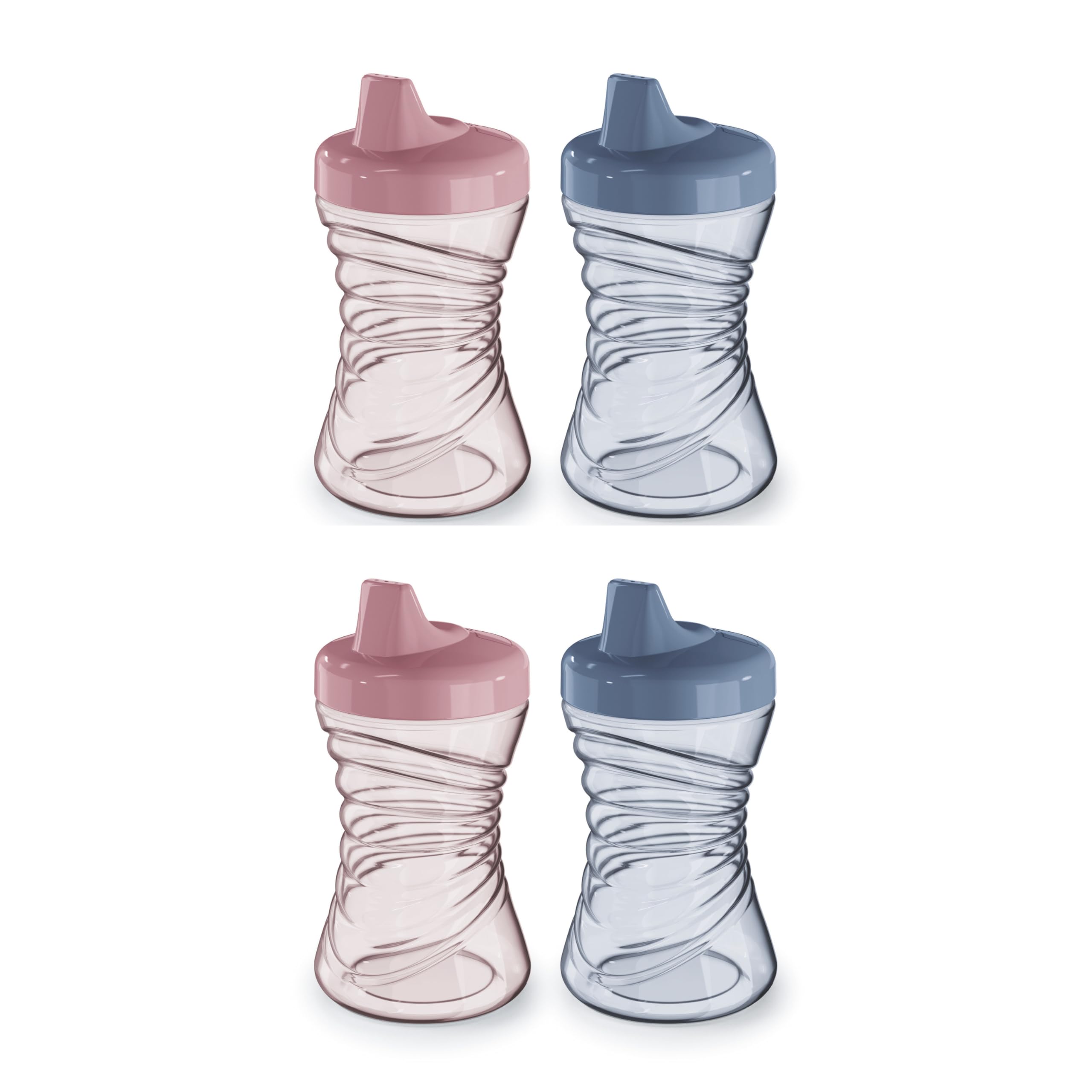
The hard spout is bite-resistant, the valve is a single silicone piece that snaps in and out, and there are no handles to lose — which sounds like a small thing until the handles have gone missing in a shared kitchen. The hourglass body sits easily in small hands, which is why these get carried around rather than left on the table.
What sells it is the lack of fuss. Nothing on this cup needs aligning, the parts are big enough to wash without a brush, and the leak record is the best of the spout cups in this group. It’s the cup we hand over when we want to stop thinking about cups for a while.
Pros
- Best leak record of the spout cups here
- Four cups for daycare rotation
- Bite-resistant spout, one-piece valve
- Easy to hold for small hands
Cons
- Base too wide for standard cup holders
- No handles, so it suits confident holders
For daycare and backup duty, this four-pack is the simplest, most leak-resistant spout cup here — as long as it doesn’t need to fit a cup holder.
Best for Open-Cup Practice
Dr. Brown’s Cheers360 Cup

Key Features
- Valve: Removable silicone valve
- Capacity: 10 oz
- Age range: 9 months and up
- Drinking edge: Spoutless 360° rim
- Price: Budget
The valve lifts out. That’s the trick, and it’s a better one than the marketing around it: with the silicone disc in place you have a leak-resistant 360 cup, and with it out you have a plain rimmed cup — the same cup, one stage later. Few trainers here bother to plan for the day the training ends.
The rest is thoughtful. The valve is translucent and set into a clear window in the lid, so a toddler can see the drink and how much is left without the lid coming off, and the pentagonal body gives small hands a grip that isn’t a taper. Two cups to the pack, top-rack dishwasher, and a rim that survives being dropped.
What we don’t love is the effort. Drinkability is the weakest thing about this cup and the weakest in this group: the valve asks for a firm, sustained suck, and a toddler used to a soft spout may simply hand it back. Take the valve out and it’s an ordinary open cup — which is what it’s designed to become, just sooner than you planned.
Pros
- Valve comes out to become a true open cup
- See-through valve shows the drink inside
- Easy to clean, two cups per pack
Cons
- Valve is fiddly to seat back in the lid
The trainer we recommend when you want the cup to outlive the training: pull the valve and it becomes a real open cup.
Best for Straw-Drinking Step
Zak Designs Kelso Tumbler

Key Features
- Care: Dishwasher safe
- Straw: Silicone straw with valve
- Capacity: 15 oz
- Age range: 3 years and up
- Price: Midrange
A straw is the skill after a spout, and this is the only cup here built around one. The silicone straw carries a valve, so a tipped tumbler doesn’t empty itself into a backpack, and the body is shaped like a kids’ drink rather than a sippy: fifteen ounces, tall and narrow, sized to drop into a car-seat holder.
Fifteen ounces is a lot for a two-year-old and about right for a three-year-old, which is the age on the box. Treat this as the cup after the trainer rather than a trainer itself; a child still learning to seal their lips on a spout isn’t ready for a straw this long.
Durability is the weak point, and the weakest in this group. The lid is what goes: after enough drops the collar stops gripping and the top turns too easily, and the printed dinosaurs fade within weeks even when the cup is hand-washed. The straw itself is genuinely good — wide enough that a thick smoothie goes through without collapsing.
Where it earns its place is the school bag and the back seat: big enough for an afternoon, sealed well enough to be left sideways, and easier for a three-year-old to work than a 360 rim. Nothing else here holds a smoothie or a whole afternoon of water in one go, which is why we keep it in rotation for the older kids.
Pros
- Wide straw handles thick drinks without collapsing
- Valved straw keeps a tipped cup sealed
- Fits car cup holders, 15-ounce capacity
- Comes apart for thorough cleaning
Cons
- Straw stops short of the bottom
For a three-year-old who has left spouts behind, this is the straw cup we reach for — big, sealed, and easy to carry.
How We Tested Toddler Transition Cups
We started by scanning the most-reviewed transition cups on the market, then filtered out anything with a narrow base, a valve that looked impossible to disassemble, a price that felt out of line for what it was, or replacement parts that were hard to find. That left 16 cups, which we tested over four months in the places they actually get used: high chairs, stroller snack trays, car seats, diaper bags, and the kitchen floor.
Every cup was filled with water and milk, sealed, and shaken upside down inside a diaper bag for 20 minutes. We dropped each one from high-chair height onto tile and from stroller height onto pavement, then checked the lids, straws, and hinges for cracks. After hand-washing and top-rack dishwasher cycles, we looked inside the valves and straws for milk film, pulp, or lingering odor.
At snack time, we handed each cup to toddlers between 12 and 24 months and watched how quickly they figured out the straw or spout, whether they coughed or dribbled, and whether they asked for more. We measured base diameters and tried every cup in a stroller holder, a car-seat cupholder, and a minivan console. We also weighed them empty and full to judge how they handled once loaded.
Finally, we tracked the small stuff over four months: hinges that loosened, printed designs that faded, lids that got harder to snap, and cups that started to smell funky even after washing. Value wasn’t about the sticker price — it was whether a cup still worked after daily use. The ones that passed all of that are the ones we recommend.
How to Choose a Transition Cup for a Toddler
The cup that works is the one that asks your toddler to change a single thing at a time — and the one that fails is usually the one demanding three new skills in the same afternoon.
Start With the Skill, Not the Age on the Box
A transition cup is a sequence, not a purchase. Soft silicone spouts feel closest to a bottle and suit a baby who is still taking one; hard spouts survive biting and ask for a stronger suck; a 360 rim teaches the lip seal and jaw action of an open cup; a straw trains a different set of muscles again and usually comes last. Match the cup to what your toddler can already do, then let them get bored with it before you move on. Our top pick sits at the soft-spout end for exactly that reason, and the 360 cups here are the step after it.
Leak-Proof Is a Range, Not a Switch
Every cup here is sold as spill-proof, and almost every one can be made to leak. The causes are ordinary: a valve that isn’t seated after washing, a cup filled past the line so liquid sits above the seal, a lid cross-threaded onto the collar, or a cup left on its side in a bag all morning.
So judge the design, not the adjective. Valves you can see and pull out are easier to check, wide necks are easier to fill to the right level, and a light twist seals better than a hard crank. Test a new cup with water before you trust it with milk, and carry milk upright.
Handles, Capacity, and Whether It Fits the Holder
Removable handles are the cheapest way to make one cup last two stages — on for the two-handed learner, off once your toddler grips the body. Eight to ten ounces is the sweet spot for the twelve-to-twenty-four-month stretch; fifteen ounces is for a three-year-old who drinks a lot and carries the cup themselves. The trap is the base: several cups here use a wide, hourglass foot that sits beautifully on a high chair and not at all in a stroller or car-seat holder. Measure the holder before you buy a cup for the car.
Parts, Cleaning, and the Bits That Wear Out
Parts count matters more than brand. A cup with a valve, a collar, a spout and a lid has four places for milk to sit, and the valve is where it hides. Look for a valve you can pull out with a fingernail and a body wide enough for a bottle brush; top-rack dishwasher safe is the baseline for everything here. Then treat silicone as a wear item. Spouts and valves go soft, tear and stop sealing long before the cup does, so check them weekly and replace them at the first tear — for safety as much as for the drips.
Frequently Asked Questions
When should a toddler stop using a bottle?
The usual guidance is to move off bottles around twelve months, with an open cup on the table at meals well before that. In practice you drop one feed at a time, starting with the midday bottle, and offer the transition cup in its place; the bedtime bottle is the last to go. A cup that ships with a bottle-style nipple as well as a spout, like the MAM, makes the first swap easier.
How many transition cups does a toddler actually need?
Three is the number that works: one in use, one clean, one in the bag. That’s the case for the two-packs and the four-pack here — a single cup means washing up before every outing, and four is about right for a child in daycare five days a week. Start with two and add more if your toddler leaves them everywhere.
Are spoutless cups better for a toddler’s teeth?
Generally yes. A 360 rim or a straw doesn’t pool liquid against the front teeth the way a spout can, which is the reasoning behind the dentist-recommended label on the Munchkin Miracle 360. The rim is still a training tool, though: keep an open cup on the table at meals so the habit holds once the training is done.
Final Verdict
Our pick is the NUK First Choice Learner 2.0. It starts earlier than anything else here, its soft spout is the shortest step off a bottle, and its leak control is the surest of the spout cups in this group.
If your toddler already tips a cup and copies you at the table, buy the Munchkin Miracle 360 instead. The rim is the actual open-cup skill, and it’s the cup that finishes the transition rather than starting it.
