This post contains affiliate links. We may earn a small commission when you buy through our links — at no extra cost to you.
The first time a sippy cup unscrewed itself inside my diaper bag and soaked a onesie, I stopped trusting the drawerful. The right cup has to do more than hold liquid: it needs a lid a toddler can’t pop off, a size that fits small hands and car seat cupholders, and a valve you can actually scrub. What you’re really after is fewer outfit changes and a cup your kid will actually drink from. Over four months, we tested 16 sippy cups—straw styles and classic spout cups—and the differences were not subtle.
Here’s the thing I wish I’d known sooner: leak-proof and easy to clean often pull in opposite directions. A silicone valve that seals perfectly can hide a milk trap; a simple spout rinses in seconds but may dribble in the bag. The 16 cups ran from 5-ounce starters to 12-ounce straw cups, and the ones that earned a spot balanced those tradeoffs—and survived the dishwasher, the high chair drop, and a toddler’s opinion. Below are the ones that held up, and what each does best.


Best for Everyday Toddler Use
Munchkin Miracle 360
Key Features
- Capacity: 10 fl oz
- Age range: 12 months and up
- Drinking style: 360° spoutless rim
- Parts to clean: 3
- Price: Midrange
There’s no spout on this cup, and that’s the point. Your toddler drinks from any spot along the rim — the same motion as a real cup — and the silicone valve underneath opens under suction and seals again the moment they stop. It’s the closest thing in this guide to practicing on an open cup without changing your shirt twice a day.
The detail that decides whether it works is the fill line. Take it near the top and the valve can’t do its job; tip the cup and you get drips. Leave a little headroom and the rim stays dry through an afternoon of being carried around, dumped on its side, and picked back up. It isn’t a cup you can fill to the brim and forget.
Three parts — cup, lid, valve — and all of them go in the top rack, which counts for more than any single feature, because a cup that’s miserable to clean gets left in the sink. Twelve months and up is the honest starting point; below that the suction is a real obstacle rather than a small one. The two-cup pack means one can be drying while the other is in the diaper bag, and at this price keeping a second in rotation is the whole strategy.
If cold drinks matter over a long morning out, the stainless version below runs the same rim with insulation. Neither replaces the other — they’re for different days, and the plastic one is the better everyday buy.
Pros
- Drinks from any edge, like a real cup
- Valve shuts itself between sips
- Three parts, all top-rack dishwasher safe
- Two cups in the pack
Cons
- Younger toddlers need a week or two to learn the suction
We recommend the Miracle 360 first because it builds real-cup drinking instead of a spout habit, and it seals between sips with only three parts to wash.
Best for Spill-Prone Toddlers
NUK First Choice Hard Spout
Key Features
- Spout: Hard, bite-resistant
- Capacity: 10 fl oz
- Age range: 9 months and up
- Pack size: 2 cups
- Price: Budget
Nothing in this guide held its seal as consistently as this cup, and the hard spout is the reason. Silicone gets chewed, stretched, and eventually torn; firm plastic doesn’t. A two-year-old can work on this spout all afternoon and hand it back the same shape, which is more than we can say for the soft-spout cups once the molars arrive.
It’s also one of the cheaper cups here, which makes it the easy answer for daycare, the grandparents’ kitchen, and the car door pocket. One thing to know before you buy: the small white flow valve inside the lid has to be pushed fully home after every wash. That single part is the difference between a dry cup and a dripping one, and it’s the piece people lose. The Sesame Street prints also survive the dishwasher, which isn’t true of every character cup we’ve owned.
Pros
- Strongest leak record in this set
- Hard spout stands up to chewers
- Prints survive the dishwasher
- Budget price for a two-cup pack
Cons
- Spout does nothing to teach rim drinking
We hand this to anyone whose main complaint is spills: it holds its seal better than anything else here, takes chewing in its stride, and comes two to a pack.
Best for Bottle Weaning
NUK Learner Cup
Key Features
- Spout: Soft silicone with air vent
- Handles: Removable, anti-slip
- Capacity: 10 oz
- Age range: 9 months and up
- Price: Midrange
This cup is built for one specific moment: the baby who can hold their own bottle but isn’t ready to give it up. It arrives with a soft spout that feels closer to a nipple than anything else here, plus a pair of anti-slip handles that come off once they stop needing them.
For a 9- to 12-month-old, this is where we start. The handles spin freely, which sounds like a flaw until you watch a baby grab the cup at an angle and still get the spout to their mouth — the handle finds its own position instead of fighting the grip. The air vent at the base of the spout does quieter work too, cutting down the air a fast drinker swallows along with the milk.
Ten ounces is a good size for this stage, big enough for a snack and small enough that a wobbly two-handed grip can manage it, and the whole thing comes apart for the dishwasher. It’s a stage rather than a destination: once a toddler is drinking confidently, the handoff to a hard spout or a 360 rim is quick.
Pros
- Soft spout suits babies still on a bottle
- Removable anti-slip handles
- Air vent reduces swallowed air
- Comes apart for the dishwasher
Cons
- Soft spout tears once a toddler starts biting
We recommend it for weaning rather than forever: the soft spout and spinning handles get a 9-month-old drinking, and the cup steps aside once they start biting.
Best for On-The-Go Cold Drinks
The First Years Insulated
Key Features
- Spout: Short, hard
- Capacity: 9 oz
- Pack size: 2 cups
- Insulation: Insulated walls
- Price: Budget
The rubber ring around the lid is the detail we noticed first. It’s a bumper, and it takes the landing when the cup goes over the side of the highchair, so the plastic underneath isn’t the part that cracks. Given how much of a toddler’s cup life happens at hip height, that’s a smart place to spend a bit of material — and it’s why we reach for this one on days out rather than the plainer cups here.
The walls are insulated, so milk and water stay cooler than in single-wall plastic across a morning, and the spout is deliberately shorter than most: a step toward the sipping motion of an open cup rather than a long nipple substitute. The silicone valve needs pushing fully into the lid after washing, or the cup will weep on you — do that and it behaves. What you’re buying here is a tough, cool-drinking cup for the bag rather than a teaching cup for the table.
Pros
- Insulated walls keep drinks cooler
- Rubber bumper protects the lid
- Short spout preps for open-cup sipping
- Budget price for two cups
Cons
- Marvel graphics only, no neutral color option
- Nine ounces runs out fast
We like this for the stroller bag: insulated walls, a bumper that saves the lid, and a short spout that moves a toddler closer to a real cup.
Best for All-Day Cold Drinks
Munchkin 360 Stainless
Key Features
- Capacity: 10 oz
- Material: Vacuum-sealed stainless steel
- Cold retention: 15 hours
- Parts to clean: 4
- Price: Premium
Same rim, different body. This is the Miracle 360 in vacuum-sealed stainless steel, and it costs noticeably more per cup than the plastic version. What the money buys is temperature: the claim is 15 hours of cold, and a cup that sits in a stroller console all morning still tastes like it came out of the fridge at lunch.
The other thing stainless does is stay dry on the outside. No condensation ring on the table, no damp patch in the diaper bag, and the screw-on lid makes it the one here you can fill and pack without a second thought. Four parts come apart for washing, one more than the plastic cup, and the valve is the same design — so the fill-line rule applies exactly as before.
If your toddler drinks water and you’re never far from a tap, the plastic version is the better buy and we’d say so twice. If you’re packing milk for a morning out, this one earns the premium: it’s the cup we keep reaching for on long days because the drink inside is still cold at the end of them.
Pros
- Keeps drinks cold for hours
- Stainless wall stays dry outside
- Comes with a travel lid
- Same 360 rim as our top pick
Cons
- Dents when dropped on a hard surface
- Sold as a single cup
We recommend the stainless 360 for long days out: it holds cold for hours, never sweats on the table, and the rim is the same one we already trust.
Best for Youngest Beginners
MAM Trainer Cup
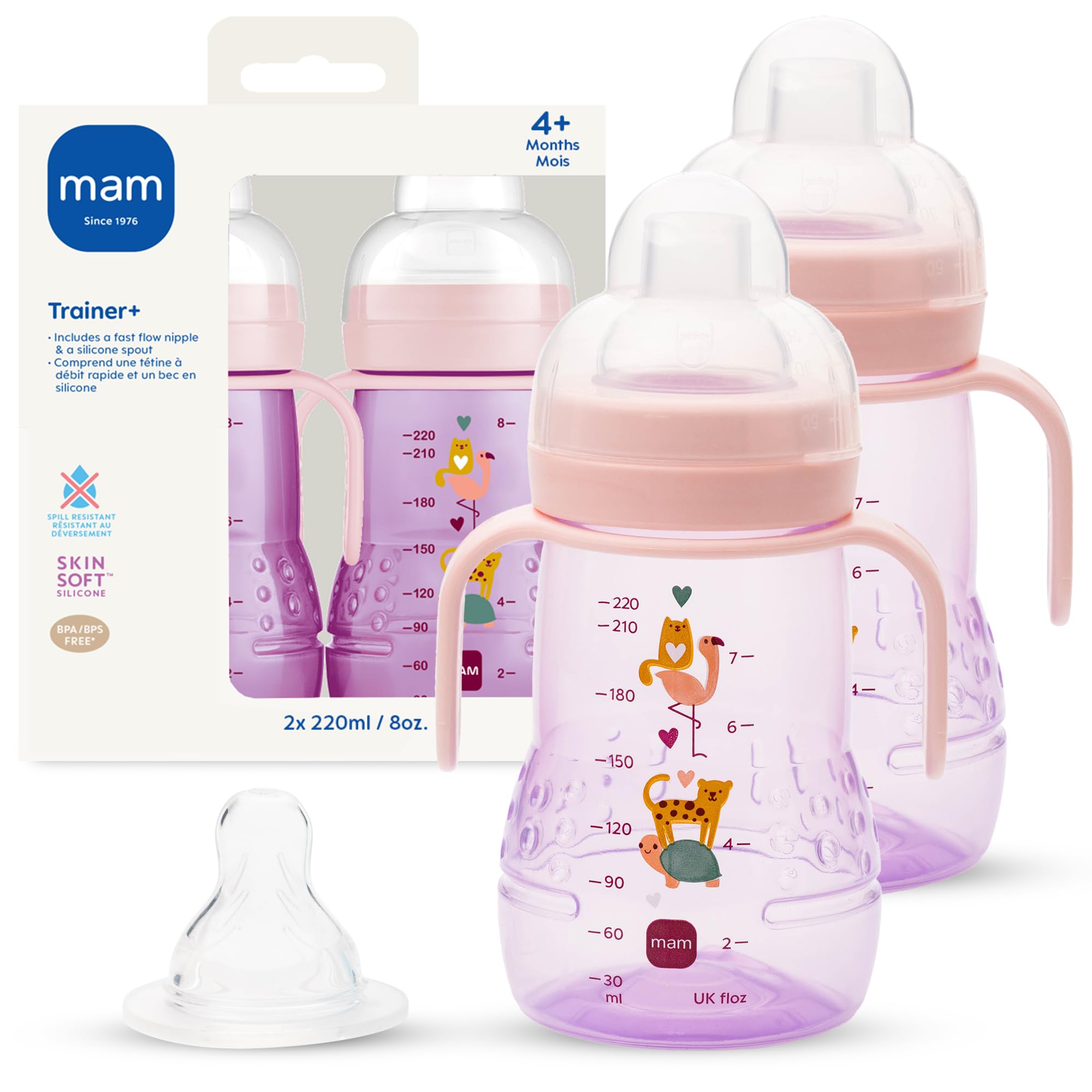
Key Features
- Handles: Non-slip
- Capacity: 8 oz
- Included: Nipple and trainer spout
- Age range: 4 months and up
- Price: Midrange
Four months is earlier than anything else here, and it tells you what this cup is: less a sippy cup than a bottle considering a career change. The box holds a spill-free nipple and an extra-soft trainer spout, and you swap one for the other when your baby is ready rather than buying a second product six weeks later.
That makes it the one we point to for the earliest stage. Two things we appreciate beyond the convertible top: the wide opening at the rim, which makes filling and washing genuinely quick, and the ounce markings down the side, so you can see how much actually went in rather than guessing from what’s left in the bottle.
Eight ounces is right for a baby this age, and the non-slip handles are sized for hands still working out grip. It isn’t a long-term cup — by the time your toddler is chasing a 360 rim, this one has done its job — and the handles and nipple are extra parts to keep track of in the drying rack.
Pros
- Converts from nipple to trainer spout
- Wide opening for filling and cleaning
- Ounce markings show how much was drunk
- Non-slip handles sized for babies
Cons
- Leaks if left fully upside down
We recommend it for the 4-to-9-month window: it starts as the bottle your baby knows and turns into a trainer without a second purchase.
Best for Preschoolers
Zak Designs Kelso

Key Features
- Capacity: 15 oz
- Age range: 3 years and up
- Pack size: 2 cups
- Drinking style: Silicone straw with valve
- Price: Midrange
This isn’t a training cup and Zak doesn’t pretend it is. The box says three and up, the tumbler holds 15 ounces, and the drinking method is a silicone straw with a valve built into it — which puts it in a different category from everything else in this guide.
The valve is what makes the straw useful rather than decorative: liquid comes up when your kid sucks and stays put when the cup goes sideways in a car seat. The straw is wide enough that a smoothie or a thick yogurt drink moves through it, which is not true of the narrow straws on most kids’ cups, and it doesn’t collapse when it gets chewed.
Fifteen ounces is the biggest capacity here, and the tumbler fits a car cup holder, so this is the cup that goes to preschool or into the bike bag rather than the one that lives on the highchair. Three pieces, all dishwasher safe, and the valve is built into the straw instead of floating loose in the lid where it can vanish down the drain.
For a three- or four-year-old who has outgrown sippy cups, this is the one we hand over: big enough that you aren’t refilling it every hour, steady in a cup holder, and built around the straw most kids already prefer. It’s not a starting point — a toddler who has never used a straw works harder for every mouthful — so treat it as the cup after the trainer, not instead of one.
Pros
- Biggest capacity here at 15 ounces
- Valved straw handles thick drinks
- Fits car cup holders
- Three pieces, dishwasher safe
Cons
- Straw stops about an inch short
- Printed graphics wear off quickly
We recommend the Kelso once your kid has left sippy cups behind: 15 ounces, a valve that survives the car, and a straw that handles real drinks.
Best for Budget Rim Practice
Dr. Brown’s Cheers360
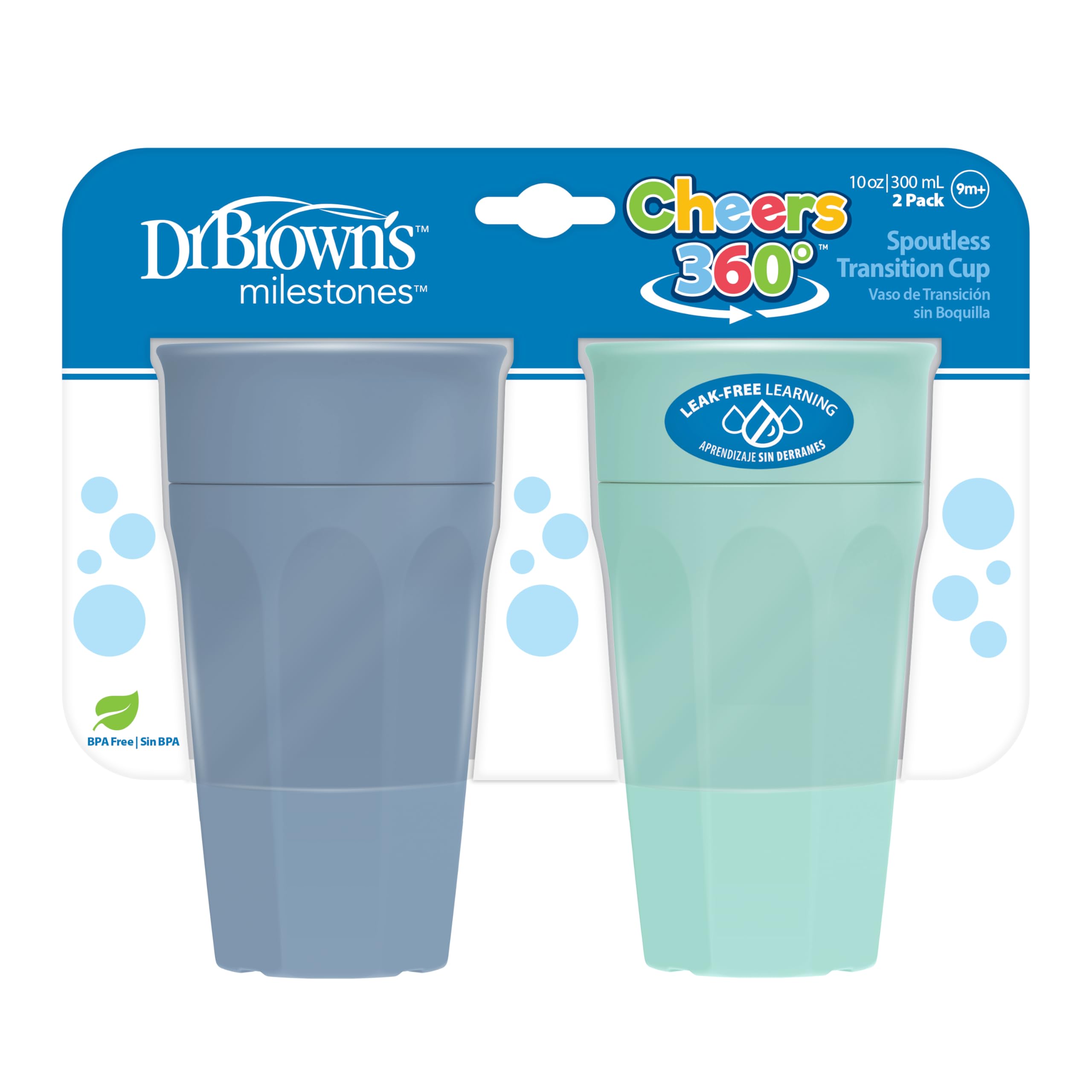
Key Features
- Valve: Removable, clear
- Capacity: 10 oz
- Age range: 9 months and up
- Drinking style: 360° spoutless rim
- Price: Budget
The clear valve is the idea here. Your toddler can see the liquid sitting in it, and — the part we like most — the valve lifts out entirely once they’ve outgrown the training stage, turning the cup into a plain open cup with a rim. That’s two cups in one, and it’s the reason this one stays in the cupboard longer than most.
That same valve explains the trade-off. It takes real suction. A toddler used to a free-flowing straw or a soft spout will pull, get a mouthful of nothing, and hand the cup back. Give it a week of daily offerings and most of them get there, but it is not the gentlest introduction to rim drinking we’ve come across in this set.
Cleaning is straightforward — three parts, top rack — and the two-cup pack puts it at the budget end of this guide. The clear valve comes out for washing, which is also how you check that it hasn’t stretched.
Our take: it’s a good second 360, not the first one. If your toddler already drinks from a rim cup, the removable valve makes this the more versatile of the two rim cups here, because it graduates to open-cup use. If they’ve never used one, start elsewhere and come back when they’ve got the suction worked out.
Pros
- Valve removes to make an open cup
- Clear valve shows the drink inside
- Three parts, top-rack dishwasher safe
- Budget price for two cups
Cons
- Lid can be stiff to unscrew after washing
We recommend it as a second 360 for a toddler who has the suction down: the valve lifts out to make a genuine open cup.
How We Tested the Best Sippy Cups
We started by pulling every sippy cup from major retailers and registry lists, then narrowed the field by size range, lid style, replacement-part availability, and price per cup. That left 16 cups, which we tested for four months with three families on our team, including kids from 9 months to 3 years old.
Each cup went through morning milk, afternoon water, and a nightly wash. We packed them in strollers, car seat cupholders, and diaper bag pockets; sent them to daycare; and left milk in them for a full day to see what came back. To check leak-proofing, we filled each cup, turned it upside down, shook it, and left it on its side in a bag for an hour. For durability, we dropped them from high chair height onto tile and ran each through the dishwasher repeatedly, checking lids for cracks and spouts for chew marks.
Cleaning was its own test: we disassembled every valve and straw, washed by hand and in the dishwasher, and looked for milk residue in the crevices. We also watched how hard a toddler had to suck, whether the straw reached the bottom, and whether the flow was too fast or slow. Along the way we checked size against car seat cupholders, stroller pockets, and small hands; compared price per cup and whether replacement parts were sold separately; and noted fading or scratches after repeated washes. A cup only made the list if a 1-year-old could get the lid on straight and drink without help—and if it still looked presentable after a month of real use.
How to Choose a Sippy Cup
The most useful thing to know about sippy cups is that spill-proof describes a valve, not a promise — nearly every leak starts with a valve that isn’t pushed fully home or a cup filled past its line.
Start with the drinking style, not the character
Every cup here uses one of four methods, and the method decides what your child learns. A soft spout (the NUK Learner, the MAM) is the closest thing to a bottle and the gentlest weaning tool. A hard spout (the NUK First Choice, The First Years) survives chewing but teaches little beyond tipping. A 360 rim (both Munchkin cups, Dr. Brown’s) rehearses real-cup drinking. A straw, like the Zak, is efficient and travel-friendly but usually comes later.
If you’re buying one cup for a 12-month-old, pick a rim or a straw. At 9 months, start with a soft spout and handles, and keep the spout cup as a stage rather than a permanent fixture.
What spill-proof actually means
Three things break the seal on any of these cups: a valve that isn’t pushed fully home after washing, a cup filled past its line, and pressure from a warm drink or a cup left in a hot car. That’s why the same cup can be dry for one family and a puddle for another — it is usually assembly and fill level, not the cup.
Fill to the line, seat the valve every time you reassemble after washing, and test a new cup with water over the sink before it goes anywhere near a diaper bag.
Size, capacity, and how many to buy
Capacity should follow age rather than appetite. Eight ounces is plenty under a year, as on the MAM. Nine to ten ounces covers the 1-to-3 window most of these cups are built for, and 15 ounces, as on the Zak, suits a preschooler who drinks a lot and refills rarely.
Buy at least two of whatever you choose, and three if daycare is involved: one in use, one in the wash, one in the bag. Light cups tip more easily; a stainless body sits steadier but dents when it lands badly.
Parts, cleaning, and what wears out first
Count the pieces before you buy. A cup with three parts — body, lid, valve — gets washed; a cup with five gets left in the sink. Everything recommended here is top-rack dishwasher safe, but the dishwasher is also what slackens silicone over time, so check the valve fit every month or so.
A cup that starts weeping at the seam after a few months usually needs a new valve rather than a replacement. Bite marks on a soft spout are the other signal: that’s the cup telling you it’s time for a hard spout or a rim.
Insulated or plain: is it worth paying for?
Insulation buys time, not magic. Double-wall plastic, as on The First Years, keeps a drink cooler than a single wall through a morning out. Vacuum-sealed stainless, as on the Munchkin 360, keeps it cold for hours and never sweats onto the table, which matters inside a diaper bag. The trade-offs are weight, denting, and price per cup.
If your toddler drinks water at home and you’re never far from a tap, plain plastic is the sensible buy. Save the insulated cup for days when the drink has to last.
Frequently Asked Questions
When should I move my baby from a bottle to a sippy cup?
Most families start somewhere between 6 and 9 months, once a baby can sit up and hold a cup with both hands. A soft-spout trainer with handles is the usual first step; the MAM cup is rated from 4 months if you want to begin with its nipple and convert later. A 360 rim or straw cup usually comes around 12 months.
The practical move is to offer water in the cup at snack time and keep the bottle for milk for a few weeks, rather than switching everything on the same day.
How do I get a toddler to actually use a sippy cup?
Start with the cup that matches what they already do. A baby who takes a bottle accepts a soft spout fastest, especially from the same brand — which is exactly what the NUK Learner and the MAM are for. Offer the cup when your child is calm and a little thirsty, not starving, and put water in it rather than milk.
Don’t make the bedtime bottle the first one you drop, and leave the cup within reach for a week. Familiarity does more than any technique.
Are sippy cups bad for a toddler’s teeth?
The cup matters less than what’s in it and how long it sits there. A spout that pools liquid against the front teeth is the shape to move past, which is why a 360 rim or a straw cup is worth the upgrade once your child can manage one.
Keep water in the cup between meals, save milk for mealtimes, and treat a spout cup as a step rather than a destination — plan to move on within about a year of starting.
Final Verdict
For most families the Munchkin Miracle 360 is the cup we recommend: it teaches rim drinking rather than a spout habit, it seals between sips, and three parts are easy to face at nine in the evening. Fill it to the line and it stays dry through an ordinary day.
Change the requirement and the pick changes. If spills are the thing you can’t live with, the NUK First Choice holds its seal best and takes chewing in its stride. If you’re weaning a 9-month-old, start with the NUK Learner and move up when the biting starts.
