This post contains affiliate links. We may earn a small commission when you buy through our links — at no extra cost to you.
The two-minute standoff at the bathroom sink usually isn’t about toothpaste. More often it’s the brush itself: a head too wide for a small mouth, bristles that scratch, a handle that slips out of a wet toddler hand. A kids’ toothbrush that actually fits is the difference between a child who tolerates brushing and one who grabs the brush themselves — and that’s the thing worth shopping for, not the cartoon on the package.
I’ve watched two kids go through the wobbly-handed stage, and the flashy features matter far less than fit. Over the past four months, my team and I have had 14 kids’ toothbrushes in daily rotation, manual and electric, toddler-sized through big-kid, and the pattern was consistent: the ones kids reached for were the ones that fit their mouths and hands without a fight. One thing I wish I’d known earlier — the age printed on the package is a rough guess at best; hold the head next to your kid’s back molars and let that decide. The brushes below earned their spot at our sink.



Best for First Toothbrush
Dr. Brown’s Giraffe Toothbrush
Key Features
- Handle: Soft comfort grip
- Weight: 1.06 oz
- Bristles: Super-soft
- Recommended age: 0-3 years
- Price: Budget
We recommend the giraffe for one reason above the others: it is built to be chewed. A baby working on a first tooth does not brush so much as gnaw, and this one gives them a whole molded body to gnaw on at the wrong end while the bristles do their work at the right one. The soft comfort-grip handle takes a whole fist, which is what a nine-month-old brings to the job, and at about an ounce the brush is light enough for them to wave around and long enough for you to reach the back of the mouth.
The bristles are genuinely soft, soft enough that an adult would find them insubstantial. That is the point at this age. The head is small, so it slips under a lip and behind a first molar without setting off a gag. What we noticed is how little negotiating it takes: the brush is already in the mouth before the argument starts, because the giraffe is a toy that happens to clean teeth.
Two practical notes. The legs are molded so the brush stands up on a shelf, which keeps the head off whatever was last wiped across the counter, though it is not a suction base and a knock will send it over. And the whole brush is replaced rather than the head, so a chewed-up giraffe means a new giraffe, which is worth knowing at a stage when everything ends up in a mouth.
Pros
- Molded body works as a teether
- Super-soft bristles for new teeth
- Comfort grip sized for small fists
- Light at just over an ounce
Cons
- Covers only the 0-3 stage
For a first tooth we recommend the giraffe without reservation: the bristles are soft enough for new gums and the molded body is soft enough to chew, which is what a baby does with it anyway.
Best for Toddlers 1-4
Dr. Brown’s Dino 2-Pack
Key Features
- Base: Suction cup
- Bristles: Super-soft
- Pack size: 2 brushes
- Recommended age: 1-4 years
- Price: Budget
The suction cup on the bottom is the reason these beat a plain manual brush, and it is a small, twice-a-day kind of win: press the brush onto tile or a mirror and it stands upright, head up and off the counter. It wants a smooth, glossy surface and a firm press. The cup is smaller than it looks, and a textured or matte ledge gives it nothing to hold.
On the brush itself, we are won over by the shape. The dino body is easy for a one- or two-year-old to palm, the super-soft bristles suit gums that are still moving teeth around, and the head sits at a slight offset from the handle, a detail that feels odd for the first session when you are the one brushing and then stops mattering entirely. Green and orange also settle the which-one-is-mine question before it starts.
Buying two is the sensible way to use this brush: one at the sink, one in a bag or at a grandparent’s house, and a spare already in the drawer when the first goes soft. At this age a toothbrush is a consumable, not an heirloom, and the two-pack gets that arithmetic right.
Pros
- Suction base keeps it off the counter
- Dino shape suits small hands
- Super-soft bristles for sensitive gums
- Two brushes, one always dry
Cons
- Bristles can splay within a few weeks
These are the toddler brushes we reach for when a child wants to hold the brush themselves: a suction base, a chunky dino body, and a two-pack that keeps a spare dry.
Best for First Electric
Oral-B Kids Spider-Man
Key Features
- Head: Rotating power head
- Power: 1 AA battery (included)
- Bristles: Extra-soft
- Recommended age: 3 and up
- Price: Midrange
There is no charging dock to lose with this one, and in a bathroom where the sockets are already contested that counts for more than it sounds. It runs on a single AA, included, so a dead brush is a two-minute fix from the kitchen drawer rather than an evening on a base. The Disney MagicTimer app is there if your child lights up at a screen; it is a bonus, not the reason to buy.
The head does the real work, and it is what you are paying for: a rotating power head that sweeps around the surfaces of a tooth rather than buzzing against them, with a raised center row of bristles that reaches the pits in the chewing surfaces of molars. For a child moving up from a manual brush, this is the powered one we recommend, because it does the part they cannot.
Spider-Man is the bribe, and he is doing his job if a four-year-old opens up to have a look at him. The extra-soft bristles mean it cleans no harder than a good manual brush, so what you are buying is motion, not force. Give it a week before deciding they hate it, because a child who clamps down on the head feels every one of those rotations.
Pros
- Rotating head reaches chewing surfaces
- Extra-soft bristles as gentle as manual
- AA battery, no charging dock
- Character buy-in for a reluctant kid
Cons
- Brush head runs large for 3-year-olds
- Battery life can fall short
Our pick for a first powered brush: a rotating head that reaches the chewing surfaces, extra-soft bristles, and one AA battery instead of a dock.
Best for Bluey Fans, 2+
Colgate Kids Bluey 2-Pack
Key Features
- Base: Suction cup
- Extras: Tongue cleaner
- Bristles: Extra soft
- Recommended age: 2 and up
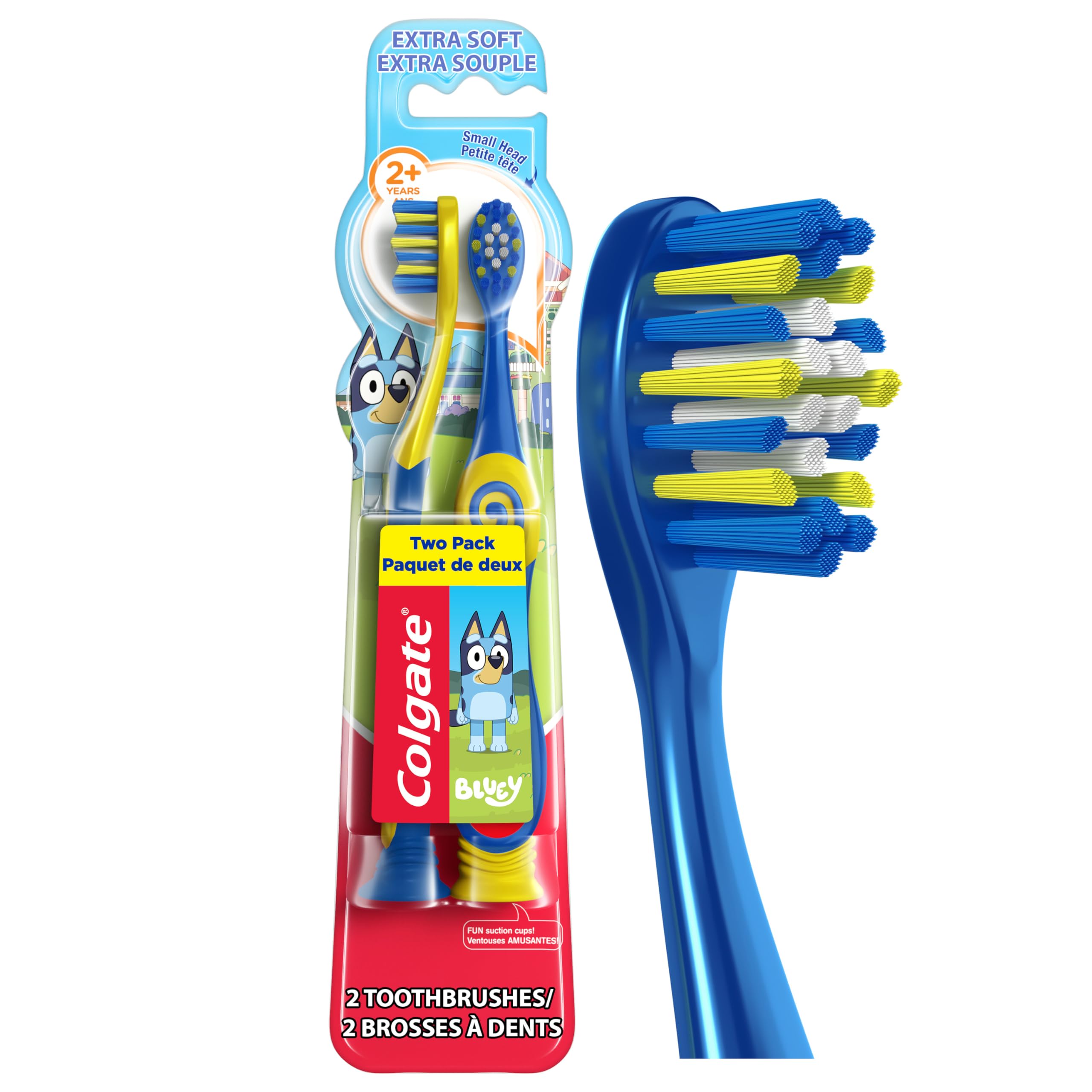
Bluey is doing more work here than any feature on the packaging, and that is fine by us. A two-year-old who will not open for a plain brush will open for a blue heeler, and once the mouth is open the brush underneath is a perfectly good toddler manual: extra-soft, multi-height bristles, a slim handle, and a suction base that parks it upright on the sink. What we appreciate most is the tongue cleaner molded into the back of the head. Most brushes at this level skip it, and it gives you something useful to do with the last few seconds of a session.
The two-pack is the right shape for how these get used, one at the sink and one in the travel bag, and the bright handle means a toddler can pick theirs out of the cup. The suction base is strong enough to hold on vertical tile, which is more than some of the cups in this guide manage. As a way to end the standoff at the sink, it is the easiest recommendation we can make.
Pros
- Character that gets toddlers brushing
- Tongue cleaner on the back of the head
- Suction base holds on vertical tile
- Extra-soft multi-height bristles
Cons
- Head and bristles can come apart early
If a character is what gets your toddler to open up, this is the one to buy: a genuinely good soft brush hiding behind a blue heeler.
Best for Budget Electric
Colgate Kids Minecraft Battery
Key Features
- Head: Small vibrating head
- Power: 1 AA battery (included)
- Bristles: Extra soft
- Recommended age: 3 and up
- Price: Budget
A round handle rolls. That is a small problem until you are holding a squirming three-year-old with one hand and trying to land a ribbon of toothpaste with the other, which is why the flat handle on this one is the detail we like best: set it down and it stays where you put it, bristles up.
The head is small, noticeably smaller than the Oral-B’s, and the vibration is gentle enough to read as a tickle rather than a scrub. Extra-soft bristles keep it as kind to gums as the manual brushes here, and the included AA means it is running the moment it comes out of the pack. For a three-year-old that combination is the whole point: small, soft, and slow enough not to be frightening.
As a first powered brush, this is the one we hand to a family testing the water: a small head, a gentle motor, and no dock to find a socket for. What it will not do is brush for them, and that is true of everything here, since the vibration is a nudge to keep moving rather than a substitute for a parent finishing the back corners. If you want real rotation, step up to the Oral-B; if you want to find out whether your child tolerates power at all, start here.
Pros
- Flat handle will not roll away
- Small head suits younger children
- Gentle vibration that does not irritate
- AA battery included and replaceable
Cons
- Vibrates rather than rotates
The sensible first electric for a three-year-old: gentle, small-headed, and modest enough in price that it does not sting if they reject it in a month.
Best for Covered Storage
Firefly Sonic the Hedgehog

Key Features
- Head: Compact rotary head
- Cover: 3D hygienic cover
- Bristles: Premium soft
- Recommended age: 3 and up
- Price: Budget
The cover is the reason to pick this one over the other battery brushes here. A molded Sonic head clips over the brush head and keeps it off the shelf, off the counter, and away from whatever else is rattling around in a travel bag. It is the only brush in this group that arrives with somewhere to put itself.
Under the cover it is a compact rotary brush with a kid-sized head, an AA battery included, and enough oscillation to feel like it is doing something. The Sonic graphics are as loud as a six-year-old wants them to be, and the handle is textured for wet hands.
Buy it for a shared bathroom or a kid who carries a brush to school and back, where a covered head is worth more than a smarter motor. Buy it somewhere with an easy return, and clip the cover on before the first trip rather than after.
Pros
- Cover keeps the head clean between uses
- Compact rotary head for small mouths
- Character that encourages brushing
Cons
- Motor can stop working within weeks
A compact rotary brush with a cover that keeps the head clean between uses, and the best choice here for a shared bathroom or a school bag.
Best for Kids 3-10
Trueocity Kids 4-Pack

Key Features
- Base: Suction cup
- Bristles: Soft
- Pack size: 4 brushes
- Recommended age: 3-10 years
- Price: Midrange
Four brushes in four colors only matters in a house with more than one child, and in that house it matters every single morning: nobody’s brush gets used by the wrong kid, and nobody has to remember whose is whose before the coffee.
The build is aimed at small hands: a thick, slightly tacky handle a two-year-old can hold in a fist rather than a pinch, soft bristles, and a suction cup underneath that parks the brush on the sink. Each one comes with its own protective cover, which is the detail that makes them work in a school bag and on a shared shelf.
Four is also the right number. At the three-month replacement pace dentists recommend, one child gets a year from a pack, and two children get six months plus a spare for the car. That is the arithmetic that makes these worth buying, and the per-brush cost stays sensible for something you are meant to throw away.
Where these earn their place is in a household running two or three children through the same routine: one purchase, four colors, covers for the bags, and a spare in the cupboard when someone drops theirs in the sink. A single child is better served by one of the two-packs here, which leaves you a spare without four brushes crowding the cup.
Pros
- Four colors stop the daily mix-up
- Suction base and a cover each
- Covers a year of replacements
Cons
- Head runs large for small mouths
Four soft brushes in four colors: the simplest way to keep two or three children supplied, color-coded, and covered for the school bag.
Best for Multipack Value
GuruNanda Kids 4-Pack

Key Features
- Base: Suction cup
- Extras: Tongue cleaner
- Bristles: Soft big tuft
- Recommended age: 3 and up
- Price: Budget
By cost per brush, nothing else here comes close, and that is the honest headline: a four-pack of soft, suction-based kids’ brushes for less than the price of one powered one. What it buys you is spares, one at the sink, one in the downstairs bathroom, one in a bag, one in the cupboard.
The bristles are the unusual part. Instead of a conventional bristle field, each head carries one broad tuft of soft bristles, which feels forgiving against gums and sweeps the flat surfaces of small teeth well. We found it kind rather than thorough, and for a child who clamps down or has sore gums from teething, kind is the more useful property.
The handle is non-slip and easy for a three-year-old to hold, and the suction cup does what a suction cup should on a smooth sink: press it down and the brush stays upright and off the counter. The tongue cleaner on the back of the head is a bonus at this price, and the bright characters mean a child picks their own out of the cup.
From three up, with an adult doing the back corners, we are happy to recommend it, as the brush in the downstairs bathroom, the vacation bag, or the drawer kept for sleepovers, where a decent cheap spare beats an expensive one that is never where you need it. It is the pack we restock with rather than the one we reach for every night.
Pros
- Lowest cost per brush here
- Broad soft tuft is gentle on gums
- Suction base and tongue cleaner
- Bright characters kids pick themselves
Cons
- Head is a mouthful for toddlers
- Suction cup is fussy on textured surfaces
The spare-everywhere pick: soft bristles, a suction base, and the lowest cost per brush here, which matters when a brush is a three-month consumable.
How We Tested Kids’ Toothbrushes
We started with the full wall of kids’ brushes at our local stores plus the most-reviewed options online, then filtered by head dimensions, stated bristle softness, handle size, replacement-head availability, and price. Fourteen made the cut, spanning manual and electric, toddler brushes for first teeth and larger ones for kids with molars coming in.
Testing ran four months across two households with kids aged 1 to 8, brushed twice a day as part of the normal morning rush and bedtime routine. We noted which brushes kids picked up on their own, how readily a 2-year-old accepted the head, and whether anyone gagged when the brush went toward the back teeth.
Along the way we dropped each brush onto tile from counter height, let the chewers chew, and checked bristles after four weeks for splaying and bent tips. We ran the bristles across the back of our hands to feel for scratchiness, and on electric models we checked whether the bristles kept moving when a child bit down, how long batteries held, and whether the buttons were easy for small wet hands to press without switching on by accident.
How to Choose a Toothbrush for Kids
The brush that works is the one that fits the mouth being brushed and the hand holding it, so treat the age on the box as a starting point rather than a rule.
Fit the head to the mouth, not the age on the box
Age ranges on kids’ brushes run from 0-3 to 3-10, and they overlap so widely that they tell you less than the head does. A head that is too big cannot angle into the back corners behind the molars, and a child who gags once remembers it. Before you commit, hold the brush next to your child’s mouth: the head should look small against their back teeth, roughly the width of two of them.
This is where the packs here split. The Dr. Brown’s and Colgate toddler brushes have slim heads that suit a two-year-old, while the Trueocity and GuruNanda heads are fuller and work better on a three- or four-year-old than on a child still cutting molars.
Soft bristles, and how long they last
Soft or extra-soft bristles matter more than any other specification at this age, because gums that are moving teeth around are easy to irritate. The trade-off is durability. The softer the bristles, the faster they splay, and a head that looks like a mushroom after a month is finished, however gently it started.
Dentists recommend a new brush every three months regardless. We check the head weekly and replace it when the bristles lean instead of standing. If that pace sounds like a lot of brushes, buy multipacks: several picks here make more sense as a supply than as a single purchase.
Manual, battery, or rechargeable
A manual brush is enough for most children under three, and it is the one you can hand over without worrying about technique. Battery brushes sit in the middle: one AA, no dock, and a small head that does some of the work for a child still learning. They are also the least risky way to find out whether your child tolerates power at all.
The trap is the word powered. Some kids’ brushes only vibrate while others rotate, and the two feel completely different in the mouth, so check which one you are buying before you promise a spinning brush. Rechargeable models cost several times more, and that outlay makes sense once you know a child will use one twice a day without a fight.
Getting a reluctant child to open up
Half of this purchase is dentistry and half is negotiation. A character your child loves this month is worth more than a better brush they refuse to put in their mouth, which is why the Bluey and Spider-Man brushes earn their places here rather than being novelties we tolerate.
Novelty fades, so keep a second brush with a different face on it in the cupboard and swap when enthusiasm dips. Buy for the child you have now: the brush they will actually use beats the one with the better specification sheet every time.
Frequently Asked Questions
How do I brush my toddler’s teeth when they won’t open their mouth?
Give them a brush of their own to hold and chew while you use the second one. The two-brush swap works because the child is busy rather than restrained. Sit them on your lap facing away from you, or stand behind them, and brush in the same order every night so the routine is predictable. Do the back corners last, and stop before they decide they have had enough.
My child chews the toothbrush instead of brushing. Is that a problem?
Chewing is normal, especially while molars are coming through, and it is why the same brush holds up so differently from one child to the next. Chewing ruins bristles faster than brushing does, so check the head weekly and replace it once the bristles lean rather than stand. If your child mostly chews, let them get it out of their system and then do the real brushing yourself.
How should we store a kids’ toothbrush between uses?
Rinse it, shake it out, and stand it up to air-dry with the head clear of everything else. A suction base or a cup does that better than laying the brush on the counter. Do not seal a wet head inside a cover: let it dry first, then cap it for travel. A brush that stays damp and capped is the one that gets unpleasant.
Final Verdict
Start with the Dr. Brown’s giraffe. Through the first year it is soft enough for new gums, shaped for a baby’s fist, and sturdy enough to be chewed, which is what actually happens to it. Move to the dinosaur two-pack once your child wants to hold the brush themselves, and to the Oral-B Spider-Man once they are past three and have a mouth that can take a rotating head.
If a character is the only thing that ends the standoff at the sink, hand over the Bluey two-pack and consider the argument closed.
