This post contains affiliate links. We may earn a small commission when you buy through our links — at no extra cost to you.
Somewhere between the third reminder and the toothpaste on the mirror, brushing stops being a routine and becomes a negotiation. A kids electric toothbrush won’t win that argument alone, but the right one tips it: a head small enough to reach a 6-year-old’s back molars, a timer that does the nagging for you, and a grip that survives wet hands. Over the past four months, my team and I have put 14 brushes through morning and bedtime duty with kids ranging from toddlers to a very opinionated 9-year-old.
The surprises were rarely in the specs: one brush buzzed so hard my 4-year-old tester clamped her mouth shut, and another died three days into a week. The ones that stayed in the cup were the ones my testers reached for unprompted, which matters more than any feature list, because a refused toothbrush cleans nothing. And nobody warns first-time buyers that replacement heads can cost more over a year than the brush itself. The picks below earned their spot on the counter.


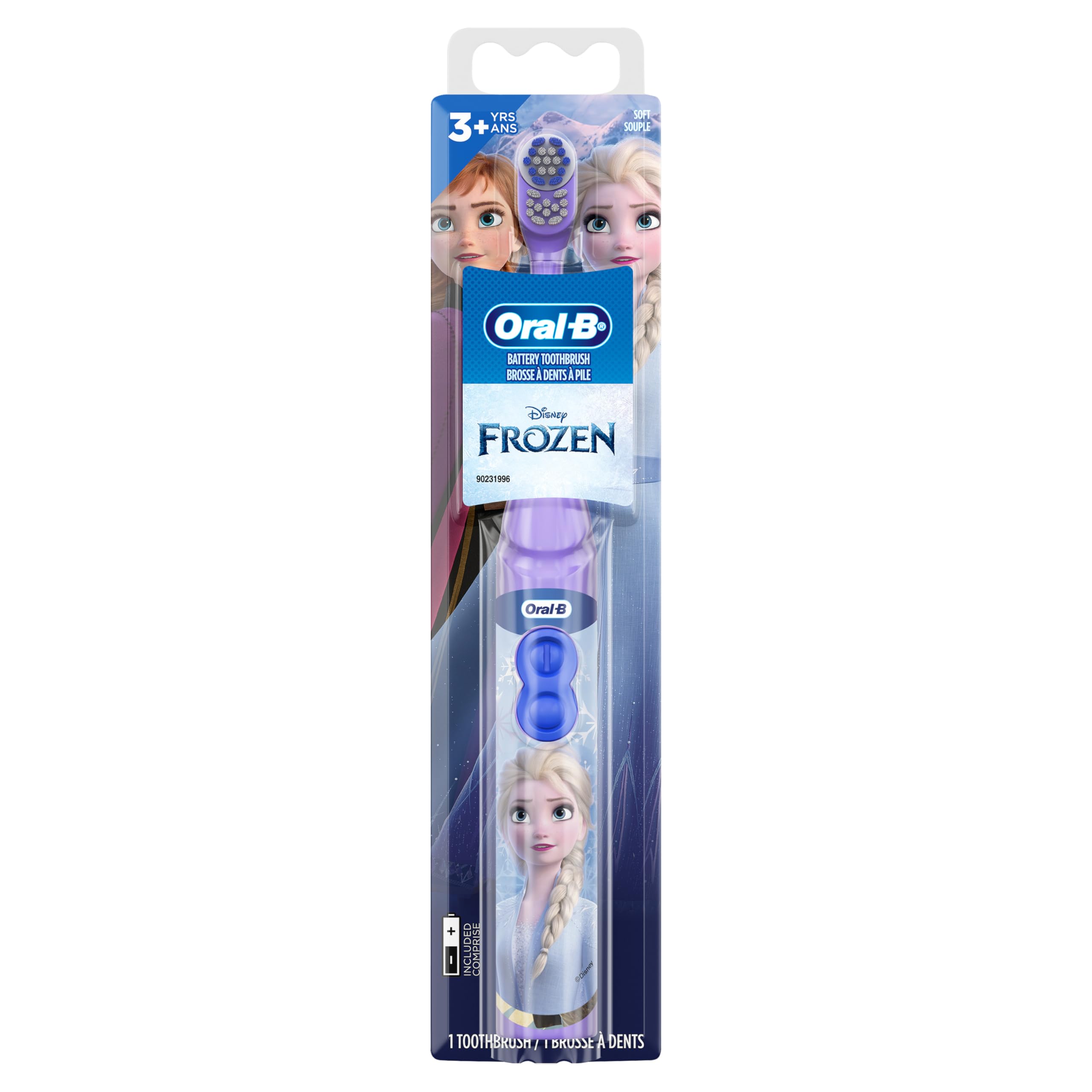


Best for Most Families
Philips Sonicare for Kids
Key Features
- App: Parent dashboard and rewards
- Power: Rechargeable
- Age range: 3 and up
- Sonic action: 500 strokes per second
- Price: Premium
What puts this brush at the top of our list is the app rather than the motor. Pair the handle with the free companion app and the two minutes become a job with a payoff at the end: the child brushes, the virtual pet gets fed, and the parent dashboard quietly logs how long and how often. The part we didn’t expect to care about is that log. Looking back over a week and seeing that Tuesday and Thursday were short sessions tells you more about technique than any cartoon character can.
The hardware earns its place too. Philips quotes 500 sonic strokes a second and 75% more effective cleaning than a manual brush in the hard-to-reach spots; every box in this category carries a claim like that, and what actually matters is that the head is small enough to sit on a six-year-old’s back molars without a fight and the handle fits a child’s grip without being a fat imitation of an adult brush. The 3+ age floor is honest rather than cautious — a two-year-old will find this a mouthful, and the Papablic below is the better answer for that mouth.
It sits at the top of the price range here, and we think that’s where it belongs. The app is the only thing in this group that gives a resistant child a reason to keep going to the end of the two minutes, and the dashboard is the only thing that tells you whether the habit is forming. If your child already brushes without a fight, save the money and take the Oral-B pack or the Colgate. If brushing is a nightly negotiation, this is the one that ends it.
Pros
- App gives kids a reason to finish two minutes
- Parent dashboard logs time and frequency
- Small head reaches a child’s back molars
- Rechargeable, so no battery drawer
Cons
- Can stop running after about a year
- Rewards depend on a phone in the bathroom
Our pick for most families: the app gives a reluctant child a reason to finish the two minutes, and gives you a record of whether they did.
Best for Under-Threes
Papablic Baby Sonic
Key Features
- Timer: 2-minute with 30-second pulses
- Age range: 1 month to 3 years
- Brush heads: Baby 1–18 months, toddler 18–36 months
- Sonic action: 18,000 vibrations per minute
- Price: Budget
Most brushes sold as kids’ brushes are sized for a five-year-old, which is no help at all when the mouth in question holds a handful of teeth and belongs to someone who is still mostly gums. Papablic builds for that mouth. The set includes two heads — one for 1–18 months, one for 18–36 months — and the whole handle weighs just over two ounces, so a one-year-old can hold it without you steering.
The light is the feature we didn’t expect to lean on as much as we did. It’s bright enough to show you the back of a small mouth while the brush is in it, which is the difference between brushing properly and hoping. The 18,000 gentle vibrations read more like a massage than a scrub, and the 2-minute timer with a pulse every 30 seconds means the pacing happens without a parent counting out loud. It shuts itself off at the end, which matters when the child has already lost interest.
What sold us is that it doesn’t pretend to be a big-kid brush. It’s slow, soft and small, and a child who has already rejected a Sonicare on size alone will take to it, which makes it the one we reach for in this age group. It’s also the only set here whose two heads cover the whole 0–3 stretch, so you’re not buying refills before your child can talk.
Pros
- Two heads sized for 1–18 and 18–36 months
- Light shows the back of a small mouth
- 2-minute timer with 30-second pulses
- Just over two ounces; easy for tiny hands
Cons
- Outgrown by age three
- Brush heads can snap at the stem
If your child is under three, this is the brush we start with — small enough for a mouth holding a handful of teeth, gentle enough that it doesn’t start a fight.
Best for Multiple Children
Oral-B Kids 4-Pack
Key Features
- Head: Rotating with raised center row
- Bristles: Extra soft
- Pack size: 4 complete toothbrushes
- Characters: May vary
- Price: Premium
Four complete toothbrushes for less than one of the rechargeable models here is the kind of arithmetic that makes a parent look twice, and the pack holds up beyond the price. Each one is a proper brush with a rotating head rather than a vibrating handle, extra-soft bristles, and a raised center row aimed at the chewing surfaces where decay starts. The Disney MagicTimer app works alongside them if you want a character counting the two minutes on a phone.
We think of this as the household pack: one per child, one in the suitcase, one at the grandparents’. There’s no dock to lose and nothing to remember to charge, which in a busy bathroom is a feature in itself. The trade is size — the head is on the large side, so a small three-year-old may find it a mouthful while a five- or six-year-old will get along with it fine. Past the toddler stage, it’s the best value in the group.
Pros
- Four complete brushes in one pack
- Rotating head with raised center row
- Extra-soft bristles for young gums
- Nothing to charge or lose
Cons
- The character inside isn’t guaranteed
We recommend the four-pack to anyone brushing more than one child: four working brushes, no chargers to lose, at the price of a single premium handle.
Best for Tight Budgets
Colgate Kids Batman
Key Features
- Head: Small vibrating head, extra-soft bristles
- Power: 1 AA battery (included)
- Weight: 2.4 oz
- Age range: 3 and up
- Price: Budget
The Batman handle is doing a lot of the work here, and we don’t mean that dismissively. For a four-year-old who has decided that brushing is something that happens to him rather than something he does, a brush with a face on it is a way in. It also happens to be the lightest brush in this group at 2.4 ounces, on a slim handle that small hands close around properly instead of gripping like a hammer.
What we appreciate is that it doesn’t overreach. One AA battery, one button, extra-soft bristles and a head that is genuinely small — which is the thing inexpensive kids’ brushes most often get wrong. It isn’t pretending to be a dental instrument. It’s trying to be a brush a three- or four-year-old picks up without a scene, and at the bottom of the price range it does that better than anything else here.
The battery sits in a tight compartment that takes a deliberate turn to open, which in a house with a two-year-old is worth more than any feature on the box, and it lasts long enough that we stopped thinking about it. Give it to the child who keeps borrowing an older sibling’s brush, or the one who needs a second brush at the other house. At this price you can keep one in each bathroom and not mourn when it goes missing.
Pros
- Genuinely small head for small mouths
- 2.4 ounces with a slim grip
- One AA battery, one button
Cons
- Vibration only; the head doesn’t rotate
Our budget pick, and not a grudging one: a genuinely small head, a light handle and a character that gets a three-year-old to the sink.
Best for Ages Two to Six
Dada-Tech Kids Electric
Key Features
- Timer: 2-minute with 30-second quadrant prompts
- Lights: Rainbow LED plus white inspection light
- Age range: 2 to 12
- Sonic action: 24,000 vibrations per minute
- Price: Midrange
The rainbow lights are what gets a child to pick it up; the white inspection light is what keeps a parent using it. Switch to inspection mode and you get a proper look at the molars at the back, which is exactly where brushing gets missed and where a small head earns its keep.
Underneath the lights it’s a 24,000-vibration sonic brush with a 2-minute timer and prompts every 30 seconds to move to the next quarter of the mouth, so the routine is built in rather than narrated. It’s rated for ages 2 to 12, which is generous: the head suits the younger end of that range, and a twelve-year-old will want an adult brush.
One thing worth knowing before it goes on a bedside table: these can switch themselves on unprompted, and a buzzing toothbrush in the middle of the night startles the whole house. It doesn’t affect the cleaning, but keep it in the bathroom and check it’s off before you put it away.
Where it lands for us is the middle of the market: it gives you the two things that actually change behaviour — a light you can see with and a timer that paces the quadrants — without an app or a premium price. For a child between two and six who is still learning the routine, that’s a sensible place to spend. If you want a record of whether the brushing happened, you need the Sonicare instead.
Pros
- White inspection light shows the back teeth
- 2-minute timer with quadrant prompts
- Rainbow lights get a reluctant child started
- Rated for ages two to twelve
Cons
- No rechargeable version; batteries are the running cost
We point parents here when they want lights and a timer without an app — a mid-price brush that does the pacing for you.
Best for Bathroom Routine
Brusheez Kids Set
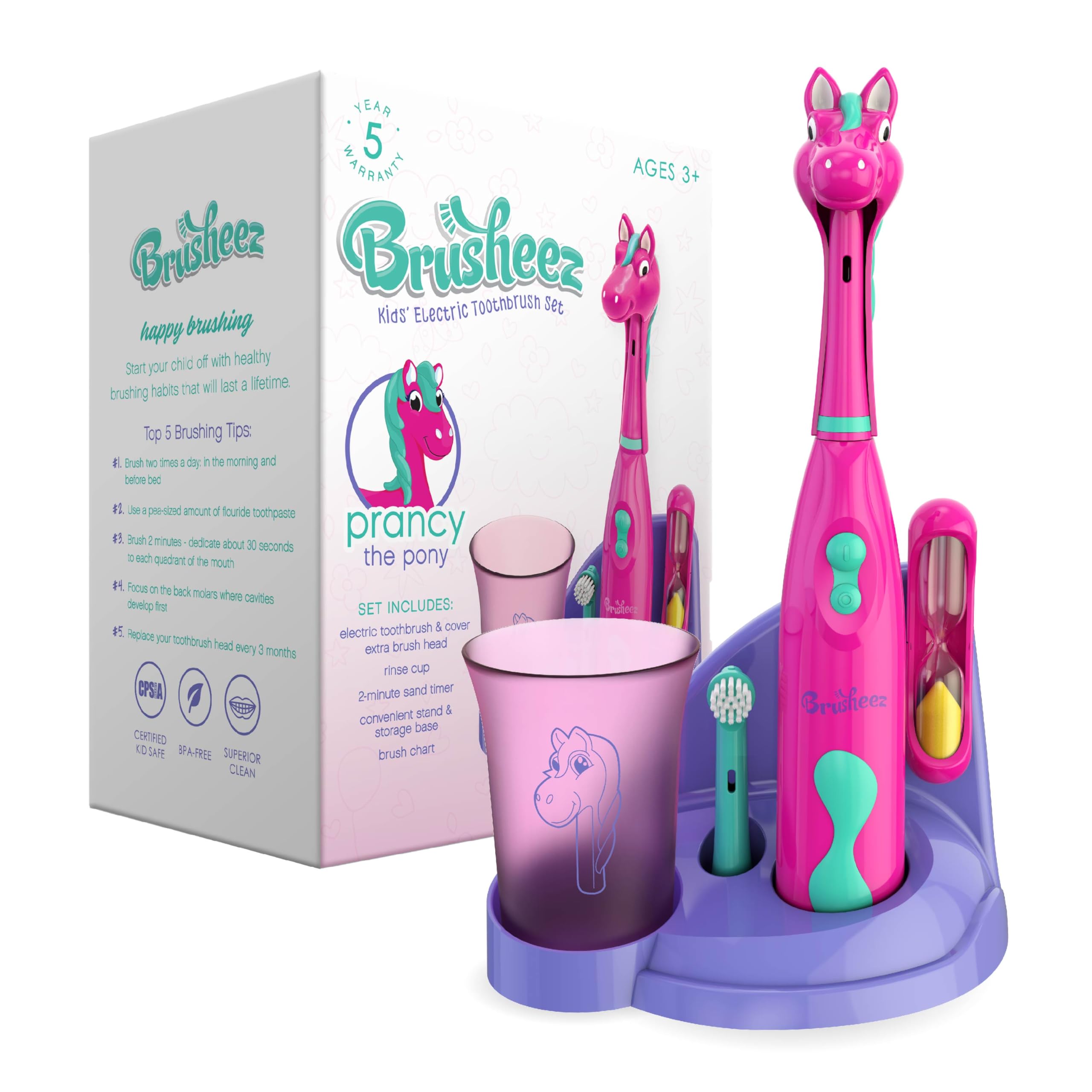
Key Features
- Power: Battery powered
- Timer: 2-minute sand timer on the stand
- Age range: 3 and up
- In the set: Brush, cover, extra head, cup, stand, timer and chart
- Price: Midrange
Brusheez sells a ritual more than a motor: a character-handled brush, a matching cover, a rinse cup, a stand, an extra head, a printed chart and a two-minute sand timer that lives on the stand. Set the whole thing up on the bathroom counter and brushing becomes a small ceremony with a beginning, a middle and an end, which is more than most brushes here manage.
The sand timer is the smart part. It’s a physical object a child flips themselves, it needs no battery or app, and it runs for two minutes without a beep — a small thing, but it gets taken more seriously than a countdown on a phone. The chart and stars are the other half of it: two stars a day for remembering, which is a reward system that doesn’t depend on a screen.
As a brush it’s ordinary — a battery-powered head that buzzes rather than rotates, with bristles on the soft side. As a system for a four-year-old who needs the whole production before they’ll stand still, it’s the most complete package here, and the cup and stand mean the brush has somewhere to live other than face-down on the sink. That’s worth paying for if your child responds to ceremony. If they respond to screens, the Sonicare app will do more for you.
Pros
- Cup, stand and cover give the brush a home
- Sand timer runs two minutes without a beep
- Printed chart with stars for each brush
Cons
- Some arrive dead or stop turning on
- Sand timer can snap off the stand
Buy it for the kit rather than the motor: the cup, stand and sand timer build a routine a four-year-old can run without you.
Best for Character Fans
Firefly Sonic the Hedgehog

Key Features
- Head: Compact rotary
- Cover: 3D character cover with silver
- Power: 1 AA battery (included)
- Age range: 3 and up
- Price: Budget
We’re not going to pretend the Sonic the Hedgehog on the handle is beside the point, because for the child it is the entire point. The cover is a molded 3D character head that pops over the bristles, the handle underneath is a compact rotary brush with soft bristles and a decent anti-slip grip, and at 3.2 ounces it’s light enough for a four-year-old to wave about without clipping a tooth.
What you’re buying is a character and a motor for very little money, and there’s nothing wrong with that — it’s the cheapest route to a powered brush a child actually wants to pick up, and the head is smaller than the big-brand kids’ brushes, so it fits a small mouth better than the price suggests. The silver in the cover is a small nicety we won’t oversell. If the character isn’t what gets your child to the sink, spend a little more on one with a timer.
Pros
- Character cover gets a reluctant child brushing
- Compact head fits small mouths
- Light at 3.2 ounces
Cons
- Reliability is uneven; some quit within weeks
The simplest route to a powered brush for a child who will only use something with a character on it — cheap, light and small-headed.
Best for Travel and Spares
SEAGO Kids Sonic
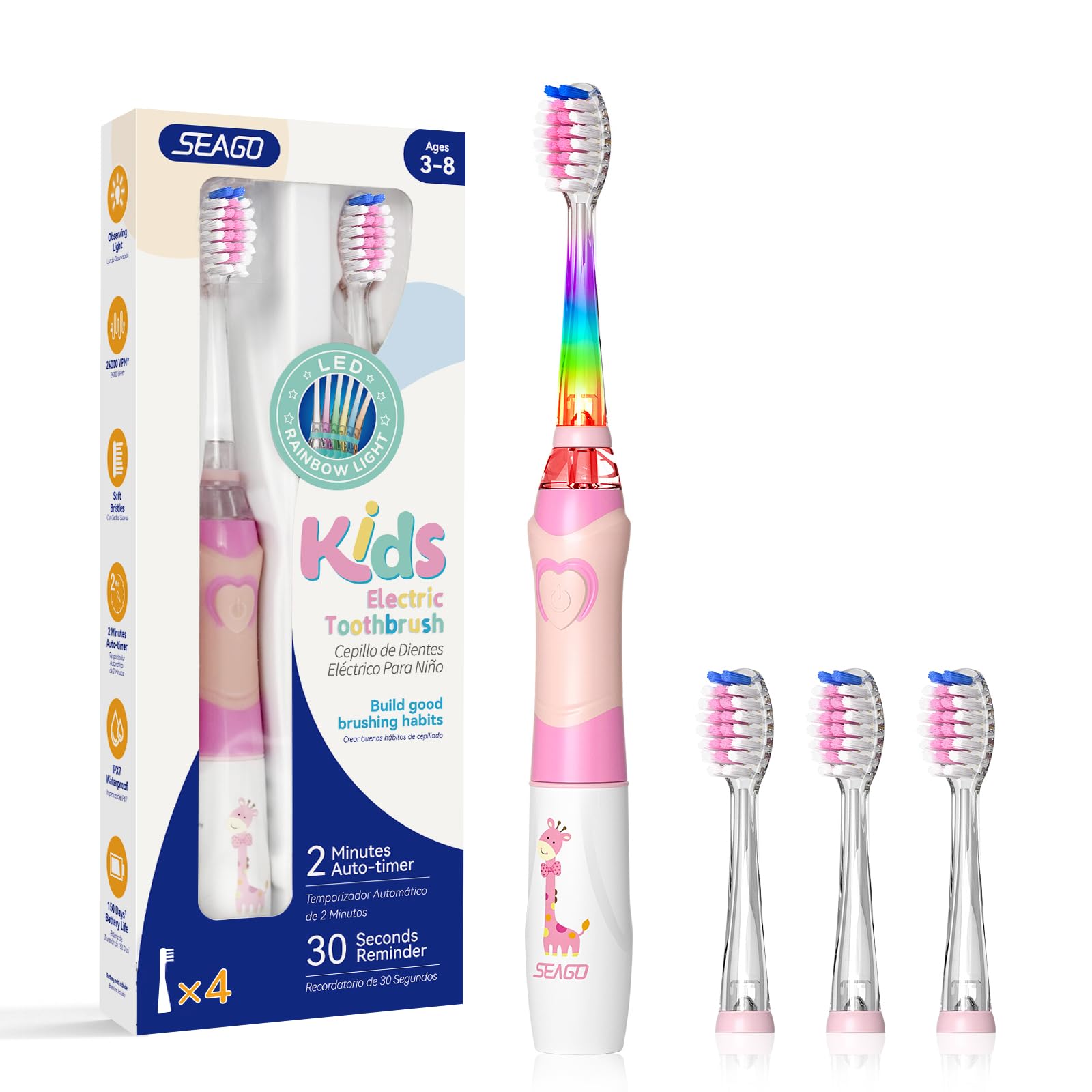
Key Features
- Waterproof: IPX7
- Sonic action: 24,000 vibrations per minute
- Battery claim: Up to 150 days on one AAA
- Heads included: 3 replacement heads
- Price: Midrange
One AAA battery for up to 150 days of brushing is the claim on the box, and it’s the reason this brush earns a place. A single battery covers most of a school year, and there’s no charger to pack or lose, which is the difference between a brush that travels and a brush that stays in a drawer.
It ships with three replacement heads and a bristle cover, which makes the running cost about as low as anything here. The head is small, the shell is rated IPX7 so it can be rinsed under the tap after use, and the built-in timer handles the pacing a child this age won’t do for themselves.
Where it divides is the feel. This is a buzz rather than a scrub, and a child coming off a rotating head will notice; a child who finds rotating heads too much will settle into it within a week. That’s a preference rather than a fault, and it’s why we don’t push it as a first brush.
For us it’s a second brush rather than a main one: the bag, the spare bathroom, the house your child stays at twice a week. The low running cost is what makes that work — a battery you already own, three heads in the box, nothing to remember. Buy it as the brush that travels, and let the one at home be whatever your child actually likes.
Pros
- Up to 150 days on one AAA battery
- Three replacement heads in the box
- IPX7 shell rinses clean under the tap
Cons
- No battery in the box
Our pick for the travel bag and the spare bathroom: months of brushing on one battery, three heads in the box, and no charger to pack.
How We Tested 14 Kids Electric Toothbrushes Through Bedtime
We started with a long list from the major oral-care brands and a few store labels, then narrowed it by what the manual actually promised: an age range that matched the head size, a two-minute timer with a 30-second pulse, and replacement heads that were easy to find and affordable to keep buying. Anything with a head too bulky for a preschooler came off the list. That left 14 brushes, tested over four months.
Testing happened where brushing actually happens — the bathroom counter at 7:40 on a school morning, and again at 8 p.m. when everyone is tired. Each brush went home with a family on the team and was used twice a day by kids between 2 and 10, plus a weekend trip stuffed in a toiletry bag. We held every head against a traced outline of a 4-year-old’s and an 8-year-old’s dental arch to see how far back the bristles reached, and handed out pink plaque-disclosing tablets to check what the brush actually cleaned.
Battery life got logged by date: when each brush was charged, whether it made a full week of twice-daily use, whether it survived being left running in a suitcase. Vibration was judged by the kids, and several brushes were simply too buzzy to keep in the mouth for two minutes. For durability we dropped each handle from counter height onto tile and watched the bristles through four months of chewing; for reliability, we checked whether the seal still kept toothpaste gunk out of the button. We also added up a year of replacement heads, since that number decides whether a cheap brush is really a good value.
What separated the winners was simpler than any spec: kids picked them up without being asked, and the heads still looked decent at the end.
How to Choose a Kids Electric Toothbrush
The brush matters less than the two minutes, so pick the one your child will actually hold for the whole session — then check the head size before anything else.
Start with the head, not the motor
Nearly every complaint about a kids’ electric toothbrush that isn’t about it breaking is about size. A brush labelled for kids is sized for roughly a five-year-old, and a three-year-old’s mouth is smaller than that. If the head covers two teeth at once, or makes your child gag, it won’t get used however good the motor is.
Two of our picks exist on this basis: the Papablic set includes heads sized for 1–18 months and 18–36 months, and the Colgate stays small and light where most cheap brushes bulk up. If your child is under four, compare the head against a manual brush they already tolerate and take the closest match.
Rotating, sonic, or just vibrating
Three different things get sold as electric. There are heads that rotate, heads that vibrate at sonic speed — the brushes here run from 18,000 to roughly 30,000 movements a minute — and handles that buzz without moving the bristles much. The first two clean. The third mostly motivates, which is why a cheap powered brush can feel like a toy with a motor in it.
That doesn’t make a gentle buzz wrong. A nervous first-timer often takes a soft vibrating brush more easily than a spinning head. Just know which one you bought: look for the words rotating or sonic rather than a vibration count, and remember that a small head on a real motor beats a big head on a buzzer.
Rechargeable or replaceable batteries
A rechargeable brush gives you a sealed handle and a dock that will eventually end up behind the sink. A battery brush gives you a top-up that takes seconds and a drawer of spares. For one child brushing at home, charging is the better routine and one less thing to buy.
For a travel bag, a second bathroom, or a household where the charger disappears, batteries win. Check the box before you order: several brushes here ship without the battery, and a brush that needs an AAA you don’t have is a brush that sits in its packaging.
Timers, lights and whether you want an app in the bathroom
Two minutes twice a day is the target, and every mechanism that gets a child there is doing the same job — a countdown timer, prompts every 30 seconds to move around the mouth, a sand timer, a light that changes colour, or a cartoon in an app. Stacking all of them is how a bathroom ends up with four gadgets and a dead phone.
Pick the mechanism your child responds to and stop there. The app is the only option here that also gives you a log of how long and how often your child actually brushed, which is worth more than the game when you’re trying to work out whether the habit is real or being faked.
What it costs after you buy it
The handle is the smallest part of the spend. Heads want replacing every three months, which is the interval quoted across this category, and a brush whose heads are expensive or hard to find becomes a false economy quickly. Before you commit, check that replacement heads are sold separately and in stock.
Then treat the handle as a two-year item rather than an heirloom. Motors and seals are what fail, and buying somewhere with a straightforward return is worth more than a slightly better specification. If a brush ships with spare heads — the SEAGO has three, the Papablic covers the whole 0–3 stretch with two — that’s money already spent well.
Frequently Asked Questions
Can a toddler use an electric toothbrush?
Yes, from the first tooth — provided you are the one doing the brushing. A small-headed brush on a gentle setting cleans at least as well as a manual brush and gets a toddler used to the sensation before they have opinions about it.
Plan on brushing their teeth for them until around seven, when the coordination to reach the back molars arrives. Start with the brush switched off for a few days, then switch it on once it’s already in the mouth.
How often should you replace a kids electric toothbrush head?
Every three months, or sooner if the bristles look splayed or your child has been unwell. A worn head cleans poorly and can be rough on gums, which is exactly the wrong experience to give a child who is still deciding whether they like this.
That’s the argument for buying a set with spares: the SEAGO includes three heads and the Papablic’s two cover the whole 0–3 stretch. Order the next pack before the current one dies, not after.
My child won’t tolerate the vibration. What helps?
Take the surprise out of it. Let them hold the brush switched off, brush with it off for a few days, then turn it on only once the head is already against a tooth — it’s the sudden buzz in mid-air that most children object to, not the sensation itself.
A brush with a soft or massage setting helps, and some children simply prefer a rotating head to a buzzing one. If it’s still a hard no after a fortnight, go back to a manual brush and a two-minute timer rather than turning brushing into a fight.
Final Verdict
The Philips Sonicare for Kids is the brush we point most families to, because it’s the only one here that hands the two minutes to the child and gives you a record of whether they happened. That combination is what changes a habit, and it’s worth the top-of-range price if brushing is currently a negotiation.
Two situations change the answer. If your child is under three, buy the Papablic instead — the Sonicare’s head is simply too big for a mouth that size. If you’re brushing several children and charging nothing, the Oral-B four-pack does the job for about what one premium handle costs.
