This post contains affiliate links. We may earn a small commission when you buy through our links — at no extra cost to you.
The moment a kid gets their own headphones, the next question is what goes into them — and handing over a phone or tablet usually means five minutes of a story and forty minutes of a video about slime. A kids audio player solves exactly that: a chunky, drop-friendly box with real buttons, a shelf of stories and songs already loaded, and no screen to fall into. My two kids have been fighting over ours since spring, and the difference between a player they can run themselves and one that needs an adult every ten minutes is the whole ballgame.
We’ve now lived with 12 of these players over the past six months, in the back seat, at bedtime, and through one very long camping weekend. The lesson worth passing on before you scroll: story length matters more than you’d expect. A player stocked with four-minute songs runs out on a two-hour drive, while one with 40-minute chapters buys you an actual conversation in the front seat. What follows are the ones we’d hand to our own kids again.


Best for Everyday Home Listening
Yoto Player (3rd Gen)
Key Features
- Battery: Up to 24 hours
- Storage: 32GB
- Age range: 3–12 years
- Nightstand features: Nightlight, sleep sounds, alarm
- Price: Premium
A card goes in the slot and the story starts; pull the card out and it stops. That is the whole interface, and it is why we hand the Yoto Player to a child who has never used an audio player before. No unlocking, no menus, no way to end up somewhere you did not plan. The two dials on the front are sized for a small hand, and the volume moves in steps you can hear.
The box is a 4.37-inch cube with a 40mm 5W stereo speaker, and the sound is the surprise here: clear at bedroom volume, with none of the thin toy-speaker tone we expected from something this size. There is 32GB inside, which the listing puts at more than 600 hours of offline listening, so a week at the grandparents’ does not need Wi-Fi.
The nightstand features are what turn it into furniture. A nightlight, sleep sounds, an alarm with an OK-to-wake function and a room-temperature reading all live in the same box, and we ended up leaving it out on the shelf between uses rather than packing it away, which is the highest compliment we can pay a kids’ device.
The app is the one part that is not child’s play: the account, the card linking and the content controls all sit there, and an uninterrupted half hour before a birthday beats ten minutes after. Once that is done the player asks nothing of you, and the library runs from preschool songs to chapter books to podcasts — the widest age span in this group, at 3 to 12.
Pros
- Card in, story on, no menus
- Nightlight, sleep sounds and OK-to-wake in one
- 32GB holds 600+ hours offline
- Stereo sound that is not toy-thin
Cons
- Cards cost extra and a library adds up
We recommend the Yoto Player to nearly every family who asks: a child can run it alone from day one, and the card library still has something for them at nine.
Best for Bags and Road Trips
Yoto Mini (2024 Edition)
Key Features
- Weight: 5.64 oz
- Battery: Up to 14 hours
- Age range: 3+ years
- Dimensions: 1.57 x 2.76 x 2.76 in
- Price: Premium
At 160 g and roughly the size of a baseball, the Mini is the one that leaves the house — the backpack, the car-seat pocket, the bag by the door. Same cards, same dials, same pixel display, so the child who can run the full-size player can run this one, and we found the smaller body easier to hand over in a restaurant than the cube.
The 2024 bundle is what makes it a sensible buy rather than an accessory: it ships with the Starter Pack for Little Kids — preschool songs, 5-Minute Sleepy Stories — plus a welcome card you can load your own audio onto, and a USB-C cable. The trade is battery: 14 hours rated against 24 on the full-size, which in practice means charging it more often than the big one.
Pros
- 160 g and small enough for a backpack
- Starter Pack cards included
- Same card system as the full-size
Cons
- Cards can stop being read by the player
- Priced close to the full-size player
Buy the Mini if the player needs to leave the house: it is the Yoto system at 160 grams, and it is the one we would pack for a flight.
Best for Toddlers on the Go
alilo Pocket Bunny
Key Features
- Carry: Lanyard and loop
- Age range: 1–5 years
- Connectivity: Bluetooth
- Preloaded content: 120 items
- Price: Midrange
Nothing to buy, nothing to download, nothing to sign into. The Pocket Bunny arrives with 120 items loaded — 30 stories, 45 songs, 28 lullabies and 20 white-noise tracks — and a toddler can press a button and get one. The strap and plastic ring hang it off a stroller bar or a car-seat handle, which is where it spends most of its life.
For a one- or two-year-old, that is the whole job. The alilo is rated from 1 to 5 years, the buttons are chunky and few, and the body is ABS with silicone on the handle and buttons, which is why it comes through drops that would finish other electronics here. This is the one we hand a two-year-old before anything else on this list.
Battery life is the variable: a charge can run long or want topping up daily, so make plugging it in part of the bedtime routine rather than a weekly chore, and let the automatic shutoff timer do some of the work. The white-noise set surprised us as well — twenty tracks for naps and travel, in something already clipped to the stroller.
Pros
- 120 items preloaded, nothing to buy
- Lanyard hangs on a stroller or car seat
- Chunky buttons a toddler can work
Cons
- Some units stop working entirely
This is the one we give a two-year-old: 120 items already loaded, a strap that hangs it on the stroller, and nothing to set up or pay for later.
Best for No Extra Purchases
WonderBuddy StoryBox
Key Features
- Battery: Up to 20 hours
- Age range: 3–10 years
- Volume cap: 90 dB
- Stories included: 500+
- Price: Midrange
Five hundred stories and rhymes arrive on the device, and the running cost after that is zero: no cards, no subscription, no account. The StoryBox plays out of the box, and its ten playlists run from nursery rhymes through fables and adventures to science fiction for the older end of the 3-to-10 range.
The extras are more thoughtful than they needed to be. There is a voice recorder for a child’s own stories and for messages from a grandparent, an activity book and story writing kit with prompts, vocabulary cards and stickers, a 90 dB volume ceiling, a headphone jack and up to 20 hours of battery.
Where it earns its place is with the family that does not want a card habit. We think it is the most listening per purchase in this group, and the volume cap and headphone jack make it the easiest to hand over in a car. What it does not have is the ritual — no card to choose, no character to place — and the library is fixed rather than growing, which starts to matter once a child is past picture-book stories.
Pros
- 500+ stories included, no cards to buy
- Voice recorder for family messages
- 90 dB cap and a headphone jack
Cons
- Adding your own audio means a USB transfer
Pick the StoryBox if you do not want a card habit: 500+ stories come with it, the volume is capped, and the running cost stays at zero.
Best for Older Kids Streaming
Globluum Kids MP3 Player
Key Features
- Screen: 4-inch touchscreen
- Weight: 3.46 oz
- Battery: 25 hours
- Storage: 16GB
- Price: Premium
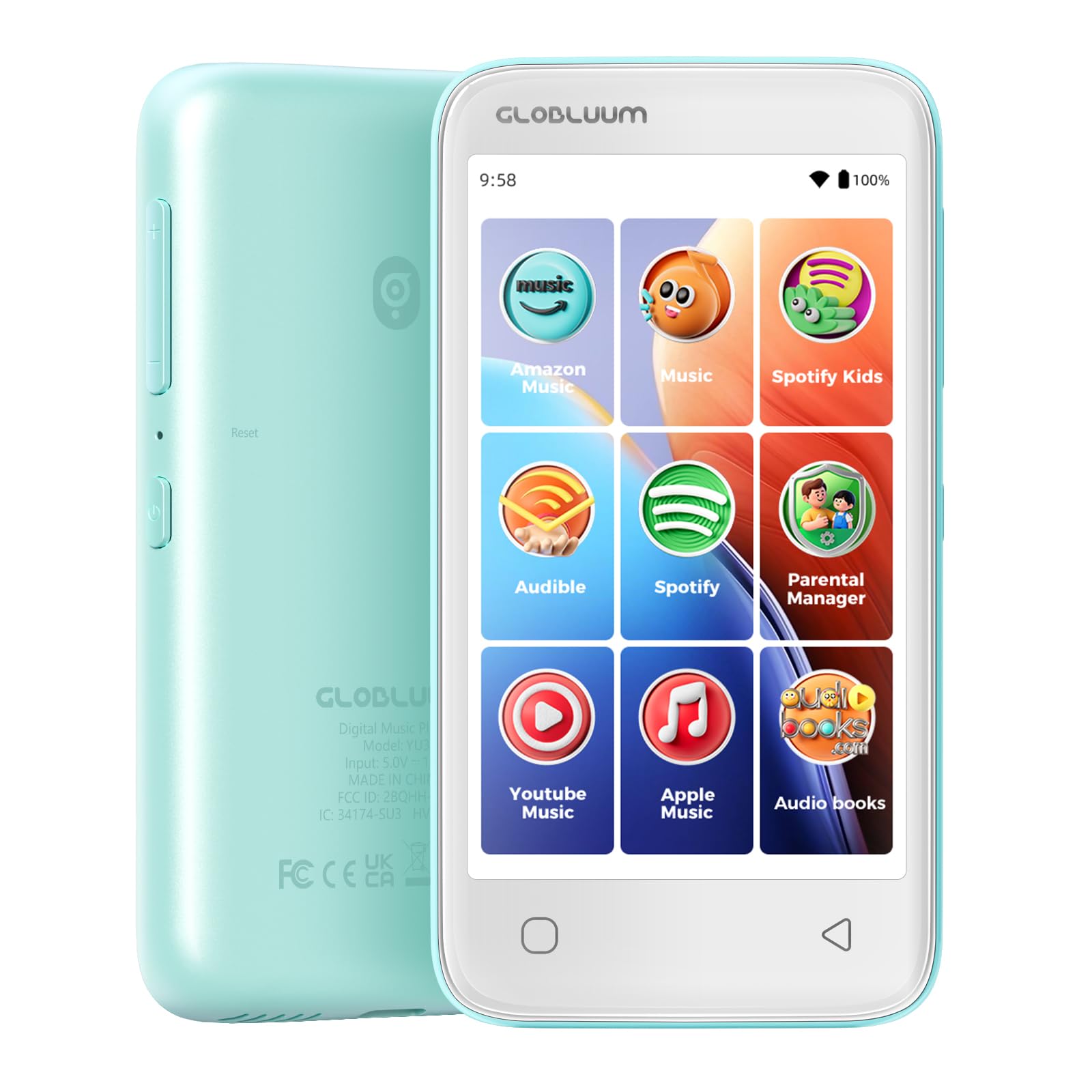
It is the odd one in this group: a phone-shaped 4-inch touchscreen running a restricted version of Android. Spotify Kids, Spotify and YouTube Music come preinstalled, Google Play lets you add more, and parents can approve which apps a child sees. There is no browser, so the screen stays a music screen rather than a way onto the internet.
The case for it is the hardware, and the numbers are good ones: 98 g in the hand, 16GB of storage, 2GB of RAM, a 1750 mAh battery rated for 25 hours and Bluetooth 5.0 for headphones or the car. We checked its weight against the Yoto Mini’s 160 g and it is the lighter of the two. A protective case and a pair of wired earbuds come in the box.
Where it stops is the very young end. Navigating to an app is a different skill from dropping a card in a slot, and the setup side — signing into streaming services, approving apps — is adult work at the start. From about six or seven up that flips into an advantage: it is the only player here where a child chooses their own albums and playlists rather than a card you bought.
Pros
- Spotify Kids and YouTube Music preinstalled
- 98 g with a 25-hour battery
- Parental app locks and no browser
Cons
- A screen, where the others are screen-free
- Streaming needs accounts and Wi-Fi
The pick for an eight-year-old who wants their own Spotify: a light, long-running player with parental app locks, as long as you accept the screen.
Best for First Music Player
LeapFrog Let’s Record! Music Player

Key Features
- Power: 4 AA batteries
- Age range: 18 months+
- Recording: 30 minutes total
- Songs included: 40
- Price: Budget
The least expensive thing here is also the least ambitious: forty songs, no stories, no cards, no app. Ten dance tracks, ten lullabies and classical pieces, ten sing-alongs and ten learning songs about letters, counting, animals and weather, all on a chunky teal box with a volume wheel instead of buttons — which is the detail most toddler toys get wrong.
The recording function is what makes it more than a speaker: hold a button and record up to three minutes, thirty minutes in total, so a grandparent’s voice can sit next to Twinkle Twinkle. Bluetooth streams from your phone, the age range runs from 18 months to about four, and four AA batteries are in the box — rechargeables are the sensible upgrade. Treat it as a first music player rather than a story library and it earns its spot.
Pros
- Records up to 30 minutes of your voice
- 40 songs across four sets
- Bluetooth streaming from a phone
Cons
- Some units stop working
Buy it as a first music player for a toddler, not as a story library: it is the cheapest route to a child’s own songs, and the record button is why it lasts.
Best for Bedtime Projection
Little Tikes Story Dream Machine

Key Features
- Power: 4 AA batteries
- Age range: 3–8 years
- Sleep sounds: 5
- Stories included: 3 Little Golden Books
- Price: Midrange
The book ends, the light goes out and the machine stops: no auto-playing into the next story, no scrolling. That is why the Story Dream Machine works at bedtime in a way a tablet does not. It projects a Little Golden Book onto the wall or ceiling a page at a time, narrates it with sound effects, and then it is over.
Three stories come in the starter set — The Poky Little Puppy, Tawny Scrawny Lion and The Saggy Baggy Elephant — along with a Poky Little Puppy character. We liked that the cartridges store in slots down the side of the unit, so a set does not dissolve into the toy bin. It doubles as a nightlight with five sleep sounds and runs on four AA batteries.
Length is the catch. The stories are short, and a child who is hooked will want the next cartridge, which is where the money goes. It is also not a portable player: 1.3 pounds, four AA batteries, and a unit happiest on a nightstand. As a bedtime ritual it does something none of the audio-only players here can, and that is worth a place on this list.
Pros
- Projects story pages onto the wall
- Stops at the end of each story
- Doubles as a nightlight with 5 sounds
Cons
- Stories are short
- Some units malfunction
For a three- to five-year-old’s bedtime, this does something the audio-only players cannot: a picture book on the wall that ends when the story ends.
How We Tested the Best Kids Audio Players
We started with a shortlist built from spec sheets and parent forums, filtering out anything that required a subscription to hear a story, anything that needed a phone nearby to play, and anything too bulky for a car seat cup holder or a backpack pocket. That left 12 players, spanning screen-free story boxes to music players with a headphone jack, which we tested for six months with kids ages 3 through 9.
Each player went into the back seat for the school run and at least one longer drive, sat on the nightstand for bedtime, and spent a week in a backpack for quiet time after school. We watched how quickly a 4-year-old found play without help, whether the volume buttons were reachable in the dark, and whether the build still felt tight after a few drops onto a kitchen floor. Battery life got timed rather than guessed: how many hours of listening a charge actually delivered, and whether the unit still held that charge after sitting unused for two weeks.
On sound, we listened with the built-in speaker at kid volume and with cheap headphones, noting whether narration came through clearly or turned muddy when a story got loud. We also counted what you get for the money — how many stories came included, whether new ones were easy to add without a computer science degree, and how long a typical chapter ran. Two players dropped out of contention for losing paired content, and one had a battery that faded noticeably by month four.
How to Choose a Kids Audio Player
Most of this decision comes down to three things: how the stories get in, whether your child can run the thing without you, and what it costs to keep new listening coming.
Decide How the Stories Get In
There are three models, and they cost very differently. Card and cartridge systems, like the Yoto and the Story Dream Machine, sell you the player once and then charge for each story, so a real library outgrows the price of the device within a couple of years. Preloaded players such as the StoryBox, the alilo Pocket Bunny and the LeapFrog hand you everything up front and charge nothing more. App players put the cost into streaming subscriptions you may already be paying for.
Budget for the library, not the box. If you expect to buy a few cards a year and like the idea of a collection that grows, a card system is the better long-term buy. If you would rather never think about it again, buy preloaded and accept that the library is what it is.
Check Whether a Child Can Run It Alone
Every box says kid-friendly. The useful test is whether a three-year-old can start a story without asking you, and that comes down to the control: a card in a slot, a chunky button, a dial. A touchscreen with large icons still asks a child to unlock, navigate and choose from a menu, which is fine at seven and frustrating at two.
Once they are listening alone, two features matter more than they look: a volume ceiling, which the StoryBox caps at 90 dB, and a headphone jack for the car or a shared bedroom.
Match the Battery to Where It Lives
A player that stays on a nightstand does not need much battery; one that lives in a bag does. The Yoto Mini is rated for 14 hours, the full-size Yoto for 24 and the StoryBox for 20, and USB-C charging is the convenience you will notice weekly.
The budget end runs on AA cells: the LeapFrog and the Story Dream Machine take four each. That is not a dealbreaker, but buy rechargeables with the toy, or you will be hunting for batteries at bedtime.
Weigh Durability Against the Age You Are Buying For
Under three, buy for the drop: something with a strap or a soft body that survives being carried by one ear. The alilo is built for exactly that, and the Yoto Mini’s 160-gram body is easy for small hands to hold rather than drop.
From about four the calculation changes. A player that lives on a shelf, like the full-size Yoto, the StoryBox or the Story Dream Machine, never has to survive a playground, so you can buy for sound and features instead of armor.
Frequently Asked Questions
What age can a child start using a kids audio player?
From around 12 to 18 months for a button-and-strap player: the alilo Pocket Bunny is rated from 1 year and the LeapFrog from 18 months. Card players start at 3, because slotting a card without bending it takes coordination. The real test is quicker than any rating — hand it over and see whether your child can start a story without help.
Do these players need Wi-Fi or a phone?
The preloaded ones do not. The StoryBox and the alilo Pocket Bunny play out of the box with no app, account or connection. The Yoto needs a phone and Wi-Fi once, to create the account and link the cards, then plays offline from its 32GB. Do that setup the night before a birthday rather than in front of the child.
Can we add our own music or record our voices?
Yes, on most of them. The StoryBox has a voice recorder and takes three custom playlists over USB; Yoto sells blank Make Your Own cards you load with your own audio; the LeapFrog records up to three minutes per button, 30 minutes in total. The Globluum works the other way round — you sign into Spotify or YouTube Music and stream.
Is one worth buying if we already have a tablet or a smart speaker?
Only if independence is the point. A tablet plays the same stories but does everything else too, and a smart speaker usually needs an adult to start it. The player earns its price when a four-year-old can start a story alone and nobody has to hand over a screen. If your child already uses a tablet sensibly and you do not mind that, keep the money.
Final Verdict
Start with the Yoto Player (3rd Gen). The card-in, story-on interaction is the standard everything else here is measured against, and the nightlight and OK-to-wake clock mean it earns a place on the shelf rather than in a toy bin — a child can run it alone at three and still be using it at nine.
If buying cards is the thing that puts you off, the StoryBox hands over 500+ stories with nothing further to purchase. If the player has to leave the house, the Yoto Mini is the same system at 160 grams.
