This post contains affiliate links. We may earn a small commission when you buy through our links — at no extra cost to you.
A kids’ alarm clock that loses time or stops working after a few months isn’t just frustrating — it undermines the whole point of teaching a child to wake independently. Yet many budget-friendly models suffer from exactly these problems: timekeeping drifts, alarms fail, and plastic parts break. The result is a clock that becomes a source of morning chaos rather than a helpful tool.
The best kids’ alarm clocks don’t have to be expensive, but they do need to hit the right balance of accuracy, durability, and age-appropriate features. A large, dimmable display helps kids read the time without disturbing sleep. A reliable alarm — whether digital or analog — builds morning confidence. And a power source that won’t let you down (plug-in with battery backup) avoids the constant reset cycle. This guide helps you match those priorities to the clock that fits your child’s room and your family’s routine.


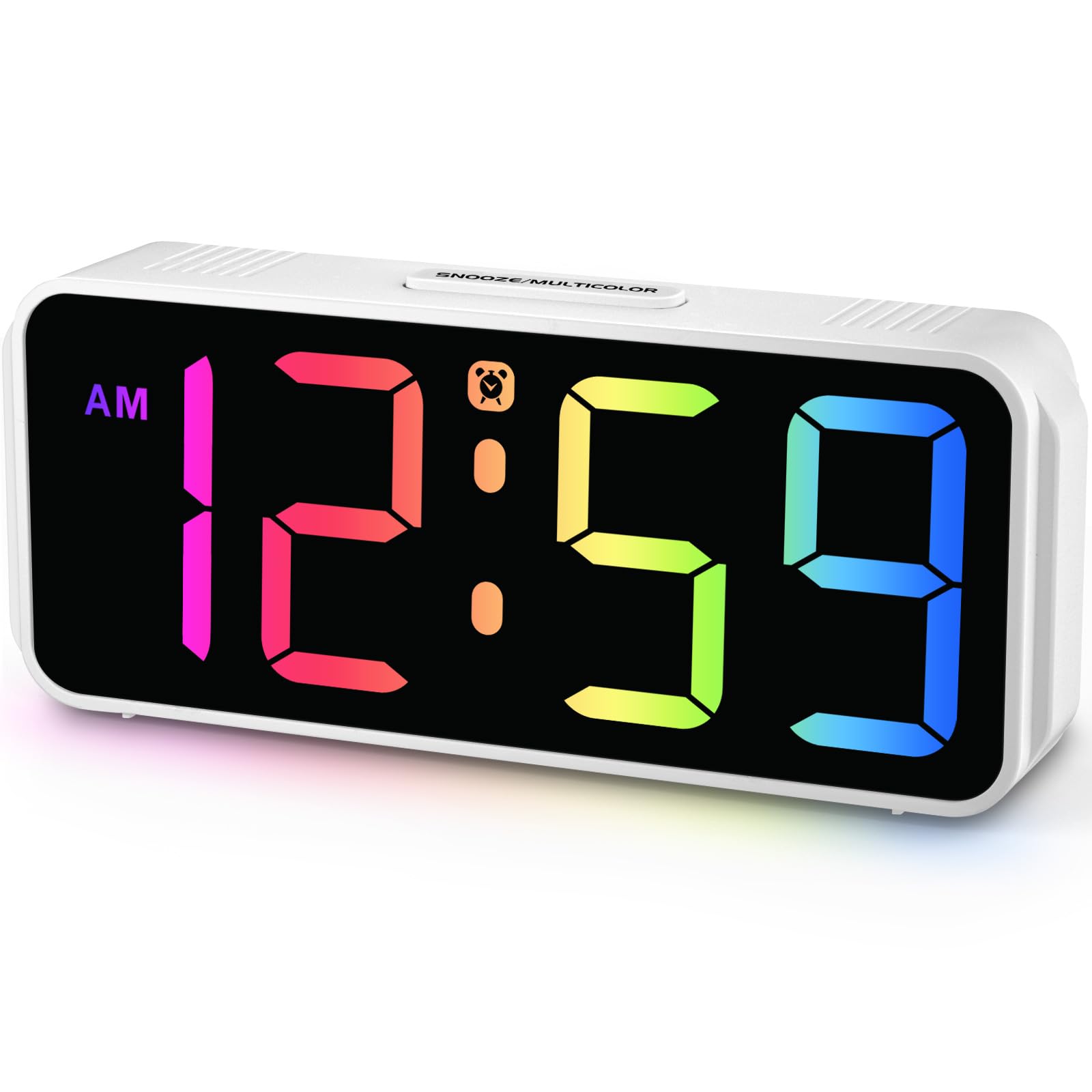


Best for Simple Large Display
DreamSky Small RGB Alarm
Key Features
- Display Type: Digital LED
- Brightness Control: Adjustable dimmer
- Power Source: Corded + battery backup
- Special Features: RGB digits, USB port
- Alarm Volume: Adjustable
- Price: $
The 1.5-inch digits are visible from any corner of a child’s bedroom, and the five-level dimmer lets you dial down to a soft glow that won’t disturb sleep. Setup takes seconds, and the USB port on the back charges a phone or tablet overnight. The compact footprint leaves room for a lamp and book.
This clock is best suited for parents who want a no-fuss alarm for a young child’s room, or for seniors who need large, adjustable numbers. A small number of units lose about a minute per day; if yours does, a weekly reset keeps it accurate. That tradeoff is minor compared to the clock’s otherwise dependable timekeeping.
Pros
- Oversized digits readable from across a child’s bedroom.
- Five-level dimmer allows a soft glow that won’t disrupt sleep.
- Fits small nightstands while keeping a big, clear display.
Cons
- Some units lose about a minute per day, requiring occasional reset.
Buy this if you want a large, dimmable display and USB charging at a budget-friendly price. Skip it if you need battery-only operation or advanced features like projection.
Best for Ceiling Projection Fans
Mesqool Projection Clock
Key Features
- Display Type: Digital LED + projection
- Brightness Control: 5-level dimmer
- Power Source: Corded + battery backup
- Special Features: 180° rotatable projector
- Alarm Volume: 5 levels
- Price: $$
The 180° rotatable ceiling projection and 7-inch display let you see the time without turning your head – a distinct advantage over the top pick’s simpler LED face. Dual alarms and five volume levels suit couples or parents and kids sharing wake-up times. However, the main display and projection stay notably bright even at the lowest dimmer setting, which can disturb light-sensitive sleepers.
Pros
- Ceiling projection shows time without moving your head.
- Large 7-inch display readable across the room.
- Intuitive controls make setup quick.
Cons
- Display and projection remain bright even at the lowest setting, bothersome for light-sensitive sleepers.
- Occasional reports of projection dimming or stopping over time.
Buy this if you want a projection clock that makes time visible from any position and need dual alarms. Skip it if you are highly sensitive to light during sleep or require a clock that can run on batteries alone.
Best for Fun Colorful Decor
Peakeep RGB Plug-in Clock
Key Features
- Display Type: Digital LED with RGB
- Brightness Control: 6 levels (incl. off)
- Power Source: Corded + battery backup
- Special Features: 8 colors, color-changing
- Alarm Volume: 5 levels
- Price: $
The Peakeep clock stands out with 8 RGB color choices and 6 brightness levels including off, letting kids pick their favorite hue or cycle through colors. The large digits remain easy to read across a room, and setup is simple enough for children. However, the power cord exits the bottom, which can tilt the clock forward if not routed carefully, and the small buttons on the back require a bit of dexterity. This trade-off is worth it for families who want a customizable, plug-in clock with battery backup — ideal for kids who enjoy a fun visual wake-up over a plain display.
Pros
- Vibrant color-changing display with 8 RGB colors kids love
- 6 brightness levels including off for any room lighting
- Large, easy-to-read numbers despite compact size
Cons
- Power cord exits bottom, can cause clock to tip forward
- Small buttons on rear require careful pressing
Buy this if your child wants a colorful, adjustable clock with large digits and you can work around the slightly awkward cord and button placement.
Best for Gentle Wake-Up
JALL Sunrise Alarm Clock
Key Features
- Display Type: LED colored light panel
- Brightness Control: 20 brightness levels
- Power Source: Corded
- Special Features: Sunrise simulation, FM radio
- Alarm Volume: 16 levels
- Price: $$
The JALL’s sunrise simulation gradually brightens the room over 10–30 minutes, making morning wake-ups less jarring for children. It also offers 7 colors and 20 brightness levels for use as a nightlight or mood light. However, some units develop button responsiveness issues or clock resets after months of use, and the interface can be confusing to set up. For families willing to trade a bit of long-term dependability for a gentle light-based wake-up, this is a functional option, but parents who prioritize durability and simplicity will be better served by the top pick.
Pros
- Gradual sunrise simulation reduces morning grogginess for kids.
- 7 colors and 20 brightness levels for reading or nightlight use.
- Dual alarms and FM radio at a fair price.
Cons
- Some units develop button responsiveness issues or clock resets over time.
- Setup can be confusing due to unclear instructions.
Buy this if your child responds well to gradual light and you want a multi-functional bedside lamp and alarm. Skip it if you need a simple, dependable clock without setup headaches.
Best for Toddler Sleep Training
LittleHippo Mella Trainer
Key Features
- Display Type: LCD with colored face
- Brightness Control: Not adjustable
- Power Source: Corded + battery backup
- Special Features: Sleep trainer, sound machine
- Alarm Volume: 3 sounds
- Price: $$$
Mella’s red-yellow-green system teaches toddlers when to stay in bed and when to get up, backed by thousands of positive parent reports. Unlike simpler clocks that rely on bright colors alone, the face blinks and changes expression to reinforce the cue. The built-in nightlight and nap timer add convenience for sleep training. However, the sound machine and alarm produce tinny, unpleasant audio, and some units stop working after six to twelve months. This clock works best for parents who prioritize behavioral training over long-term durability or soothing sounds.
Pros
- Color-coded wake-up system teaches kids when to stay in bed (744 mentions, 84% positive).
- Cute expressive face that blinks; kids love it (878 mentions, 98% positive).
- Combines sleep trainer, nightlight, sound machine, and nap timer in one device (1146 mentions, 79% positive).
Cons
- Sleep sounds and alarm are tinny and not soothing (539 mentions, 40% positive).
- Reliability concerns: some units stop working after 6–12 months (754 mentions, 24% positive).
Buy this if you want a visual sleep training system that toddlers respond to and you’re willing to accept limited durability. Skip it if you need a reliable clock with pleasant sounds or plan to use it beyond a year.
How to Choose
The most important factor when choosing a kids’ alarm clock is reliable timekeeping — a clock that loses minutes each day undermines its entire purpose.
Display Type and Readability
Digital displays with large, bright numbers are easiest for children to read from across the room. Analog clocks with color-coded hour bands can help teach time, but only if the child already knows numbers. For preschoolers, a clear digital face prevents morning frustration.
Brightness Control
A screen that glows too brightly can disturb sleep, while one that’s too dim is useless at night. Look for at least 3–5 dimmer levels or an auto-dimming feature. Some clocks offer an ‘off’ setting for the display, relying on a separate nightlight or projection instead.
Power Source
Plug-in clocks with battery backup offer the best accuracy — they never drift from a dying battery. Battery-only models are convenient for placement but often use cheap quartz movements that lose time quickly. If you choose battery, expect to reset the clock weekly.
Special Features
Sunrise simulation gently wakes light-sensitive children, while projection clocks show the time on the ceiling for kids who don’t like turning over. Sleep trainers use color cues (red = stay in bed, green = okay to get up) and work well for toddlers. RGB color displays add fun but don’t affect wake-up quality.
Alarm Volume and Adjustability
Some children sleep through gentle beeps, while others startle at loud bells. Multiple volume levels let you tailor the wake-up sound. Avoid fixed-volume alarms; they either fail to wake a heavy sleeper or cause a harsh awakening for a light one.
FAQ
Why does my kids alarm clock keep losing time?
Most battery-operated budget clocks use inexpensive quartz movements that drift by seconds each day. Plug-in clocks with battery backup are far more accurate because they rely on the power grid’s stable frequency. If you must use a battery clock, expect to reset it every few days or invest in an atomic-sync model.
Are sunrise alarm clocks worth it for heavy sleepers?
Sunrise alarms work well for children who wake gently to light, but heavy sleepers often need an audible backup. Look for models that combine a gradual light ramp with a loud alarm that gets progressively louder. Without sound, many heavy sleepers will simply sleep through the sunrise.
Can I use an analog alarm clock for a child who can’t tell time yet?
Not effectively — the child won’t understand when to get up. A digital display with large numbers or a sleep trainer that uses colors (red/yellow/green) gives an immediate visual cue. If you want to teach time, choose a clock with a learning face, but pair it with a digital or color-based wake-up system.
What’s the best alarm clock for a toddler’s room that doesn’t need batteries?
A plug-in digital clock with a dimmable display and battery backup for power outages is ideal. Models like the DreamSky or Peakeep RGB offer large numbers, adjustable brightness, and reliable AC power. Avoid battery-only clocks for toddlers — they lose time and require frequent resets that disrupt the routine.