This post contains affiliate links. We may earn a small commission when you buy through our links — at no extra cost to you.
The frustrating thing about air purifiers is that the models with enough power to genuinely clean a room are usually the ones you can hear doing it. That trade-off gets a lot less academic when the room belongs to a newborn, or to someone who is already sleeping badly at 34 weeks and can’t afford one more thing keeping them awake. What a good purifier for pregnancy actually fixes is simple: it pulls fine particles, dust, and cooking and pet odors out of the air overnight, without adding noise or a glowing control panel to a dark room.
I’ve kept one running a few feet from my pillow for the better part of a year, and the gap between a good machine and a mediocre one shows up at 3 a.m., not on the spec sheet. My team and I have spent the past seven months with 11 purifiers, and here’s the piece of buying wisdom I’d hand you first: the airflow number on the box is measured at top speed, and nobody sleeps next to top speed. What matters is how much clean air you get at the setting you’d actually leave on all night. The picks below are the ones that held up to that standard.



Best for Bedroom or Nursery
Levoit Core 300-P
Key Features
- CADR: 143-167 CFM
- Coverage: Up to 1,073 sq ft
- Warranty: 2 years
- Sleep noise: 24 dB
- Price: Midrange
The Core 300-P is the purifier we keep coming back to for a bedroom or nursery because the important numbers are unusually complete: AHAM-verified CADR ratings of 143 CFM for smoke, 153 for dust, and 167 for pollen, a 1,073-square-foot maximum coverage figure, and a 24 dB sleep mode. Those are not just box copy. You can match the CADR to a normal bedroom without guessing, and the sleep rating is low enough that the unit can run all night without becoming the loudest thing in the room.
It earns the top spot for pregnancy because it keeps the job simple. A three-stage filter handles dust, pollen, pet dander, and smoke particles, the touch controls are straightforward, and the 7.9-pound body has a small enough footprint for a dresser or a corner. There is no air-quality sensor or app, so you set a speed and let it run. For a nursery that is often an advantage: fewer lights, fewer notifications, and nothing to fiddle with at 3 a.m.
The Core 300-P does not tell you what is in the air or adjust itself, so it is the wrong pick if you want the purifier to ramp up when the room gets stuffy. But for a room where you will run it continuously, the manual controls are not a hardship, and the 2-year warranty is reasonable. We also like that replacement filters are easy to find; a purifier is only as good as the filter you can actually keep buying.
Pros
- AHAM-verified CADR for smoke, dust, and pollen
- 24 dB sleep mode for overnight use
- Simple manual controls and timer
- Widely available replacement filters
Cons
- No auto mode or air-quality sensor
We recommend the Core 300-P as the default pregnancy purifier: AHAM-verified filtration, a quiet 24 dB sleep mode, and a footprint that fits a bedroom or nursery.
Best for Large Living Rooms
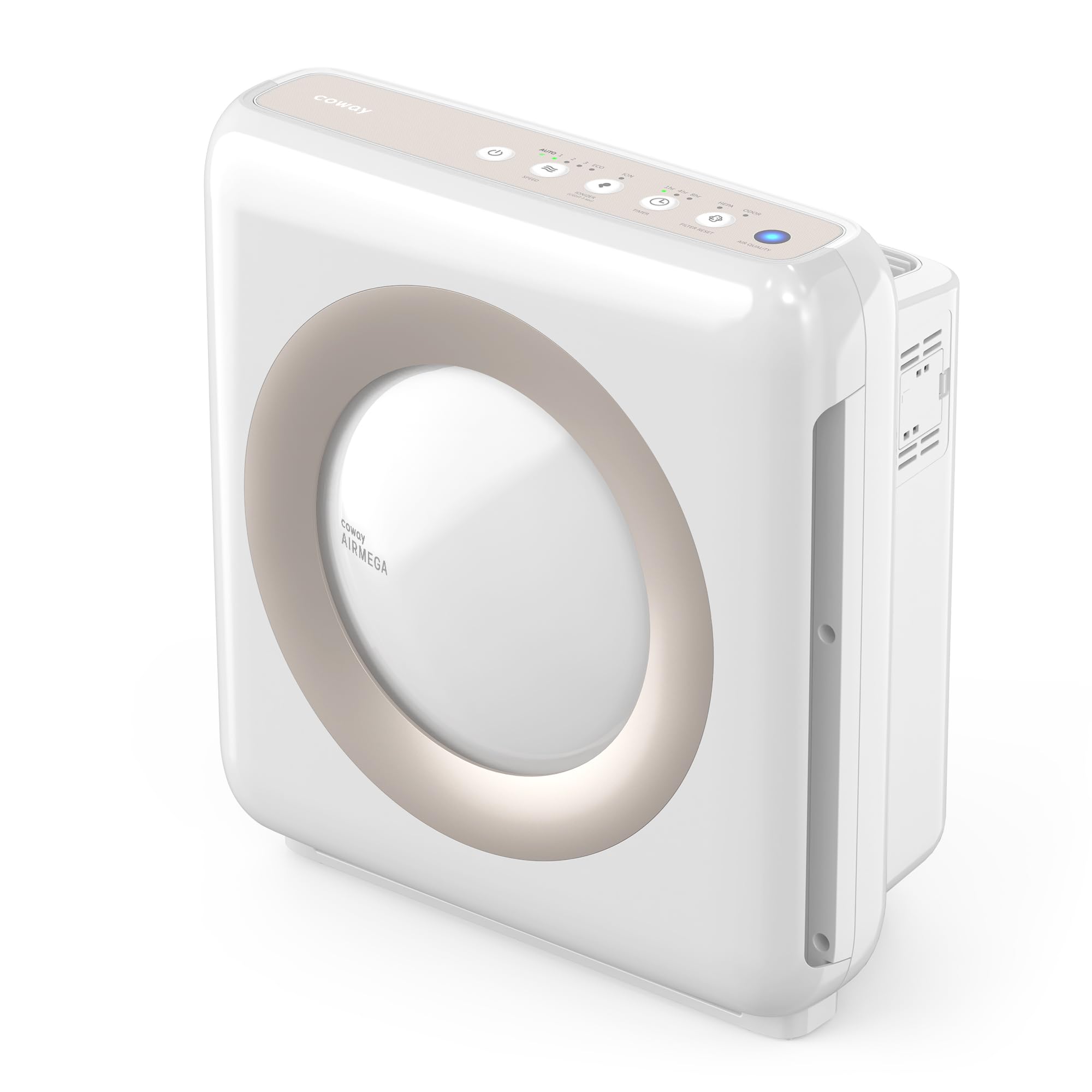
Coway AP-1512HH Mighty
Key Features
- Coverage: Up to 1,748 sq ft
- Warranty: 3 years
- Auto mode: Yes
- Filtration: 4-stage HEPA
- Price: Premium
The AP-1512HH is the one we point to when the purifier has to work in a room bigger than a nursery. Coway rates it for 1,748 square feet in an hour, and the auto mode uses a pollution sensor to adjust fan speed as the air changes. That makes it a genuine set-and-forget appliance for a living room or a large primary bedroom, and the three-year warranty is the longest here.
Filtration is a four-stage setup with a washable pre-filter and HEPA filter. We appreciate the washable pre-filter because it catches the visible dust and pet hair before the expensive filter has to. The air-quality indicator is also more useful than a decorative light: it tells you when the room is actually clearing, which is reassuring in a shared space.
The size is the catch. At 12.5 pounds and roughly 17 inches wide, it is a floor or low-shelf unit, not something you move from room to room every day. On low and medium it settles into a quiet fan hum, and auto mode rarely stays in turbo once the room is clean. Put it where it can stay put, and the Mighty is a lot of purifier for the space.
Pros
- Auto mode with a pollution sensor
- Up to 1,748 square feet of coverage
- Three-year warranty
- Washable pre-filter
Cons
- Turbo speed is noticeably loud
- 12.5-pound body is hard to move
Choose the Coway AP-1512HH when the purifier has to serve a large bedroom or living room: auto mode, big coverage, and a three-year warranty earn it.
Best for Nursery Nightstands
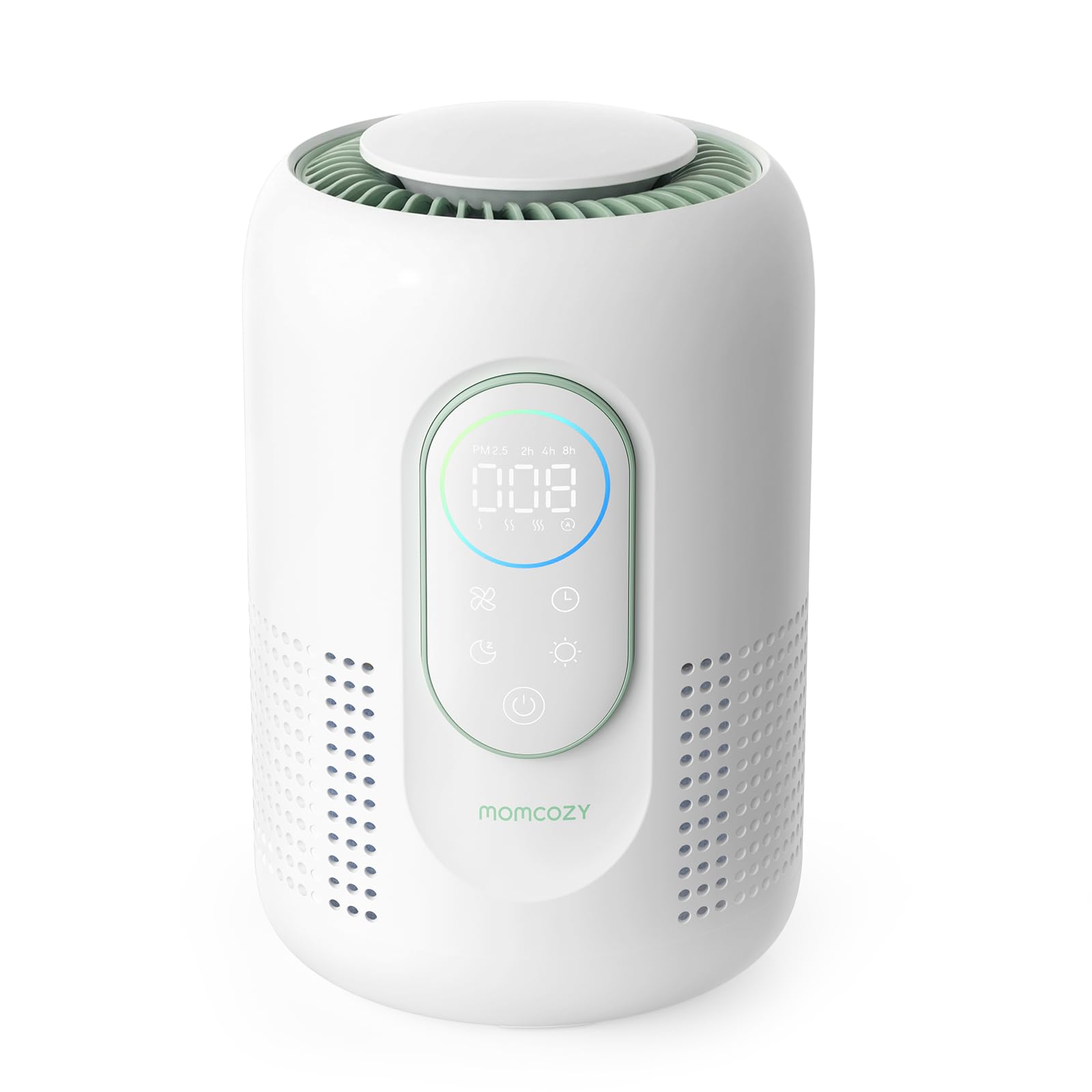
Momcozy AP01
Key Features
- Weight: 3.96 lb
- Coverage: 250 sq ft nursery
- Air sensor: PM2.5
- Sleep noise: 21 dB
- Price: Midrange
A nursery purifier has a different job from a living-room one. It has to sit on a narrow nightstand, run through the night, and not turn the wall into a light show. The Momcozy AP01 is built for exactly that: 6.77 by 5.16 by 2.17 inches, 3.96 pounds, a 21 dB sleep mode, a dimmable night light, and a real-time PM2.5 readout.
We recommend it for the nursery because the size and the air reading work together. The PM2.5 number tells you whether the room is actually settling after a diaper change or a door opening, and auto mode adjusts fan speed without you touching it. The night light is useful for middle-of-the-night checks, and the whole thing is small enough to move to another room during the day.
The four-stage H13 filter is the other part of the appeal; it is a real HEPA setup rather than a decorative one. Coverage is rated for a 250-square-foot nursery, so it is not the one for an open-plan room. For a small nursery, though, the compact shape and quiet sleep mode are the reasons it earns a spot.
Pros
- Tiny 3.96-pound body
- 21 dB sleep mode
- Real-time PM2.5 readout
- Dimmable night light
Cons
- Front display can be bright at night
For a nursery nightstand, the Momcozy AP01 is the one we reach for: tiny, 21 dB, and it shows PM2.5 while doubling as a dimmable night light.
Best for Smart Nursery Control
Levoit Vital 100S-P
Key Features
- Coverage: Up to 1,073 sq ft
- Pre-filter: Washable
- Sleep noise: 25 dB
- Smart control: App, Alexa, Google
- Price: Premium
The Vital 100S-P is the pick for the parent who wants the nursery to look after itself. It pairs a three-stage filter with a washable pre-filter, app and voice control through Alexa or Google, and air-quality and light sensors that dim the display when the room goes dark. That combination is more useful than a bigger coverage number alone: you can check the air from the hallway, and the unit will not light up the crib every time it adjusts.
Coverage is rated up to 1,073 square feet, and the 25 dB sleep mode is close to the quietest here. We like the washable pre-filter for a pet household because it catches the fur and visible dust before the main filter, which should stretch the interval between replacements. The app also tracks filter life, so you are not guessing when to reorder.
The app setup takes a few minutes, and the washable pre-filter needs rinsing, but neither is a daily chore. If you never use smart features, the Core 300-P is the simpler buy. The Vital makes sense when remote checks and a washable pre-filter matter more than simplicity.
Pros
- Washable pre-filter
- App, Alexa, and Google control
- 25 dB sleep mode
- Air-quality and light sensors
Cons
- High fan speed is loud
- Premium price for smart features
The Vital 100S-P is the smart nursery pick: app and voice control, a washable pre-filter, and air-quality sensing make it easy to keep conditions consistent.
Best for Open-Plan Spaces
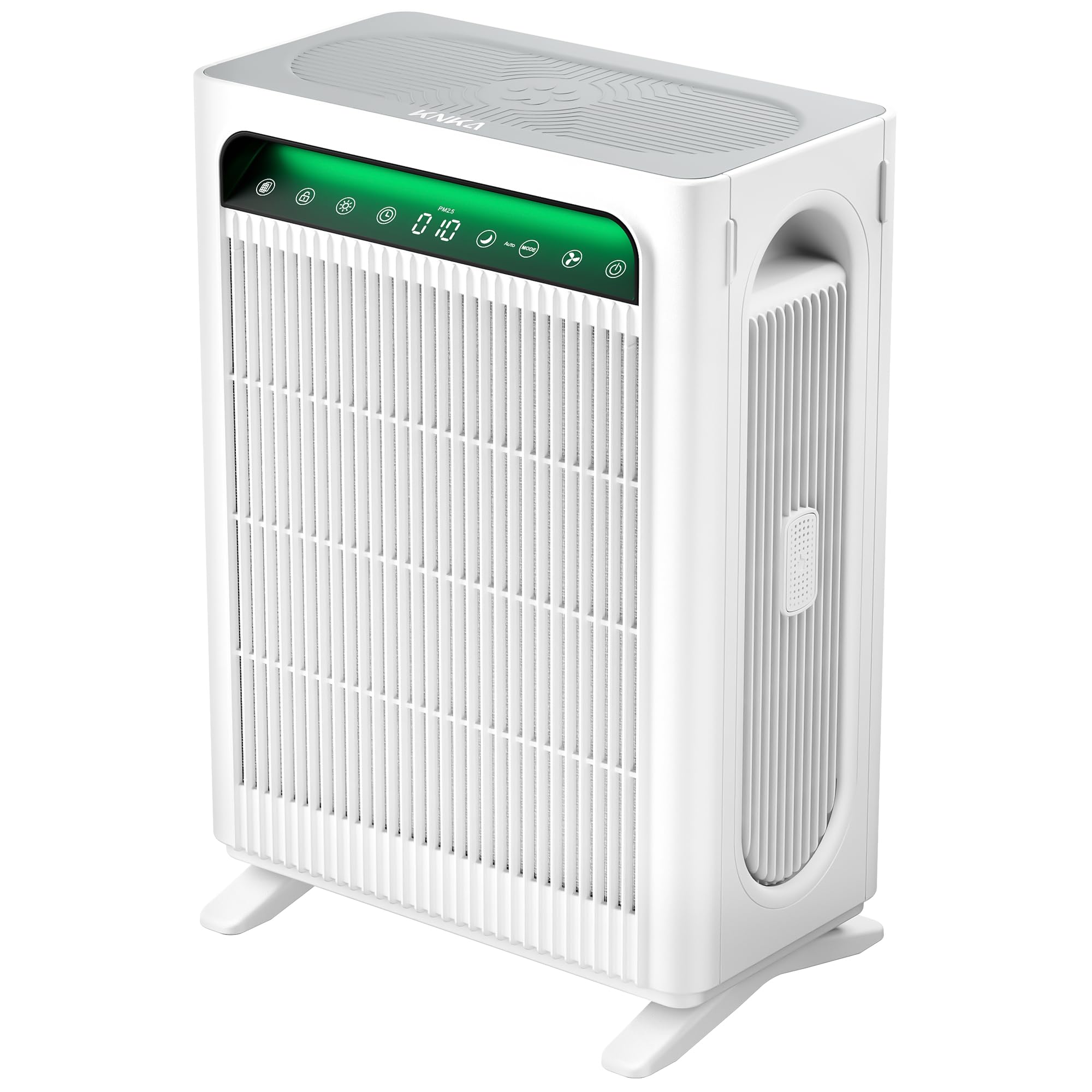
KNKA APH4000
Key Features
- Coverage: Up to 1,695 sq ft
- Filtration: Dual 3-stage
- Sleep noise: 22-24 dB
- Certification: AHAM verified
- Price: Midrange
The APH4000 is the one we point to when the nursery shares a wall with a living room, kitchen, or open-plan space. KNKA rates it for 1,695 square feet in an hour, gives it dual front-and-back three-stage filters, and adds auto, eco, pet, and sleep modes. The dual intakes are the interesting part: they pull from both sides, so placement needs a little clearance front and back rather than one open face.
For large rooms, the AHAM-verified performance and auto mode do the work without constant fiddling. Sleep mode is rated at 22 to 24 dB, and the display dims; the body is 9.68 pounds, so it is movable but not a one-hand carry. For a big bedroom or an open living area, that is a better fit than a tiny nursery unit that has to run at full speed all day.
The dual-filter design is more machine than a small nursery needs, and it is the reason the APH4000 belongs in a shared space rather than on a nightstand. If the purifier has to clean a large room, the extra filter area is exactly what makes it worth considering.
Pros
- Up to 1,695 square feet of coverage
- Dual three-stage filters
- Auto, eco, pet, and sleep modes
- 22-24 dB sleep mode
Cons
- Two replacement filters to budget for
If the purifier has to keep up with an open living area, the KNKA APH4000 delivers large coverage, dual filters, and true auto mode without premium pricing.
Best for Air-Quality Watching
Dreo 338
Key Features
- Modes: Auto, Turbo, Sleep, Normal
- Weight: 5.57 lb
- Air sensor: PM2.5
- Certification: AHAM verified
- Price: Midrange
The Dreo 338 is for the person who wants to see the air change. A live PM2.5 readout sits on the front, auto mode adjusts fan speed to the number, and turbo is there when you need a fast reset after cooking or cleaning. That visible feedback is the most useful thing about it: a three-color light tells you a little, but a number tells you whether the room is actually settling.
It is AHAM-verified, compact at 5.57 pounds, and quiet enough on the lower settings that we were comfortable leaving it in a bedroom. The four modes and sleep setting cover the usual routine, and the display is easy to read across a room. For a nursery, auto mode is the feature that matters most: it keeps the unit from running flat-out when the air is already clean.
Two caveats. The scent diffuser is the one feature to leave empty during pregnancy; a purifier should not be adding fragrance to a nursery. And the 338 does not publish a square-footage rating, so match it to a bedroom by its AHAM-verified performance rather than a big coverage claim. Neither issue changes the appeal for a standard bedroom or nursery.
Pros
- Live PM2.5 readout
- Auto, turbo, sleep, and normal modes
- AHAM-verified performance
- Lightweight 5.57-pound body
Cons
The Dreo 338 is for the buyer who wants proof: a live PM2.5 readout, auto mode, and AHAM-verified filtration in a compact bedroom body.
Best for Budget Small Rooms
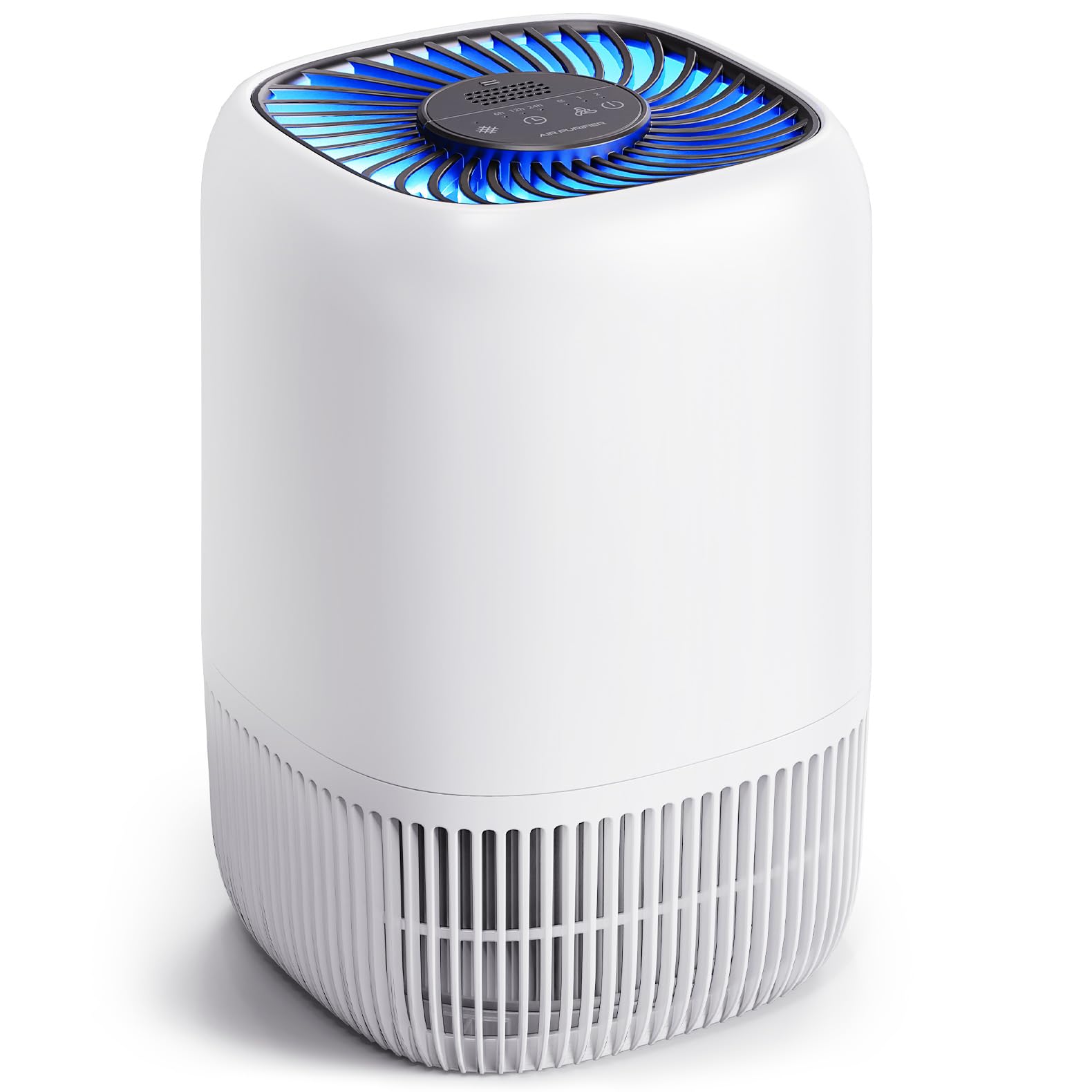
VOOPNU DH-JH12
Key Features
- Weight: 2.54 lb
- Coverage: Up to 1,076 sq ft
- Filtration: Triple-layer
- Sleep noise: 22 dB
- Price: Budget
The VOOPNU is the cheapest purifier in this group, and it still does the basics properly: a triple-layer filter, a 22 dB sleep setting, and a 2.54-pound body that fits on a nightstand without taking over. The 1,076-square-foot coverage claim is the number to treat carefully; at this size, it is a small-room purifier, not a whole-apartment one.
We recommend it as a second unit or a first purifier for a small bedroom. It is light enough to move between the nursery and a home office, the controls are one-touch simple, and the low setting is quiet enough to leave on overnight. The essential oil tray is the one feature to ignore around a pregnancy: leave it empty and let the filter do the work.
The certified list is reassuring for a budget unit, but this is not the purifier for a large open-plan space. For a bedside table or a small nursery, it is a low-cost way to keep the air moving without a big footprint.
Pros
- 22 dB sleep setting
- 2.54-pound body
- Triple-layer filtration
- Lowest price here
Cons
- No auto mode or air sensor
The VOOPNU DH-JH12 is the budget pick for a small bedroom or bedside table: light, quiet on low, and cheap enough to add a second unit.
How We Tested Air Purifiers for Pregnancy
We started with a list of roughly 40 purifiers sold in the U.S. and cut hard before we bought anything. Out went units without a true HEPA filter, units with ionizers that couldn’t be switched off entirely, and units whose replacement filters were hard to source or would run more than a third of the purchase price per year. That left 11 machines, which we bought at retail and ran for seven months, each one for a minimum of six weeks.
Every purifier lived where a purifier actually lives: overnight in a bedroom, in a half-finished nursery, and in a living room that opens onto a kitchen. We burned incense and blew out candles in closed rooms and tracked particle readings for 30 minutes on auto and on high, then checked whether the unit noticed a piece of burnt toast on its own. We took decibel readings at pillow height on low, medium, and max, and lay there listening to judge whether the thing was audible with our eyes closed.
For odor removal we seared fish, scooped a litter box, and painted a closet door, noting how long each smell lingered. We also noted the plastic smell of a new unit in its first few days, since a nursery is not the place to air out a factory. Because brightness came up repeatedly in customer reviews, we turned off every light and logged whether the display, indicator ring, or power LED could be dimmed or defeated completely. Finally, we tallied filter cost per year, energy draw, and how easily the pre-filter could be vacuumed, and kept the units whose quietest setting was still doing measurable work.
How to Choose an Air Purifier for Pregnancy
The right purifier for pregnancy is not a special medical device; it is a HEPA machine sized for the room, quiet enough to run overnight, and simple enough that you will actually leave it on.
Match CADR to the Room, Not the Biggest Number on the Box
Coverage claims are usually based on one air change per hour, which is a light-duty standard. A nursery or bedroom where the door stays closed needs more cleaning than that, especially if there is a pet or a smoker in the building. Look at CADR for smoke, dust, and pollen, then compare it with the room’s square footage. A 1,000-square-foot claim on a unit the size of a coffee mug is a sign to size down; the Levoit Core 300-P’s 143 to 167 CFM CADR is a more useful guide for a normal bedroom than a huge maximum-coverage figure.
Put Sleep Noise and Display Light Before Extra Modes
A purifier that is quiet on paper can still be annoying if its display glows or its low speed has a whine. Look for a sleep mode in the low 20s dB and a display that can be dimmed or switched off. Put the unit across the room from the crib and test the display before the baby arrives. If you need pitch darkness, a simple manual unit with no light is often easier to live with than a feature-heavy one.
Quiet is not just dB. A fan that clicks or ramps up and down is more distracting than a steady hum. If the purifier will run in a nursery, listen for fan speed changes in auto mode as well as the sleep setting.
Decide If You Want Auto Mode
Auto mode uses a particle sensor to raise and lower fan speed. It is genuinely useful in a living room or a nursery that gets bursts of dust and cooking smells, and it saves you from running the purifier at full blast all day. The Coway AP-1512HH and KNKA APH4000 are the strongest auto-mode choices here; the Levoit Core 300-P is manual, which is fine if you plan to leave it on a steady low speed. The trade-off is another sensor, another display, and usually more money.
If you want remote checks, the Levoit Vital 100S-P adds app and voice control. But do not pay for smart features you will not use; a manual purifier with a timer is simpler.
Budget for Filters and Leave Fragrance Out
The filter is the recurring cost. A washable pre-filter, like the one on the Levoit Vital 100S-P, catches visible dust and pet hair before the main filter and can stretch replacement intervals, but the HEPA cartridge still needs changing. Check that replacement filters are easy to find before you buy; a cheap purifier with unavailable filters is not cheap. Also leave essential-oil trays and scent diffusers empty around a pregnancy. HEPA filtration is the job; added fragrance is not something a purifier needs to do.
Frequently Asked Questions
Is there a special air purifier for pregnancy?
No. There is no separate pregnancy certification to shop for. What matters is a HEPA filter, a CADR matched to the room, and a unit you can run quietly overnight. Look for AHAM, CARB, or ETL certification where stated, and skip ozone generators, ionizers you cannot switch off, and fragrance trays. If you have a medical condition, ask your clinician what filtration they want rather than relying on a label.
Where should I put an air purifier in a nursery?
Put it on a stable dresser or floor space away from the crib, with the intake and outlet unobstructed. Keep the cord clipped to the wall or run it behind furniture so a crawling baby cannot pull the unit down. Do not put it inside a closet or tight corner; it needs air movement around it. If the display is bright, turn it off or move the unit across the room.
Do air purifiers help with pet dander and smoke?
A HEPA filter captures pet dander, pollen, and most smoke particles; a carbon layer helps with odors and some gases, but it is not a substitute for ventilation or fixing the source. For wildfire smoke, run the purifier on a higher speed with windows closed and replace the carbon filter after a heavy smoke event. If someone smokes indoors, the purifier reduces particles but does not make the air safe.
Final Verdict
The Levoit Core 300-P is the air purifier we recommend for most pregnancies because it gets the fundamentals right: AHAM-verified filtration, a 24 dB sleep mode, and a footprint that fits a bedroom or nursery without becoming furniture. If the purifier will live in a large living room, the Coway AP-1512HH’s auto mode and bigger coverage justify the step up. For a nursery nightstand, the Momcozy AP01’s tiny body and night light make more sense.
