This post contains affiliate links. We may earn a small commission when you buy through our links — at no extra cost to you.
Bedtime at my house used to end in a standoff at the sink: one kid, mouth clamped shut, insisting the toothpaste was spicy. It seems like a small thing until you’re three months into a tube nobody will touch and the dentist starts asking about fluoride. A kids’ toothpaste has to clear two bars at once — enough fluoride to actually protect new molars, and a taste, texture, and tube that a child will say yes to twice a day without a negotiation.
My team and I spent four months testing 14 toothpastes with families who have toddlers, preschoolers, and a couple of very opinionated seven-year-olds. We watched the 7 a.m. and 8 p.m. brushings: whether the paste got spat or swallowed, whether the cap survived wet hands, whether anyone asked for that flavor again. Effectiveness came down to reading the fluoride concentration on every label rather than trusting the words cavity protection on the front. The picks below passed both the ingredient check and the kid vote.


Best for Everyday Brushing
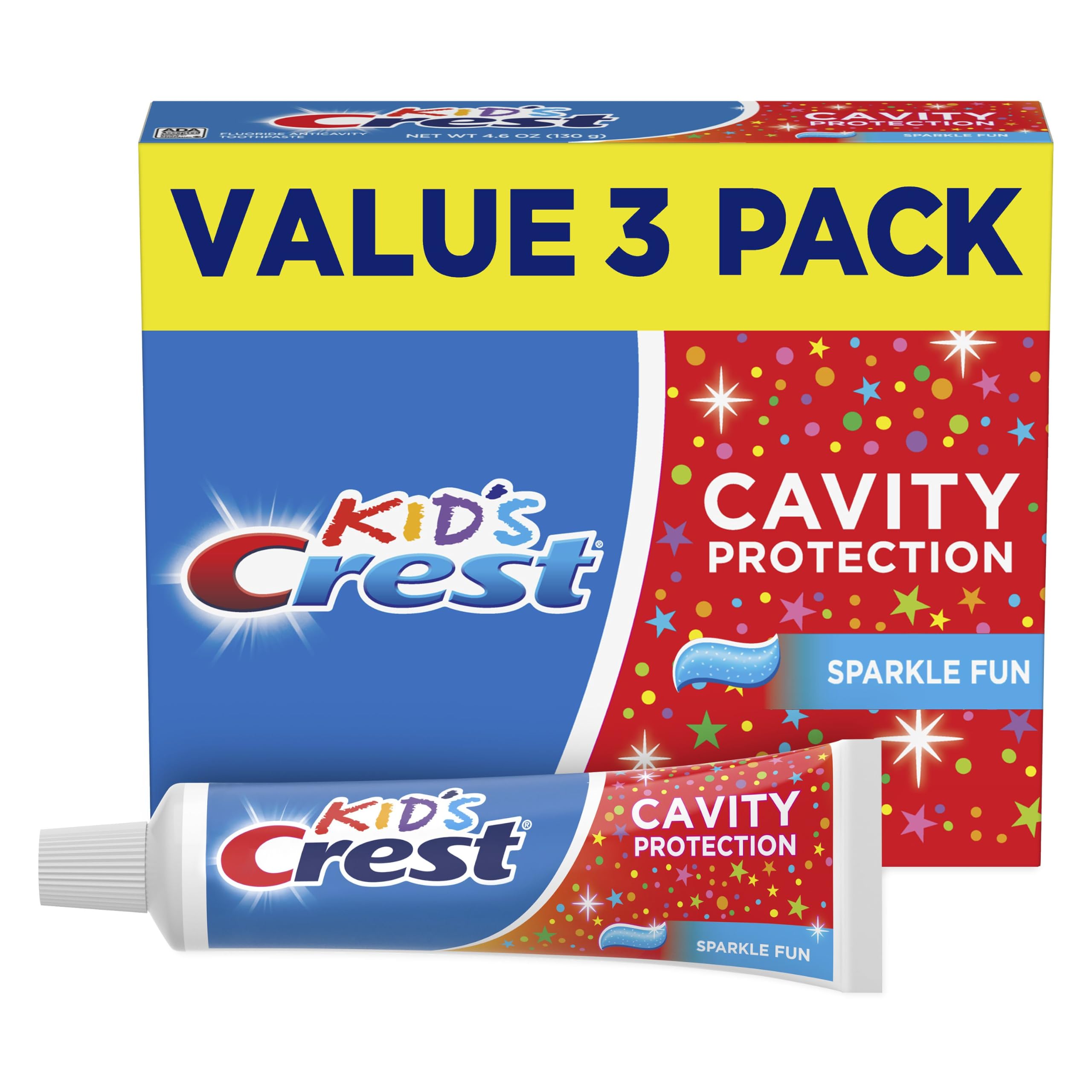
Crest Sparkle Fun
Key Features
- Ages: 2 and up
- Size: 4.6 oz, 3 tubes
- Flavor: Sparkle Fun bubble gum
- ADA accepted: Yes
- Price: Budget
Per tube, this is the least expensive toothpaste in our group, and it’s the one we hand to most families without a second thought. It’s ADA accepted, labeled for ages 2 and up, and built on the fluoride formula Crest calls Fluoristat. What sells it is partly what it doesn’t do: it doesn’t sting.
Mint is the usual reason a small child refuses to brush, and Sparkle Fun has none of that heat. The flavor is a soft bubble gum that a kid will keep in their mouth for a full two minutes, and the gel is full of blue sparkles — which sounds like a marketing gimmick and behaves like a useful one, because the sparkle is what makes a child reach for this tube instead of a plainer one on the shelf.
The tubes are 4.6 ounces, comfortable in a small hand and small enough to follow a child to a grandparent’s house for the night. Three of them arrive together, which is how the cost per tube gets as low as it does.
That three-pack is also the catch. You can’t buy a single tube of Sparkle Fun here, so if your child turns out not to want bubble gum, you own three tubes of it. If you already know the flavor works in your house, this is the most sensible thing on the page; if you’re mid-standoff with a picky brusher, start with the ACT tube and come back once you know.
Pros
- Lowest cost per tube here
- ADA-accepted fluoride protection
- Mild bubble-gum gel that doesn’t sting
- Three full-size tubes per pack
Cons
- Only sold as a three-pack of one flavor
This is the tube we recommend for most families: ADA-accepted fluoride, a bubble-gum gel that doesn’t sting, and the lowest cost per tube in this group.
Best for Clean-Label Brushing
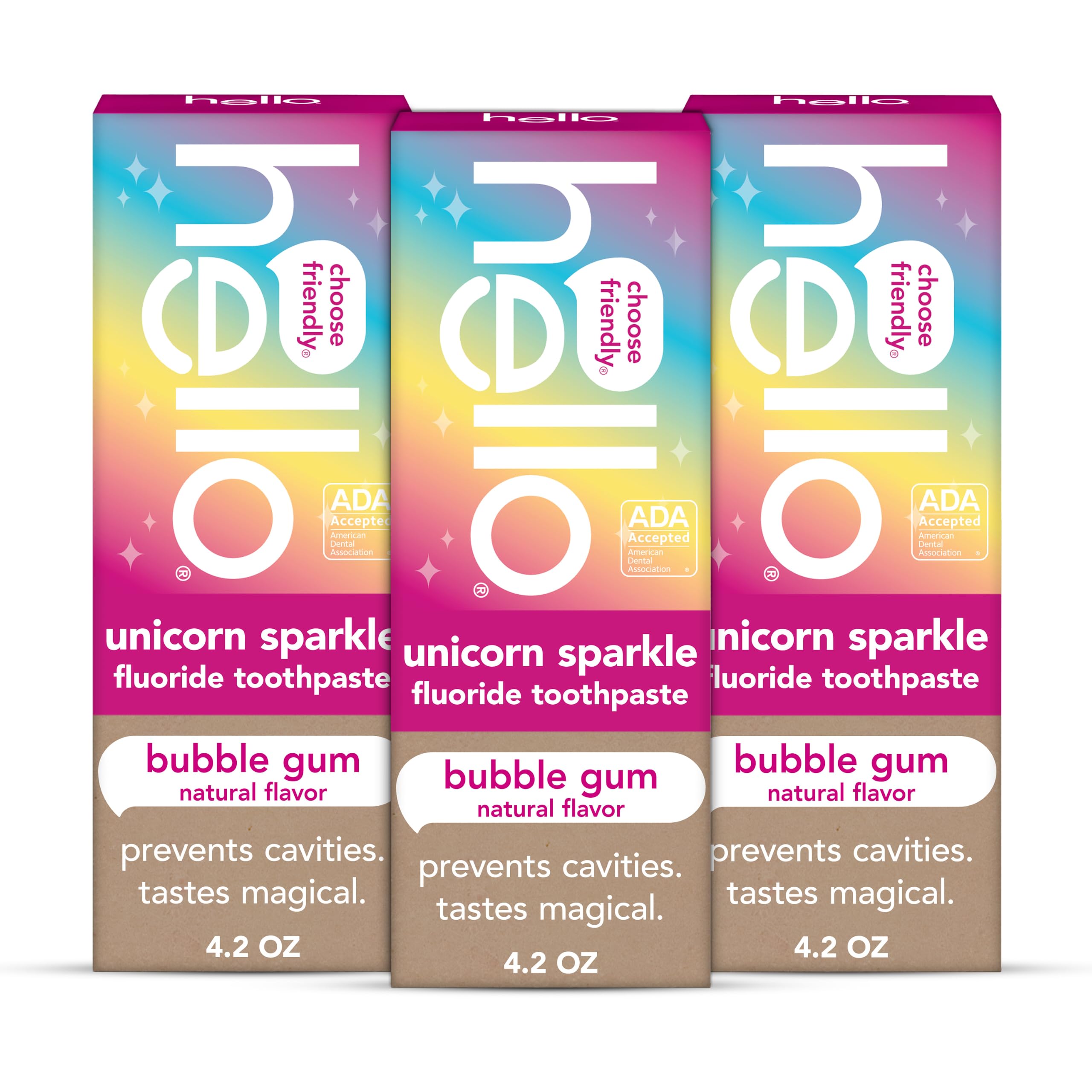
hello Unicorn Sparkle
Key Features
- Ages: 2 and up
- Size: 4.2 oz, 3 tubes
- Flavor: Bubble gum
- Free from: SLS, dyes, artificial sweeteners
- Price: Midrange
The ingredient list is the reason this one earns a place. No SLS, no dyes, no artificial sweeteners, no preservatives — and a natural bubble-gum flavor that still reads as a treat. If your child gets mouth sores after brushing, or gags on a mouthful of foam, SLS is the ingredient to try leaving out first, and this is the paste here that does it without turning brushing into a chemistry lesson.
It’s a sparkly gel, which the under-six crowd treats as a genuine feature rather than a detail. hello also prints a unicorn on the box for kids to color in, so resist flattening the packaging on the way to the recycling bin.
The fluoride is there, the label covers ages 2 and up, and the flavor stays on the gentle side of bubble gum rather than the candy end. That restraint is what makes it work for a child with sensory sensitivities: it’s sweet without being interesting enough to eat, and it doesn’t leave a lingering aftertaste that a fussy brusher will complain about.
Two costs come with it. It runs higher per tube than our top pick, and the tube itself is stiff — fine when an adult does the squeezing, irritating when a four-year-old insists on doing it alone and ends up with paste on the counter.
Pros
- No SLS, dyes or artificial sweeteners
- Gentle on sensitive mouths
- Sparkly gel and a color-in box
- Fluoride protection for ages 2 and up
Cons
- Costs more per tube than our top pick
- Stiff tube is hard for small hands
We point dye-free, SLS-free shoppers to hello Unicorn Sparkle: a gentle bubble-gum gel for sensitive mouths, with the sparkle that keeps kids interested.
Best for Stubborn Brushers
ACT Bubble Gum Blowout
Key Features
- Flavor: Bubble Gum Blowout
- Format: Single tube
- Net content: 4.6 oz
- Price: Budget
If brushing in your house is a negotiation, this is the flavor that ends it most often. Bubble Gum Blowout tastes like actual bubble gum rather than a sweetened approximation of one, and it’s the paste in this group that the most committed toothpaste refusers accept — including four-year-olds who won’t touch anything else on the shelf.
It arrives as a single 4.6-ounce tube, and that’s a genuine advantage rather than a thin one: it’s the low-risk way to find out whether a new flavor lands before you commit to a three-pack. The cavity protection is standard fluoride fare, and the paste is gentle on gums with none of the mint heat that starts most arguments.
We rank it near the top of this set on flavor and near the bottom on packaging. The flip cap is stiff enough that a preschooler can’t open it alone, which quietly undoes the independence a kids’ tube is meant to build, and it’s the cap that has split at the seam on some tubes — a sticky mess exactly where you don’t want one.
None of that changes the toothpaste itself. It’s sweet enough that a toddler will happily eat it straight from an open tube, so keep it on a high shelf, and buy two if your child is the reason you’re reading this page.
Pros
- Flavor kids accept when others fail
- Single tube to try before committing
- Gentle on gums, no mint burn
- Standard fluoride cavity protection
Cons
- Stiff flip cap is hard for kids to open
- Cap seam can split
ACT Bubble Gum Blowout is our pick for the child who rejects everything else: a single tube, a flavor kids ask for, and no mint sting.
Best for Toddler Motivation
Colgate Bluey
Key Features
- Ages: 2 and up
- Size: 4.6 oz, 1 tube
- Flavor: Mild Bubble Fruit
- ADA accepted: Yes
- Price: Budget
Bluey on the tube does more work than any flavor claim on this page. A two- or three-year-old who has decided that brushing is a personal insult will often still open their mouth for a character they recognize, and that’s a real part of the case for this one.
The paste underneath holds up. It’s ADA accepted, labeled for ages 2 and up, gluten-free and sugar-free, with a mild bubble-fruit flavor that lands between fruit and bubble gum and stays well clear of mint.
Small design details matter more here than they should. The cap stays attached to the tube instead of pulling off in a toddler’s hand and vanishing under the vanity, and the tube squeezes easily enough that a child can do it themselves without a fight.
Our reservation is flavor depth. Mild is the whole idea, but this is the most restrained-tasting paste in the group, and a child used to a big sweet bubble-gum gel may treat it as a downgrade. For a Bluey household in the two-to-four window, that’s a trade worth making; for a five-year-old who already brushes without drama, buy on flavor instead and take the Crest.
Pros
- Bluey tie-in motivates reluctant toddlers
- ADA accepted for ages 2 and up
- Mild bubble-fruit flavor with no mint
- Cap stays attached and the tube squeezes easily
Cons
- Mildest flavor in this group
The Bluey tube is what we hand to toddler parents: ADA-accepted fluoride, a mild fruit flavor that avoids mint, and a character that does the persuading.
Best for Brushing Timer
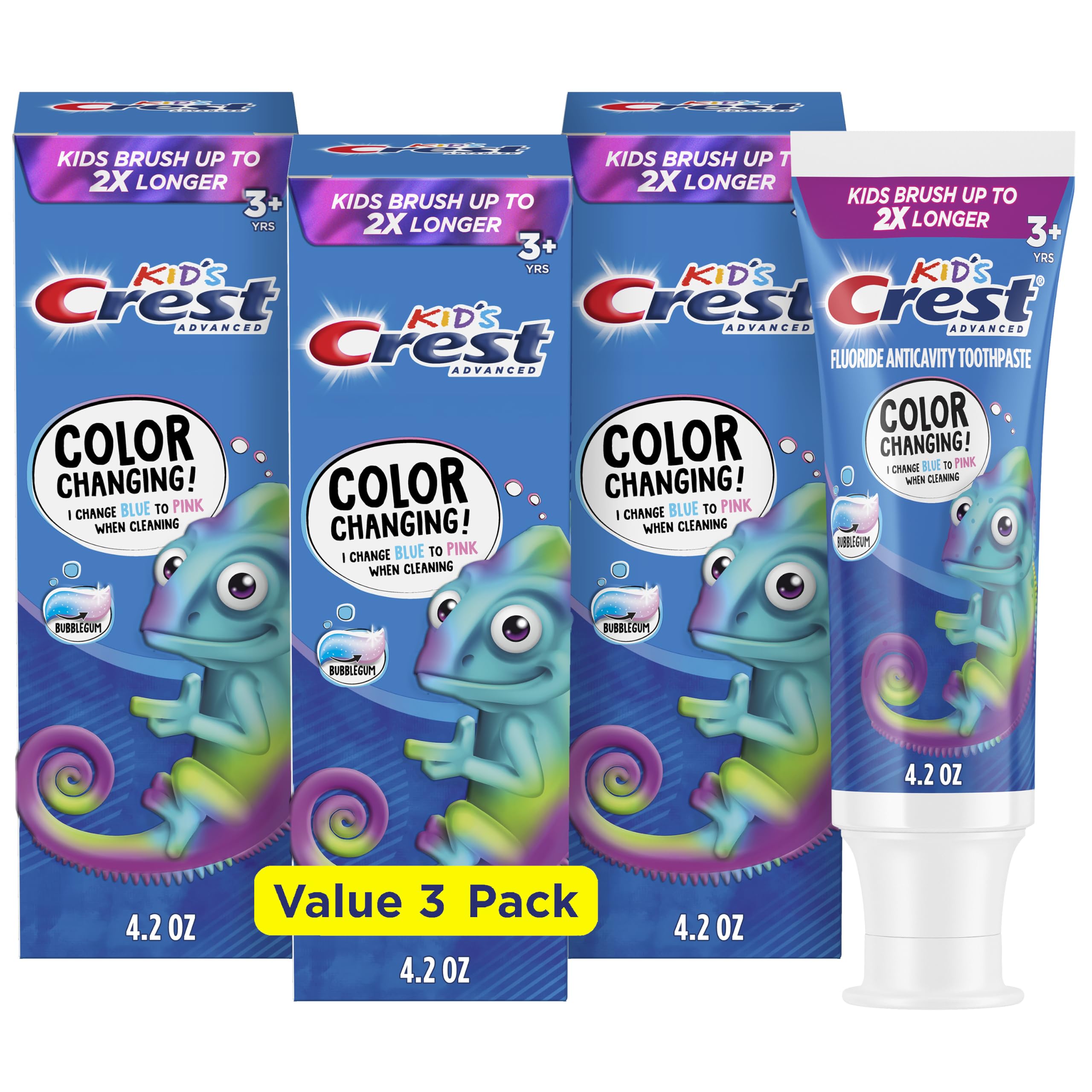
Crest Color-Changing
Key Features
- Size: 4.2 oz, 3 tubes
- Flavor: Bubble gum
- Color shift: Blue to pink
- Price: Midrange
A two-minute timer a child can see inside their own mouth is a smarter idea than most kids’ toothpaste gimmicks, and this is the one product here that changes brushing behavior rather than just flavor.
The paste starts blue and shifts toward pink as brushing goes on, so the finish line is visible: if it’s still blue, you’re not done. That’s the difference between this and a sand timer on the shelf — the child is watching their own mouth rather than a gadget across the bathroom, and it’s the reason a three-year-old who used to spit after twenty seconds keeps going to see the color turn.
Underneath the trick it’s a solid bubble-gum fluoride paste, three 4.2-ounce tubes to a pack, and the flavor is mild enough that the color is doing the persuading rather than the taste.
The trick only works when the color cooperates, and it doesn’t always: some tubes shift only partway, which leaves you with an ordinary bubble-gum paste and a child who has noticed. It also costs more per tube than the plain Sparkle Fun, so you’re paying for the timer — worth it if brushing length is your problem, wasted money if it isn’t.
Pros
- Visible blue-to-pink brushing timer
- Encourages longer brushing without nagging
- Mild bubble-gum flavor
- Three tubes per pack
Cons
- Color doesn’t always complete the shift
- Costs more per tube than our top pick
We buy the color-changing Crest for the child who quits after thirty seconds: the blue-to-pink shift gives them a finish line they can see.
Best for Sensitive Teeth
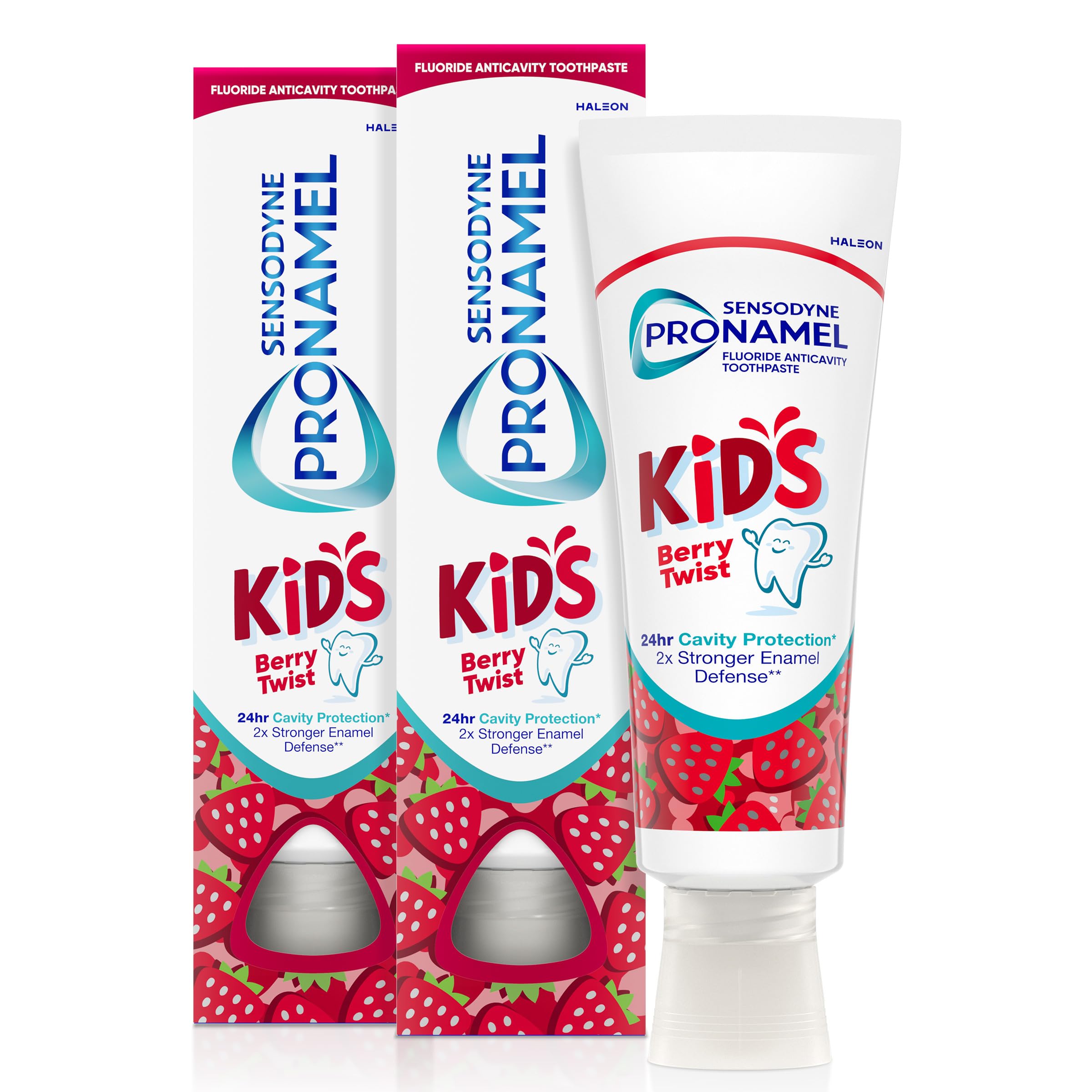
Sensodyne Pronamel Kids
Key Features
- Ages: 2 and up
- Size: 4 oz, 2 tubes
- Flavor: Berry Twist
- Free from: SLS, sugar, parabens
- Price: Midrange
Most kids’ toothpastes are designed around flavor. This one is designed around enamel: Pronamel’s pitch is acid erosion and a gentler clean for children whose teeth are sensitive or whose enamel the dentist is keeping an eye on.
It’s SLS-free, sugar-free and paraben-free, and it’s the only paste in this group sold on acid-erosion protection rather than cavity protection alone. Two 4-ounce tubes, labeled for ages 2 and up, with a natural berry flavor.
We keep it for a specific child: the one who flinches at strong flavors or says brushing hurts. The berry is the softest flavor in this group, the foam is restrained, and it’s the paste a sensitive mouth is least likely to complain about — which is the whole battle when a child is already wary of the brush.
Two things surprise people. The berry has a twist of mint, faint but present, so a mint-averse child may still notice it. And the pink color comes from a red dye that isn’t obvious from the front of the tube — if dye-free is the reason you’re shopping, read the inactive ingredients before you buy this one.
Pros
- Gentle on sensitive teeth and enamel
- SLS-free and sugar-free
- Softest berry flavor here
- Ages 2 and up, two tubes
Cons
- Contains a red dye
- Faint mint note some kids notice
Sensodyne Pronamel Kids is our pick for sensitive teeth and watched enamel, with one caveat: a red dye that surprises parents shopping for a clean label.
Best for Ages 2 to 6
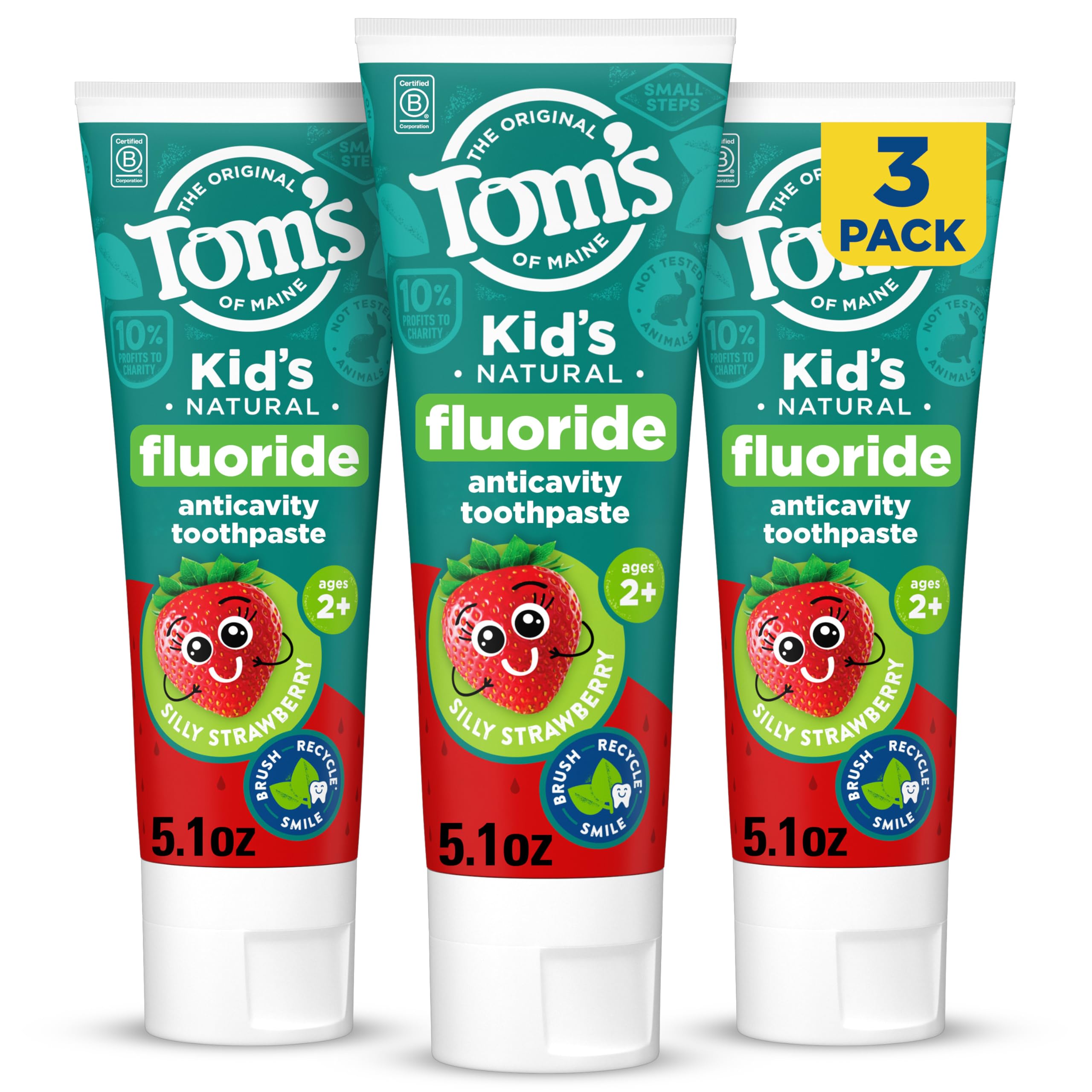
Tom’s of Maine Kids
Key Features
- Ages: 2 to 6
- Size: 5.1 oz, 3 tubes
- Flavor: Silly Strawberry
- Free from: Artificial dyes and sweeteners
- Price: Midrange
Strawberry should be the easiest sell in kids’ toothpaste, and this one is made with real fruit juice, which is exactly why it’s love-it-or-leave-it. It tastes like fruit rather than candy, and a child who expects the candy version may refuse it after a single brush.
We still point to it for a particular household: one that reads labels and wants the biggest tubes on the shelf. At 5.1 ounces these are the largest in the group, the label covers ages 2 to 6 — the window when a child is learning to spit rather than swallow — and the formula skips artificial dyes, sweeteners, flavors and preservatives entirely.
It’s also gluten-free, vegetarian and not tested on animals, which matters enormously to some families and not at all to others. The paste itself is a soft, mild strawberry with no mint anywhere in it, and it doesn’t foam into a mouthful that a small child has to manage.
The format is the real commitment: three big tubes is more toothpaste than most families use in a season, and there’s no single tube to try first. If your child has never had strawberry, that’s a lot of paste riding on one first impression.
Pros
- No artificial dyes, sweeteners or preservatives
- Largest tubes in this group at 5.1 oz
- Labeled for ages 2 to 6
- Real fruit juice flavor, no mint
Cons
- Flavor is love-it-or-leave-it for kids
For label-reading families with kids aged 2 to 6, we land on Tom’s of Maine: real-fruit strawberry, the biggest tubes here, and no artificial dyes.
Best for Mint Haters
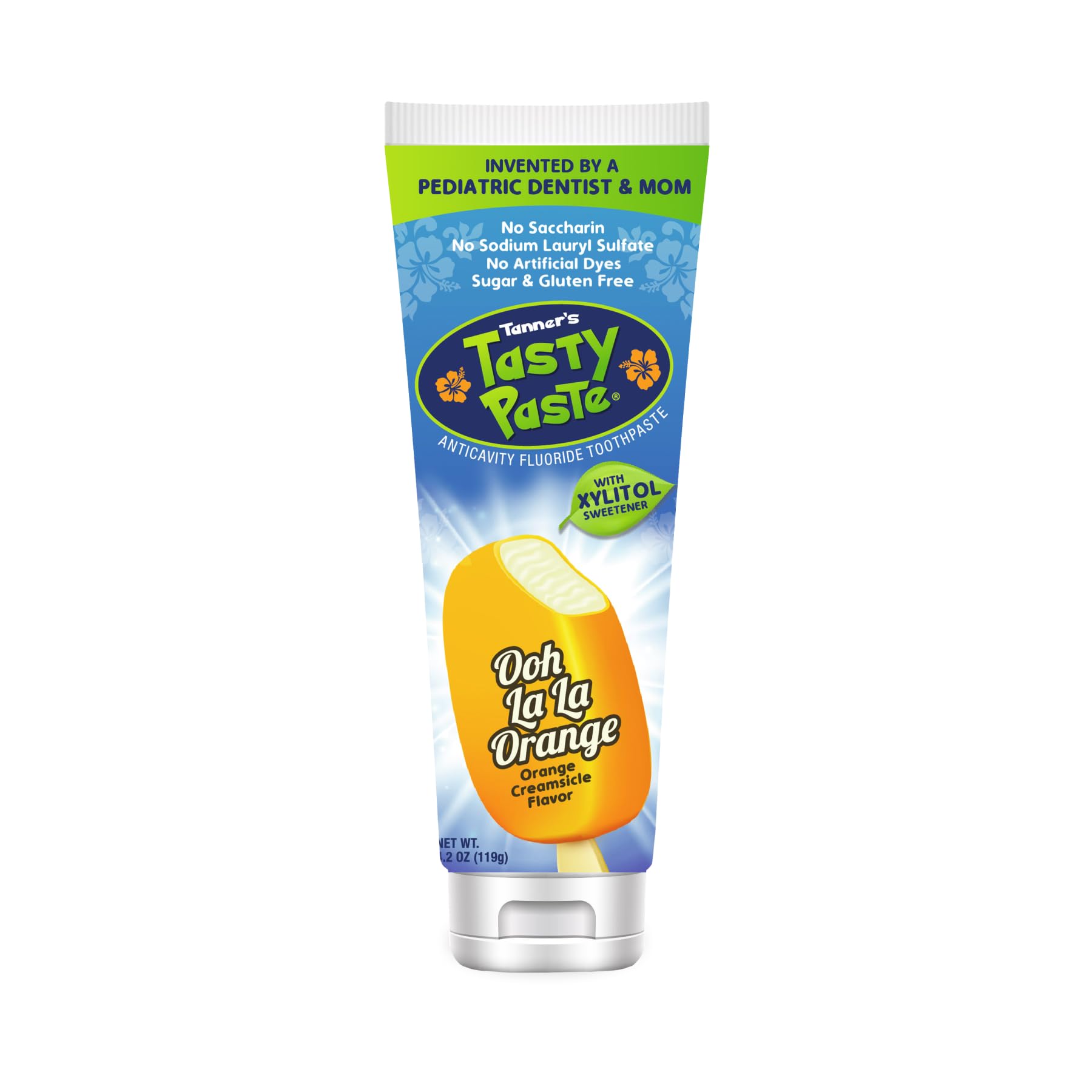
Tanner’s Tasty Paste
Key Features
- Size: 4.2 oz, 1 tube
- Flavor: Orange Creamsicle
- Free from: SLS, dyes, mint
- Price: Premium
Orange creamsicle is a flavor nothing else in this group offers, and for a child who gags on mint it isn’t a novelty — it’s the difference between a toothbrush that goes into the mouth and one that doesn’t.
The formula behind the flavor is unusually careful: fluoride for cavity protection, xylitol, no SLS, no saccharin, no dyes, sugar-free and gluten-free. It also barely foams, which is the point for a child who panics at a mouthful of bubbles and the reason this one works for sensory-sensitive brushers when a foaming gel doesn’t.
It’s a single 4.2-ounce tube, and it’s the priciest toothpaste here by a wide margin — there’s no multipack to spread the cost across. Some children also find the texture gritty, which is worth knowing before you commit to a flavor this far outside the usual bubble-gum lane.
We keep it anyway, because it solves a problem the cheaper tubes can’t: a child who tolerates no mint, no heavy foam and no strong flavor. When nothing else goes into the mouth, the expensive tube turns out to be the cheap solution.
Pros
- No mint, SLS, dyes or saccharin
- Orange creamsicle flavor for picky brushers
- Low-foam for kids who gag
- Fluoride with xylitol
Cons
- Priciest tube here
- Texture can feel gritty
We keep Tanner’s Tasty Paste for the mint-hating, gag-prone brusher: an orange-creamsicle fluoride paste that goes on smooth and barely foams.
How We Tested Kids’ Toothpaste — With Actual Kids Doing the Brushing
To build the shortlist, I started with the label, not the cartoon on the tube. I compared fluoride concentrations across more than 40 pastes sold for children, checked the age guidance printed on each box, and cut anything with vague claims or a price that felt silly for something a kid will smear on the counter. That left 14, which my team and I tested over four months in four households with children aged 2 to 8.
Every tube went into a real routine: the 7 a.m. rush before school, the 8 p.m. standoff when everyone is tired, weekend sleepovers, and one road trip where a tube sat squashed in a toiletry bag for six hours. We logged how much paste actually made it into a mouth versus the sink, whether kids spat or swallowed (a real concern for the toddler set), and how the flavor held up on the tenth brushing rather than the first. The kids rated each one themselves using a three-face scale, and the adults noted whether a fruit or mint note turned spicy halfway through a brush.
We also paid attention to everything happening around the brushing. Children opened the caps themselves, often with wet hands, and we noted which flip-tops jammed with dried paste or popped off entirely; tubes rode in cups and drawers to see whether seams split or paste leaked out. Texture got the squeeze test — whether it came out smooth or grainy, foamed enough to feel like bubbles without gagging a small mouth, and whether the color made a kid wrinkle their nose or ask for the blue one again. By week six we could tell which tubes still looked and smelled like they had on day one.
We’re still brushing with a few of these daily and will keep updating as new pastes reach the shelf.
How to Choose a Kids’ Fluoride Toothpaste
Fluoride is the part that prevents cavities and flavor is the part that decides whether the tube ever gets used twice a day, so buy for both, in that order.
Check the fluoride and the age on the tube
Every toothpaste here contains fluoride, which is the whole point — it’s the ingredient that hardens enamel and cuts decay. Where they part company is the age printed on the label. Most of our picks say 2 and up, Tom’s of Maine narrows it to 2 to 6, and plenty of anticavity pastes on the shelf are labeled 6 and up, which is a different purchase from a toddler paste. Match the label to your child before you match the flavor.
The ADA seal is a useful shortcut rather than a marketing badge: it means the cavity-protection claim has been reviewed. Crest Sparkle Fun and Colgate Bluey both carry it. Its absence isn’t a red flag — several good pastes here simply don’t display it — but when two tubes look identical otherwise, the seal is a tiebreaker.
Treat flavor as a compliance feature
The most common way a kids’ toothpaste fails has nothing to do with chemistry: the child won’t accept the taste. Mint is the usual culprit — children tend to describe it as spicy — and even a hint of it can end a routine. That’s why our picks lean bubble gum, berry and fruit, and why a no-mint orange creamsicle earns a place on this list at all.
The practical rule is one tube before three. ACT and Colgate come as singles; most of the rest arrive as multipacks, and a three-pack of a rejected flavor is a three-pack you’ll be brushing with yourself. If your child already has a flavor they trust, buy the multipack and take the savings.
Work out what gentle and natural mean on the label
Two ingredients decide how a paste feels in a small mouth. SLS is the foaming agent, and it’s the one most often blamed when a child complains of stinging or gets mouth sores; hello, Sensodyne and Tanner’s all leave it out. Dyes are the other: if a short ingredient list matters more than a bright pink gel, read the inactive ingredients rather than the front of the tube.
‘Natural’ is a marketing word, not a regulated one. What you can act on is what a paste actually leaves out — artificial sweeteners, dyes, preservatives, SLS — and which of those your child reacts to. A sensory-sensitive brusher will usually do better with a low-foam, mild-flavored paste than with any particular label.
Caps, tube size and daily friction
Caps cause more daily irritation than formulas do. A flip cap stiff enough that a four-year-old can’t open it quietly undoes the independence a kids’ tube is supposed to build, and a cap that splits at the seam leaves a sticky tube on the shelf. A hinged lid that stays attached to the tube is worth more than it sounds.
Size is the other quiet factor. A 4.2- to 4.6-ounce tube sits comfortably in a small hand, while the 5.1-ounce tubes at the big end of this group last longest but need an adult to hold them. If your child insists on squeezing their own, that matters more than the extra ounce.
Frequently Asked Questions
How much toothpaste should I put on my toddler’s brush?
A smear about the size of a grain of rice for children under 3, and a pea-sized amount from 3 to 6. Both amounts are deliberately small, so that swallowing what’s left after brushing isn’t a concern. Supervise the brushing, encourage spitting rather than rinsing, and keep the tube out of reach between brushes.
Can my child just use the family toothpaste?
Usually yes, in the right amount — the fluoride is the same ingredient. The reason to buy a kids’ tube is flavor: adult pastes are typically minty and can sting a young mouth, and a child who refuses to brush cancels out the benefit. If your child tolerates your paste, save the money; if they don’t, flavor is what you’re shopping for.
Can I put a kids’ toothpaste in my carry-on?
Only if the tube is 3.4 ounces or less, the standard carry-on liquid limit. Most of the tubes here run 4.1 to 5.1 ounces, so they belong in checked luggage. For a weekend away, a travel-size fluoride paste in a flavor your child already accepts beats decanting from a full-size tube.
Final Verdict
For most families, the Crest Sparkle Fun three-pack is the one to put in the cart: ADA-accepted fluoride, a bubble-gum gel that doesn’t sting, and the lowest cost per tube here. It’s the least dramatic recommendation on the page, and it’s the one that quietly solves brushing for years at a time.
The right alternative depends on the one thing going wrong in your bathroom. Refusing to brush at all? ACT Bubble Gum Blowout. Mouth sores or too much foam? hello Unicorn Sparkle. Sensitive teeth? Sensodyne Pronamel Kids. Mint is the enemy? Tanner’s Tasty Paste. Buy for the problem, not the packaging.
