This post contains affiliate links. We may earn a small commission when you buy through our links — at no extra cost to you.
Getting sunscreen on a kid is half negotiation, half wrestling match, and the wrong formula loses both. The chalky one gets refused; the thick one pills under a camp T-shirt. What parents need is protection that lasts through a full afternoon outside, rubs in without a fight, and feels light enough that nobody complains. Over four months, my team and I tested 14 kids sunscreens from school mornings to sprinkler afternoons and beach weekends, noting how each smelled, spread, absorbed, and held up.
Sun protection is the baseline, not the whole story. A high SPF still fails if it leaves a white cast on a squirming toddler or turns greasy by mid-afternoon. We judged value by how far a bottle stretched across faces, ears, shoulders, and reapplications, checked for residue on car seats and swimsuits, and read ingredient lists for fragrance and other additives. Skin sensitivity got equal weight: a few formulas left kids with redness, while gentler ones vanished without drama, and the picks below handled all of it.


Best for Everyday Baby
Blue Lizard Baby Mineral Sunscreen
Key Features
- SPF: 50+
- Size: 5 oz
- Active filter: Zinc oxide
- Water resistance: 80 minutes
- Price: Midrange
The color-changing smart cap is the detail that makes Blue Lizard Baby easy to live with: it shifts when UV exposure is high, so reapplication stays on your radar instead of depending on memory. Under the cap is a fragrance-free mineral formula with SPF 50+, zinc oxide, and 80-minute water resistance. For most families, that is the combination we recommend first.
It spreads more easily than the thickest zinc-heavy lotions here, which matters when you are chasing a toddler with a tube. We noticed the cream settles to a soft finish rather than a greasy one, and the 5 oz size is practical for arms, legs, and the back of the neck. It rubs in without much drag, though you still need to be deliberate around hairlines and eyebrows.
The cap is genuinely useful, not a gimmick, and the tube is large enough that you can be generous on a beach day. We wish it were a little easier to work into eyebrows and hairlines, where mineral formulas tend to collect. The flip-top is one-handed, which helps when the other hand is holding a baby. That is a small irritation in an otherwise straightforward baby sunscreen.
Pros
- Fragrance-free mineral formula
- Smart cap changes color in high UV
- 5 oz tube is generous for body use
- 80-minute water resistance
Cons
- Leaves a pale film on deeper skin
For most families, Blue Lizard Baby is the mineral sunscreen we recommend first: fragrance-free, water-resistant, and easy enough to apply before a toddler loses patience.
Best for Babies and Toddlers
Thinkbaby Baby Sunscreen
Key Features
- SPF: 50+
- Size: 3 oz
- Active filter: Mineral
- Water resistance: Yes
- Price: Midrange
Thinkbaby is the smaller tube we reach for when the diaper bag needs a mineral backup, and it has the classic baby-sunscreen profile: SPF 50+, broad-spectrum protection, and water resistance. It is a no-frills mineral formula, but it is dependable, and that counts for something when you are buying for a baby.
We like the light coconut scent, and it spreads more easily than the thickest creams here. It is still a thick lotion, so thin layers work better than one big dollop; a fidgety baby will test your patience either way. The 3 oz tube is easy to toss in a bag, but a family that spends whole days outside will go through it quickly.
For a baby’s face and smaller areas, it is a solid classic, and the water resistance holds up through a splash session. We wish the tube were larger for body application, but the size is part of why it travels well. If you want a bargain family tube, look at Thinkkids instead.
Pros
- Classic mineral SPF 50+ formula
- Light coconut scent
- Water resistant
Cons
- Leaves a white cast if over-applied
Thinkbaby is the classic mineral baby sunscreen we keep for faces and small areas: broad SPF 50+ protection in a compact, water-resistant tube.
Best for Big Kids
Thinkkids Kids Sunscreen
Key Features
- SPF: 50+
- Size: 6 fl oz
- Active filter: Mineral
- Water resistance: Yes
- Price: Midrange
The 6 fl oz tube is what sets Thinkkids apart from its baby sibling: same mineral approach, more product, and a size that makes sense for school-age kids who need sunscreen on arms, legs, and necks. It is the tube we reach for when one child has outgrown the baby stage but still needs a mineral formula.
We found it works best as a body sunscreen. It is water resistant, so it holds up through pool sessions, and it does not feel as greasy as some mineral lotions. The texture is still on the thick side, so thin layers are better. It also does not leave hands as greasy as a heavy cream.
The 6 fl oz size is the real advantage: it lasts longer than the 3 oz baby tubes and is easier to reapply generously. We skip it for a baby’s face, where a smaller tube or stick makes more sense. For camp, school, and backyard afternoons, it earns its place.
Pros
- Generous 6 fl oz tube
- Mineral SPF 50+ protection
- Water resistant for pool days
Cons
- Leaves a pale film on deeper skin
Thinkkids is the family-size mineral tube we use for bigger kids’ bodies, with water resistance and a texture that spreads without a fight.
Best for Organic-Minded Families
Badger Kids Mineral Sunscreen
Key Features
- SPF: 40
- Size: 2.9 fl oz
- Organic content: 98%
- Water resistance: 80 minutes
- Price: Premium
The first thing you notice about Badger Kids is the scent, it smells like an orange creamsicle, not a beach towel. That is a nice change from the unscented mineral lotions that dominate this group, though it will not suit a child who prefers no scent at all. The formula is 98% organic, with non-nano zinc oxide and a short ingredient list.
We also appreciate the texture: it is closer to a balm than a lotion, and it takes a bit of work to spread. Warm a small amount between your fingers first, then press it onto arms and legs. It is water resistant for 80 minutes, so it holds up through sprinklers and shallow swims. On a baby’s face, use a very small amount and blend the edges.
For families who prioritize organic ingredients and do not mind a heavier cream, Badger earns its place. It is not the pick for a quick no-fuss application, and the SPF 40 rating is lower than the SPF 50 options here. But when the ingredient list matters most, it is the one we reach for. The tube is a good size for a weekender bag.
Pros
- 98% organic formula
- Pleasant orange scent
- 80-minute water resistance
Cons
- Leaves a white tinge on skin
Badger is the organic-minded pick: a thick, plant-based mineral cream with a pleasant orange scent and dependable water resistance.
Best for Sensitive Skin
Babo Botanicals Sensitive Baby
Key Features
- SPF: 50
- Fragrance: Fragrance-free
- Active filter: Zinc oxide
- Certification: EWG Verified
- Price: Premium
The EWG Verified mark on Babo Botanicals Sensitive Baby is the first thing we look at, but the formula is what keeps it in the bag: fragrance-free, zinc oxide, SPF 50, and a texture that is lighter than the other mineral baby lotions here. It is designed for very sensitive skin, and that is exactly where it makes the most sense. It is also vegan, a detail that matters when you are reading every label.
We recommend it for reactive skin. It spreads smoothly, does not feel greasy once it sets, and the fragrance-free formula is a good match for a baby who has reacted to scented products. It is water resistant for 80 minutes, which covers a splash session but not a whole afternoon. The trade-off is cost: this is one of the pricier tubes here.
The lighter texture makes it easier to use on the face and neck, where thick creams tend to collect. We wish the tube were larger for the price, and you will need to reapply after swimming or heavy sweating. For a baby with eczema-prone or easily irritated skin, those are acceptable compromises.
Pros
- Fragrance-free zinc oxide formula
- EWG Verified
- Light texture for face and body
- 80-minute water resistance
Cons
- Leaves a slight white tint
Babo’s fragrance-free, EWG Verified lotion is the one we choose for a baby with reactive skin, provided the premium price fits your budget.
Best for Face Application
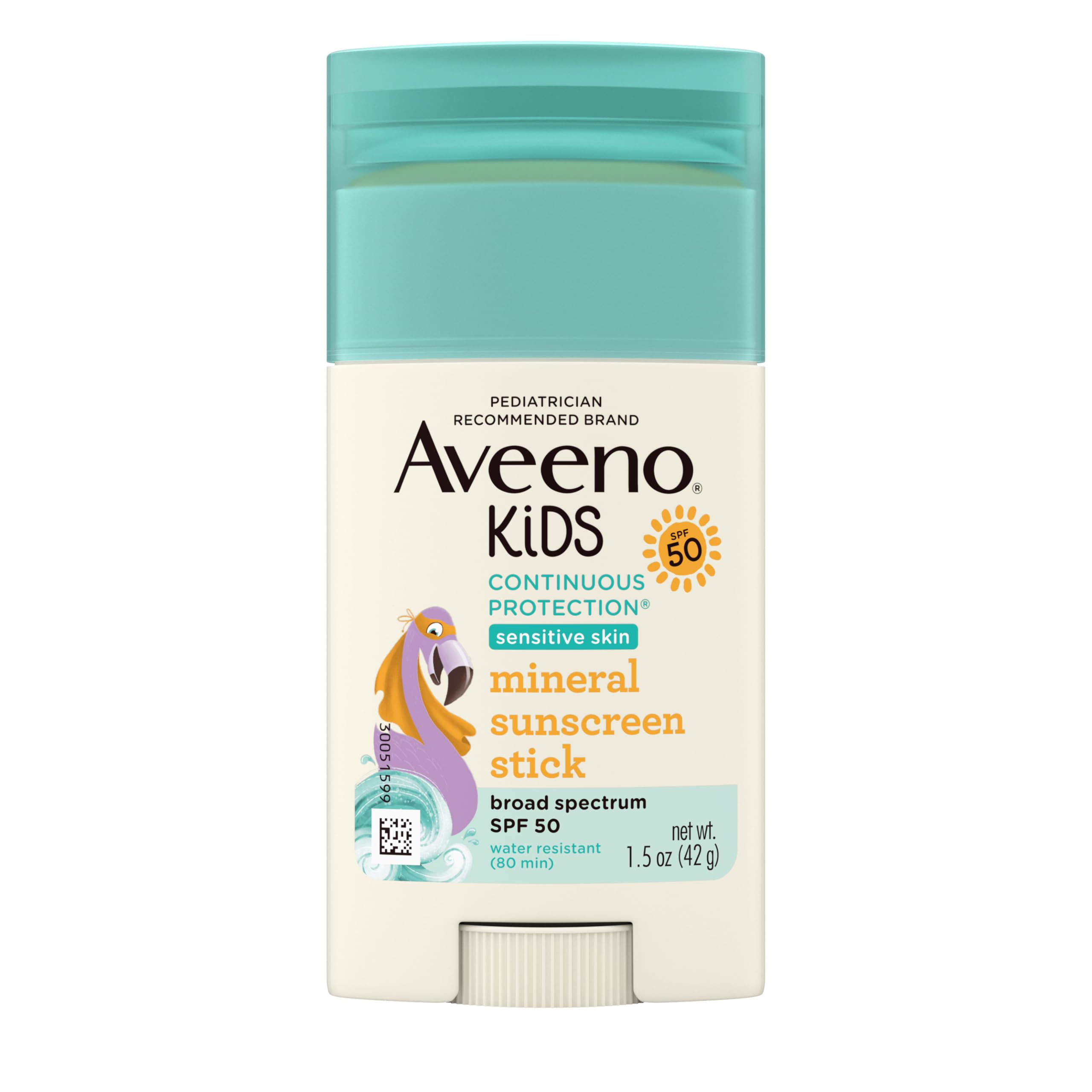
Aveeno Kids Sunscreen Stick
Key Features
- SPF: 50
- Size: 1.5 oz
- Fragrance: Fragrance-free
- Active filter: Zinc oxide
- Price: Midrange
A daycare morning is where the Aveeno Kids stick makes sense: one swipe across the nose, cheeks, and ears, and you are out the door before your toddler realizes what happened. It is a 1.5 oz mineral stick with SPF 50, fragrance-free, and water resistant, which is a useful combination for a face-only product. It is also free of phthalates and parabens, according to the label.
We found it easier to control than a lotion for faces, and it does not leave your hands greasy. The stick glides on smoothly, though it can drag if the skin is dry, so apply it after moisturizer. It is not the best choice for arms and legs, a 1.5 oz stick will not last through a full-body application.
For quick face application on a wriggling child, this is the stick we recommend. It earns its spot in the diaper bag, and it is a good option for daycare or preschool, where teachers need something simple to use. The smaller size also makes it easy to keep in a purse for weekend errands. Just do not twist it up too far or it can break.
Pros
- Quick no-mess face application
- Fragrance-free mineral formula
- Water resistant
Cons
- Leaves a visible white cast
Aveeno’s mineral stick is the quickest way to cover a squirmy toddler’s face, with a fragrance-free formula that fits in a daycare bag.
Best for Beach Days
Baby Bum Mineral Sunscreen Lotion

Key Features
- SPF: 50
- Size: 3 oz
- Active filter: Zinc oxide
- Water resistance: 80 minutes
- Price: Midrange
Baby Bum’s lotion is built for the beach: mineral zinc oxide, SPF 50, 80-minute water resistance, and a Hawaii-compliant formula. That last point matters if you are swimming in places with ingredient restrictions, and it is a useful shorthand for a reef-conscious formula. The 3 oz tube is small enough for a beach bag.
We found it spreads more easily than the thickest zinc pastes here, and it does not feel heavy once it settles. It is unscented, which is a plus for sensitive skin, though the formula itself has a faint base note. The lotion is thin enough to spread quickly, which helps when you are applying to a child who wants to get back to the sand.
The caveat is skin reactions. Some children with very reactive skin can break out from it, so patch-test on the inner arm before a full beach day. It is not the gentlest pick here for a baby with known eczema, and a fragrance-free formula from Babo or Blue Lizard is a better first choice.
For a beach vacation or a pool-heavy summer, Baby Bum is a solid mineral option, provided your child’s skin tolerates it. It is water resistant, easy to spread, and compliant with reef-focused rules. That is a useful combination for a family that spends long days outside.
Pros
- 80-minute water resistance
- Hawaii 104 compliant
- Unscented mineral formula
- Spreads more easily than thick pastes
Cons
- Leaves a white residue if not rubbed in
Baby Bum is the beach-day mineral lotion we reach for when water resistance matters, with a patch test first for a child with sensitive skin.
Best for Diaper Bag
Blue Lizard Kids Sunscreen Stick

Key Features
- SPF: 50
- Size: 0.5 oz
- Active filter: Zinc oxide
- Water resistance: 80 minutes
- Price: Budget
The 0.5 oz Blue Lizard Kids stick is small enough to disappear in a diaper bag, which is exactly the point. It is a zinc oxide face stick with SPF 50, fragrance-free, and 80-minute water resistance, useful for cheeks, noses, and ears without lotion on your hands.
We found it glides on easily and does not clump, and the small surface is good for precision around the face. It is still a mineral stick, so you need to blend the edges with a finger; a little goes a long way. It is not the product for arms and legs, where the stick runs out in a single application.
The size is also the problem. A stick this small runs out quickly if you use it on more than faces, and the cost per ounce is high. Treat it as a face-only tool, not a body sunscreen. For a school bag or a purse, that is a fair trade.
For quick touch-ups on the go, the Blue Lizard stick is a handy backup. It is precise, fragrance-free, and easy to aim. For a full day at the beach, bring a lotion too.
Pros
- Compact 0.5 oz face stick
- Fragrance-free zinc oxide
- 80-minute water resistance
Cons
- Leaves a white cast on deeper skin
Blue Lizard’s kids stick is a precise, fragrance-free face tool for the diaper bag, not a full-body sunscreen.
How We Tested Kids Sunscreens
We started with roughly 30 kid-specific sunscreens from drugstore shelves, outdoor retailers, and direct-to-consumer sites, then cut the list to 14 based on ingredient lists, stated SPF and water resistance, price per ounce, and whether the formula was mineral, chemical, or a hybrid. Those 14 spent four months in diaper bags, camp backpacks, and beach totes. We applied them before school, before swim lessons, and on weekend hikes, then checked again after two hours of sweat, sprinkler runs, and towel-drying.
At each application, we noted whether the formula came out runny, stiff, grainy, or smooth, and whether it spread evenly or needed repeated rubbing. We timed how quickly it absorbed, looked for white cast on faces and arms, and checked for greasiness or tackiness ten minutes later. We tracked residue on car seats, swimsuits, and picnic blankets, and estimated value by how far one bottle stretched across a family of four. For fragrance, we logged whether it smelled clean, plasticky, or heavily scented, and whether anyone objected.
Skin sensitivity got its own log: redness, stinging around the eyes, and breakouts on kids with eczema-prone or reactive skin. For effectiveness, we followed the same reapplication schedule and noted pink shoulders after long outdoor blocks, treating that as a real-world check rather than a substitute for lab SPF testing. The formulas that advanced were the ones that protected without a fight, rubbed in clear, and did not leave a greasy film or a scent cloud behind.
How to Choose a Non-Toxic Sunscreen for Kids
The best kids sunscreen is the one you can apply quickly, completely, and again in two hours, so we start with the formula, then the format.
Read past the non-toxic label
Non-toxic is not a regulated sunscreen claim, so treat it as a starting point rather than a guarantee. For a child, the useful version of that idea is a mineral filter, zinc oxide or titanium dioxide, plus broad-spectrum coverage and a short list of known irritants. We look for fragrance-free formulas when a child has reacted before, and we accept a scent only when the rest of the formula earns it.
SPF 30 is a reasonable baseline for everyday exposure; SPF 50 gives more margin for uneven application, which is common with kids. Higher numbers do not mean you can skip reapplication. A well-applied SPF 30 beats a patchy SPF 50 every time.
Choose the format around your child
Lotions are the most economical for arms, legs, and backs; sticks are faster for faces and small areas; sprays are convenient but need to be rubbed in and should not be sprayed directly on the face. If your child fights cream, a stick can be the difference between covered ears and a missed spot.
We keep a lotion for body days and a stick for the diaper bag. A spray can work for a quick reapplication on the beach, but use it in a well-ventilated spot and spread it with your hands. No format replaces the need to cover every exposed bit.
Expect a mineral finish
Mineral filters sit on the skin, so a pale cast is a normal trade-off, not a sign the sunscreen is failing. It shows up most on deeper skin tones and around hairlines and eyebrows. You can reduce it by applying in thin layers, warming the lotion between your fingers, and blending the edges.
A stick is often the better tool for a face because you can aim it precisely and avoid a thick smear. If the cast still bothers your child, a tinted mineral product may help, but tint is not a safety feature. Do not skip a spot just because it looks white.
Treat water resistance as a timer
An 80-minute water-resistance claim means exactly that: about 80 minutes in the water or sweating heavily, not a full afternoon. Towel drying can remove sunscreen even earlier, so reapply after a swim, a long sweaty play, or a snack break that turns into a face wipe.
We build reapplication into the routine: sunscreen before we leave, then again after the first swim and before the walk home. A stick or small tube in the bag makes that second application more likely. The best water-resistant formula is still the one you actually put back on.
Match the size to how you apply it
A 0.5 oz face stick is a precision tool, not a body sunscreen; a 5 or 6 oz tube is the better buy for arms and legs. Price per ounce matters more than the sticker price, especially with mineral formulas that need generous application.
We like a large tube for the beach bag and a small stick for the car or daycare. If you are choosing only one, pick the size that matches the area you cover most often. For full-body application, a family-size tube usually wins.
Frequently Asked Questions
Can I use my own adult sunscreen on my child?
A mineral kids formula is the safer default for faces and frequent reapplication, since it is often fragrance-free and less likely to sting the eyes. If you use an adult mineral sunscreen, check for fragrance and follow the same reapplication schedule. Do not use an adult chemical formula on a baby without checking with a pediatrician.
How do I get mineral sunscreen off at bath time?
Use warm water, a soft washcloth, and a mild cleanser; zinc can cling to eyebrows, hairlines, and creases. For stubborn spots, massage a little oil-based cleanser or baby oil into the skin first, then wash. A second pass with the washcloth usually does it.
What should I do if my child gets a rash from a new sunscreen?
Stop using it, wash the area with mild soap and water, and note the product so you can avoid it. Patch-test the next sunscreen on the inner arm for a day before a full application. If the rash spreads, blisters, or comes with breathing trouble, seek medical care.
Final Verdict
Blue Lizard Baby is the tube we keep by the door: fragrance-free, mineral, water-resistant, and easy to spread before a toddler loses patience. The smart cap is a useful nudge, not a gimmick. If you want a smaller bag sunscreen, Thinkbaby is the classic; if you need a fast face stick, Aveeno is quicker. For organic ingredients, Badger is the choice, just expect a thicker cream.
