This post contains affiliate links. We may earn a small commission when you buy through our links — at no extra cost to you.
A beach day with a baby is a game of chasing shade. The sun moves, the breeze picks up, and your setup—blanket, umbrella, pile of towels—ends up blowing down the sand or baking like a parked car. A good baby beach tent fixes that: it gives you a dedicated, shaded, sand-friendly spot where your baby can nap, crawl, or cool off while you watch the waves. The catch: a tent can look sturdy and still collapse in the first gust or turn into a greenhouse by noon.
I spent a summer with ten tents, pitching each solo, staking on windy days, and crawling inside to check airflow and heat. The best set up in under two minutes, packed into a shoulder bag, and offered real sun coverage plus mesh panels that kept the interior from turning into an oven. I also noted whether the size fit a baby plus a diaper bag, and how fabric, zippers, and stake loops held up after beach trips. The picks below earned a permanent spot in my beach bag.


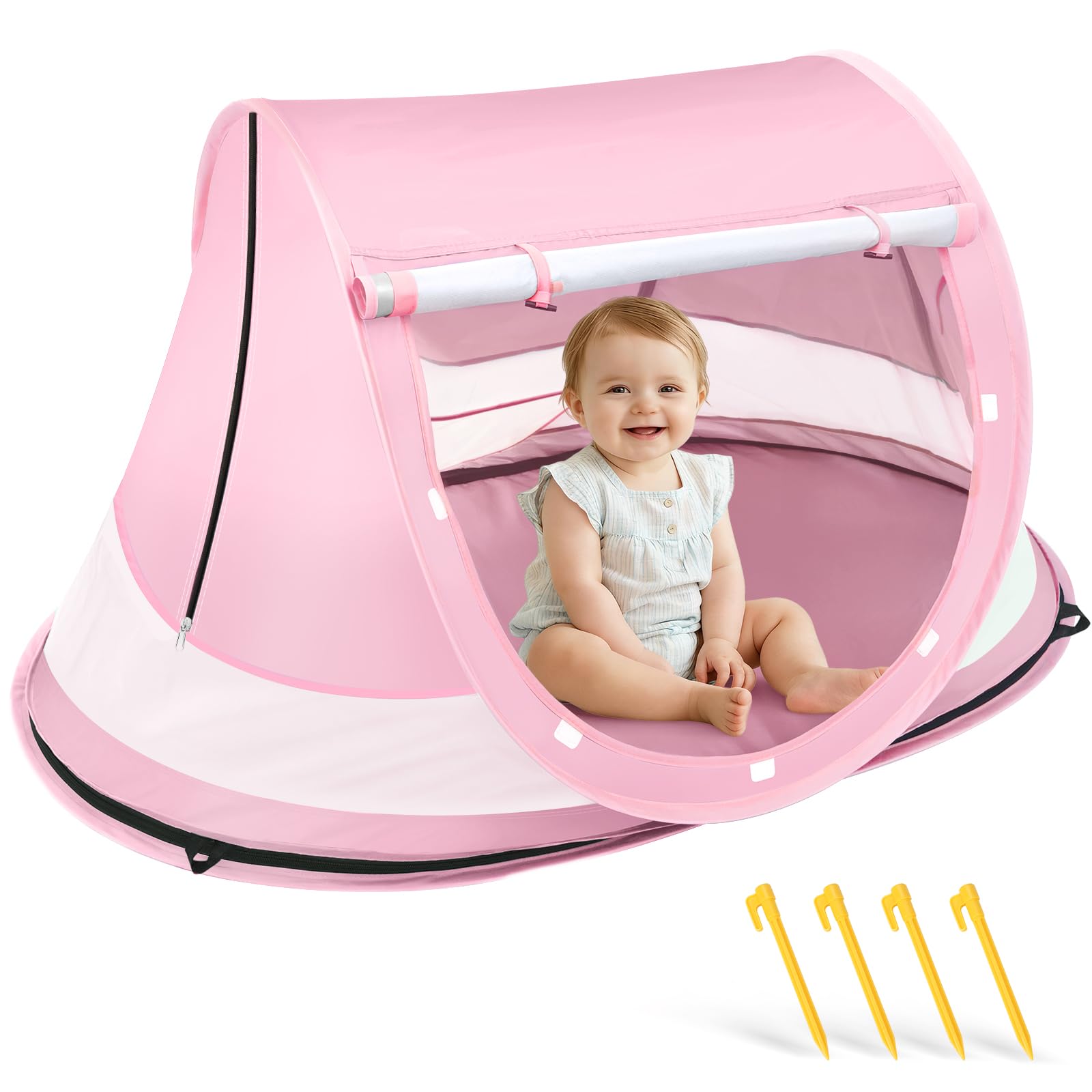
Best for All-Round Beach Shade
Kapeazo Baby Beach Tent
Key Features
- Weight: 1.3 lb
- UV rating: UPF 50+
- Floor area: 13.14 square feet
- Peak height: 26 inches
- Price: Midrange
Fifty-four by thirty-five inches works out to 13.14 square feet, and that number is why this tent is our default. It takes a bouncer seat or a folded quilt and still leaves a crawling baby somewhere to go, which is more than most of the tents here manage at 1.3 pounds.
The rest of the package is quietly competent: UPF 50+ silver-coated nylon, four pegs, a carry bag, and mesh panels on every side so you can watch a baby from your chair without opening anything. On an open beach we loaded the corners with a beach bag as well as pegging them, and it sat still through a steady onshore breeze. That’s the afternoon this tent is built for.
Getting it back down is the part to rehearse. Pop-up shells open in a second and then argue with you, and the carry bag has a QR code to a folding video for exactly that reason. The first collapse is the only one that’s ever hard — do it at home on a carpet, not with a tired baby and a rising tide.
What we like most is how little of the day it takes up. It goes up while the cooler is still being unpacked, it comes down before the walk back to the car, and by the second trip nobody in the family thinks about it at all.
Pros
- Largest usable floor in this group
- Genuine UPF 50+ with silver coating
- 1.3 pounds with pegs and carry bag
Cons
- Low 26-inch peak; you can’t sit inside with your baby
For most families this is the one: the biggest usable floor in the set, honest UPF 50+ cover, and 1.3 pounds to carry.
Best for Still, Hot Days
Dsquu Fan Beach Tent
Key Features
- Fabric: 210D Oxford polyester
- Cooling: Solar panel, 4000mAh battery
- UV rating: UPF 50+
- Interior dimensions: 47.5 x 31.5 x 35.5 inches
- Price: Midrange
A fan hangs from the ceiling of this tent, fed by a 4000mAh battery and a small solar panel, and that single addition changes a windless afternoon. Shade alone doesn’t cool anything; moving air does. That’s the case for paying more than a plain pop-up, and after a still day on the sand we think it holds.
The tent underneath is solid: 47.5 by 31.5 inches of floor with a 35.5-inch peak, tall enough for a toddler to stand and for you to reach in over the top. Four walls of dense PE mesh do most of the ventilating, with 210D Oxford and a silver coating over the canopy for UPF 50+ cover. Hanging the fan from the ceiling rather than clipping it to a wall is the decision that matters — the airflow lands on the baby, not the fabric.
What you accept in return is one more object to charge and keep track of, plus a battery and a switch that are the only electronics in this guide and therefore the only thing that can fail electronically. Leave the tent out in the open rather than under a tree and the panel does the charging for you between trips.
Pros
- Ceiling fan cools a still, shaded interior
- 35.5-inch peak suits standing toddlers
- Mesh on all four walls
Cons
- Needs its own anchoring when the wind picks up
On still, hot days the ceiling fan earns its keep, and that’s the reason to choose this over a plain shell.
Best for Newborns and Naps
Babymoov Babyni Tent
Key Features
- Weight: 1.2 lb
- Bug net: Built in
- UV rating: UPF 50+
- Dimensions: 37.4 x 29.5 x 19.7 inches
- Price: Premium
A newborn can’t wear sunscreen yet and can’t sit up, which makes most beach tents useless for the first few months. This one is built for that baby: a low dome 37.4 by 29.5 inches across and just 19.7 inches high, with a padded base and a mosquito net built into the opening.
It weighs 1.2 pounds and the frame is aluminium, so it goes up with one hand while the other hand holds the baby. The cover is UPF 50+, rated to block 99% of UVA and UVB, and the closure is Velcro rather than a zip — which sounds like a small thing until you’re opening it one-handed beside a sleeping baby.
That’s where it earns its keep for us: as a cot you can put down on the sand, not a play tent. The padded floor means you aren’t also packing a blanket, and it folds to something you can hang off a stroller handle. Once your baby is crawling and wants out, move to something with headroom.
Pros
- Padded base doubles as a nappy-change mat
- Velcro closure opens quietly one-handed
- Built-in mosquito net keeps bugs off
Cons
- Fabric isn’t water resistant
For a newborn who lies flat and can’t wear sunscreen yet, this padded, bug-netted dome is the kindest shade here.
Best for Sitting-Up Toddlers
Babymoov Anti-UV Tent
Key Features
- Weight: 1.5 lb
- UV rating: UPF 50+
- Dimensions: 39.6 x 35.4 x 33.5 inches
- Floor area: 1336.6 square inches
- Price: Premium
This is the most expensive tent we’re recommending, and the money buys headroom: 33.5 inches at the peak and 39.6 by 35.4 inches of floor, enough that you can unzip the door and sit inside with a toddler instead of crouching at the entrance. That’s a different job from the low domes here, and it’s why this one stays on the list.
Around that space Babymoov has built a proper little room: a stainless steel frame with fibreglass poles, mesh windows on the sides, a mosquito net, an integrated floor mat and a few sensory details on the walls. The zip runs smoothly and closes the tent completely, which matters on a buggy evening.
Weight is the surprise. At 1.5 pounds it’s barely heavier than our top pick despite standing eight inches taller, so the extra size costs you almost nothing in the carry. The sewn-in mat is the other detail we appreciated: no separate blanket sliding off into the sand, and one less thing to shake out at the end of the day.
Pros
- Tall enough for an adult to sit inside
- Sewn-in mat keeps sand out of the floor
- Zip door and mosquito net close it fully
Cons
- Heats up on still days; airflow is its weak point
Buy this if you want to sit inside with your toddler: 33.5 inches of headroom and a zip door, at a premium.
Best for Budget Beach Trips
Techip Pop Up Beach Tent
Key Features
- Pegs: 4 included
- UV rating: UPF 50
- Dimensions: 54 x 33 x 25 inches
- Floor area: 1890 square inches
- Price: Budget
The shape will look familiar if you’ve read the top pick: 54 by 33 inches, silver-coated 190T nylon, four pegs, mesh on every side. The Techip is that same kind of tent for noticeably less money, and it earns its place for exactly that reason.
Judged on that basis, it’s excellent value. The floor is nearly the size of our top pick’s, so a big baby gets the same room to roll around in, and the sun protection is the same silver-coated fabric rather than a token panel at the front. For a first summer, a second tent for the grandparents’ house, or a trip where luggage space is tight, that’s the sensible buy.
The catch is height. Twenty-five inches at the peak means a sitting toddler’s head sits close to the fabric, and a tall three-year-old will want out. Folded, it goes down to a disc that tucks behind a car seat, and the four pegs are the same pegs every tent this size ships with.
Pros
- Full-size floor for the least money here
- Four pegs and full-coverage silver coating
Cons
- Thin fabric and a light frame won’t last for years
The cheapest way into a full-size beach tent that still blocks the sun; just accept thinner fabric and a lower roof.
Best for Tight Car Trunks
Tiny Land Baby Beach Tent
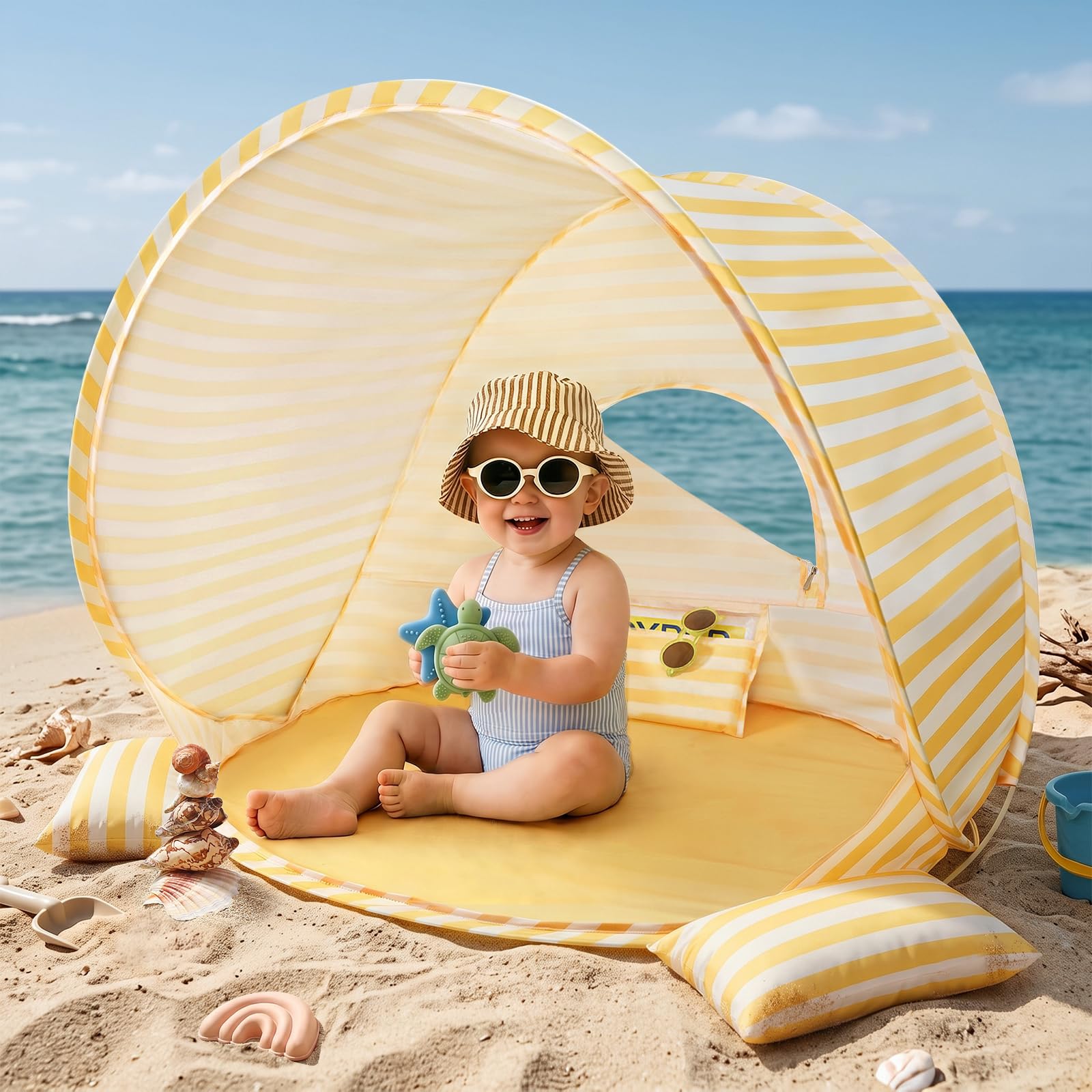
Key Features
- Weight: 1.3 lb
- Dimensions: 35.4 x 27.6 x 31.5 inches
- Floor area: 975.64 square inches
- Pole material: Plastic
- Price: Midrange
Round and tall is an unusual combination at this size: a 35.4 by 27.6 inch floor under a 31.5-inch dome, so a baby gets headroom without the tent claiming half your patch of sand. Next to the wide, low shells here, it looks like a small pavilion.
It pops open one-handed and weighs 1.3 pounds, and it has travelled in a suitcase without complaint from anyone carrying it. Two babies can lie in it side by side for a nap, which is more than the footprint suggests at first glance.
The listing contradicts itself, though: the title promises UV protection while the specification list says no. We don’t think that makes it a bad tent — it makes it shade you add sunscreen and a hat behind rather than rated cover, which is a real difference on a bright day. If you want a small, tall dome and you’re bringing the sunscreen anyway, it’s a lovely thing; if you want a stated UPF rating, buy one of the others.
Pros
- Tall dome on a genuinely small footprint
- Pops open one-handed, 1.3 pounds packed
- Roomy enough for two napping babies
Cons
- Interior runs warm; ventilation is limited
A tall, small-footprint dome for one baby and a nap — as long as you don’t count on it for rated UV cover.
Best for Quick Trips Out
Pivoryla Pop Up Baby Tent
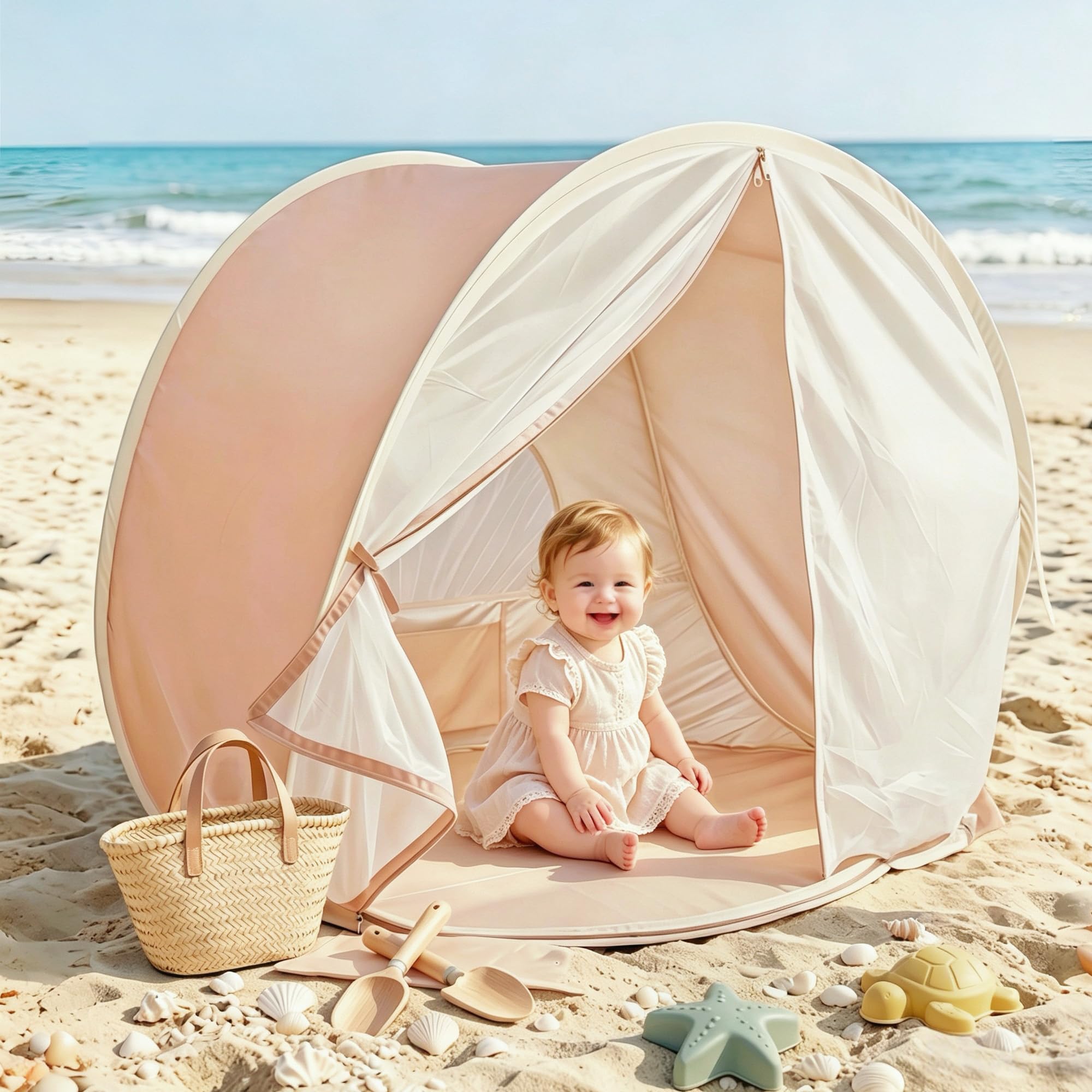
Key Features
- Weight: 1.2 lb
- UV rating: UPF 50+
- Dimensions: 37 x 29 x 33 inches
- Sand pockets: 3 reinforced
- Price: Budget
At 1.2 pounds this is as light as anything in the guide, and at 37 by 29 inches open it’s the one that disappears into the car and comes out whenever the shade has moved. It’s the tent you stop noticing you brought.
Three large reinforced sand pockets are the reason it holds on soft, dry sand, where pegs pull straight out. Fill them, dig them in, and the tent stays put in a way a four-peg shell doesn’t — we tested that on the loose stuff at the top of the beach, and it made the difference between shade and a chase.
Above the base it’s a proper shelter: silver-coated fabric for UPF 50+, high-density mesh on the walls to keep sandflies out while the air moves, 33 inches of headroom and four steel stakes for the firmer ground. We didn’t find anything improvised about it.
For a quick hour of shade, or a whole afternoon with a baby who mostly lies down, it does everything the bigger tents do with far less to carry. Set it up once and you stop thinking about it, which is the highest compliment a beach tent can get.
Pros
- 1.2 pounds with 33 inches of headroom
- Sand pockets hold where pegs won’t
Cons
- Small floor suits one baby and little else
When the trunk is already full, this is the tent that still comes along: light, quick, and properly shaded.
Best for Room for Two
NXONE Pop Up Baby Beach Tent

Key Features
- Anchoring: Sandbags, stakes, guy lines
- Main door: No-zipper, easy open
- UV rating: UPF 50+
- Dimensions: 50 x 50 x 41.5 inches
- Price: Midrange
The main door doesn’t have a zip. It’s an easy-open flap at kid height, so a toddler can get in and out without help and nobody’s fingers get caught in a slider. Small design decision, large effect on how a beach afternoon actually goes.
The rest of it is the roomiest shape here: 50 by 50 inches of floor and a 41.5-inch peak, closer to a small play tent than a baby dome, with a silver-coated interior for UPF 50+ and mesh panels for air. Two children fit without negotiation.
Anchoring is the most complete in this group — sandbags, ground stakes and guy lines all included — which is what you want on an open beach, and the fabric is water-repellent enough for a light shower or a spilled bucket. The whole thing still folds into a bag you can carry over one shoulder.
Where it gives ground is footprint: that 50-inch square needs a clear patch of sand, and on a crowded August beach that isn’t always on offer. If you have the space and more than one small child, this is the tent we hand over — just claim your patch before you unpack the cooler.
Pros
- No-zip door a child can open alone
- Roomiest floor and tallest peak here
- Full anchoring kit included
Cons
- Large footprint needs a clear stretch of sand
The one to get if you want room for a toddler plus a sibling, with a door a child can work alone.
How We Chose and Tested Baby Beach Tents
We started by pulling together every baby beach tent we could find from major retailers and specialty baby brands—about 30 models in all—then narrowed the list by reading specs, customer reviews, and the features that actually matter on sand: UPF rating, stake loops, mesh panels, packed size, and claimed setup time. We cut anything that required two people to pitch, lacked a floor, or had a carry bag that looked flimsy. That left ten tents, which we tested over the course of one summer.
Testing happened where these tents actually live: on beach days with a six-month-old and a toddler in tow, in a windy backyard, at a park with no shade, and on a weekend trip to a lake. For each tent, I timed setup and takedown solo with a stopwatch, staked it in loose sand and packed sand, then checked after an hour whether the corners had pulled free. I crawled inside on a 90-degree afternoon to see whether the mesh panels moved air or just let heat build up, and I loaded the interior with a diaper bag and a beach tote to see what actually fit. After each use, I folded every tent back into its carry bag, noted whether it went in easily or turned into a wrestling match, and carried the packed bag by its handle for a short walk to the water.
The tents that rose to the top shared a few traits: setup under two minutes without swearing, a bag that slung over one shoulder, real shade over the whole floor, and enough airflow that the interior stayed noticeably cooler than the sand. The ones that failed did so in predictable ways—stakes pulled out in a gust, zippers jammed after a single sandy afternoon, or the packed tent was too bulky to carry along with a baby. We kept using the top contenders through the end of summer to see how they held up, and we’ll update this list if anything changes.
How to Choose a Baby Beach Tent
The tent that saves a beach day isn’t the fanciest one — it’s the one you can put up, keep shaded and get back in the bag before your baby loses patience.
Shade Is a Rating and a Shape
UPF 50+ is a fabric rating, and nearly every tent here claims something close to it, so the number alone won’t separate them. Shape does. A tall canopy keeps the sun off a sitting child but lets low, late-afternoon light in under the hem, while a low dome like the Babyni’s 19.7 inches wraps a lying baby in shade from most angles.
Whichever you pick, plan to move the tent as the sun swings, or choose one with a roll-down panel you can drop on the sunny side. And remember what the rating covers: the fabric panels, not the open door, the mesh or the gap along the sand.
Floor Area and Headroom
Among our picks, floor area runs from about 7.5 square feet to more than 17, and peak height from under 20 inches to over 40. A baby who only lies down needs very little: enough floor for a mat and a nappy change, and shade that reaches the sand.
Once your baby sits up, headroom matters more than width, and 30 inches or so lets a toddler play without folding over. If you want to sit inside with them, look for 33 inches and a zipped door — which is the Babymoov Anti-UV’s whole argument.
The Fold-Down Nobody Warns You About
Every pop-up tent here opens in about a second, and almost none of them closes that way. Folding is the one skill this category demands, and it’s what turns a good beach afternoon into a wrestling match with springy fabric.
Rehearse it at home, on a carpet, before the trip — most bags now carry a QR code to a folding video. Then collapse it on the beach while the tent is empty rather than with a baby inside it. Wind turns an open, unpegged tent into a kite in seconds.
Pegs, Pockets and Wind
Look at what holds the tent down before you look at anything else. Pegs work in firm, damp sand and pull straight out of the loose dry stuff at the top of the beach, so dig sand pockets in and pile sand on the upwind edge instead. Guy lines help on an open shore, and a tent with only pegs can still be weighted with a beach bag on each corner.
Take it down when you leave, even for a swim. An empty tent in a gust travels further than you think, and chasing one across a beach is the worst possible use of a holiday.
Airflow and Heat
Shade is not the same as cool. Mesh panels on all four sides keep air moving and let you watch the baby without opening anything, and a built-in fan, as on the Dsquu, adds real airflow when there’s no breeze at all.
On a still day, turn the mesh toward the water, leave the door open and check the back of your baby’s neck rather than the air temperature. If a tent only vents through two flaps on the same side, expect a warmer interior than the pictures suggest.
Frequently Asked Questions
Do I still need sunscreen inside a UPF 50+ tent?
Yes, on any skin the canopy isn’t covering. UPF 50+ describes the fabric panels, not the open door or the gap under the hem, and sand and water bounce a surprising amount of UV back up at a baby’s face.
A hat, a long-sleeve swim top and sunscreen on hands and feet cover the rest. Reapply after every trip into the water, not just at lunchtime.
Can my baby sleep overnight in a beach tent?
No. These are shaded play spaces with a thin floor, no mattress and no firm, flat sleep surface, and none of them is designed for unsupervised sleep.
A nap on the sand with an adult sitting beside the tent is a different matter, and it’s exactly what the Babyni’s padded base is for. For nights, bring a travel crib.
How do I get sand and salt out without ruining the coating?
Shake it out upside down, wipe the floor with fresh water and let it dry completely in the shade before it goes back in the bag. Salt and grit folded into a silver-coated floor abrade the coating over a summer.
A soft brush handles the seam where the floor meets the wall. Skip the washing machine — the frame won’t survive it.
Final Verdict
If you want to buy once and stop reading, choose the Kapeazo. It gives you the largest usable floor in this group, a genuine UPF 50+ canopy, four pegs and 1.3 pounds to carry, and its fiddly fold is a skill you learn once rather than a fault.
Two things change the answer. A newborn who can’t sit up belongs in the Babymoov Babyni’s padded, bug-netted dome, and a windless, baking beach justifies the Dsquu’s ceiling fan. If you plan to sit inside with your toddler, the taller Babymoov Anti-UV is the one worth the extra.
