This post contains affiliate links. We may earn a small commission when you buy through our links — at no extra cost to you.
A baby gate has one job, and it has to do it every single time. That sounds simple until you’re measuring a doorway, eyeballing the baseboard, and realizing you’ll be opening and closing this thing dozens of times a day. The right gate makes the safety part feel automatic: it’s sturdy enough to lean on, easy to open with one hand, and tidy enough that you don’t mind looking at it for the next couple of years.
I’ve learned that fit is where most gate shopping goes sideways. A gate that’s technically the right width can still wobble, scrape paint, or leave a pass-through so narrow that you’re sidestepping a laundry basket every time. Over six months, our team tested 12 baby gates in real doorways and at the top and bottom of stairs, paying attention to installation, daily function, stability, adjustability, and whether each one was actually worth the money. Measure the opening in three places — top, middle, and bottom — because old houses are rarely square, and the picks below are the ones that held up to all of it.


Best for Doorways and Stairs
Cumbor Auto-Close Baby Gate
Key Features
- Height: 30.5 in
- Mounting: Pressure or hardware
- Auto-close: Yes
- Fits openings: 30-46 in
- Price: Premium
The Cumbor’s width range is why it holds the top spot. Thirty to 46 inches covers a standard doorway, a hallway, and most stairway openings, and it does that with either mounting method in the box: pressure-fit it without touching a screwdriver, or bolt the brackets to a stairway wall and hang the gate on them. Of everything here, it is the one we can recommend without first asking where it is going.
The door is where the everyday value shows up. It swings both ways, closes itself when released below 90 degrees, and stays put where you park it past 90 — useful when you are carrying a basket through. The double-lock handle takes a squeeze and a lift at the same time, which is enough to stop a two-year-old and still works one-handed once you have done it twice.
The carbon steel frame is a step up from the budget gates here, and the brown finish disappears against dark wood, which is worth having when the gate sits in a hallway you look at all day. Measure at the skinniest point of the opening, baseboards included, because 30 inches is a hard floor. And for a stairway, the hardware brackets are the correct choice.
Pros
- Fits 30 to 46-inch openings
- Pressure or hardware mounting in one box
- Closes and latches itself below 90 degrees
- Double-lock release works with one hand
Cons
- Can shift under a leaning child in pressure mode
- Around 14 pounds to move between openings
We recommend the Cumbor as the default gate for most homes: it covers doorways and stairs, mounts either way, and closes behind you.
Best for Wide Open-Plan Spaces
Toddleroo Deluxe Décor Gate
Key Features
- Height: 30 in
- Mounting: Hardware
- Fits openings: 38.3-72 in
- Walk-through door: 25.5 in
- Price: Premium
Seventy-two inches is a long way. This is the gate for the opening no standard barrier reaches — the pass-through between a kitchen and a living room, a wide hallway, the gap beside a wall of built-ins. It covers 38.3 to 72 inches, and it does that with one unit rather than a stack of extension bars bolted end to end.
We think it is the best answer here for a genuinely wide opening, and the mount is the reason. It is a pair of wall plates rather than a tension fit: the gate hangs on the plates, lifts off when you want the opening back, and holds the line across six feet without bowing in the middle.
The details are better than the price suggests. The walk-through door is 25.5 inches wide, the easiest of these to carry a laundry basket through, and the handle is a two-step press and lift that adults manage with one hand. The matte bronze finish reads as furniture trim rather than baby equipment, and the paper template included for the wall screws is the difference between a twenty-minute job and an afternoon of guessing. Get the frame level before you tighten anything, because that is what makes the latch land cleanly every time.
Pros
- Covers openings up to six feet wide
- 25.5-inch walk-through door
- Lifts off its wall plates when not needed
- Matte bronze finish reads as furniture
Cons
- Too wide for a standard doorway
- Hinged panels need lining up on an uneven wall
If your opening is measured in feet rather than inches, this is the gate to buy: a hardware-mounted barrier that reaches 72 inches in one piece.
Best for Top of Stairs
Toddleroo Easy Swing & Lock Gate
Key Features
- Height: 31 in
- Mounting: Hardware
- Fits openings: 28.68-47.85 in
- Swing control: Both directions
- Price: Midrange
One rule matters more than any feature at the top of a staircase: the gate has to be screwed into the wall. A pressure fit can work loose under a child’s weight, which is why every maker here says the same thing. This Toddleroo is built for that job — hardware only, 31 inches tall, and, the part we care about most, no bar across the bottom to catch a foot on the landing at night.
The swing control is what separates it from a plain stair gate. You set the direction the door opens, and at the top of a staircase you set it to swing away from the drop, so a child leaning on it cannot push it outward over the stairs. The frame is matte bronze steel at 8.3 pounds, and the latch is a press-and-lift at the top rail rather than a handle at toddler height.
We rate it the strongest choice here for a staircase, with one caveat worth testing in person: that latch takes a firm press and an upward pull together. That is exactly what keeps a four-year-old out and also what makes it more work than the Cumbor with a baby on one hip. If anyone in the house has limited grip, try the handle before you commit. For everyone else, the resistance is the feature.
Pros
- No bottom bar to trip over
- Swing direction can be set away from the stairs
- 31-inch height, taller than most here
Cons
- Installation is fussy on an out-of-square opening
- Premium price for a single opening
We pick this one for the top of a staircase: hardware-mounted, 31 inches tall, and no bar to trip over on the landing.
Best for Budget Doorways
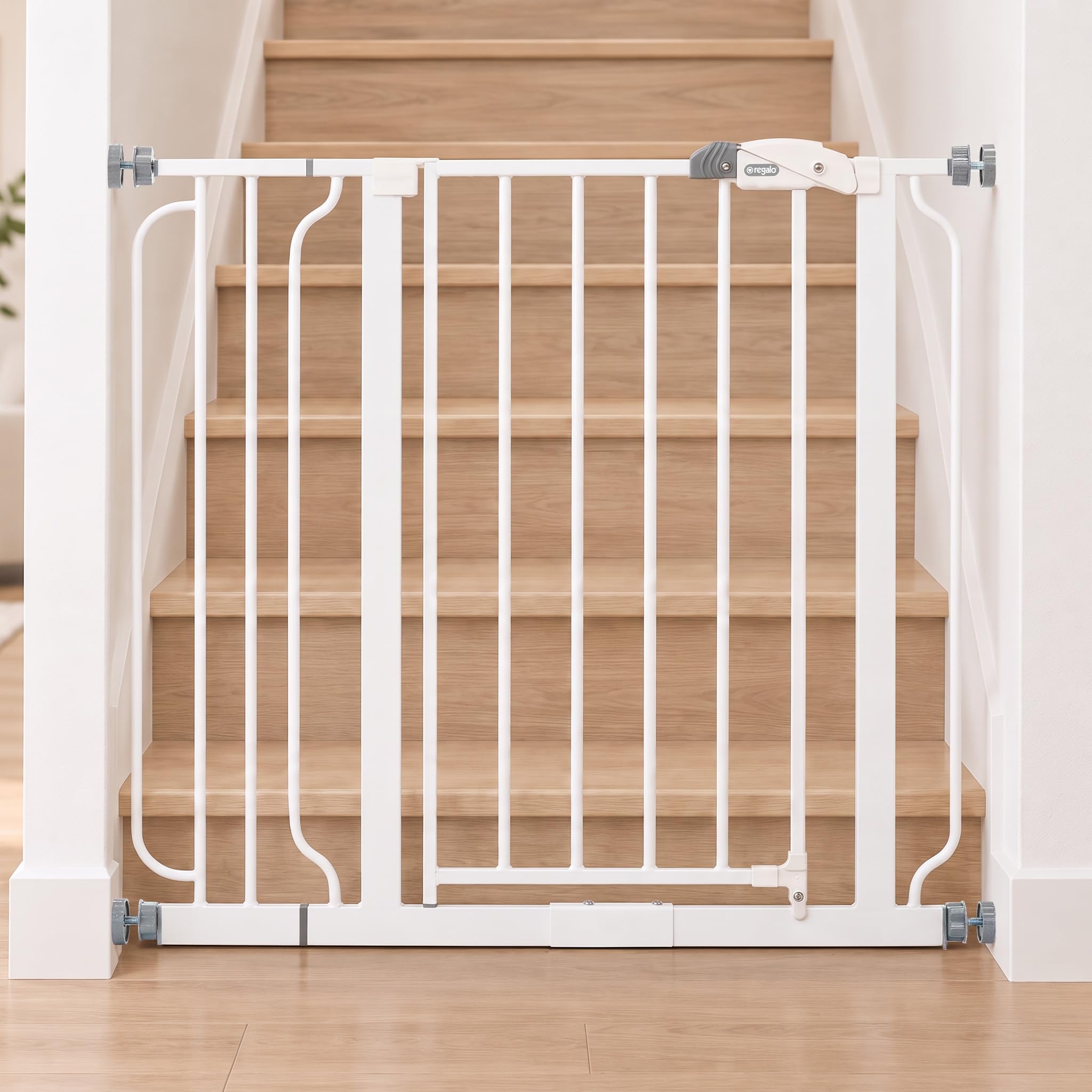
Regalo Easy Step Gate
Key Features
- Height: 30 in
- Weight: 9 lb
- Mounting: Pressure
- Fits openings: 29-38.5 in
- Price: Budget
The walk-through on the Regalo Easy Step is tight. Tight enough that you turn sideways with a laundry basket and notice it every single day. It is also the gate we keep recommending, because at roughly half the price of our top pick it does the one job most families need: it closes off a standard doorway, it stays shut, and it goes up in minutes.
What you get is a 30-inch steel gate at 9 pounds, with a latch an adult can work one-handed and a safety catch that takes a second motion. It expands from 29 to 38.5 inches with the extensions in the box — enough for most interior doorways, not enough for the wide opening at the end of a hall.
The wall cups are the part people skip and shouldn’t. They are what stops the gate walking out of the frame, and they mean small screws in the door trim. That is the whole install. For a doorway you cross a dozen times a day with your hands full, the narrow opening is the thing that will wear on you; for a spare room, a rental, or a gate that goes up when the grandchildren visit, this is the sensible buy.
Pros
- Roughly half the price of our top pick
- Pressure mount, up in minutes
- One-hand latch with a second safety motion
Cons
- Swings one direction only
We recommend it when the budget is fixed and the doorway is standard — the squeeze through the opening is the price you pay.
Best for Wide Doorways, No Drilling
keny Auto-Close Baby Gate

Key Features
- Height: 30 in
- Mounting: Pressure or hardware
- Auto-close: Yes
- Fits openings: 29-42.5 in
- Price: Midrange
The keny’s width range comes with something almost no gate prints: a list of openings it will not fit. It covers 29 to 42.5 inches with its two extension kits, but not 31.8 to 33.4 inches, and not 38.7 to 40.3. The gaps fall where the fixed-width extensions land, and one of them sits right on a standard 32-inch doorway. Measure before anything else, and if your opening is 32 inches, this gate is not the one.
Get past that and it is the value pick for a wide, no-drill opening. Steel frame, 30 inches tall, auto-close below 90 degrees, and a double-lock handle — the features our top pick charges a premium for, at a midrange price. Setup is a five-to-ten-minute job with the threaded rods, no drill and no brackets, which is what makes it worth a look in a rental.
It is pressure-first, with hardware as a secondary option rather than the way it is designed to live. The door holds open when you push it past 90 degrees, and the walk-through is wide enough to pass with an armful. Just take the tape measure to the frame first: the whole argument for this gate rests on the number.
Pros
- Auto-close and double lock at a midrange price
- No drilling, five-to-ten-minute setup
- Reaches 42.5 inches without brackets
Cons
Our value pick for a wide opening you can’t drill: auto-close and a double lock, provided your doorway isn’t 32 inches.
Best for Tool-Free Doorways
Safety 1st Easy Install Gate

Key Features
- Height: 28 in
- Mounting: Pressure
- Fits openings: 29-38 in
- Lock indicator: Red-to-green
- Price: Midrange
The red-to-green strip on the top rail is the best single idea on any gate here. You turn the tension knobs, the indicator flips from red to green, and you know the gate is locked without testing it with your hip. Setup needs no tools and no drilling, and the whole install is four knobs and a check of the strip.
At 28 inches it is as low as anything in this group, and that cuts both ways. Adults step over it without breaking stride; so does a motivated climber. The metal frame is rigid and the door shuts with a solid click, and the two-action handle keeps little fingers out. It spans 29 to 38 inches, which covers a standard doorway and not much else.
We recommend it for a doorway where you want a fast, hole-free setup and a visual confirmation every time you walk past. The catch is the handle: it takes a squeeze and a lift together, and it is the stiffest of the group. If you are usually carrying the baby, that matters more than any spec on this page — try one in a store before you buy two.
Pros
- No tools and no drilling to install
- Red-to-green indicator shows it is locked
- One-hand operation for adults
Cons
- Pressure mount can work loose in a busy doorway
We recommend it for a tool-free doorway where the tension indicator does the guesswork; work the handle before you commit.
Best for Wide Wood-Look Spans
Evenflo Expansion Walk-Thru Gate

Key Features
- Height: 32 in
- Material: Wood and plastic
- Mounting: Hardware
- Fits openings: 24-60 in
- Price: Budget
Wood, or at least the look of it, for less than most of this group: the Evenflo’s natural finish is the one here that does not read as baby equipment. It is also the tallest at 32 inches, and it spans 24 to 60 inches, which is a lot of opening for the money.
The gate swings both ways and folds flat against the wall when you push it past 90 degrees, so a doorway stops feeling like a doorway when you don’t need the barrier. It is a hardware mount, four screws into the frame, and then it is up. That swing is the feature we came back to — it is the difference between a gate you tolerate and one you stop noticing.
One thing to weigh if there is a toddler in the house: the latch is simple, and a child who watches you open it can learn it. As a room divider that is fine. As the barrier between a toddler and a staircase it is not the gate we choose, because the swing and the easy latch are conveniences rather than security.
So we rate it the pick for a wide, good-looking barrier on a budget. Use it to close off a kitchen, a porch, or a playroom. For the top of the stairs, spend the extra on the Toddleroo Easy Swing & Lock, whose latch and wall mount are built for that job.
Pros
- Spans 24 to 60 inches
- 32-inch height, the tallest here
- Natural wood finish
- Swings both ways and folds to the wall
Cons
- Panels flex across a long span
We rate it the good-looking wide barrier for a room divider, not for the top of the stairs.
Best for Extra-Wide Spans
Regalo 2-in-1 Super Wide Gate

Key Features
- Height: 28 in
- Mounting: Hardware
- Fits openings: 24-192 in
- Converts to play yard: Yes
- Price: Premium
Sixteen feet of barrier that folds into a play yard: that is the pitch, and it is accurate. Eight panels, 28 inches tall, hinged so the whole thing can snake around a corner, a fireplace, or the end of a banister, and pinned to the wall with the included brackets. Nothing else here covers a span like that.
The manufacturer is clear about where it goes: the bottom of the stairs, or a large opening, and never the top. Take that literally. Where it earns its keep is an open-plan room you want to break up, the space around a tree in December, or a porch you want a toddler kept off.
It is 31 pounds of steel with a walk-through door you will use daily, and at 28 inches tall it is a barrier rather than a serious climbing deterrent. The frame tightens at each corner, so a shape that starts wobbly can be pulled straight — give that step the time it needs, because a half-tightened panel is where the sag starts.
We recommend it for the one job nothing else here does: an extra-wide span, treated as a semi-permanent barrier rather than a gate you swing a hundred times a day. Set it up for the season, tighten every joint, and leave it alone.
Pros
- Covers spans up to 16 feet
- Converts to a freestanding play yard
- Folds around corners and angles
Cons
- Panel joints work loose with repeated folding
We recommend it for the span nothing else covers, on the understanding that it goes at the bottom of the stairs only.
How We Tested the Best Baby Gates
We started with the gates that show up again and again in parent recommendations and retail best-seller lists, then filtered by mounting style, width range, and what came in the box. We skipped any gate that couldn’t fit a standard doorway without an extension or that seemed fussy to install, and we made sure the shortlist included options for narrow openings and uneven trim. We ended up with 12 gates and used them for six months.
Each gate went into at least two spots in our homes: a main doorway we pass through constantly and either a stairway or a hallway pinch point. We installed them ourselves, noting how long it took, whether the hardware lined up, and whether the gate left marks on drywall or trim after a week. We adjusted each one for baseboards and checked whether the latch still caught after the gate was shifted a half inch.
In daily use, we opened and closed each gate one-handed while carrying laundry or a toddler, measured the clear pass-through at the latch, and noted whether the frame got in the way of a laundry basket or vacuum. We leaned on the top rail, shook the gate at the latch, and watched whether it stayed square after weeks of being pushed and climbed on. We also compared what came in the box, since a gate that needs extra hardware or an extension to work isn’t much of a value. By the end, quality came down to small things: a latch that clicked on the first try, a gate that didn’t rattle, hardware that stayed tight, and a finish that still looked decent after repeated wipe-downs.
How to Choose a Baby Gate
The gate you need is decided by the opening, not the feature list: where it goes determines how it mounts, and how it mounts decides nearly everything else.
Start with the mounting decision
A pressure gate wedges into a frame with threaded rods. A hardware gate screws into studs. That one line settles most of the choice: at the top of a staircase only a hardware mount belongs, because a tension fit can shift under a child’s weight, and every manufacturer here says so. For a doorway or the bottom step, pressure is fine and saves the wall.
A gate that does both, like our top pick, is the flexible buy — start it in a doorway and bolt it down when the stairs become the problem.
Measure the opening, then the walk-through
Measure the narrowest point, baseboards and trim included, and don’t assume a stated range is continuous. Extensions come in fixed widths, which is why the keny prints two bands inside its own range that it will not fit. Then check the door: a gate can cover your opening and still leave a gap you turn sideways to get through.
A maker who publishes the walk-through width — 25.5 inches on the Toddleroo Deluxe Décor — is telling you more about daily life than any other number on the box.
Latches, auto-close, and one hand
Every gate here is meant to be hard for a toddler and easy for an adult, and those two goals pull against each other. A press-and-lift handle takes two motions, which is exactly what stops a two-year-old and exactly what makes some handles a fight with a baby on your hip.
Auto-close earns its price: the door catches itself below 90 degrees and holds open above it, so you aren’t closing it with your foot. Work the handle before you buy two of anything.
Height and what actually stops a climb
These gates run 28 to 32 inches. Taller is not automatically safer, because a determined climber uses furniture rather than height, and a low gate is easier for adults to step over at a doorway they cross all day.
Height earns its place at the top of the stairs, where 31 inches gives more margin. Move the ottoman, the toy box, and the laundry basket away from both sides; that does more than two extra inches ever will.
Walls, holes, and how it looks
Wall cups are not decoration. They are the small screws that stop a pressure gate walking out of its frame, and they leave small holes when you move. Hardware gates leave brackets, though most let you lift the gate off and keep the plates up.
If the gate sits in view all day, the finish earns its keep: matte bronze on the Toddleroo gates, natural wood on the Evenflo. Renters should count the holes before choosing.
Frequently Asked Questions
How do I stop a toddler from climbing over a baby gate?
Height helps a little; furniture helps more. Clear chairs, stools, toy boxes, and laundry baskets from both sides, because most climbs start from something to stand on. Then check the latch — a child who can open the gate does not need to climb it.
The 31-inch Toddleroo Easy Swing & Lock gives more margin than a 28-inch gate, but it is no substitute for a clear landing on both sides.
Can I move one gate between several doorways?
Yes, if it is pressure-mounted. A tension gate comes out in a couple of minutes and goes into the next frame, but re-tension it every time and give the top rail a tug before you trust it.
If you cross the same doorway a dozen times a day, buy a second gate rather than shuttling one. Repeated setup is where tension gates go sloppy.
What is the difference between a baby gate and a play yard?
A gate is fixed to a wall or a door frame and blocks a passage; a play yard is freestanding and encloses a space. A convertible like the Regalo 2-in-1 does both — 16 feet of hardware-mounted barrier that folds into an eight-panel enclosure.
Buy a gate to close a route, a play yard to make a safe zone, and a convertible only when you need both and have a wall to anchor it.
Final Verdict
The Cumbor is the gate we point most families to: it covers a 30-to-46-inch opening, mounts either way, and closes behind you. Start it in a doorway, bolt it to the stairway wall when that becomes the risk.
If your opening is six feet wide, the Toddleroo Deluxe Décor is the better buy. If the budget is the deciding factor and the doorway is standard, the Regalo Easy Step closes it for about half the money — as long as you can live with the squeeze.
