This post contains affiliate links. We may earn a small commission when you buy through our links — at no extra cost to you.
It’s 2 a.m., your baby is stuffed up and miserable, and the pediatrician’s parting advice was to get some moisture into the air. That’s usually how a humidifier ends up in a nursery — not as a design decision, but as a rescue mission. The right one keeps that room comfortably moist through cold season and dry summer nights, which tends to mean easier breathing and fewer wake-ups; the wrong one gurgles, spits, or leaves a wet ring on the dresser.
Here’s what nobody tells you on the first buy: the tank is the whole relationship. A humidifier you dread cleaning — narrow neck, fiddly corners, a base you can’t reach into — turns into a science project within two weeks, no matter how quietly it runs. We’ve put 12 of them through five months of real nursery duty, and the ones still sitting on the dresser are the ones that were easy to fill, easy to scrub, and honest about how much mist they actually put out. They’re below, along with a few that suit very small rooms.


Best for Most Nurseries
Levoit NeoClassic 450
Key Features
- Noise: 21 dB
- Runtime: Up to 42 hours
- Capacity: 4.2 liters
- Coverage: 432 square feet
- Price: Midrange
Twenty-one decibels is roughly the level of a quiet bedroom, and it is the number that settled this pick for us. The NeoClassic 450 reaches it in sleep mode, which also kills the display entirely: no glowing ring on the dresser, no clock, nothing for a baby to stare at during a 2 a.m. feed. Two nights in, we stopped hearing it unless we stood right beside it.
Then there is the tank math. A 4.2-liter capacity, up to 42 hours of runtime in sleep mode, and 432 square feet of rated coverage mean this thing spends its life loafing on the lowest setting in a room the size of a nursery. One fill carried us through the better part of a week of nights, which is exactly the interval that stops refilling from becoming a chore you skip.
Cleaning is where most humidifiers lose their shine, and this is the easiest of the group to live with. The tray lifts out, the base wipes clean, and the tray is dishwasher-safe on the top rack with mild detergent and no heat dry. Only the tray, though, since the tank is still a hand-wash job. We also appreciated the night light: it is blue-light-free with two brightness levels, so it works as a dim check-in glow rather than the blue beacon most units throw across a wall.
The aroma tray stayed empty in our nursery, because fragrance is not something we want around a baby, but it is there if the humidifier later moves to a hallway or an office. And 270 mL an hour is more mist than a nursery ever needs at full tilt, which is the real argument for this much headroom: you buy it to run it low.
Pros
- Whisper-quiet 21 dB sleep mode
- Up to 42 hours between refills
- Dishwasher-safe detachable tray
- Blue-light-free night light, two levels
Cons
- Only the tray is dishwasher-safe
For most nurseries, this is the one we point parents to: 21 dB in sleep mode, 42 hours between fills, and a tray that goes in the dishwasher.
Best for Small Nurseries
Levoit Classic 160
Key Features
- Noise: 25 dB
- Runtime: Up to 25 hours
- Capacity: 2.5 liters
- Coverage: 219 square feet
- Price: Budget
At a little over seven inches across and just 2.2 pounds, the Classic 160 is the one that disappears onto a narrow dresser top or a shelf above the changing table, which counts for a lot in a nursery where every flat surface is already spoken for. It is the smallest and least expensive unit we are recommending, and for a standard-sized nursery it is also the least fussy.
Two and a half liters of water buys up to 25 hours on low, so in a small room you are filling it most days, sometimes every other. We liked the simplicity of that: one knob, a 360-degree nozzle you aim away from the crib, and all lights off, so nothing glows at bedtime. There is no app to pair and no schedule to set, which for plenty of parents is the entire point.
Maintenance is better than the price suggests. The tank opening is wide enough to get a hand and the included brush inside, and the base is a simple shape without hidden corners, two things that matter more than any feature list once mineral film starts forming. The one annoyance is the little water filter sponge, which has to be pulled out and rinsed separately, an extra step that is easy to forget on a busy night.
Pros
- Fits a narrow dresser top
- Dark and quiet for a shared room
- Wide tank opening and included brush
Cons
- Filter sponge needs separate rinsing
We recommend the Classic 160 for a small nursery: it is tiny, dark, quiet, and simple, and 25 hours on a tank is plenty at that size.
Best for Cold Season
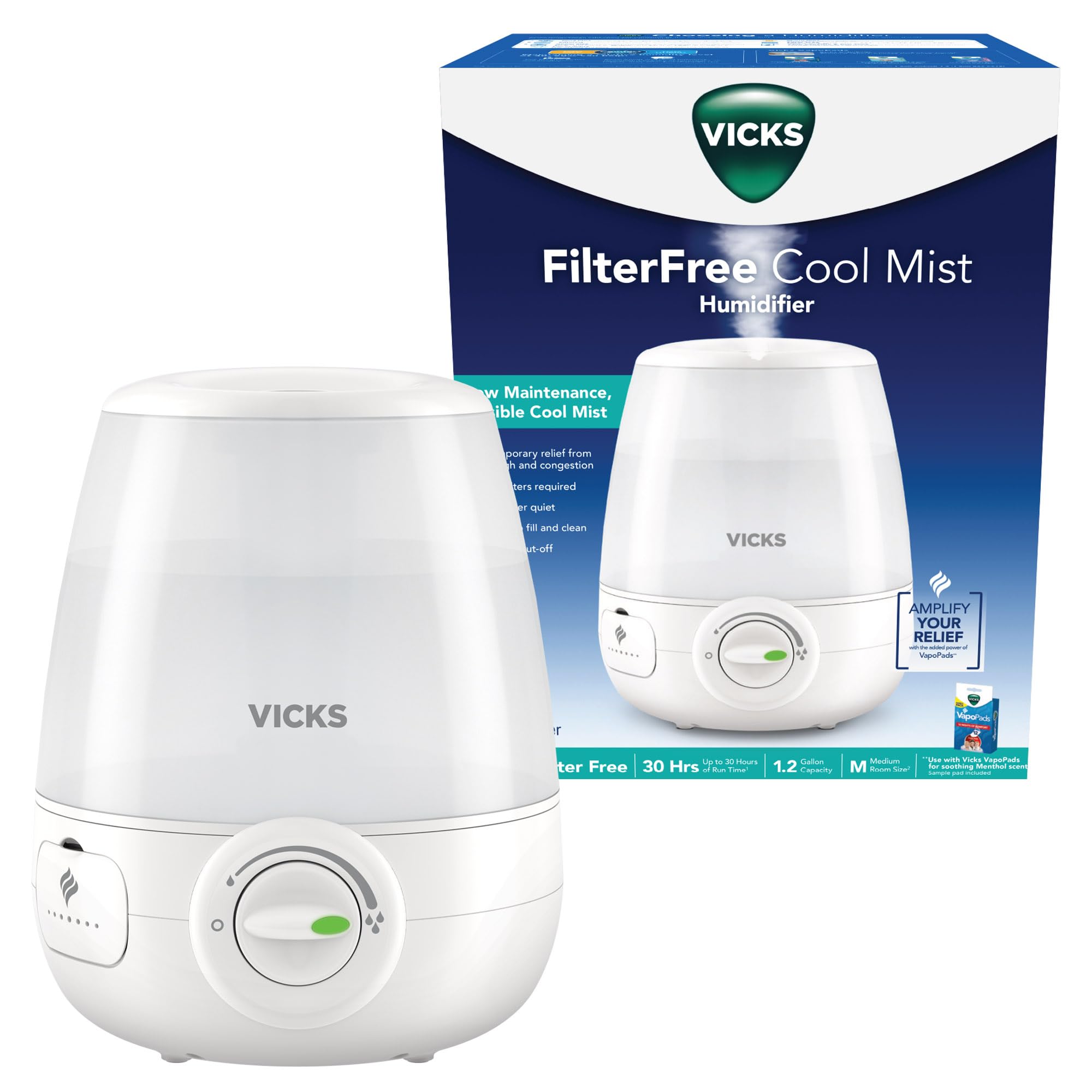
Vicks V4600
Key Features
- Runtime: Up to 30 hours
- Capacity: 1.2 gallons
- Dimensions: 9.45 x 10.87 x 13.46 inches
- Filtration: Filter-free
- Price: Midrange
A gallon and a fifth of water, thirty hours of runtime, and no filter to buy: the Vicks V4600 is built for the week a cold moves through the house and the humidifier runs from dinner to breakfast without anyone topping it up. It holds more water than anything else here, and going filter-free means no wick to sour, no cartridge to reorder, and no running cost beyond the water itself.
Quiet is where it splits. On low it fades into the background of a room, but the refill is audible, a gurgle and a drip that carried further than we expected in a silent nursery. Cleaning takes some patience too: the wide fill opening helps, but mineral film still forms and needs soaking rather than a quick rinse.
One thing to nail down before you buy: an auto shutoff is not spelled out for this model, and in a nursery that is not a detail to guess at. If it is essential, and for plenty of parents it is, confirm it or choose one of the Levoit picks instead. What the Vicks does bring is a long history as a cold-season workhorse and a design with nothing to reorder in February.
Pros
- 1.2-gallon tank runs up to 30 hours
- No filters to buy or replace
- Wide opening for filling
Cons
- Gurgles audibly when it refills
- Mineral film needs soaking
For a dry winter with a congested baby, we recommend the Vicks: a 1.2-gallon tank, up to 30 hours between fills, and no filters to buy.
Best for Bigger Rooms
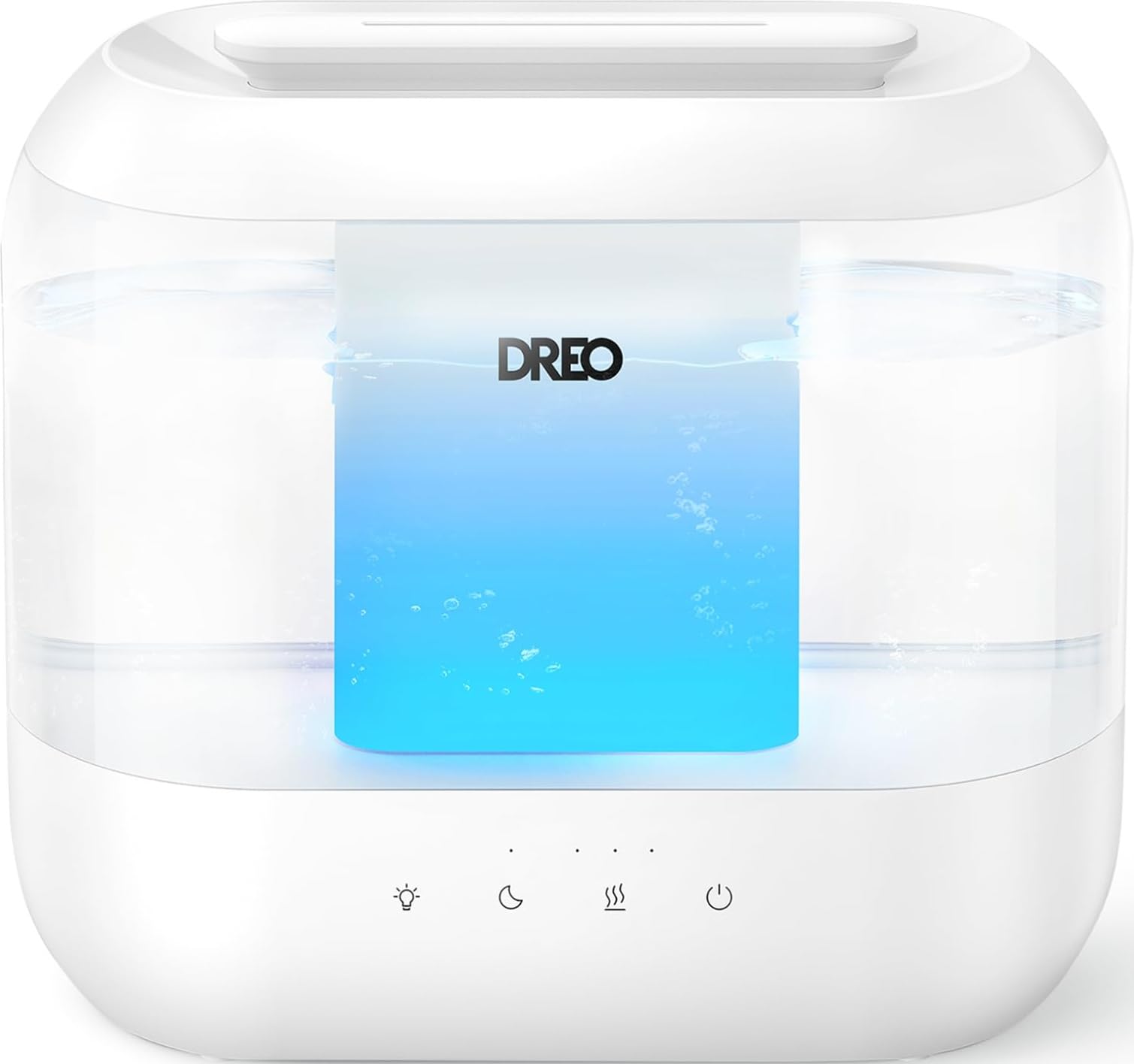
DREO HM311
Key Features
- Noise: 28 dB
- Runtime: Up to 36 hours
- Capacity: 4 liters
- Coverage: 300 square feet
- Price: Budget
Four liters and 36 hours of runtime, with 300 square feet of coverage, for less than our top pick: on paper the DREO HM311 is the value leader of this group. In a bigger nursery, or a room that shares a door with the hallway, that capacity does real work, and the mist outlet is a genuinely wide four inches.
It is quiet, rated at 28 dB, and the touch controls are easy enough to work one-handed in the dark. The night light is blue rather than warm, which is the one design choice we minded; blue light beside a crib is not what we want at bedtime, so ours stayed switched off.
The leak question is the one to go in with your eyes open. Water can escape from under the tank when the top is not seated perfectly square, so press down until it settles and give it a coaster or a tray for the first week while you learn the feel of it. Seated properly it stayed dry for us, and at this capacity for this money we are comfortable with it in a nursery. Fill it at the sink and carry it back assembled rather than topping it up in place.
Pros
- 4-liter tank at a budget price
- Quiet 28 dB operation
- Modular parts come apart for cleaning
Cons
- Blue night light rather than warm
We recommend the DREO for a bigger room on a smaller budget, as long as you seat the tank squarely every time and keep the blue night light off.
How We Tested Nursery Humidifiers
We began with roughly 40 models sold at major retailers and filtered hard: no tank you couldn’t lift one-handed while holding a baby, no cord under three feet, no base that needed a screwdriver to open for cleaning. That left 12 humidifiers, which we ran for five months in actual nurseries — on dressers beside cribs, on nightstands in small shared bedrooms, and in a couple of rooms where the door stays shut all night.
At bedtime we ran each one on high and measured sound from three feet away, about where a baby’s head sits, then again on low to hear which ones carried through a closed door. A hygrometer in the room tracked how much the humidity actually climbed over four hours, and we timed each tank to see whether it lasted until morning or gave out at 4 a.m. We also measured each unit’s footprint against a standard nightstand, since nursery floor space runs out fast.
Once a week we emptied, rinsed, and scrubbed each tank the way a tired parent would — no soaking, no special brushes — and noted narrow openings, awkward corners, and parts that had to come apart first. A paper towel sat under every unit for the first month to catch drips and seepage. We carried full tanks from the bathroom sink to the nursery to judge weight and handle design, and tried working the controls in the dark.
Five months of nightly runs and hard-water refills exposed the weaker builds: seams that cracked, mist that thinned out after descaling, units that started rattling by month three. We weighed price against what came in the box — hygrometer, night light, timer — and against how often each one needed a full teardown clean.
How to Choose a Nursery Humidifier
The right humidifier for a nursery is not the one with the longest feature list; it is the one you will keep filling, cleaning, and running quietly until spring.
Size the tank to the room, then think about refills
Most nurseries land somewhere between 100 and 150 square feet, and a 2.5-liter tank rated for 219 square feet covers that comfortably, which is why the smallest pick here is not a compromise. Capacity buys convenience, not performance: a bigger tank does not humidify better, it just means fewer trips with a jug.
If the crib shares an open-plan space, or you would rather fill once a week than once a day, step up to four liters. That is the whole argument for the NeoClassic 450 over the Classic 160, and it is the only one you need.
Night noise, and the glow you do not want
Ratings across this group run from about 21 to 28 dB, and the top of that band is audible from a crib on a still night. Look for a sleep mode that also switches the display off, because the light on a humidifier is usually more disruptive than its fan.
Night lights deserve a second look. A blue glow beside a crib is the opposite of what you want at bedtime, so either choose a warm, blue-light-free light or plan to run the unit dark. The NeoClassic 450 offers both a warm light and a fully dark mode.
Cleaning decides how long it lasts
Scale and biofilm are what turn a working humidifier into a smelly one, and both come from water sitting in a tank. A wide tank opening, a base with no hidden corners, and parts that can go in a dishwasher matter far more than any smart feature, especially once you are doing this weekly in February.
Read the dishwasher claim carefully. On most units it covers the detachable tray only, top rack, mild detergent, no heat dry, while the tank stays a hand-wash job. Buyers who assume the whole thing is dishwasher-safe are the ones leaving one-star complaints about a warped tank.
Ultrasonic mist, white dust, and filters
Nearly everything here is ultrasonic: quiet, cheap to run, and hard on hard water. It pushes minerals into the air as a fine white dust that settles on crib rails and dark furniture first. Distilled or filtered water solves it, and that is a recurring cost worth budgeting for.
Evaporative units push out invisible moisture and their output drops as the room gets more humid, so over-humidifying is harder. The trade is a wick filter you replace. Filter-free designs avoid that entirely, which is most of the Vicks appeal.
Frequently Asked Questions
What humidity level should a nursery be at?
Aim for 30 to 50 percent. Below that, heated winter air dries out noses and throats; above it, you get condensation on windows and damp corners.
Put an inexpensive hygrometer on the dresser before you buy anything. If the room already sits at 45 percent, you may not need a humidifier at all, and if it reads 20 percent you will know within a night whether the unit is keeping up.
Where should the humidifier go in a nursery?
On a stable, flat surface at least three feet from the crib, with the mist aimed away from where your baby sleeps and away from the wall and any outlet. Cool mist that drifts onto bedding or drywall leaves everything damp.
A dresser across the room beats a shelf beside the crib, and tuck the cord behind furniture so a toddler cannot pull the unit over.
How often should I clean it?
Rinse the tank and tray every day you use it, and soak both weekly in equal parts white vinegar and water to break down scale. If a chalky ring forms within a few days, your water is hard and the interval needs to shrink.
Never submerge the base, since the electronics live there. Wipe it, let everything air dry, and skip harsh cleaners that leave a residue in the mist path.
Final Verdict
Start with the Levoit NeoClassic 450. It has the lowest rated noise in this group at 21 dB, runs 42 hours between fills in sleep mode, and its tray goes in the dishwasher, which is the difference between a humidifier you keep using and one that ends up in a closet by January.
For a small nursery on a tight budget, the Classic 160 does the same job in a smaller, darker, simpler package. And if tank size is what matters most, the Vicks holds the most water here and never asks you to buy a filter.
