This post contains affiliate links. We may earn a small commission when you buy through our links — at no extra cost to you.
Many toddler night lights advertise dusk-to-dawn sensors, but in practice they often stay on 24/7 or glow too brightly for sleep. Parents end up pulling them out of the socket or covering them. The category has a gap between marketing and real-world use. The key is knowing which features actually work.
The biggest fork in the road is plug-in versus portable. Plug-in lights can be set-and-forget but may lack dimmability; portable rechargeable lights offer flexibility and timer controls but risk battery fade. Neither is perfect for every home. This guide helps you match the right type to your child’s room and your nightly routine, focusing on dependable sensors, adjustable brightness, and build quality that lasts.




Best for Night Feeds & Travel
MediAcous Egg Light
Key Features
- Brightness: Stepless 0-?
- Light Color: 7 colors + warm white
- Power Source: USB-C rechargeable
- Design / Portability: Egg-shaped silicone, touch control
- Price: $$$
Stepless dimming and a 1-hour timer directly address two major parent pain points: adjustable brightness and a reliable auto-off. The soft warm white light stays low enough for night feeds without waking a sleeping baby, and the touch controls are intuitive enough to operate one-handed while holding an infant. Battery life holds up through the night on low settings, matching the promise of all-night use without hunting for a plug.
This light is best for new parents who need a portable, dimmable companion for nighttime feeding and diaper changes. The silicone body is travel-friendly and the USB-C charging is convenient. However, durability is a known weak point: some units stop working or lose charge capacity after a few months of use. That trade-off matters less during the newborn stage when the light sees gentle handling, but it’s worth factoring in if you expect rough toddler play or long-term daily use.
Pros
- Soft, dimmable light ideal for nighttime feedings and diaper changes.
- Long battery life supports overnight use on low setting.
- Easy one-hand operation with responsive touch controls.
Cons
- Durability concerns: occasional units stop working or lose charge ability after months of use.
- Color mode brightness is fixed; only white light is dimmable.
Buy this if you need a portable, dimmable night light with a reliable timer for nighttime feedings. Skip it if you want a character-themed fun shape or if long-term durability is your top priority.
Best for Bluey Fans
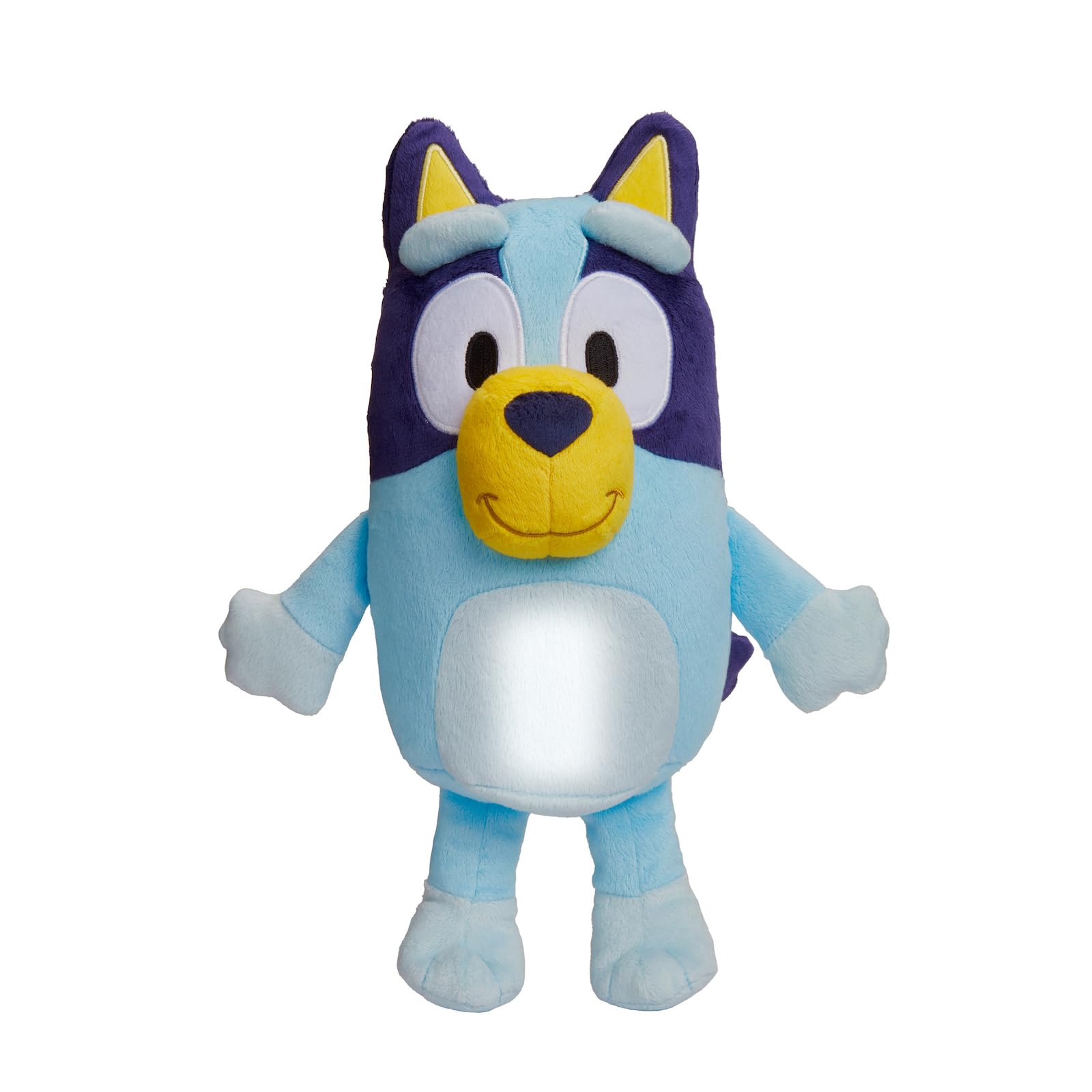
Bluey Goglow Pal
Key Features
- Brightness: Fixed soft glow
- Light Color: Warm white
- Power Source: 3 AAA batteries
- Design / Portability: Plush with handle, huggable
- Price: $$
The Bluey Goglow Pal is a huggable plush with a soft glow and voice phrases that toddlers adore — but it’s more comfort toy than serious night light. Its 10-minute timer and squeeze activation are well-liked, yet the light output is dim (companion glow, not room illumination) and the speaker volume is quiet enough that some children can’t hear the phrases clearly. Additionally, some units ship with fewer than the advertised nine phrases. This is best for Bluey-fan toddlers who need a bedtime buddy, not a bright functional light — and parents should manage expectations on sound and brightness.
Pros
- Plush design that toddlers love to cuddle and carry.
- Automatic 10-minute timer helps establish sleep routines.
Cons
- Volume level may be too quiet for some children to hear clearly.
- Phrase count varies — some units deliver fewer than the advertised nine.
Buy this if your toddler is a Bluey fan and you want a comforting bedside companion with a soft glow. Skip it if you need a bright night light or reliable sound features.
Best for Whole-Home Navigation
MAZ-TEK Dimmable 4-Pack
Key Features
- Brightness: Stepless 0-15 lm
- Light Color: Warm white
- Power Source: Plug-in
- Auto Sensor: Dusk-to-dawn
- Design / Portability: Low-profile, flush mount
- Price: $$
This four-pack combines stepless 0-15 lumen dimming with an auto sensor that typically turns on at dusk and off at dawn, offering a budget-friendly alternative to dedicated sleep lights. Each unit is slim and leaves the second outlet free. However, max brightness is modest, so it’s best for hallways, stairways, and kids’ rooms rather than task areas. The sensor may stay on in dim indoor settings, and the width can overlap neighboring outlets on quad plates. Ideal for parents wanting a set-and-forget solution across multiple rooms without spending per-light premium.
Pros
- Adjustable brightness lets you dial in the perfect glow for any room.
- Four-pack offers outstanding value per light for whole-home setup.
- Low-profile design leaves second outlet accessible.
Cons
- Some units stay on during daylight if ambient light is dim.
- Width can block adjacent outlets on shared plates.
Buy this if you need multiple dimmable night lights for hallways and rooms where modest warm light suffices. Skip it if you need brighter output or a sensor that turns off in dim indoor light.
Best for Sleep-Friendly Amber
GE Sleeplite Amber 2-Pack
Key Features
- Brightness: Fixed (auto-dimming)
- Light Color: Amber
- Power Source: Plug-in
- Auto Sensor: Dusk-to-dawn
- Design / Portability: Large faceplate, covers outlet
- Price: $
Unlike the GE Color Changing model’s bright multicolor output, this Sleeplite delivers a consistently dim warm amber glow that supports melatonin production. The dusk-to-dawn sensor adjusts automatically, so there’s no need to flip a switch. It’s a straightforward pick for bedrooms and nurseries where you want a set-and-forget light that won’t disturb sleep. Keep in mind the light is intentionally dim—not enough for hallways—and the plastic build shows its budget roots with occasional fit issues. This 2-pack offers good value at a low per-unit cost.
Pros
- Warm amber light that preserves sleep quality
- Auto-adjusts to ambient darkness without manual switching
- Low per-unit cost for a two-pack
Cons
- Light output is very dim, limiting use to sleep-friendly spaces
- Plastic housing can feel cheap with occasional alignment issues
Buy this if you want an inexpensive, no-fuss night light for bedrooms that won’t disturb sleep. Skip it if you need brighter illumination for hallways or tasks.
Best for Portable Duck
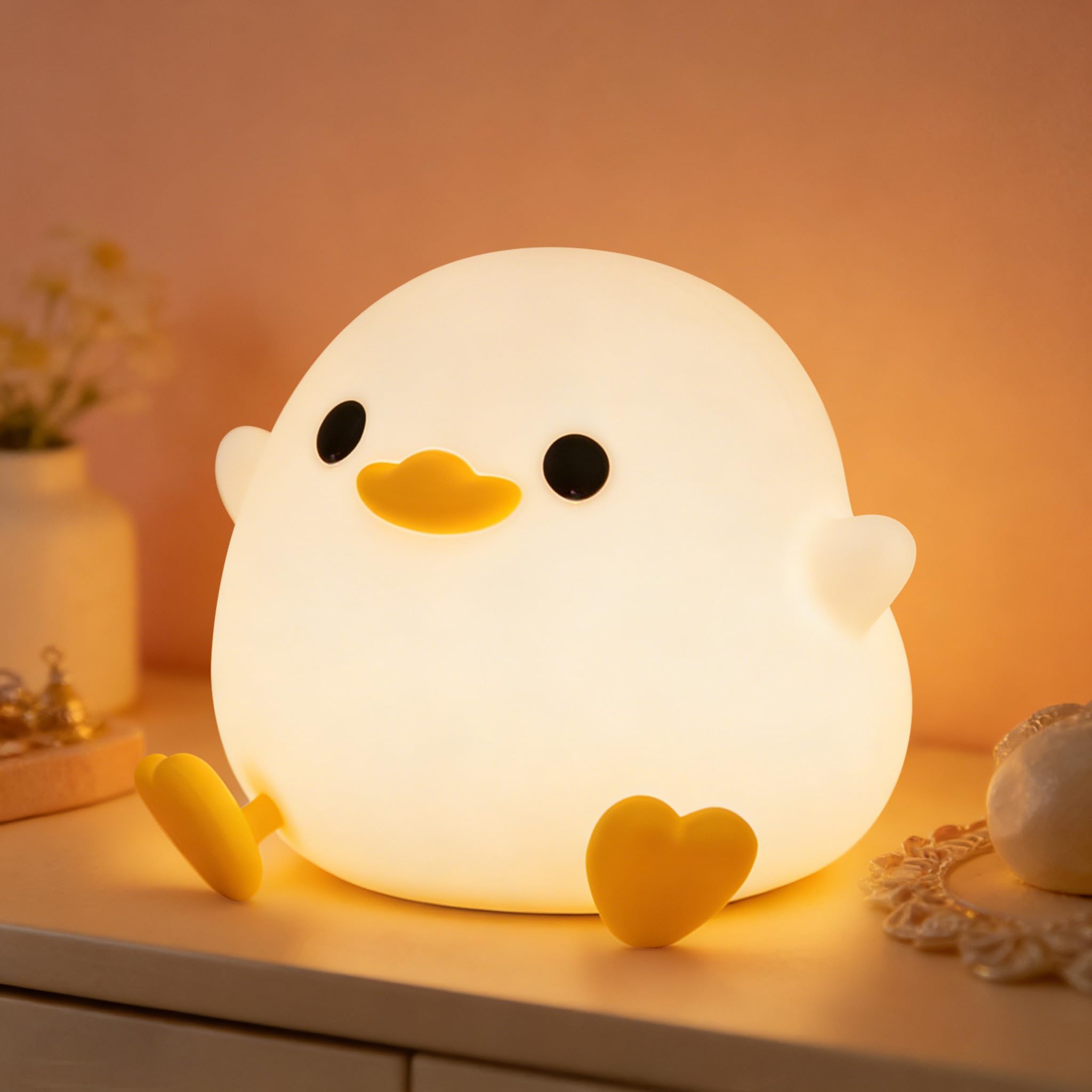
FAMIDUO Duck Squishy Light
Key Features
- Brightness: 2 levels (warm white)
- Light Color: Warm white
- Power Source: USB rechargeable
- Design / Portability: Silicone duck, squishy, portable
- Price: $$
Unlike the top pick’s stepless dimming and adjustable timer, this duck lamp is fixed at two brightness levels and a 20-minute auto-off. That simplicity works well for bedtime if your child falls asleep quickly, but the battery may not last through the night on brighter settings. The squeezable silicone body makes it a comforting companion for toddlers during travel or as a nursery friend. Ideal for families who value cute character design over fine-grained control—just expect to recharge daily.
Pros
- Adorable duck design that kids want to hold and play with.
- Simple touch control and durable silicone build.
Cons
- Battery life may fall short of advertised runtime, especially on high brightness.
- Timer is fixed at 20 minutes with no option to extend.
Buy this if your toddler loves cute animal lights and you want a portable, rechargeable option for bedtime comfort. Skip it if you need adjustable brightness or a longer, customizable timer.
Best for Sleep Hygiene
YUNLEX Red Night Light 2-Pack
Key Features
- Brightness: 3 levels (red)
- Light Color: Red (635nm)
- Power Source: Plug-in
- Auto Sensor: Dusk-to-dawn
- Design / Portability: Low-profile, flush mount
- Price: $
Dedicated to preserving sleep cycles, the YUNLEX uses a 635nm red LED that emits no blue light, making it more effective than amber alternatives for minimizing melatonin disruption. Three brightness levels allow adjustment from a faint glow to a visible outline – though even the highest setting remains dim by design, insufficient for reading or navigating unfamiliar rooms. The dusk-to-dawn sensor activates consistently in completely dark rooms but may not trigger in spaces with ambient light. This red light is best suited for parents needing a truly sleep-friendly light for overnight checks, kids sensitive to bright lights, or bathroom hallway use where a subtle guide is needed.
Pros
- Red light at 635nm avoids blue light wavelengths that disrupt natural sleep cycles.
- Three brightness levels offer flexibility from a barely-there glow to a visible outline.
Cons
- Red light is naturally dim even on high – not for reading or navigating clutter.
- Dusk-to-dawn sensor may not activate unless the room is extremely dark.
Buy this if you want a sleep-preserving night light for bedroom or hallway that won’t disrupt melatonin. Skip it if you need bright illumination for reading or if the room has ambient light that could interfere with the sensor.
Best for Color Fun
GE Color Changing LED Night Light

Key Features
- Brightness: Fixed (color changing)
- Light Color: 8 colors + cycling
- Power Source: Plug-in
- Auto Sensor: Dusk-to-dawn
- Design / Portability: Compact plug-in, color selector
- Price: $
The GE Color Changing LED Night Light offers eight colors plus cycling with a dusk-to-dawn sensor. Its bright output and massive user base suit hallways and playrooms. But it’s too bright for most bedrooms and the sensor may stay on in dark hallways, so it’s not ideal for sleep.
Pros
- Eight vivid color options plus color cycling for playful ambiance.
- Budget-friendly price with strong value for a single light.
Cons
- Lowest brightness level may still be too bright for some sleepers.
Worth considering if you want a fun, bright color-changing light for hallways or playrooms and don’t need a dim sleep light.
Best for Bright & Dimmable
LOHAS Dimmable 2-Pack

Key Features
- Brightness: Stepless 0-80 lm
- Light Color: Daylight 5000K
- Power Source: Plug-in
- Auto Sensor: Dusk-to-dawn
- Design / Portability: Compact, wall mount
- Price: $
This 2-pack delivers a brightness range from faint to 80 lumens in cool 5000K daylight, ideal for stairways or playrooms where visibility matters. But the color temperature is too stimulating for sleep, and the dusk-to-dawn sensor often fails to turn off unless hit by direct sunlight—some units also develop flickering after months of use.
Pros
- Wide brightness range from dim to very bright for varied needs.
- Affordable 2-pack with stepless dimming control.
Cons
- Sensor needs direct sunlight to turn off; may stay on in shaded rooms.
Worth considering if you need a very bright, adjustable light for hallways or play areas and can place it where direct sunlight hits the sensor during the day.
Best for Colorful Budget
DORESshop Color 2-Pack

Key Features
- Brightness: Fixed (color cycling)
- Light Color: 8 colors + white
- Power Source: Plug-in
- Auto Sensor: Dusk-to-dawn
- Design / Portability: Clear acrylic bubble
- Price: $
This two-pack delivers vibrant 8-color cycling and solid brightness in a clear acrylic design, making it a fun accent for playrooms or bathrooms. However, the dusk-to-dawn sensor often fails to turn off in daylight, leaving the light on 24/7. The advertised rainbow mode only cycles single colors rather than showing a true gradient, so it works best if you don’t rely on the auto feature.
Pros
- Vibrant 8-color cycling with bright LED output adds fun ambiance to any room.
- Affordable two-pack delivers strong value for decorative lighting.
Cons
- Dusk-to-dawn sensor often stays on 24/7, preventing true automatic operation.
Worth considering if you want a cheap, fun color-changing night light and don’t mind manually turning it off during the day.
Best for Dinosaur Fun
OneFire Dinosaur Squishy Light

Key Features
- Brightness: Dimmable (touch)
- Light Color: 16 colors
- Power Source: USB rechargeable
- Design / Portability: Silicone dino, fun shape
- Price: $$
The OneFire Dinosaur Squishy Light charms with 16 colors and a soft silicone body that toddlers love to squeeze. However, battery life is shorter than advertised—many users report needing to recharge after a few nights—and some units develop charging port issues. While this makes it less suitable as a daily night light, it works well as a fun bedside companion for dinosaur fans who don’t need all-night operation.
Pros
- Cute dinosaur design that appeals to toddlers
- Soft silicone is safe and pleasant to hold
Cons
- Battery life falls short of claims; some units have charging port failures
Worth considering if your child is dinosaur-obsessed and you’re willing to accept shorter battery life for the playful design.
Best for Duck Alternative
YuanDian Duck Squishy Light

Key Features
- Brightness: 2 levels (warm white)
- Light Color: Warm white
- Power Source: USB rechargeable
- Design / Portability: Silicone duck with dangling legs
- Price: $$
Charming duck shape with floppy legs appeals to all ages. Rechargeable battery lasts days, and the 20-minute timer suits short comfort uses. A small chance of flickering or early failure means the similarly priced duck light in this guide is a safer choice.
Pros
- Adorable duck design with dangling legs captures attention of kids and adults alike.
- Rechargeable battery lasts several days between charges, reducing frequent plugging.
Cons
- Some units experience flickering or stop working after short use.
Worth considering if you want a cute, portable duck light for a child’s bedside or as a gift, and are comfortable with a small risk of early defects.
Best for Classic Owl
Munchkin Owl Nightlight

Key Features
- Brightness: Fixed white
- Light Color: White LED
- Power Source: 3 AAA batteries
- Design / Portability: Plastic owl with carry handle
- Price: $$
This owl night light’s adorable shape and easy-grasp handle make it a hit with toddlers, and the 20-minute auto-off timer saves batteries during sleep training. However, the white LED is often too bright for a dark bedroom, and the plastic build has occasional durability issues. It also uses disposable AAA batteries, which puts it behind newer rechargeable alternatives.
Pros
- Adorable owl shape with a handle that toddlers love to carry.
- Simple on/off switch that toddlers can operate alone.
Cons
- White LED light may be too bright for some children’s sleep.
Worth considering if you need a simple, portable night light for toddler independence and your child loves owls, but be prepared for a bright white light and potential durability issues.
Best for Frozen Magic
Projectables Frozen Projector

Key Features
- Brightness: Fixed (projection)
- Light Color: Frozen scenes
- Power Source: Plug-in
- Auto Sensor: Dusk-to-dawn
- Design / Portability: Projector, rotates to angle
- Price: $$
This projector delivers six Frozen 2 scenes that mesmerize young fans and can ease bedtime fears. However, the bright, sometimes blurry images can overstimulate rather than soothe. Some units have stopped working within weeks. It’s best for occasional use or as a toy, not a nightly sleep aid.
Pros
- Disney Frozen projections delight toddlers and reduce bedtime anxiety.
- Affordable way to add Disney magic to a bedroom.
Cons
- Projection is too bright for restful sleep.
Worth considering if your toddler is deep in a Frozen phase and you want a fun, short-term light. Skip it for daily sleep use.
How to Choose
The most important factor is light color and dimmability: warm amber or red light at adjustable brightness helps toddlers sleep, while cool white or bright colors can keep them awake.
Brightness Adjustability
A night light that’s too bright disrupts sleep; one that’s too dim doesn’t provide enough comfort for anxious toddlers. Look for stepless dimming or at least three brightness levels so you can fine-tune the glow to your child’s sensitivity.
Light Color and Temperature
Warm white (2700-3000K), amber, or red light are best for sleep because they minimally affect melatonin production. Cool white or blue light can be stimulating. Color-changing modes are fun for play but should be turned off at bedtime.
Power Source
Plug-in lights never need charging and are simple to maintain, but they limit placement to near an outlet. Rechargeable battery-powered lights offer portability for travel and can be placed anywhere, but battery life degrades over months. Consider how often you’ll move the light.
Auto-On/Off Sensor Reliability
Dusk-to-dawn sensors are convenient but many require direct sunlight to turn off. If your child’s room doesn’t get strong daylight, the light may stay on 24/7. Look for models with a manual override switch or a separate on/off button so you’re not stuck.
Timer Feature
An auto shut-off timer (10-60 minutes) is valuable for sleep training and battery conservation. Fixed timers are common, but adjustable or longer options give more flexibility. Lights without a timer rely on you to manually turn them off, which can be inconvenient during the night.
Portability and Child-Friendly Design
Soft silicone or plush designs are safe for toddlers to handle and less likely to break if dropped. Handles or lightweight shapes make it easy for a child to carry their own light to the bathroom or bed. Avoid sharp edges or small parts that could become choking hazards.
FAQ
Why does my night light stay on during the day?
Most dusk-to-dawn sensors need strong direct sunlight to detect daytime. If your outlet is in a shaded hallway or a room with only artificial light, the sensor may never trigger. The fix is to choose a light with a manual on/off switch or move the light to a sunnier spot.
What color night light is best for toddlers?
Amber, warm white (2700-3000K), or red light are best because they minimize melatonin suppression. Blue or bright white light can interfere with sleep. Color-changing lights are fun but should be reserved for playtime, not bedtime.
How long should a toddler night light stay on?
A timer of 20-60 minutes is ideal. It gives enough comfort to fall asleep without running all night, which wastes battery and may disrupt later sleep cycles. Lights without a timer can be left on all night if they are very dim and warm, but many toddlers sleep better with an auto-off.
Are rechargeable night lights better than plug-in for kids?
Rechargeable lights offer portability (travel, camping, room-to-room) and eliminate cord safety concerns, but battery life often degrades within months. Plug-in lights are more reliable for daily use and never need charging, but limit placement. For a toddler’s main bedroom light, a plug-in with a dimmer is usually better; for a travel or bedside companion, go rechargeable.