This post contains affiliate links. We may earn a small commission when you buy through our links — at no extra cost to you.
A pair of kids’ headphones has to clear a higher bar than the adult kind. Before the music or the fourth listen to the same audiobook, it has to keep volume at a level small ears can handle, survive being crammed into a backpack, and fit a head that is still growing. The right pair doesn’t have to be the priciest: it buys you a quieter car ride, a child who can focus on a lesson, and one less fight over the tablet’s speaker.
Over the past four months, my team and I have put 15 pairs through school runs, homework sessions, long drives, and tug-of-war over the tablet. The pairs kids reached for were not always the ones with the longest feature list. They fit without constant adjusting, held a charge all day, survived kitchen-floor drops, and sounded good enough that nobody asked to switch back to the tablet’s speaker. Noise cancellation helped on noisy bus rides, but only when the controls were simple enough for a kid to manage. The picks below earned their place.



Best for Everyday Family Use
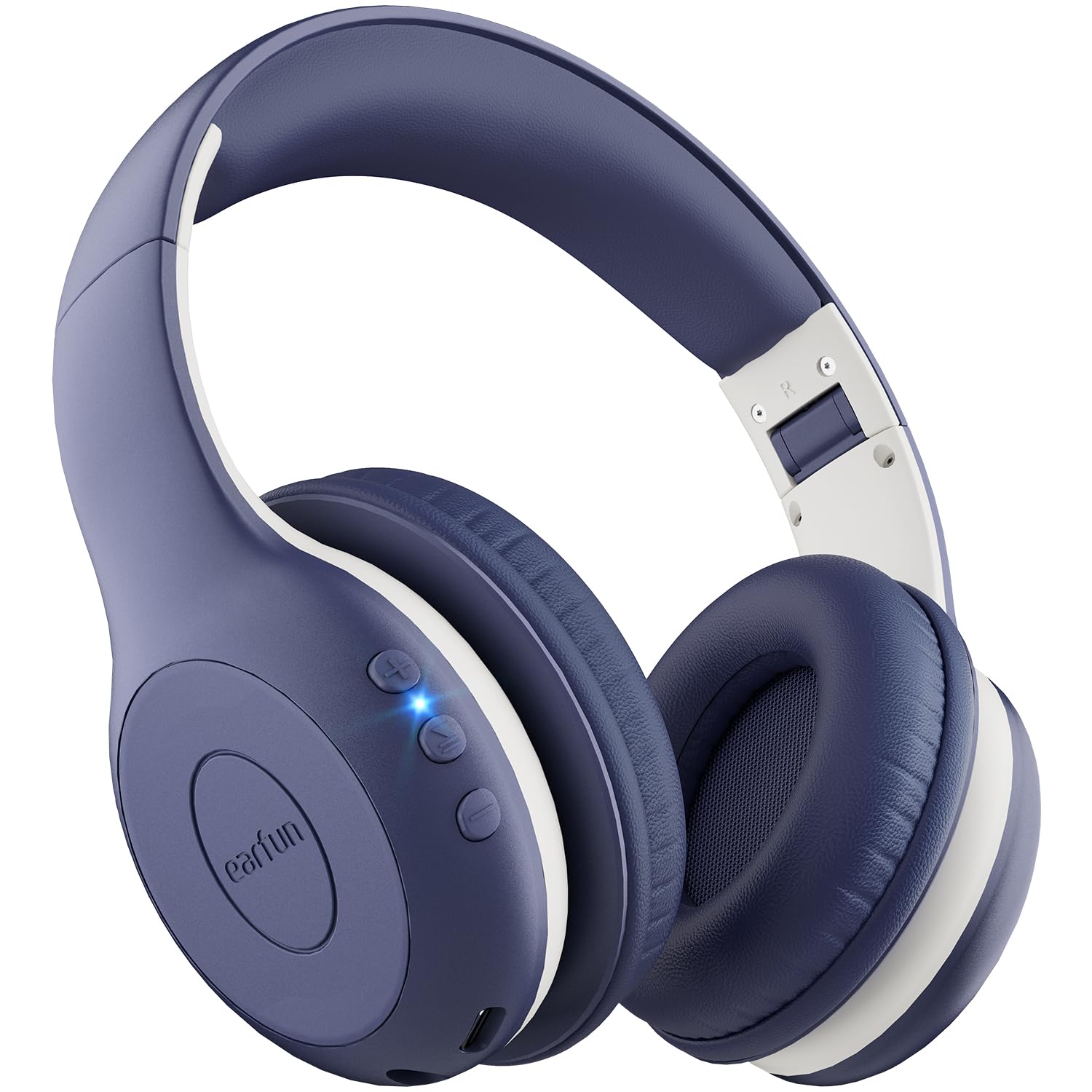
EarFun K2
Key Features
- Weight: 6.17 oz
- Bluetooth: 5.4
- Battery life: 40 hours
- Volume limit: 74/85/94 dB
- Price: Budget
The switch on the EarFun K2 offers three ceilings — 74, 85 and 94 dB — and no other pick here spans that range. The 74 dB setting is the one that matters: it’s quiet enough for a two-year-old in a car seat, where 85 dB already sounds loud because the speakers sit an inch from small ears. The 94 dB mode is for the highway with the windows down, not for everyday listening.
That range is why it’s our default pick. A family with a four-year-old and an eight-year-old buys one set, dials it to whichever child is in the back seat, and hands it down as both grow. Around the limiter you get Bluetooth 5.4, 40 mm drivers, a 3.5 mm cable in the box for a dead battery on a plane, and 175 g of foldable plastic that drops into a backpack.
Playtime is the one place the listing argues with itself: the main blurb promises 60 hours, the spec table lists a 40-hour average. Plan on the lower number — roughly a week of school use between charges — and note the two-hour USB-C charge. It also powers itself down when nothing is playing, which is the difference between a set that survives a term in a school bag and one that’s flat by Monday.
The thing to know before ordering is that the frame is the weak point. Some of these come back after a full school year; others break at the joint after a few months of being pulled on and off. The 18-month warranty is longer than most here and covers exactly that failure, so keep the order email.
Pros
- Three volume ceilings from 74 to 94 dB
- Wired 3.5 mm backup for flat batteries
- Folds flat and weighs 175 g
- 18-month warranty
Cons
- Plastic frame is the weak point under rough handling
- Playtime claims disagree: 60 hours in the blurb, 40 in the specs
We recommend the K2 for most families: it’s the only set here that goes from a 74 dB toddler mode to a 94 dB noisy-car mode, with a cable in the box for dead batteries.
Best for Long Trips
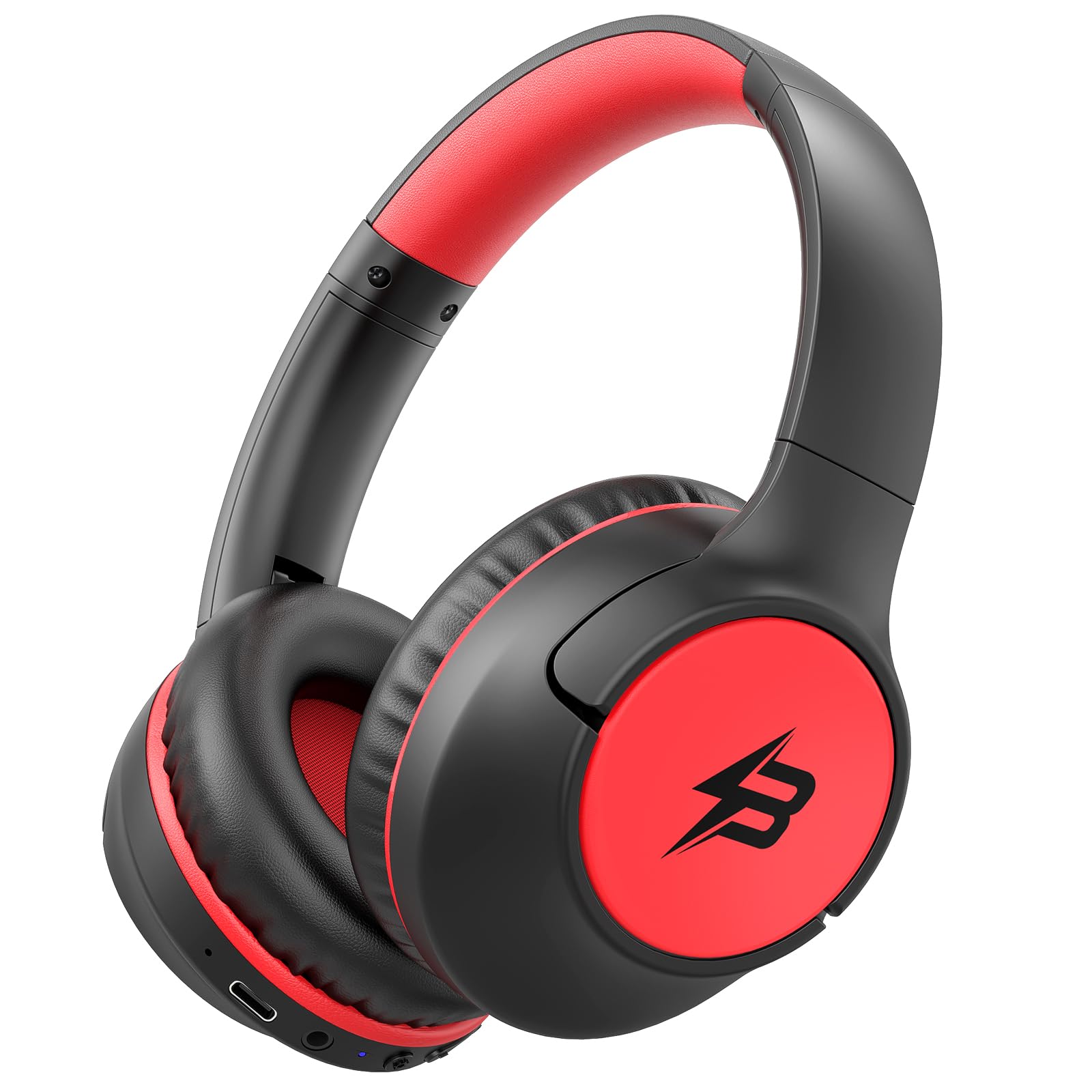
Botesty BS01
Key Features
- Playtime: 85 hours
- Warranty: 6 months
- Bluetooth: 5.4
- Volume limit: 85/94 dB
- Price: Budget
Eighty-five hours is the number that separates the Botesty BS01 from the rest of this group — the next-longest set here is twenty hours behind it. In practice that’s a month of school commutes, or a two-week holiday without packing a charger, and a ten-minute top-up buys nine more hours if someone forgets. If your house is where charging cables go to die, start here.
The second reason we like it is the build. It’s the only set on this list with a metal headband frame, and durability is the calmest story in the group: this is the one that shrugs off drops and being stretched by a child who hasn’t worked out the headband yet. BPA-free plastic, swiveling cups and a fold-flat hinge finish the job.
Two boundaries. The limiter covers 85 and 94 dB but has no tier below that, so for a two- or three-year-old we point you to the iClever BTH22 instead. And the warranty runs six months, which sits oddly beside a metal frame. For a rough five- to ten-year-old, though, it’s a lot of headphone for the money.
Pros
- 85 hours of playtime, longest here
- Metal headband frame survives rough handling
- Ten-minute charge gives nine hours
Cons
- Six-month warranty, shortest in this group
- No volume tier below 85 dB
If your kid is hard on gear and you’re tired of charging, the BS01 is our pick: an 85-hour battery and a metal frame at the budget end, with a short warranty to weigh.
Best for Toddlers
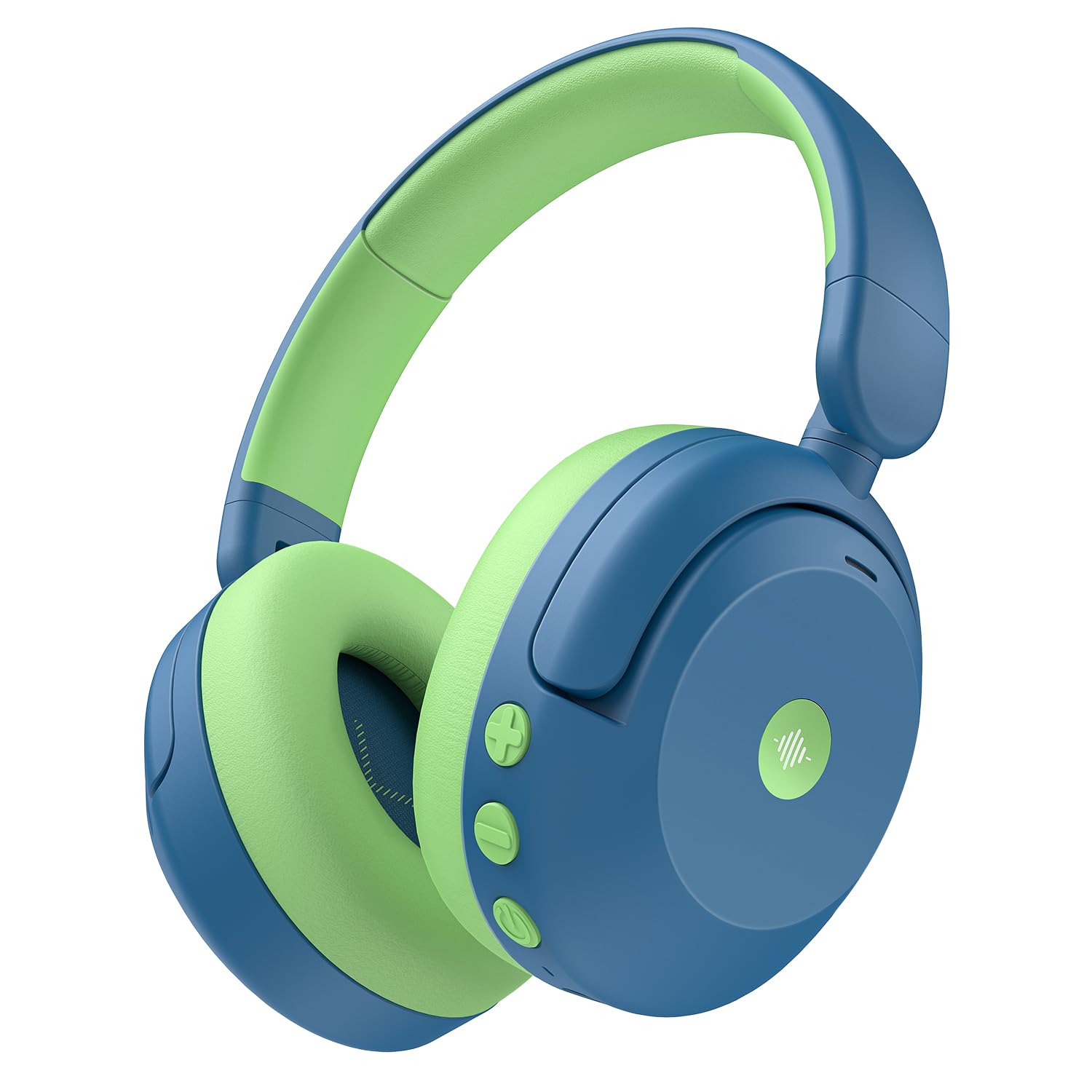
iClever BTH22
Key Features
- Weight: 5.26 oz
- Headband: 10-step adjustment
- Playtime: 60 hours
- Volume limit: 74/85 dBA
- Price: Budget
Ten headband positions and cups that rotate to sit flat — the iClever BTH22 is shaped for heads that haven’t finished growing. At 149 g it’s the lightest set here, and that matters more than it sounds: weight on a small neck is the reason a lot of toddler headphones end up on the floor of the car.
The limiter tops out at 85 dBA with a 74 dBA tier beneath it, which is the right range for a two- or three-year-old. Bluetooth 5.4, a 60-hour battery, a 1.8-hour charge and a detachable 3.5 mm cable cover the practical side, and it folds into something that fits a diaper bag’s side pocket. The top of the headband is the part to watch: it can crack when a child pulls the cups apart instead of easing the band open.
For a two- to four-year-old this is the set we hand parents first. Older kids will want the 94 dB mode and the longer warranty that the bigger sets bring, but for a first pair on a small head, 149 grams and a 74 dBA ceiling are the two numbers that decide it.
Pros
- Lightest here at 149 grams
- Ten-step headband with rotating cups
- 74/85 dBA ceiling suits toddlers
- 60-hour battery, 1.8-hour charge
Cons
- Headband can crack if pulled open by the cups
- No 94 dB mode for very noisy places
For toddlers and small heads, the BTH22 is the one we point to: 149 grams, ten headband steps and a 74 dBA ceiling that keeps a first pair quiet.
Best for Siblings Sharing
JLab JBuddies Studio 2
Key Features
- Fit: Ages 6–16
- Playtime: 65+ hours
- Warranty: 2 years
- Volume limit: 85/95 dB
- Price: Midrange
Two kids, one tablet, one long drive: the JBuddies Studio 2 is the only set here that solves that, with a share mode that pairs a second pair of JLab headphones to the same device so both children hear the same movie. In a family with siblings close in age, that single feature settles the argument in the back seat.
The rest is sensible. Two parent-selectable ceilings, 85 dB for everyday and 95 dB for a loud cabin, chosen with a switch rather than an app. An adjustable headband JLab rates for ages six to 16, cloud-foam ear cushions, 65 hours of playtime, a USB-C cable for wired listening when the battery dies, and a two-year warranty that is the longest in this roundup.
Where it falls down is younger fit and the wireless link. Five-year-olds find it tight, and this is an on-ear design, so it presses rather than surrounds — comfortable for a school day, less so on a ten-hour flight. Bluetooth dropouts are the flaw to know about: when the link goes mid-film you re-pair and carry on, which is annoying rather than fatal.
Pros
- Share mode pairs two pairs to one device
- 85/95 dB switch, no app needed
- Two-year warranty, longest here
- Headband rated for ages six to 16
Cons
- Bluetooth dropouts interrupt playback
- On-ear fit runs tight below age six
For siblings sharing a tablet, this is the pick: share mode, a 95 dB boost for loud cars and a two-year warranty, as long as your kids are six or older.
Best for Noisy Places
iClever BTH20
Key Features
- Weight: 7.68 oz
- Playtime: 60 hours (ANC off)
- Volume limit: 80 dBA
- Noise cancellation: Up to 40 dB
- Price: Midrange
The BTH20 is the heaviest kid-first set here at 7.68 ounces, and most of that weight is the noise-cancelling hardware. That’s the trade: a pair that presses a little more on a small head in exchange for the ability to quiet a plane cabin or a supermarket.
It’s genuinely quiet, too — up to 40 dB of reduction across two modes, and cancellation is the strongest thing about this model. For a child who covers their ears in shops or finds assemblies overwhelming, this is the set that changes the outing rather than just piping audio into it. If you’re buying for a child with sensory needs, it’s the one worth the extra money.
The volume ceiling is 80 dBA, the lowest fixed cap in this group, which is a safety feature and a limitation at once: on a noisy plane, the quietest safe ceiling can leave dialog hard to follow. You get 60 hours with the cancellation off, Bluetooth 5.4, a detachable cable and a fold-flat shape that survives a school bag.
We like it best as a second pair for specific situations — travel days, appointments, crowded shops — rather than as the everyday school set. The iClever BTH22 is the better all-day choice from the same brand; this one earns its keep when the world is loud.
Pros
- Up to 40 dB of active noise cancellation
- 80 dBA cap, the lowest here
- 60 hours with cancellation off
- Detachable cable and fold-flat design
Cons
- 80 dBA ceiling can leave plane audio hard to follow
- Ear cups can crack with heavy use
If your child struggles with noise, the BTH20 earns its price: 40 dB of cancellation and an 80 dBA cap, in a heavier set best kept for travel and loud places.
Best for Parental Control
JBL Junior 470NC
Key Features
- Weight: 6.91 oz
- Battery life: 50 hours
- Volume limit: 85 dB max
- Noise cancellation: Active
- Price: Premium
At the top of this group sits the JBL Junior 470NC, and what you’re paying for is control rather than sound. The companion app lets you drop the ceiling below JBL’s fixed 85 dB and set a daily listening-time limit, which is the only parental tool of its kind here and the reason a careful parent might choose it over cheaper sets.
The hardware is solid: over-ear cups that cover the whole ear rather than pressing on it, active noise cancellation, Bluetooth 5.3, 50 hours of playtime, USB-C charging in about two hours, a sticker set for naming them, and a light 196 g for an over-ear design.
Two catches. Plug in the 3.5 mm cable and the electronics switch off, so cancellation and the app’s limits only work wirelessly — fine on a tablet, less so with a seat-back screen. And the 85 dB ceiling makes it quiet: some children find dialog thin on a plane, and there’s no 94 dB escape hatch for a noisy car.
For a family that wants a hard time limit and a volume ceiling they set themselves, none of the cheaper sets here can do it, and that’s worth the premium. For everyone else the EarFun does most of the same job for far less, and the JBL’s quiet output and missing case are easier to forgive at the lower price than at this one.
Pros
- App sets custom volume and daily time limits
- Active noise cancellation with over-ear cups
- 50-hour battery
- Light at 196 g for an over-ear
Cons
- No case or pouch at this price
- Cancellation and app limits work only wirelessly
The 470NC is worth it for the app: custom volume ceilings and daily time limits that no other set here offers — otherwise, save your money.
Best for Comfort
JoySpark T5

Key Features
- Cable: Detachable 3.5 mm
- Weight: 6 oz
- Playtime: 60 hours
- Volume limit: 85/94 dB
- Price: Budget
Memory foam over-ear cushions and a 170-gram frame: the JoySpark T5 is the comfort pick, and the shape of the cups is why. Padding that surrounds the ear spreads the pressure instead of pressing on cartilage, so a child who complains about sore ears after half an hour tends to keep these on through a whole film.
The practical side is well covered — 85 and 94 dB ceilings, Bluetooth 5.3 with a ten-metre range, 60 hours of playtime, a detachable 3.5 mm cable, 2.5-hour charging and an 18-month warranty that beats most of this group. The cups fold and swivel, so the whole thing packs flat in a school bag.
It suits a school-age child more than a toddler: 85 dB is the floor here, with no quieter tier, and the 2.5-hour charge is on the slow side for a house that forgets to plug things in. For a six- or seven-year-old who wants soft cups and a big battery, it’s a strong second to the EarFun.
Pros
- Memory foam over-ear cushions
- 60-hour battery with 18-month warranty
- 85/94 dB ceilings and wired backup
Cons
- Some units stop accepting a charge
- No volume tier below 85 dB
If your kid complains about sore ears, try the T5: memory foam cups, a 60-hour battery and an 18-month warranty, with charging as the thing to watch.
Best for Spiderman Fans
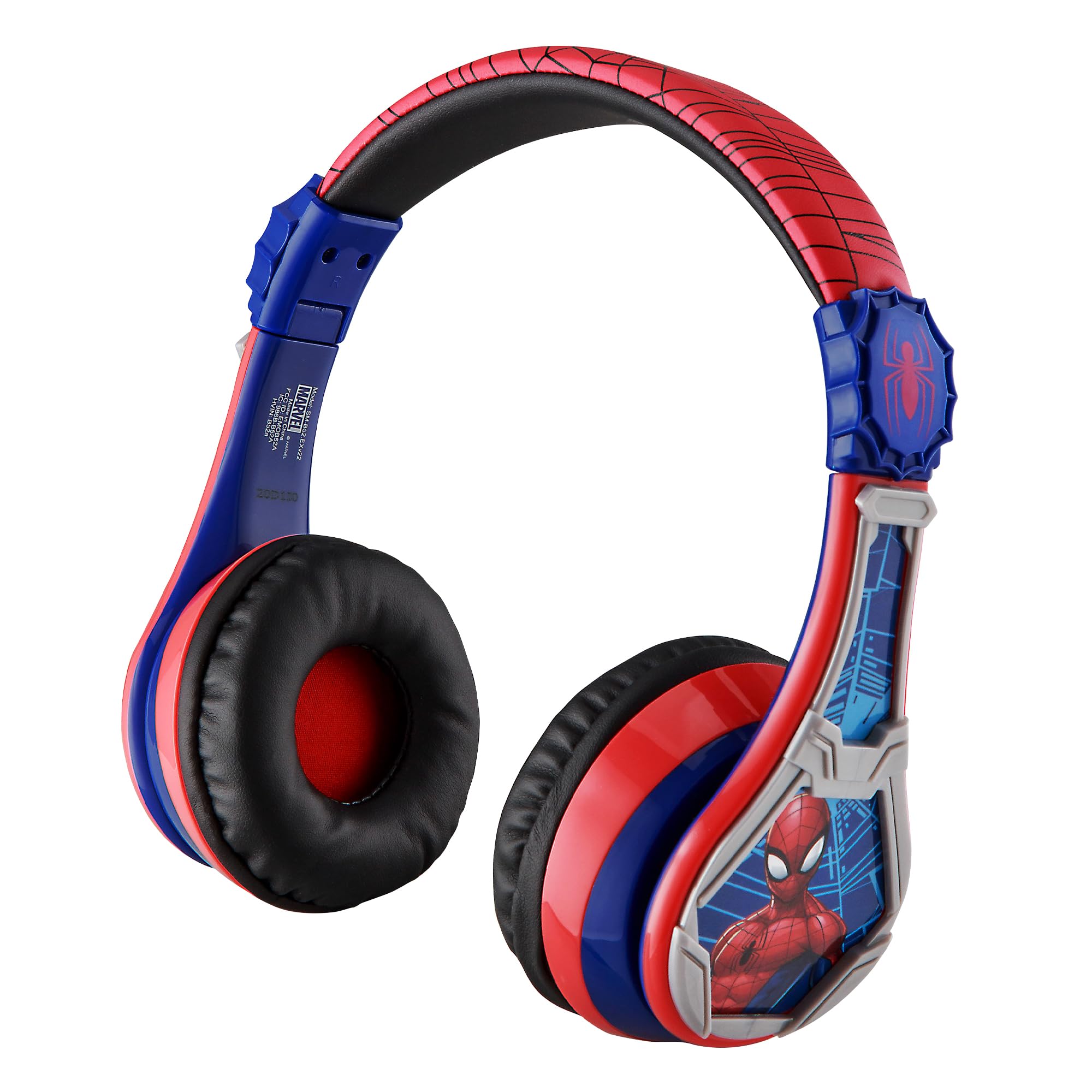
eKids Spiderman
Key Features
- Warranty: 1 year
- Bluetooth: 4.0
- Wired cable: Detachable 3.5 mm
- Battery life: 18 hours
- Price: Midrange
There’s no spec-sheet argument for the eKids Spiderman set, and that’s not why you’d buy it. A five-year-old who won’t put on plain headphones will wear these, and the character is doing real work — a built-in mic, a detachable cable for seat-back screens and a fold-flat shape, all in a package a child asks for by name.
Know what you’re paying for. Durability is the gamble: these turn up with a snapped band after a month in some houses and last a year in others, so treat the one-year warranty as the safety net rather than a formality. If the Spiderman is non-negotiable, buy it and keep the receipt. If it isn’t, the EarFun costs less and holds up better.
Pros
- Licensed Spiderman design children ask for
- Mic and detachable 3.5 mm cable
Cons
- 18-hour battery is the shortest here
- Bluetooth 4.0 is the oldest standard here
Buy the Spiderman set only if the character is the point: a reluctant five-year-old will wear it, but the specifications trail everything else here.
How We Tested the Best Kids Bluetooth Headphones
We began by gathering kid-specific Bluetooth headphones from brands with a track record, then crossed off models with vague volume-limiting language, flimsy hinges, or battery claims that did not match the price. That left us with 15 pairs, which went home with families whose kids range from preschool age to tweens. Testing ran for four months, long enough for the new-toy excitement to wear off and for the weak spots to show.
The pairs lived in backpacks, sat through online lessons at the kitchen table, rode in the back seat on weekend drives, and got passed between siblings during tablet time. We watched how kids put them on, whether the controls made sense without an adult, and whether Bluetooth reconnected on its own after a night in a bag. Every pair took the same abuse: dropped from desk height onto hardwood, headband flexed, earcups twisted, and wiped with a damp cloth. We checked for cracks at the hinges, flattened padding, and buttons that went mushy. We also timed each battery from full charge to shutdown while streaming an audiobook, then noted how long a recharge took.
For sound, we played familiar songs, audiobooks, and video lessons at low and high volume, listening for muddy voices or harsh treble and checking that the volume cap held when a kid mashed the buttons. We noted which pairs stayed comfortable through a full movie, which pinched or slid off during a sprint to the bus stop, and whether noise cancellation muffled the kitchen without blocking a parent calling from the next room. We also watched which pairs the kids asked for without being told, because enjoyment matters. At the end, we compared what each pair delivered against what it costs; a cheap pair that dies in a month is not a bargain.
How to Choose Kids Bluetooth Headphones
The volume ceiling is the one specification that changes what you should buy; battery, weight and warranty only sort the sets that pass it.
Read the ceiling, not the label
Almost every set in this category calls itself volume limited, but the number behind the label differs: a fixed 80 dBA on the iClever BTH20, 85 dB on the JBL Junior 470NC, a 74/85/94 dB choice on the EarFun K2, 85/95 on the JLab. For a toddler, look for a tier at or below 80 dB. For a school-age child, an 85 dB default with a higher mode for car and plane noise is more useful than a single fixed cap.
The trap is a set advertised as safe listening that simply stops at 94 dB. That is loud enough to matter over a long session, so check the top number before you buy, not the badge on the box.
Match the fit to the head, not the age on the box
Kids’ sets run from 149 g to more than 200 g, and the light ones are the ones that stay on small heads. Check the headband’s adjustment range and whether the cups rotate to sit flat against the ear — both make the difference between a set that settles in place and one that slides off mid-film. On-ear designs press against the ear; over-ear designs surround it, which is more comfortable over long wear but adds weight.
Our lightest pick suits a two- to four-year-old. Once a child is in school, the sets rated for ages six and up give more room to grow.
Battery, charge time and the cable in the box
Playtime claims here run from 18 to 85 hours, and the big numbers assume moderate volume with lights and cancellation off. The more useful questions are how quickly it charges and whether a cable is included — ten minutes on USB-C can buy most of a flight, and a wired connection keeps the movie going when the battery doesn’t.
If your child never remembers to plug anything in, weight the battery heavily and pick the longest number. If you travel, weight the cable, and check which one: most sets here take a 3.5 mm jack, but at least one falls back to USB-C only.
Where these break, and what the warranty covers
The failures cluster in the same three places: the top of the headband, the hinge where the cups fold, and the charging port. Only one set here has a metal headband frame, and it’s the one we trust most with rough handling; the rest are plastic and live or die by how gently they’re pulled open.
Warranties run from six months to two years, so match the coverage to the child. A toddler who drags a set off by the cups is a different risk from a nine-year-old who leaves it in a bag, and a longer warranty is worth more than a flashier finish. Keep the order confirmation somewhere you can find it.
Do you need noise cancelling?
Active cancellation costs money, adds weight and needs battery to work — on the JBL, plugging in the cable switches the electronics off entirely. It earns its place for a child who covers their ears in shops or struggles on flights, where cutting engine drone matters far more than hi-fi sound.
For everyday school and tablet use, the passive seal of an over-ear cup is usually enough, and the difference in price is better spent on a longer warranty or a bigger battery.
Frequently Asked Questions
Can kids use Bluetooth headphones on a plane?
Not through Bluetooth, no. Seat-back entertainment systems don’t pair with headphones, so pack the 3.5 mm cable that came with the set plus a two-prong airline adapter, which most cabin sockets still need. For a tablet, put it in airplane mode first and pair the headphones as usual. A splitter is worth the pocket space if two children are watching one screen.
How loud is safe for a child?
Use the lowest ceiling your child can still hear clearly — 74 to 80 dB for a toddler, 85 dB for a school-age child — and treat it as a cap, not a target. A limiter protects against sudden spikes, not against six hours of steady listening. Keep sessions to around an hour at a time and take the set off in between.
How do I clean headphones a child wears every day?
Don’t rinse them. None of the sets here are water resistant, so wipe the ear cushions with a barely damp cloth and a little mild soap, then let them dry fully before use. A cotton swab clears crumbs out of the hinge and around the buttons, and skip alcohol or solvent wipes, which dry out the padding.
Final Verdict
The EarFun K2 is the pair we recommend to most families. It’s the only set here with a 74 dB mode for a toddler and a 94 dB mode for a noisy car, and it backs that up with a 3.5 mm cable, Bluetooth 5.4 and an 18-month warranty — the details that keep a kids’ set useful after the novelty wears off.
If your child is hard on gear, the Botesty BS01’s metal frame and 85-hour battery make it the tougher buy. For a two- or three-year-old, the 149-gram iClever BTH22 fits a small head better.
