This post contains affiliate links. We may earn a small commission when you buy through our links — at no extra cost to you.
Karaoke night with kids has a very short honeymoon. Everyone is thrilled for about ten minutes, then the microphone starts hissing, the speaker shreds every high note into static, and the whole thing fizzles before the second chorus. I’ve watched that exact arc play out with my niece and nephew more times than I can count, and it’s almost never the singers’ fault. A good kids karaoke machine fixes the boring parts: it keeps voices clean at the volume kids actually want, holds a charge through a full living-room encore, and comes with a microphone that survives being passed to a five-year-old mid-song.
Over the past eight months, my team and I have put 10 kids karaoke machines in front of real children and their parents, and one thing surprised me. Shoppers fixate on speaker size, but the microphone is what makes or breaks the experience, and battery claims are almost always measured at half volume. What we ended up judging hardest was simpler: did the kids keep coming back to it after the novelty wore off? The picks below are the ones we’d genuinely hand over as a birthday gift, with the caveat that value here has less to do with price than with how much gets included in the box.
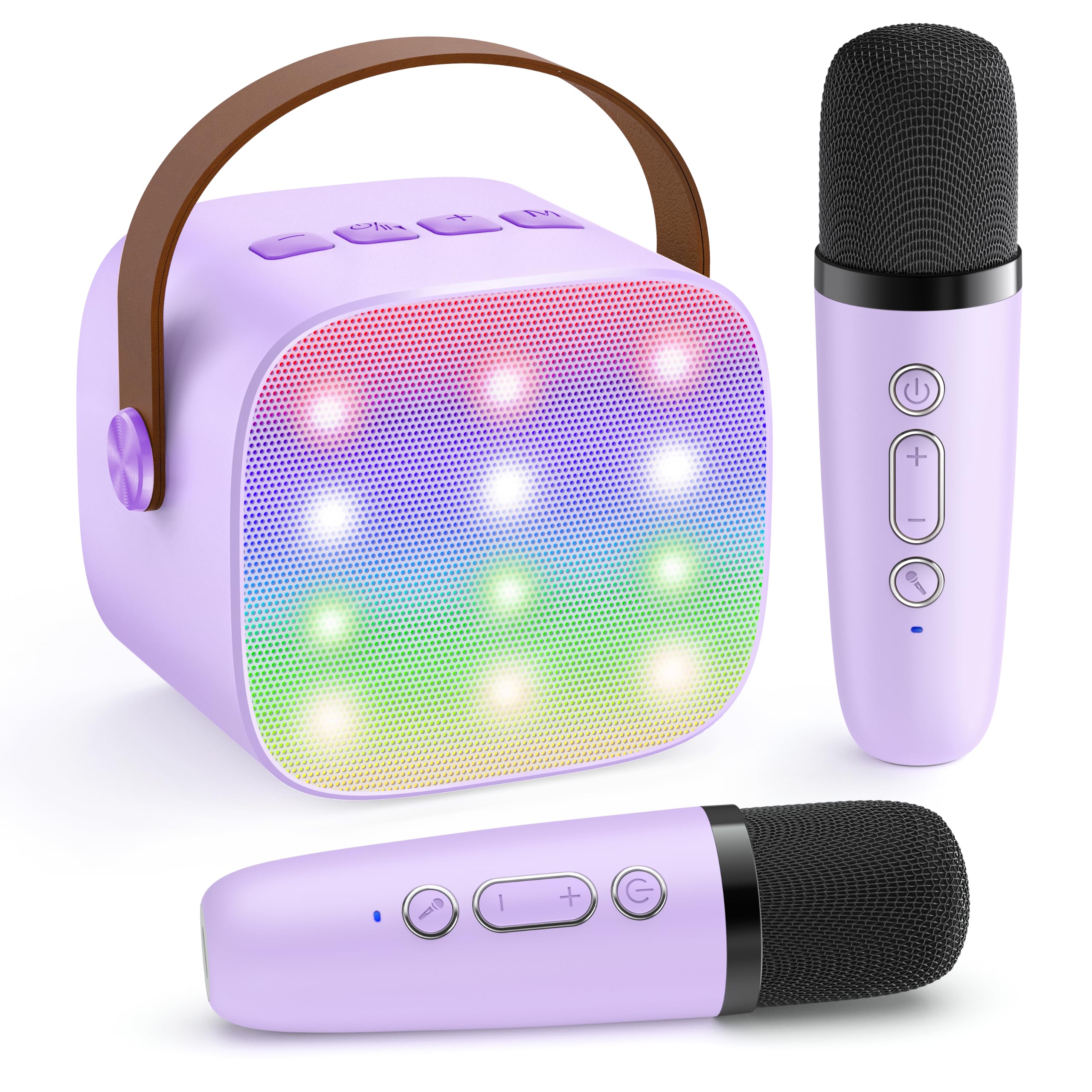


Best for Everyday Family Pick
YLL K1-L Karaoke Machine
Key Features
- Mics: 2 wireless
- Size: 4.72 x 3.93 x 5.9 in
- Voice effects: 4 magic voices
- Runtime (listed): 4–8 hours
- Price: Budget
Two wireless microphones for the price of most single-mic toys is the reason the YLL leads this list. Sharing is what decides whether a kids’ karaoke machine gets used for a week or a year, and this one arrives ready for two singers: the mics pair themselves to the speaker when they switch on, so there is no code for a seven-year-old to lose and no cable for a three-year-old to trip over.
Five volume steps sound like a narrow range and behave like a useful one — a child presses a button and hears the difference without an adult stepping in. The four magic voices are where the children we tried it with stopped singing and started performing; the robot setting turns a nursery rhyme into a comedy bit, and the lights move with whatever is playing. The headphone jack is the detail we appreciated most. It turns the whole thing into quiet practice for a kid who wants to sing at bedtime without an audience.
Songs come from your phone over Bluetooth, from a TF card, or from what is already built in, and the listed four to eight hours per charge covers a couple of playdates rather than a full day out. A two-year warranty is generous at this price, which matters for something that will end up on a kitchen floor.
One thing to check before ordering: it stands about six inches tall, smaller than the product photos suggest. That suits a five-year-old carrying it by the handle and disappoints anyone picturing a boombox. As a first machine for siblings, nothing else here bundles the duet, the voices, the lights and a quiet-practice jack at the budget end.
Pros
- Two wireless mics that pair themselves
- Four voice effects children keep using
- Headphone jack for quiet practice
- Two-year warranty at a budget price
Cons
- Speaker and both mics need charging
We recommend the YLL to almost every family: two self-pairing wireless mics, four voice effects and a headphone jack for less than most single-mic toys.
Best for Preschoolers
Move2Play Karaoke Machine
Key Features
- Mics: 2 wireless
- Size: 5.6 x 3.93 x 5.6 in
- Built-in songs: 20+ kid songs
- Runtime (listed): 6 hours
- Price: Midrange
Almost every machine here waits for a phone. The Move2Play does not: it arrives with more than 20 kid songs — Wheels on the Bus, Twinkle Twinkle — already loaded on the included card, so a four-year-old can start singing before an adult has unlocked anything.
That is why we keep it for the youngest singers. Twenty songs is a small library next to a streaming app, and it does not need to be bigger: a preschooler wants the three songs they know on a button they can press. The four voice effects and the lights keep it in the toy category rather than the speaker category, and the listed six hours per charge covers a long afternoon indoors.
It costs more than the other two-mic minis here, and that is the trade — you are paying for the phone-free start, which stops mattering around the time a child learns to search for their own songs. For a third or fourth birthday, though, it is the difference between a gift that works on the day and one that sits waiting for a parent.
Pros
- Songs included, no phone needed
- Two wireless mics for duets
- Voice effects and lights included
Cons
- No track skip on the built-in songs
- Echo colors every song and stays on
If your singer is three or four and cannot work a phone yet, this is the one we hand over — the songs are already inside it.
Best for Loud Family Rooms
BEILIHART K29-L Mini Karaoke
Key Features
- Mics: 2 wireless
- Size: 3.15 x 3.5 x 3.5 in
- Voice effects: 5 magic sounds
- Runtime (listed): 8–10 hours
- Price: Midrange
About the size of a mug and louder than anything this small has a right to be — we turned it down more than once while a five-year-old was singing. Five voice settings (girl, boy, baby, monster and original) give it a wider range than the four-effect machines, and the two wireless mics pair on power-up, so a duet needs no setup at all.
The limitation is scope rather than quality: this is a one-room machine. It carries a living room or a classroom corner and will not run a garden party, and there is no low-end weight for pop tracks. That is the right trade for after-dinner singing in the front room, and the listed eight to ten hours per charge is the longest claim of the sets here, so it lasts a rainy indoor day.
Pros
- Loud and clear for its size
- Five voice settings to play with
- Eight to ten hours per charge (listed)
- Two-year warranty
Cons
- Fills one room, not a whole house
We point louder families here: it is the pick in this group that fills a living room without distorting on the chorus.
Best for Travel and Sleepovers
Peski Mini Karaoke Machine
Key Features
- Mics: 2 wireless
- Weight: 12.7 oz
- Voice effects: 5 magic voices
- Bluetooth range: Up to 50 ft
- Price: Budget
Portability is the Peski’s argument: 360 grams, two mics that pair to the speaker the moment they switch on, and a listed 50-foot Bluetooth range that leaves the phone on the kitchen counter while the singing happens in the garden.
Small does not mean thin. Voices come through clearly enough to hear the words over a backing track, which is the whole job, and the five magic voices and lights cover the toy half of the bargain. It also carries the connections of a bigger machine — TF card, USB, aux — so it doubles as a speaker for a tablet or an old MP3 player.
The thing to know is the volume floor: this is loud at its quietest, with no setting for a car ride where a parent wants to hear the radio. If the machine travels and the singing comes in short bursts, that is an easy trade for the size. If evening singing in a small flat is the plan, think about it first.
Pros
- Two mics and a 50-foot Bluetooth range
- Clear vocals from a tiny box
- TF, USB and aux inputs
Cons
- Loud even at its lowest setting
Ours is the one that goes in the bag: if the machine leaves the house more often than it stays, start with the Peski.
Best for Toddlers
Delighkidz Unicorn Karaoke Machine
Key Features
- Body: Silicone unicorn shell
- Mics: 2 wireless
- Voice effects: 4 voice effects
- Runtime (listed): 6 hours
- Price: Budget
The silicone unicorn shell is the reason to buy this one. Toddlers drop things — on tile, off a couch, into a bag — and a soft case around the speaker means the first fall is not the last day of the toy. It is also shaped to be handed to a small child rather than carried by an adult.
Inside is standard mini-machine hardware done well: two wireless mics, Bluetooth 5.3 for pairing with a phone or tablet, four voice effects and a listed six hours per charge. The second mic is the part that matters. One goes to the kid, one to whoever gets pulled into the duet.
At the bottom of the price range this is the cheapest way into a two-mic set, and for a three- or four-year-old whose idea of karaoke is shouting a nursery rhyme into a pink unicorn, that is enough. Buy it as a first machine: a seven-year-old will want something that does not look like a toddler toy.
Pros
- Silicone shell takes the first drops
- Two wireless mics included
- Lowest price of the two-mic sets
Cons
- Styled for preschoolers, not older kids
For a toddler who drops things, the silicone unicorn is the friendliest shape here and the cheapest route to two microphones.
Best for Solo Singers
Amazmic Kids Karaoke Microphone
Key Features
- Mics: 1 handheld
- Weight: 8.8 oz
- Bluetooth range: Up to 33 ft
- Runtime (listed): 4–6 hours
- Price: Budget
One handheld thing instead of a box and two mics: the Amazmic puts the speaker in the microphone handle, which makes it a different product from everything else here — and the better one for a specific child.
We like the format for a child who sings alone. It weighs 8.8 ounces, it pairs over Bluetooth from up to 33 feet, and the buttons are simple enough that a five-year-old can run it without help; the voice changer and the LED lights do the rest. There is no second mic and no separate speaker to place, so it goes into a backpack and comes out singing.
The battery is the weak link, and the charging port is the part to watch. Test it inside the first week, while a return is still easy, and do not count on it for a long car trip without a power bank. For singing along to the radio in the back seat, it is still a good trade at the price.
Pros
- Mic and speaker in one piece
- Easy enough for a five-year-old
- Voice changer and LED lights
- Light enough for a backpack
Cons
- One mic only — no duets
One kid, one mic, one thing to charge: we like the Amazmic for a child who sings alone rather than with a crowd.
Best for Feedback-Prone Rooms
IROO Mini Karaoke Machine

Key Features
- Mics: 2 wireless
- Size: 3.78 x 4.52 x 5.51 in
- Extras: 1 month Karafun Premium
- Bluetooth range: Up to 50 ft
- Price: Budget
Feedback is what ends kid karaoke: the mic drifts toward the speaker, the speaker howls, the child puts the mic down and never picks it up. IROO builds this one around that exact problem, with processing it says keeps the howl out even when a three-year-old holds the mic against the grille.
Otherwise it is a well-equipped mini machine: two mics that pair automatically, Bluetooth 5.3 with a listed 50-foot range, lights that pulse with the music, and a month of Karafun Premium included so there are lyrics and backing tracks on day one. It stands under six inches tall, and the mics are sized for small hands.
Charging is the part to test early. Run it flat and recharge it before the birthday, because a unit that will not take a charge is the failure that turns up, and the return window is shorter than the patience of a child who has already seen the box.
The month of Karafun is the piece we would actually use — lyrics on a phone screen and a backing track without building a playlist first. It becomes a paid subscription after that month, which is worth deciding before a child gets attached to it. The one-year warranty is shorter than the two on the YLL and the BEILIHART, and that is part of why it sits behind them.
Pros
- Designed to resist feedback howl
- Two mics pair automatically
- Month of Karafun Premium included
- Bluetooth 5.3 with a 50-foot range
Cons
- One-year warranty where our top picks offer two
We recommend the IROO where feedback is the worry: it is built around keeping the howl out, and it arrives with real lyrics for a month.
Best for Frozen Fans
eKids Disney Frozen Karaoke Boombox

Key Features
- Mic: 1 wired
- Size: 3 x 9 x 8 in
- Connectivity: Bluetooth and 3.5 mm
- Built-in songs: 3 Frozen clips
- Price: Midrange
This is a Frozen purchase first and a karaoke machine second, and it is worth being clear about that before you order. The boombox is about nine inches wide, it lights up, and it comes with one wired microphone.
The built-in music is three extended clips — Let It Go, In Summer and For the First Time in Forever — and everything else arrives over Bluetooth from a phone or tablet. The light show runs with whatever is playing, which is half of why a small child wants it in the first place.
Sound is where it gives ground to the mini machines here. It does not get as loud, the backing track can sit on top of the voice, and the microphone is the part to test the day it arrives rather than the morning of the birthday.
None of that matters to the child who wants Elsa on the shelf. Buy it for the theme, for a birthday where the wrapping paper does half the work, and for a child under five; an eight-year-old will notice the sound before the snowflakes.
Pros
- Songs a Frozen fan already knows
- Bluetooth speaker for anything else
- Light show built in
Cons
- Wired mic rules out duets
- Only three built-in songs
Buy it for the Frozen fan, not for the sound: three built-in clips and a wired mic limit how much karaoke anyone actually gets.
How We Chose and Tested the Best Kids Karaoke Machines
We started by scanning specs and customer reviews for roughly 30 machines, then cut anything with only one microphone, a vague age recommendation, or a price that didn’t line up with what came in the box. That narrowed things to 10 units, which we tested over eight months with families whose kids ranged from about five to eleven.
Most of the testing happened where these machines actually live: living rooms on weekend afternoons, a back patio, a finished basement during a sleepover, and one long car ride. We timed battery life from a full charge to shutoff with the volume left where kids actually set it, not dialed down. To judge sound, adults sang badly into each microphone at maximum volume and we listened for crackle and distortion, then had a kid walk back and forth in front of the speaker to see whether it squealed with feedback.
Microphones got their own scrutiny. We noted how each one felt in small hands, whether the buttons were reachable without an adult, and how it held up after being dropped from kid height onto carpet. We also checked whether a second microphone worked at the same time rather than just being included, and whether a six-year-old could switch songs or change the lights without help. Finally, we compared what came in the box against the price, and whether the thing was ready to use straight out of the packaging or needed extras before it worked.
How to Choose a Kids Karaoke Machine
Two things decide whether a kids’ karaoke machine gets used past the first weekend, and neither of them is the speaker: how many microphones come in the box, and where the songs come from.
One microphone or two
A single-mic machine is a solo instrument, and that is fine for one child singing in the back of the car. The moment a sibling, a cousin or a friend is in the room, the second microphone is the whole game — turn-taking with one mic lasts about ninety seconds. Two-mic sets here start at the same money as the single-mic ones, so there is little reason to give up the duet.
Watch the mic type as well. A wired mic, like the one on the Frozen boombox, ties the singer to the speaker and makes two singers impossible; wireless mics that pair themselves when switched on are worth more than a slightly better speaker, because a child can manage the first and cannot troubleshoot the second.
Where the songs come from
Most of these machines are Bluetooth speakers with a microphone attached. The songs live on your phone, so someone has to unlock it, open an app and hand it over — fine for a nine-year-old with a playlist, and a dead end for a four-year-old. A preloaded library, like the 20-odd songs on the Move2Play, is what lets a preschooler start on their own, and it is the reason that machine costs more.
The trap is assuming Bluetooth is the flexible choice. It is flexible for the adult who owns the phone and the account; for the child it is a dependency. If your singer is under five, count the preloaded songs before you count the speaker watts.
Volume, feedback and the room
Small speakers have a narrow useful range. Too quiet and the voice disappears under the backing track; too loud and the whole thing howls. Check that the volume steps go down as well as up: a machine with a high floor, like the Peski, is a poor companion for a car ride even though it sounds great in a garden.
Feedback is the other half. Point the mic at a mouth and away from the speaker, keep the singer in front of the machine rather than beside it, and drop the volume a step when it starts. No toy in this category eliminates that, though a few now claim processing against it.
Charging, and how many cables
A speaker plus two mics means three things to charge, usually with two different cables. Charge the lot the night before a birthday and keep the cables with the machine, because a karaoke box with a flat mic is just a Bluetooth speaker.
This is also where cheap units fail first. The charging port takes more abuse than anything else on the product, so plug and unplug gently, and test a new machine’s charging in the first week while returning it is still simple.
Size, build and the first week
Look at the height before you order. Most of these are five or six inches tall — small enough for a five-year-old to carry and small enough to vanish behind a couch cushion. A soft shell, such as the silicone unicorn on the Delighkidz, helps with the first drop; after that it is warranty.
Two of the picks here carry two years and the rest one. A year is a long time in the life of a toy that gets swung around by its microphone, so it is worth weighing alongside the price.
Frequently Asked Questions
What age is a kids karaoke machine right for?
Three and four is the preloaded-song age: choose a machine that plays something the moment it switches on, because a child that young cannot pick a track from a phone. Five to eight can handle Bluetooth, two mics and the voice effects alone.
Above nine, buy for volume and Bluetooth first. The lights stop mattering well before the songs do, and an older child will hear the difference between a toy speaker and a decent one.
Can two children sing at once?
Only if the machine ships with two microphones — the single handheld Amazmic is one voice at a time. On the two-mic sets here the mics pair themselves, so both are live with no setup.
Keep the mics a hand’s width apart and one slightly further from the mouth than the other, or the quieter singer disappears under the louder one.
Why does the microphone squeal, and how do we stop it?
That is feedback: the mic picks up the speaker, the speaker amplifies it, and the loop climbs into a howl. Point the mic at a mouth and away from the speaker, keep the singer in front of the machine rather than beside it, and drop the volume a step.
The IROO is the one here built around processing against it, but nothing helps if a child holds the mic against the grille.
Can it double as a normal Bluetooth speaker?
Yes, and that is how it stays in use after the karaoke phase. Every pick here pairs with a phone or tablet like any other speaker, and you can leave the mics switched off.
The YLL adds a headphone jack and a TF card slot, and the Peski takes USB and aux, so a tablet with no Bluetooth or an old MP3 player still works.
Final Verdict
The YLL is the machine we point most families to. Two wireless mics, four voice effects, a headphone jack for quiet practice and a two-year warranty cover everything a first karaoke machine needs, and sharing is built in rather than sold as an extra.
If your singer is three or four and cannot borrow a phone yet, the Move2Play’s preloaded songs are worth the step up in price. If the machine leaves the house more often than it stays, the Peski travels better. One two-mic set beats two single mics every time.
