This post contains affiliate links. We may earn a small commission when you buy through our links — at no extra cost to you.
Kids outgrow a rear-mounted bike seat in about one summer, and before they do you’ll spend most of it with a helmet pressed into your back and their legs dangling asleep. A trailer changes the shape of the ride: they sit low and strapped in, with room for a snack and a stuffed animal, and you get your balance back on the climbs. What it doesn’t fix is a sloppy hitch, a soggy footwell, or a harness a wriggling 3-year-old can worm out of.
My kids have been the test pilots for six trailers over the past five months, from quick school runs to long weekend greenway rides, and the gap between a bargain model and a good one shows up in details no product photo captures. The spec nobody reads is the weight limit, which counts both kids, their helmets, the snacks, and the half-inch of rainwater sitting in the footwell. Below are the ones worth hitching up, and what each one is genuinely best at.


Best for Two Growing Kids
Allen Sports Deluxe Steel Child Trailer
Key Features
- Wheels: 16-inch quick-release
- Harness: Padded five-point
- Seating: 2 children
- Max payload: 100 lb
- Price: Premium
One hundred pounds is the number that decides this one. It’s the highest payload in this roundup, enough for two school-age children or two toddlers plus a day’s gear, and the steel frame stays settled behind the bike with that much aboard instead of feeling skittish through a turn.
The cabin is what kept us coming back to it. Windows across the front and both sides let a child actually see the ride, and the footguard tubes keep feet out of the wheel arch, which is the sort of small design decision that saves you stopping halfway along a greenway.
Leg room is where it gives ground. Two toddlers and a bag fit comfortably; two children already in school end up with their knees angled and the cabin stops feeling generous. It’s also trailer-only, with no front wheel or handlebar in the box, so if you want to push it around a market after locking up the bike, this isn’t the one.
Pros
- Highest payload here at 100 pounds
- Roomy cabin with large front and side windows
- Padded five-point harness and footguards
- Folds flat with quick-release wheels
Cons
- Leg room tightens up for two school-age kids
- No stroller or jogger conversion
We recommend it for two children: the 100-pound payload and roomy cabin cover two toddlers and a bag, and the harness and footguards are the details that earn our trust.
Best for One Child Only
Schwinn Trailblazer Plus
Key Features
- Wheels: 16-inch air-filled
- Seating: 1 child
- Max weight: 40 lb
- Rear storage: 12 lb
- Price: Midrange
If the household has one rider, this is the trailer the rest of the group has to beat. The aluminum frame is why: 21 pounds is light enough to be a one-person lift onto a rack or into a hatchback, and it tows without the dead weight you feel from a steel double.
We liked the proportions more than the two-seaters. One child gets the full width, so a three-year-old sits with room to spare and there’s still 12 pounds of space behind the seat for a diaper bag and a picnic. The two-in-one canopy zips from bug screen to weather shield without anything coming apart, the wheels release with a push, and the folded package drops into a sedan trunk.
Our reservation is the cover, which is the component that shows age first; store the trailer dry and out of the sun and it stays presentable far longer. Everything else here is a straight answer to a single-child household that rides often.
Pros
- Aluminum frame keeps lifting to one person
- 12 pounds of cargo space behind the seat
- Canopy switches from bug screen to weather shield
- Quick-release wheels and folding frame for the trunk
Cons
- Single rider only
For one child, this is our pick: an aluminum frame you can lift alone, 12 pounds of cargo space, and a cabin that gives a single rider room to grow.
Best for Budget Two-Kid Setup
InStep Take 2
Key Features
- Frame: Folding, quick-release wheels
- Wheels: 16-inch pneumatic
- Seating: 2 children
- Max weight: 80 lb
- Price: Budget
The least expensive double in this group doesn’t feel like a compromise. You get a folding frame, 16-inch pneumatic wheels, five-point harnesses and a full canopy — the parts that hold a child — without paying for stroller hardware you may never unfold.
It earns its keep on ordinary trips. One toddler plus a diaper bag and a picnic leaves room to spare, the cover zips all the way around, and it collapses small enough to live under a bed or in the back of a small SUV. On gravel and packed dirt it tracked well enough that we stopped thinking about it, which is the highest compliment a trailer gets.
InStep backs it with a one-year warranty rather than the lifetime coverage the Allens carry, and there’s no conversion in the box. Neither matters if the trailer’s job is the school run and the bike path, which is exactly the job most families have — and for that, this is the smartest money in the roundup.
Pros
- Lowest-priced double in this group
- Five-point harnesses and full zip-around canopy
- Folds small enough for a trunk or under a bed
- Roomy for one toddler plus gear
Cons
- Snug for two kids past toddler size
Our value pick for two children: the lowest price of the doubles here, with the harness, canopy and folding frame that matter, and no stroller hardware you may not need.
Best for Bike-To-Stroll Errands
InStep Quick-N-EZ Double
Key Features
- Modes: Trailer and stroller
- Wheels: 16-inch pneumatic
- Seating: 2 children
- Max weight: 40 pounds listed
- Price: Midrange
The moment that sells this trailer happens off the bike. You park, unclip, and push a sleeping toddler into the café without lifting them out of the seat, because the Quick-N-EZ converts to stroller mode with the child still strapped in.
As a trailer it’s the familiar InStep package: 16-inch pneumatic tires, five-point harnesses, a folding frame and a canopy with bug screen, weather shield and a rear vent. That vent earns its place — a closed cabin on a warm afternoon gets stuffy, and airflow is the difference between a happy passenger and a complaining one.
Set against the plain doubles here it costs a little more and adds the push mode; set against the jogging convertible it’s lighter and simpler to live with, with no third wheel to store.
We came away convinced the conversion is the reason to choose it. A trailer you only ride to is one thing; a trailer that comes with you for the rest of the afternoon is the one that gets used, and that’s worth paying a little for.
Pros
- Converts to stroller with the child still seated
- Rear vent keeps the cabin from getting stuffy
- Folds flat into a small car trunk
Cons
- Harness buckle takes two hands to fasten
- 40-pound listed rating is tight for two seats
If the trailer has to double as a stroller, this is the one: it converts without unloading a sleeping child and still folds flat for the trunk.
Best for Rough Pavement
Schwinn Echo
Key Features
- Wheels: 20-inch air-filled
- Seating: 2 children
- Max weight: 40 pounds per child
- Rear storage: 12 lb
- Price: Premium
Twenty-inch wheels are the reason to look at the Echo. Every other two-seater here rolls on 16s; the bigger air-filled wheels lift the cabin over curb cuts and root-heaved pavement, and the difference in how much jolt reaches the seat was the first thing we noticed.
The rest of the package is sensible. Both children get 40 pounds of rating, the harness is a five-point with shoulder patches, the canopy gives you bug screen or weather shield, and there’s a rear vent, a safety flag and 12 pounds of gear space behind the seats. The alloy spoked wheels look like bicycle parts rather than toy parts, which is a fair summary of the whole trailer.
Two details to know. The cabin is snug once both riders are out of toddlerhood — treat this as a two-small-kids trailer — and the side pockets have elastic tight enough that a sippy cup won’t go in. You meet the second one on every trip; the first only matters if your children are already tall.
Pros
- 20-inch wheels roll over curbs and rough pavement
- 40-pound rating for each child
- 12 pounds of weather-protected gear space
- Safety flag and rear vent included
Cons
- Side pockets too tight for a sippy cup
- Cover Velcro sits within a toddler’s reach
Twenty-inch wheels make the Echo the smoothest-rolling two-seater here, and it’s the one we take when the route leaves the pavement behind.
Best for Jogging and Pushing
ClevrPlus Deluxe 3-in-1
Key Features
- Modes: Trailer, stroller, jogger
- Seating: 2 children
- Max weight: 88 lb
- Trailer weight: 37 lb
- Price: Premium
A pivoting front wheel and a handlebar brake with a parking lock are what separate this from the other convertibles here. It steers like a stroller rather than a trailer being shoved, and the brake holds it on a slope while you lift a child out.
There’s more to like. The steel frame sits higher off the ground than the InStep convertibles, which helps on gravel driveways and grass, the canopy is a plastic top with tinted windows and mesh, and reflectors run along all four sides. The cargo bay behind the seats is big enough for a real picnic rather than a snack.
The hitch is the check-before-you-order item. The coupler fits most rear axles, but ClevrPlus warns that it may not suit e-bikes, so measure your axle bolts first rather than discovering the problem at the trailhead.
Our verdict is narrow and confident: this is the trailer for a family that wants one piece of equipment for the bike path and the park, and keeps it in a garage rather than hoisting it onto a roof rack. The weight stops mattering the moment it lives at ground level.
Pros
- Pivoting front wheel and handlebar brake
- 88-pound capacity with a large cargo area
- Reflectors on all four sides
Cons
- Heavy at 37 pounds to lift alone
- 34.5 inches wide for doorways and gates
Choose it for the push mode and accept the bulk: a pivoting front wheel and a parking brake make this the most stroller-like trailer here.
Best for Value Convertibles
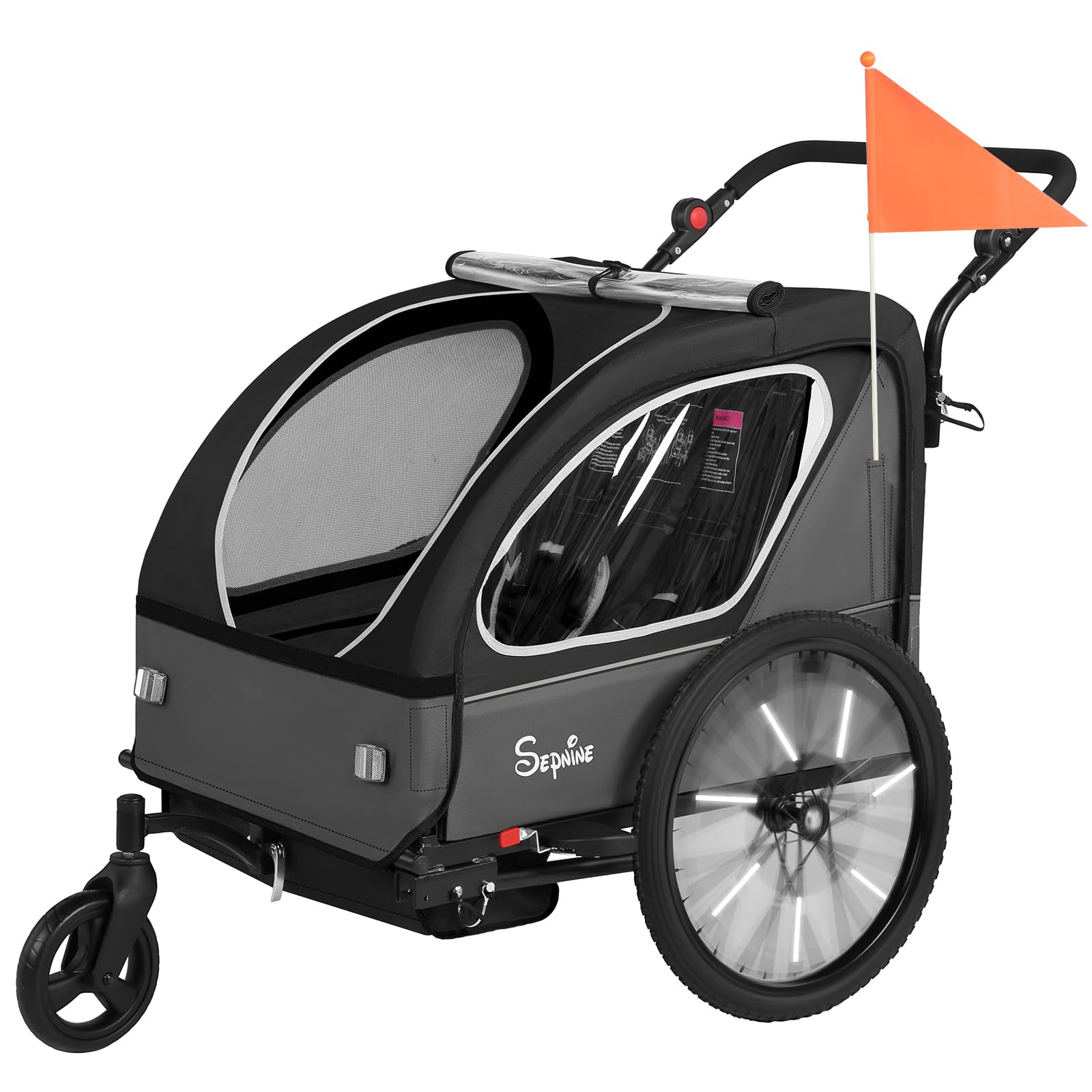
Sepnine 2-in-1 Kids Trailer
Key Features
- Modes: Trailer and pushcart
- Seating: 2 children
- Warranty: 3 months
- Max weight: 88 lb
- Price: Midrange
Three months. That’s the warranty on the Sepnine, and it’s worth knowing before the spec sheet wins you over, because the rest of the trailer reads like a much more expensive one: two five-point harnesses, 88 pounds of capacity, 16-inch air-filled wheels, a bug screen and weather cover, reflectors and a safety flag.
It also converts to a pushcart, folds on quick releases, and carries a large pocket behind the seats for bottles and snacks. On paper it’s the most feature-dense trailer at its price point in this group, and the cabin is roomy enough for two toddlers.
Our reaction was split, and honestly it still is. Every part that matters is present, but three months of coverage is a real signal about how much standing behind the product to expect, and a trailer takes more abuse than most kid gear — it lives outside, rolls through puddles and gets folded and unfolded every week. Buy it as a value convertible, not as a ten-year purchase.
Pros
- Two five-point harnesses and 88 pounds of capacity
- Converts to a pushcart for off-bike use
- Reflectors, reflective strips and safety flag
Cons
- Three-month warranty is the shortest here
A feature-packed convertible with one real catch — a three-month warranty — which makes it a fine first trailer and a riskier long-term buy.
How We Tested Six Kid Trailers, With Two Very Honest Passengers
We built the shortlist from roughly two dozen trailers, then cut anything with an underspecified weight limit, a single-point harness, or a stroller conversion kit sold separately and priced like an afterthought. Six made the final cut, and I have been towing them for five months: school runs on weekday mornings, greenway rides on weekends, a gravel rail-trail, and one memorable grocery trip.
Assembly came first. I unboxed and built each one alone, using only the tools in the box, and clocked how long it took and whether the instructions quietly assumed a second adult. Then the daily handling: hitching and unhitching with a kid on my hip, folding it flat, and lifting it into the back of a hatchback.
On the bike, I watched for what kids actually complain about. Did a 5-year-old’s knees clear the seat in front, did a helmet rub against the canopy, did anyone nod off against a hard side panel? I ran each trailer through tight U-turns on a crowded path and bumped it off curbs to see how it tracked and whether it tipped, and I asked my passengers, bluntly, which one they wanted to ride in again.
Durability got the lazy test: two trailers stayed outside through rain and three weeks of sun, after which I checked seams, zipper pulls, hinge play, and tire wear. Value came down to a plain tally of what the box included versus what I had to go buy separately.
How to Choose a Kids Bike Trailer
The trailer you actually use is the one that fits your bike, fits your car and fits the children you have right now — in that order, because a bargain that won’t hitch or won’t fold stays in the garage.
Seats, payload and how fast children grow
Payload gets quoted two different ways, and the difference matters. The Allen Deluxe lists 100 pounds total; the Schwinn Echo lists 40 pounds per child; the InStep Quick-N-EZ lists 40 pounds for a two-seater, which is worth confirming before you order. Weigh both children, add ten pounds for a bag and a jacket, and compare that against the total rating rather than the per-seat one.
Then look at leg room, because it runs out well before the weight limit does. Two school-age children in a cabin built for toddlers is the most common disappointment in this category.
Wheels: 16 inches is standard, 20 is the upgrade
Almost everything here rolls on 16-inch pneumatic tires, which is fine on pavement and packed limestone. Air-filled tires absorb more than solid ones and are worth the occasional flat. The Schwinn Echo’s 20-inch wheels are the exception, and they are why it rides smoother over curbs, roots and chipped seal.
If most of your riding is a paved greenway, save the money. If you’re regularly on gravel or broken pavement, the bigger wheels earn their place.
Canopy, venting and being seen
A two-in-one canopy gives you a bug screen for summer and a weather shield for drizzle, usually by zipping one layer over the other. What we look for is a rear vent, because a sealed cabin fogs and heats up quickly, and a cover that fastens where a child can’t reach it.
Then add visibility: a safety flag and reflectors are what make a low trailer register with a driver on a gray afternoon.
The hitch, and the bike it won’t fit
Universal couplers clamp to the rear axle and fit most quick-release bikes, which is not the same as all of them. Thru-axles, some disc-brake setups and many e-bikes need a different nut or an adapter, and at least one maker here warns its hitch may not suit e-bikes at all.
Check your axle type and nut size before ordering. Hitch fit is the one issue that turns a good trailer into a return.
Folding, lifting and where it sleeps
Folded doubles take roughly the space of a large suitcase, so the real question is whether you’re lifting one onto a rack or rolling it into a garage. Our picks run from 21 pounds for the aluminum Schwinn single to 37 for the ClevrPlus convertible, and the widest of them needs a doorway measured before it becomes indoor furniture.
Decide where it will live before you decide what to buy.
Frequently Asked Questions
Are kids bike trailers allowed on trails?
On paved multi-use paths and rail-trails, usually yes. On narrow singletrack and some park trails, no — the rule comes from whoever manages the land, not the trailer manufacturer, so check before you drive out. Measure your trailer against the bollards and gates at the trailhead too; the widest one here is 34.5 inches.
How do I keep a trailer from tipping on a turn?
Brake before the corner rather than in it, and walk the bike through tight switchbacks and steep driveway cuts. A two-wheel trailer is stable running straight and much less so when a turn is taken quickly with weight sitting high. Keep bags low and behind the seats instead of on a child’s lap, and slow further on cambered or wet pavement.
What do I need to buy beyond the trailer?
The coupler comes in the box, so the extras are small: a properly fitted helmet for each child, a spare inner tube and a pump that matches your valve, and a light if you ride near dusk. The Schwinn Echo and the Sepnine both ship with a safety flag. Expect a tube or a cover to be the first part you replace.
Final Verdict
The Allen Sports Deluxe is the trailer to buy if two children are the job: the 100-pound payload, the roomy toddler cabin and the footguards put it ahead of the cheaper doubles. If you’re carrying one child, the Schwinn Trailblazer Plus is the better-shaped purchase, with a light aluminum frame and 12 pounds of cargo behind the seat.
And if the trailer has to become a stroller at the other end of the ride, the InStep Quick-N-EZ is worth the extra money.
