This post contains affiliate links. We may earn a small commission when you buy through our links — at no extra cost to you.
The gate agent calls for families to board, and that’s the moment a travel stroller has to prove itself: one hand on the boarding pass, one on a folded stroller, a toddler circling your legs, and a jet bridge full of people behind you. The right one folds small enough for the overhead bin, lifts up there without a spotter, and pops open with a flick at the aircraft door. The wrong one turns every connection into a negotiation about whether it counts as a carry-on.
I’ve been through enough 6 a.m. security lines to distrust the spec sheet; what matters is how a stroller behaves with a diaper bag on the handle and a line of impatient passengers behind you. Over eight months, my team and I flew with, folded, lifted, and gate-checked 12 of them. One lesson up front: published folded dimensions are optimistic, because they rarely count a canopy that won’t collapse flat or wheels that poke past the frame. The picks below are the ones that made the trip easier.



Best for Cabin-Size Travel
gb Pockit Air All Terrain
Key Features
- Weight: 10.4 lb
- Harness: 3-point
- Folded size: 11.8 x 7 x 13.8 in
- Max child weight: 55 lb
- Price: Premium
Collapsed, the Pockit measures 11.8 by 7 by 13.8 inches, which makes it small enough to ride in the overhead bin or slide under the seat in front of you. Almost nothing else in this guide can claim that, and it is the reason it holds the top spot: the stroller never leaves your side, so there is no gate-check tag, no waiting on the jet bridge, and no wondering what shape it comes back in.
It weighs 10.4 pounds and takes a child up to 55 pounds, the widest range here, so it can still be the travel stroller when your toddler is four. The fold has a knack to it. There is a sequence, and until it becomes muscle memory it wants two hands and a bit of patience; after that it is a couple of seconds at the security belt. We would not call it the smoothest mechanism in this group, but it is the most rewarding one.
What you give up is substance. The frame flexes, the seat is thin, and on cobblestones or gravel it skips and jitters where the heavier picks roll through. The canopy is a token shade rather than real sun cover, and the harness is a three-point, which is less secure for a baby who slumps than the five-point setups elsewhere here. On terminal carpet and hotel lobby floors, none of that matters much.
The moment that decides it is boarding. Everyone else is queueing for a tag and wrestling a bag over a stroller; you fold, lift, and sit down. For a family flying more than once a year, that is the whole purchase in one motion.
Pros
- Smallest folded package in this guide
- 10.4 lb with a 55 lb weight limit
- Carry-on compliant and under-seat friendly
Cons
- Three-point harness only
- Minimal canopy and a flexy frame
We recommend the Pockit to anyone whose main worry is where the stroller goes on the plane: it folds smaller than everything else here and still carries a four-year-old.
Best for Budget Cabin Travel
Mompush Jeto
Key Features
- Weight: 10.1 lb
- Harness: 5-point
- Folded size: 20.5 x 17.3 x 7.1 in
- Max child weight: 40 lb
- Price: Midrange
The Jeto is the least expensive stroller here that still folds into cabin shape, at 10.1 pounds, and it undercuts every other overhead-friendly pick by a wide margin. Folded, it is 20.5 by 17.3 by 7.1 inches: a flat, self-standing package with a carry strap. For a family who flies a couple of times a year and does not want a second mortgage in the hall closet, this is the sensible buy.
In use it behaves like a stroller that costs more. The seat is roomier than the folded size suggests, the wheels have suspension and enough tread that airport carpet and city pavement both go smoothly, and the package stands up on its own when you set it down at the gate. The basket is small but real. The catch is the 40-pound limit, which is on the low side for the cabin group; fine for a two- or three-year-old, tight for a big four-year-old.
The folded length is the other thing to know. At 20.5 inches it is longer than the Pockit, so it takes a deliberate angle into the overhead bin, and on a small regional jet it may end up gate-checked after all. Check your airline’s sizer before you commit, and measure your child against that 40-pound ceiling. What it will not do is keep growing with a tall preschooler.
Pros
- Lightest stroller in this guide at 10.1 lb
- Self-standing fold with a carry strap
- Least expensive cabin-size pick here
- Suspension and larger wheels for its class
Cons
- 40 lb weight limit
- Longer folded package than the top pick
We point budget-minded flyers to the Jeto: cabin-size folding, 10.1 pounds, and a price that makes buying a second stroller an easy decision.
Best for Naps and Long Days
Mamazing Ultra Air
Key Features
- Weight: 11.6 lb
- Folded size: H22x W19.3 x D11 inch
- Basket capacity: 22 lb
- Max child weight: 50 lb
- Price: Premium
A reclining seat is the feature most travel strollers skip, and it is often the one that decides whether a long travel day ends in a meltdown. The Ultra Air has a reclining seat, a UPF50+ canopy that actually extends over a sleeping child, and a 50-pound limit that runs from 6 months to about four years. On a delayed flight or a three-hour connection, being able to lay a tired toddler back is worth more than a couple of ounces.
It is also the most comfortable of the cabin-size picks for the adult doing the pushing. The carbon fiber frame keeps it at 11.6 pounds without the flex you feel in the lighter strollers, the push is smooth on terminal floors, and the basket takes a full diaper bag, 22 pounds of it, which is rare in this group. We rate it the best of these for a trip where the stroller is also the day stroller at the other end.
The folded package is where it gives ground. At H22x W19.3 x D11 inch it is the bulkiest of the overhead-friendly picks, and that 19.3-inch width means you angle it into the bin rather than sliding it in. It fits, but on a full flight you are negotiating for space. The harness buckle is fiddly enough to want two hands, and the hardware, the bag strap and a frame joint, is the part to check before you pack.
Pros
- Reclining seat and extended UPF50+ canopy
- 22 lb basket takes a full diaper bag
- Sturdy carbon fiber frame at 11.6 lb
Cons
- Bulkiest folded package in the cabin group
- Fiddly five-point harness buckle
For trips where the stroller is also your day stroller, we pick the Ultra Air: it reclines, it shades, and it carries a diaper bag without feeling flimsy.
Best for Gate-Check on a Budget
Dream On Me Aero

Key Features
- Weight: 7.2 lb
- Harness: 3-point
- Folded size: 40.6 x 7.7 in
- Max child weight: 33 lb
- Price: Budget
The Aero folds like an umbrella: long and thin, 40.6 by 7.7 inches. That is not a shape that goes in an overhead bin, and it is not meant to be. This is a gate-check stroller, the kind you wheel to the aircraft door, hand over, and collect on the other side. At 7.2 pounds it is the lightest thing in this guide by a wide margin, light enough to carry up a jet bridge with a baby on your hip.
It is also the cheapest stroller here by a long way, and for occasional flights that is a sensible trade rather than a compromise. You get a steel frame, a three-point harness, dual brakes, a removable canopy, and rubber wheels, all at a fraction of what the cabin-size picks cost. We think of it as the stroller to buy when you fly twice a year and cannot justify a premium folder.
Two boundaries decide whether it suits you. The handles sit low, so taller parents end up stooped over the bar, and on a long terminal walk that wears thin. The weight limit is 33 pounds, which a big three-year-old will reach. The canopy is small and the seat is a basic sling, so this is a stroller for short hops rather than a two-week holiday.
Pros
- Lightest stroller here at 7.2 lb
- Very inexpensive for occasional travel
- Quick umbrella fold and dual brakes
Cons
- Low handles suit shorter parents
- 33 lb weight limit
We recommend the Aero when the budget is tight and the trip is short: 7.2 pounds, a fast umbrella fold, and a gate-check tag instead of a cabin spot.
Best for Overhead-Bin Folding
Munchkin Sparrow
Key Features
- Weight: 12.8 lb
- Harness: 5-point
- Folded size: 15 x 14 x 6.25 in
- Max child weight: 55 lb
- Price: Premium
Set the Sparrow next to the Pockit and the difference is obvious: 15 by 14 by 6.25 inches folded, so flatter but longer and wider, and 12.8 pounds instead of 10.4. It still fits most overhead bins and, in practice, the space under the seat in front of you, which puts it in the same small club of strollers that never see a baggage handler.
The trade is comfort and security. There is a five-point harness, a mesh seat that breathes in a warm cabin, a lap bar, and a shell that holds a child to 55 pounds and 41 inches. It arrives assembled, so there is nothing to click together in a hotel room, and the zip carry bag is in the box. The front wheels are 8 inches, larger than most here, which helps on rough pavement.
For a stroller that lives in the cabin, we rate the Sparrow the most livable of the tiny folders, and the harness is the reason. Buckling a tired baby into a three-point belt at the end of a long day is exactly the small friction that compounds over a trip. If your child is past two and mostly walks, save the weight and take the Pockit; if you are still strapping in a baby who slumps sideways the moment they fall asleep, this is the kinder seat.
Pros
- Five-point harness for a slumping baby
- Flat 6.25-inch fold fits most bins
- No assembly, carry bag included
- 55 lb and 41 inch limit
Cons
- Minimal canopy coverage
- Storage is a pouch, not a basket
Our choice for a baby rather than a toddler: the Sparrow folds nearly as small as the Pockit but adds the five-point harness and mesh seat a slumped sleeper needs.
Best for Bigger Toddlers
Jeep Altitude by Delta Children

Key Features
- Fold: One-hand auto fold
- Weight: 16.6 lb
- Folded size: 12.5 x 19 x 29 in
- Max child weight: 50 lb
- Price: Midrange
The Altitude gives you more stroller than the cabin-size picks: a one-hand auto fold, four-wheel suspension, a multi-position recline, an extendable canopy with a peek-a-boo window, and a 50-pound limit. It is GreenGuard Gold certified and it feels like a complete small stroller rather than a compromise folded out of a bag.
At 16.6 pounds it is the heaviest thing in this guide, and that is the trade. Lifting it into an overhead bin is a two-hand job you will not enjoy with a baby on your hip, though it does fit: the folded shape is 12.5 by 19 by 29 inches, so it takes most of a bin and a deliberate shove. Where it earns the weight back is the seat, which is roomier than the cabin-size group and reclines far enough for a three-year-old to sleep.
We recommend it for the family who wants one stroller for the airport and the week that follows, and is willing to gate-check it on a small jet or take the extra lift. Keep a hand on the handle when a child climbs in from the side or leans hard over the back, because the frame will tip. The canopy is also shorter than the Jeep’s price suggests, so pack a clip-on shade for the beach.
Pros
- Roomier seat with a real recline
- One-hand auto fold and four-wheel suspension
- 50 lb limit for bigger toddlers
Cons
- 16.6 lb is a real overhead lift
- Can tip when a child leans over the back
For a bigger toddler and a week-long trip, the Altitude is the substantial stroller that still fits the overhead bin, provided you can lift 16.6 pounds above your head.
Best for Newborn Travel
Mompush Nexis
Key Features
- Weight: 13.9 lb
- Age range: 0-36 months
- Folded size: 19.88 x 18.11 x 7.87 in
- Max child weight: 50 lb
- Price: Premium
Most travel strollers start at six months, when a baby can sit upright. The Nexis does not. It reclines from near-upright to nearly flat and is rated from birth to 36 months, which makes it the one here that can carry a newborn on a first flight without a car seat snapped on top.
The frame is carbon fiber and the stroller is listed at 13.9 pounds, the heaviest of the cabin-size group, though the frame alone is 11.5. That weight buys a genuinely plush seat, an XL canopy with a mesh window and UPF50+ protection, a rain cover, a cup holder, and an automatic fold that stands on its own with a shoulder strap for carrying.
What it does not buy is rock-solid stability. The Nexis is narrow and tall, and it can feel tippy when a child leans over the side or stands on the footrest, so keep a hand on the frame at the gate. The fold is quick, but the stroller is bulky enough when open that it takes a wide aisle to turn.
For a first flight with a baby still in the bassinet stage, the Nexis is the pick we reach for: the flat recline means you can lay a newborn down in the terminal, and the canopy gives real shade at the beach end of the trip. Families with a toddler who wants in and out every ten minutes will be better served by something lighter.
Pros
- Reclines near-flat from birth to 36 months
- Carbon frame with auto fold and shoulder strap
- Rain cover and cup holder included
Cons
- Heaviest of the cabin-size picks
- Can feel tippy when a child leans
The newborn-friendly travel stroller we reach for: near-flat recline, a big canopy, and an auto fold, at a weight you feel when you lift it overhead.
Best for Infant Car Seats
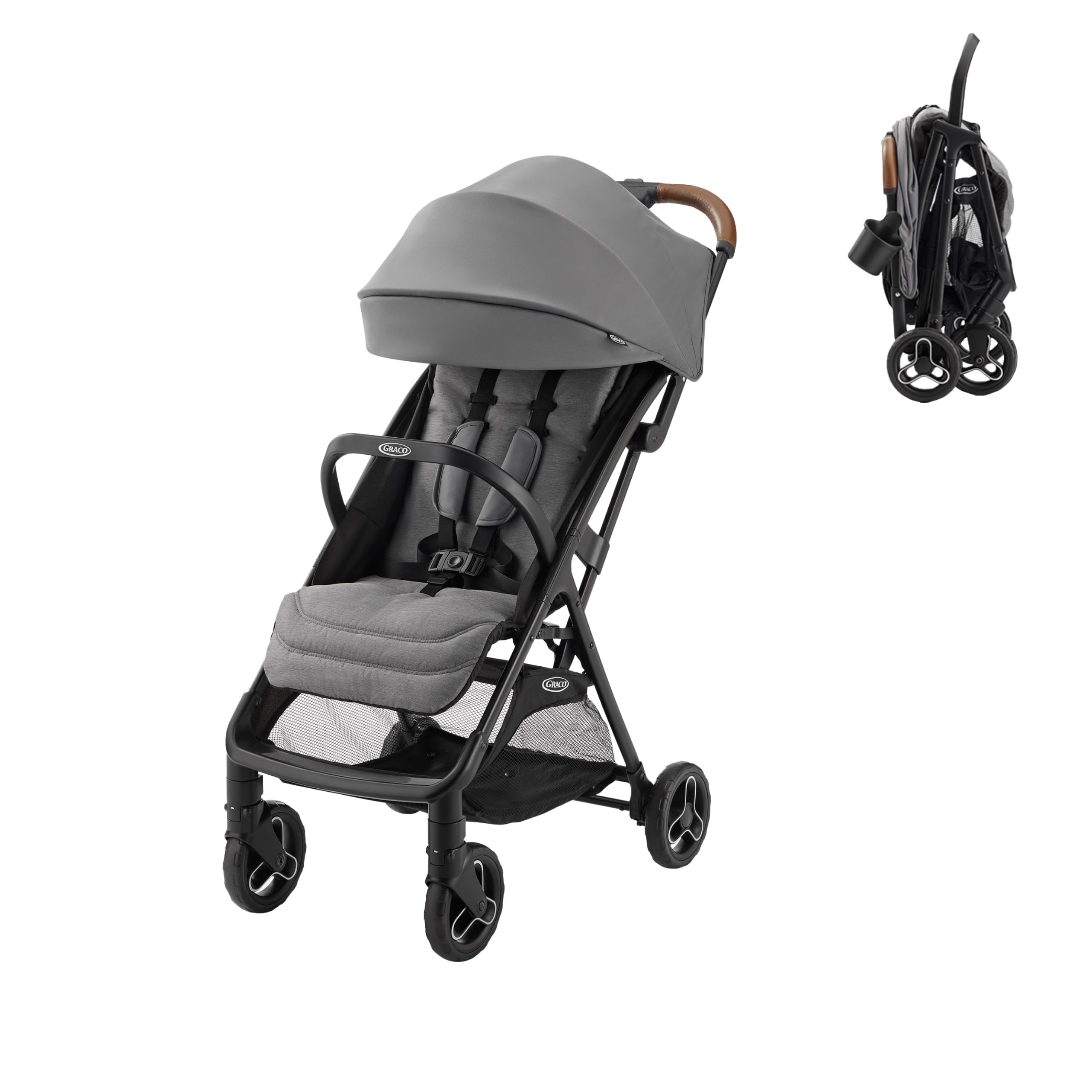
Graco Ready2Jet
Key Features
- Fold: One-hand automatic
- Weight: 13.2 lb
- Max child weight: 50 lb
- Car seat compatibility: Graco SnugRide
- Price: Premium
Flying with an infant changes the maths: the stroller needs to accept a car seat, because transferring a sleeping baby at the gate is the whole game. The Ready2Jet clicks a Graco SnugRide seat onto the frame, so you can wheel the baby from the curb, through security, to the door of the aircraft and lift the seat aboard.
It weighs 13.2 pounds and folds itself at the press of a button, collapsing and standing upright on its own. That is the version of a fold that works while you are holding a baby and a boarding pass. Graco calls the fold overhead-bin friendly and advises checking with your airline first, which is the right instinct: on a small regional jet it stays at the gate.
Around that, the equipment is generous for a travel stroller: all-wheel suspension, a multi-position recline, a UV 50 canopy, a cup holder, and a belly bar that doubles as a carry handle. The seat is not the roomiest here for a tall toddler, and the basket underneath is shallow enough that a backpack is the better plan. None of that undercuts the car-seat case.
We recommend it to anyone traveling with an infant in a Graco seat. The connection is not always instant, and it can take a couple of tries to get the seat to lock, so practice at home before the trip rather than in the security line. For everyone else the 13.2 pounds and the price put it behind the lighter picks.
Pros
- Takes Graco SnugRide infant seats
- One-hand automatic fold that self-stands
- All-wheel suspension and a real recline
Cons
- Car-seat lock can take a few attempts
- Shallow under-seat basket
Our pick for infant travel: it takes a SnugRide car seat, folds itself one-handed, and stands on its own while you juggle a baby.
How We Tested Airplane-Friendly Strollers
We started with more than 40 strollers marketed as travel or compact models, then cut anything whose published folded size exceeded major U.S. airline carry-on limits, anything over roughly 16 pounds, and anything that couldn’t be folded one-handed. That left 12, and over eight months each one flew at least two round trips with us — regional jets, mainline carriers, and one three-leg itinerary I wouldn’t wish on anyone.
Testing happened where the problems happen: the ticket counter, the security belt, the jet bridge, and a plane aisle with people waiting behind us. We timed the fold and unfold with a stopwatch, then repeated it one-handed while holding a 25-pound toddler and again while wearing a baby. Every stroller got weighed on a luggage scale, bare and packed in its travel bag, then hoisted into an overhead bin from standing to see whether it went up with one hand or needed help. Handle height was checked by testers from 5-foot-2 to 6-foot-3, since a bar that suits one parent has another one hunched over by the second concourse.
Back home we hung a diaper bag and a full water bottle from each handle to see how quickly it tipped, pushed them over curbs and cracked sidewalk, and clicked three different infant car seats onto every model claiming compatibility — noting adapters, two-handed releases, and whether the seat came off cleanly. Canopies were judged by where the shade actually fell on a seated child at noon. And because gate-checking is the reality for most families, we sent several through the jet bridge chute on purpose and inspected them afterward for bent frames, torn fabric, and wheels that stopped tracking straight. We also counted what came in the box, since a carry bag sold separately quietly changes what you’re actually paying for.
How to Choose a Stroller for Air Travel
The folded size decides almost everything: choose a stroller that fits your airline’s cabin sizer and you skip the gate-check lottery entirely.
Cabin, gate, or hold: where the stroller rides
There are three choices. A cabin-size folder goes in the overhead bin or under the seat and never leaves your side. A gate-check stroller is tagged at the aircraft door and handed back on the jet bridge, which usually works but exposes it to baggage handling. A checked stroller goes in the hold and is the most likely to arrive damaged.
Start with the numbers. The common domestic carry-on limit is 22 by 14 by 9 inches, and a stroller has to fit inside that, not near it. Compact in a listing often means compact for a car trunk; check the folded dimensions against your airline’s sizer before you buy.
Weight is about lifting, not pushing
You will lift the stroller onto a security belt, up a jet bridge, and into a bin, usually with a child on one arm. That is where a pound matters. Under about 12 pounds is comfortable for most adults to hoist one-handed; past 15 pounds you will want both hands and a free moment.
If you always travel with a partner, weight is a smaller issue. If you fly solo with a baby, it is close to the top of the list, and it is the reason the lightest picks here hold their value.
The fold has to work one-handed
The fold happens at the worst moment of the trip: at the security tray with your shoes in one hand and a child in the other. A stroller that needs two hands and a shake is fine at the hotel and miserable at the jet bridge.
Practice at home until it is automatic, and favor a fold that locks open and stands on its own once collapsed. An auto-fold that pops open on a button is the easiest version to manage while holding a baby.
Harness, recline, and shade
A five-point harness holds a slumped sleeper upright and is the better choice below a year; a three-point is quicker for a toddler who climbs in and out alone. Recline decides whether the stroller doubles as a nap spot, and near-flat is what a newborn needs.
Check the canopy closely. Travel strollers often carry a token shade that stops helping once the sun drops to an angle, so plan on a clip-on cover for beach trips and long terminal waits.
Wheels and storage on the ground you will cover
Most travel strollers are built for terminal floors and city pavement. Small hard wheels catch on cobblestones, gravel, and old-town streets, so if your trip includes those, favor bigger wheels and some suspension.
Storage is usually a small basket or a pouch, enough for a changing kit and a snack rather than a full day of gear. Pack a backpack and treat the basket as a bonus.
Frequently Asked Questions
Can I take a stroller through airport security?
Yes, and it goes through the X-ray like any other bag. Take your child out and carry them or have them walk, fold the stroller flat, and send it through on the belt. Empty anything hanging underneath before you reach the tray so you are not unloading at the scanner.
If the folded stroller is too big for the machine, security staff will hand-inspect it, which adds a few minutes.
Does a stroller count as one of my carry-on items?
Usually not. Most airlines treat a stroller as a separate travel item rather than a carry-on, but policies differ by carrier and fare, and a stroller you bring into the cabin on a stripped-back fare can be counted against your allowance.
Check your airline’s stroller page before you book, and note the size limit: it is the same sizer your suitcase has to pass.
Do I need a travel bag for a stroller?
If you gate-check, yes. A bag keeps grit out of the fold mechanism, stops the frame getting scraped, and gives handlers something to grab. Several picks here ship with one, including the Mamazing Ultra Air and the Munchkin Sparrow, so check the box before buying a separate bag.
A cabin-size folder that never leaves your side can travel without one.
Can a travel stroller be my only stroller?
For quick errands, often yes. For a full day out, usually not: small wheels, token canopies, and little storage make them hard work on rough pavement or in heat, and most families keep a full-size stroller at home.
If you want one stroller to cover both, a heavier compact like the Jeep Altitude is the compromise, and you accept the lift into the overhead bin.
Final Verdict
Start with the gb Pockit Air All Terrain. It folds smaller than anything else here, small enough for the overhead bin or the space under the seat, and at 10.4 pounds it is easy to lift with a baby in your arms. That combination removes the gate-check risk hanging over every other pick.
If your baby is under a year, look at the Munchkin Sparrow for its five-point harness, or the Graco Ready2Jet if you are flying with a SnugRide car seat. On a tight budget and flying rarely, the Dream On Me Aero covers the same trip at 7.2 pounds for a fraction of the price.
