This post contains affiliate links. We may earn a small commission when you buy through our links — at no extra cost to you.
A compact stroller makes one narrow promise: that you can fold it, lift it, and get it out of the way on your own — into a trunk, up a flight of stairs, through a turnstile. The catch is that the smallest ones often flex on cracked pavement, tip when a diaper bag hangs off the handlebar, or leave a tall parent hunched over the push bar. That tradeoff is really the whole decision — how much sturdiness and comfort you’re willing to swap for a footprint the size of a golf bag, and whether the seat, harness, and car seat mount still work like a full-size stroller once you’ve made that swap.
I’ve used a compact as my only stroller through two airport connections and about forty grocery runs, and the folded spec sheet matters far less than the fold itself — one hand or two, and whether the thing stands up once it’s down. Over the past six months, my team and I have folded, lifted, and pushed 12 of them, weighing each loaded and empty and clipping car seats onto every model that claims to take one. The picks below are the ones that held up without a wobble.



Best for Everyday and Travel
Mamazing Ultra Air
Key Features
- Weight: 11.6 lb
- Harness: 5-point
- Folded size: H22 x W19.3 x D11 inch
- Weight limit: 50 lb
- Price: Premium
Folded, the Ultra Air is a bundle you can tuck into a footwell: roughly 22 by 19.3 by 11 inches, and 11.6 pounds on the scale. That pairing is the whole argument for it. Plenty of strollers fold small; far fewer stay this light while still behaving like a stroller rather than a set of tent poles on wheels, and on the airlines that let you bring one aboard, the folded shape goes into an overhead bin.
The carbon fiber frame is what we noticed on the move. Set up, it stays rigid when a toddler throws weight sideways, the push stays light on pavement and smooth terminal floors, and the canopy is listed as UPF 50 and pulls forward far enough to shade a sleeping face. The 50-pound weight limit carries it well past the preschool years, and the basket takes a diaper bag and a jacket without bulging into the seat. We think it is the best balance of weight, folded size and ride in this group.
It is the priciest stroller here, so if your outings are mostly drives to the store, the Jeep Altitude does much the same job for a great deal less. The one part we treat as fragile is the strap on the included travel bag, which can tear; use the bag for storage at home and lift the stroller by the frame when you travel.
Pros
- 11.6 pounds and easy to lift
- Folds small enough for an overhead bin
- Rigid carbon frame with a 50-pound limit
- Basket takes a full diaper bag
Cons
- Priciest stroller in this group
This is the one we recommend to most families: light enough to carry up a jetway, small enough to hoist overhead, and steady with a toddler leaning over the side.
Best for Car Seat Transfers
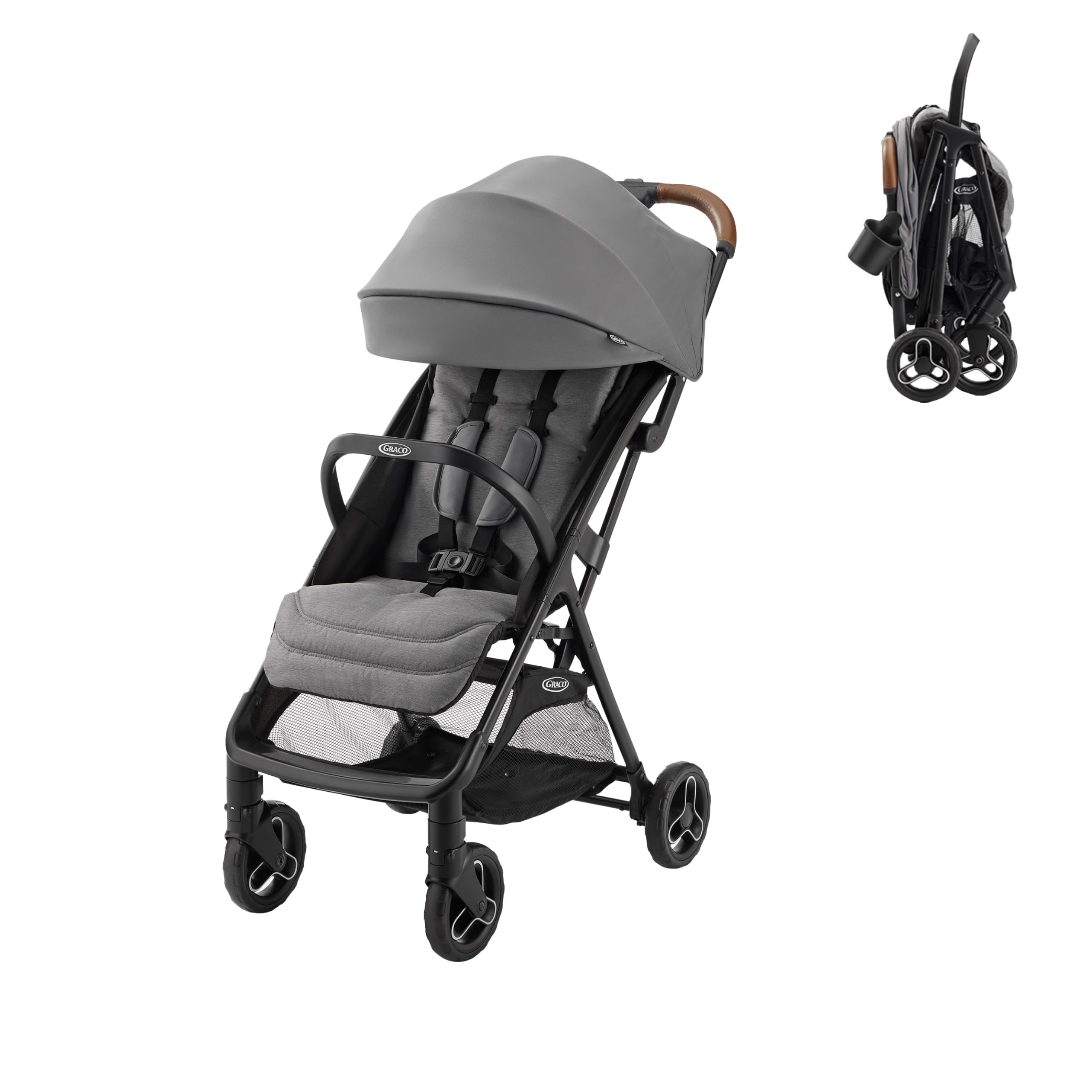
Graco Ready2Jet
Key Features
- Fold: One-hand auto, self-standing
- Weight: 13.2 lb
- Car seat: Graco SnugRide
- Weight limit: 50 lb
- Price: Premium
The fold settles it. Pull the release and the Ready2Jet collapses on its own, then stands upright on the pavement while you get the baby out of the car, with no bending down and no balancing it against a wheel. At 13.2 pounds it lifts into a trunk with one hand, and the removable belly bar doubles as a carry handle for the walk in.
Graco builds it around its own SnugRide infant seats, and that is the reason to choose it over the other strollers here: the bucket clicks onto the frame, so a sleeping newborn travels from car to sidewalk without being unbuckled. Give it a firm push and listen for the click, because it can take a couple of tries to lock in. Check before you walk away.
The rest of it is unusually complete for the size: a multi-position recline, a harness that converts between three and five points, adjustable calf support, all-wheel suspension, a UV 50 canopy, a parent cup holder and a leatherette handle that looks better than the price suggests. Be clear about the limit, though. It takes Graco SnugRide seats and nothing else, so if you already own a Chicco bucket, this is not your stroller.
Pros
- Folds one-handed and stands on its own
- Takes a SnugRide seat without adapters
- 13.2 pounds with suspension and a reclining seat
- Adjustable calf support as legs grow
Cons
- Only fits Graco SnugRide infant seats
If you want to move a sleeping baby from car to stroller without unbuckling, this is the frame we pair with a SnugRide seat, and it stands up on its own when folded.
Best for Value Travel
Jeep Altitude
Key Features
- Fold: One-hand auto fold
- Weight: 15.7 lb
- Folded size: 12.5 x 19 x 29 inches
- Weight limit: 50 lb
- Price: Midrange
You spend far less than our top pick asks and still get the thing that matters most on a trip: a stroller that opens and closes with one hand. The Altitude’s auto fold takes a second, and the carry handle built into the frame means you walk it through a terminal instead of dragging it behind you.
Folded, it measures about 12.5 by 19 by 29 inches, a shape that slides into a trunk corner or a closet shelf and has gone into an overhead bin on flights where the crew allowed it. Four-wheel suspension and EVA tires smooth out pavement, the canopy extends with a peek-a-boo window, and the seat reclines far enough for a nap while the footrest adjusts as legs grow.
At 15.7 pounds it is a few pounds heavier than our top pick, which you notice on a long carry and not at all on a walk. The leatherette handle and belly bar make it look more expensive than it is, a small thing that turns out to matter when you use it every day.
We think it is the best value in this group for travel and everyday errands both. One handling note: the light frame can tip if a toddler stands up and leans back over the handle, so keep a hand on it when they do.
Pros
- One-hand auto fold with a carry handle
- Folds small enough for a trunk corner
- Suspension and reclining seat at a mid price
Cons
- 15.7 pounds is above the lightest picks here
The best value here for travel: a one-hand fold, a genuinely compact folded shape and a comfortable seat, for far less than our top pick.
Best for Budget Errands
Kolcraft Cloud Plus
Key Features
- Weight: 11.8 lb
- Cup holders: 4, parent and child trays
- Folded size: 18 x 12 x 34 inches
- Weight limit: 50 lb
- Price: Midrange
The storage is the first thing you notice. A deep basket under the seat takes a diaper bag and a bag of groceries, the parent tray holds two drinks, and a removable child tray adds two more cup holders and a snack spot. Four in total, more than any other stroller on this page.
At 11.8 pounds it lifts into a trunk one-handed, and the fold stands the stroller on its own once collapsed, which keeps the seat off a wet floor. Fifty pounds of child capacity means it lasts. We think it is the best value here for errands, and it is the one that would live by our front door.
Two things to know before you buy. The fold is an umbrella-style collapse that wants two hands and a bit of practice; it loosens with use, but it is not the one-hand toss of our top pick. And the front wheels drag and skip on gravel and broken pavement, so it is fine on a sidewalk or a theme park path and annoying on a cobbled street.
Pros
- Basket takes a full grocery run
- Four cup holders across parent and child trays
- 11.8 pounds with a 50-pound limit
- Fold stands the stroller upright
Cons
- Two-hand umbrella fold takes practice
Our budget all-rounder: 11.8 pounds, a basket that swallows a grocery run and four cup holders, at a price that leaves room for the diaper bag.
Best for Ultralight Quick Trips
Dream On Me Aero
Key Features
- Weight: 7.2 lb
- Harness: 3-point
- Folded size: 40.6 x 7.7 inches
- Weight limit: 33 lb
- Price: Budget
At 7.2 pounds the Aero is lighter than anything else here by a wide margin. That is not a rounding error. It is the difference between carrying a stroller up subway stairs in one hand and making two trips, and it is the reason this one earns a place.
What you get at that weight is deliberately simple: a steel frame, a three-point harness, dual brakes and 4.1-inch wheels, with no tools needed for assembly and a one-hand fold held shut by a latch on the right side.
Folded, it is a long, thin package at 40.6 by 7.7 inches, so it slides behind a car seat or into a closet rather than into a cube-shaped space. The canopy is small: it gives light shade on a sunny sidewalk and not much more.
We think it is the right second stroller, the one that stays in the trunk for errands, school pickup and short trips, rather than the only one you own. It is also the least expensive way to find out whether an ultralight suits the way you travel.
Pros
- 7.2 pounds, the lightest here
- One-hand fold with a carry latch
- No-tools assembly
- Cheapest stroller in this group
Cons
- 33-pound limit is the lowest here
- Handles sit low for taller parents
The lightest stroller here by a wide margin, and the one we reach for on stairs, buses and short trips, as long as you are not tall.
Best for Hauling Gear
Ingenuity 3Dquickclose CS+
Key Features
- Weight: 17 lb
- Storage: Large basket, back pocket
- Folded size: 20.5 x 17.3 x 7.1 inches
- Weight limit: 50 lb
- Price: Midrange
Seventeen pounds is heavy for a compact stroller, and we will not pretend otherwise. What that weight buys is a properly padded seat, a full canopy, a large basket, a back pocket and a phone holder, which are the everyday things you start missing on an ultralight by the second week.
The quick-close fold is genuinely one-handed, and it packs down to about 20.5 by 17.3 by 7.1 inches, flat enough to lie under a week’s shopping in the trunk. It also accepts several common infant seats, including Chicco KeyFit and Graco SnugRide models, so it can serve as a newborn-transfer stroller before your baby moves into the seat itself.
One thing to watch: the frame can collapse if the fold latch is not fully engaged, so open it firmly until it clicks and check the recline lock the same way. That is not a reason to skip it; it is a reason to be deliberate the first few times you open it in a parking lot.
Pros
- Large basket plus a back pocket and phone holder
- One-hand quick-close fold that packs flat
- Takes several common infant car seats
- 50-pound limit with a padded, reclining seat
Cons
- 17 pounds to lift into the trunk
- Plastic fittings feel ordinary
For a stroller that lives in the car and hauls real cargo, we like the flat one-hand fold and the big basket, and we forgive the 17 pounds.
Best for Tight Hallways
Delta Children Icon

Key Features
- Fold: One-hand auto fold
- Weight: 15.6 lb
- Folded size: 10 x 16.5 x 23.6 inches
- Weight limit: 50 lb
- Price: Premium
Ten inches deep is the number that stands out. Folded, the Icon measures about 10 by 16.5 by 23.6 inches: upright and narrow, the shape that disappears into a hall closet or stands in the corner of a small entryway, and Delta lists it as TSA-approved for overhead compartments.
It is a 15.6-pound stroller with a one-hand auto fold, four-wheel suspension, puncture-proof EVA tires, a multi-position recline, an extendable canopy with a peek-a-boo window and a cup holder in the box. Greenguard Gold certification is a reasonable bonus if you are particular about finishes in a small apartment.
We point anyone with a tight hallway or a compact car at this one before the bigger travel strollers, because the folded shape is what you live with between outings. Just budget a moment for the side latch the first time.
Pros
- Smallest folded footprint in this group
- One-hand auto fold with a carry handle
- Suspension and a reclining seat at 15.6 pounds
Cons
- Side latch is stiff to release
Ten inches deep when folded, the smallest footprint here, and the one we point at whenever a hallway or a trunk is genuinely tight.
Best for Theme Park Days
Dream On Me Coast Rider

Key Features
- Modes: Stroller, ride-on, scooter
- Weight: 12.8 lb
- Folded size: 24.4 x 16.1 x 10.6 inches
- Weight limit: 45 lb
- Price: Budget
Most compact strollers are finished by the time a child turns four. This one converts from a stroller into a ride-on and then a scooter, so the same frame that carried a toddler in the morning gives a preschooler something to scoot along behind in the afternoon, which is why it turns up at theme parks.
At 12.8 pounds with an adjustable handle and a five-point harness, it pushes easily one-handed through a crowd, and the 45-pound limit covers most preschoolers. The seat is structured and upright rather than nest-like, which suits an older child who wants to see where they are going.
The fold is where it loses ground. It is stiff and deliberate rather than quick, and the frame wants a firm push and a small wiggle before it lets go. We think it earns its place for park days and for travel where the stroller doubles as entertainment, and it is a poor fit as the stroller you fold ten times a day.
Pros
- Converts to a ride-on and then a scooter
- 12.8 pounds with a 45-pound limit
- Pushes one-handed through crowds
Cons
- Stiff fold that needs practice
We like this one for theme park days: it converts from stroller to ride-on to scooter, so a four-year-old still wants to sit in it.
How We Folded, Lifted, and Pushed 12 Compact Strollers
We started with more than 40 compact and lightweight strollers from the brands that show up on every registry, then filtered hard: a true one-piece fold, a measured folded footprint that still leaves room in a sedan trunk, a listed weight one adult can lift with one arm, and a car seat adapter that’s either included or genuinely in stock. We spread the shortlist across price tiers so we could see what the extra money actually buys. Twelve made the cut, and each one became a daily driver for six months.
Every stroller went through the same rotation. We folded it one-handed while holding a 22-pound toddler on a hip, counting seconds and noting whether it needed a foot, a wrist flick, or a second hand — and whether it stayed upright once down. We filled the basket, hung a packed diaper bag on the handlebar, then pushed over a cracked sidewalk and up a curb ramp to watch how much the frame flexed and whether it felt tippy. Each one rode in a sedan trunk and through an airport jet bridge, and we raised and lowered the handle with testers from 5’2" to 6’1" to check reach and stride.
Adjustability got checked on real children: we rethreaded every harness, reclined each seat for a nap, and noted which buckles were fiddly with cold hands. For car seat compatibility, we clicked an infant seat in and out ten times and watched for slop at the attachment point. Durability was a six-month observation — fabric that pilled, stitching that pulled, wheels that developed a shimmy, brake cables that started to drag, and whether each stroller still looked presentable after a wash. We also weighed every model on a luggage scale, empty and loaded, because the published number rarely matches what you feel hoisting it into the trunk.
How to Choose a Compact Stroller
The two numbers shoppers care about most, carry weight and folded size, never move together, so the right compact stroller usually comes down to which one your week punishes.
Carry weight comes before folded size
Two strollers can both be called compact and feel completely different in daily use. Weight is what you feel on stairs, on a bus and at the bottom of a jetway with a child on your hip. Folded size is what you feel in a hallway, a trunk or an overhead bin. They do not move together: a 12-pound stroller with a long umbrella fold can be harder to store than a 15-pound one that folds into a block. Decide which your week punishes more. If you drive everywhere, folded size wins; if you take transit or climb stairs, weight wins.
What an overhead bin really takes
A stroller that genuinely goes in a bin folds into a short, deep block. Our top pick’s roughly 22 by 19 by 11 inches is that shape. The umbrella-folding strollers here collapse into long, thin tubes that slide behind a seat but rarely into a bin. Airline rules differ and change, so check your carrier’s stroller policy before you plan around cabin carriage, and weigh the alternative honestly: a stroller you can carry in one hand and gate-check is often less trouble than one you argue about at the door.
One hand or two
The fold matters least in your hallway and most when you are on your own with a baby. A one-hand auto fold lets you collapse the stroller while you hold the child. A two-hand umbrella fold means putting one of them down. Run the sequence in your head, pull, collapse, lift, stow, and count how many steps need a free hand and a flat surface. A model that stands on its own when folded, like the Graco Ready2Jet, keeps the seat out of parking-lot puddles while you sort the baby out.
Seat limits, harnesses and recline
Weight limits here run from 33 pounds to 50, which is roughly two years of extra use at the top end. A five-point harness is the default for good reason: it holds the shoulders as well as the lap, which matters for a child who twists. A three-point harness is quicker to buckle and less secure for a small baby. Recline is the third piece. A near-flat seat is what makes a nap on the go possible, and a stroller without one turns a missed nap into a public meltdown.
Handles, wheels and the ground you cover
Handle height is the specification almost nobody publishes and everybody feels. Several compact strollers put the bar low, which suits shorter parents and leaves taller ones hunched over it. If you are tall, look for an adjustable handle, or at minimum a bar you can hold without bending. Wheels are the other tell. Small hard wheels are fine on smooth pavement and theme-park paths but catch on gravel, cobbles and grass. If your regular route includes broken sidewalks, suspension and a bigger front wheel are worth more than a pound of weight.
Frequently Asked Questions
Can I use a compact stroller for a newborn?
Only if it pairs with an infant car seat or has a fully flat seat. Several strollers here list a six-month minimum and are built for babies who can sit up, so check the age range before you buy.
If you want one stroller from the first week, pick one with a car-seat connection. The Graco Ready2Jet takes Graco SnugRide buckets, and the Ingenuity 3Dquickclose CS+ accepts several Chicco and Graco models. Move your baby into the stroller seat once they can sit unassisted.
Do I still need a full-size stroller?
Not necessarily, but a compact stroller is a compromise on storage, canopy coverage and seat padding, which are the things a full-size stroller does well.
If most of your outings start at your front door, keep the big stroller and add a compact one for the car and for travel. If space is tight and you mostly drive, a model with a bigger basket and a padded seat, like the Ingenuity 3Dquickclose CS+, covers both jobs.
How do I clean a compact stroller?
Assume spot cleaning first. The common instruction across these strollers is cold water and mild soap on the fabric, a damp cloth on the frame, then air drying before you fold it.
Some seats have removable covers that can be machine washed, and the Kolcraft Cloud Plus allows machine washing of its polyester parts. Never fold a damp stroller: mildew settles into the creases. Let it dry open.
Final Verdict
The Mamazing Ultra Air is the compact stroller we recommend. At 11.6 pounds with a fold that goes into an overhead bin, it covers travel days, and it is steady enough with a toddler aboard to be the everyday stroller too.
If you want to move a sleeping baby from car to stroller without unbuckling, choose the Graco Ready2Jet for its SnugRide connection and self-standing fold. If budget decides it, the Jeep Altitude gives you a one-hand fold and a compact shape for a great deal less.
