This post contains affiliate links. We may earn a small commission when you buy through our links — at no extra cost to you.
Every stroller is a negotiation between two things that don’t get along: weight and stability. The ones you can swing into a trunk one-handed tend to feel twitchy on a cracked sidewalk, and the ones that glide through a grocery aisle usually weigh about as much as a shopping cart. I’ve pushed both kinds around my own neighborhood — up curbs, through a crowded farmers market, into a waiting room that was never built for a wide frame — and the ones I keep reaching for quietly remove the small frictions of the day: a fold you can manage while holding a baby, a handle that doesn’t leave you hunched, a basket that swallows a diaper bag.
Over the past six months, my team and I have put 12 everyday strollers through that same routine, and the spec sheet almost never told the truth about weight or ease of use. What matters is how the folded frame feels coming out of a trunk at the end of a long day, and whether the fold takes one hand or two. Below are the ones that earned a spot by the door.
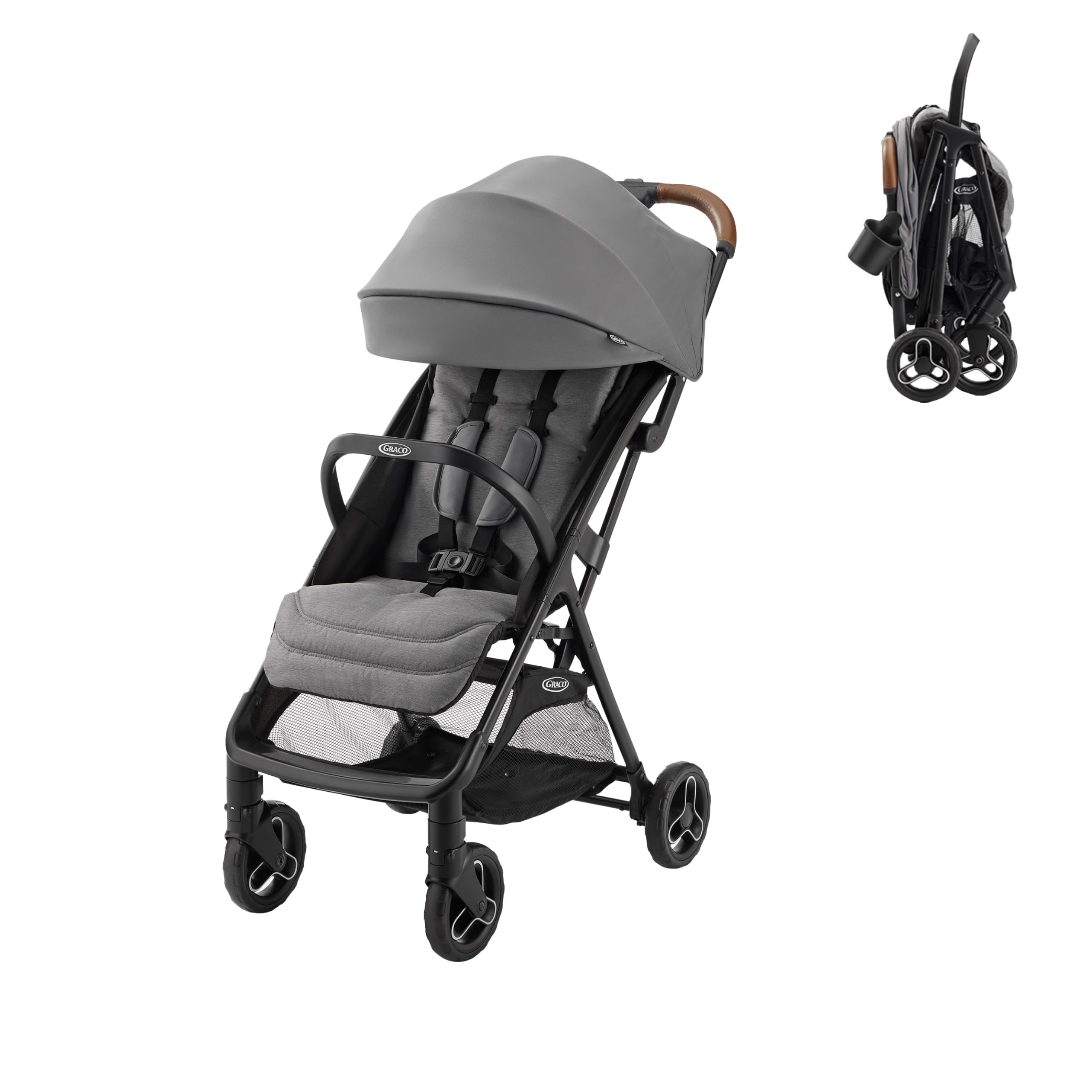


Best for Everyday All-Rounder
Graco Ready2Jet
Key Features
- Fold: One-hand auto fold, self-standing
- Suspension: All-wheel
- Stroller weight: 13.2 lb
- Max child weight: 50 lb
- Price: Premium
The Ready2Jet’s auto fold is why it takes the top spot. Press the release and the stroller collapses and stands there on its own, and the whole thing works with a baby on one hip. It is the fold we stopped thinking about, which is the highest compliment an everyday stroller gets.
At 13.2 pounds it lifts into a hatchback without braced knees, and the 50-pound child limit means it keeps working when your toddler turns into a preschooler. The seat reclines for naps, the canopy carries UV 50 protection, the belly bar doubles as a carry handle, and there is a parent cup holder where your hand expects one. None of that is exotic. All of it is the difference between a stroller you use and one that stays in the garage.
The ride is where it pulls ahead of the cheaper picks: all-wheel suspension over broken sidewalk and parking-lot pavement, and a push that tracks straight when you steer with one hand. Where it gives ground is the folded package, which is a trunk-and-closet shape rather than an overhead-bin one — the travel-first picks below fold flatter. That is the one thing to check against your own car before you commit.
Pros
- One-hand auto fold that stands alone
- 13.2 pounds with a 50-pound seat limit
- All-wheel suspension for pavement
- Reclining seat, UV 50 canopy, parent cup holder
Cons
- Shallow under-seat basket
Our default everyday stroller: it folds with one hand, stands on its own, carries a child to 50 pounds, and rides smoothly enough for daily errands.
Best for Flights and Trunks
Mompush Jeto
Key Features
- Folded size: 20.5 x 17.3 x 7.1 inches
- Basket capacity: 4.4 lb
- Stroller weight: 10.1 lb
- Max child weight: 40 lb
- Price: Budget
Ten pounds and a seven-inch folded thickness is the entire argument. The Jeto folds into a flat square with a strap on the side, so it slides under a seat, into an overhead bin, or into the gap between the vacuum and the coats. Nothing about it needs figuring out.
What surprised us is how little it gives up on the push. The wheels and suspension cope with brick and broken asphalt far better than a stroller this light has any right to, and the seat is roomier than the folded package suggests. On a trip that means a plane, a rental car and a lot of walking between them, this is the one that comes with us.
The catch is range. The seat is rated to 40 pounds, which is comfortable for a three-year-old and tight for a tall four-year-old. If one stroller has to cover nursery runs through preschool for years, the Graco does that better; if you want the one that vanishes into a trunk and never feels like a chore, this is it.
Pros
- 10.1 pounds folded to 7.1 inches thick
- Fits overhead bins and small trunks
- Suspension and larger wheels push smoothly
- Self-standing fold with a carry strap
Cons
- Basket rated to only 4.4 pounds
The travel stroller we reach for first: it folds to a flat square, rides on a shoulder strap, and pushes like a bigger stroller.
Best for Budget and Storage
Kolcraft Cloud Plus
Key Features
- Folded size: 18 x 12 x 34 inches
- Parent tray: Two cup holders and storage
- Stroller weight: 11.8 lb
- Max child weight: 50 lb
- Price: Budget
The Cloud Plus makes you check the price twice. There is a parent tray with two cup holders, a removable child tray with its own cup holder, a three-tier canopy with a peek-a-boo window, and a basket big enough that we stopped carrying a separate tote — on a stroller that weighs less than twelve pounds.
That weight is the part we keep coming back to. It lifts out of a trunk with one hand, the front suspension softens sidewalk seams, and the seat reclines far enough for a nap without an argument. Assembly is straightforward, and the canopy extends far enough to matter on a sunny walk.
The fold is the compromise. It works, and the stroller stands on its own once it is down, but it wants two hands and a little practice, and the folded shape is a tall rectangle rather than a tidy square. For a stroller that lives in a garage and goes into a trunk twice a day, that is acceptable. For tight hallways and one-armed mornings, it is the reason to spend more and take the Graco.
Pros
- Large basket plus parent tray and two cup holders
- 11.8 pounds with a 50-pound limit
- Front suspension and extended canopy
- Straightforward assembly
Cons
- Front wheels wander on rough pavement
Our value pick: a big basket, a parent tray and an 11.8-pound frame, as long as you can live with a two-handed fold.
Best for Tight Hallways
Delta Children Icon
Key Features
- Folded size: 10 x 16.5 x 23.6 inches
- Certification: GREENGUARD Gold
- Stroller weight: 15.6 lb
- Max child weight: 50 lb
- Price: Midrange
Ten inches by sixteen and a half by twenty-four: the Icon folds into a package that slips between a coat rack and a door frame and stands there on its own while you get the baby out of the car. That footprint is the reason to buy it, and it is the most closet-friendly shape in this group short of the flat-folding travel models.
The rest is more considered than the price tier suggests. The seat is leatherette over a multi-position recline, the canopy extends, and GREENGUARD Gold certification means the materials have been screened for indoor air emissions — worth knowing if the stroller lives in your living room as often as in your trunk. The five-point harness has shoulder pads, and the seat takes a child to 50 pounds.
At 15.6 pounds it is not featherweight, and the plastic latch and buckle are the parts worth watching over a couple of years of daily folding. The frame and fabric feel solid, and we have not seen enough long-term use to call that either way, which is the honest reason it sits below the Graco.
Pros
- Folds to 10 x 16.5 x 23.6 inches and stands alone
- GREENGUARD Gold certified materials
- Leatherette seat with multi-position recline
Cons
- Side latch must be released before unfolding
The compact one we recommend: it folds to a narrow, self-standing package for hallway closets and small trunks, with a nicer seat than most strollers this size.
Best for Cargo and Comfort
Mamazing Ultra Air
Key Features
- Frame: Carbon fiber
- Basket capacity: 22 lb
- Stroller weight: 11.6 lb
- Max child weight: 50 lb
- Price: Premium
Carbon fiber at this price tier is the headline, and the Ultra Air delivers on it: 11.6 pounds with a 50-pound child limit, so you are not trading years of use for a light frame. The recline is proper, the harness has five points, and a travel bag comes in the box.
What sold us is the basket. It is rated to 22 pounds, several times what the tiniest travel strollers allow, and it sits low and open enough that a diaper bag drops in without unfolding anything. Add a UPF 50 canopy and a seat that stays comfortable through a theme-park afternoon, and this behaves like a full-size stroller until you lift it.
The caveat is toughness under real abuse. The carbon frame is the strong part; the carry strap and the fold joint take the most strain and are where wear can show, so store it indoors rather than leaving it in a hot car for months. It is also light enough that a child leaning hard against one side can shift it, so keep bags in the basket and the harness on. On smooth floors and paved paths it is excellent; on gravel, a bigger-wheeled stroller is kinder.
Pros
- 22-pound basket capacity
- Carbon fiber frame at 11.6 pounds
- UPF 50 canopy and travel bag included
- 50-pound seat with five-point harness
Cons
- Folded width of 19.3 inches is wide
The one we point to when you need a light stroller that still carries groceries: a 22-pound basket, a 50-pound seat and a carbon frame at 11.6 pounds.
Best for Bigger Kids
Summer 3Dlite ST

Key Features
- Fold: Umbrella fold with auto lock
- Basket capacity: 10 lb
- Stroller weight: 15 lb
- Max child weight: 50 lb
- Price: Budget
Most light strollers are built for the first three years. The 3Dlite ST is built a little longer: a wide seat, a 50-pound child limit, and a frame that does not feel like a compromise when a five-year-old climbs in for the walk home from school.
For a stroller this simple, the details are right. The canopy is adjustable and removable, the front wheels have anti-shock mounts and the rear wheels lock, the basket holds 10 pounds with a rear pocket for keys and a phone, and the cup holder sits where you can actually reach it. It folds like an umbrella — one movement, an auto lock to keep it shut, and a footprint that fits a small trunk.
For a second stroller, a grandparent’s car or a child who is outgrowing the light ones, this is the one we point to. The wheels are the part to watch over a couple of years of daily use, which is a shame because everything above them is well judged. If this will be your only stroller for four years of pavement, the Graco or the Kolcraft will hold up better.
Pros
- 50-pound seat with a wide seating area
- 10-pound basket, rear pocket and cup holder
- Umbrella fold with auto lock
Cons
- Handles sit low for taller pushers
Our pick for a bigger kid: a wide seat, a 50-pound limit and a 10-pound basket on a simple umbrella stroller that folds in one motion.
Best for Neighborhood Walks
Jeep Altitude

Key Features
- Suspension: Four-wheel
- Folded size: 12.5 x 19 x 29 inches
- Stroller weight: 16.6 lb
- Max child weight: 50 lb
- Price: Midrange
Four-wheel suspension and puncture-proof EVA tires are unusual at this price tier, and they change the daily walk: the Altitude rolls over tree roots and cracked driveway aprons with less clatter than the hard-wheeled umbrella strollers here.
The finish is nicer than we expected too. Leatherette covers the parent bar and the child bumper, the canopy extends with a mesh peek-a-boo window, and the footrest adjusts as your child grows. It is the kind of detailing that makes a stroller feel less like equipment and more like something you chose.
The seat reclines in steps and the harness has five points with comfort pads, and the 50-pound limit covers the preschool years. Our first week with it, we used the carry handle more than the wheels — it is the right way to move a folded stroller between the car and the hall.
One thing to know before you buy: this is a stroller to keep off slopes with a restless toddler, and a child who stands and leans over the back bar can tip it. Harness them in, put the bags underneath, and it is a comfortable, smooth-riding stroller for the school run and the evening loop.
Pros
- Four-wheel suspension on EVA tires
- Leatherette parent and child bars
- 50-pound limit with adjustable footrest
Cons
- Folded package is 29 inches tall
- Heaviest here at 16.6 pounds
We recommend it for neighborhood walks where the pavement is the worst thing you will meet, as long as your child stays seated and harnessed.
Best for Spare and Travel
Dream On Me Aero

Key Features
- Harness: 3-point
- Folded size: 40.6 x 7.7 inches
- Stroller weight: 7.2 lb
- Max child weight: 33 lb
- Price: Budget
Seven pounds is not a typo. The Aero is the lightest stroller here by a wide margin — light enough to carry up a flight of stairs with a toddler on your other hip, and light enough that you stop resenting the thing you have to bring.
What you get is honest and basic: a one-hand quick fold with a side latch, dual brakes, a removable canopy, a steel frame and a 300D polyester seat. We appreciate that it does not pretend to be more than a seat on wheels.
The limits are the price of that weight. The seat is rated to 33 pounds and the harness has three points, so this covers the toddler years and stops; the canopy gives light shade rather than real coverage, and there is no storage to speak of. None of that matters for a fifteen-minute walk to the playground.
As a grandparent’s stroller, a trunk spare or a travel companion that lives in the car, it earns its place. As the stroller you push every day for three years, it is the wrong tool — the fold is a 40-inch umbrella shape, and the short handles will have a taller parent stooping by the end of the block.
Pros
- 7.2 pounds, the lightest here
- One-hand quick fold with side latch
- Dual brakes and ASTM certification
Cons
- Short handles for taller pushers
- Long 40.6-inch folded shape
The one we keep as a spare: 7.2 pounds, a one-hand fold and a price that makes a second stroller reasonable, just not for tall pushers.
How We Tested the Best Everyday Strollers
We started with roughly 40 strollers from brands we’d trust to warranty a frame, then filtered by listed weight, folded dimensions, car seat compatibility, and the features that repeat across owner reviews — one-handed folds, adjustable handles, a basket you can actually reach. Anything with a pattern of complaints about wobbly frames or a fold that demands two hands and a prayer got cut before it reached us. That left 12, all bought at retail so nobody could send us a cherry-picked unit.
Testing ran for six months, and these strollers lived in our hallways and car trunks rather than on a lab bench. Each one did the daycare walk — 20 minutes of sidewalk, two curb cuts, and a gravel shortcut — plus grocery runs, a Saturday farmers market, a pediatrician visit, and a weekend trip with a diaper bag and a gallon of milk riding in the basket. We weighed every model on a luggage scale, timed the fold from parking lot to trunk, and folded and unfolded each one while holding a 15-pound sandbag in the other arm to see what one hand could honestly manage.
Handles were sized by two testers — one at 5 feet 2, one at 6 feet 3 — who walked a full block to see whose wrist ended up bent. For stability, we hung a loaded diaper bag on the handlebar and nudged the frame with a toe; for car seat accessibility, we clicked infant seats in and out in a dim parking lot, in the rain, in a hurry. Maneuverability came down to steering one-handed around a store display with a coffee in the other hand, and value came down to what shipped in the box versus what you had to buy separately. Durability got a three-month verdict: wheels that started to shimmy, fabric that pilled at the harness slots, brakes that needed two stomps instead of one.
How to Choose an Everyday Stroller
The stroller that gets used every day is the one that is easy to put up and easy to live with, so weight, folded shape and a fold you can work one-handed matter more than the feature list.
Start With What You Lift, Then What You Fold
An everyday stroller is lifted more often than it is pushed: into a trunk, up a step, onto a bus. The lightest here is 7.2 pounds and the heaviest 16.6, and that gap is obvious by the tenth lift of a Saturday. Weight and folded size pull in different directions, though. The flattest fold in this group is seven inches thick, while the narrowest standing package is ten inches wide, so decide which one you handle more: a trunk rewards a thin, flat fold and a hallway rewards a narrow one.
Treat the word compact on a listing as a claim about one dimension until you read the numbers. A 40-inch umbrella fold is slim and still long, and it will sit across a trunk rather than along it.
Wheels Decide How Far You Will Walk
Small hard wheels are fine on shop floors and miserable on brick. The strollers that push best here have suspension somewhere in the system — all-wheel on the Graco Ready2Jet, four-wheel on the Jeep Altitude, front-only on the Kolcraft Cloud Plus — and larger wheels help more than any all-terrain badge. That phrase on a stroller with five-inch wheels means pavement and packed gravel, not a trail.
If your daily loop is stroller-friendly sidewalk, any of these will do. If it is tree roots and cobbles, pay for suspension and skip the lightest picks.
How Many Years the Seat Buys You
Child weight limits run from 33 to 50 pounds across these strollers, which is the difference between one that lasts through preschool and one that is finished at three. Most children reach the height ceiling before the weight limit, so look at the seatback and the canopy clearance too. A five-point harness matters for a toddler who leans; a three-point is fine for quick hops with an older child.
We put more weight on the 50-pound seats here — the Graco, Kolcraft, Delta Icon, Mamazing, 3Dlite and Jeep all carry that rating — because a stroller you keep for four years is cheaper than two you replace.
Storage You Can Actually Reach
Baskets run from a 4.4-pound pouch to a 22-pound hold, and the number matters less than the opening. A deep basket under a low frame is worse than a shallow one you can get a hand into without stooping. Parent trays and cup holders are worth having if you carry coffee, but they are also among the first things to break, so do not choose on them alone.
If you shop on foot, put basket capacity near the top of your list; if you drive everywhere, a big basket mostly collects receipts and a spare blanket.
The Fold, the Latch and the Carry Handle
The fold is where everyday strollers earn or lose their place. A one-handed fold that stands on its own lets you lift the baby out of the car and set the stroller down without putting either on the ground. Then check the latch: several of these need a side clip released before the stroller opens, which becomes habit within a week and is maddening for the first three days.
A carry strap, or a belly bar that doubles as a handle, shortens the walk from the parking lot to the gate more than you expect.
Frequently Asked Questions
How do I know when my child has outgrown an everyday stroller?
Two numbers decide it: the seat’s weight limit and the height before the canopy touches your child’s head. Limits here run from 33 to 50 pounds, and most children reach the height ceiling first. Weigh your child and measure from the seat to the canopy; if you are within five pounds of the limit, or a head is brushing fabric, start shopping.
Can I use an everyday stroller from birth?
Only if the seat reclines flat and the harness has five points. Several light strollers here are listed from six months, and an upright seat with a three-point harness is not a newborn’s seat. If you want one stroller from the first week, buy a full recline with a five-point harness, or wait until your baby can sit up unaided.
Will a lightweight stroller fit in an overhead bin?
Sometimes, and the folded measurements decide rather than the box copy. The flattest stroller here folds to 20.5 by 17.3 by 7.1 inches, and even that depends on the sizer at the gate. Measure your folded stroller against the bag you carry on, and plan on gate-checking if it is close.
Final Verdict
Buy the Graco Ready2Jet. It has the fold you can work with one hand while holding a baby, a seat that lasts to 50 pounds, and suspension that makes a daily loop of sidewalk pleasant — the most useful balance in this group.
If travel is the main event, the Mompush Jeto at about ten pounds and seven inches thick is the one that disappears into a trunk. If your storage is a narrow hallway closet, the Delta Children Icon folds smaller and stands up on its own better than anything else here.
