This post contains affiliate links. We may earn a small commission when you buy through our links — at no extra cost to you.
Choosing a child bike seat often turns into a puzzle of compatibility and installation frustration. Many parents discover only after purchase that their bike frame, tube diameter, or disc brakes won’t accommodate the seat they picked, or that the mounting system feels unstable. The gap between ‘universal fit’ marketing and real-world fit is wide, and installation difficulty ranges from tool-free to a full afternoon project.
The key is matching the seat to your specific bike and child’s age from the start. Rear seats remain the standard for stability and higher weight limits, while front seats offer interaction but work best on bikes with straight top tubes. This guide highlights which seats actually deliver on their claims — focusing on fit, ease of use, and safety features that matter for your riding style.



Best for Rear Mount Families
Schwinn Deluxe Carrier
Key Features
- Mount Type: Rear
- Weight Limit: 40 lbs
- Installation: Moderate
- Harness: 3-point
- Bike Compatibility: Standard frames
- Price: $$
The Schwinn Deluxe combines a sturdy frame, a 3-point harness, and a built-in rear rack into one package that’s held up well for thousands of owners. Assembly goes smoothly for most, though the fit depends heavily on your bike’s frame geometry — some riders report the seat leaning forward if the mounting points don’t align. The 40-lb weight limit and integrated rack make it practical for dropping off a toddler at daycare or grabbing groceries, without needing a separate cargo solution.
This seat is best for families with older toddlers (1+ years) who ride on standard bike frames. If your bike has non-standard geometry, small tubing, or an unusual seat-stay design, check compatibility before buying — the leaning issue is real but avoidable with the right frame. Skip it if you prefer a front-mounted interactive ride; that experience belongs to the front-mount options in this review.
Pros
- High build quality and durable frame handle daily use
- Safety features include a protective crossbar and 3-point harness
- Sturdy construction supports loads up to 40 lbs without flexing
Cons
- Fit issues with certain bike frames — check your bike’s seat-stay clearance
- Stability can suffer on non-standard frames; seat may lean forward
Buy this if you need a durable rear seat with an integrated rack for daily biking with a toddler. Skip it if your bike has unusual frame geometry or you want front-mount interaction.
Best for Interactive Front Mount
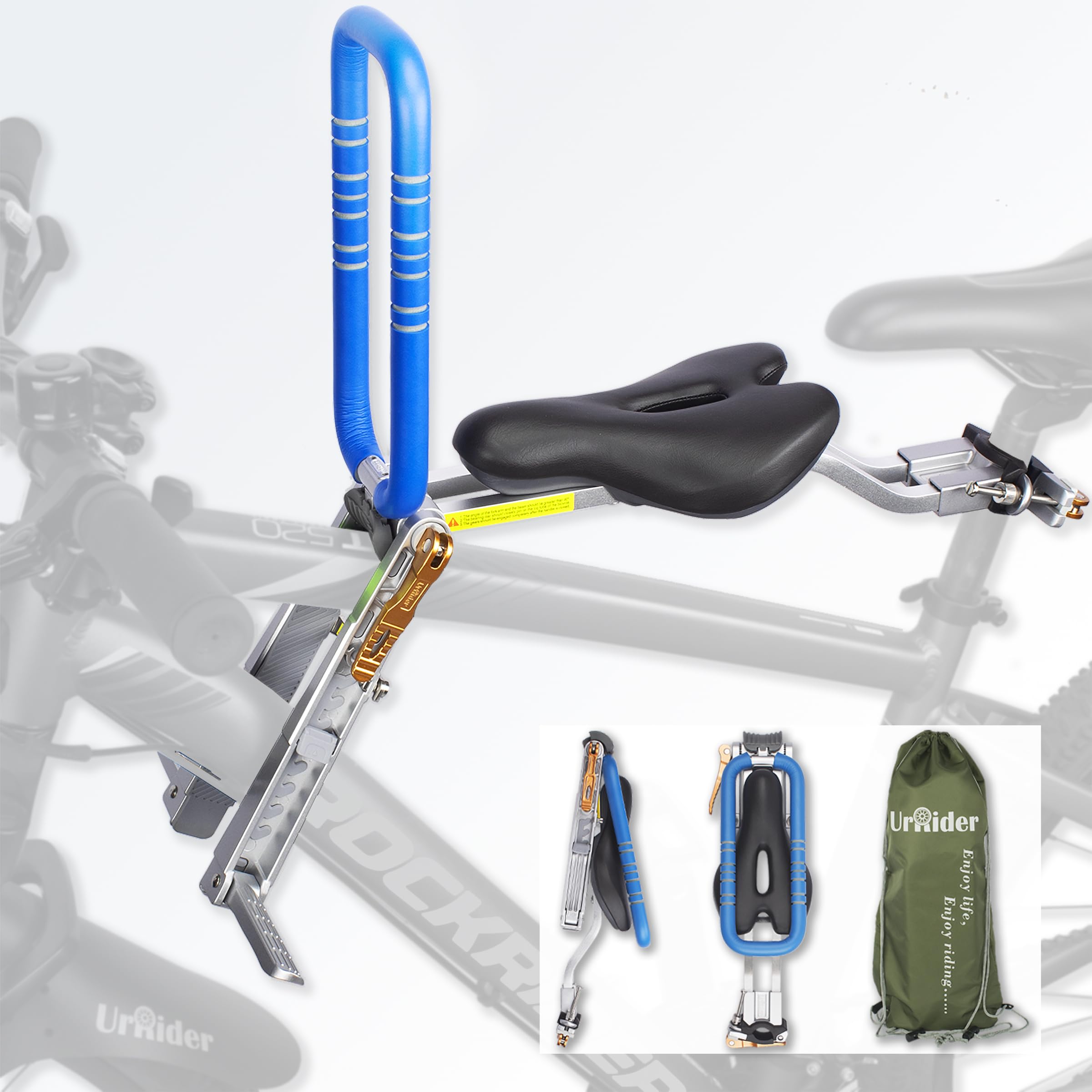
UrRider Front Mount
Key Features
- Mount Type: Front
- Weight Limit: 60 lbs
- Installation: Tool-free
- Harness: 3-point
- Bike Compatibility: Not step-through
- Price: $
Unlike the top pick’s rear-mount design, the UrRider puts your child in front for face-to-face bonding. Tool-free installation makes it simple to swap between bikes, and the 60-lb weight limit accommodates kids up to age 6. However, it won’t fit women’s step-through or folding bikes, and the hard seat padding can cause fidgeting on longer rides. This front seat is best for parents who prioritize interaction and own a compatible straight-top-tube bike.
Pros
- Tool-free install and removal for quick swapping between bikes.
- High 60-lb weight limit fits older and heavier kids up to age 6.
Cons
- Incompatible with women’s step-through and folding bikes – check your frame.
- Hard seat padding uncomfortable for rides over 30 minutes.
Buy this if you want a front-mounted seat for interactive riding and need a high weight capacity with easy bike-to-bike swaps. Skip it if you own a step-through or folding bike, or plan regular long rides where child comfort matters.
Best for Premium Comfort
Hamax Caress Rear
Key Features
- Mount Type: Rear
- Weight Limit: 48.5 lbs
- Installation: Easy
- Bike Compatibility: Non-standard tubes
- Price: $$$
The Hamax Caress stands out from the top pick by offering a reclining seat and shock-absorbing suspension that keep your child comfortable on bumpy paths. Installation is straightforward, and the seat fits children from 9 months to 48.5 lbs. However, the premium price and limited availability make it a bigger investment, and the mount may not fit all bike frames – check clearance before buying. This seat is best for families who prioritize long-ride comfort and have a compatible bike.
Pros
- Adjustable recline keeps child comfortable on long rides
- High-quality materials and sturdy construction
- Easy to install and adjust
Cons
- Fit can be problematic on some bike frames; measure before buying
- Buckle and latch can be stiff to release
Buy this if you want maximum comfort and recline for long rides with a young child. Skip it if you need a budget-friendly seat or have a non-standard bike frame.
Best for Young Toddlers
iBert Front Mount
Key Features
- Mount Type: Front
- Weight Limit: 38 lbs
- Installation: Easy
- Harness: 3-point
- Bike Compatibility: Short head tube
- Price: $
Unlike rear seats, the iBert puts your child in front for eye contact and a shared view. Installation takes minutes—the clamp is simple to tighten—and the steering wheel keeps toddlers entertained. The trade-off: a 38 lb weight limit means most children outgrow it by age 3, and the single-screw mount can feel unstable on bikes with short head tubes. It fits best for short neighborhood rides with a child under 3. Parents wanting long-term use or a higher weight limit should consider a front mount like the UrRider instead.
Pros
- Easy installation and removal with tool-free clamp.
- Padded seat and footrests keep toddlers comfortable on short rides.
- Built-in steering wheel and open view make rides engaging for young children.
Cons
- 38 lb weight limit restricts use to toddlers under age 3; many outgrow it quickly.
- Single-screw mount may feel wobbly on bikes with short head tubes; some users report instability.
Buy this if you want an easy-to-install front seat for short rides with a toddler under 3.
Best for Budget Rear
Bell Cocoon 300
Key Features
- Mount Type: Rear
- Weight Limit: 40 lbs
- Installation: Difficult
- Harness: 5-point
- Bike Compatibility: Older-style bikes
- Price: $$
Compared to the top pick, the Bell Cocoon 300 saves you money but demands patience. Its 5-point harness and spoke guard deliver essential safety at a budget-friendly price. However, installation is notably time-consuming and many modern bikes—especially those with disc brakes, thick tubing, or fenders—won’t accommodate it. If your bike has standard 26-27 inch wheels and you’re willing to spend extra effort on assembly, this seat provides a functional, secure ride for short trips. Children up to 40 lbs fit, but taller kids near the limit may find the footrests cause heel strike.
Pros
- Good value with essential safety features
- Sturdy and secure once properly installed
- Functional and dependable for its intended use
Cons
- Installation is difficult and time-consuming
- Fitment issues with many modern bike frames (thick stays, disc brakes)
Buy this if you have an older-style bike, are on a tight budget, and can handle a challenging setup. Skip it if you own a modern bike with disc brakes or thick tubing, or if quick installation matters.
How to Choose
The single most important step is measuring your bike’s frame tube diameter and seatpost clearance before buying any seat.
Mount Type
Front mounts let you interact with your child and are lighter, but they require a straight top tube and can interfere with knee clearance. Rear mounts offer higher weight limits and better stability for longer rides, but they add weight to the bike and can cause heel strikes on the footrests. Test ride without a child first to adjust handling.
Weight Limit
Weight capacity determines how long you can use the seat. Rear seats typically cap at 40-48 lbs, while some front mounts like the UrRider go to 60 lbs. A higher limit extends usability for older children, but also increases the load on your bike’s frame and balance.
Ease of Installation
Installation difficulty varies widely. Tool-free designs let you swap between bikes in seconds, while others require wrenches and careful alignment. Read reviews for specific bike models – many fitment issues appear only after hours of assembly.
Safety Harness Type
A 3-point harness clips at the waist and between legs – sufficient for most toddlers. A 5-point harness adds shoulder straps and provides more restraint for active children, especially in rear seats where vibration is higher. Ensure the buckle is easy to release but secure.
Bike Compatibility
Not all seats fit all bikes. Step-through frames, disc brakes, fenders, and thick tubing are common incompatibilities. Check your bike’s seatpost diameter, frame geometry, and clearance around the wheel before purchase. Many manufacturers provide fit guides online.
FAQ
Will a front child bike seat fit my women’s step-through bike?
Most front mounts require a straight top tube to clamp onto. Step-through frames without a horizontal top bar are typically incompatible with front seats. You’ll need a rear-mounted seat or a front seat designed for step-through bikes, which are rare.
How do I install a child bike seat without tools?
Some front-mount seats like the UrRider use a clamp that tightens by hand and a quick-release mechanism – no tools needed. Rear seats usually require a wrench for the rack or frame bracket. If you want tool-free installation, look for seats that explicitly advertise ‘tool-free’ in the description.
What is the difference between a 3-point and 5-point harness?
A 3-point harness buckles at the waist and between the legs, similar to a stroller. A 5-point harness adds shoulder straps that buckle at a central chest clip, providing more restraint if the child leans forward or falls asleep. For active toddlers or bumpy rides, a 5-point harness offers better security.
Can a child ride in a rear bike seat if they fall asleep?
Yes, but the child’s head may droop forward or to the side. Some rear seats have a recline feature (like the Hamax) that tilts the seat back slightly. Without recline, a child falling asleep may be uncomfortable but generally safe if the harness keeps them upright. A front seat makes it easier to monitor and support their head.