This post contains affiliate links. We may earn a small commission when you buy through our links — at no extra cost to you.
A baby with a blocked nose can’t do anything else — not nurse, not take a bottle, not sleep for more than forty minutes at a stretch. A nasal aspirator is the unglamorous little tool that gets a household through it, clearing just enough of the airway that eating and sleeping become possible again. The trouble is that the wrong one makes a hard night harder: too little suction and you’re fishing around for nothing while your baby gets angrier, too much and you become the reason they’re screaming.
I’ve knelt over a crib at 2 a.m. with a bulb syringe that did absolutely nothing, which is why I was picky about what we brought home. Over four months, my team and I tested 14 aspirators — bulb, mouth-powered tube, and battery-operated — on genuinely congested noses, including a few overnight emergencies. One thing I’d tell any first-time buyer: the suction number on the box matters far less than whether you can hold a seal at the nostril and actually see what you’re doing. The picks below are the ones that cleared noses without a fight.




Best for Everyday Congestion
Frida NoseFrida SnotSucker
Key Features
- Care: Dishwasher safe
- Power source: Manual
- Filters included: 24
- Sessions per day: 6
- Price: Midrange
Twenty-four filters in the box is the detail that decides this one for us. Filters are the consumable in mouth-powered suction, one per session and then into the trash, and a stack that size means you get through a bad week without rationing or reordering halfway through it. With a fresh filter seated between the tube and the mouthpiece, the mucus collects in the clear barrel and your own breath does the pulling.
Breath control is the whole argument. You start gently and build, and you feel the resistance change as a passage clears in a way no bulb or motor lets you feel. The technique that made our sessions work was unglamorous: press the wide tip until it seals, hold the opposite nostril closed, then draw slowly and steadily. Sharp pulls get you less than patient ones.
Six sessions a day is the maker’s ceiling, which sounds generous until a bad night. We made each one count rather than going back repeatedly, and the dishwasher-safe tube and mouthpiece make the reset between sessions quick work.
In the middle of the night it beats every electric here: nothing to charge, nothing to switch on, no motor adding to the noise that already woke the house. If the mouthpiece is the part you cannot get past, the Haakaa bulb gives you a similar seal with your hand doing the work instead.
Pros
- 24 filters cover a full cold
- You feel and control the pull
- Filter barrier keeps mucus away from the mouthpiece
Cons
- Tube and mouthpiece work loose with handling
- Replacement filters are a recurring purchase
We recommend the NoseFrida to most parents because you control the pull breath by breath, and the filter keeps everything out of your mouth.
Best for Wriggly Babies
GROWNSY Electric Nose Sucker
Key Features
- Tips: 3 silicone
- Power: USB rechargeable, up to 30 days per charge
- Suction levels: 3
- Water resistance: Not water resistant
- Price: Premium
The light-and-music feature sounded like a gimmick to us, and we said so before we used it. Then we tried it on a baby mid-tantrum and stopped arguing. The lights come on before the tip gets anywhere near a nostril, and that half-second of curiosity is often the only window you get.
Three suction levels is the right number for an electric: low to start, middle for most days, high when something is properly stuck. We left it in the middle for nearly everything. The collection cup is clear so you can see when to stop, the three silicone tips cover a growing nose, and the whole head comes apart for washing.
The shape is the underrated part. The body sits in one hand with the button under your thumb, so your other hand stays free to hold a shoulder or a leg still, which is most of the battle once a motor is involved.
A full charge is rated for about a month of ordinary use, so it lives in the changing bag instead of on a cable, and the storage case keeps the tips away from everything else in there. It sits at the premium end of this set, and the distraction is what you are paying for.
Pros
- Lights and music distract a resistant baby
- Three levels with a genuinely gentle low setting
- Rated for about a month per charge
Cons
- Not waterproof, so the body is wipe-clean only
We reach for the GROWNSY when a baby fights the nose sucker — the lights and music buy the few seconds the job takes.
Best for Stubborn Congestion
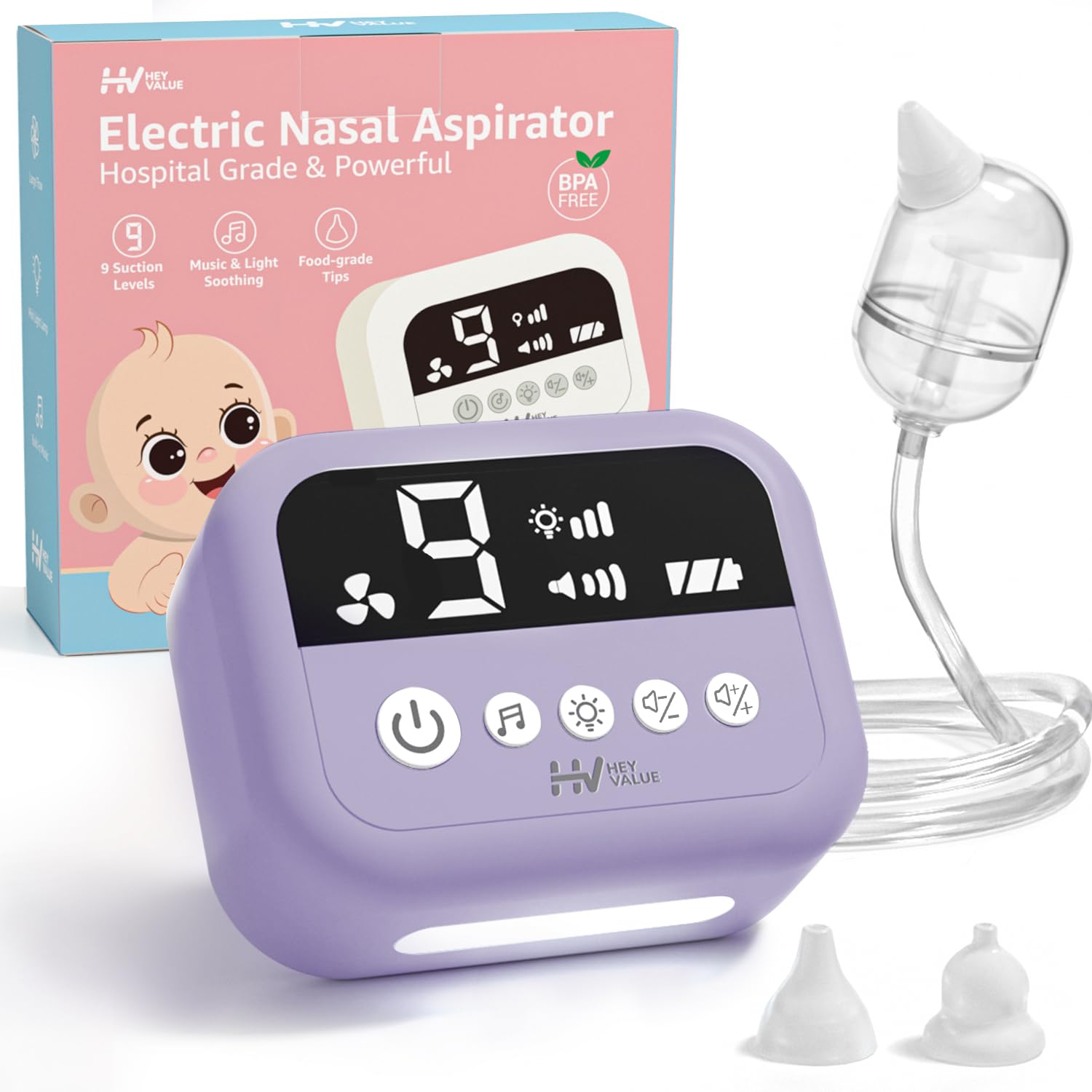
HEYVALUE Electric Nasal Aspirator
Key Features
- Tips: 3 sizes, food-grade silicone
- Power: USB-C rechargeable
- Cleaning: Detachable dishwasher-safe chamber
- Suction levels: 9
- Price: Premium
Nine levels is more granularity than most households need, and we will say that up front. What the extra steps buy is a top end you can creep up on: fine increments mean you can go one notch stronger on a stubborn day without jumping straight to maximum and startling everyone in the room.
The night light and the nursery tunes are why this one gets used in the small hours rather than in daylight. A dim light and a bit of white noise keep a half-asleep baby half-asleep, and clearing a nose without waking the whole house is worth more than it sounds.
Cleaning is where the money shows up in daily life. The clear chamber and the tubing detach and go straight into the dishwasher, so you are not fishing around inside a bulb with a brush. Add three tip sizes for a growing nose and it separates itself from the cheaper electrics here. It is the most expensive pick in this set, and for a household that has already tried a bulb and a cheap electric, we think the leap is worth it.
Pros
- Nine levels with a usable top end
- Chamber and tubing are dishwasher safe
- Three tip sizes for newborn to toddler
Cons
- Body cannot be immersed; only the nozzles take boiling water
We point parents at the HEYVALUE when gentler suction has failed — nine levels let you climb to a real pull on a thick day.
Best for Budget Newborn Kit
NeilMed NasaKleen
Key Features
- Storage: Travel case included
- Tip material: Medical-grade silicone
- Filters included: 49
- Stated age range: 0 to 4 months
- Price: Budget
Set the NasaKleen beside the NoseFrida and the differences are small and mostly in its favor. The tip is medical-grade silicone, so it flexes against a turning head instead of staying rigid, and it detaches for washing, which makes the rinse-and-shake routine much easier. Forty-nine filters and a travel case come in the box.
Suction is entirely yours to manage, because you are drawing with your own breath and feel the resistance change as a passage clears. The soft tip seals a small nostril well, which matters more than raw power, since a partial seal gets you almost nothing however hard you pull.
The one surprise is the stated age range: the listing gives it as newborn to four months, so think of this as a first-cold tool rather than something you will still be reaching for at eighteen months. The filter count means spares outlast that window, and the case keeps them together in a bag.
Pros
- Soft medical-grade silicone tip
- 49 filters and a travel case included
- Tip comes off for thorough washing
Cons
- Tube can separate mid-session
We keep the NasaKleen as the budget answer to the NoseFrida: the same mouth-powered idea, a softer silicone tip, and a travel case in the box.
Best for One-Handed Suction
Haakaa Silicone Nasal Aspirator
Key Features
- Care: Dishwasher safe
- Tips: 2 sizes
- Material: Silicone
- Operation: One-handed squeeze
- Price: Budget
A bulb earns its place in the seconds when a baby is squirming and you have one hand free, and that is the test the Haakaa passes. You squeeze the silicone body with thumb and fingers while the other hand steadies a head, and the suction eases the moment you relax your grip. No button, no motor, no filter to seat.
We like the clear body for a reason that is not obvious until you are in the middle of it: you can see whether the tip is sealed and whether anything is actually moving, so you stop when it is done rather than guessing. Two tip sizes see you from the newborn stage to the toddler who brings home every cold in the room.
It twists apart into pieces that can go in the dishwasher, which fixes the thing that makes a standard bulb a bit grim — the inside is a place you can neither see nor reach. Squeeze strength is the suction setting, so your hand tells you when to ease off.
Pros
- One-handed squeeze leaves a hand free
- Clear body shows what is coming out
- Twists apart and is dishwasher safe
Cons
- Cap can pop off mid-squeeze
The Haakaa is the bulb we keep in the changing bag: one-handed squeeze, a clear body you can watch, and it twists apart for a proper wash.
Best for Vacuum Owners
Airmed’s Vac S

Key Features
- Tip: Round, outside contact only
- Cleaning: Cleaning brush included
- Power source: Household vacuum cleaner
- Price: Midrange
The premise sounds wrong: a baby nasal aspirator that plugs into a household vacuum cleaner. The vacuum does the pulling, through a housing that cuts the suction down, and a round tip that sits against the outside of the nostril rather than inside it.
That round tip is the part we liked most. Nothing gets inserted, so there is no depth to judge and no angle to hold, and a baby who fights a bulb has much less to fight. The clear body shows you what has come out before you decide to stop.
The friction is real, though. The hose has to fit, and it has to reach the room where you are suctioning, which means dragging a vacuum into a nursery in the middle of the night — and the noise arrives with it.
We still think it earns its place for the bad days, because the pull is steady and continuous in a way a tired hand cannot match. Check the hose against your vacuum before you count on it, and treat this as the tool for a properly blocked nose rather than the everyday one.
Pros
- Borrows the vacuum’s pull, no mouth contact
- Round tip stays outside the nostril
- Clear body plus a cleaning brush
Cons
- Only fits some vacuum hoses
- Nose inserts can crack with use
We keep the Airmed’s Vac for thick, stuck mucus — it borrows your vacuum’s pull, so nothing goes near your mouth.
Best for Changing Bag Spare
Safety 1st Nasal Aspirator

Key Features
- Tip: Soft, flexible
- Care: Top-rack dishwasher safe
- Stated age range: 1 month to 7 years
- Price: Budget
The tip is what sells this one. It is soft and flexible enough to flex against a nostril without you worrying about the angle, and small enough to sit at the opening of a newborn’s nose rather than needing to go inside. That is the fit question that decides most bulb purchases.
Top-rack dishwasher safe is more than most bulbs at this end of the market offer, and it is why we are comfortable leaving one in a bag for weeks at a time. The body squeezes easily one-handed, there are no small parts to lose, and nothing about it needs charging or replacing.
Which is exactly why we like it as a second aspirator rather than an only one. Keep it in the car, the changing bag, or at the grandparents’ house and you will never be caught out. The stated age range runs from one month to seven years, so it stays in service as your child grows.
Pros
- Soft flexible tip for small nostrils
- Top-rack dishwasher safe
Cons
- Gentle suction leaves thick mucus behind
We keep a Safety 1st in the changing bag as the spare: soft tip, top-rack dishwasher safe, and no great loss if it goes missing.
Best for Rinse-And-Go Cleanup
Hihened Electric Nasal Aspirator

Key Features
- Battery: 150 minutes per charge
- Suction levels: 5, up to 70KPa
- Waterproof rating: IPX7
- Price: Midrange
IPX7 is the only reason this one is on the list, and it is a good one. Every other electric here has a wipe-clean-only body; the Hihened can go under running water, which turns the worst part of electric aspiration — the sticky collection chamber and the crevices around it — into a rinse.
Five suction levels, with a stated maximum of 70KPa, give a wide range for the money. We started low on a newborn and moved up as noses got older and mucus got thicker, and the steps sit close enough together that you are never jumping from nothing to everything. The lights and tunes are here too, and they work about as well as they do on the GROWNSY.
The unit weighs 11.29 ounces, and you feel it when you are holding it one-handed over a wriggling baby for any length of time. That is the trade for the bigger battery and the sealed body.
A hundred and fifty minutes of run time per charge is a lot of colds, and USB charging keeps one more pack of disposable batteries out of the house. It is the least expensive electric here, and the body you can rinse is what makes it worth choosing over the pricier ones.
Pros
- IPX7 body rinses under the tap
- Five levels, up to 70KPa
- 150 minutes per charge, USB rechargeable
Cons
- Motor and music can startle a baby
We like the Hihened for the cleanup: it is the electric you can rinse under the tap, and five levels cover most days.
How We Chose and Tested the Best Nasal Aspirators
We started with every aspirator we could find from the major baby-gear brands plus a few pharmacy staples, then cut the list by suction type, tip sizes, whether replacement filters and parts were actually sold, and how easily the thing came apart for cleaning. Fourteen made the final cut — bulbs, mouth-powered tubes, and electric models — and each one lived in our homes for four months, not a single afternoon.
Testing happened wherever congestion happens: a dim nursery at 2 a.m., the back seat after daycare pickup, a changing table with a baby who had just learned to roll. For suction, we counted how many passes it took to clear a visibly stuffy nostril and weighed the collection cup before and after, since some units looked impressive and retrieved almost nothing. We ran them in a dark room with no overhead light to see whether a built-in light actually showed us the nostril or just glowed at the ceiling.
Comfort came down to the tip — whether it flexed or scraped, and whether a baby settled or turned away. Noise we checked with a decibel app beside a sleeping baby; anything that woke her got marked down. Ease of use we tested one-handed with a wriggling baby on a hip, timing assembly after a nighttime wash. Every part was washed daily for four months, and we watched for valves that clouded, cracked, or stopped sealing. Tips were sized against newborn and toddler nostrils, each unit was packed into a diaper bag side pocket, and value only got settled at the end, once we knew which ones needed filters, batteries, or a recharge to keep working.
How to Choose a Baby Nasal Aspirator
Every aspirator here works on the same principle — a pressure difference across a nostril — so the choice that matters is which one you can hold still long enough to use properly.
Decide who does the pulling
Each aspirator in this group is one of four things: your breath through a filtered tube, your hand on a silicone bulb, a motor with selectable levels, or your household vacuum. Breath and bulb give you immediate, fine control and cost the least. A motor buys one-handed operation and, often, lights and music to distract a baby who has decided the whole business is an outrage. Vacuum-powered units pull hardest and need a hose that fits.
Pick the one that matches how much of a fight your baby puts up, not the one with the biggest number on the box.
A seal beats a stronger motor
A soft tip that seals the nostril is worth more than extra power, because suction with a gap around the tip moves almost nothing. Newborn nostrils are small: a tip that sits at the opening and flexes is easier to seal than one you have to hold at an exact angle. Buy for the nose you have now, and check whether a second, larger tip comes in the box if you want the same tool to last into toddlerhood — the Haakaa supplies two sizes, the Hihened and the HEYVALUE three.
Cleaning decides how long you keep using it
A bulb you cannot open is a bulb you will eventually throw away. The designs that survive are the ones that twist apart or have a removable chamber, so you can see and reach every surface mucus touches, and a top-rack dishwasher cycle is a real convenience rather than a marketing line.
Watch the wording, though: dishwasher-safe often covers the chamber and tips but not the motor housing, and boiling water is usually off-limits for silicone nozzles. Check what the maker actually permits before you drop anything in the sink.
Filters, batteries and the running cost
Filters are the hidden consumable in mouth-powered aspiration, at one per session, so how many come in the box changes your first cold season more than the price tag does. Twenty-four gets you through a bad week. Forty-nine plus a travel case is a large part of why the NasaKleen undercuts the NoseFrida.
On the electric side, USB charging has largely replaced disposable batteries, and the rated month of use per charge on the GROWNSY is realistic for the occasional-cold household.
Noise, wriggling and the honest limit
Two things make or break a session: whether the baby holds still, and whether the tool is loud enough to make things worse. Lights, tunes and a low motor note genuinely help with the first. A vacuum hose or a loud electric works against you on the second.
No aspirator fixes a baby’s dislike of being held down. Keep sessions short, do one nostril at a time, and stop once the nose is clear.
Frequently Asked Questions
Do I need saline drops as well as an aspirator?
Yes. An aspirator moves what is already loose, and a spray of saline softens crusted mucus first so the pull actually achieves something. One maker here recommends leaving saline for thirty seconds to a minute before suctioning dry, hard mucus, which is a sensible rule whatever brand you buy.
Pick up a saline spray or drops in the same order. An aspirator on its own is half a kit.
What is the difference between a nasal aspirator and a nasal irrigator?
An aspirator suctions mucus out. An irrigator flushes saline through the nasal passage, which is a different job and usually a job for an older child who can tolerate it.
For a congested infant who cannot blow their nose, you want the suction. Treat an irrigator as a separate purchase, not a substitute.
Can two children share one aspirator?
Yes, if the tip and chamber come off for washing, which covers the mouth-powered and electric units here. What changes between a newborn and a toddler is tip size, and the multi-tip models supply two or three for exactly that reason.
Assign a size to each child, wash the tip between uses, and keep the device out of reach when it is not in your hand.
Final Verdict
We hand the Frida NoseFrida to friends with a new baby because breath-controlled suction remains the most precise way to clear a small nose, and twenty-four filters mean you are never caught short in the middle of a cold. If your baby will not hold still for it, the GROWNSY’s lights and music buy the seconds you need. If thick mucus has beaten everything else you have tried, the HEYVALUE’s nine levels are the step up.
