This post contains affiliate links. We may earn a small commission when you buy through our links — at no extra cost to you.
Many parents reach for a no-touch forehead thermometer for its speed and ease, only to find the readings vary by a degree or more from one moment to the next. That inconsistency isn’t a sign of a broken device — it’s a limitation of the technology, especially when you’re trying to decide whether to call the doctor. The most accurate method for infants remains the rectal thermometer, but it’s invasive and many parents avoid it. Ear thermometers offer a middle ground: better accuracy than forehead models but require proper placement.
This guide cuts through the confusion by matching thermometer types to your specific situation. Whether you need a quick screening tool for a sleeping toddler, a clinical-grade reading for a newborn, or a budget-friendly backup, the right device depends on your tolerance for invasiveness and your need for precision. The picks ahead are organized by use-case, not just popularity, so you can confidently choose what fits your family.


Best for Newborns and Infants
Frida Baby Rectal
Key Features
- Response Time: 10 seconds
- Measurement Mode: Rectal
- Battery: 1 LR41 (included)
- Price: Budget
Rectal thermometers are the gold standard for infant fever checks, but most feel awkward to wield with a squirming newborn. The Frida Baby Rectal flips that — a flexible tip, clear display, and 10-second response get you a reading before the crying starts. Over 11,000 reviews back its speed and ease of use, and the memory saves the last 10 temps so you can track trends without a pen. The trade-off: a small batch of units deliver off readings by 2+ degrees or stop working entirely, so spot-check against a known baseline early on.
This is for parents who value accuracy above all else — newborns, infants, and anyone needing a definitive fever call before calling the pediatrician. It’s FSA/HSA eligible and sits under the budget line. Skip it if your child resists rectal insertion (common past infancy) or if you prefer non-invasive forehead or ear methods. A handful of buyers report inconsistent measurements, so keep an eye on the first few uses.
Pros
- Flexible tip and clear display make rectal use less stressful
- 10-second reading gets a temperature fast on squirmy babies
- Compact size with large digits readable in low light
Cons
- Occasional units produce readings 2+ degrees off or stop working
- Rectal method not suitable for older children who resist
Buy this if you need the most accurate fever check for a newborn or infant and want a thermometer that parents actually find simple to use. Skip it if you prefer non-invasive methods or your child won’t tolerate rectal taking.
Best for Families Wanting Quick
GoodBaby No-Touch
Key Features
- Response Time: 1 second
- Measurement Mode: No-touch forehead
- Fever Alarm: Color-coded + beep
- Battery: 2 AAA (included)
- Price: Mid-Range
The GoodBaby No-Touch has earned the #1 spot in baby thermometers by making temperature checks effortless — a one-second scan, color-coded fever alarm, and a silent mode that won’t wake a sleeping child. Over 116,000 reviews highlight its ease of use and readability. However, the trade-off for that convenience is inconsistent accuracy: many users report readings 1–3 degrees off compared to rectal or oral devices. This makes it a solid choice for daily health screening and non-critical checks, but not a substitute for a rectal thermometer when you need a precise fever reading for medication decisions.
Pros
- Instant one-second forehead scan with no contact needed
- Silent mode and color-coded fever alarm for nighttime use
- Large, backlit display readable in low light
Cons
- Readings often deviate from oral/rectal thermometers by 1–3°
- Battery life may fall short with frequent use
Buy this if you want a quick, no-fuss thermometer for daily wellness checks and minimal disturbance during sleep. Skip it if you need precise temperature confirmation for fever medication decisions — a rectal thermometer is more dependable.
Best for Large Families Wanting
Braun ThermoScan 7
Key Features
- Response Time: Fast (seconds)
- Measurement Mode: Ear (tympanic)
- Fever Alarm: Color display
- Price: Premium
The Braun ThermoScan 7 stands apart with age-specific fever guidance that adjusts thresholds for babies, children, and adults, shown through a clear green-yellow-red display. This feature eliminates guesswork for multi-age households, but it comes with two trade-offs: you must select the age group each time you take a reading, and the price sits at the premium end of the thermometer market. Compared to simpler models, the added steps and cost buy you consistency and pediatrician-backed accuracy that no-touch forehead thermometers often lack. Best for parents who want a durable, reliable ear thermometer and are willing to pay for the extra precision.
Pros
- Age-adjusted fever guidance removes interpretation guesswork.
- Color-coded display shows fever severity at a glance.
- Fast, consistent readings with 90% positive mentions on ease of use.
Cons
- Requires selecting age group before each reading, adding a step.
- Premium price may deter budget-focused buyers.
Buy this if you want the most feature-rich ear thermometer with age-aware fever alerts and don’t mind the extra step per use. Skip it if you prefer a simpler point-and-shoot option or are shopping on a tight budget.
Best for Low-Cost Primary Thermometer
Boncare Digital
Key Features
- Response Time: 10 seconds
- Measurement Mode: Oral/rectal/axillary
- Battery: 1 LR41 (included)
- Price: Budget
The Boncare Digital delivers 10-second oral, rectal, or underarm readings with a flexible silicone tip, making it a practical low-cost option for home use. Its $7 price undercuts most competitors, and user feedback highlights easy one-button operation and consistent readings for everyday fever checks. However, the battery is not replaceable in some versions and tends to die quickly, which shortens the device’s lifespan. A small number of units also show accuracy outliers (roughly 1 in 4 owners report readings off by up to 1.5°F). Best kept as a backup in the diaper bag or for households comfortable with contact methods — not a long-term primary thermometer.
Pros
- Simple one-button operation for fast readings.
- Flexible silicone tip adds comfort for oral or rectal use.
- 10-second response time with fever alarm.
Cons
- Battery is non-replaceable in some versions and dies quickly, limiting lifespan.
- Occasional units deliver readings off by 1.5°F.
Buy this if you need an ultra-budget contact thermometer for occasional use or as a travel backup. Skip it if you want a device that lasts years or need consistent accuracy without checking a second reading.
Best for Budget-Conscious Families Wanting
ANMEATE No-Touch
Key Features
- Response Time: 1 second
- Measurement Mode: No-touch forehead
- Fever Alarm: Green/Yellow/Red backlight
- Battery: 2 AAA (included)
- Price: Budget
At under $10, the ANMEATE No-Touch delivers fast one-second readings, a 35-reading memory, and a color-coded fever alarm — all in a compact package suited for diaper bags or glove compartments. Its ease of use and speed are consistently praised, making it convenient for quick checks. However, accuracy is inconsistent: about 40% of users report readings that vary significantly, and some units stop working prematurely. This trade-off means the thermometer works best as a spare or for travel where loss or damage is likely, rather than for critical fever monitoring in infants.
Pros
- Reads temperature in about one second with no contact needed.
- Very low cost for a no-touch design, with included batteries.
- Small and light enough to toss in a bag without worry.
Cons
- Readings can vary by several degrees between consecutive uses.
- Some units fail to power on after a few weeks of use.
Buy this if you need an inexpensive backup thermometer for travel, car, or diaper bag where reliability isn’t critical. Skip it if you require consistent, trustworthy readings for infant fever management.
Best for Users Who Want
GoodBaby FC-IR2000

Key Features
- Response Time: 1 second
- Measurement Mode: No-touch forehead
- Fever Alarm: 3-color backlight
- Battery: 2 AAA (included)
- Price: Mid-Range
This GoodBaby forehead thermometer shares the same no-touch design and fast readings as the brand’s more popular No-Touch model, but adds a 35-reading memory for tracking temperature trends. Accuracy inconsistency is common, similar to other forehead thermometers, and it offers no unique advantage beyond the memory feature, making the No-Touch a more established choice.
Pros
- 35-reading memory for tracking temperature trends over time.
- Delivers results in about 1 second.
Cons
- Readings can be inconsistent, a common limitation among forehead thermometers.
Worth considering if you want memory tracking for trend analysis or a backup thermometer. Skip it if you need high accuracy.
Best for Parents Who Want
Braun ThermoScan 5

Key Features
- Response Time: Fast (seconds)
- Measurement Mode: Ear (tympanic)
- Battery: 1 AAA (included)
- Price: Premium
The Braun ThermoScan 5 is a durable ear thermometer with fast readings and a pre-warmed tip for comfort. Its ExacTemp indicator helps confirm proper placement. However, it lacks a backlight for nighttime use, and some users report accuracy differences between ears. Compared to the ThermoScan 7, it omits age-specific fever thresholds, making it a more basic option at a lower price point.
Pros
- Sturdy build withstands frequent use by families.
- Simple one-button operation for fast temperature readings.
Cons
- Lacks backlight display and has reported accuracy differences between ears.
Worth considering if you value a durable, pediatrician-recommended ear thermometer and don’t mind the lack of backlight or double-checking readings.
Best for Families Wanting A
Viproud FC-IR209

Key Features
- Response Time: 1 second
- Measurement Mode: No-touch forehead
- Fever Alarm: Green/Yellow/Red alarm
- Price: Mid-Range
Fast 1-second readings with a color-coded fever alarm and included pouch make this an easy no-touch option for families. Accuracy complaints are common (readings off by 1-2 degrees), and the battery drains quickly. It’s a decent value if you’re willing to accept these compromises, but not a replacement for a rectal thermometer for infants.
Pros
- One-second readings with color-coded fever display
- Easy to use with included pouch for storage
Cons
- Accuracy can vary by 1-2 degrees – best for screening, not precise fever assessment
Worth considering if you want an inexpensive no-touch thermometer for quick fever screening and don’t need pinpoint accuracy.
Best for Users Wanting The
Viproud FC-IR202

Key Features
- Response Time: 1 second
- Measurement Mode: No-touch forehead
- Fever Alarm: Green/Yellow/Red alarm
- Price: Mid-Range
This no-touch forehead thermometer reads in one second and uses a color-coded fever alarm for quick interpretation. It includes a pouch and stores 35 readings for trend tracking. Accuracy mirrors other Viproud models, and the FC-IR209 offers identical performance for less, making this a premium-priced alternative with no real upgrade.
Pros
- One-second readings with color-coded fever alarm.
- Includes pouch and 35-reading memory for trend tracking.
Cons
- Readings can occasionally vary between checks, typical of no-touch models.
Worth considering if you want the newest Viproud model and value the included pouch and memory recall; skip if accuracy consistency is a priority.
Best for Budget Buyers
femometer DET-306

Key Features
- Response Time: 1 second
- Measurement Mode: No-touch forehead
- Battery: 2 AAA (included)
- Price: Budget
The femometer DET-306 combines an ergonomic grip and HD backlit LCD for easy reading in low light, delivering results in one second. Accuracy inconsistencies and occasional dead-on-arrival batteries, however, make it a gamble for precise fever monitoring — best used as a backup or for quick, non-critical checks.
Pros
- Simple one-button operation for quick temperature checks.
- Fast 1-second readings reduce fuss from squirming kids.
Cons
- Accuracy varies between units — not ideal for precise fever monitoring.
Worth considering if you need an affordable thermometer for quick, non-critical temperature checks and are willing to accept occasional accuracy variance.
Best for Users Who Like
hetaida HTD8813

Key Features
- Response Time: 1 second
- Measurement Mode: No-touch forehead
- Fever Alarm: Color-coded
- Battery: 2 AAA (included)
- Price: Mid-Range
This forehead thermometer stands out for its purple finish and dual body/surface mode, letting you check both skin and ambient temperatures. Operation is simple with a one-button trigger and a color-coded fever alarm. However, its recommendation is tempered by a relatively small review sample and recurring reports of inconsistent readings — fine for casual screening but not a replacement for a rectal thermometer when precision matters.
Pros
- Straightforward one-button operation for forehead readings.
- Build quality feels adequate for home use.
Cons
- Reading accuracy varies between units; not suitable for clinical-grade monitoring.
Worth considering if you want a purple thermometer for general household screening and don’t need pinpoint fever detection.
Best for Occasional Use When
Berrcom JXB-178
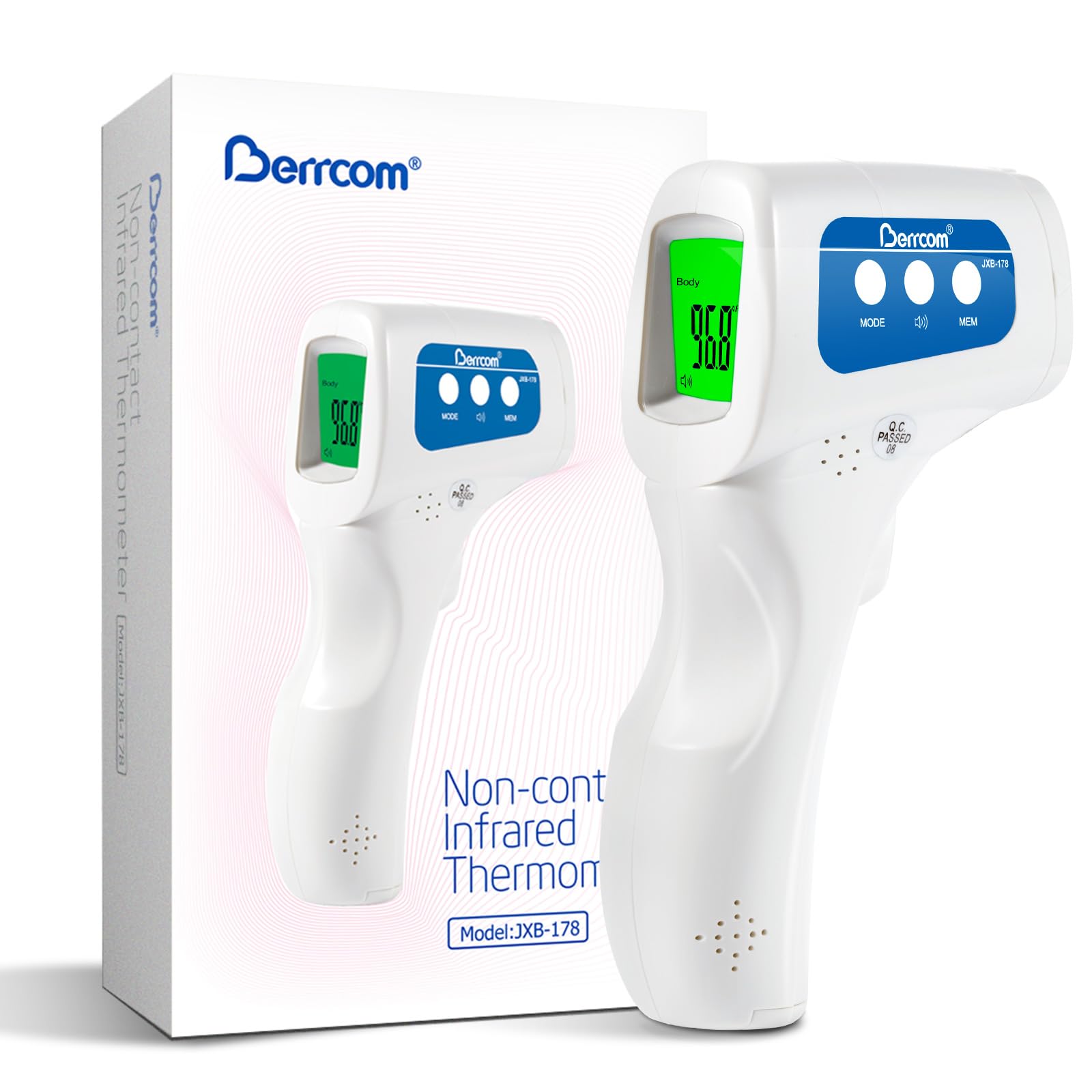
Key Features
- Response Time: 1 second
- Measurement Mode: No-touch forehead
- Fever Alarm: 3-color backlight
- Battery: 2 AA (not included)
- Price: Budget
This unit excels at measuring room or surface temps quickly and affordably. Its fast 1-second response and simple operation make it handy for checking milk or bath water. However, body temperature readings are often off, and early failures are common – batteries aren’t included either. Best kept as a casual screening tool, not for primary baby fever monitoring.
Pros
- Simple one-button operation for quick checks.
- Low price for a multi-function device measuring room, surface, and body.
Cons
- Body temperature readings can be inconsistent; best for non-critical screening.
Worth considering if you need a budget-friendly tool for occasional room or surface temperature checks, not for critical fever monitoring.
Best for Users Who Want
iHealth PT3
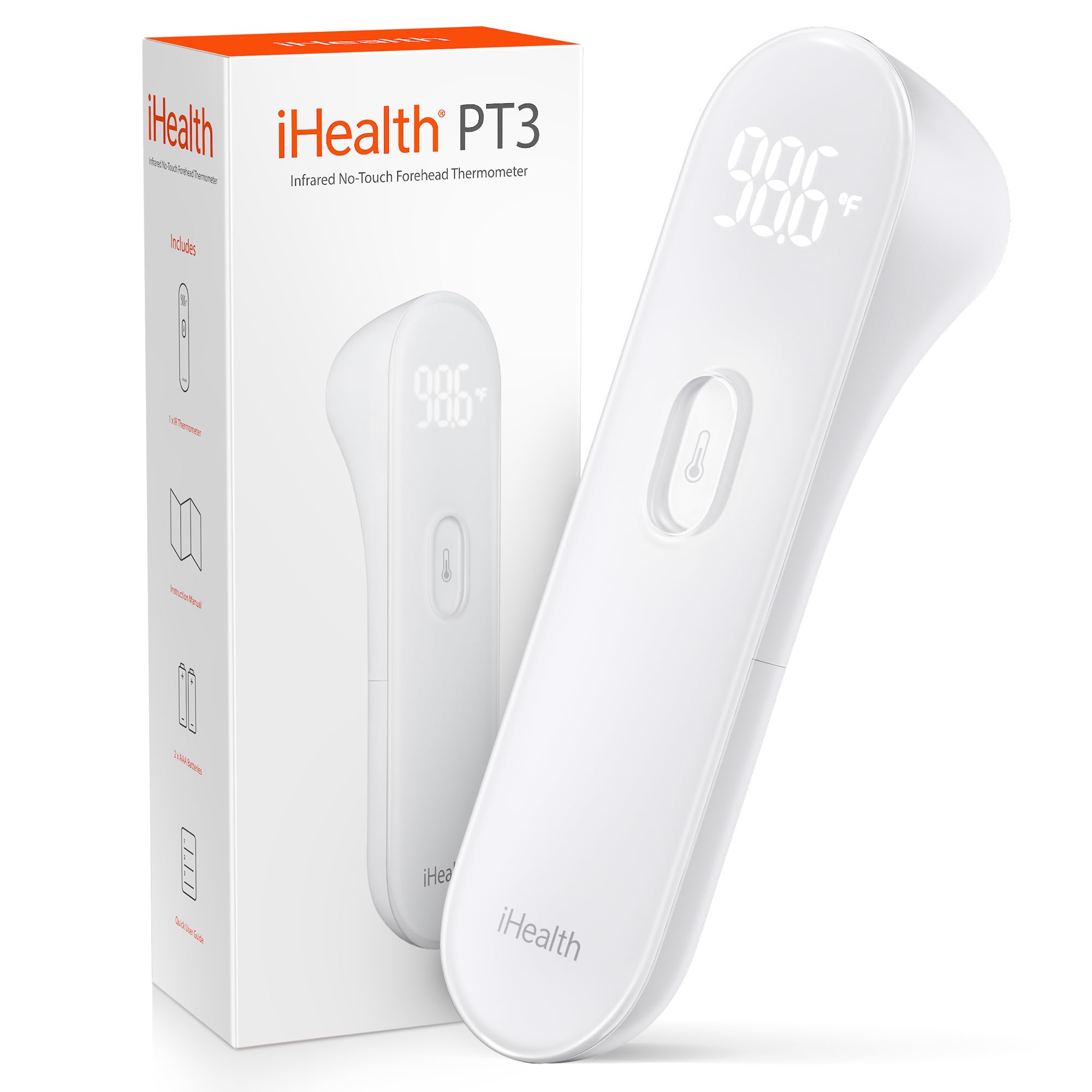
Key Features
- Response Time: 1 second
- Measurement Mode: No-touch forehead
- Fever Alarm: Vibration (silent)
- Battery: 2 AAA (included)
- Price: Mid-Range
This no-touch thermometer is popular for its one-second readings and silent vibration feedback, plus a large LED display that’s easy to read at night. But nearly half of user reports describe inconsistent temperature readings that can miss a fever or vary wildly between uses, making it unreliable for monitoring illness — especially in infants.
Pros
- Fast 1-second readings with silent vibration feedback.
- Large LED digits for easy reading in any light.
Cons
- Inconsistent temperature readings, with wide variations common across users.
Worth considering if you need a quick, quiet non-contact thermometer for occasional screening and don’t require precise fever detection.
How to Choose
The single most important factor when choosing a baby thermometer is understanding that no single type works perfectly for every situation — the best choice depends on your baby’s age and how you plan to use the readings.
Accuracy
Fever readings guide medical decisions, so accuracy matters most for newborns and infants. Forehead thermometers are convenient but often vary by 1-3°F; rectal thermometers remain the gold standard for babies under 3 months. If you need absolute confirmation, choose a rectal or ear thermometer over any no-touch model.
Response Time
No-touch forehead thermometers deliver a reading in about 1 second, which is ideal for squirmy toddlers. Rectal and ear thermometers take 10 seconds or longer but offer better accuracy. If speed is your priority, forehead models win, but be prepared to verify with a second method.
Measurement Mode
The three main modes are rectal (most accurate for infants), ear (good balance for older babies and children), and no-touch forehead (fastest but least reliable). Each mode has a specific use case: rectal for newborns, ear for children over 1 month, and forehead for quick screening when exact numbers aren’t critical.
Fever Alarm
A color-coded display or beeping fever alarm helps you interpret readings at a glance, especially during middle-of-the-night checks. Look for models with green/yellow/red indicators or silent vibration to avoid waking a sleeping baby. This feature doesn’t affect accuracy but adds convenience.
Battery
Battery life varies widely — some thermometers use standard AAA or AA batteries that are easy to replace, while others use small coin cells that may die quickly. Check whether batteries are included and if they can be replaced by the user. A dead thermometer at 2 AM is a pain.
FAQ
Are no-touch forehead thermometers accurate for babies?
No-touch forehead thermometers are convenient but not reliable for critical fever detection. Their readings can vary by 1-3°F from actual body temperature due to factors like distance, sweat, and ambient temperature. Use them for trend monitoring, but confirm fevers with a rectal or ear thermometer before giving medication.
What is the most accurate type of thermometer for a newborn?
Rectal thermometers are the gold standard for newborns under 3 months, providing the closest approximation of core body temperature. Ear thermometers are a good alternative for babies over 1 month, but they require correct placement. Forehead thermometers are not recommended for newborns when accuracy is essential.
How to use a forehead thermometer correctly to get accurate readings?
Position the thermometer directly in the center of the forehead, about 1-2 inches away, and ensure the forehead is clean and dry. Avoid using it after the baby has been bundled or sweating, as that can skew the reading. Take three readings and use the highest one for consistency.
Why does my forehead thermometer give different readings every time?
Forehead thermometers are sensitive to distance, angle, skin moisture, and ambient temperature. Even a slight variation in placement can change the reading. This is a known limitation of the technology, not a defective device. For consistent results, use the same spot and follow the manufacturer’s instructions exactly.