This post contains affiliate links. We may earn a small commission when you buy through our links — at no extra cost to you.
A thermometer reading is only useful if you trust it—especially at 2 a.m., when your baby is fussy and you’re trying not to wake the house. For newborns and young infants, pediatricians often recommend a rectal reading when accuracy matters most, and the right thermometer makes that job quicker and calmer. Look for a flexible tip, a fast and steady read, a display you can see in dim light, and controls you can manage one-handed.
Over four months, my team and I tested 14 rectal thermometers through real diaper changes, nighttime fever checks, and the usual middle-of-the-night scramble. We cared about consistent readings, easy operation, clear beeps and display, sensible battery life, and a price that matches what you get. A first-time buyer may not realize how much difference a backlight, a memory button, and a cover that stays put can make until you’re fumbling in the dark; the picks below earned a permanent spot in the nursery drawer.


Best for First-Time Parents
Frida Quick-Read
Key Features
- Modes: Rectal only
- Resolution: 0.1 °F
- Probe depth: 1.5 inches
- Reading time: 10 seconds, final at 30
- Price: Midrange
There are two numbers in a Frida reading, and only one of them counts. A first reading appears at around ten seconds; the final one lands at about thirty. Write down the ten-second figure and you are acting on a provisional number, which is exactly the mistake a 2am check invites. Wait for the second one, then decide.
That detail is easy to miss, and it is the most useful thing we can tell you about this thermometer. What we like is how little else there is to think about. The probe is 1.5 inches and made for rectal use alone, so depth is a much smaller judgement call than with a general-purpose stick that could go in a mouth or an armpit. There is no mode to cycle, no cover to fit, and one button. With a baby who has decided they have had enough, fewer decisions is the feature.
If there is a weakness in the design, it is that a probe which shifts partway through throws the reading, and a squirming baby is exactly the condition that causes it. Hold steady, follow the manual on depth, and take it again rather than accepting a number that does not match how the baby seems.
It comes with a case, which matters more than it sounds, because this one should never be rattling loose in a drawer next to the nail scissors. Wipe the probe with alcohol or soapy water before and after every use, and accept that rectal use is a one-way door: this thermometer does not go in a mouth afterwards.
Pros
- Short 1.5-inch probe made for rectal use
- One button, no modes to fumble at night
- Carry case keeps the probe separate and clean
Cons
- Some units fail almost immediately
The one we point new parents to: purpose-built for rectal use, short enough to take the guesswork out of depth, and quick enough to finish before the protest starts.
Best for Two-Place Setup
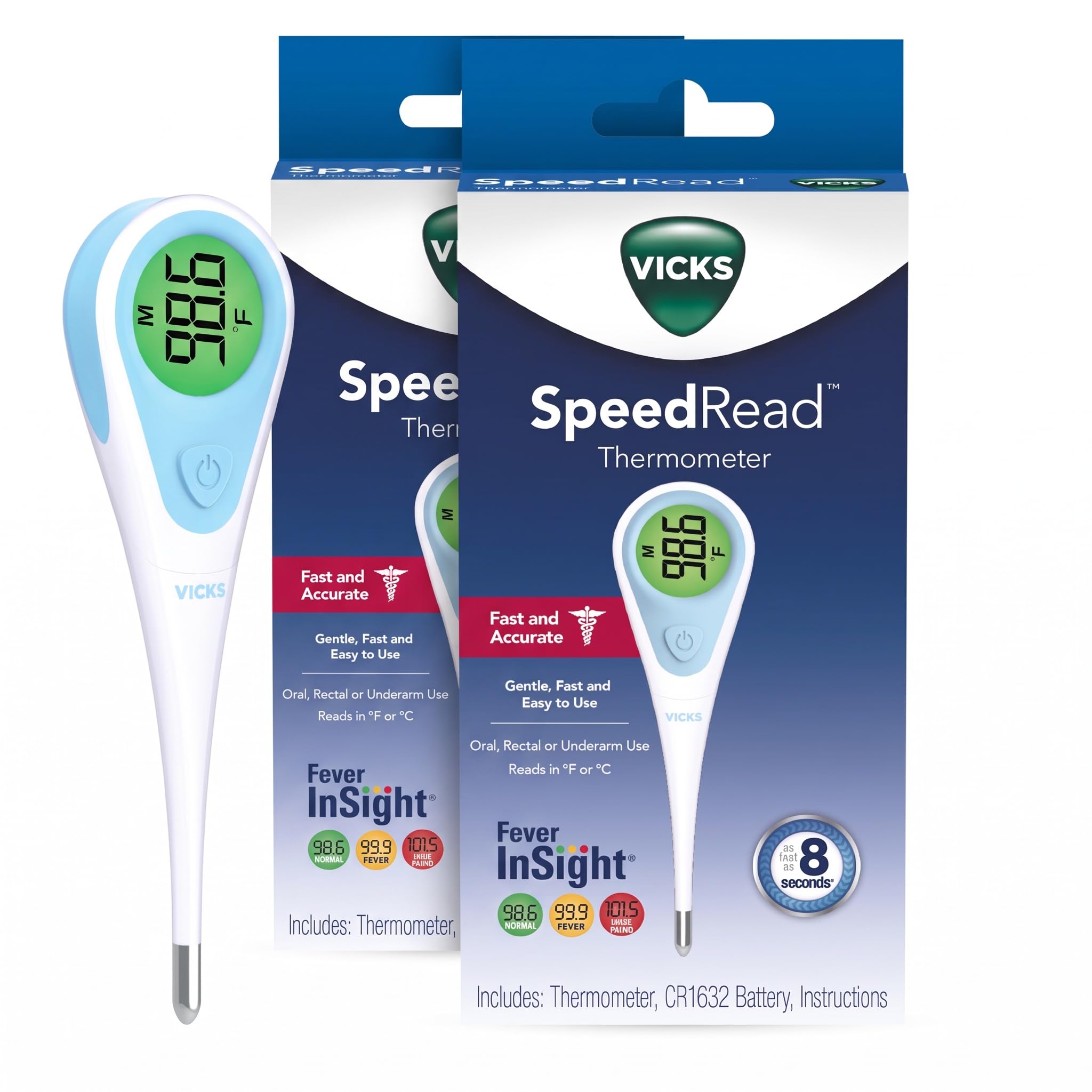
Vicks SpeedRead
Key Features
- Modes: Oral, rectal, underarm
- Pack size: 2 thermometers
- Reading time: 8 seconds
- Fever display: Color-coded
- Price: Premium
Two thermometers in one box is the whole argument. One lives in the nursery, one stays in the diaper bag, and you never have to remember which room you left it in — which, on the night a baby spikes a temperature at a grandmother’s house, is the difference between a reading and a drive home.
We expected the Fever InSight colors to be a gimmick and came away liking them. Green, yellow, and red tell you at a glance whether you are looking at normal, elevated, or a fever, without squinting at a small number in a dark room. The eight-second read is the fastest in this group, and the memory function means you are not repeating a reading because you forgot the number while settling the baby.
What takes the shine off is the power situation. These arrive with a battery that is often already flat, and a thermometer that will not switch on is worse than no thermometer at all, because you have stopped looking for the other one. Fit a fresh cell on day one. There is also no case or probe cover in the box, so give it a zip bag to live in.
Pros
- Two thermometers, so one can live in the bag
- Eight-second read, the fastest here
- Color-coded fever display for dark rooms
Cons
- Ships with a weak or dead battery
- No case or probe cover included
Two thermometers in one box, an eight-second read, and a color-coded display — the setup that survives being used in two rooms and one diaper bag.
Best for Fever Tracking
Kinsa QuickCare
Key Features
- App: Unlimited profiles
- Modes: Oral, rectal, underarm
- Reading time: Under 8 seconds
- Certification: FDA-cleared
- Price: Premium
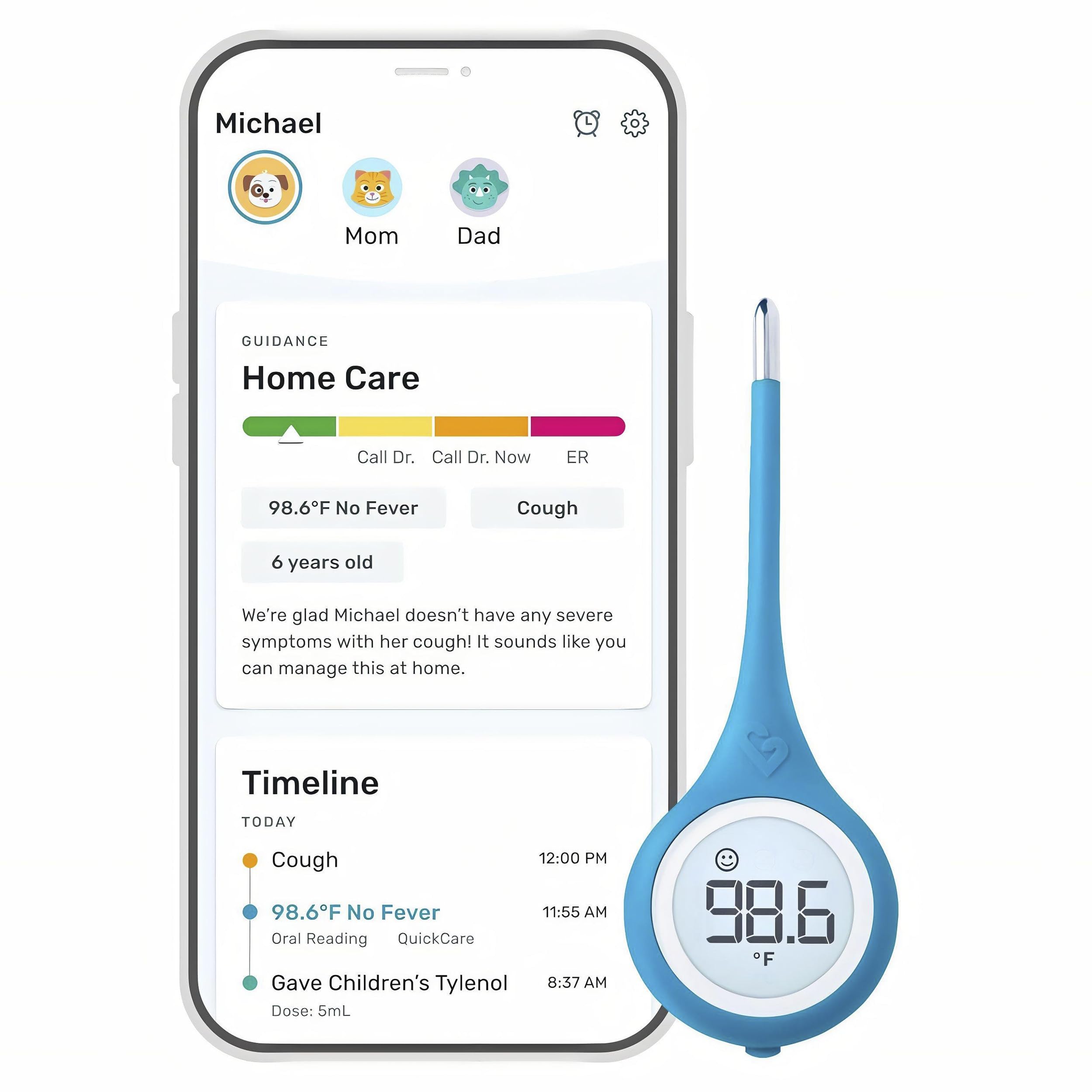
The reason to pay more for the Kinsa is not the reading — it is the record. A fever in a small baby is rarely one number; it is a night of them, plus what you gave and when you gave it. The free app logs each reading against a profile, so at the morning appointment you are handing over a timeline instead of reconstructing one from memory.
As a thermometer it holds up. The tip flexes rather than pushes, it reads in under eight seconds, and the display lights up with fever icons so a 3am glance does not need interpreting. It is FDA-cleared and works orally, under the arm, or rectally, and it takes a reading without the app if you do not want to pair a phone to your baby’s temperature.
Where we land: the app earns its keep when a fever is being watched over several days or shared between caregivers, and it is surplus to requirements for a single check in the night. Two cautions. The tracking lives behind an account and a Bluetooth pairing, and some units stop working after a while, which is a bad trait in a device you keep for years.
Pros
- Logs readings, symptoms, and doses per person
- Reads in under eight seconds
- Flexible tip and lighted fever display
Cons
- Fever tracking needs an app account
- Some units stop working after months
Worth the extra if a fever is being watched over days: it logs every reading so you can hand a doctor a timeline instead of a guess.
Best for Tight Budgets
Boncare GF-MT501
Key Features
- Tip: Soft silicone, waterproof
- Modes: Oral, rectal, underarm
- Weight: 0.37 oz
- Reading time: 10 seconds
- Price: Budget
Cheap thermometers usually ask you to give up something. Here, we struggled to name what. Soft silicone over a stainless probe, a ten-second read, a waterproof tip that wipes clean, and a case with a battery already fitted. At 10.5 grams and under five inches it disappears into a changing-table drawer instead of taking it over.
The trade-off is that this is a general-purpose stick rather than a rectal thermometer. It goes in a mouth, an armpit, or a rectum, and the depth comes from the manual rather than from a probe that is short by design. That is fine — it is how most parents have taken a temperature for decades — but if judging insertion depth is the part that makes you nervous, the Frida’s 1.5-inch probe is worth the difference.
One quirk to know about: the sensing tip cannot be handled before a reading. Touch it, or let it rest against something warm, and the number goes off, so you are holding the body of the thermometer while a baby squirms rather than steadying the tip. Ten seconds is short enough to manage, and the memory button means the number is still there when we look back.
Pros
- Soft silicone tip over a stainless probe
- Waterproof tip wipes clean in seconds
- Just 10.5 g with case and battery
Cons
- Sensing tip cannot be touched before a reading
The budget pick that gives up very little: a soft tip, a ten-second read, and a case, for a price that makes a second one painless.
Best for a Quick Spare
Safety 1st Rapid Read

Key Features
- Case: Included
- Modes: Oral, rectal, underarm
- Upper range: 104 °F
- Reading time: 8 seconds
- Price: Midrange
The weak point here is not the sensor, it is the cell it ships with. These arrive with a battery that is already nearly flat, and a thermometer down to its last bar the first time you switch it on is one you will distrust at 3am. Order a spare with it.
Otherwise it is a straightforward, quick stick. Eight seconds puts it level with the Vicks and close to the Kinsa, the tip flexes enough for a baby who is already unhappy, and the display is clear. It does oral, underarm, or rectal, and it comes with a storage case.
We treat this as the second thermometer rather than the only one. It is inexpensive enough to leave in a bag, and if the battery goes you have not lost your main device. Accuracy is where it sits mid-pack: good enough to follow a fever across an evening, less reassuring as the single number you act on for a newborn.
Pros
- Eight-second reading
- Flexible tip for a squirmy baby
- Storage case included
Cons
- Arrives with a nearly flat battery
A fast, flexible eight-second stick that works well as the second thermometer in the house — as long as you fit a fresh battery.
Best for Cheapest Backup
Berrcom DT-007

Key Features
- Case: Included
- Modes: Oral, rectal, underarm
- Resolution: 0.1 °C
- Reading time: 30 seconds
- Price: Budget
Thirty seconds is a long time. That is the specification that decides this one: the Berrcom wants about half a minute of stillness for a reading, and a baby on a changing table at 2am is not in the business of giving you half a minute. With a second pair of hands it is a perfectly good cheap thermometer. On your own, the eight-second models earn their extra cost.
A 5.5-inch stick weighing 12 grams, a waterproof tip that wipes clean, a memory for the last reading, and an automatic shut-off. It reads to 0.1°C, works orally, rectally, and under the arm, beeps when it is finished, and arrives with a case and a battery. What we minded was the clock; everything else about it does what the listing says.
So this is the cheapest way into a working rectal thermometer, and it does nothing badly. The reading time is why it sits at the end of our list rather than in the middle of it: on a calm baby it is fine, and on a crying one it is the longest half-minute of your night.
Pros
- Lowest price of the group
- 0.1 °C resolution with memory recall
- Waterproof tip and storage case
Cons
- Thirty seconds of stillness with a baby
The cheapest way in, and a decent one, if there is someone else in the room to help you hold a baby still for thirty seconds.
How We Tested Baby Rectal Thermometers
We started by researching the rectal thermometers pediatricians and parents mention most often, then filtered that list by size and shape, tip flexibility, display clarity, cover compatibility, memory features, battery type, and price. From there, we bought 14 models and used them for four months with a group of parent testers, following each manufacturer’s instructions and their own pediatrician’s guidance.
The testing happened where these thermometers actually live: on the changing table during diaper changes, in a dim nursery during nighttime fever checks, and in a diaper bag during travel and early-morning appointments. We timed how long each took from power-on to final beep and repeated the check to see whether back-to-back readings landed close together and matched a reference reading. We also noted whether the buttons were easy to work one-handed, whether the beep was loud enough to hear without waking the house, and whether the display was readable in low light.
Over four months, we inspected the tip, seams, button feel, and cover fit for quality; tested memory recall and Fahrenheit/Celsius switching for functionality; and logged low-battery warnings and battery changes for battery life. To judge value, we compared the price against included covers, storage case, backlight, and memory rather than just the sticker. The models that advanced were the ones that stayed reliable through repeated use—no false starts, no loose battery doors, no readings that wandered for no reason.
How to Choose a Baby Rectal Thermometer
The thermometer is the easy part; the hard part is holding a baby still, so buy for the second problem.
Probe length is the specification that matters most
Rectal thermometers for babies are short by design, and the point of the shortness is to take judgement out of the equation. The Frida’s probe is 1.5 inches: you follow the manual for depth and the probe itself limits the rest. A general-purpose stick like the Boncare or the Kinsa works rectally too, but nothing about its five-inch body tells you when to stop, so the manual carries all the weight. If insertion depth is the part that worries you, buy the dedicated shape and stop reading spec sheets.
Seconds matter more than they look on a listing
An eight-second read and a thirty-second read look like a rounding error online and feel entirely different with a baby on a changing table. Movement is what spoils a rectal reading, so the longer the probe has to stay put, the more likely you are to give up and start again. The Vicks, Kinsa, and Safety 1st finish in eight seconds or less, the Frida and Boncare in about ten, and the Berrcom asks for thirty. Two adults can make any of them work; one adult alone should buy the fastest they can justify.
One instrument with rules, or two with none
A thermometer used rectally should not go in a mouth afterwards. That is the argument for a dedicated unit like the Frida, and it is why a 3-in-1 needs a little discipline: wipe the probe with alcohol or soapy water before and after every use and treat the rectal job as its own. The 3-in-1s here — the Boncare, the Vicks, the Kinsa, the Safety 1st — are genuinely convenient for the rest of the family. The real decision is whether you want one instrument with rules or two instruments and no rules.
What actually helps at 2am
A lit display, a memory button, and a case. The display matters most: color coding or a backlit screen lets you read the number without switching on a lamp and waking the household, and the Kinsa’s fever icons do the interpreting for you. Memory recall means you are not holding a number in your head while settling a baby. The case is unglamorous, and it is the reason the probe is not loose in a drawer with the nail scissors. None of this shows up in a description of accuracy, and all of it decides whether you take a second reading.
Frequently Asked Questions
Is a rectal thermometer more accurate than a forehead thermometer for a baby?
For infants, a rectal reading is the reference standard, and it is the number pediatric practices act on. Forehead and ear thermometers are quicker but less dependable in babies, so treat them as a rough check between proper readings rather than the number you make a decision on.
If you own both, use the forehead one for a quick trend across the evening and confirm with the rectal reading before you call anyone.
What temperature counts as a fever in a baby?
A rectal reading of 100.4°F (38°C) or higher is a fever. Take it again to confirm before acting on it, and for a very young infant — under three months — call the pediatrician rather than waiting to see how the night goes. The thermometer tells you whether to make the call, not what is wrong.
Do these thermometers come with batteries, and will they work out of the box?
Most do, and several arrive with a cell that is already weak. Switch the thermometer on the day it arrives, confirm it completes a full cycle, and keep a spare of the right size — LR41, AAA, or a coin cell depending on the model — in the same drawer. It is a small habit that saves a search at the worst possible hour.
Is a smart thermometer worth it for a baby?
Only if you are tracking. The Kinsa’s app earns its keep when a fever is watched over several days, handed between caregivers, or described to a doctor who wants times and doses rather than impressions. For a single middle-of-the-night check, a plain thermometer with a lit display does the same job with less setup.
Final Verdict
Our recommendation for most parents is the Frida Quick-Read. It is the only pick here designed for rectal use and nothing else, and the short probe takes the guesswork out of the part that worries people most. Wait for the thirty-second reading rather than writing down the ten-second one.
Two requirements move the decision. If you want the fastest read in this group and a second thermometer for the diaper bag, the Vicks SpeedRead two-pack covers both. If a fever is being followed across days and handed to a doctor, the Kinsa’s log is worth paying for.
