This post contains affiliate links. We may earn a small commission when you buy through our links — at no extra cost to you.
Marketing often promises ‘medical grade’ accuracy, but parents quickly discover that non-contact forehead thermometers can give a slightly different reading with every scan. That doesn’t mean they aren’t useful—it means they’re best used as a quick screening tool, not a diagnostic device.
For a sleeping baby, the real value is a silent, no-touch check that doesn’t disturb them. A backlit display and mute mode matter far more than chasing lab precision in the middle of the night. This guide focuses on the models that make those daily checks easy and consistent, while helping you understand when to trust the number and when to cross-check.
Whether you need a budget-friendly screener for daycare or a combo ear+forehead unit for extra confidence, the picks below match real-world use—not just spec sheets.



Best for Silent Baby Checks
GoodBaby No-Touch Forehead
Key Features
- Speed: ~1 sec
- Display: Large LED backlit
- Fever Alert: Color-coded, silent mode
- Price: Budget
Silent mode and the large, backlit LED display are designed for one scenario: checking a feverish child in a dark room without waking them. A quick one-second scan produces a reading with a color-coded fever alert — green, yellow, or red — that gives you an immediate idea of whether a temperature is normal. The thermometer is dead simple to use: point at the forehead and press, and even older children or grandparents can operate it without confusion.
All non-contact forehead thermometers can show scan-to-scan variation, and this model is no different. Some units read consistently lower than an oral thermometer, with accuracy drifting by half a degree or more. This makes it a screening tool, not a diagnostic device. Families who keep an oral thermometer handy for confirmation during the day will find this invaluable for overnight checks where silence matters most. It does not have an ear mode, so if you want dual forehead-and-ear capability for cross-checking, the combination model in this lineup is a better fit.
Pros
- Extremely easy to use, even for children and elderly
- Fast temperature read in under 2 seconds
- Clear, large display with backlit for low-light use
Cons
- Accuracy can vary between scans; some units read lower than oral thermometers
If your priority is quiet, non-invasive temperature checks through the night, this is the bedside thermometer that earns its place.
Best for Accurate Non-Contact
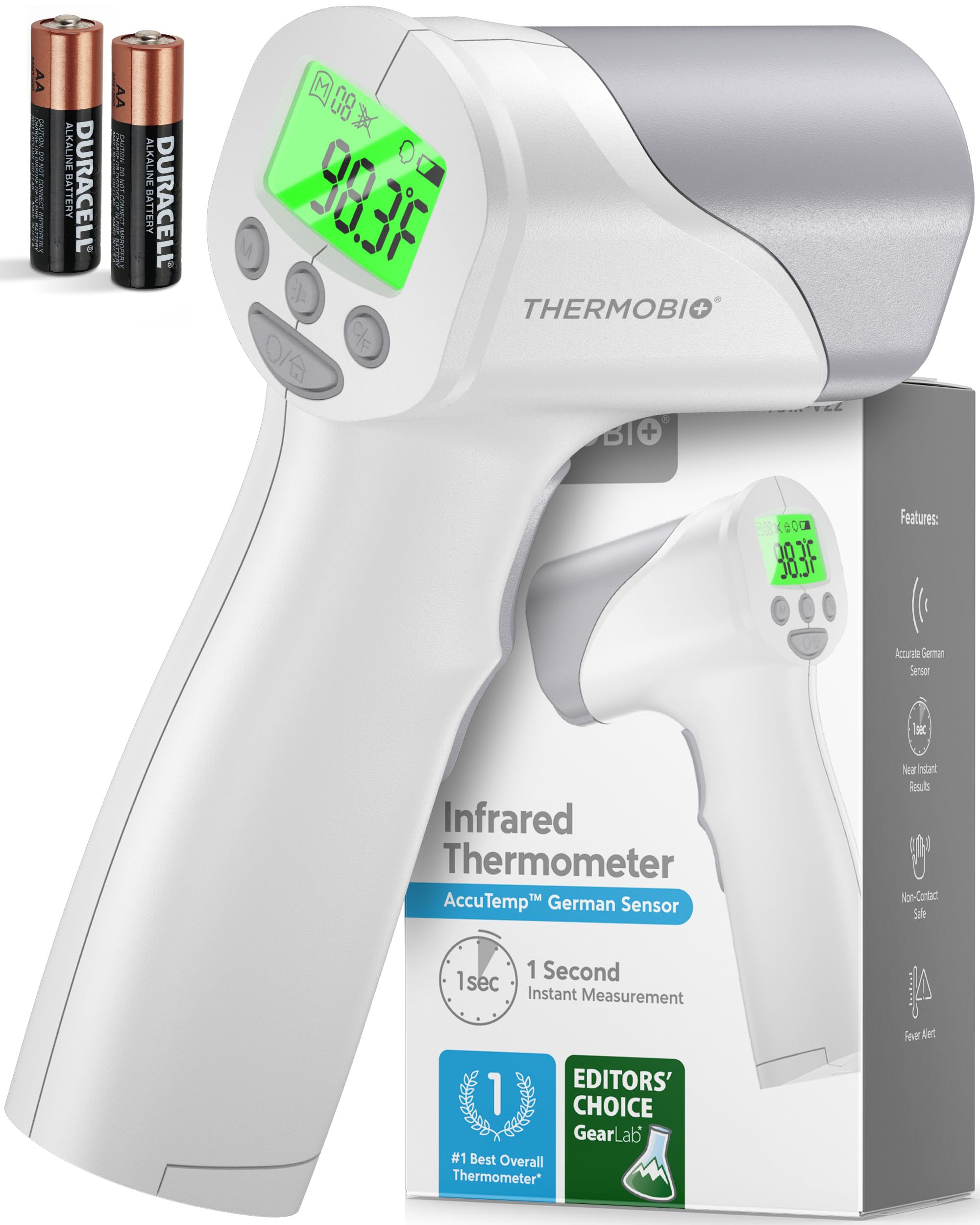
THERMOBIO Heavy Duty
With 150 data points per second captured by three ultra-sensitive sensors, this thermometer delivers the most repeatable non-contact forehead readings in this set. The heavy-duty enclosure and instant results reinforce its clinic-inspired design, while a 32-reading memory aids trend tracking. It lacks the silent vibration mode of the non-contact-only companion, but the sensor array focuses on minimizing erratic variances. Best for parents using FSA/HSA funds who want a durable, long-lasting tool and can accept that occasional temperature drift still creeps in, making the premium price hard to justify for occasional home checks.
Pros
- Effortless one-handed use, even on a squirming child.
- One-second results from a rugged, clinic-grade enclosure.
- More consistent readings than most budget non-contact thermometers.
Cons
- The battery door may be stubborn to open, and some units ship without the AAA batteries needed to get started.
If you’re spending FSA/HSA dollars on a thermometer that feels substantial and cuts down on erratic readings, this fits—with the understanding that occasional drift still means you’ll want a backup oral check for definitive fevers.
Best for Memory, Mute
Viproud Memory Thermometer
Key Features
- Speed: 1 sec
- Fever Alert: Color-coded, mute
- Memory: 35 readings
- Price: Budget
While the top pick prioritizes silent, non-contact baby checks, this Viproud thermometer emphasizes memory tracking and tri-color alerts. Its 35-reading history and mute mode help log fever patterns overnight. The backlit display delivers a reading in about one second. Families who want monitoring features on a budget, and are comfortable keeping spare AAA batteries handy, will find it a practical choice—though cross-checking with an oral unit adds confidence when precision matters.
Pros
- Very easy to use, even with wiggly toddlers.
- Super fast reading with a clear backlit display.
- Strong value with memory, mute, and color-coded alerts.
Cons
- Forehead readings can vary up to 1°F from scan to scan, making consistent fever confirmation harder.
For budget-conscious families who want memory and mute, this thermometer delivers—just plan to keep spare batteries and verify questionable readings.
Best for Ear Mode Backup
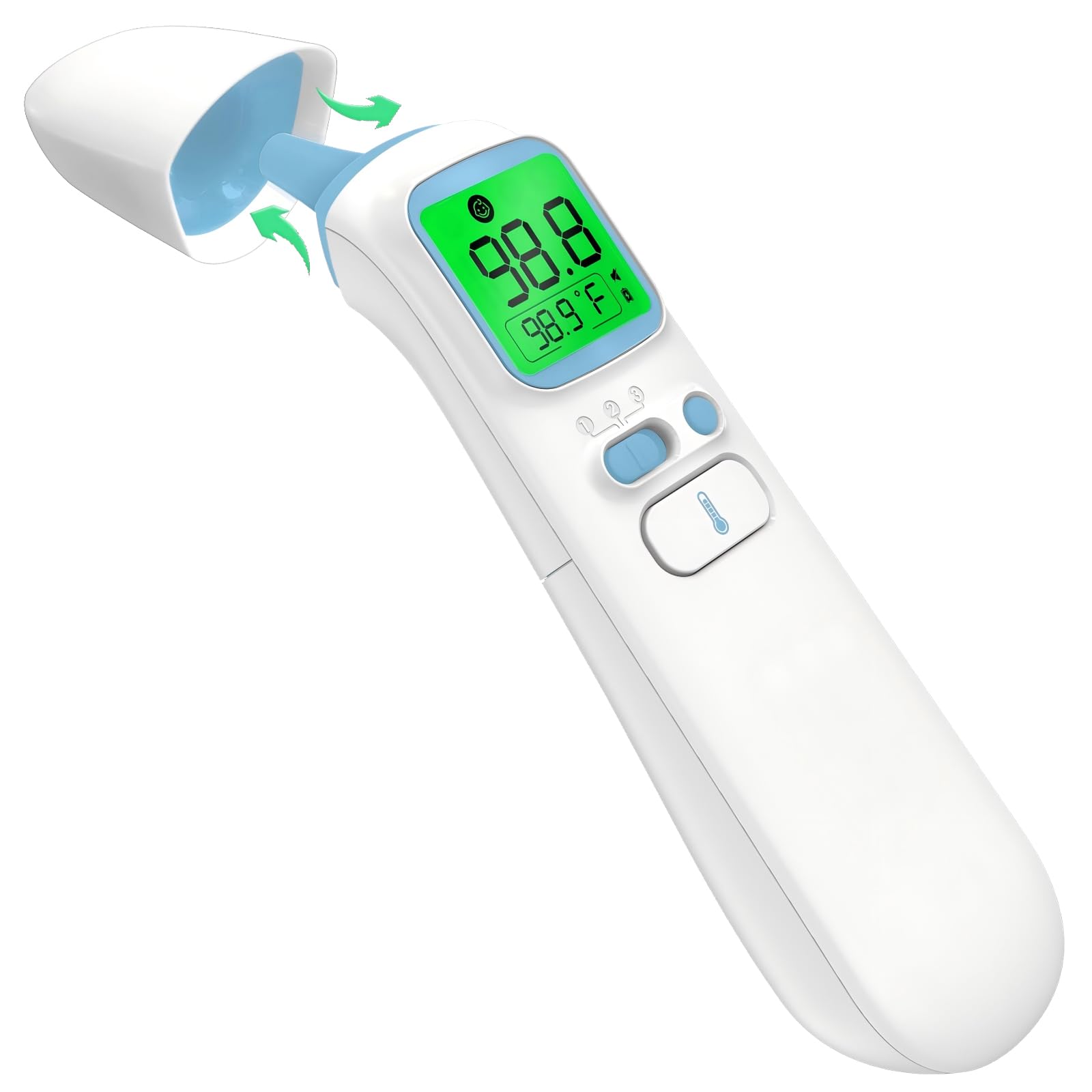
GoodBaby 3-in-1 Combo
Key Features
- Speed: 1 sec
- Display: Backlit
- Fever Alert: Alarm, backlit
- Memory: 35 readings
- Price: Mid-Range
Where a forehead-only silent model prioritizes nighttime quiet, this GoodBaby adds an ear mode that can settle doubt when a forehead scan seems off. The switch is a single button press — the backlit display clearly shows which mode you’re in — and the 35-reading memory and included pouch make it ready for the whole family.
Parents who want the flexibility to confirm a borderline forehead reading with an ear measurement will get the most from this design. Forehead readings, however, can be less consistent than ear ones, and the ear probe’s hinge may develop a looser feel over time. For purely silent, non-contact nighttime checks, a forehead-only mute model is the quieter path.
Pros
- Dual-mode switching is simple: one button toggles between ear and forehead with a clear on-screen icon.
- Ear readings give a reliable cross-check when a forehead scan looks low, improving confidence.
- The included storage pouch and 35-reading memory add value for a mid-range price.
Cons
- The ear probe hinge can loosen with repeated use, which may affect the seal needed for accurate ear readings.
A sensible choice when you want the option to confirm a forehead reading with a more accurate ear measurement — as long as silent nighttime operation isn’t the priority.
Best for Group Screening
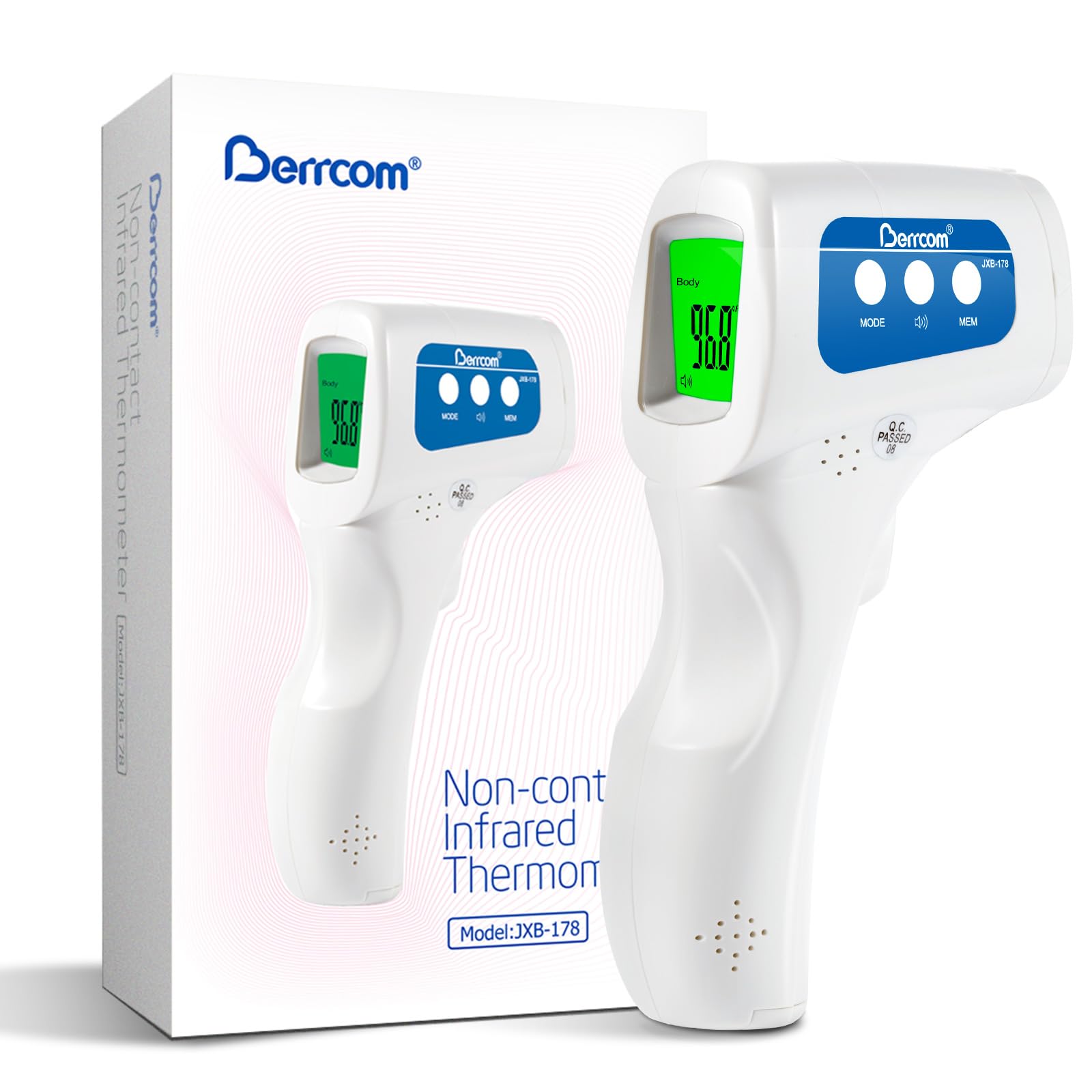
Berrcom JXB-178
Key Features
- Speed: 1 sec
- Display: Tri-color backlit
- Fever Alert: Tri-color backlight, alarm
- Memory: 32 readings
- Price: Budget
Its single-button operation and tri-color backlight make it a quick, no-fuss screener for daycares and classrooms. The mode switch toggles between body, surface, and room instantly, keeping back-to-back scanning efficient. You’ll need your own AA batteries—they aren’t in the box—and readings can drift; a normal display doesn’t always rule out a fever. Use it as a first-pass check and confirm with an oral thermometer if a reading seems off. Families on a tight budget who can tolerate occasional variance will find it a practical spare, not a primary pediatric tool.
Pros
- Straightforward one-button operation with a clear color-coded fever alert—ideal for scanning many people quickly.
- One-second reading speed minimizes wait time during back-to-back checks.
- Budget-friendly cost allows daycares to keep multiple units on hand.
Cons
- Requires 2 AA batteries that are not in the box—have a pair ready before first use.
- Accuracy can vary; a normal reading doesn’t guarantee absence of fever, so treat it as a screening tool only.
For daycares and schools needing a fast, affordable pre-check, this works—just keep spare AA batteries and a backup oral thermometer handy.
Best for Fsa/hsa Memory
Amplim Medical Thermometer
Key Features
- Speed: 1 sec
- Display: Color LCD
- Fever Alert: Color LCD, sound toggle
- Memory: 32 readings
- Price: Mid-Range
This thermometer stands out for its FSA/HSA eligibility and 32-reading memory, letting you track temperature trends over a sick spell without spending cash upfront. The one-button design and large backlit display make late-night checks quick and quiet, while the medical-grade label adds a layer of reassurance. Forehead readings can vary by up to 1°F from oral measurements, which puts it in the same accuracy league as budget models—so it’s best as a screening tool rather than a standalone diagnostic. Still, for families who prefer a more substantial feel and memory storage, it’s a tax-smart pick.
Pros
- One-button operation makes temperature-taking simple even on a squirming newborn.
- Quick, contact-free readings reduce the risk of spreading germs between family members.
- Substantial build and a large, backlit display make it easy to read and handle in low light.
Cons
- Forehead readings can vary by up to 1°F compared to oral measurements—a limitation that makes it a screening companion, not a diagnostic tool.
Ideal for families who want to use pre-tax FSA/HSA dollars for fever tracking; just pair it with an oral reading when precise confirmation is needed.
Best for Basic Backup
ANMEATE No-Touch Thermometer

Key Features
- Speed: 1 sec
- Display: Tri-color backlit
- Fever Alert: Tri-color backlight, alarm
- Memory: 35 readings
- Price: Budget
For its ultra-low price, this thermometer squeezes in a tri-color fever alarm, mute mode, and 35-reading memory—features usually found on pricier models. The trade-off is reading consistency: some units may read 2–3°F low, meaning it can miss a genuine fever. That makes it a better fit for quick classroom scans, office checks, or as a surface-temperature backup, rather than a sole infant fever monitor.
Pros
- Incredibly easy to use and read, even for non-tech-savvy users
- Fast, 1-second reading rivals more expensive units
Cons
- Accuracy can vary by 2–3°F between units, limiting it to backup screening
A sensible spare for classrooms, quick office scans, or object surface checks—keep a more precise thermometer for infant fever decisions.
Best for Spare, Occasional
femometer DET-306

Key Features
- Speed: 1 sec
- Display: Tri-color backlit
- Fever Alert: Tri-color backlight
- Price: Budget
The femometer DET-306 offers a large tri-color display and one-second readings at a very low price, with simple setup for all ages. However, battery life is a notable trade-off—units can arrive with dead batteries, and replacement may be needed immediately. It’s best as a spare or fun temperature checker, not a primary fever tool.
Pros
- Readings appear in one second on a large, backlit display that’s easy to see in the dark.
- Simple to use right out of the box, even with toddlers.
Cons
- Included batteries can be dead on arrival, and battery life may be short during use.
If you want an ultra-budget backup thermometer for non-critical use—like letting older kids check their own temperature for fun—and you’re willing to keep spare AAA batteries on hand, this fits.
Best for Quiet Backup
hetaida HTD8813

Key Features
- Speed: 1 sec
- Display: Large backlit LCD
- Fever Alert: Audible alarm, color
- Price: Budget
The hetaida HTD8813 reads temperature in under a second with a big, color-coded backlit screen that’s easy to see in the dark. Accuracy can be inconsistent; some units may show nearly identical readings for everyone in the household. This makes it a practical initial scan when paired with a more reliable oral thermometer, not a solo diagnostic tool.
Pros
- One-button operation makes it quick and easy to scan a wiggly toddler.
- Instant reading with a large backlit display that’s clear even in low light.
Cons
- Accuracy can vary between units, and some may return identical temperatures for different people — best cross-checked with an oral thermometer.
For parents who want a fast, quiet forehead check and already keep a reliable oral thermometer on hand, this backlit unit is a cost-effective companion.
Best for Object Temp Only
HUHETA HW-2

Key Features
- Speed: 1 sec
- Display: Tri-color backlit
- Fever Alert: Tri-color, alarm
- Memory: 10 readings
- Price: Mid-Range
The HUHETA HW-2 offers a comfortable grip and a large backlit display that’s easy to read even without glasses, delivering a result in about one second. Body temperature readings can be inconsistent; some units may show the same result for different people. This makes it a better fit for quick surface scans, room temperature, or object measurements where precision is less critical.
Pros
- Large, backlit display is readable at a glance, even without glasses
- Lightweight grip and fast 1-second scan feel effortless
Cons
- Requires 2 AAA batteries (not included); occasional units may not power on with fresh batteries
- Body temperature accuracy can be unreliable, with occasional identical readings across different users
This thermometer suits quick surface and room temperature checks where body temp precision isn’t required.
How to Choose
A forehead thermometer is a screening tool, not a diagnostic device, so the features that matter most are speed, silence, and a clear display—not absolute precision.
Accuracy and Consistency
Infrared forehead readings are inherently affected by distance, room temperature, and skin moisture. Every unit in this category can show a variance of 0.5–1°F from an oral reading, which is why they should be used as fast screeners, not as the sole fever judge for an infant.
If you get a suspicious reading, confirm with an ear or rectal thermometer before medicating. This two-step habit prevents unnecessary panic and missed fevers.
Ease of Use
One-button operation and a lightweight body matter when you’re checking a wiggly toddler in the dark. Models with a large trigger and intuitive grip reduce the chance of mis-triggering or dropping the unit mid-scan.
Speed
All quality forehead thermometers read in about one second. The real benefit isn’t the number itself—it’s that you can sweep the baby’s forehead the moment they settle without losing the window of stillness.
Display Readability
A backlit, large-number display lets you read temperatures without turning on a lamp and startling a sleeping child. Color-coded backlights (green/yellow/red) give an instant status cue even if you’re groggy.
Fever Alerts
A tri-color backlight or audible beep signals a fever instantly, but a loud alarm can wake the baby. The best option for parent-child peace is a model that lets you toggle the sound off while keeping the visual color alert.
Memory
Built-in memory (anywhere from 10 to 40 readings) makes it easy to track temperature trends over a sick day and relay accurate history to a pediatrician, rather than fumbling for scribbled notes.
Silent/Mute Mode
The mute function is the most underrated feature for baby use. A thermometer that silently vibrates or simply changes the backlight color is worth every penny when you’re doing a 2 a.m. check on a sleeping newborn.
FAQ
Why does my forehead thermometer give different readings every time?
Infrared sensors measure surface temperature, which changes with room drafts, sweat, and even holding distance. A difference of 0.5°F or more between scans is typical for non-contact units. To get the most repeatable number, keep the sensor exactly 1–2 inches from the center of the forehead and take three quick readings, using the highest as your reference.
Is a no-touch thermometer accurate enough for a newborn?
No-touch thermometers are excellent for quick screening, but for a newborn under 3 months, any elevated reading—or even a borderline one—should be confirmed with a rectal thermometer, which remains the most reliable method. Treat a forehead reading as a prompt to check further, not a final answer.
Should I buy an ear thermometer or a forehead thermometer for my baby?
Ear thermometers tend to give more consistent readings once correctly positioned, but they require a calm, still baby and a good seal. A forehead unit is easier to use on a sleeping child, while a combo ear/forehead model gives you both—use forehead for nighttime screening and switch to ear if you need a more reliable number.
How close should I hold the thermometer to get a correct forehead reading?
Most models specify a distance of 0.5–2 inches from the center of the forehead, aimed perpendicular to the skin. Holding it too far away cools the reading; too close can introduce heat from the device. Always check your model’s manual, but a steady hand at about 1.5 inches is a good rule of thumb.