This post contains affiliate links. We may earn a small commission when you buy through our links — at no extra cost to you.
No-touch forehead thermometers promise a quick, silent read that won’t disturb a sleeping baby. Yet many parents discover that marketing claims of “clinical accuracy” don’t hold up against a restless child and a dim nursery. The truth is simpler: these devices are phenomenal screening tools, not diagnostic instruments.
This guide focuses on thermometers that deliver the speed, quiet operation, and intuitive displays you need for middle-of-the-night checks. We’ve sorted through the models to find those that perform reliably as a first-line screening method, with features like silent vibration, large backlit numbers, and instant one-second reads.
Knowing when to trust the reading — and when to verify with a contact ear or rectal thermometer — is the real secret to using a no-touch device well. Our picks emphasize ease of use and consistent, reasonable performance over unrealistic accuracy claims, so you can make calm decisions at 2 a.m. without second-guessing.



Best for Family Tracking
GoodBaby FC-IR2000
Key Features
- Response Time: 1 sec
- Fever Alarm: 3-color backlight
- Memory: 35 readings
- Price: Mid-Range
One-second readings on a large, backlit LED display make this thermometer simple to use even when a child is squirming. With 35-reading memory and a three-color fever alarm that shows green, yellow, or red at a glance, it supports tracking multiple family members without needing to write anything down. The object mode also works for checking bottle or bath water temperature, adding everyday utility beyond fever checks.
Like all forehead thermometers, this one measures skin temperature rather than core body temperature. Readings can occasionally appear lower than what an oral or rectal thermometer would show, so it is best treated as a screening tool rather than a diagnostic device. For families who need a quick indication of whether a fever is present, the speed and color alert provide useful guidance.
This thermometer suits households that want a fast, non-intrusive way to check multiple people throughout an illness, especially when wrestling a sick child for a conventional thermometer is not an option. Buyers who require lab-grade accuracy for clinical decisions should verify with a medical-grade device, but for day-to-day fever monitoring the GoodBaby delivers the convenience and feedback most parents need.
Pros
- Extremely easy to use, even with wiggly children
- Lightning‑fast 1‑second readings
- Clear, large LED display with easy‑to‑read numbers
- Good build quality and reliable performance out of the box
Cons
- When compared to oral or rectal measurements, forehead readings can run lower — acceptable for screening but not for diagnostic certainty
For families who value quick, color-coded fever checks and a memory that tracks multiple people, the GoodBaby FC-IR2000 is a well-matched screening tool that prioritizes speed and convenience over diagnostic precision.
Best for Silent Nights
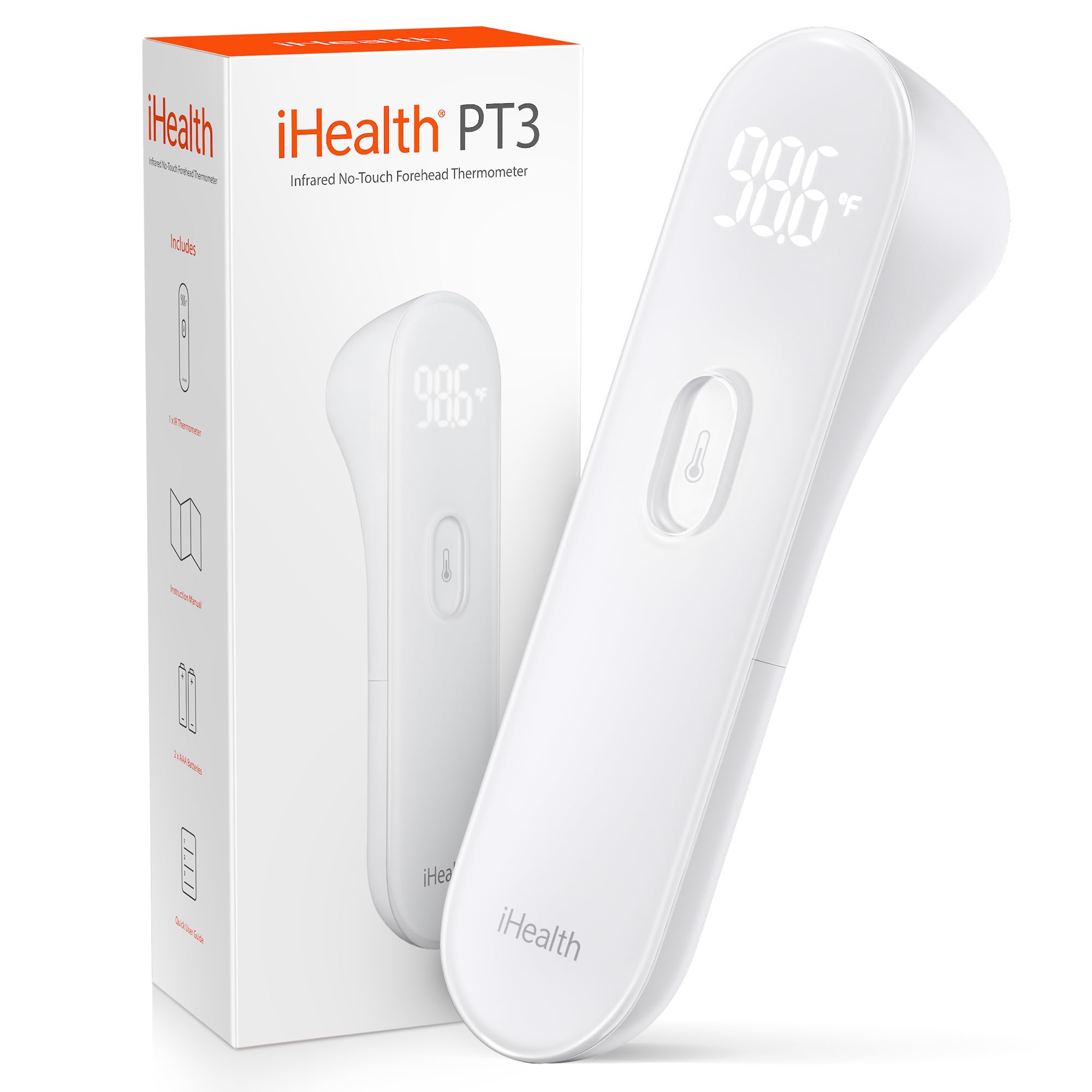
iHealth PT3
The iHealth PT3 swaps the standard beep for a gentle vibration, so you can take a temperature on a sleeping child without a sound. A single button triggers the 1-second scan, and the results appear on a giant LED screen that’s easy to read even with the lights off. Where other no-contact options add an ear probe for backup readings, this one commits to pure silence, relying on three ultra-sensitive sensors for its forehead measurement.
Parents who need a mute-mode fever check will appreciate the thoughtful design, but they should understand the reading’s role. Forehead infrared is a screening method, and this unit can show a result that’s 2–3°F lower than an oral thermometer in some instances. Treat it as a quick first pass — confirm any elevation with a contact thermometer. For a more definitive number, the dual-mode ear-and-forehead option in this set provides that backup.
Pros
- Single-button operation and 1-second response make taking a temperature nearly effortless.
- Extra-large LED display remains clearly visible in a dark room.
Cons
- Occasional units may stop displaying readings or fail to power on.
Use the iHealth PT3 for no-touch overnight checks when silence matters, and confirm any elevated result with a contact thermometer — then the vibration-only alert and huge display become genuine advantages.
Best for Dual-Mode Backup
iProvèn DMT-77
Key Features
- Response Time: 1 sec
- Fever Alarm: Vibration + hypothermia
- Price: Mid-Range
This thermometer pairs a contact-free forehead sensor with an ear thermometer that delivers core-temperature readings. The large backlit display and silent vibration make nighttime checks simple without waking a sleeping child.
Best suited for parents who want the speed of a no-touch scan but need the reliability of an ear reading when forehead results seem low. Forehead mode alone can read lower than actual body temperature — ear mode is more accurate but requires probe covers and brief contact.
Pros
- One-button operation takes the guesswork out of temperature checks.
- Feels sturdy and well-constructed in the hand.
- Readings appear on the display in about one second.
Cons
- Forehead mode alone can read lower than core temperature, limiting its reliability as a standalone screening tool.
- Ear mode requires probe covers and direct contact, reducing the convenience of a no-touch device.
For households that occasionally need the backup precision of an ear thermometer, this dual-mode device is a practical compromise — lean on the ear mode for confirmation whenever forehead readings seem off.
Best for Budget Portable
ANMEATE FC-IR202
Key Features
- Response Time: 1 sec
- Fever Alarm: 3-color backlight
- Memory: 35 readings
- Price: Budget
The ANMEATE FC-IR202 carves out its niche by being the most travel-ready and affordable no-touch thermometer among the top contenders. Where other options add silent alerts or dual-mode scanning, this model sticks to the essentials: a one-second reading, 35-reading memory, and a color-coded backlight that changes from green to yellow to red with fever. The compact body and included carry bag mean it slips into a purse or carry-on without a second thought.
Budget-conscious families and frequent travelers will appreciate the speed and convenience for quick screening. The temperature display is large and easy to interpret, making it usable for checking children or elderly relatives. Accuracy may read 2-3°F lower than an oral thermometer, particularly if the measurement distance isn’t held steady. This is a normal tradeoff at this price point and matches the category-wide limitation of measuring skin temperature rather than core body temperature. For fever management, pair it with a contact thermometer to confirm any concerning readings.
Pros
- Extremely easy to use and read, with a clear backlit display.
- Readings appear in just one second, reducing wait time for fidgety children.
- Compact design and included travel bag make it highly portable for daily bag carry.
Cons
- Accuracy can vary; readings may be 2-3°F lower than oral thermometers if measurement distance shifts.
If you need an affordable no-touch thermometer that can live in your bag or suitcase and give a rapid screening read, this ANMEATE model fits the bill — just keep an oral thermometer handy for confirmation.
Best for Simplicity & Value
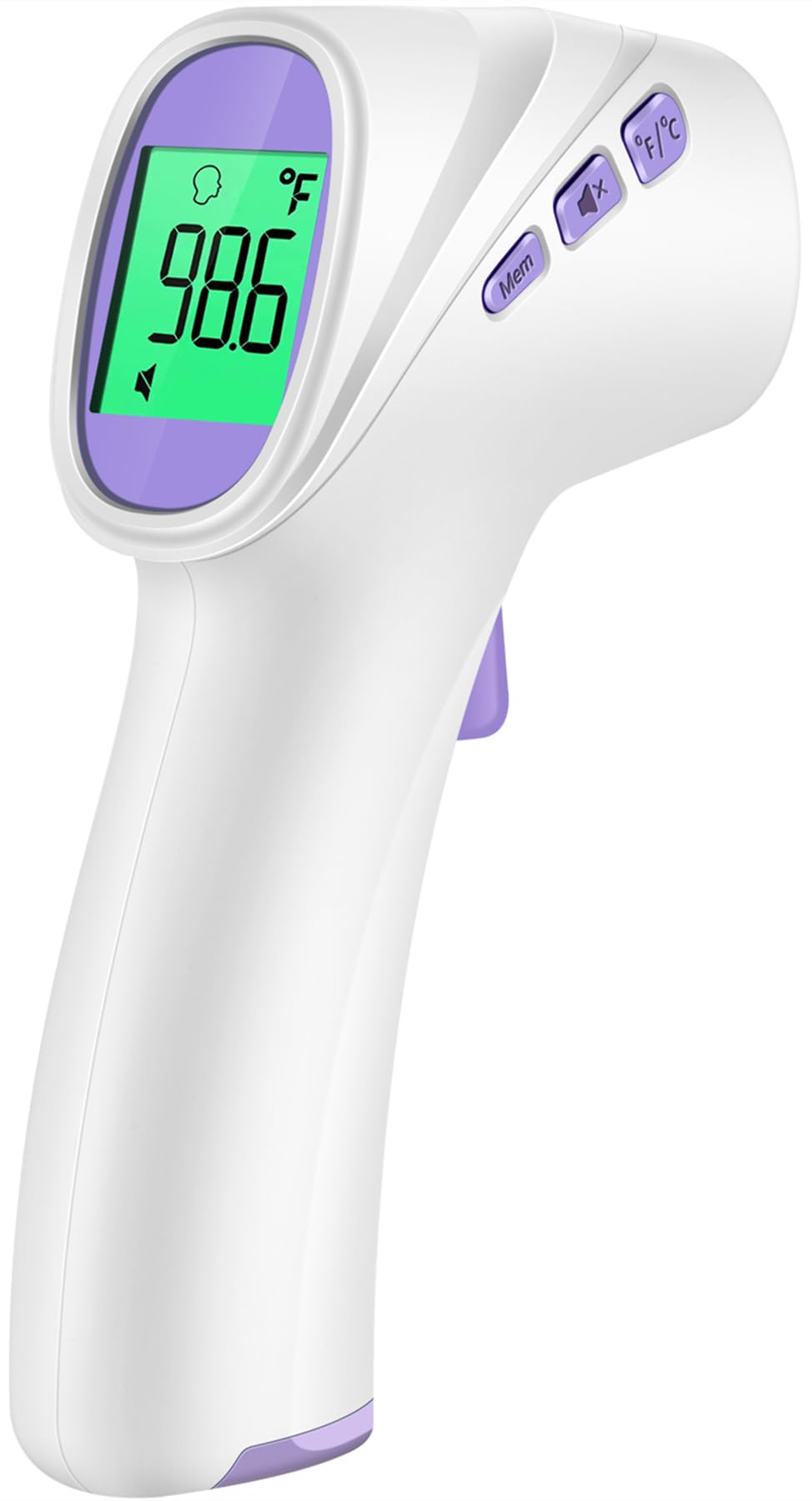
Viproud FC-IR2000 Purple
Key Features
- Response Time: 1 sec
- Fever Alarm: 3-color backlight
- Memory: 35 readings
- Price: Mid-Range
The Viproud FC-IR2000 Purple delivers a 35-reading memory, mute mode, and three-color fever alerts in a compact, purple-accented body. Unlike simpler models that strip out tracking tools, this version retains enough memory for a family and lets you switch to a silent display for sleeping children.
Parents who want a straightforward, no-touch forehead thermometer for daily screening will appreciate the immediate clarity — the display glows green, yellow, or red, and readings come in one second. Setup is minimal — included batteries and a simple button layout get you taking temperatures within seconds of opening the box. The mute mode is especially useful for nighttime checks, and storing up to 35 readings helps spot fever trends without a notebook. Since this is a newer entrant, its long-term durability after daily drops and drawer storage hasn’t been proven over the years like category mainstays. If you’re comfortable with that tradeoff, it’s a solid match.
Pros
- Extremely easy to set up and use — just aim, press, and read.
- Delivers consistent, as-advertised readings right out of the box without calibration.
- 35-reading memory tracks trends, and mute mode keeps nighttime checks silent.
Cons
An instinctive, quick, and quiet thermometer that handles nighttime checks and daily screening without fuss — a strong choice if you prioritize immediate simplicity over a lengthy track record.
Best for Family Tracking
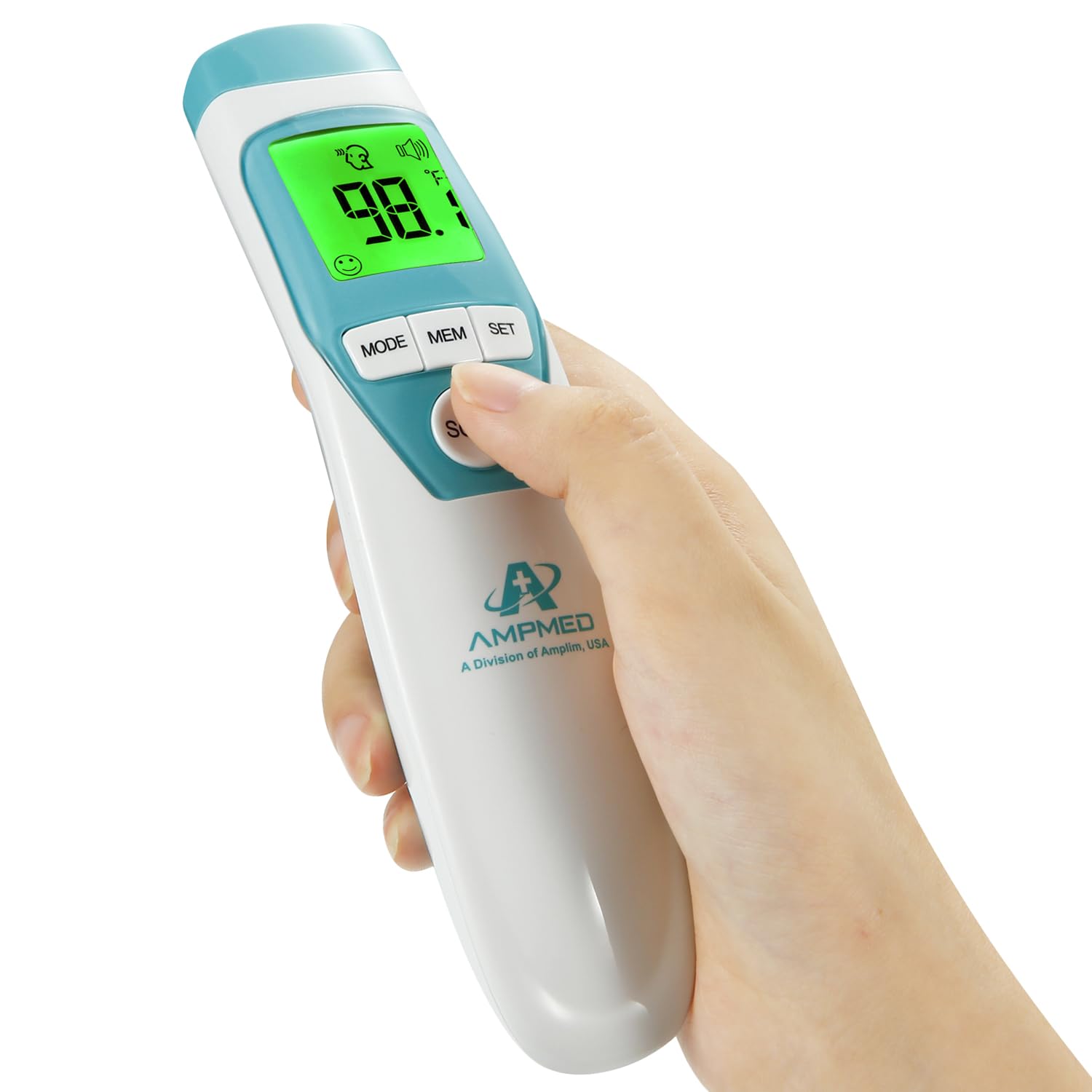
Amplim AmpMed
Key Features
- Response Time: 1 sec
- Fever Alarm: Audible + visual
- Memory: 60 readings
- Price: Mid-Range
Where many forehead thermometers cap memory at 35 readings, the AmpMed doubles that to 60, paired with a giant color LCD that turns red when a fever is detected. The one-second response and one-button operation make it feel effortless, even with a restless child.
This model suits larger households wanting to log temperatures for multiple people, as the 60-reading bank lets you monitor trends without deleting entries. However, its accuracy can vary — some units may read two degrees or more away from an oral thermometer — so it’s best treated as a screening tool rather than a diagnostic device.
Pros
- Fast one-second readings make checking a squirming child quick and fuss-free.
- Large backlit LCD with color-coded fever indication is easy to interpret at a glance.
- Straightforward to use across all ages, with simple one-button operation.
Cons
Households needing to track temperatures for several people will appreciate the 60-reading memory and oversized display, while those who only need occasional spot-checks can skip the extra capacity.
Best for Simple No-Frills
GoodBaby No-Touch Thermometer

The GoodBaby thermometer reads in one second and includes a silent mode that’s practical for nighttime checks. Object mode broadens its utility to surface temperatures. Its design stops at basic features: no memory storage, no color-coded fever indicators, and minimal documentation. This leaves it as a screening-only device without the trend-tracking capabilities of more fully featured models. Sparse performance data also adds uncertainty about measurement consistency.
Pros
- One-second non-contact reading reduces fuss, especially with squirmy kids.
- Silent mode gives a fever alert visually instead of audibly, preserving sleep.
Cons
- Readings measure skin surface temperature, not core, so variations from oral thermometers are possible.
- Minimal specifications leave limited guidance for interpreting inconsistent results.
If you want a straightforward, one-second reading and a silent mode without extras like memory or color alerts, this thermometer handles basic fever screening, though it won’t replace an oral thermometer for precise tracking.
Best for Budget Alternative
femometer DET-306

Key Features
- Response Time: 1 sec
- Fever Alarm: 3-color backlight
- Price: Budget
The femometer DET-306 gives a fast, no-touch temperature check for a budget-friendly price. Setup is simple and the large display is easy to scan. Readings can drift a couple of degrees from oral readings, and the battery may need replacing sooner than expected. That makes it a practical backup or screening tool for families who accept those trade-offs.
Pros
- Extremely easy to use and set up
- Super-fast 1-second readings
Cons
- Battery may drain quickly, requiring early replacement
- Readings can be off by several degrees compared to oral thermometers
For an extra, low-cost thermometer used as a quick screening tool, its speed and ease justify the occasional inaccurate reading and battery swap.
Best for Quick Screenings
hetaida HTD8813

The HTD8813 is simple to use: point at the forehead, press a button, and the large color display lights up with a reading in under a second. This makes it practical for a wiggly child or a busy office queue. However, the battery can run down faster than expected, and some units ship with little charge. Temperature accuracy may also vary, sometimes reading lower than an oral thermometer. For casual screening where you can keep spare batteries and don’t need lab precision, it’s a functional choice.
Pros
- Effortless one-button use, even with fidgety toddlers.
- Readings appear in under a second, minimizing check-time struggle.
Cons
- Battery may drain quickly and some units arrive with depleted batteries.
- Readings can skew below core temperature, reducing fever-detection dependability.
If a short-term screening tool for a classroom or workplace is the goal—and you don’t mind keeping spare batteries and verifying with another thermometer when a fever is suspected—the HTD8813’s bright display and fast operation are practical for the price.
Best for Casual Use
HUHETA HW-2

Key Features
- Response Time: 1 sec
- Fever Alarm: 3-color backlight
- Memory: 10 readings
- Price: Mid-Range
The HUHETA HW-2 delivers readings in about one second on a large, colorful backlit display that changes color to indicate fever. Its body and object modes allow checking both forehead temperature and surface temperatures like a baby bottle. However, accuracy can vary notably — readings may not align with oral thermometers, and battery issues such as dead-on-arrival units or quick drain have been reported. This makes it better suited for casual, occasional checks where a quick indication is sufficient, rather than for reliable fever monitoring in medical contexts.
Pros
- One-button operation delivers a temperature reading in about one second.
- Large, bright display with three-color backlight changes color to indicate fever level.
Cons
- Accuracy can vary notably, making it unsuitable for critical fever monitoring or medical decisions.
- Battery issues have been noted — some units arrive with dead batteries or drain power quickly.
A suitable pick for quick, non-critical temperature checks where convenience matters more than precision — but not for medical decision-making.
Best for Stylish Design
Amplim 2001W1

The Ampler 2001W1 delivers a sleek remote-control aesthetic, one-button simplicity, and a 32-reading memory with FDA/CE certification — all in a package that looks more like a gadget than a medical tool. However, accuracy can be inconsistent, which undermines its medical-grade claim, and the rubber-ducky shape does nothing to improve measurement consistency. This is a quick screening tool for design-conscious households where a precise temperature readout is less critical than ease and style.
Pros
- One-button operation makes forehead checks fast and straightforward.
- 32-reading memory and FDA/CE certification offer trend tracking with some regulatory credibility.
Cons
- Readings can drift between scans, which may lead to missed fevers.
Pick this if you value a stylish, easy-to-use thermometer for casual forehead checks and don’t need clinical-grade accuracy.
Best for Object Mode Only
Frida Baby 3-in-1 Thermometer

Key Features
- Response Time: 1 sec
- Fever Alarm: Color-coded screen
- Memory: 40 readings
- Price: Premium
The Frida Baby 3-in-1 is quick and gentle with infants, delivering one-second readings on a color-coded screen. The touchless mode works for checking bottle warmth or room temperature. Body temperature, however, requires the ear or forehead contact modes — no no-touch forehead scanning — and those contact readings can vary enough to miss a fever. This thermometer suits parents who value fast, easy contact checks and occasional touchless surface measurements, but it won’t satisfy buyers looking for a dedicated non-contact body thermometer.
Pros
- Very easy to use with infants — the probe is smooth and the display leaves little room for guesswork.
- Delivers temperature readings in about one second, with a large, color-coded screen that speeds up interpretation.
Cons
- Ear and forehead body temperature readings can be inconsistent; values may differ by several degrees from oral thermometers.
A practical pick if you want to measure bottle or room temperature touchlessly and are comfortable using ear or forehead contact methods for body readings — just expect occasional accuracy variation that may warrant a second check with another method.
How to Choose
The key to choosing a no-touch thermometer is understanding that it’s a quick screening companion, not a precise diagnostic instrument — once you accept that, you can focus on features that make nighttime checks calmer.
Response Time
Virtually every no-touch model claims a 1-second reading, but real-world speed depends on correct positioning. If the sensor isn’t centered on the forehead at the right distance, the device may hesitate or give an error, costing you precious quiet seconds. Look for models that give instant feedback with a vibration or bright backlight the moment a valid reading is taken, so you can move on quickly.
Accuracy Expectations
Forehead skin temperature is a surface measurement that fluctuates with room temperature, sweat, and whether your baby was just under a blanket. Because of this, no-touch thermometers frequently read 1–3°F lower than a rectal or oral thermometer. The best practice is to treat the reading as a screening signal — if it’s elevated, confirm with a contact method before making a medical decision. No amount of premium pricing changes this physical limitation.
Ease of Use & Display
At 2 a.m., you need a thermometer that works with one hand and shows numbers you can read without glasses. Large, backlit displays eliminate squinting, and a simple one-button operation reduces the chance of waking a sleeping child. If the interface feels confusing or the display is too dim, you’re more likely to get inconsistent readings from poor positioning. Prioritize models where the screen is the hero, not an afterthought.
Fever Alarm
Color-coded backlights (green, yellow, red) or vibration alerts let you assess severity at a glance, without waking your partner or baby with a loud beep. However, the thresholds that trigger a warning vary — some alarms may activate for minor elevations, causing false concern. Choose a model with a clear visual indicator that aligns with your pediatrician’s fever guidance, and remember that the alarm is a prompt, not a diagnosis.
Memory Storage
Tracking readings over time helps you spot patterns, especially when multiple family members are sick. A thermometer with 35 or 60 readings can store a day’s worth of spot checks, but the memory is only useful if you remember whose readings belong to whom. If tracking across several people matters to you, a larger memory plus a simple logbook habit will give you the clearest picture.
FAQ
Why does my no‑touch thermometer give different readings each time?
Forehead skin temperature fluctuates with room temperature, sweat, and even whether your baby was just under a blanket. Even slight changes in measurement distance or angle affect infrared readings. To improve consistency, always scan the same spot (center forehead) from the distance specified in the manual, and take two or three readings in a row. If numbers still vary widely, it’s a sign the device is a screening tool, not a diagnostic one.
How accurate are no‑touch thermometers for babies compared to rectal ones?
No-touch forehead thermometers are significantly less accurate than rectal thermometers, which measure core body temperature. Real-world feedback shows they often read 1–3°F lower than rectal readings, enough to miss a true fever in a young infant. For newborns under 3 months, always confirm with a rectal reading; for older babies, treat no-touch readings as a prompt to check more closely.
Why did my no‑touch thermometer come with dead batteries?
Many no-touch thermometers ship with inexpensive batteries that may have drained during storage, or the device may draw a small current while off. It’s common to need fresh batteries right out of the box, so keep a spare set of AAA or lithium batteries handy. This isn’t necessarily a defect but a known hassle in the category.
Can you use a forehead thermometer to check baby bottle temperature?
Yes, many no-touch thermometers have an object or surface mode that lets you scan a bottle’s exterior. However, the reading reflects the bottle surface, not the liquid inside, so always swirl the milk and test a drop on your wrist before feeding. The object mode is handy for quick checks, but not a substitute for safe feeding practices.