This post contains affiliate links. We may earn a small commission when you buy through our links — at no extra cost to you.
It’s 2 a.m., and the cough that started at bedtime has turned into a metronome. I’ve been the parent squinting at a dosing cup by the bathroom nightlight, trying to remember whether the last dose was four hours ago or five. A good kids cough medicine won’t cure the cold, but it can quiet the cough enough for your child, and you, to get back to sleep.
Over the past six months, our parent testers have tried 14 different cough medicines with their own kids, from homeopathic tablets to natural-ingredient syrups to more conventional formulas. We paid attention to what matters at 2 a.m.: whether a dose lasted long enough, whether our kids would take it without a negotiation, and whether anyone woke up groggy or queasy. We also logged how often the cough came back and compared cost per dose. One thing we learned: the best formula is the one your child will actually take, at the dose you can measure correctly, when you’re half-asleep. The picks below reflect that.



Best for Day and Night
Mucinex Children’s Day/Night
Key Features
- Form: Liquid
- Pack size: 2 x 4 fl oz
- Day actives: Dextromethorphan HBr, guaifenesin, phenylephrine HCl
- Night actives: Diphenhydramine HCl, phenylephrine HCl
- Price: Midrange
The Mucinex Children’s Multi-Symptom Day/Night pack is the one we reach for first when a child has the full cold package: cough, chest congestion, stuffy nose, and a runny nose that makes bedtime miserable. The daytime bottle lists dextromethorphan HBr for cough, guaifenesin for mucus, and phenylephrine HCl for nasal congestion; the nighttime bottle swaps in diphenhydramine HCl and keeps phenylephrine. That is a real day/night split, not the same syrup in two bottles.
What we like is the coverage. One pack handles the symptoms that usually send a parent looking for two or three products, and the 4-ounce bottles are easy to keep in a medicine bin. The active ingredients are printed clearly enough that you can check them against whatever else your child is taking, which matters because phenylephrine appears in both formulas. For a school-age child with a mixed cold, this is the most complete single purchase here.
The two bottles also make the routine simpler: the daytime formula is the one for the morning rush, and the nighttime formula is the one for after dinner. We appreciate that the pack gives you a full daytime and nighttime option without buying two separate products. For the average mixed cold, that combination is what earns the top spot.
Pros
- Broad cough, congestion, and runny-nose coverage
- True day and night formulas
- Clear active-ingredient listing
- Two bottles in one purchase
Cons
- Taste is polarizing
- Nighttime antihistamine can cause drowsiness
We make the Mucinex Day/Night pack the default for a full cold: it covers cough, congestion, and runny nose day and night, with clearly listed actives and two bottles in one buy.
Best for Young Children
Hyland’s Kids Cold & Cough
Key Features
- Form: Syrup
- Age range: 2 years and up
- Pack size: 2 x 4 fl oz
- Doses per bottle: Up to 23
- Price: Midrange
The first thing to notice about Hyland’s Kids Cold and Cough is the age line: 2 years and up. In a category where several strong picks start at 6, that label is the reason it has a place here. It is a homeopathic syrup, not a conventional cough suppressant, and it comes as a day and night pair with 4 ounces in each bottle.
We recommend it for families who want a homeopathic option for a toddler or preschooler, especially when the symptoms are the usual runny nose, sneezing, chest congestion, and a cough that interferes with sleep. The nighttime bottle is designed to help with sleeplessness, and the daytime bottle is for the same cold symptoms without the bedtime focus. Each bottle holds up to 23 doses, so a two-pack covers a fair stretch of a cold.
The formula is sweet, which helps with acceptance, and the label lists no known drug interactions. That does not make it a substitute for a fever reducer or a reason to skip a pediatrician call for a young child. But if your child is at least 2 and you have already decided to go the homeopathic route, this is the most directly useful pick in this set.
Pros
- Labeled for ages 2 and up
- Day and night bottles in one pack
- Up to 23 doses per bottle
- Sweet taste is easy for kids to accept
Cons
We recommend Hyland’s for families with a child 2 or older who want a homeopathic day/night option, especially when the cough and runny nose are keeping everyone up.
Best for Drug-Free Relief
Zarbee’s Kids Cough + Mucus
Key Features
- Form: Syrup
- Free from: Drugs, alcohol, dyes, artificial sweeteners
- Pack size: 2 x 4 fl oz
- Key ingredients: Dark honey, ivy leaf extract, chamomile
- Price: Midrange
Zarbee’s takes a different route: no conventional cough drug, just dark honey, ivy leaf extract, and, in the nighttime bottle, chamomile. That makes the Kids Cough Syrup + Mucus Value Pack the pick for a parent who wants a drug-free option but still wants a separate daytime and bedtime bottle. The 4-ounce pair is built around a cough-and-mucus job, not a fever or a stuffy nose.
The honey base is the practical hook. Honey coats and soothes a scratchy throat, and ivy leaf is included for cough and mucus support. The nighttime formula adds chamomile rather than a sedating antihistamine, which is a meaningful difference if your child has had a rough reaction to nighttime cold medicines. It is also free of alcohol, dyes, and artificial sweeteners, and the sweet taste tends to go down without a fight.
We like this as the gentler option for a cough that is keeping a child awake, especially when the symptoms are mostly throat tickle and mucus. It will not clear a hard stuffy nose, and it is not the product to choose if you want a measured conventional cough suppressant. But for the parent who wants honey-and-herb support and a nighttime bottle that does not rely on drowsiness, this is the most coherent pick here.
Pros
- Drug-free honey-based formula
- Separate day and night bottles
- No alcohol, dyes, or artificial sweeteners
- Sweet taste children accept
Cons
- Cough and mucus support only
We like Zarbee’s for a drug-free, honey-based cough and mucus routine, with a separate nighttime bottle that uses chamomile rather than a sedating cold medicine.
Best for Long-Lasting Cough
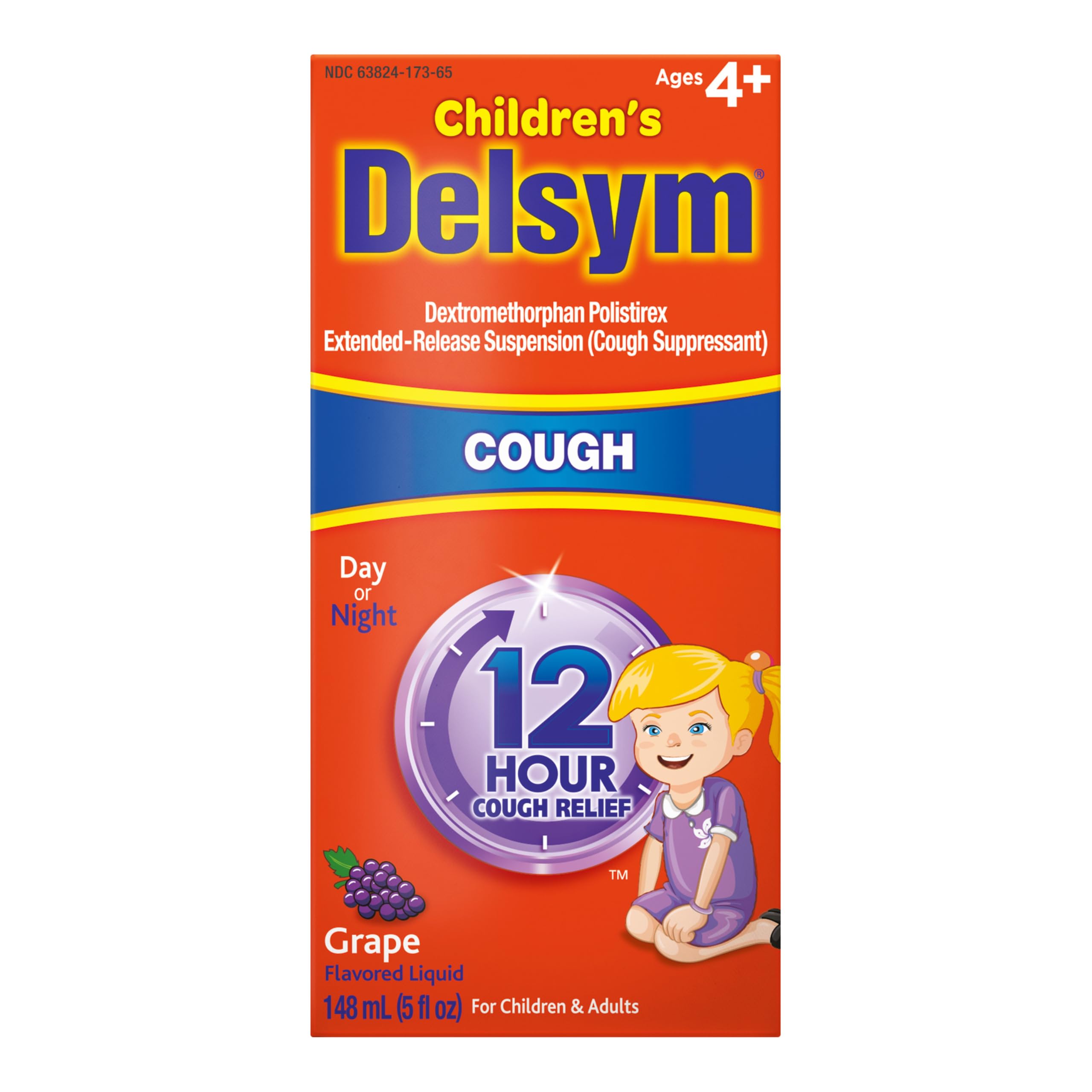
Delsym Children’s 12 Hour
Key Features
- Form: Liquid
- Flavor: Grape
- Bottle size: 5 fl oz
- Cough relief: 12 hours
- Price: Midrange
Delsym’s Children’s 12 Hour Cough Relief is the simplest tool in this set: one bottle, one job, and a label that promises up to 12 hours of cough control. We reach for it when the cough is the problem and the rest of the cold is manageable, especially for a school day or a night when a cough keeps everyone awake. It is a cough suppressant liquid, not a multi-symptom cold pack.
The grape flavor is the only flavor in this listing, and the 5-ounce bottle is a straightforward size for a medicine cabinet. Because it is cough-only, you are not paying for decongestants or fever reducers your child may not need, and there is less to check against other medicines. That focus is the appeal. If your child also has a stuffy nose, a fever, or a lot of chest congestion, choose a broader formula instead of stacking this with another cough product.
Pros
- Up to 12 hours of cough relief
- Cough-only simplicity
- Grape flavor
- 5 oz bottle
Cons
- Taste is not universally loved
We choose Delsym when cough is the only symptom that needs handling and you want one bottle to cover a school day or a long night.
Best for Fever with Cough
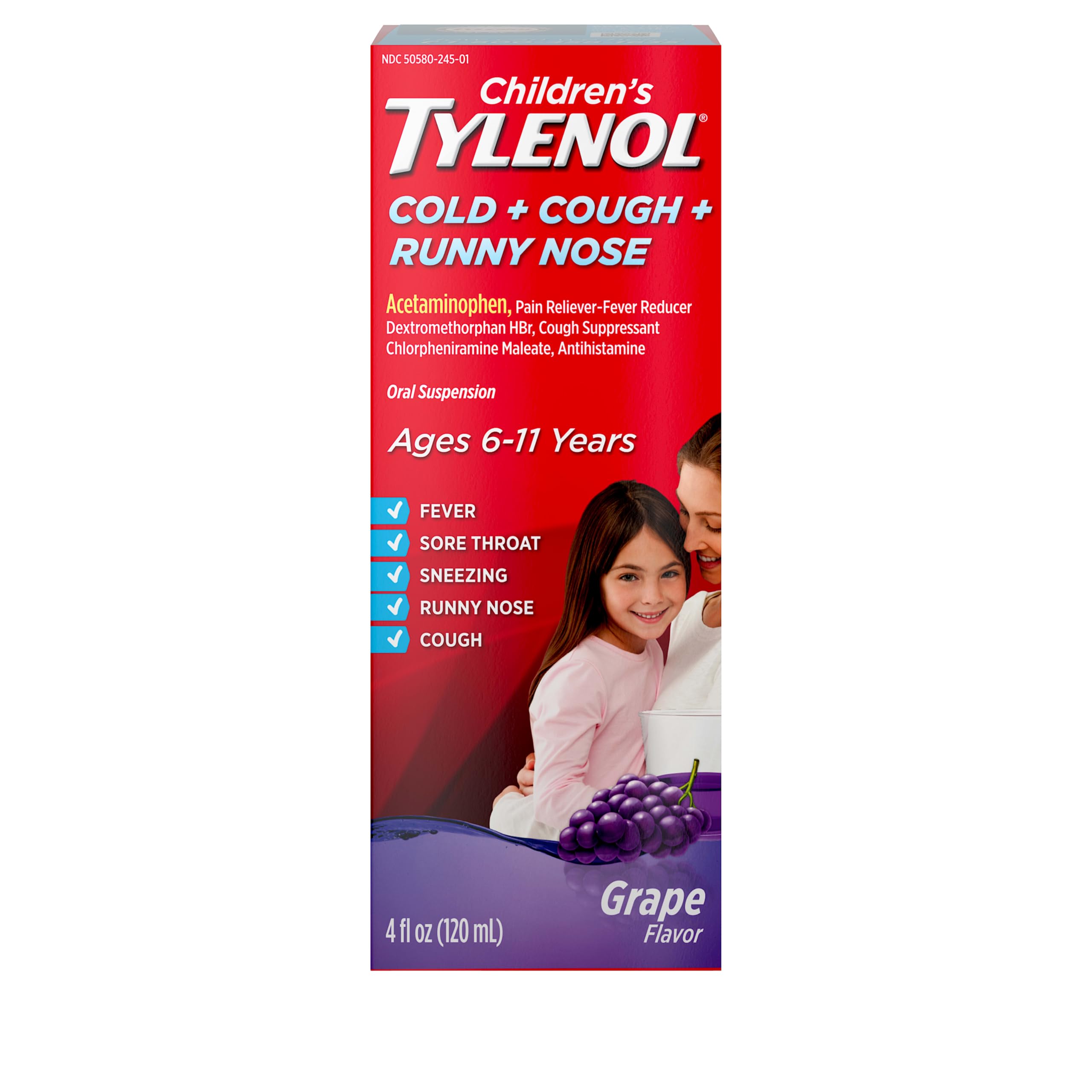
Children’s Tylenol Cold + Cough
Key Features
- Flavor: Grape
- Age range: 6-11 years
- Bottle size: 4 fl oz
- Active ingredients: Acetaminophen 160 mg, chlorpheniramine 1 mg, dextromethorphan 5 mg per 5 mL
- Price: Budget
Children’s Tylenol Cold + Cough + Runny Nose is the pick when a fever is part of the picture. Each 5 mL dose carries 160 mg of acetaminophen, 1 mg of chlorpheniramine maleate, and 5 mg of dextromethorphan, so it is doing three jobs at once: fever and aches, runny nose and sneezing, and cough. The grape liquid is a school-age formula, and the combination is unusually targeted for a cold with fever.
That combination is genuinely useful for a child who is miserable with a cold and running a fever. Instead of reaching for a fever reducer and a separate cold syrup, you have one measured liquid. The dosing cup is included, and the grape flavor is one of the easier ones to get down.
We choose this over a cough-only syrup when fever or body aches are the dominant symptoms, and over a broad multi-symptom product when you need a predictable acetaminophen dose. It is not the right pick for a cough with no fever or cold symptoms. For the right school-age child with a febrile cold, it is the most targeted bottle here.
Pros
- Fever and pain relief
- Cough and runny-nose coverage
- Grape liquid with dosing cup
- Targeted combination for colds with fever
Cons
- Labeled only for ages 6 to 11
- Contains acetaminophen; check other medicines
We reach for Children’s Tylenol when fever and body aches join the cough, because one grape liquid covers three symptoms for kids 6 to 11.
Best for No-Liquid Dosing
Mucinex Children’s Mini-Melts
Key Features
- Form: Dissolving pellets
- Count: 12
- Flavor: Orange crème
- Active ingredients: Dextromethorphan HBr, guaifenesin
- Price: Budget
Mucinex Children’s Mini-Melts are the answer to the child who will not take a spoonful of syrup. Each packet holds a small amount of dissolving pellets with dextromethorphan HBr for cough and guaifenesin for chest congestion; you pour it into the mouth and it dissolves without water. There is no cup to measure, no sticky bottle, and no need to find a sink.
That portability is the real advantage. A 12-count box fits in a backpack, a purse, or a car console, and the individual packets mean you are not carrying a whole bottle for a weekend trip. The packet is also a fixed dose, which removes the guesswork of a half-filled spoon when you are away from home.
We like it best for travel and for kids who are old enough to let pellets dissolve rather than chew them. It is a cough-and-chest-congestion product, not a full cold formula, so it will not handle fever or a runny nose. But when the barrier is the delivery method, the packet is the difference between a dose taken and a dose refused.
For the right child, the no-liquid format earns its place; for a child who needs a measured liquid, it is simply the wrong tool. The packet is a rescue option, not the whole medicine cabinet.
Pros
- No water or spoon needed
- Portable individual packets
- Cough and chest congestion actives
- Good for medicine refusers
Cons
- Taste and texture divide kids
- Small 12-dose pack
We keep Mini-Melts for the child who refuses syrup: the packets need no water or spoon and deliver cough and chest-congestion relief on the go.
Best for Older Kids
Vicks Kids DayQuil & NyQuil

Key Features
- Flavor: Berry
- Age range: 6 years and up
- Free from: Alcohol, aspirin, acetaminophen, high-fructose corn syrup
- Pack size: 2 x 8 fl oz
- Price: Premium
Vicks Kids DayQuil & NyQuil is the pick for a household that already has a fever reducer on the shelf. The day and night bottles are free of acetaminophen, alcohol, aspirin, and high-fructose corn syrup, and the pack is built for older kids. That makes it a useful alternative when you want cold and cough relief without adding another acetaminophen product.
The two 8-ounce bottles are generous for a kids’ cold pack, and the berry flavor is a deliberate attempt to make the medicine less of a battle. The daytime formula is built for the busy part of the day; the nighttime formula is for the symptoms that settle in after dinner. It is not a dosing shortcut, because you still need the age and weight chart, but the day/night split is easy to understand.
We like it for older kids who can swallow a liquid and who need multi-symptom coverage, especially when a fever reducer is already in the routine. The acetaminophen-free label is the reason to choose it over a combination product that already contains a pain reliever. Just check the nighttime bottle against anything else your child is taking, because free of acetaminophen does not mean free of every overlapping ingredient.
For the right older child, the larger bottles and the day/night split make it a practical buy. For a younger child, the Hyland’s pack or a pediatrician-recommended option is the better starting point.
Pros
- Day and night pack
- Acetaminophen-free
- Large 2 x 8 oz bottles
- Berry flavor
Cons
- Only for ages 6 and up
- Taste is mixed
We recommend Vicks DayQuil & NyQuil for ages 6 and up when you want a day/night cold pack that leaves acetaminophen out of the formula.
Best for Budget Cough Relief
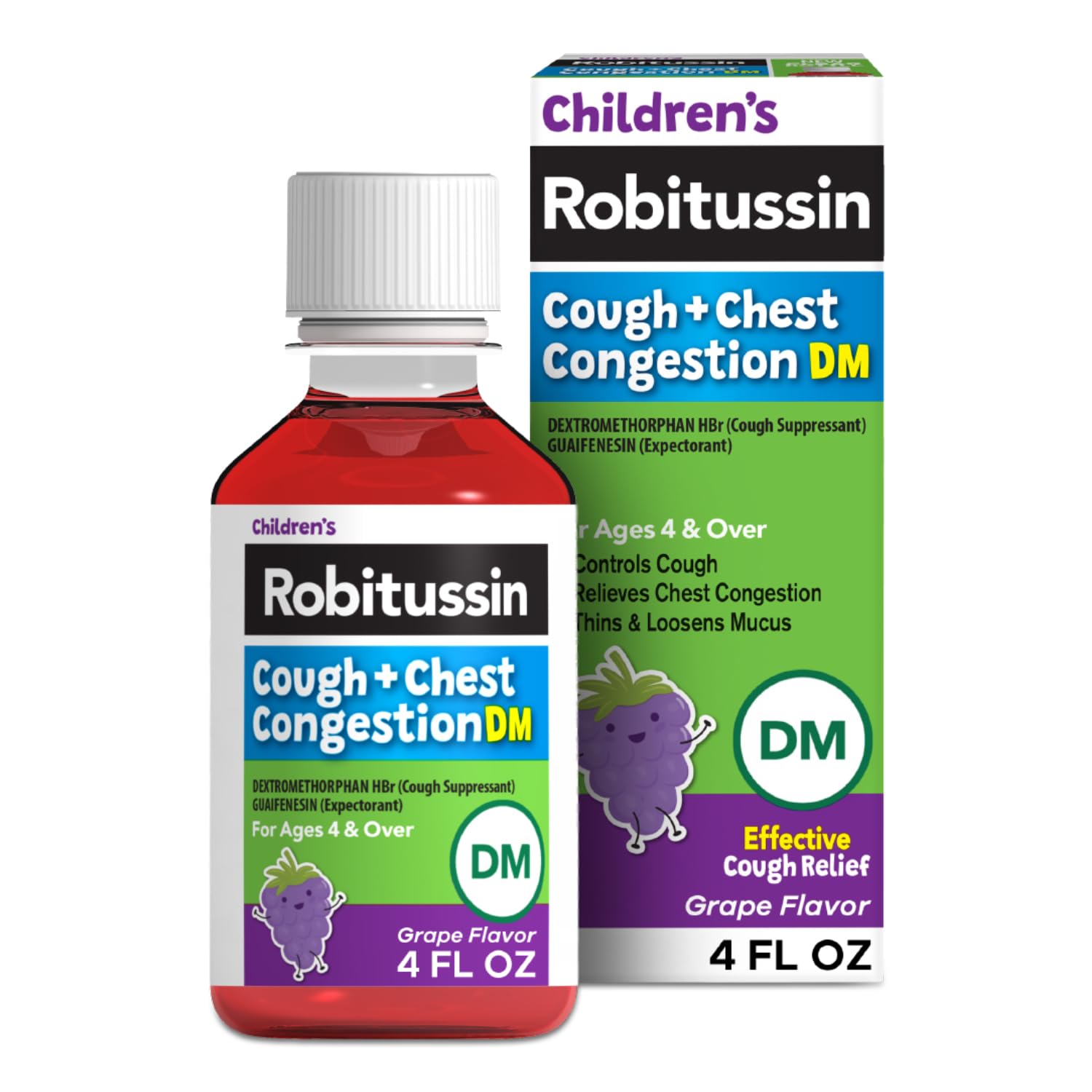
Children’s Robitussin Cough DM
Key Features
- Form: Liquid
- Flavor: Grape
- Bottle size: 4 fl oz
- Key actions: Cough relief, mucus thinning, antihistamine
- Price: Budget
Children’s Robitussin Grape Cough and Chest Congestion DM is the straightforward single-bottle option: a cough suppressant, an antihistamine, and an expectorant action for chest congestion, all in a 4-ounce grape liquid. It is the kind of bottle you keep in the cabinet for the first day of a cough, not a day/night system.
We reach for it when the budget matters and the symptoms are cough plus chest congestion. It is one of the least expensive ways to get a cough-and-congestion formula here, and the grape flavor is easy enough for most kids to take. It is not the pick for a child who also has a fever or a very runny nose, because it does not cover those symptoms.
The label is simple, the bottle is small, and the price is the point. That makes it a sensible backup for a cough that is mostly chest congestion, especially if you already have a fever reducer and a decongestant on hand. It does not have the day/night flexibility of the Mucinex pack or the child-friendly formats of the melts, but it does one job at a low cost.
Pros
- Low-cost single bottle
- Cough and chest congestion relief
- Grape flavor
- Simple to keep on hand
Cons
- Antihistamine can cause drowsiness
We choose Robitussin when you want a low-cost single bottle for cough and chest congestion, and you can accept a formula that may make some kids sleepy.
How We Tested Kids Cough Medicines
We started by pulling together more than 30 cough medicines sold for kids, then narrowed the list by reading ingredient panels, checking age ranges and dosing instructions, and comparing cost per dose. We set aside anything with unclear dosing for young children or a price that felt hard to justify for a bottle that might get used only a few times. That left 14 products, which our parent testers used with their own kids over one full cold-and-flu season—about six months.
The testing happened where coughs actually show up: at bedtime, during overnight wake-ups, on school mornings, and after daycare pickup. Each parent kept a shared log and rated how well a dose quieted the cough, how long the relief lasted, and how many times the child woke overnight. We noted taste reactions—whether a kid grimaced, refused, or asked for more—and tracked next-day side effects like drowsiness, stomach upset, or irritability. For homeopathic and natural-ingredient options, we checked whether the label matched what parents expected and whether the formula delivered any noticeable change.
By the end, the differences were less about marketing claims and more about small, practical things: a bottle that was easy to measure at 2 a.m., a flavor that didn’t start a fight, and a dose that bought enough quiet for everyone to fall back asleep. We’ll keep using these through the next cough season and update if anything changes.
How to Choose a Kids Cough Medicine
The right kids cough medicine is the one whose label matches your child’s age, symptoms, and willingness to take it, not the one with the loudest box.
Check the Age and Dose Line First
Before you compare flavors or pack sizes, find the minimum age and the weight-based dose chart. This set ranges from a 2-and-up homeopathic syrup to formulas labeled for ages 6 to 11, and the difference is not cosmetic. A product that is right for a 7-year-old may have no dose for a preschooler.
Use the dosing cup or oral syringe that comes with the product, not a kitchen spoon, and call your pediatrician if your child is below the label age or has a health condition that makes dosing uncertain.
Match the Formula to the Symptom
A cough-only syrup is the cleaner choice when the cough is the main problem; a multi-symptom formula makes sense when congestion, runny nose, and fever arrive together. Look at the active ingredients rather than the front label. Dextromethorphan is a cough suppressant, guaifenesin thins mucus, and acetaminophen handles fever and aches.
Nighttime formulas often add an antihistamine, which can sedate; that can be useful at bedtime but awkward before school. Our top pick is broad because it covers the common cold package, while Delsym is deliberately narrow.
Pick a Form Your Child Will Actually Take
Syrups are easy to measure and easy to flavor, but they are not easier to swallow for every child. Dissolving melts or pellets can be a better fit for a child who refuses spoons, and individual packets travel well. The trade-off is texture: a child who dislikes grit will reject a melt just as firmly as a syrup.
If you are switching forms, check that the product still has a labeled dose for your child’s age, and do not assume a pellet is safer just because it is small.
Conventional, Honey-Based, or Homeopathic?
Conventional cough medicines name their active ingredients and give a measured dose, which makes them predictable and easy to check against other products. Honey-based syrups soothe a throat without a cough drug, and homeopathic options appeal to parents who want a different approach.
Neither natural nor homeopathic means risk-free or right for every age. If you choose one of those routes, use it as a deliberate choice rather than a substitute for a fever reducer, and ask your pediatrician before giving it to a toddler.
Buy for This Cold, Not the Whole Winter
A day/night combo pack is convenient, but it only makes sense if both formulas fit your child’s age and symptoms. Check the expiration date and the dose count before you commit; two bottles can outlast a single cold, and a larger pack is not a bargain if half of it expires.
A single bottle of cough-only syrup or a small melt pack can be the smarter buy for a first cold or a travel kit. Value is doses you will actually use, not ounces on the shelf.
Frequently Asked Questions
Can I give my child adult cough medicine in a smaller dose?
No. Adult formulas can contain different active ingredients and strengths, and half a dose is not a safe way to guess. Use a product with a labeled dose for your child’s age and weight, measure with the supplied cup or an oral syringe, and call your pediatrician if you are unsure.
Can I give a cough syrup and a fever reducer at the same time?
Only after checking both labels for overlapping ingredients. Some cold liquids already contain acetaminophen, so adding a separate fever reducer can double that ingredient. If the cough product is acetaminophen-free, a fever reducer can fit alongside it, but confirm there is no repeated cough suppressant or antihistamine before you combine them.
Which cough medicine is best for a 2-year-old?
Hyland’s is the only pick in this set labeled for ages 2 and up, but age alone is not a reason to skip a pediatrician call. For a 2-year-old, use only a product with a labeled dose for that age, follow the weight chart, and ask your clinician before starting any OTC cough or cold medicine.
Final Verdict
Most families should start with Mucinex Children’s Multi-Symptom Day/Night: it is the broadest, most clearly labeled day/night pack here, and it covers the cough, congestion, and runny nose that usually show up together.
Choose Hyland’s if you need a 2-and-up homeopathic option, Zarbee’s if you want a drug-free honey formula, or Delsym if the cough is the only symptom you need to treat. The right pick is the one whose label fits your child, not the one with the biggest bottle.
