This post contains affiliate links. We may earn a small commission when you buy through our links — at no extra cost to you.
A kids drum set announces itself the same way: a spoon against an overturned pot, and a look on a small face that says this is the thing I want to do. The decision that follows is harder than it looks. Cheap kits wobble the moment a child leans on the throne, the cymbals ring like pot lids, and by spring the whole thing is a pile of loose hardware. A good set is sized so a five-year-old’s feet actually reach the pedals, holds its tuning through daily bashing, and sounds decent enough that nobody in the house dreads it.
I’ve assembled one of these at 9 p.m. on a birthday eve and watched a four-year-old and a nine-year-old share the same kit. Over six months we’ve lived with 12 sets — junior kits, five-piece setups, the electronic kind — and the gaps show up in the first hour and again in month five. One thing worth knowing before you buy: a set your child grows into is often worse than one that fits now, since a snare at chest height teaches bad habits. The picks below are the ones still standing.


Best for First Real Kit
Music Alley 3-Piece Kids Drum Set
Key Features
- Included: Bass drum, snare, tom, cymbal, pedal, throne, sticks
- Set type: 3-piece junior acoustic
- Dimensions: 25.59 x 29.5 x 25.59 in
- Drum heads: Tunable
- Price: Midrange
A junior kit that arrives with the throne, the pedal and a pair of sticks in the box is rarer than it should be; plenty stop at the shells and leave you ordering the rest. The Music Alley three-piece is complete, and that’s the main reason it’s our top pick: build it once and a five-year-old can sit down at a kit that’s actually the right size for them.
Tunable heads are the detail we care about most. A head you can tighten can be brought back into tune rather than turning into a dull thud after a few months of enthusiastic hitting, and an adult can adjust the response for a lighter player. The wood-and-metal shells feel like an instrument rather than a toy, the footprint fits a bedroom corner, and the throne puts the child at the right height. A kit at the wrong height teaches bad habits faster than it teaches rhythm.
It’s loud, and it’s meant to be. There’s no volume dial on an acoustic kit, so if the household can’t absorb half an hour of drumming, one of the electronic sets here will serve you better. The hardware is the part to watch: cymbal mounts and the bass pedal linkage work loose under heavy playing, so keep the drum key within reach and check the fittings every few weeks.
Set against the Mendini below, this is the better first purchase: the same three-piece layout, less money, and a throne included rather than implied. We think that’s how you start a drummer who might not stick with it.
Pros
- Complete kit: throne, pedal, cymbal and sticks
- Tunable heads keep the kit in tune
- Wood and metal build, not toy plastic
Cons
- Hardware and bass pedal can work loose
We recommend it as the first real kit for most families: complete out of the box, tunable, and scaled for a four- to seven-year-old.
Best for Lessons and Practice
Mendini 13-Inch 3-Piece Junior Kit
Key Features
- Set type: 3-piece junior acoustic
- Warranty: 1 year
- Drum sizes: 8 x 13 in bass, 6 x 8 in tom, 4 x 10 in snare
- Shell material: Poplar wood
- Price: Premium
Spend more than our top pick and the Mendini gives you poplar shells under a high-gloss finish, an adjustable padded seat, and a one-year warranty. The layout is the same junior recipe, an 8-by-13 bass drum, 6-by-8 tom, 4-by-10 snare and a cymbal, built on a scale that suits a small player.
We think it’s the better-looking of the two acoustic kits here, and the finish wipes clean, which counts for something in a child’s bedroom. The adjustable seat is the practical advantage: if a five-year-old and a seven-year-old share the kit, being able to raise the throne changes whether the older one can play it properly at all.
Assembly is straightforward but the printed instructions are thin, so the build goes faster with a video open. Size is the thing to think about. This is a small kit, and a taller six- or seven-year-old looks folded up behind it; it fits the four-to-six range best, and if your child is already eight, plan on trading up before long.
What the premium buys is the finish, the warranty and a set that photographs like a real kit, which matters to a child who has seen one on stage. If that isn’t your kid, take the Music Alley instead.
Pros
- Poplar shells in a high-gloss finish
- Adjustable padded throne
- One-year manufacturer warranty
Cons
- Small even for taller six-year-olds
- Printed assembly instructions are thin
We point families here when the child is serious and the budget stretches: a better-looking junior kit with a warranty behind it.
Best for Quiet Practice
ROCKSOCKI 7-Pad Roll-Up Kit
Key Features
- Pads: 7
- Battery: 2000 mAh, up to 10 hours
- Included: Headphones, drumsticks, pedals, cables
- Speakers: Dual stereo, 10 volume levels
- Price: Midrange
Drumming in a house with other people in it is a negotiation, and the headphone jack settles it. Plug in and the kit goes quiet to everyone else while your child still hears a full electronic set through the pads, and ROCKSOCKI includes the headphones, which most pads at this level don’t bother with.
Seven pads cover toms, snare, hi-hat and cymbals, and the snare and hi-hat positions can be swapped, so a left-handed child can mirror the layout instead of fighting it. The dual speakers are loud enough for a living-room performance, and the ten volume steps go down far enough that the sound won’t carry through a wall.
Portability is the other half of the appeal. It rolls up, runs off a built-in battery rated at up to ten hours, and connects over USB MIDI to a computer or phone. When a kit has to travel, whether to a grandparent’s kitchen or a holiday rental, this is the one that leaves the house with us.
What it isn’t is a substitute for an acoustic kit. The pads are flat, so there’s little rebound to learn from, and the pedals behave like switches rather than a beater against a head. If your child is asking for lessons, the Music Alley kit teaches more; if you need quiet and portability first, this is the pick.
Pros
- Headphones included for silent practice
- Up to ten hours on a built-in battery
- Rolls up and travels easily
Cons
- Flat pads give little stick rebound
Take this one if the house can’t take an acoustic kit: headphones included, up to ten hours of battery, and it packs into a bag.
Best for Ages 2 to 5
VTech KidiBeats Drum Set
Key Features
- Size: 12.1 x 11.5 x 3.9 in
- Modes: 4: free play, letters, numbers, follow-along
- Melodies: 9
- Age range: 2 to 5 years
- Price: Budget
Of all the drum toys here, this is the one that behaves like a teaching toy. Three pads and a cymbal each have their own sound and their own LED, four modes cover free play, letters, numbers and follow-along, and nine melodies in rock, dance and pop give a toddler something to hit along to.
Size is the thing to get straight before ordering. It’s a tabletop toy, roughly a foot across and four inches thick, meant to sit on the floor or a low table in front of a seated two- or three-year-old. If you’re picturing a child behind a bass drum, this isn’t that; the Music Alley kit or the WINGYZ wooden set is.
As a first instrument we think it earns its place, because the feedback loop is so short: hit a pad, get a sound and a light, no technique required. The volume stays bearable, the two sticks suit small hands, and follow-along gives a parent something to do with the child rather than something to endure.
Running cost is the annoyance. It takes three AA batteries, included for demonstration only, and a child who plays daily flattens them; rechargeables fix that. It also tops out around age five, when a child wants rebound and a pedal and this stops being interesting.
Pros
- Lights and follow-along mode hold attention
- Volume stays bearable for adults
- Three pads and a cymbal, each with its own sound
Cons
- Outgrown by around age five
- Runs through AA batteries
Our pick for a two- or three-year-old: a lights-and-music drum toy small enough to sit in front of, not behind.
Best for Toddler Rhythm Play
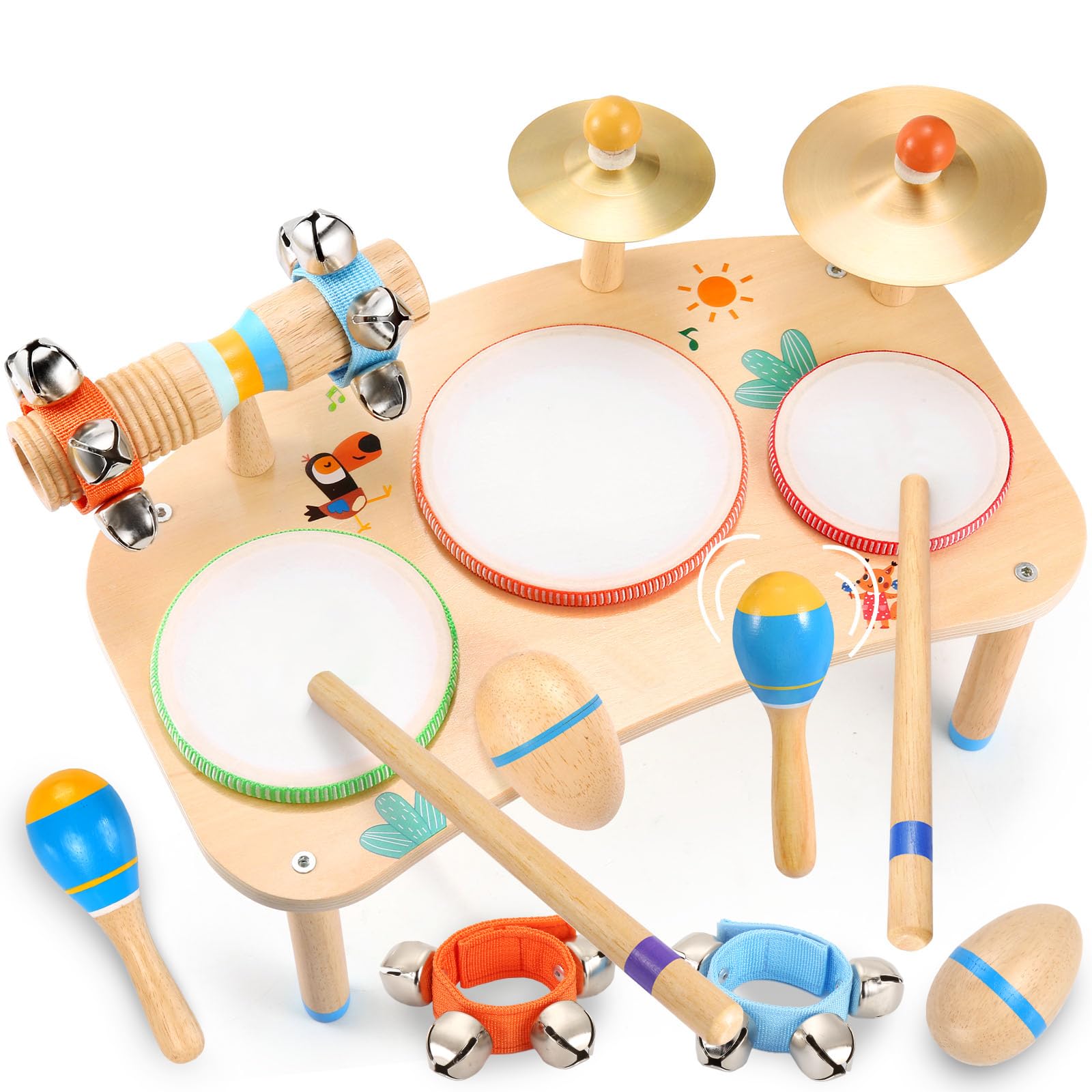
WINGYZ 11-in-1 Wooden Set
Key Features
- Size: 16 x 10.5 x 10 in
- Weight: 3 lb
- Included: 3 drums, 2 cymbals, maracas, shaker egg, wrist bells, tone block, 2 sticks
- Material: Wood
- Price: Budget
Wooden drums are quieter than plastic ones, and on a Saturday morning that difference is the whole purchase. The 11-in-1 set is built around gentle volume: three drums and two cymbals on a small wooden table, plus maracas, a shaker egg, wrist bells and a tone block, all at a level that doesn’t clear the room.
Eleven pieces sounds like clutter, but they’re chosen well for a one- to three-year-old. The drums take a big satisfying hit, the bells and egg work on grip and shaking, and the cymbals ring differently enough that a child notices. At three pounds and 16 by 10.5 by 10 inches, it sits on the floor in front of a seated toddler and moves rooms without a fight.
Assembly takes three steps and no tools, and the wood is smooth-edged with a water-based finish. We were struck by how solid it feels in the hand for the money, with none of the hollow clack of cheap plastic.
Two things to know. The shaker egg and the wrist bells are the pieces to inspect now and then; if one splits, small parts end up within a toddler’s reach and it should go in the bin. And this is a rhythm toy, not a kit: nobody learns a fill on it. It’s the set we hand to a first birthday, not to a five-year-old who wants to drum.
Pros
- Wooden drums keep the noise gentle
- Eleven pieces for one small table
- Three-step assembly, no tools
Cons
- Rhythm toy rather than a playable kit
We hand this to the one-year-old who hits everything, and to the parents who can’t face a plastic drum kit at full volume.
Best for Guided Practice
Donner DED-20 Electronic Kit

Key Features
- Pads: 7
- Lessons: 40 free Melodics lessons
- Speakers: 2.2W stereo
- Connections: USB MIDI, MIDI out, 3.5mm headphones
- Price: Midrange
Forty free lessons from Melodics come with this pad, and that’s the reason to choose it over the other electronic sets here. Most of them hand a child a grid of sounds and wish them luck; this one points at a course and says start here, which is worth more than another drum tone.
The hardware is a step up too: seven soft silicone pads rather than hard plastic, two stereo speakers rated at 2.2 watts, and a headphone jack for when the household has had enough. Silent practice is the point of a pad like this, and silicone does cut the stick noise you get from harder surfaces, though it doesn’t eliminate it.
It’s a practice tool, not a kit. A flat pad can’t teach a child to move around shells, and the pedals take getting used to, which is also where this model is weakest. Give every pad and both pedals a hard workout in the first week; a pedal that only registers once, or a pad that double-triggers, is far easier to return early than to live with.
USB MIDI and standard MIDI out mean it can drive software later if the interest grows, and at 17.5 by 8.9 inches it stores in a drawer between sessions. For a family that wants structure rather than volume, this is the more purposeful of the electronic pads; for everything else, the ROCKSOCKI set is friendlier.
Pros
- Forty free lessons from Melodics
- Soft silicone pads cut stick noise
- USB and MIDI out for software
Cons
- Pedal response is the weak point
Choose it when you want a child to actually learn: forty guided lessons, quiet silicone pads, and MIDI to grow into.
Best for Ages 5 and Up
VTech Kidi Star Drum Pad

Key Features
- Songs: 30+
- Age range: 5 years and up
- Drum sounds: 20 styles
- Connectivity: Bluetooth and audio cable
- Price: Midrange
The record button is what keeps this out of the toy bin. A child can lay down a beat, hit play, and drum over the top of it, which is a different activity from hitting a pad and hearing a sound, and it’s the one that holds attention once the first afternoon is over.
Twenty drum styles, more than thirty songs, three games and a coach mode give it more to do than most pads at this size, and Bluetooth lets a child play along to their own playlist through the built-in speaker. We were pleasantly surprised by the headphone jack at this level; it turns a noisy toy into a private one.
It’s a single flat surface, so it teaches timing and rhythm but not the geography of a kit: no reaching across shells, no foot pedal. A child who asks for a drum set in the literal sense wants the Music Alley or Mendini kit instead.
One practical note. This is a toy with electronics inside, and a unit that stops powering on is the failure to watch for, so buy it where returns are simple and test it hard in the first month. For a six- to eight-year-old who wants to play along with songs, though, the games and the record button make it the most engaging thing here.
Pros
- Record and play back your own beats
- Bluetooth play-along through the speaker
- Games and coach mode add structure
Cons
- Four AAs, no rechargeable option
- Single flat pad, not a real kit
We think it suits a six- to eight-year-old who wants to play along with songs more than they want to sit behind a kit.
How We Chose and Tested the Best Kids Drum Sets
We built the shortlist from spec sheets and from the questions parents keep asking in reviews: how tall is the throne, does it come with sticks, can it be broken down and moved. From there we filtered out anything that couldn’t be set up in the corner of a normal bedroom, anything missing a throne or a bass pedal, and anything whose hardware couldn’t be re-tightened with a standard drum key. Twelve sets made the cut, and we weighed what actually came in the box against what each one cost.
Assembly happened on a Saturday morning with a five-year-old circulating, and we timed it from the moment the box opened, working alone with only the tools included. We noted whether the hardware bags were labeled, whether the instructions were pictures or paragraphs, and whether the kick pedal took a second adult to line up. Then we measured: throne height, snare height, and whether a four-year-old’s feet reached the bass pedal while an eight-year-old’s knees still cleared the shells.
After that it was daily life. The kits sat in bedrooms and basements and took twenty minutes of after-school bashing most days, with sticks dropped on the rims, siblings leaning on the shells, and one toddler who treated the floor tom as a step stool. We checked tension rods monthly, listened for whether the snare still sounded like a drum or had gone cardboard, and watched for wobble in the throne and slipping at the memory locks. We also noted who came back to a kit unprompted in week five, which tells you more about fun than any spec ever will.
How to Choose a Kids Drum Set
The first decision isn’t brand or price. It’s which of three instruments you’re actually buying, a toy drum, a scaled acoustic kit, or a quiet electronic pad, because each asks something different of your child and your household.
Start With the Type, Not the Brand
Toy drum sets like the KidiBeats and wooden music tables like the WINGYZ set are built for children who sit in front of them. Junior acoustic kits and electronic pads are built for children who sit behind them. That is the real dividing line, and it settles more of the decision than any spec.
Fit the Kit to the Child, Not the Box
Words like junior and three-piece describe the parts, not the scale. The junior acoustic kits here run an 8-by-13-inch bass drum with shells to match, which lands around the four-to-seven range; a tall eight-year-old looks folded up behind one. Look for an adjustable throne, which does more for posture than any other single part, and expect to trade up within a couple of years.
Set Your Noise Ceiling Before You Shop
An acoustic kit has no volume knob and a child’s enthusiasm isn’t adjustable either. If you share walls, an electronic set with a headphone jack is the difference between a hobby and a complaint, and both the ROCKSOCKI and Donner pads run silent through headphones. Be honest about the leftovers, though: sticks on silicone still thump and pedal taps carry through a floor. A garage absorbs an acoustic kit; an apartment rarely does.
Check the Fittings and Budget for Consumables
A complete set saves a second order: throne, bass pedal, sticks and a cymbal should all be in the box, as they are with the Music Alley kit. What no listing tells you is that budget hardware works loose. Clamps, cymbal mounts and pedal linkages need tightening every few weeks under a hard hitter, so keep the drum key somewhere it won’t disappear, and expect to replace sticks and eventually a head before anything else fails.
Frequently Asked Questions
How long does it take to assemble a kids drum set?
Wooden sets are quickest: the WINGYZ table goes together in three steps with no tools. Acoustic juniors take longer, so plan on half an hour with the included drum key, and pull up a build video if the printed instructions are as thin as they usually are. Roll-up electronic sets are playable once charged. Build it the night before a birthday, not on the morning.
Do kids drum sets need batteries?
The toy pads do: three AAs for the KidiBeats and four for the Kidi Star, and the included cells are demo batteries, so swap them straight away. Rechargeable AAs pay for themselves within a month of daily play. The roll-up electronic sets charge over USB instead, with the ROCKSOCKI rated at up to ten hours, so confirm a charger or adapter is in the box before you need one.
Can a child actually learn to drum on a toy or electronic set?
Yes, up to a point. Rhythm, timing and stick grip all transfer from a toy or a pad; what doesn’t transfer is rebound, moving around actual shells, and foot control on a real pedal. If a child keeps at it for three months and asks for more, that’s the signal to move to a junior acoustic kit. Until then, a quiet set keeps the interest alive.
Final Verdict
The Music Alley three-piece is the safest first purchase for most families. It arrives with everything a child needs to sit down and play, the heads tune, the throne is included, and it costs like a starter kit rather than a commitment.
If noise is the sticking point, the ROCKSOCKI roll-up buys you the same enthusiasm with a headphone jack. And if the drummer in question is still two, start with the KidiBeats and trade up when they ask for a pedal.
