This post contains affiliate links. We may earn a small commission when you buy through our links — at no extra cost to you.
A laser tag set looks like the easiest gift in the world—until you’re standing in a dark backyard with four kids and one blaster that won’t sync. The appeal is obvious: active play, a little friendly competition, and a reason to be outside after dinner. But cheap sets can turn a birthday party into a chorus of "it’s not working." What you want is a set that’s simple enough for a 7-year-old to figure out, sturdy enough to survive a tackle, and fun enough that the kids don’t drift back to the couch. Over the past six months, my team and I have tested 10 sets—through backyard battles, rainy-day living room skirmishes, and a few sleepovers—to find the ones that actually deliver.
The dirty secret of laser tag is that the blaster is only half the equation; the other half is sensor reliability and recharge time. Rechargeable batteries are a gift to parents and a better value than disposables, but only if they hold a charge through a full afternoon. We kept all of that in mind—and the picks below are the ones the kids asked to play with again.


Best for Family Four-Player
Squad Hero 360° Set of 4
Key Features
- Power: Rechargeable (charging dock)
- Range: 150 ft
- Players: 2-4
- Targets: Chest, back, and blaster
- Price: Premium
Three sensors — chest, back, and the blaster itself — are why this set is our default. A back panel changes how kids move: nobody can stand in the open and trade shots, because someone will always be able to come around behind. That turned our sessions from a firing line into something closer to tag, and it’s the detail we mention first when another parent asks what to buy.
Rechargeable everything is the other half of the argument. Four blasters and four vests charge on one dock, so a Saturday doesn’t end with a hunt through a drawer of AAA cells. Watch the dock in the first week: run all four slots and confirm each one lights up, because charging hardware is the piece that can take the whole set out of rotation. The readouts on gun and vest settle the ‘I hit you first’ argument without an adult stepping in.
Range is 150 feet, enough for a backyard or a long basement, and the four weapon modes — pistol, automatic, laser, rocket — give kids something new to argue about besides the score. The vests adjust from small kids up to adults, and the set is rated for eight and up; the younger players in our group needed one walkthrough of the reload and then were away.
Two things to know before you commit. The vests are the first part to give out under hard play, so they’re the pieces to look after and the reason to keep the box. And four players is the ceiling — a fifth kid means a second set, which is where the six-player version of the same system comes in.
Pros
- Back sensor ends stand-and-shoot battles
- Guns and vests recharge on one dock
- LCD readouts on gun and vest
- 150 ft range for yards and basements
Cons
- Vest straps and clips fail first
- Premium price against the rest of the group
Our pick for most families: the back sensor keeps kids moving, and one dock keeps four blasters ready without a battery drawer.
Best for Vest-Free Play
Best Choice Products Set of 4
Key Features
- Power: Rechargeable (docking station)
- Range: 130 ft
- Players: 4
- Targets: Blaster only
- Price: Midrange
There are no vests in this box, and that’s the design, not a shortcut. Each of the four blasters is also the receiver, so a hit shows up as a vibration and a light on the gun you’re holding. Nothing to strap on, nothing to adjust, nothing to lose in the garage — a kid picks one up and is playing.
We think the vest-free idea is the smartest simplification in this group, because the child who refuses to wear the vest still plays. The trade is real: with no back sensor, a hit only lands when the blasters line up, so a kid holding theirs down at their side is hard to tag and knows it. It rewards players who keep their blaster up, which is either a skill or a loophole depending on who’s winning.
Six hours of play from a one-to-two-hour charge is the ratio that makes the whole thing work, and the dock does all four at once, so the set spends more time outside than on a cable. Four weapon modes, from single shot to repeating, give it more staying power than the plain shell suggests. Rated eight and up, it plays indoors at close range and outdoors out to 130 feet.
Pros
- Nothing to strap on or lose
- All four blasters charge on one dock
- Six hours of play per charge
- Four weapon modes with sound and vibration
Cons
- No back sensor; hits need a clear line
- Light plastic feels less sturdy than vest sets
For kids who won’t wear a vest, this is the set we hand over: the blaster is the target, and the dock keeps all four charged.
Best for Party Play
Squad Hero Set of 6
Key Features
- Power: Rechargeable (charging cable)
- Display: LCD lives on gun and vest
- Players: 6
- Targets: Chest and blaster
- Price: Premium
If our top pick is the family set, this is the party set: the same rechargeable approach as the four-player Squad Hero, with two more blasters and vests in the box and lives and team data synced between gun and vest.
Six is the number that changes a game. Four players split into two teams and one argument; six fills a yard and makes hiding and flanking worth doing. Charging is by cable rather than a dock, so the whole kit wants one outlet and a bit of organisation the night before a birthday.
The compromise is the sensor layout: chest and gun only, with no panel on the back, so the circling that makes the four-player version so good has less to punish it. For a party with nine-year-olds scattering in every direction, we didn’t find that it mattered. For two kids who play every weekend, the four-player set is the better game.
Buying six at once also keeps everyone on one system — one set of rules, one charging routine, one box to find in the cupboard — instead of pairing a four-player set with a two-player set from another brand that can’t talk to it.
Pros
- Six blasters and vests in one box
- Rechargeable guns and vests
- Lives and team data sync automatically
- Quick setup for party afternoons
Cons
- Chest and gun targets only; no back sensor
- Charges by cable rather than a dock
Six players on one rechargeable system, synced scores and quick setup — the set that turns a birthday into a proper battle.
Best for First Set
Kidzlane Set of 4
Key Features
- Power: 4 AAA per blaster
- Range: 130 ft
- Players: 4
- Targets: Blaster only
- Price: Budget
Four blasters, four ammo modes, four team colours, 130 feet of range and no vests to fit: this is the set we point to when a family wants to try laser tag without spending at the top of the category. It’s also the one whose controls a young kid works out first, which matters more than any feature on the box.
No vests means the blaster is the receiver, so a player has to keep their gun out to stay in the game. Kids work that out in about a minute, and it removes the two things that go wrong with vest sets: straps that don’t fit and sensors that slide around. These are also the lightest blasters here, at a bit over twelve ounces for the set, which matters for a small kid carrying one around a yard for an hour.
Sound is the annoyance: the blasters are loud and there’s no quiet setting, so a basement game is audible through the floor. Everything else is stripped back on purpose, and nothing about the way it plays feels like a compromise. It also takes up less shelf space than any vest set here.
Pros
- Cheapest four-player set here
- No vests to fit or lose
- Light enough for small hands
- Four teams and four ammo modes
Cons
- Four AAA batteries per blaster
The cheapest way into four-player laser tag here, and the one we hand over without a briefing: light blasters, no vests, no learning curve.
Best for Younger Siblings
LASER X Two-Player Set
Key Features
- Age: 6 and up
- Power: 6 AAA batteries
- Linking: Works with all Laser X sets
- Players: 2
- Price: Budget
Ages six and up is the detail that earns this set a place. Everything else here starts at eight, and while most six-year-olds can keep up with an eight-year-old’s toy, the number on the box matters when the set belongs to the younger kid.
Two blasters and two receiver vests make it the sibling set, and the voice coach does the explaining — it calls hits and offers tips between rounds, so an adult isn’t refereeing. It’s also the most expandable thing here: every Laser X set works with every other one, so a second pair joins the same game instead of starting a separate one.
The beeping is the drawback. It’s constant, it announces where you are, and it doesn’t stop until the round does. The headphone jack is the fix nobody expects on a toy gun: plug in and the soundtrack stays in your ears, which is a nicer option than it sounds on a rainy afternoon.
Pros
- Rated for ages six and up
- Voice coach calls hits and gives tips
- Links with any other Laser X set
- Headphone jack keeps the noise personal
Cons
- Six AAA batteries to keep stocked
- Two players until you add another set
The set we start younger kids on: rated from six, guided by a voice coach, and compatible with every other Laser X set when the cousins arrive.
Best for Score-Reading Kids
Halo Sport Set of 6
Key Features
- Power: AAA batteries
- Display: LCD lives on gun and vest
- Linking: Works with other Halo Sport sets
- Players: 6 (4 teams)
- Price: Midrange
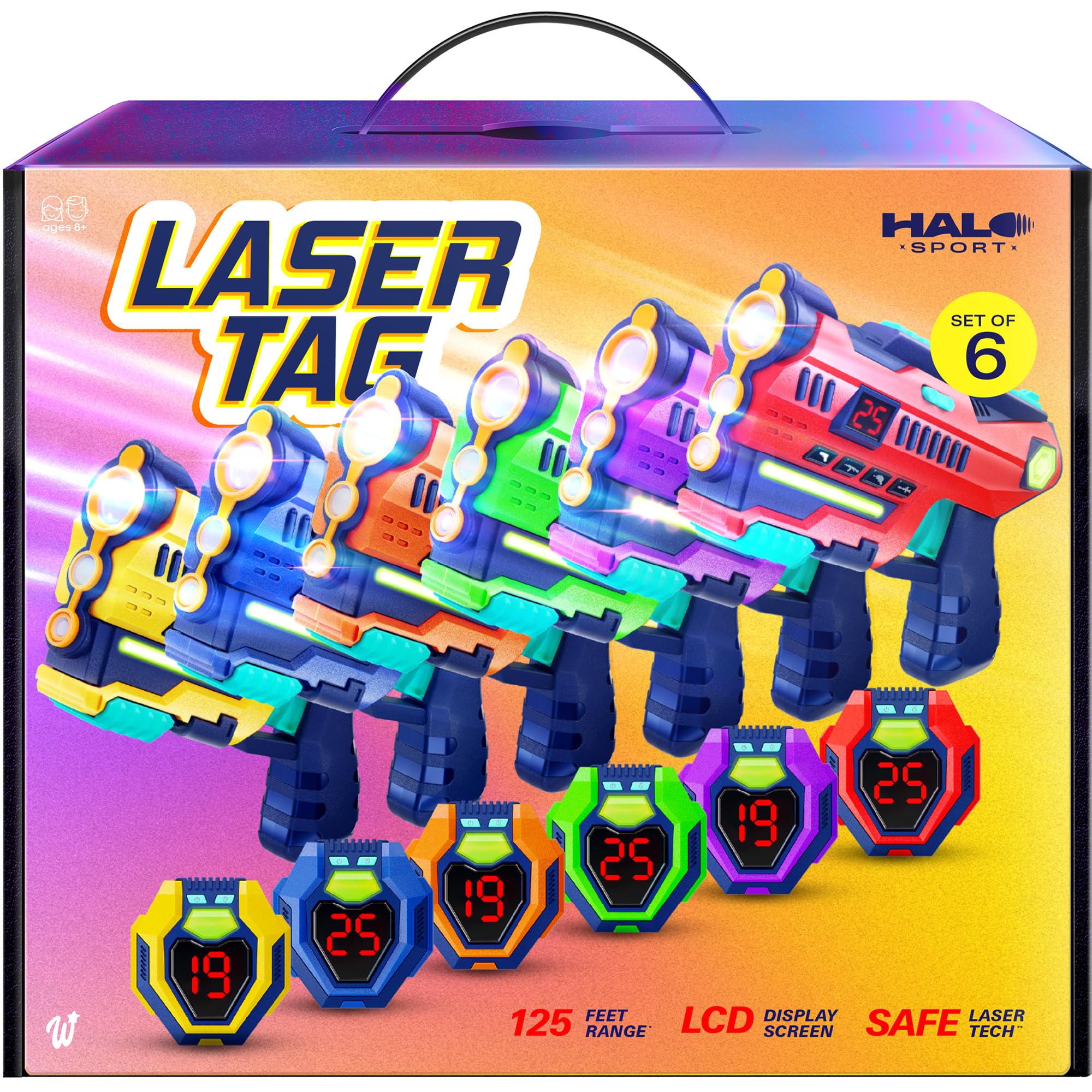
Six vests, six blasters, and a small LCD on every gun and vest showing lives and team colour. Gearing up is the easy part — a vest over the head, a blaster in each hand — and after that the scorekeeping is handled.
Those displays are what separate it from the cheaper six-player sets. A kid who can see a life count plays differently, ducking behind a bush to reload instead of charging, and lit team colours make sides obvious across a yard. Four weapon modes and four teams give a group plenty to negotiate before the first round.
It suits a family whose kids are old enough to read a display and want to play in teams. Mixed-age groups need a demonstration of the reload slider first, and the youngest players drift back to the simplest mode — which is fine, because a hit is still a hit.
Every Halo Sport set links to every other one, so a second box turns six players into twelve rather than starting a separate game. That’s the argument for buying into a system rather than a one-off set, and it’s why this one holds a place even with two six-player options on the page.
Pros
- LCD life and team panels on gun and vest
- Six blasters and vests in one box
- Four teams with unlimited players
- Four weapon modes with sound and lights
Cons
- Battery-powered; budget AAA cells for six players
The six-player set for kids who read the score: LCD panels on every vest and gun, four teams, and compatibility with every other Halo Sport set.
Best for Style-Conscious Kids
Winyea Set of 4

Key Features
- Power: 6 AAA per player
- Range: 150 ft
- Display: Lives on gun and vest
- Players: 4
- Price: Budget
Matching life displays on the gun and the vest are this set’s calling card: glance at either one mid-firefight and you see remaining lives and team colour without breaking stride.
The look is deliberate — bright camo shells with lighting down both sides and a sci-fi silhouette — and it’s the set kids reach for first when there’s a choice on the table. Range is 150 feet, there are four teams and four weapon modes, and the vest and gun stay in sync as hits land.
Set-up is where it needs a grown-up. Each gun has to be paired to its vest, and pairing is fiddly enough that you want to do it at the kitchen table before the kids arrive, not in a yard with four of them waiting. Once paired, it holds for the session.
That pairing routine is the price of the extra display, and it’s a fair trade if the lights and the look are what gets a reluctant kid outside. It sits below our budget pick because the extras don’t change the game underneath, and once the novelty settles it plays much like any other four-player set.
Pros
- Life and team readouts on gun and vest
- 150 ft range
- Striking look with dual-sided lighting
- Four teams and four weapon modes
Cons
- Six AAA batteries per player
A four-player set with matching life displays on gun and vest and a look kids gravitate toward — as long as you pair everything before the game.
Best for Maximum Theatrics
JakMean Rechargeable Set of 4

Key Features
- Power: Rechargeable
- Range: 40 m
- Players: 4
- Weapon modes: 5
- Price: Midrange
Water mist is the headline: fire, and a puff of spray goes out with the shot. It’s theatre rather than tactics, and it’s the feature a nine-year-old demonstrates to a friend before anything else on the blaster.
Under the flourishes is a rechargeable four-player set: lithium-polymer batteries in the guns and vests, five weapon modes, voice prompts that talk players through the rules, a digital status readout, and a stated 40-meter range that covers a normal yard.
The rechargeable batteries are the part we rate highest. Four players and no drawer of AAA cells is the difference between a set that gets used on a Tuesday and one that waits for a shopping trip. The vests vibrate and light up on every hit, which reads clearly after dark.
What keeps it in also-consider is the risk in the extras. More features mean more to go wrong, and a gun or vest that quits early is the failure this kind of set is prone to; the mist also adds a reservoir to fill before play. If the theatrics are what get your kid off the sofa, the trade is worth making.
Pros
- Mist spray adds visible feedback to shots
- Rechargeable guns and vests
- Five weapon modes plus voice prompts
- Vibration and lights on every hit
Cons
- Mist reservoir needs filling before play
- More electronics to fail than the plain sets
Water mist, five weapon modes, voice prompts and no battery bill — the set to buy when a kid wants the most theatre per shot.
How We Tested the Best Laser Tag Sets for Kids
We started by narrowing the field to sets with adjustable blaster sizes, clear instructions, and rechargeable batteries, then crossed off anything with a pattern of sync complaints in customer reviews. That left us with 10 sets, which we tested over six months. The kids in our group ranged from 6 to 11, and we rotated them so no single child’s preferences dominated the results.
Testing happened where laser tag actually lives: backyards at dusk, a living room on rainy Saturdays, a sleepover in a finished basement, and one chaotic birthday party. We watched how quickly each set synced out of the box and whether every blaster paired on the first try. We measured range by having kids spread out across a yard and note when hits stopped registering, and we checked reliability by running the same three-shot sequence at close, medium, and long distances. Ease of use meant handing a blaster to a 7-year-old and seeing if they could join a game without an adult rescuing them.
Battery life got a stopwatch: we charged each set fully, then timed continuous play until the blasters shut down, and noted how long a recharge took. For durability, we dropped blasters from waist height onto grass and driveway, tossed them into a toy bin, and let the usual roughhousing happen. Sound and noise got equal attention—we noted how loud the effects were from 10 feet away and whether the beeps carried across a yard or through a wall, since a set that’s fun for kids can be grating for adults in the next room. We also checked what came in the box, whether it was ready to play out of the box, how clearly the instructions explained the games, and whether the set felt complete without extra purchases—a quiet test of value. The kids’ repeat requests were the final vote.
How to Choose a Laser Tag Set for Kids
The set that gets played with is the one that stays charged, fits the kids you’ve got, and doesn’t need an adult to referee — every other feature is decoration.
Rechargeable, or a battery habit
Count the cells before you buy. A four-player vest set can take six AAA batteries per player, and a six-player set doubles that; a dock or a charging cable turns a recurring shopping trip into an overnight routine. Rechargeable is worth paying for if the set will come out weekly. The four-player set we recommend first, and the six-player version of the same system, both run on built-in batteries.
If you go the AAA route, buy rechargeable cells and a charger at the same time. It pays for itself faster than you expect, and it means a dead blaster is a swap out of the drawer rather than an evening lost.
What counts as a hit
Vest sensors and gun sensors are different games. A vest with chest and back panels means a player can be tagged from behind, which kills the stand-off where two kids face each other and fire; a gun-only set makes the blaster the target, so hits need a clear line and a player can hide theirs behind a leg. Vest sets suit kids who circle and flank; gun-only sets suit kids who won’t wear anything, and there’s one less thing to lose.
If your players argue about whether a hit landed, buy the set with the most visible life display. An LCD on the gun and vest ends the argument before it starts.
Two players, four, or six
Buy for the group that will actually play, then check what happens when a friend arrives. Two-player sets suit siblings, and the expandable ones let you add a pair without starting over. Four is the family standard here; six fills a yard and makes flanking worth doing.
The trap is mixing brands. Sets only link within their own family, so two cheap sets from different makers play as two separate games. Buying six in one box beats pairing a four with a two from somewhere else.
Range and the space you’ve got
The 130-to-150-foot figures on these sets are outdoor numbers measured in open air. Indoors, walls, furniture and a hallway corner cut the usable distance long before the rated range matters, and infrared needs a fairly clean line to register.
Walk the longest clear line in your yard before you order and picture two kids at either end. If that’s shorter than a driveway, spend the difference on more players rather than more range.
The first-week check
Open everything inside the return window and test each blaster on its own. The recurring failure in this category is one dead gun or vest in an otherwise good box, and that is much easier to sort out before a birthday than after one.
Charge the dock overnight and confirm every slot lights up. Tighten battery doors all the way down, because a half-closed door is a blaster that won’t switch on. Pair guns to vests at the kitchen table, tape a name to each one, and keep the packaging until the whole set has survived a full round.
Frequently Asked Questions
What age is a laser tag set right for?
Most sets here state eight and up; one starts at six. The real test isn’t the number on the box but whether a kid can reload and read a life count without help. If your youngest is six, buy the set rated for six and let the older kids handicap themselves.
Eight to twelve is where these toys land hardest, and adults can play the same game with the same blasters.
Do laser tag blasters hurt your eyes?
No. These sets fire infrared light rather than a laser beam, and the makers describe the emission as child-safe, so you don’t need goggles and the light doesn’t damage eyes.
Ordinary toy precautions still apply: the emitter shouldn’t be pressed against anyone’s eye, and spare AAA cells should stay away from toddlers, who put everything in their mouths.
Can you play laser tag in the dark?
Yes, and it’s the best version of the game. Infrared doesn’t need light, and the guns and vests light up when hit, so scores are easier to follow after dark than in daylight. Sets with a night flashlight or glowing team colours are easier to track across a yard.
Clear the trip hazards out first. The sensors work fine in the dark; kids don’t.
Final Verdict
The Squad Hero four-player set is what we tell most families to buy, for two reasons that show up every time it comes out of the cupboard: the back sensor makes kids move, and the dock makes it easy to say yes on a Tuesday night.
If your kids won’t wear a vest, take the Best Choice blasters instead — the same rechargeable routine with nothing to strap on. And if the occasion is a birthday with six kids coming, go straight to the six-player Squad Hero. Six is the number where a backyard starts to feel like an arena.
