This post contains affiliate links. We may earn a small commission when you buy through our links — at no extra cost to you.
A pregnancy journal is one of those keepsakes you imagine filling every night, then realize around week 22 you’ve written three entries. The right one doesn’t fix your schedule, but it makes the ten minutes you do have feel worth capturing — the first ultrasound, the name you vetoed, the stranger who touched your belly without asking. Over eight months, I’ve lived with 14 pregnancy journals, from pocket-size notebooks to thick keepsake albums, and the differences come down to feel, content, and whether they fit your nightstand or the bag you already carry.
Appearance matters because this is a book you’ll leave out, and possibly gift at a shower; the keepsake-worthy ones look good on a table without shouting. Content is the bigger divider — clear prompts with room for appointments, ultrasound photos, and the unglamorous stuff beat dense or vague pages that make you close the book. Size decides whether it travels with you, and value comes down to paper, binding, and whether it feels like a gift rather than a form. The best made me want to keep writing, not just tick boxes.
Our Top Picks




The Best Pregnancy Journal, Reviewed
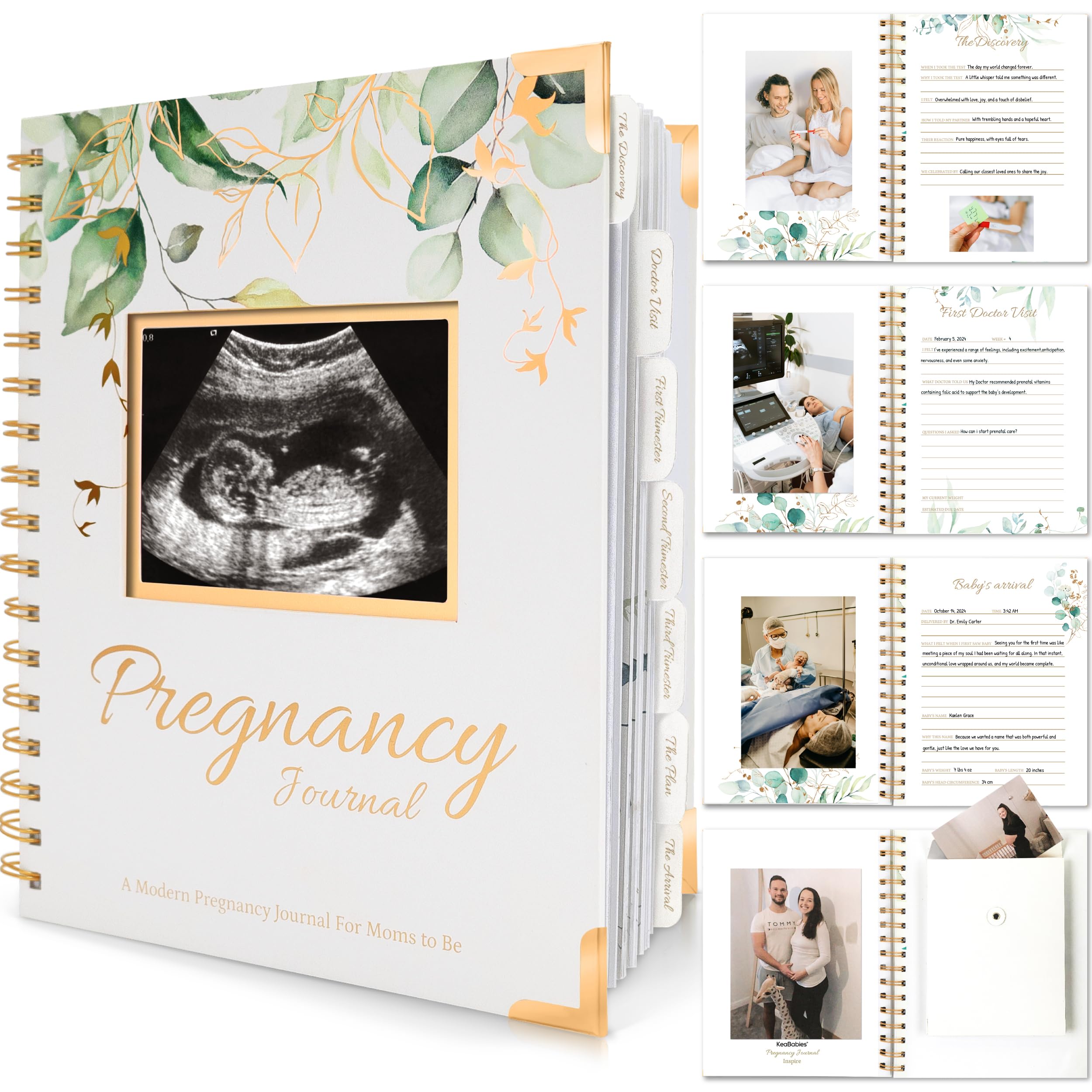
KeaBabies Inspire Journal – Best Overall
Key Features
- Pages: 90
- Binding: Ring-bound hardcover
- Page size: 7.8 x 9 in
- Keepsake storage: Envelope
- Price: Midrange
A pregnancy journal has to clear two bars: it must be pretty enough to keep and structured enough to fill in. The KeaBabies Inspire gets the balance right. Its 90 pages are organized into seven chapters, with room for doctor’s visits, trimester notes, registry and birth-plan lists, and ultrasound pictures. The ring binding lies flat, and the hardcover and elastic band make it feel like a book you keep rather than a workbook you lose.
What makes it our top pick is the pacing. Ninety pages is generous without demanding a daily ritual. Most of us can manage a page or two a week, and the prompts do the remembering for you—appointments, symptoms, questions for the doctor, the small things that vanish by the second trimester. The keepsake envelope earns its keep; ultrasound prints and appointment cards have somewhere to go besides a drawer.
We also appreciate that it does not assume a particular aesthetic. The Alpine cover is calm and gender-neutral, which makes it easy to give to a first-time mom without guessing her nursery colors. The guided structure is the point, but it does mean this is not the pick for someone who wants a completely blank book to fill on her own terms. For most first-time parents, one book for one pregnancy is exactly the right scope.
Pros
- Guided seven-chapter layout keeps entries organized
- Room for ultrasound photos and appointment notes
- Hardcover ring binding lies flat and feels durable
- Keepsake envelope stores scans and small mementos
Cons
- Stops at birth, with no first-year pages
We pick the KeaBabies Inspire as the best default here: it balances guided pages, photo space, and a keepsake feel without demanding a 200-page commitment.
ZIRI & ZANE Sweet Beginning – Best Compact Keepsake
Key Features
- Pages: 76
- Binding: Spiral-bound
- Page size: 7.5 x 7.25 in
- Photo formats: 4×6, 3×3, 4×4 in
- Price: Midrange
The Sweet Beginning is the journal we reach for when the goal is to keep up, not to create an heirloom doorstop. At 7.5 inches square it slides into a tote, and the spiral binding lies flat on a cafe table or a hospital waiting-room chair. The 76 pages run week by week from the first positive test to coming home, with prompts that take minutes rather than an evening. The linen-look cover gives it enough polish to leave out on a coffee table.
What earns it a runner-up spot is the photo planning. There are spaces for 4×6, 3×3, and 4×4 prints, which covers the usual ultrasound and bump-photo sizes without forcing you to trim everything to one shape. The pebble-grained keepsake folder at the back is the detail we kept coming back to: hospital bracelets and scan printouts can stay with the book instead of migrating to a shoebox.
The compact size is the point. It is easy to carry, makes a five-minute weekly habit feel doable, and does not demand a desk. For a weekly keepsake that travels with you, this is the one we recommend. The small format also makes it easy to tuck into a diaper bag later if you want to keep it close.
Pros
- Compact enough for a tote or bedside table
- Photo spaces fit several print sizes
- Spiral binding lies flat for quick entries
- Keepsake folder holds scans and hospital bracelets
Cons
- Compact pages limit long-form entries
We reach for this compact journal when portability matters: weekly prompts, several photo sizes, and a keepsake folder fit in a tote.
Bibi & Beau Woodland Journal – Most Comprehensive
Key Features
- Pages: 196
- Weight: 1.96 lb
- Coverage: Pregnancy through first year
- Dimensions: 11 x 8 x 1 in
- Price: Midrange
The Woodland journal is the overachiever of the group: 196 pages, an 11-by-8-inch footprint, and a structure that starts with the first positive test and keeps going through the baby’s first year. If you want one book that will not be outgrown at birth, this is the obvious place to start. Weekly pages, ultrasound spots, baby-name lists, shower notes, a nursery vision board, and a birth plan make it feel like a pregnancy planner and a family scrapbook in one.
We like that the guidance is practical without being clinical. Tips and checklists are woven through the pages, and the first-year section gives all those early milestones somewhere to land. It is a lot of book, though, and it asks for more upkeep than a 90-page journal. The reward is a record with more texture—letters, photos, shower memories, the nursery you imagined before it existed.
This is the book for the parent who wants the whole story in one place. It gives you room for the practical lists and the emotional record, and it does not stop at the delivery room. If you want a keepsake that will still have blank pages to fill during the first year, this is the one.
Pros
- 196 pages cover pregnancy through the first year
- Weekly trackers, checklists, and photo spaces in one book
- Practical tips and prompts add guidance
Cons
- Heavy, desk-bound format
We choose this one for the most complete record: it follows pregnancy through the first year, provided you have desk space.
Two Little Dinos Journal – Best for Checklists
Key Features
- Pages: 132
- Binding: Hardcover
- Page size: A5
- Keepsake storage: Pocket
- Price: Midrange
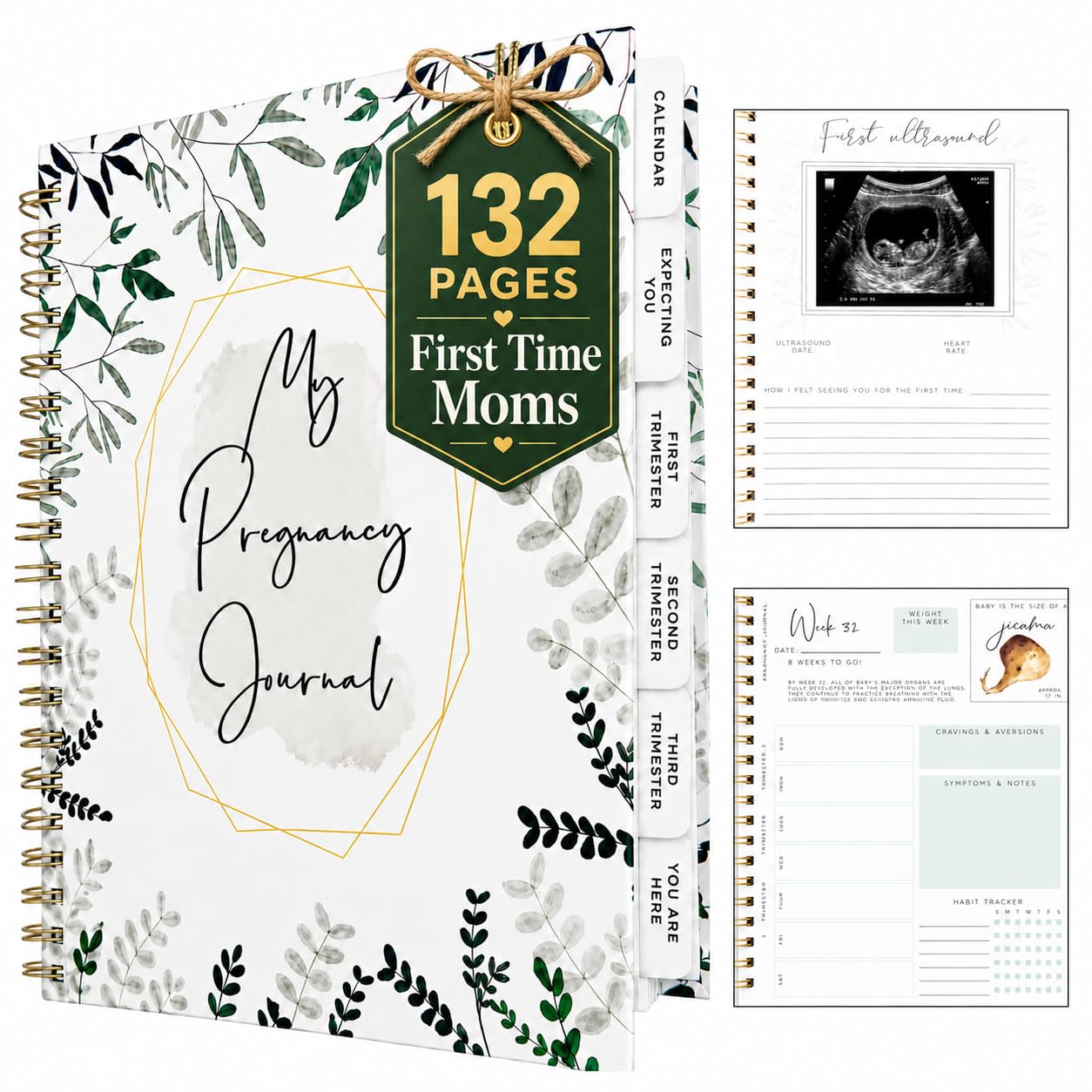
Most pregnancy journals are memory books first and planners second. The Two Little Dinos journal flips that: the hospital bag list, registry checklist, medical notes, and appointment tracking sit right beside the weekly updates. If you are the kind of person who feels calmer with a checklist, this is the runner-up we point you toward.
The 132 pages are packed but not chaotic. Weekly pages show the baby’s size and milestones, while guided prompts leave room for symptoms, questions, and the practical prep that tends to get lost in the third trimester. The hardcover and A5 page size feel substantial without turning into a binder, and the keepsake pocket gives scans and notes a home. Personalization prompts keep the book from feeling generic.
The result feels less like a baby album and more like a working companion. It is the pick for a first-time mom who wants one paper place for appointments, prep tasks, and weekly changes, and who likes the calm that comes from a list. It is also a good fit for someone who has watched too many pregnancy apps and wants one book to land in.
Pros
- Hospital bag and registry checklists in one place
- Weekly baby-size and milestone tracking
- Hardcover with a keepsake pocket
Cons
- A5 pages feel tight for long entries
We hand this to checklist lovers: medical notes and hospital prep sit beside weekly updates in the most organized layout here.
Duncan & Stone Christian Journal – Best Faith-Based
Key Features
- Cover: Linen hardcover
- Pages: 110
- Content: Weekly prayers and Bible verses
- Page size: 9.25 x 7.75 in
- Price: Premium
The Duncan & Stone journal has a clear center of gravity: every week pairs a pregnancy update with a prayer and a Bible verse. That makes it more than a pretty keepsake. If faith is part of how you are approaching pregnancy, the 40 weekly spreads give you a rhythm to return to—cravings and symptoms on one side, a short prompt and Scripture on the other.
The linen hardcover with gold embossing is the most gift-ready finish in this group, and the ivory pages feel calm rather than flashy. We appreciate that the prompts leave room for feelings and milestones without turning the book into a devotional. The pocket at the back takes scan prints and small mementos, and the 9.25-by-7.75-inch pages are large enough for photos without being unwieldy.
This is not a neutral journal, and that is the point. The prayers and verses are woven through the whole book, giving it a focus that a generic keepsake cannot match. For the right reader, it reads like a record of prayer as well as a record of pregnancy, and the linen cover makes it a gift you can hand over with confidence.
Pros
- Weekly prayers and Bible verses throughout
- Linen hardcover with gold embossing
- Space for photos, symptoms, and cravings
Cons
- Christian content won’t suit every family
- Weekly spreads are brief for daily logging
We favor this for faith-based journaling: weekly prayers and Bible verses give it a clear rhythm, and the linen cover makes it gift-ready.
Growing You – Best for Reflective Writing
Key Features
- Pages: 112
- Publisher: Paige Tate & Co
- Dimensions: 7.44 x 9.41 in
- Price: Midrange
Some guided journals make you feel behind before you have written a word. Growing You takes the opposite approach: the prompts are there, but the pages leave room to breathe. The 112-page book moves through pregnancy with space for feelings, appointments, letters, and photos, and a pocket in the back for the bits and pieces that do not fit on a line.
What we like most is the tone. It feels literary without being precious, and the prompts invite reflection rather than a status report. There is enough structure to help a tired brain get started, but not so much that every page feels like homework. The 7.44-by-9.41-inch format gives you more writing room than the compact keepsakes here, and it still feels like a book you can leave on a nightstand.
The heart of this journal is writing. There are spots for pictures and a pocket for extras, but the pages are built for reflection, letters, and the kind of entry that takes longer than a checklist. If you want to sit down and actually write, this is the most satisfying book in the group.
Pros
- Generous writing space for reflective entries
- Prompts guide without feeling like homework
- Pocket folder stores mementos
- Handsome book format suits a nightstand
Cons
- Fewer photo spots than scrapbook-style journals
We like this best for reflective writing: generous pages and a memento pocket make it the most satisfying book here for words over photos.
Expecting You – Best for Budget Writing
Key Features
- Pages: 144
- Publisher: Compendium
- Dimensions: 5.75 x 8.25 in
- Price: Budget
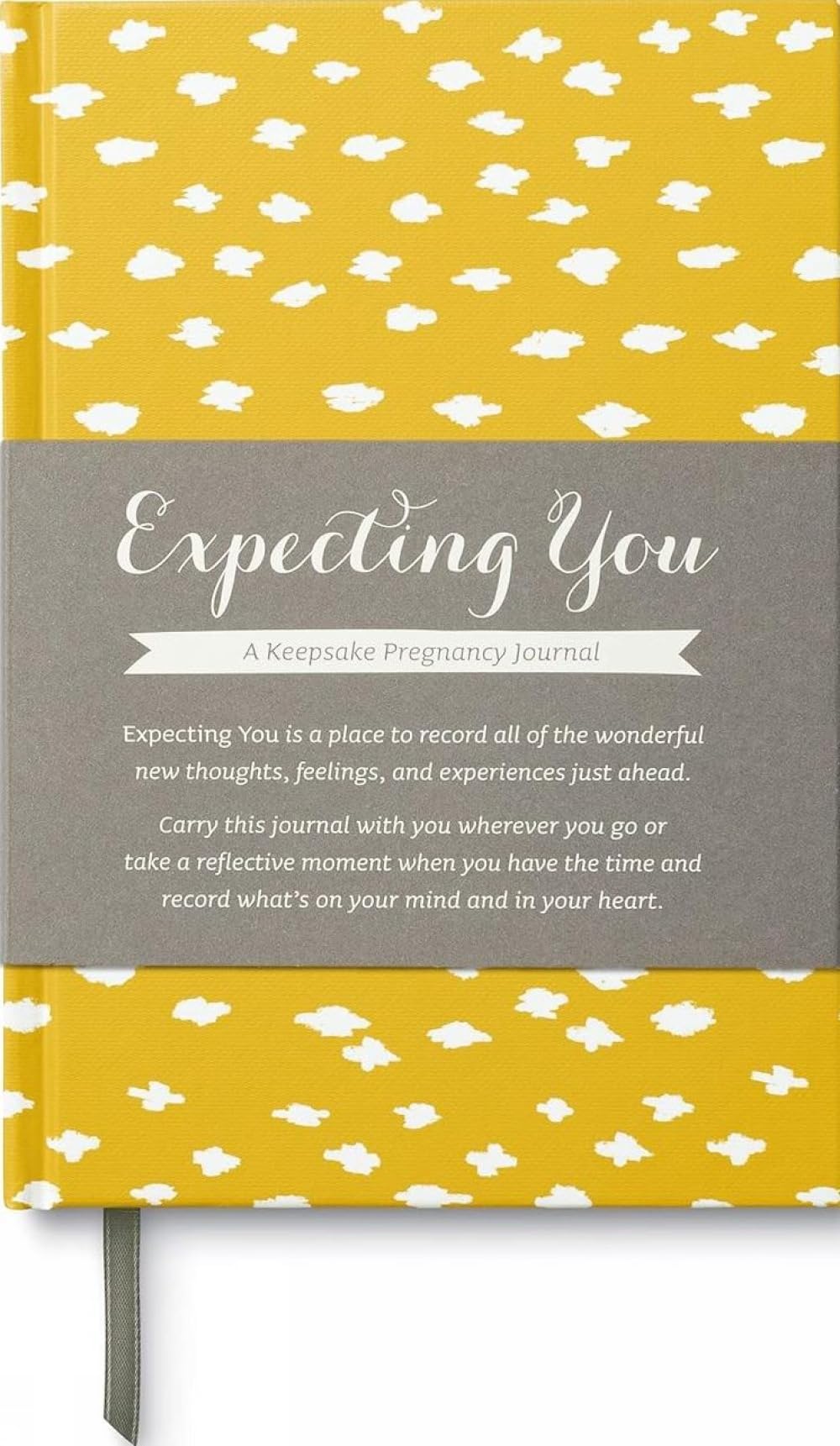
Expecting You is the budget pick, but it does not feel like a compromise on writing space. The 144 pages are compact at 5.75 by 8.25 inches, yet there is room for monthly reflections, prompts, quotes, and notes for a partner. If you want a journal you can carry in a tote and fill with words rather than photos, this is the one that makes the most sense.
The monthly structure is a big part of the appeal. It does not ask for a weekly check-in, which is realistic if your schedule is already full. The prompts are gentle and open-ended, and the quotes give the pages some personality without turning them into a baby book. We also appreciate the low-key size: it feels like a paperback you can keep in a bag, not an album that needs its own shelf.
The result is a journal that respects a busy schedule and a small budget. For a writer who wants space to think, it earns its place.
Pros
- 144 pages of writing space at a budget price
- Monthly format is easy to keep up with
- Compact size travels well
Cons
- No dedicated photo or ultrasound pages
- Monthly prompts can feel repetitive
We recommend this budget pick when words matter more than photos; it gives the most writing space here for the least money.
Peachly Pregnancy Journal – Best for Premium Gifting
Key Features
- Cover: Linen
- Pages: 110
- Packaging: Kraft gift box
- Page size: 7.7 x 9.5 in
- Price: Premium
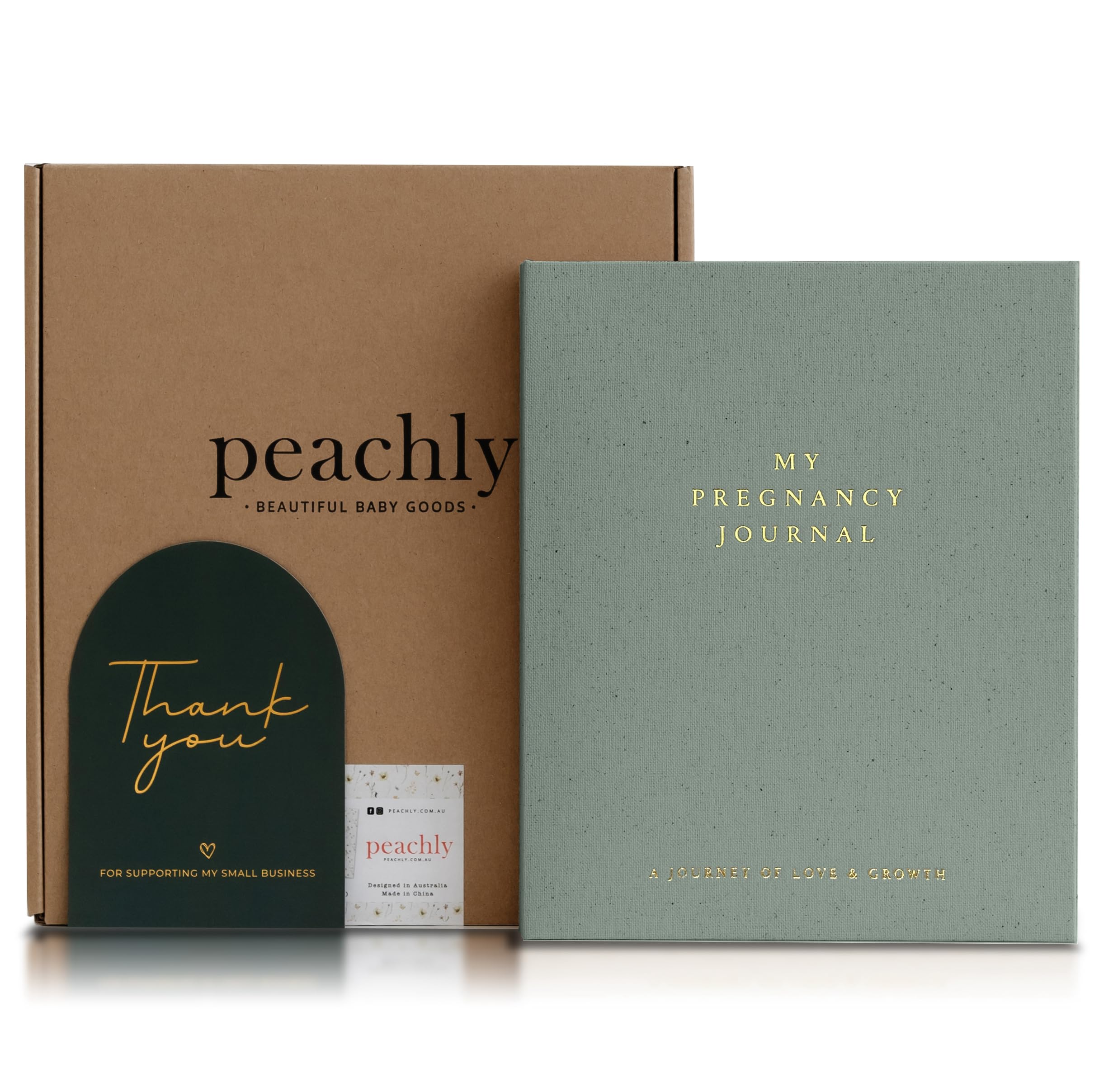
The Peachly journal arrives like a gift, because it is packaged like one: linen cover, gold foil lettering, hand-drawn illustrations, and a kraft box. That matters if you are buying for a baby shower or a first-time mom who will notice the object itself. The 110 pages are organized and pretty, with bump-photo spaces and checklists that keep the keepsake from becoming purely decorative.
We were struck by how calm the layout feels. The illustrations are a signature, but they do not crowd the writing space, and the 7.7-by-9.5-inch pages give you room for a proper entry. There are sections for finding out, ultrasound photos, and the practical checklists, plus a pocket at the back for extras. It is the most polished book here, and the one we hand over without adding a wrapping-paper upgrade.
This is the most giftable object in the group: the cover, illustrations, and packaging all feel considered. If you want a journal that looks beautiful before it is filled, this is the one. If you are buying for yourself and care mostly about page count and writing space, a simpler journal will do the job.
Pros
- Linen cover and hand-drawn illustrations feel premium
- Bump-photo spaces and checklists add structure
- Kraft gift box makes it presentation-ready
Cons
- Costs more than most journals here
We give this one when the journal itself should feel like a gift: its linen cover, hand-drawn pages, and keepsake box justify the premium.
Studio Oh! Bump for Joy – Photo Organization

Key Features
- Pages: 144
- Paper: 120 gsm acid-free
- Binding: Hardcover
- Pockets: 5 tabbed
- Price: Midrange
Five tabbed pockets are the reason to choose the Studio Oh! journal. Ultrasound prints, appointment cards, shower invitations, and the loose bits of paper that accumulate during pregnancy all have a home, and the 144 pages are organized enough to keep the book from turning into a folder. If your pregnancy paperwork is already taking over the kitchen counter, this is the most practical pick in the group.
The weekly planner pages cover appointments, notes, to-do lists, and bump progress, and there are spots for 30-plus photos. We like the hardcover and the 120 gsm acid-free paper, which make it feel like a book that can handle being handled. The family-tree and both-parent sections are a nice touch for couples who want to fill it in together, rather than making it a solo project.
It is a working journal more than a minimalist keepsake. The pockets, tabs, and family pages make it feel like a book you use, not just one you admire. For organizing the physical clutter of pregnancy, nothing else here does as much.
Pros
- Five tabbed pockets organize loose keepsakes
- 144 pages with weekly planning and photo spots
- Acid-free paper and hardcover feel substantial
- Sections for both parents
Cons
- Pockets add bulk to the book
- Some sections are first-pregnancy oriented
We recommend this for photo organization: five tabbed pockets and a sturdy hardcover make it the most practical working journal here.
Nuts & Bolts Pregnancy Journal – Minimalist Design

Key Features
- Style: Black and white
- Weight: 10.6 oz
- Package size: 8.54 x 8.03 x 0.75 in
- Price: Midrange
The Nuts & Bolts journal is for the person who winces at pastel booties. It is black and white throughout, with a clean, modern look that would not be out of place on a design bookshelf. The weekly structure is simple: a few lines for an update, a bump photo every three weeks, and a pocket in the back for extra prints.
What we like is the restraint. The prompts are enough to get you writing without dictating the tone, and the black-and-white pages make your own photos and handwriting the color. The 8.54-by-8.03-inch package is compact enough to carry, and the 10.55-ounce weight keeps it from feeling like a binder. It is a journal you can use without feeling like you are performing for an audience.
Restraint is the whole appeal. The pages leave space for your own words instead of filling every corner with prompts, and the black-and-white design will still look like you after the baby arrives. If you want a gender-neutral book that does not shout baby, this is the one we keep on the shelf.
Pros
- Black-and-white design is gender-neutral and modern
- Simple weekly prompts leave room for your own voice
- Back pocket holds extra photos
Cons
- Sparse guidance for checklist-minded planners
- Premium price for a simple format
We keep this one for minimalists: a gender-neutral, black-and-white book with just enough prompts and no babyish clutter.
How We Tested Pregnancy Journals
We built the shortlist by talking to parents and booksellers, reading reviews, and filtering for size, price, and whether the prompts covered the whole pregnancy rather than just the milestones. From there, my team and I tested 14 journals over eight months, keeping one on a nightstand, one in a tote, and one at my desk for the late-night entries I didn’t want to forget. We used each journal through real appointments, ultrasound days, baby showers, and ordinary Tuesday evenings when the only thing worth recording was heartburn and a name idea.
Quality showed up in small actions: I opened and closed each cover dozens of times, bent the spine to see whether it lay flat, wrote with gel and ballpoint pens to check bleed-through, and tossed a few into a bag to see whether corners crushed. For content, I followed a week-by-week prompt as written, noted where I had to flip ahead or hunt for space to tape in an ultrasound photo, and marked any page that felt too vague or too crowded to use. Appearance and giftability got the same treatment: I set each journal on a nightstand and a coffee table, then wrapped a few to see whether they felt presentable without extra ribbon.
Size and clarity were the deciding factors. I measured page size against a standard tote and a bedside shelf, then asked friends in different trimesters to open to a random page and tell me what they were supposed to write; prompts that needed a second read got marked down. I also compared price against page count, binding, and add-ons, but value came down to whether the journal felt substantial in the hand and asked questions I actually wanted to answer. The ones that stayed in rotation were the ones I reached for without a chore-like sigh.
How to Choose a Pregnancy Journal
The right journal is the one you will still fill in during the third trimester, so choose for the way you actually write, not the way you imagine you will.
Start with your realistic writing rhythm
Weekly journals ask for a short entry every week; monthly journals ask for more at a few checkpoints. The weekly format builds a richer record, but it also starts to feel like a chore if you miss a few weeks. Weekly works when a spread takes minutes, not a full evening. A monthly book is better for busy parents who want a few thoughtful entries rather than a diary.
Match the photo plan to the prints you keep
Ultrasound prints come in different shapes, and a journal’s photo spaces may not fit all of them. Check whether the book has dedicated photo pages, a pocket, or both. A scrapbook-style journal with 4×6 and smaller spaces is more useful if you plan to add bump photos; a text-led book is fine if you mainly want writing. If you are unsure, choose one with a pocket—loose scans are easier to store than to trim.
Decide how much structure you want
Checklists, appointment logs, and hospital-bag lists can be a lifeline in the third trimester, or they can make the book feel like homework. If you already use a pregnancy app for appointments, a simpler journal may be enough. If you want one paper place for everything, choose a planner-style book with medical notes and a hospital list. Look at the ratio of prompts to blank space before you buy.
Weigh page count against portability
A 196-page book can hold more, but it is also heavier and less likely to leave the house. A compact 76-page journal is easier to carry to appointments and may get filled more often. Count the weeks you will actually use, not just the total pages. For most pregnancies, a 90- to 130-page guided book is enough; go bigger only if you want first-year pages or lots of photos.
Choose a cover and tone you will still like later
Floral, minimalist, faith-based, and gift-boxed designs all change who the book suits. A gender-neutral cover is safer for a gift; a faith-based journal should be a deliberate choice, not a surprise. Binding matters too: ring-bound and spiral books lie flat for writing, while a standard book may need a desk. If the journal is a gift, check the presentation and the recipient’s taste before the page count.
Frequently Asked Questions
When should I start a pregnancy journal?
Start whenever you find out, even if that is already the second trimester. Begin at the week you are in, use the first page for a short recap of symptoms and appointments, and tuck earlier scan prints into a pocket rather than trying to reconstruct every week. A journal that is partly filled is still a keepsake; a blank one is not.
Can I use a pregnancy journal for a second pregnancy?
Yes, but buy a fresh copy if you want a separate record for each child; the prompts and photo spaces are organized around one pregnancy. If you reuse a book, check that it has enough blank pages for another round of weekly entries. Most journals are designed to be filled once, so a new copy is the simpler choice.
Is a pregnancy journal a good baby shower gift?
It can be, especially if you choose a gender-neutral cover and a format that matches the recipient’s style. A guided weekly journal suits a first-time mom who wants prompts; a minimal black-and-white book suits someone who dislikes babyish designs. Include a gift receipt so she can swap the format if she prefers monthly pages or a different binding.
What if I fall behind on weekly entries?
Do not abandon the book. Date the entry for the day you write, summarize the weeks you missed in a few lines, and pick up again at the current week. A journal with monthly pages or blank sections makes catching up easier; a strictly weekly book may leave gaps. The record is still useful, and gaps are part of the real pregnancy.
Final Verdict
The KeaBabies Inspire is the journal we recommend first. It gives you guided chapters, room for ultrasound prints, a keepsake envelope, and a ring-bound hardcover that lies flat—without the 196-page commitment of a book built to cover the first year too. For most first-time parents, that focus is the right one.
If you want a smaller book for weekly notes and photos, choose the ZIRI & ZANE. If you want one volume that keeps going after birth, choose the Bibi & Beau. Those are the alternatives that change the decision most.