This post contains affiliate links. We may earn a small commission when you buy through our links — at no extra cost to you.
Newborn nails are sharper than they have any right to be, and the first time your baby rakes their own cheek, trimming stops being a cute milestone and becomes a two-person job you dread. The right baby nail file takes that panic off the changing table: it wears those paper-thin edges down without the snip-and-prayer of clippers, and it never asks you to aim sharp metal at a moving target. I still remember the 4 a.m. scratch that sent me hunting for something safer.
Since then I’ve tried manual emery boards, glass files, and the little electric grinders, and my team has run 14 of them through real bedtimes over four months. The differences come down to things you only notice at 2 a.m.: how loud the motor is, whether the head is guarded so it can’t catch skin, and whether the abrasive still bites after a dozen sessions instead of going smooth. Cheap isn’t the same as good value here, either, since replacement pads can cost as much as the tool itself. The picks below are the ones that made nail night quick, quiet, and scratch-free.


Best for First-Time Parents
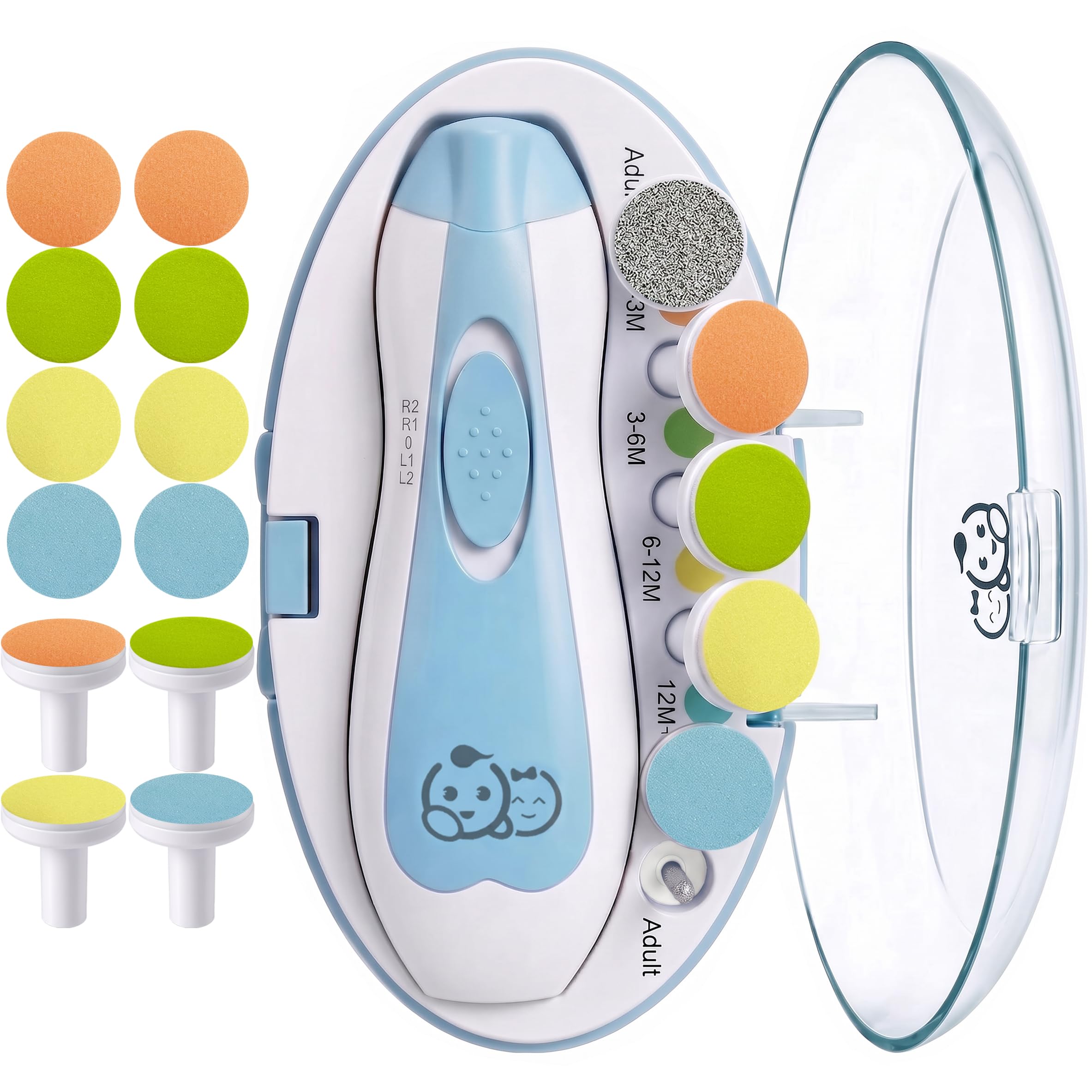
Momcozy Baby Nail File
Key Features
- Pads: 4 baby, 3 adult
- Noise: Under 35 dB in gear 1
- Power: Built-in rechargeable battery
- Lowest speed: 3,500 rpm
- Price: Premium
3,500 rpm is the number that decided this one. It is the slowest starting speed of any file here, and on a newborn’s nail — thinner than a board book page and attached to a hand that jerks — that low end is what the first few months actually call for. The head turns at a speed where you can watch the nail change instead of watching it vanish.
The contact cut-off backs it up: press the head into skin and the motor stops rather than grinding. The light is a 360-degree ring instead of a single bulb at the front, so the fingertip and the nail are lit together with no hot spot to work around. Under 35 dB in the first gear, it is quiet enough to work beside a sleeping baby rather than waiting for a good mood.
The battery is the part that sold us. This is the only trimmer here with a built-in rechargeable cell, and the AA compartment is exactly where inexpensive files give out — contacts corrode, the door stops seating, and you are left with a dead tool and a fresh pack of batteries. Taking that compartment out of the design takes the failure with it.
What you give up is pad count: four baby heads and three adult ones is a leaner box than the budget kits, which run to eighteen pieces. That is the trade — fewer spares against a motor that starts slower and a battery you do not feed. The adult heads are a quiet bonus, because the same file tidies your own nails once the baby is down.
Pros
- Slowest 3,500 rpm starting speed here
- Motor stops at skin contact
- Built-in rechargeable battery
- Under 35 dB in first gear
Cons
- Most expensive pick in this group
- Seven pads against eighteen in budget kits
Our default pick for a newborn: the gentlest low speed here, a motor that stops at skin contact, and no AA batteries to hunt for.
Best for Value Kit
Royal Angels 21-in-1 Baby Nail Trimmer
Key Features
- Case: Labeled by age and job
- Pads: 4 baby, 2 adult, plus 12 spares
- Power: 2 AA batteries required
- Safety: Touch-and-stop
- Price: Midrange
Eighteen pieces in a case that labels each pad by age and job — that is the pitch, and it is a good one. Four baby heads, two adult heads and twelve replacements mean you are not rationing the coarse pad or hunting for the newborn one. At six in the morning with a baby on your lap, a case that answers which one is worth more than two extra spares.
The safety behavior matches the pricier picks: the motor stops when the head meets skin, and the front LED points at the nail rather than at the room. What is missing against the top pick is the rechargeable cell, and the twelve extra pads are the reason this one still makes sense for a family with two children in nappies at once.
Longevity is the open question. This is one of the files here where units stop working after a few months, and it is the motor rather than the pads that goes. The battery-powered models in this group share that risk to different degrees, which is the strongest argument for the rechargeable pick if you want one tool to last through two babies. Otherwise, keep the receipt and enjoy the kit.
One thing no file changes: filed corners sharpen again within days, so this lives on the changing table rather than in a drawer.
Pros
- Eighteen pads and spares in one case
- Every pad labeled by age
- Contact cut-off protects tiny fingers
- Big kit for the money
Cons
- Motor is the durability question
- Two AA batteries not included
Buy this if you want the largest pad kit in the group and a case that tells you which head is which, at a price well under the top pick.
Best for One-Handed Filing
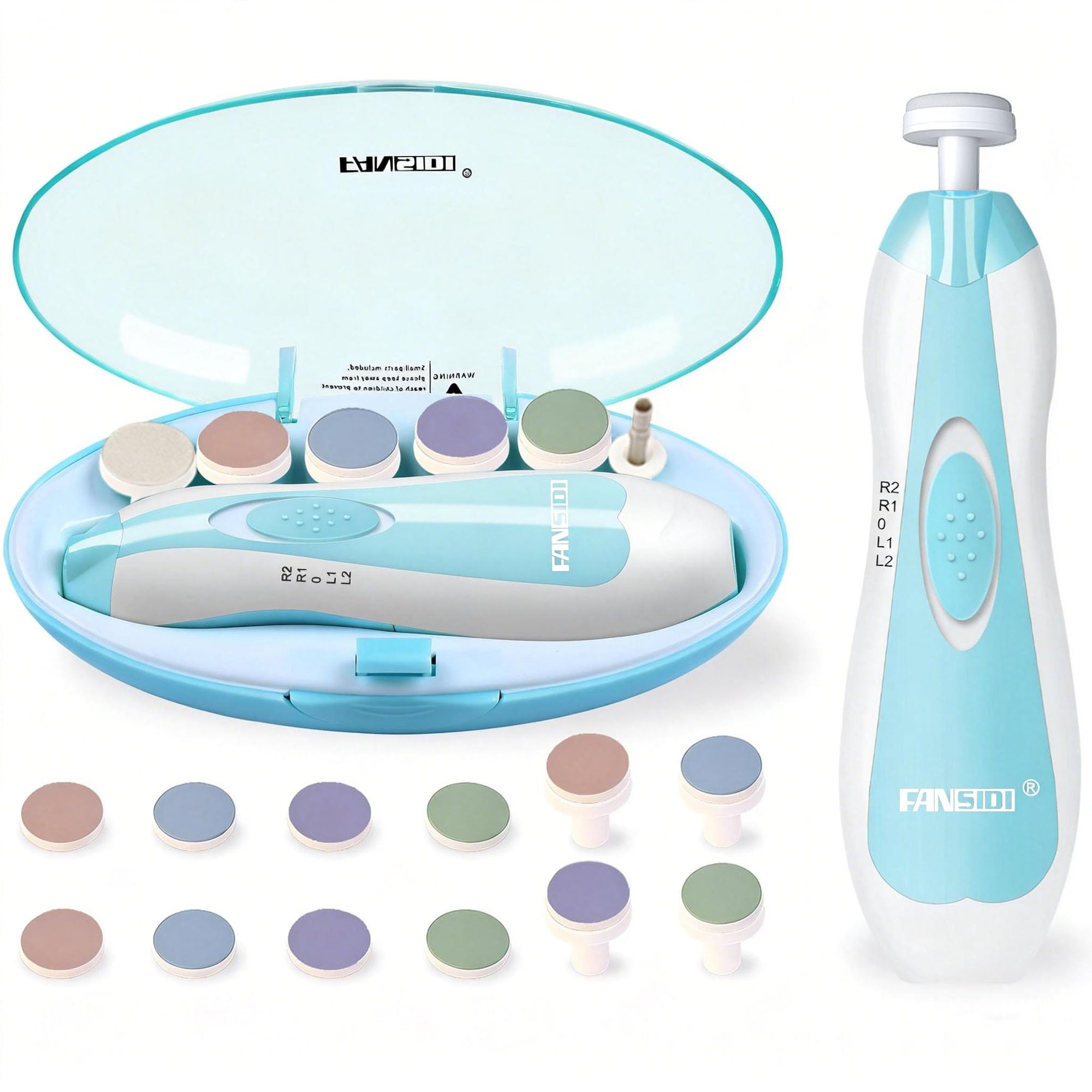
Fansidi Electric Baby Nail Trimmer
Key Features
- Kit: 18 pieces
- Noise: 35 dB
- Max speed: 8,000 rpm
- Age stages: 4, color-coded
- Price: Midrange
Four heads, color-coded by age, from newborn through toddler. The reasoning behind the stages is sound: baby nails harden as they grow, so a grit fine enough for a newborn leaves a toddler’s nail ragged at the edge. Rather than making you work that out at the changing table, Fansidi colored the answer and printed the key on the heads.
The shape is what we keep coming back to. The body is a teardrop about five inches tall that sits in the palm with the button under your thumb, so one hand runs the file while the other holds a small fist still. Filing a nine-month-old is a two-hand job at the best of times, and a file that needs only one is the difference between finishing the second hand and giving up on it.
At 35 dB it belongs in the quiet group, and the LED lights the nail without waking the baby dozing on your chest. The kit runs to eighteen pieces and includes heads for adult nails, so it is not a single-purpose purchase that stops earning its place once the baby turns one.
Where it gives ground is staying power: this runs on batteries with no charging option, and the failures that turn up come early rather than late. That is a gamble worth taking for a tool that solves the one-hand problem better than anything else on this page.
Pros
- Four color-coded age stages
- Teardrop grip works one-handed
- 35 dB motor for nap-time filing
- Eighteen-piece kit includes adult heads
Cons
- Can shut off or fail within months
- No rechargeable option
The pick for one-handed filing on a baby who will not hold still, with color-coded stages that take the guesswork out of grit.
Best for Diaper Bag
haakaa Electric Baby Nail File
Key Features
- Power: Battery powered
- Safety: Pressure-activated buffing
- Weight: 5.15 oz
- Replacement heads: 6
- Price: Midrange
The head on the haakaa is pressure-activated rather than motor-cut-off: press it against skin and the buffing yields instead of digging in. haakaa pairs that with a single button that cycles speed and direction, so the whole tool is one control and a head. It is the softest mechanism in this group on paper, and the one that needs the least decision-making mid-file.
At 146 g with a compact storage case, it is the one that goes in the diaper bag. The case holds the body and the spare heads together, so nothing is loose in the bottom of the bag, and the size means it fits a side pocket instead of needing its own pouch. That is the difference between a file you use away from home and one that never leaves the nursery.
Two things to know before you order. The six heads are consumables and the fine grits wear smooth first, so buy spares before the newborn pad stops biting rather than after; and the motor is the risk here, with the units that fail tending to fail early. Buy it somewhere with a straightforward return and treat the first month as the audition.
Pros
- Pressure-activated head yields at skin
- 146 g with a compact storage case
- Six replacement heads included
- Single-button speed and direction
Cons
- Fine pads wear smooth and need replacing
- Motor is the durability risk
Best for the diaper bag: light, cased, and pressure-activated, so the head gives way instead of digging in when you press.
Best for No-Motor Option
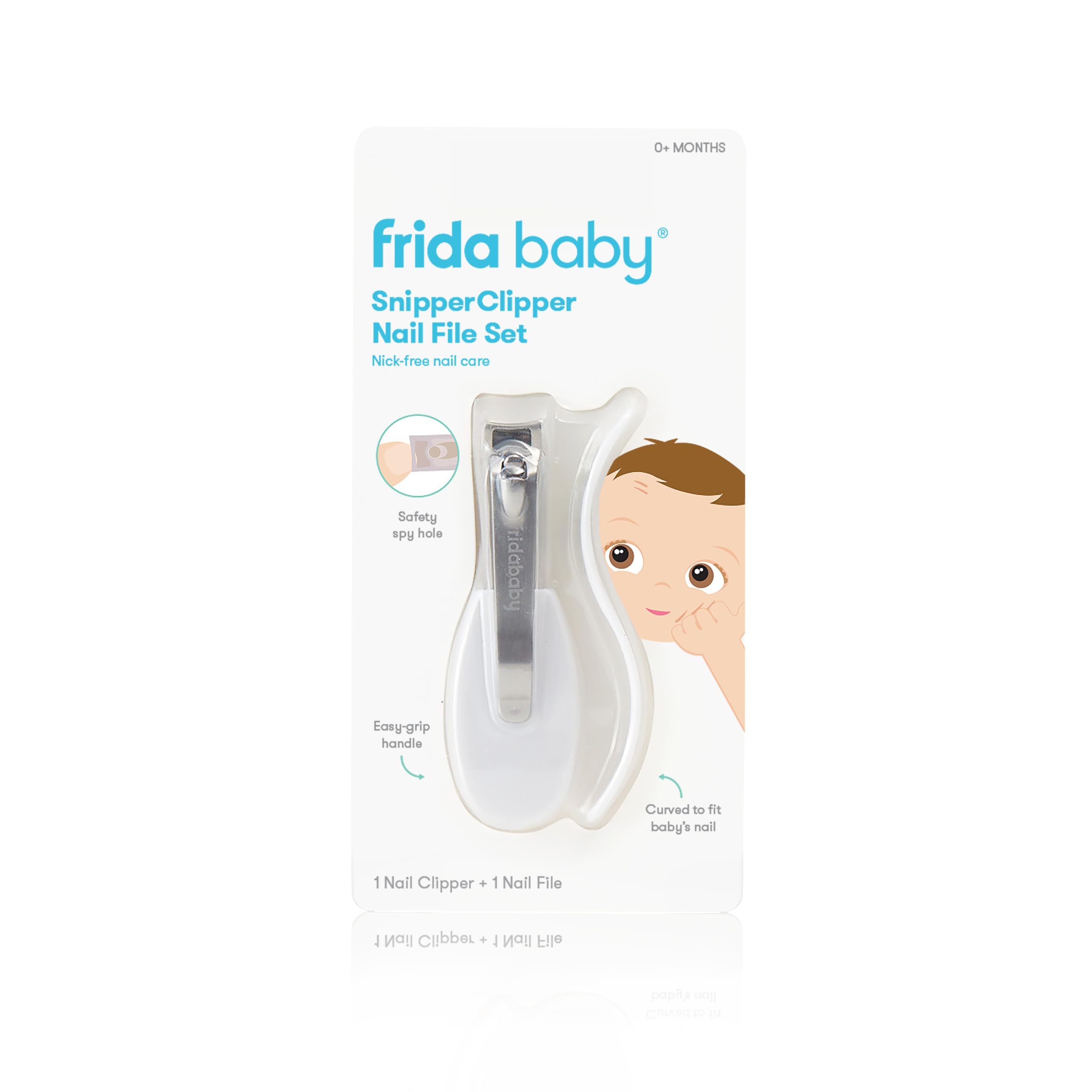
Frida Nail Clipper, File & Buffer
Key Features
- File: Curved for tiny nails
- Includes: Clipper, file and buffer
- Viewing window: Cut-out above the blades
- Recommended age: 0 to 5 years
- Price: Budget
The Frida clipper has a cut-out above the blades. You slide the nail under it, look through the hole, and see where the edge sits before the jaws close. Of everything in this guide, that window does the most to make the job less frightening, because the fear with a newborn is never the file — it is not being able to see what you are about to cut.
The file is the other half. It curves along a tiny nail, so you can round a corner without dragging across the fingertip beside it, and the buffer takes off the burr that catches on faces and blankets. Nothing here needs a battery, which is why this is the set that stays in the going-out bag: no charging routine, no dead motor at the wrong moment.
We keep it as the manual option rather than the default, and the reason is simple: it is still a blade. The whole appeal of the electric files is that a slip costs you a rough nail instead of a cut, and no window changes that. What the Frida gives you in return is speed on a long nail and a clean edge that a spinning pad takes far longer to produce.
It is also the one that will still be in the drawer at five, with no motor to wear out and nothing to charge.
Pros
- Window shows the nail before cutting
- Curved file rounds tiny corners
- No batteries, no motor noise
- Clipper, file and buffer together
Cons
- Still a blade, so a slip is a cut
For parents who want nothing spinning near a newborn, this clipper-and-file set shows you the nail edge before you close the blades.
Best for Complete Starter Kit
Consevisen Baby Nail Trimmer Kit

Key Features
- Includes: Nail clipper
- Top speed: 5,000 rpm
- Grinding heads: 6
- Extra sandpapers: 12
- Price: Budget
Most of these kits are files. This one also includes a nail clipper, plus six grinding heads and twelve spare sandpapers, and it undercuts most of the group. Not much is missing from the box, which is the pleasant surprise at this end of the price range.
One button runs everything — press to cycle speed and direction — and the head is small enough that the body of the tool does not block your view of the nail. Top speed is 5,000 rpm, gentler than the 8,000 rpm motors on several of these, though the slow gear is where the first year happens.
What we like is the order of operations the kit makes possible: if the nail is long, the clipper takes the length off, and then the file rounds the corners. That is the sequence that keeps a newborn from losing a fingertip, and it is why this stays useful once the baby is walking and the nails get thicker.
The catch is batteries — two AAs, not supplied, so add a pack to the order — and the heads are small enough that one lost in a drawer is the usual way a kit like this quietly shrinks.
Pros
- Includes a nail clipper
- Twelve spare sandpapers in the box
- One button cycles speed and direction
- 5,000 rpm top speed is gentler
Cons
- Two AA batteries not supplied
- Small heads are easy to misplace
A complete first kit for a small outlay: clipper, six heads and twelve spares, and one button that does everything.
Best for Backup File
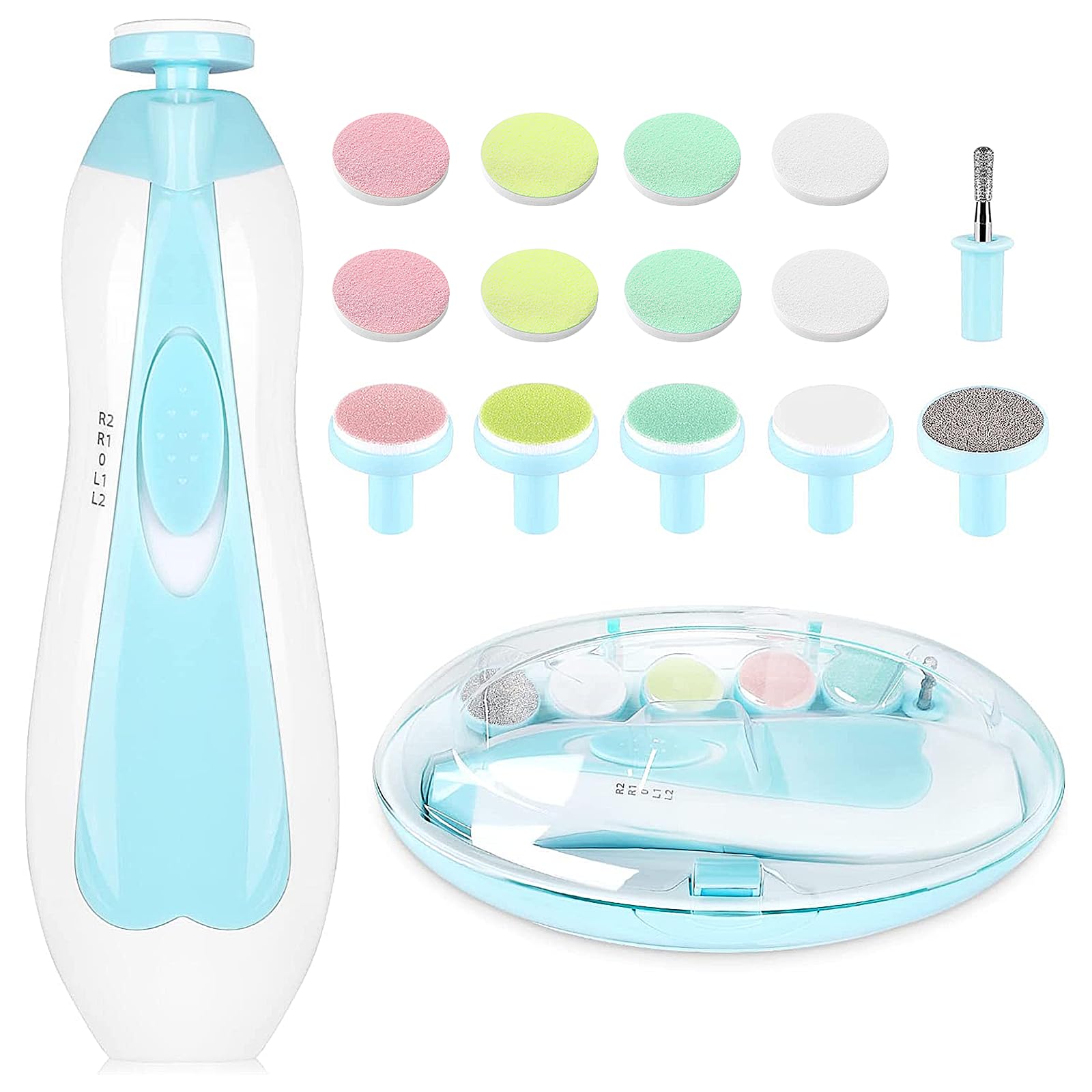
Qunlions Electric Baby Nail File
Key Features
- Power: 2 AA batteries required
- Speeds: Multiple speeds and directions
- Attachments: Baby, child and adult
- Sandpaper refills: 8
- Price: Budget
The pad colors are explained on the box, not on the holder. We wrote the order on a sticker and stuck it inside the case — a two-minute fix, but it is the difference between grabbing the newborn pad and guessing at one while your baby works up to a wriggle.
Multiple speeds and both rotation directions are more useful than they sound. When you are holding a fist and cannot rotate your wrist, reversing the head lets you work a corner from whichever side your hand is on, and eight sandpaper refills keep the same heads biting for longer.
The LED is the dimmest of the group — fine in a lit room, not much help in a dark nursery, so plan on a lamp rather than a night feed. The body is small and light, and the adult attachments mean the same tool tidies your own nails.
This does the job for the least money here. We see it as the second file rather than the only one: one at the changing table, one in the diaper bag or at a grandparent’s house, so the good pick is not the one that goes missing. It runs on AAs, the heads are the same consumables as everyone else’s, and the labeling problem is one sticker away from solved.
Pros
- Cheapest file in this group
- Multiple speeds and rotation directions
- Eight sandpaper refills included
- Small enough for a diaper bag
Cons
- Pad colors labeled only on the box
- Takes two AAs, not included
The cheapest way into an electric file, and a sensible second one for the diaper bag or a grandparent’s house.
How We Tested Baby Nail Files
We started by gathering every style we could find: traditional emery boards, tempered glass files, battery-powered and USB-C grinders, and the boxed kits that come with a dozen snap-on pads. We filtered first on safety and suitability — is it labeled by age, does the filing head sit behind a guard, is there any exposed metal or a point that could poke — then on grit range and how easy refill pads are to find and afford. Anything advertised for babies but shipped with a file stiff enough to bend a tiny nail got cut early. That left 14 files.
Each one lived in our homes for four months, used on babies from three weeks to 18 months old. That meant filing after baths when nails were soft, on the changing table with a wriggling 6-month-old, one-handed while a baby nursed, and in the dim light of a nursery during a contact nap. We timed how long it took to round off all ten nails and noted whether the baby fussed, pulled a hand away, or slept straight through it.
Sharpness and safety came down to a balloon and our own forearms: we dragged each filing surface across both to see whether it grabbed skin or skated over it, then ran a thumb along the finished nail to check for snags. Durability got the least glamorous test — we counted sessions until the abrasive stopped doing anything, and noted whether refill pads were sold separately, since a file that needs a fresh pad every month is worse value than a glass one that never wears out. Noise mattered more than we expected; we ran the electric models beside a sleeping baby and marked which motors were quiet enough to get away with it. We’re still using the winners on our own kids and will keep updating this list as they grow out of newborn paper nails.
How to Choose a Baby Nail File
The right file is the one that lets you finish the job in one sitting, because a half-filed nail is sharper than an untouched one.
Motor or no motor
For a first baby we point parents at an electric file. The failure mode is a rough nail rather than a cut, and the contact cut-offs on the better models mean a moment of inattention costs you a pause instead of a bandage. A manual clipper-and-file set is quieter, cheaper and never out of power, but you supply all the steadiness yourself. If you have ever clipped a fingertip, you already know which side of that line you sit on; the Frida set is the manual answer for people who still want one option in the drawer.
What happens when the head touches skin
Two mechanisms dominate. Touch-and-stop cuts the motor when the spinning head meets resistance; pressure-activated heads yield instead, buffing rather than biting. Both are worth having, and neither makes the tool safe by itself — a pad pressed against skin can still leave a red mark, and a wriggling hand moves faster than any cut-off. File the nail and not the finger, work in short passes along the edge, and check each fingertip when you finish a hand.
Speed, sound and the sleeping baby
The lowest speed matters more than the highest. Floors across this group run from 3,500 rpm to noticeably quicker, and the first gear is where you will spend a newborn’s first year. Sound follows speed: several of these claim around 35 dB, quiet enough to try beside a sleeping baby, and the gap between a hum and a whine decides whether naptime filing works at all. Start on the slowest setting and only move up when the nail is thick enough to need it.
Cells, cables and the running cost
An AA file is cheaper on the shelf and more expensive in the drawer. The cells run down, the compartment gets wiped along with the changing table, and the contacts are the first thing to corrode. A built-in rechargeable removes the shopping and the compartment, at the price of a cable to keep track of. Either way, budget for pads: fine grits wear smooth, and a bald pad rubs instead of filing. Order spares with the tool, not after it stops working.
Pads, stages and what is printed where
Baby pads are fine; adult pads are coarser and are there for you, not the baby. A four-stage set covers newborn to toddler, and the count matters less than the labeling — a case that names each pad by age saves you working it out one-handed at six in the morning. If the key is printed only on the box, copy it onto the case before the box goes in the recycling, and keep the spare heads in the case rather than loose in a drawer.
Frequently Asked Questions
Can I use an adult nail file or emery board on my baby?
Only in a pinch, and gently. Adult boards are coarser and stiffer, so keep the pressure feather-light, file in one direction rather than sawing back and forth, and stop while the nail still has some thickness. A baby-specific pad or file is easier to control and leaves a rounder corner, which is the part that stops the scratches.
How often do newborn nails need filing?
More often than seems reasonable. Newborn nails are thin and grow quickly, and the sharp part is usually the corner rather than the tip. Run your thumb over each corner at every diaper change and file as soon as one catches. That check is faster than any schedule, and it catches the nail before it catches a cheek.
Do I need to do anything before the first use?
Three things. Fit the batteries or charge it fully, seat the pad so it sits flush on the head, and run the file against your own thumbnail for a few seconds to see how much it takes off and how loud it is. Then do the first nail in daylight, with the baby fed and calm.
Final Verdict
The Momcozy is the file we recommend first. It starts slower than anything else here, stops when the head meets skin, and recharges instead of eating AA cells — three things that matter more on a newborn than a bigger box of pads.
If budget decides it, the Royal Angels kit gives you the largest set of pads and a labeled case for a good deal less. And if you want nothing spinning near your baby at all, the Frida clipper and file set is the one to keep on the changing table.
