This post contains affiliate links. We may earn a small commission when you buy through our links — at no extra cost to you.
Nobody warns you that a newborn’s nails are basically tiny paper cuts waiting to happen. The first time my daughter raked her own cheek open at three days old, I learned why parents obsess over clippers that feel safe in a sleep-deprived hand. A good pair has to do more than cut — it needs a guard or rounded tip, a grip that won’t slip when a baby twists, and blades sharp enough to snip cleanly instead of tugging. The right one turns a two-person wrestling match into a thirty-second task, and it shouldn’t cost more than a few coffees.
Over four months, we put 14 baby nail clippers through the wringer — after baths, on the changing table, during contact naps, and one-handed at 3 a.m. We judged them on safety, ease of use, how cleanly they cut, and whether they held up after repeated drops and wipe-downs. The pattern was clear: the best were the ones I could operate half-asleep without my heart rate spiking. Here are the pairs that earned a permanent spot in the nursery drawer.



Best for Most Families
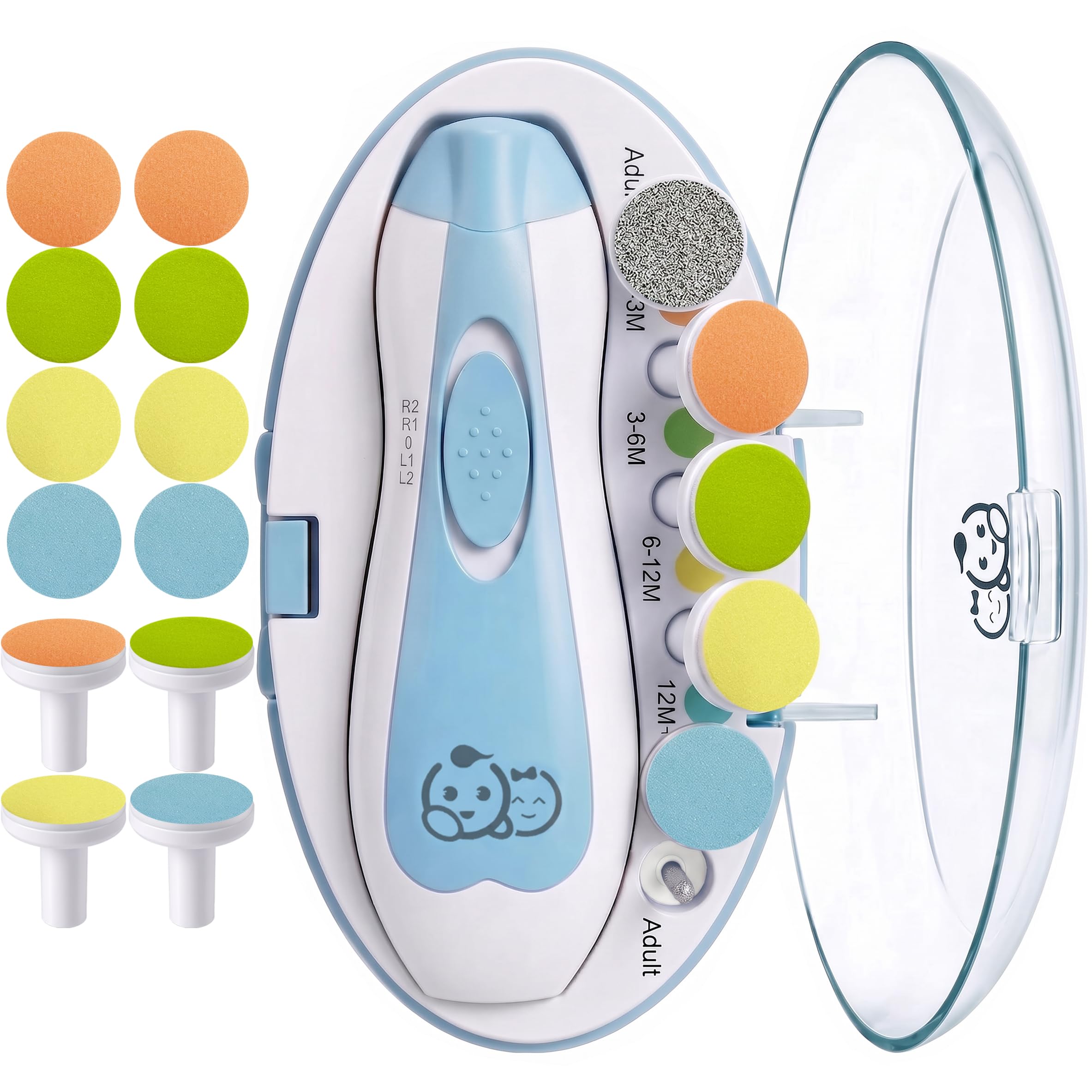
Royal Angels Electric Nail Trimmer
Key Features
- Pads: 6 pads plus 12 replacements
- Power: 2 AA batteries (not included)
- Age range: 0 months and up
- Skin contact: Touch-and-stop
- Price: Midrange
The feature that earns this set its place is the one you hope never to need: press the spinning pad against skin and it stalls instead of buffing. With a newborn, the moment you lose your nerve is the moment the tool touches something it shouldn’t, and a head that stops rather than sands gives you a half-second to pull back.
The rest of the kit is built around not having to remember things at two in the morning. Six pads cover four baby grits and two adult ones, twelve spares come in the box, and the case labels every pad by age and function. Those twelve spares are the difference between a tool you keep using and one that goes blunt in a drawer.
It’s also quiet enough to use during a feed, and the soft front LED is aimed at the nail rather than into the baby’s face. We’ve done a whole hand in a dim nursery without waking anyone fully, which is not something we can say for every tool here.
So why is this our default over the more expensive electrics here? Because it removes both things that make the job hard at once: the fear of drawing blood, and the guesswork of which grit to use. The result is a nail that’s rounded rather than sliced, and a rounded edge is what stops the face-scratching that sent you looking for a clipper in the first place. Keep the age labels facing up in the case; it sounds trivial until the third night, when you’re doing this one-handed and can’t remember which color is the newborn pad.
Pros
- Pad stops on skin instead of grinding
- Labeled case sorts pads by age
- Twelve spare pads in the box
Cons
- Motor can quit within a few months
- Runs on 2 AA batteries, not included
Our pick for most families: the pad that stalls on skin turns a two-person wrestling match into a thirty-second job you can do one-handed.
Best for Night-Time Filing
Momcozy Electric Baby Nail File
Key Features
- Pads: 7 pads (4 baby, 3 adult)
- Noise: Under 35 dB on low
- Power: Built-in rechargeable battery
- Speed range: 3,500–8,000 rpm
- Price: Premium
The built-in rechargeable battery is the reason this one lives on the changing table rather than in a drawer. There’s no battery door, no pair of AAs to discover missing at ten at night, and nothing to unscrew before you can deal with a nail that has already scratched a cheek.
Four speeds start at 3,500 rpm, which is slow enough that the pad takes a soft newborn nail down gradually instead of in one bite, and the head stalls on skin the same way the Royal Angels does. Seven pads cover baby through adult, so the tool gets a second life on your own nails once the toddler years are behind you.
It’s the quietest of the electrics here, rated below 35 dB on the low gear, and quiet is not a spec-sheet nicety in this category. It’s the difference between filing during a nap and waiting for the nap to end, and that difference decides how often the job actually gets done.
All of which makes it the priciest electric here, and we think the money is well spent if the tool will pass through two children, or if you plan to use it on yourself. What settles it for us is the light ring: it wraps around the head, so your own hand doesn’t throw the shadow you’re trying to see past.
Pros
- Rechargeable, so no AA batteries to buy
- 3,500 rpm low gear for newborn nails
- Under 35 dB, quiet enough for naps
Cons
- Priciest electric in this set
Buy this one if you want the quietest, most self-sufficient electric here; the built-in battery and the slow low gear are what you’re paying for.
Best for Manual Trimming
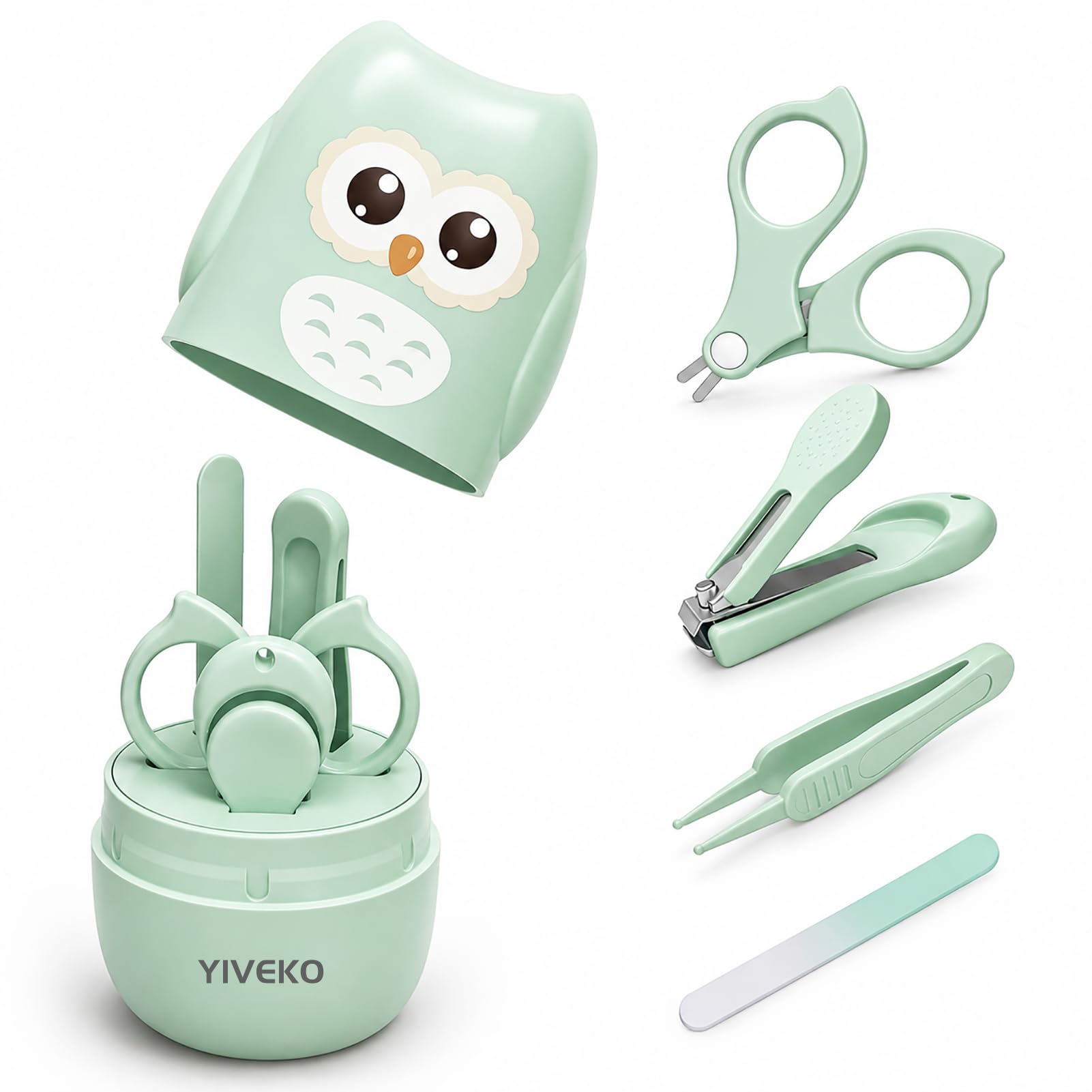
YIVEKO 4-in-1 Baby Nail Kit
Key Features
- Weight: 4.9 oz
- Case size: 2.56 x 2.56 x 4.25 inches
- Kit contents: Clipper, scissors, tweezers, glass file
- Price: Budget
The little scissors are the piece we keep reaching for. Rounded safety tips, a non-slip grip, and straight blades that take a corner in one snip where a curved clipper wants a second pass, and a second pass is exactly when a baby’s hand moves.
As a set, this is the strongest manual option here: a clipper with curved blades, those scissors, tweezers and a glass file, all in a case that closes. Manual tools ask more of you than an electric file, since you need decent light and a steady hand, but they finish a nail in seconds rather than minutes and there’s nothing to charge.
Everything except the file is stainless, the whole thing wipes clean, and nothing in the case has a motor to fail. That’s the quiet argument for buying manual: it’s the same tool on the tenth child as on the first, and the glass file rounds a clipped corner without the fuzzy edge an emery board leaves behind.
Pros
- Scissors trim corners in one snip
- Four tools in one closing case
- Nothing to charge or replace but the file
Cons
- Owl case is bulky for a pocket
For parents who want to see the blade and feel the cut, this is the manual set we recommend; the little scissors do the work a clipper can’t.
Best for Newborn Clipper
Safety 1st Steady Grip Clipper
Key Features
- Size: 0.98 x 3.54 x 1.57 inches
- Handle: Extra-large soft-touch
- Storage: Folds closed
- Blade material: Stainless steel
- Price: Budget
There’s a size mismatch at the heart of this chore: a nail a few millimeters wide, a hand that won’t hold still, and clippers built for an adult’s grip. The Steady Grip fixes the last part. The soft-touch handle is genuinely oversized, so your whole hand wraps it instead of pinching it between two fingertips, and that’s the difference between a controlled cut and a hopeful one.
The blades are stainless and the clipper folds into itself, which is why one ends up in the diaper bag and stays there. Our reservation is the blade grind: sharpness varies from unit to unit, and a dull one creases the nail instead of cutting it. Open the package and test it on your own nail first, then decide whether it goes anywhere near a newborn.
Pros
- Oversized handle steadies a shaky grip
- Folds up for the diaper bag
- Stainless steel blades and body
Cons
- Single clipper, no file or case
The big rubbery handle turns a shaky grip into a steady one, which is exactly what a wriggling newborn demands from a plain pair of clippers.
Best for Precise Clipping
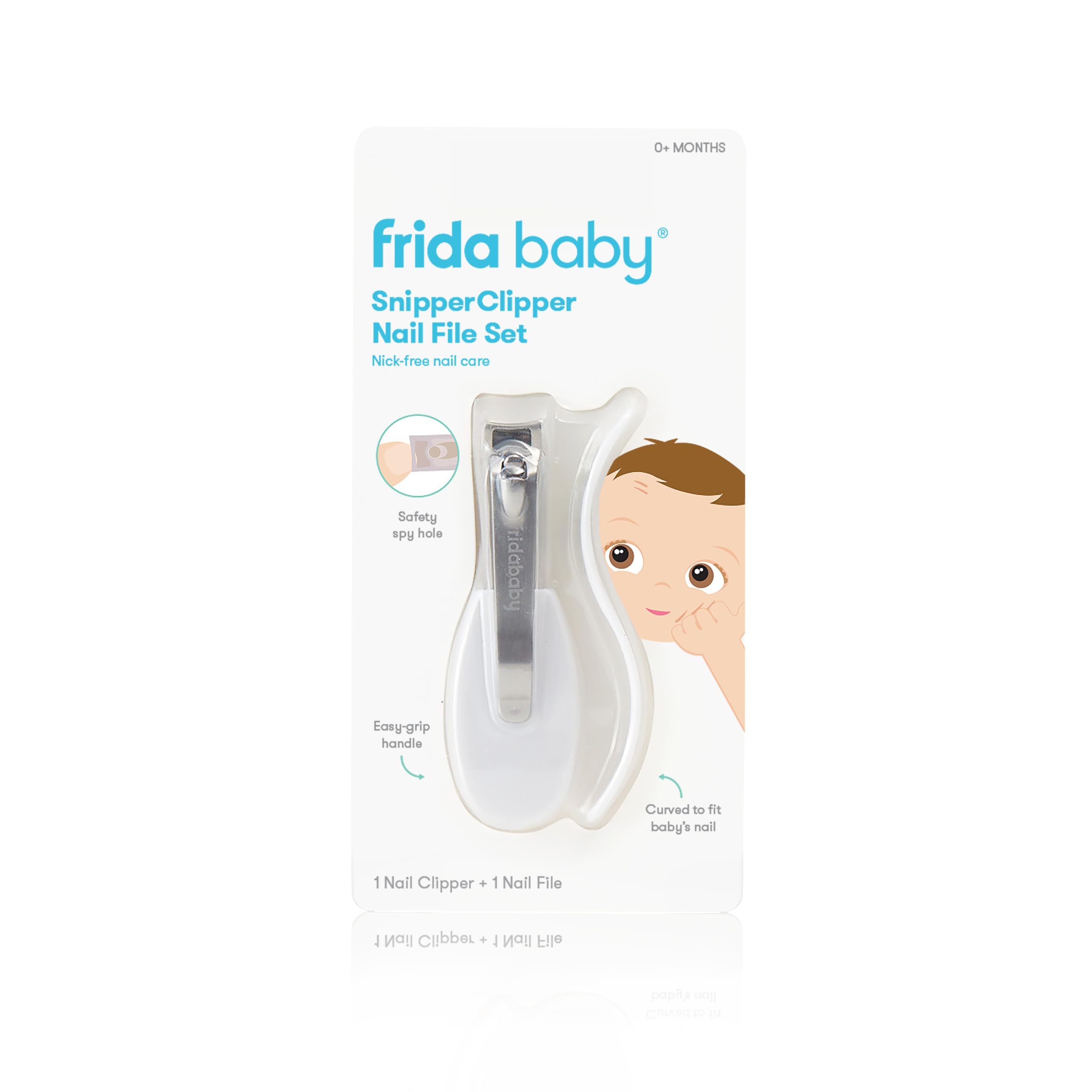
Frida Nail Clippers, File & Buffer
Key Features
- Blades: Curved, overlapping
- Included: Clipper, file, buffer
- Age range: Newborn and up
- Visibility: Spyhole above the blades
- Price: Midrange
The cut-out above the blades is the whole idea. You line the nail up in the window, see exactly where the blade sits, and close. That means you can take a nail shorter than you dare with an opaque clipper, and the corners are where newborn nails do their damage.
The blades are curved and overlapping, sized for a newborn’s fingertip, and the file that comes with it curves to follow the nail so you can round a corner without dragging across the skin beside it. Clipper, file and buffer live in a set small enough to keep in a pocket of the diaper bag.
It takes a couple of nails to find the angle, because the grip wants your fingers further back than an adult clipper does, and the first attempts feel clumsy. Then it clicks, and the window stops being a feature and becomes the reason you can cut close without flinching. Warm, damp nails straight after a bath cut more cleanly with it, which matters here because the window makes you braver than you’d otherwise be.
Pros
- Spyhole shows the nail before you cut
- Curved file follows tiny nails
- Clipper, file and buffer together
Cons
- Manual only; the sightline is the safeguard
The window over the blade is the reason to buy it: you can see the nail edge and stop before you’re too deep into it.
Best for Budget Electric
Consevisen Electric Nail File Kit
Key Features
- Light: Front LED
- Power: 2 AA batteries (not included)
- Speed: Up to 5,000 rpm
- Kit contents: Clipper, 6 heads, 12 sandpapers
- Price: Budget
What you get for the least money of any electric here is a file, six grinding heads, twelve sandpapers and a manual clipper in the same box. The clipper matters more than it sounds, because a file rounds an edge beautifully but takes forever to shorten a nail that’s already long, and the clipper does that part in one squeeze.
The file itself is a one-button tool: press to cycle speeds, flip the switch to reverse direction, and a front LED lights the nail. It runs to 5,000 rpm, spins quietly enough to use on a sleeping baby, and the pads are color-coded by age so the newborn one is easy to find in a hurry.
One technique note before you start: angle matters. Held flat, the pad smooths the nail; tipped, it can leave a ridge you’ll feel the next time the baby rakes your neck. Two or three light passes at a shallow angle on the slow gear give a better result than one firm press. Do that and this is the best value of the electrics here, and the only one that hands you both tools.
Pros
- Electric file plus a manual clipper
- Quiet at a controllable speed
- Twelve spare sandpapers included
Cons
- Runs on 2 AA batteries, not included
Our budget electric: it files gently, runs quiet, and throws in a manual clipper for the length a file can’t take off quickly.
Best for Nap-Time Filing
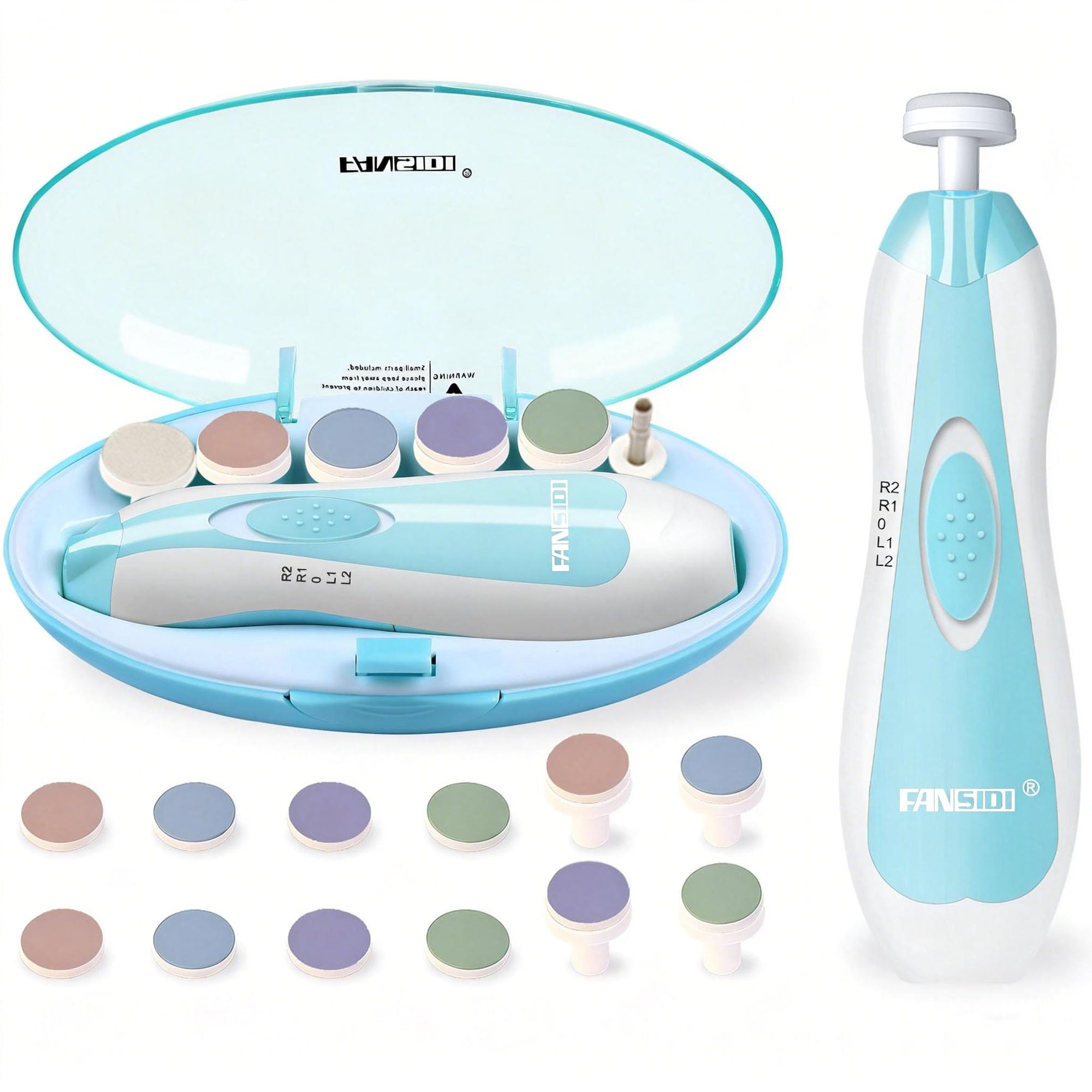
Fansidi Electric Nail Trimmer
Key Features
- Noise: 35 dB motor
- Speed: Up to 8,000 rpm
- Height: 5.1 inches
- Stages: 4 color-coded grits
- Price: Midrange
The honest thing to say first is that the motor is the weak point. A file that quits after a few weeks is worse than one that never worked, because by then it’s part of the routine and the alternative is a pair of clippers you’ve stopped trusting.
Set that aside and it’s a capable, fast filer. Four color-coded grit stages track newborn through toddler, so the pad matches the nail instead of you guessing at it, and the motor turns to 8,000 rpm, which is enough to reshape a nail in a couple of passes rather than a couple of minutes.
It runs at 35 dB, and the body is a slim teardrop about five inches tall that sits in one hand while the other holds a small fist. We filed during feeds with this one, and a sleeping or nursing baby is the only reliable window we ever found for the job.
So it’s quick, quiet and easy to hold one-handed, and it’s the one to pick if speed is what you’re after and you’re willing to gamble on the electronics. If you want the tool you’ll still have in three years, the Royal Angels or the Momcozy are the safer bets here, even though both are slower to use.
Pros
- Four color-coded grits by age
- 8,000 rpm removes nail quickly
- Slim body suits one-handed work
Cons
- Batteries drain fast with regular use
A quick, quiet filer for nap-time trimming; buy it knowing the motor is the part most likely to let you down.
Best for Simple One-Button
haakaa Electric Baby Nail File

Key Features
- Heads: 6 replacement heads
- Light: Built-in LED
- Power: Battery powered
- Weight: 5.15 oz
- Price: Midrange
One button does nearly everything: press to cycle the speeds, flick the switch to reverse direction, and the head stalls when it meets skin. That’s the entire interface, which is why this is the one we pass to a babysitter or a grandparent without standing over them.
It’s light at 146 g, the case holds the tool plus six replacement heads, and the built-in LED shines down the head so you can see the nail without turning on a lamp. Filing is gentle and a little slow, which is what you want on a newborn and what will try your patience on a fidgety two-year-old. The pads are the consumable: they load up, stop cutting, and replacements are a running cost, so order spares with the tool rather than after the third nail.
Pros
- One-button controls, nothing to learn
- Stalls on skin, gentle on newborns
- Light 146 g with a travel case
Cons
- Pads wear out and replacements add up
One button, a light and a pad that stalls on skin: a gentle filer simple enough to hand to a grandparent without a briefing.
Best for Diaper Bag
Safety 1st Fold-Up Clippers, 2-Pack

Key Features
- Blades: Curved stainless steel
- Storage: Fold-up handles
- Age range: 1 month to 7 years
- Pack size: 2 clippers
- Price: Budget
The arithmetic is the appeal. Two clippers in one pack means one lives in the diaper bag and the other stays in the nursery drawer, so you stop conducting a search every time a nail catches on a sleeve. For the least money here, that’s the failure mode of baby nail care actually solved.
They’re better than the outlay suggests: curved clipping edges sized for a baby’s fingertip, an easy-grip handle, stainless blades that fold into the body. Sharpness is the pleasant surprise, since one clean pass takes the tip with no sawing, and no sawing matters most with a hand that’s already pulling away.
Nothing here helps you see or smooth, though. It’s a clipper, and the rest is on you, which is the trade for a pack you can scatter around the house and the car. Pair it with a glass file from your bathroom drawer and you’ve covered the job for less than most single tools in this guide.
Pros
- Two clippers, one for the diaper bag
- Curved edges sized for baby nails
- Fold-up handles pack flat
Cons
- No file, light, or case in the pack
Cheap, sharp and folding: buy the two-pack so a pair lives in the diaper bag and you stop hunting for one when a nail snags.
How We Chose and Tested Baby Nail Clippers
We started by pulling together every baby nail clipper we could find from major retailers and parent forums, then narrowed the list by price, blade material, safety features like rounded tips or built-in guards, and handle shape. We prioritized a mix of scissors-style and traditional clippers, plus a few with built-in guards, so we could compare how each felt on actual newborn and toddler nails. Anything with loose hinges or flimsy plastic in owner reviews was cut before testing.
Over four months, we used the 14 finalists on my daughter and two neighbor babies, from newborn through toddlerhood. Each clipper was used after bath time when nails were soft, on the changing table during diaper changes, and one-handed during contact naps and middle-of-the-night feedings. We noted whether the tip felt secure against a wriggling finger, whether the blades bit cleanly or dragged, how much pressure the handle needed, and whether a single hand could open and close the lever.
Safety was the first filter: we checked every guard and tip against a squirming hand and flagged any clipper that could pinch skin. We also dropped each pair onto a tile floor from counter height, wiped them with baby-safe disinfectant daily, and watched for rust, dulling, or loose rivets. At the end, we asked whether each clipper was worth its cost compared with the cheapest pair that worked — and whether we’d trust it on a sleeping baby without waking them.
How to Choose Baby Nail Clippers
The tool that makes this job easier isn’t the sharpest or the fanciest one; it’s the one that lets you see the nail edge and stop before you’re too deep.
Clippers cut, files sand
These are two different jobs, which is why so many of us end up owning both. A clipper takes length off in one squeeze and leaves a corner with an edge; a file rounds that edge so it can’t catch on a face. Electric files are the forgiving half of the pair, because the pad stalls on skin instead of slicing it, but they are slow at shortening a long newborn talon.
That’s the trap: buying a file expecting it to do a clipper’s work in one pass. If you want a single tool, buy a clipper and a glass file. If you want the calmest possible first year, buy the file and keep a clipper for length.
Visibility is the safety feature
Every manual clipper cuts where you can’t quite see, and the ones that solve it do so differently: a spyhole above the blade, a fold-away magnifier, an LED at the head. A magnifier only helps if it’s clear and sits out of the way of your fingers, which is the risk with the fold-away kind.
Before the first nail, hold the tool under the lamp you’ll actually use at night. If you can’t make out the pink line where the nail meets the finger, change the tool or change the light.
Speed, skin contact and noise
On an electric file, the lowest gear is the one you’ll use: a newborn nail is soft and gives up material quickly, and a slow head does the job without heat or a jump if the pad slips off the nail. Look for a head that stops when it meets skin, and test it on your own finger first, because the feature is only useful if it engages under light pressure.
Noise matters more than it sounds. The best window for trimming is a nap or a feed, and a motor that startles a sleeping baby closes the window you were counting on.
Batteries, pads and what it costs to keep
Two running costs hide behind the purchase. Several files here take AA cells, which is fine if you keep spares in the case and miserable if you don’t, while a rechargeable asks for one more cable and no midnight search. The pads are the other cost: the abrasive loads up and stops cutting, so order spares with the tool rather than after the third nail.
Keep the adult heads or pads separate from the baby ones. They’re coarser than a newborn’s nail needs, and the labeling exists so you don’t have to remember which is which.
Grip, grit stages and how long it lasts
A handle you can hold with your whole hand beats one you pinch between two fingers, especially with a baby who is twisting away. Age-coded grits and labeled cases sound like marketing until you’re doing this one-handed in low light, and then they’re the difference between the right pad and a guess.
Longevity is the weak spot across this category, and it’s the motor that goes rather than the blades. Buy somewhere with an easy return and keep the packaging until you’ve used it a few times.
Frequently Asked Questions
Can I trim my newborn’s nails while they sleep?
Yes, and for a lot of us that’s the only time it works. A quiet electric file is the tool for it; a clipper works too if you have a light you can aim without waking them. Do one hand per nap rather than all twenty nails, and stop when they start to stir. A half-finished hand is easier to come back to than a startled baby is to settle.
How often do newborn nails need trimming?
More often than most parents expect. Newborn nails grow quickly and go sharp at the corners long before they look long, so check every few days by running the back of your hand over the fingertip; if a corner catches, it’s time. Filing the corners between trims keeps the scratches down without shortening the nail each time.
Can I use my own nail clippers on the baby?
No. Adult clippers are bigger, flatter-curved and sized for a nail several times wider, so the blade covers more of a tiny fingertip than you can control. An adult emery board is also coarser than a newborn’s nail needs. Keep a baby-specific clipper in the diaper bag so you’re never tempted to improvise with what’s in the bathroom.
Final Verdict
Buy the Royal Angels if you want one tool that handles a newborn, a toddler and the nerves of a first-time parent. The pad that stops on skin changes how the job feels, and the labeled case takes the guesswork out of a trim at two in the morning.
If a battery door is the last thing you want to think about, the Momcozy charges instead and runs quieter. And if you want to see the blade and feel the cut, the YIVEKO kit is the manual set we recommend.
