This post contains affiliate links. We may earn a small commission when you buy through our links — at no extra cost to you.
A learning tower is supposed to bring a toddler up to counter height without turning the kitchen into a climbing gym. The right one feels like a sturdy piece of furniture that puts your child at eye level with the mixing bowl; the wrong one wobbles when a 2-year-old leans over the edge, pinches fingers at the hinges, or takes up so much floor space that you fold it away and stop using it. What it fixes is simple: it lets a small child stir, rinse, and “help” safely instead of balancing on a dining chair or being hoisted onto your hip.
In eight months, we tested 10 learning towers, and the differences show up in the joints, footprint, and how steadily a toddler climbs in. One thing first-time buyers don’t anticipate: a tower that fits at 18 months may feel cramped by age three, so adjustable platform height and a generous standing area matter as much as the safety rail. The picks below stayed steady through daily kitchen use—and I didn’t dread folding or moving them.




Best for Most Kitchens
Guidecraft Classic Kitchen Helper
Key Features
- Footprint: 23 x 23 in
- Weight limit: 125 lb
- Certification: GREENGUARD Gold
- Platform heights: 15 in or 18 in
- Price: Premium
The hinge is what keeps this tower in the kitchen rather than the garage. Guidecraft’s fold is the smoothest in this group — the frame collapses to a shallow slab against a wall and stands back up with one push, and we could do it one-handed with a toddler on a hip. That is the difference between a tower you use daily and one you stop bothering with.
Two platform heights, 15 and 18 inches, put a small toddler and a four-year-old at the same 36-inch counter without a wobble. The birch plywood and hardwood frame is finished well enough that you will leave it out when you forget to fold it, the GREENGUARD Gold certification is a genuine comfort in a room where food is prepared, and the five-year limited warranty is the longest of any tower here.
Our one reservation is the non-slip mat on the platform. It is a separate pad rather than a textured surface, and when it lifts at a corner a sock foot slides. Ours needed pressing back down more than once; check it before a child climbs in rather than after. The Kitchen Helper Keeper that ships with it adds another layer of security across the back.
Everything else held up. The 23-inch platform is wide enough for two small children to share, the rails sit at a height a two-year-old can grip, and nothing flexed when we leaned on the frame. What you do not get is a party trick — no chalkboard, no conversion into a table. You are paying for joinery, a certificate and a warranty, and for most families that is the right trade.
Pros
- Folds one-handed into a shallow slab
- Two platform heights at 15 and 18 inches
- GREENGUARD Gold finish and five-year warranty
- Wide 23-inch platform with back and side rails
Cons
- Non-slip mat can lift and let a sock foot slide
- Costs the most of the towers here
Our default pick: it folds one-handed, the platform sits at a toddler-safe 15 or 18 inches, and the birch build carries a five-year warranty.
Best for Leaning Toddlers
Ocodile Standing Tower with 3 Bars
Key Features
- Age range: 18 months to 5 years
- Footprint: 18.5 x 15.7 in
- Weight limit: 150 lb
- Overall height: 35.4 in
- Price: Midrange
Three bars, not one. The Ocodile puts a rail across the back and around both sides, with the top bar lifting out when your child stops needing it. For a toddler who treats the platform as a launch pad, that extra enclosure is the whole point — we noticed it most when a child leaned back to watch something happening on the counter behind them.
The two steps carry clear non-slip strips that kept their grip in socks, which mattered more than we expected; a socked toddler on bare wood is a slide waiting to happen. It is pine, 35.4 inches tall, 18.5 inches deep and 15.7 wide, so it sits against the counter without blocking the aisle, and it went together in one sitting with the included Allen key, screws, floor pads and instructions that actually match the parts.
The behaviour to know about is backward rock. Side to side the frame is planted; push off the counter edge with both hands and it can tip back, so the anti-tip base only earns its name with the feet flat on the floor and the tower snug against the counter. Parked that way it stayed put through a busy baking session.
Take the bars out once your child is climbing confidently and it becomes a plain, good-looking wooden tower rather than a cage — which is why it sits near the top of this set on longevity, and why we did not file it as a toddler-only buy.
Pros
- Bars enclose the back and both sides
- Non-slip strips on both steps
- Tools, floor pads and clear instructions included
Cons
- Can rock backward when a child pushes off the counter
The three removable bars make this the tower we point to for a toddler who leans and climbs before they are steady on their feet.
Best for First Tower
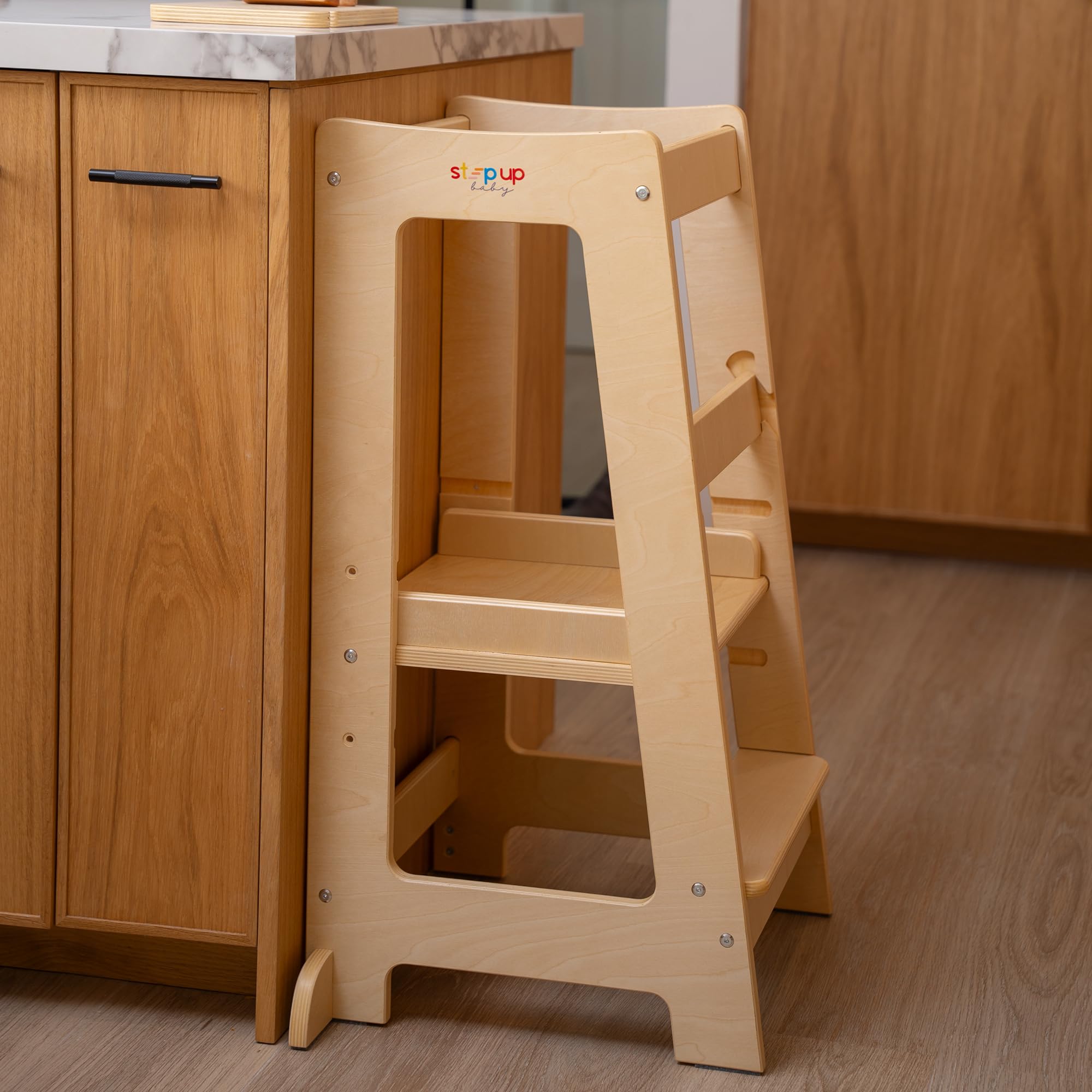
Stepup Baby Wooden Toddler Tower
Key Features
- Tower weight: 14.3 lb
- Weight limit: 110.2 lb
- Overall height: 33.46 in
- Platform heights: 12.4, 15, 17.5 in
- Price: Midrange
At 6.5 kg this is one of the lightest wooden towers here, and that cuts both ways. Moving it between the kitchen and the bathroom takes one hand; it also means a determined toddler can shove it across a wood floor, so it wants to live against something solid rather than in the middle of the room.
The platform drops to 12.4 inches, lower than anything else in this group, which is why we point to it for a child still small enough to be swallowed by a 15-inch step. Three settings — 12.4, 15 and 17.5 inches — take them up to counter height over a couple of years, and the birch frame stands 33.46 inches tall on non-skid feet.
It comes with a child-safe knife and a chopping board, which is more useful than it sounds: there is something to do on the platform instead of a parent saying don’t touch. What we minded is the finish. The wood is unsealed, so a raspberry or a marker leaves a mark a wipe will not lift. Clean it the same day and it is fine; find it the next morning and it is not.
The 50 kg limit is the lowest of these, though a toddler is nowhere near it, and the standing plate needs to be seated properly — pushed home it is secure, but a plate that has not dropped into its recess can shift underfoot. Worth a glance each time you carry it back into place.
Pros
- Lowest platform setting here at 12.4 inches
- Ships with a child-safe knife and chopping board
- Light enough to carry one-handed between rooms
Cons
- Unsealed wood stains from berries and marker
- Platform insert can shift if it is not seated
A first tower for a small toddler: the platform drops to 12.4 inches and it ships with a child-safe knife and board, so there is a job waiting up there.
Best for Small Kitchens
Little Partners Explore ‘N Store
Key Features
- Folds: Yes
- Weight limit: 150 lb
- Platform levels: Four
- Overall dimensions: 22.28 x 19.56 x 33.5 in
- Price: Premium
Twenty-two inches deep, under 34 tall, and it folds. In a kitchen where the tower has to live beside the island rather than in the middle of the floor, that combination is the entire argument for the Explore ‘N Store — we could slide it out of the walkway without moving a stool.
The compact size is why we kept coming back to it. Four platform levels start around 12 inches, so it works from a young two-year-old upward, and the fold is a genuine one: flat enough to stand behind a door or tuck beside the fridge. Assembly is numbered and quick, and the frame is light enough to reposition with one hand.
Our reservations are the finish and the base. The painted surface chipped at the edges on ours in a way the bare-wood towers did not, and the footprint is narrow enough that a toddler leaning hard on the counter can lift the far side. Kept on a level floor with the frame snug against the counter, it stays put through a full pancake morning.
For a calm climber in a small kitchen this is the tower we recommend, and it is the one that disappears most completely between uses. If your child treats rails as a challenge rather than a handhold, one of the wider towers here is the safer buy.
Pros
- Folds flat into a small kitchen
- Four platform heights from about 12 inches
- Numbered parts and quick assembly
Cons
- Narrow base can lift when a toddler leans
- Painted finish chips at the edges
For a kitchen with more traffic than floor space, this compact folding tower is the one we reach for, provided your toddler is a calm climber.
Best for Tight Storage
HBTower Foldable Toddler Tower
Key Features
- Tower weight: 10 lb
- Weight limit: 250 lb
- Overall height: 37 in
- Folded thickness: 3.3 in
- Price: Budget
Folded, this is a three-inch slab, and that number is the reason to buy it. The listed folded size is 39.8 by 18.5 by 3.3 inches, and at 10 pounds you can carry it one-handed to the closet, the car or a grandparent’s kitchen. It opens with a press of the pedal and a click, and it locks there — no wrestling with it while a toddler waits.
It also asks nothing of you. No assembly out of the box, no finish to protect, no pad to reseat. The steel frame is rated to 250 pounds, so it doubles as an adult step for the top shelf, and the safety rail lifts out when your child outgrows the need for it. Between the two steps and the rail, a two-year-old has three points to hold on the way up.
The front rail is the compromise: it sits low enough that a taller toddler catches their shins on the way in, and we watched a child negotiate it rather than stride through. The steps are metal rather than wood, which is fine in socks and brisk on bare feet in January.
What it is not is furniture. The frame looks like equipment, it folds like a ladder, and the flat metal steps will not win an interior-design argument. What it is, is the tower that survives a small kitchen, a rented flat, or a house where nothing stays in one place for long.
Pros
- Folds to 3.3 inches and weighs 10 pounds
- Arrives assembled, no tools needed
- 250-pound rating takes an adult’s weight
Cons
- Front rail catches taller toddlers at the shins
Folds to a three-inch slab, arrives assembled and takes a 250-pound adult — the one we name when the tower has to vanish after breakfast.
Best for Bathroom Sink
Onasti 3-Step Toddler Stool

Key Features
- Modes: Three-step, two-step, chair
- Footprint: 17.7 x 17.3 in
- Weight limit: 150 lb
- Overall height: 28.3 in
- Price: Budget
The panel on top turns. Three steps become two, or the whole thing becomes a low chair with a backrest, and that convertible trick is the most useful thing about this Onasti: the same stand gets a toddler to the sink at two and gives them somewhere to sit at four.
At a bathroom sink it is exactly right. Three wide steps, high sides and double armrests give a two-year-old a handhold on the way up, the BPA-free plastic is rated to 150 pounds, and the whole thing wipes down in seconds — which matters more in a bathroom than anywhere else in the house.
It is also light enough that a three-year-old can drag it from room to room, which is charming right up until it is halfway down the hall. Assembly is quick and the parts line up; the top step lifts out without taking the frame apart.
We keep it on the shortlist for the potty-training and teeth-brushing years rather than for cooking. If standing at the kitchen counter is the ambition, one of the taller towers here is the purchase; if the bathroom is the battlefield, this is the simplest thing that works.
Pros
- Right height for a bathroom sink
- Converts to a two-step stool and a chair
- Wipes clean and moves between rooms
Cons
- Tops out below kitchen counter height
The bathroom-sink and potty-training stand we keep recommending — the right buy for teeth and handwashing, the wrong one for cooking at the counter.
Best for Tight Budgets
INNOD Adjustable Toddler Tower

Key Features
- Frame: Steel and wood
- Weight limit: 150 lb
- Platform settings: Three
- Overall dimensions: 15.7 x 18.7 x 35.3 in
- Price: Budget
A wooden platform and steps held in a steel frame, 35.3 inches tall, with three height settings. There is no hinge, no chalkboard and no second life as a chair; this is a tower that does the one job and puts the rest of its budget into height.
The dimensions are the interesting part. At 15.7 inches deep and 18.7 wide it is narrow enough to stand in a galley kitchen without cutting the walkway in half, and tall enough that the platform reaches a standard counter. The 150-pound rating matches most of the wooden towers here.
We came away thinking the essentials survive at the bottom of this group’s price range: a rail at the right height, a platform that does not flex under a shifting toddler, and a frame that stayed square after assembly. What you give up is everything else — the finish is plain, there is no folding, and the styling will not be mistaken for furniture.
One thing to sort out before you order: three settings, but no published platform heights, so check the tower against your own counter — especially an island built higher than the standard 36 inches, where the platform will leave a child reaching up rather than working level.
Pros
- Full counter height at the lowest spend here
- Three platform settings
- Narrow 15.7-inch depth for galley kitchens
Cons
- No folding and no convertible modes
The least expensive route to a full-height tower with an adjustable platform — you give up folding and finish, not height.
Best for Small Homes
DGD Convertible Toddler Tower

Key Features
- Age range: 18 months to 6 years
- Footprint: 22.4 x 15.35 in
- Converts to: Table with backrest
- Overall height: 34 in
- Price: Budget
Fold it, flip it, and the tower becomes a low table with a backrest; there is a chalkboard panel on the side. It is the only tower here that keeps earning its floor space once your child would rather sit at the counter than stand at it.
As a tower it is 34 inches tall with a 22.4 by 15.35-inch footprint and three steps. It stands solidly — the panels are thick, the parts lined up, and the instructions are the logical kind where the pictures match the pieces. Assembly took us one sitting with no swearing.
The finish is where it loses ground. The rails and step edges arrived rough on ours, rough enough that we sanded before letting a barefoot toddler climb in, and the bare wood drinks up anything wet or colorful. Neither is unusual at this end of the group, but both are jobs you do before the first use rather than after.
We recommend it for one specific household: the one where a tower and a play table would otherwise compete for the same corner. In a house with room for both, a fixed tower is the more solid choice for the standing job; where space is the constraint, this is the sensible compromise.
Pros
- Converts from tower to table and chair
- Chalkboard panel children actually use
- Thick panels and a solid stance
Cons
- Rough edges and splinters out of the box
The one here that turns into a table and chair, which makes it the pick for a small home — if you are willing to smooth the edges first.
How We Tested the Best Learning Towers
We started with a shortlist of learning towers sold by established children’s furniture brands, filtered for adjustable platform heights, safety rails, weight limits, counter-height fit, and whether they folded or converted. We cut anything with vague stability claims or hardware that looked undersized for a toddler’s lean. Then we brought 10 towers into real kitchens for eight months, rotating them through morning cereal, weekend baking projects, and dishwashing duty.
Stability was the first thing we watched. We had toddlers climb in and out on their own, lean over the rail to reach the sink, and shift their weight from one foot to the other while we stood nearby; we also nudged each tower with a hip to see how much it rocked. For safety and child-friendliness, we checked gaps around hinges and platform edges, looked for sharp corners, and noted whether the first step was low enough for a 2-year-old to manage without a boost. We timed how long it took one adult to fold and unfold each model, then stored it between the counter and wall to see how much floor space it really saved.
Durability and quality came down to repeated use: loose screws, wobbly joints, finish that showed every wipe, and whether the tower still felt solid after months of daily climbs. We also judged fit at the counter—whether the platform put a child at a comfortable height for mixing, whether the standing area felt roomy enough for a growing toddler, and whether the footprint blocked cabinets. Value was never just the lowest price; it was how much sturdiness, safety, and foldability you got for the space and money.
How to Choose a Learning Tower for a Toddler
The most useful thing to know is that a tower’s overall height tells you almost nothing — the platform height and the way the base behaves under a leaning toddler decide whether it works in your kitchen.
Match platform height to your counter, not the frame
Most kitchen counters sit at 36 inches. A toddler needs the platform somewhere around 17 to 18 inches to stand at one comfortably, which is where the taller towers here land. The overall height on a listing is usually several inches more, because it includes the rails over a child’s shoulders — a 35-inch tower is not automatically a counter-height tower. Under about 15 inches you are buying a bathroom-sink stand or a first tower for a very small child; the Stepup Baby’s 12.4-inch setting is the lowest here and is meant for exactly that.
Check the counter you will actually use. An island built higher than standard, or a thick butcher-block top, can leave a child at chin height, and no platform setting fixes that.
Stability is about the base and where you park it
Every tower here is freestanding, and none of them is stable in the abstract. Stability is a relationship between the base, the floor and the counter: a wide, heavy base resists a child pushing off the counter edge, while a light or narrow one can lift at the back. That is the trade you accept for a folding or compact model.
Push the tower snug against the counter so the counter takes the lean, keep all four feet flat on a level floor, and wipe grit off the pads. A tower that walks a few inches away from the counter is a tower that will rock.
Rails decide how much you can relax
Back and side rails stop a toddler stepping sideways off the platform; a removable top bar makes it easier for a child to climb in and out alone. Which you want depends on the child rather than the kitchen. A cautious two-year-old does better with more enclosure — the Ocodile’s three bars exist for that — while a confident four-year-old will climb over whatever you leave in the way.
Most of these towers let you take the bar out once a child is steady. Buy for the toddler you have now, not the one you expect in a year.
Folding and footprint: measure the fold, not the claim
Folding helps only if the folded shape suits where you will put it. A tower that folds to three inches thick still needs somewhere to lean it, so measure the gap beside the fridge or the height of the closet shelf before you count on it. In a galley kitchen, a smaller footprint matters more than a thinner fold.
And expect a folding frame to give up a little rigidity to its hinge. If your toddler leans hard on the rails, a fixed frame like the INNOD’s is the more solid choice.
Finish and cleaning: wood, paint or plastic
Unsealed wood stains, and berries, marker and tomato sauce do not come out once they are in. Sealed or painted wood wipes clean but chips at the edges where children climb in. Plastic wipes clean fastest of all, and looks like plastic.
If the tower will be used for actual cooking, pick a sealed or plastic surface and plan to wipe it the same day. If you want it to still look like furniture in a few years, expect to sand and re-oil the bare-wood models.
Frequently Asked Questions
What’s the difference between a learning tower and a step stool?
A learning tower is a step stool with a platform at counter height and rails on three sides, so a toddler can stand and use both hands instead of balancing. The rails are the point: an ordinary two-step stool puts a child at the same height with nothing between them and the floor.
If you only need a child to reach a bathroom sink, a shorter stand does the job — the Onasti tops out at 28.3 inches. If the goal is cooking at the counter, you need the full-height platform.
What age can a toddler start using a learning tower?
Most of these are rated from 18 months, and a few run to five or six years. The real gate is whether your child can climb in and get down without help; until then you are lifting them in and out, which is fine and tiring.
Start on the lowest platform setting with the top bar in place, and take the bar out only when they are steady on their feet.
Can I use a learning tower at the bathroom sink?
Yes, and you do not need a second piece of furniture. A tower that reaches a 36-inch kitchen counter will also reach a bathroom vanity, though the child ends up standing higher above the basin than they need to.
A shorter stand is easier to carry down the hall and puts a toddler closer to the right height for teeth and handwashing, so if the bathroom is the main job, buy for that height.
Final Verdict
The Guidecraft Classic Kitchen Helper is the tower we point most families to. It folds one-handed, holds two platform heights at 15 and 18 inches, carries GREENGUARD Gold certification and a five-year warranty, and it is built from hardwood and birch plywood rather than pine. The one habit it asks for is checking that platform mat before a child climbs in.
Two alternatives change the answer. If your kitchen has more traffic than floor space, the Little Partners Explore ‘N Store folds smaller and stands narrower. If the tower has to disappear entirely between meals, the HBTower folds to three inches and arrives assembled. Both give up some solidity to do it.
