This post contains affiliate links. We may earn a small commission when you buy through our links — at no extra cost to you.
A swing set arrives as a stack of lumber, a sack of bolts, and a drawing that leaves out the step where you needed a second person. Then it eats a weekend, and the real question starts: is the thing you bolted together in July still plumb and solid next spring? What a good set actually buys you is quieter than that — kids who go outside without being asked, and a backyard that stays in use from the bucket-swing years straight through to the ones where they’re too cool for it and then suddenly aren’t.
I’ve watched a bargain set turn into a wobbling, splintering mess in a single season, and I’ve watched a well-built one get handed down to a neighbor’s family with the original hardware bag. Over the past eight months our team built and lived with seven swing sets, and the pattern was clear early: the ones worth the money had straight wood, honest weight limits, and instructions that didn’t lie. The mistake first-time buyers make most is measuring the box instead of the swing arc — you need clearance in front, behind, and overhead, plus a level patch for the legs. The picks below are the sets that stayed tight, stayed fun, and didn’t send anyone back to the hardware store twice.




Best for Most Families
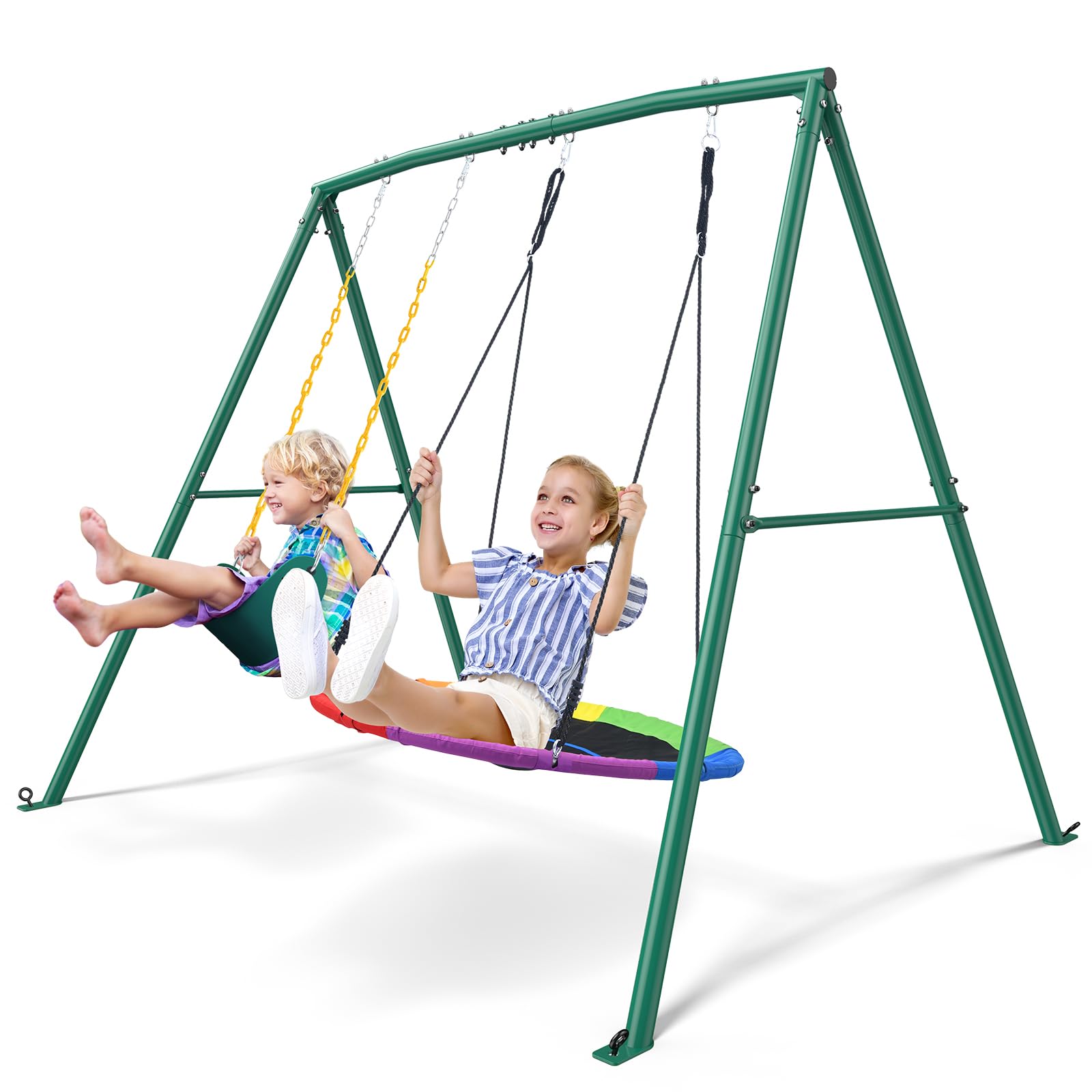
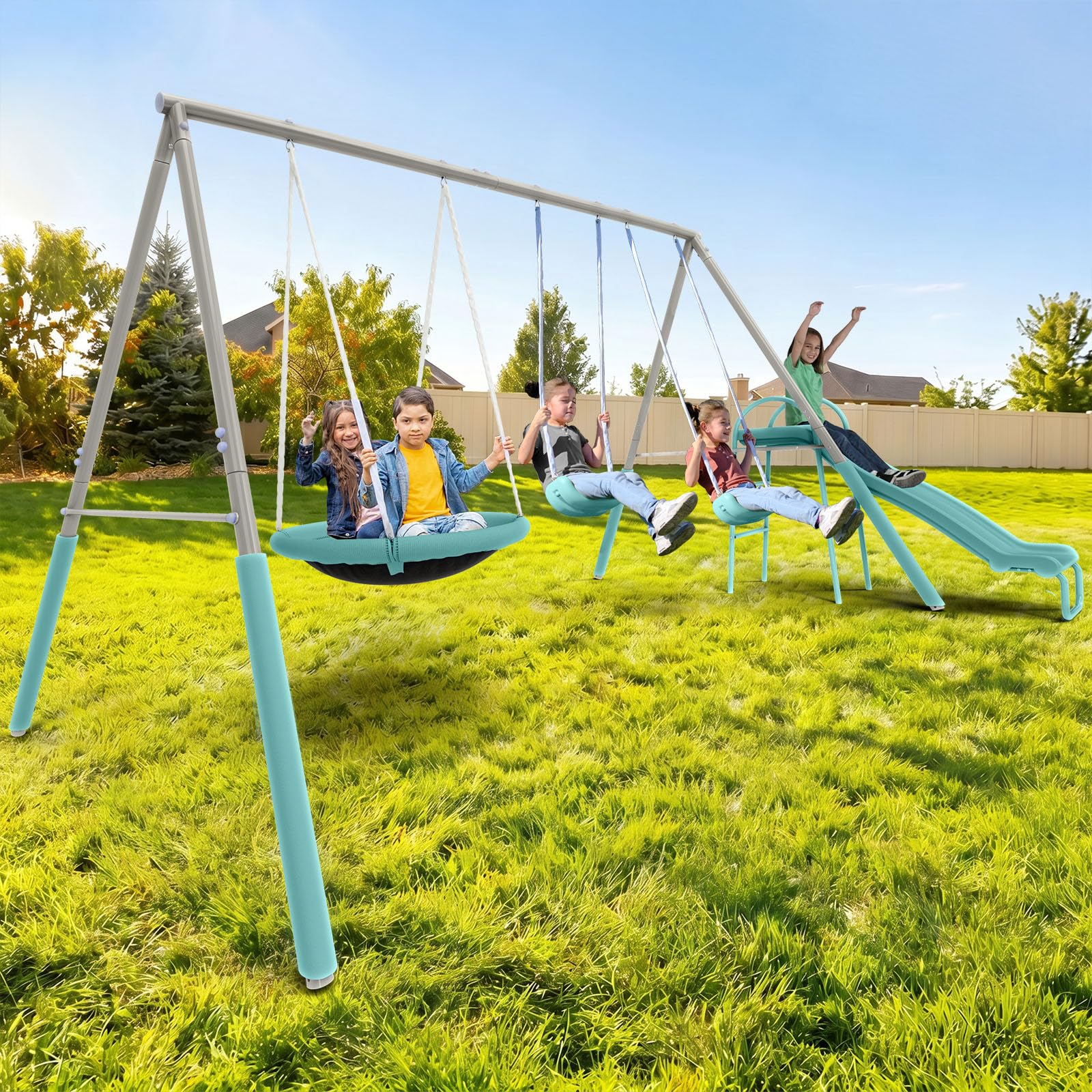
Trekassy 440lb Swing Set
Key Features
- Frame: Powder-coated alloy steel
- Assembled size: 63"D x 86.6"W x 66.9"H
- Swings included: 32" saucer and belt swing
- Weight capacity: 440 lb
- Price: Budget
A 440-pound steel A-frame with a saucer and a belt swing, in a footprint of 63 by 86.6 by 66.9 inches — that combination is why this is where we start. Most families have a strip of lawn beside a garage rather than a playground, and this set fits that strip while still giving two children a swing each. The frame is powder-coated alloy steel and the chains are zinc-plated, which is the difference between a set that lives outside and one that rusts into a garden ornament.
We like that the two seats do genuinely different jobs. The 32-inch saucer is where a three-year-old lies on her stomach and where two children pile on together; the belt swing is the one she graduates to. Both adjust on the chain, and the frame arrives pre-drilled, so raising the seats a notch each summer takes minutes rather than an afternoon with a wrench.
Anchorage is the thing to get right. This frame sways and walks under a determined swinger, and the stakes in the box are not the answer in soft ground — set it on level grass and drive proper auger anchors before the first hard push. Watch the saucer as well: the fabric goes before the steel does. Both are known quantities, and both are cheap to stay ahead of.
Pros
- Two swing styles on one 440-pound frame
- Seats adjust on the chain as kids grow
- Fits a typical backyard footprint
- Powder-coated steel with zinc-plated chains
Cons
- Saucer is smaller than the photos suggest
- Saucer fabric wears before the frame
Our default pick for most families: two swing styles, a 440-pound frame and a footprint that fits an ordinary yard, with money left for the anchors it needs.
Best for Wooden Starter Set
Swing-N-Slide Ranger
Key Features
- Assembled size: 92"D x 104"W x 82"H
- Per-swing limit: 115 lb
- Swings included: 2 belt swings and ring/trapeze
- Weight capacity: 350 lb
- Price: Midrange
Wooden sets usually cost a weekend. The Ranger is the one we point at when a family wants timber in the yard without losing both days: it is 90 pounds of pre-cut lumber and hardware, the manual is fully illustrated, and one competent adult can have it standing by lunchtime.
What that buys you is two belt swings and a ring/trapeze on plastisol-coated chain. The coating matters more than it sounds — bare chain pinches small fingers and rusts on a wet fence line — and the five-year limited warranty is longer than most here. Each swing carries 115 pounds with 350 on the frame, and at 104 by 92 by 82 inches it is a small-yard set that suits a four- and a six-year-old at the same time.
Two things to plan for. It is light, and a light wooden frame lifts and creeps forward under a hard swing even with anchors set, so site it carefully and check the anchor line each spring. The lumber is the other variable: cracks in the beams show up early, and untreated wood invites weather and insects. Treat sealing as annual upkeep rather than a fault.
Pros
- One-morning build for one adult
- Ring/trapeze adds a second way to play
- Coated chain resists pinching and rust
- Five-year limited manufacturer warranty
Cons
- Beams can crack in the first months
- Wood needs sealing against weather and insects
Buy it if you want a wooden set without giving up a weekend: it goes up in a morning and still takes two swings plus a ring/trapeze.
Best for Toddlers and Preschoolers
Backyard Discovery Buckley Hill
Key Features
- Play features: 2 belt swings, 6-ft wave slide, rock wall, play deck
- Assembled size: 107"D x 123"W x 92"H
- Recommended age: 36 months to 6 years
- Weight capacity: 330.7 lb
- Price: Midrange
Backyard Discovery rates Buckley Hill for three- to six-year-olds, and the design agrees with the label: a raised deck reached by a rock-wall ladder, a six-foot wave slide, a canopy for shade and two belt swings on rope. For a two- or three-year-old it is a whole afternoon inside 123 by 107 inches.
The deck is the part we rate highest. Somewhere to climb to, sit under a canopy and run a pretend shop from keeps a preschooler out there longer than a swing alone ever does, and the chalk board is a nice excuse for a four-year-old to stop swinging for ten minutes. Cedar is the right material at this size, and the five-year warranty covers the frame.
The catch is that it is a starter set with a keeper’s price. A seven-year-old is too tall for the deck and too heavy for the slide to feel like anything, and the cedar is thin — boards can be brittle and the slide is the piece that works loose first. With a two- and a five-year-old you get four good years out of it. With an oldest child already at seven, put the money into the Mount McKinley instead.
Pros
- Deck, canopy, slide and rock wall in one
- Sized right for ages three to six
- Cedar frame with a five-year warranty
Cons
- Thin cedar boards can be brittle
- Slide works loose over time
The toddler pick: deck, canopy, slide and rock wall in a footprint that suits a yard, sized for three- to six-year-olds rather than older kids.
Best for Budget Slide Set
Sportspower Super Saucer
Key Features
- Play features: 2 swings, 2-person saucer, 5-ft wave slide
- Assembled size: 12.2′ L x 6′ W x 5.9′ H
- Recommended age: 3 to 8 years
- Weight capacity: 500 lb
- Price: Budget
Two swings, a padded two-person saucer and a five-foot wave slide on a single 500-pound frame — this is the most play per dollar among the metal sets here, and it is the one we suggest to families who want a slide without committing to a wooden playset and a weekend of assembly.
The saucer is the draw. Two children can lie on it together, which makes it the station that keeps a playdate running, and the frame still measures 12.2 by 6 feet, so a medium yard takes it. Sportspower rates it for ages three to eight, covers the chain in vinyl so nothing pinches, pads the legs with foam and meets the ASTM standard. The frame goes together quickly; the slide is the fiddly part.
Anchor it. A seven-year-old swinging hard will lift this frame, and no anchor kit comes in the box, so drive ground anchors before the first weekend. Do that and it stays put through a summer of hard swinging, which is what a set at this price has to do to be worth the lawn space.
Pros
- Saucer seats two children at once
- Five play stations on a 500-pound frame
- Vinyl-covered chain protects small hands
Cons
- Slide fasteners work loose over time
Best value in a set with a slide: the saucer takes two children at once and the 500-pound frame covers ages three to eight.
Best for Big Kids and Teens
Hapfan 600lb Swing Set
Key Features
- Assembled size: 78"D x 118"W x 78"H
- Per-swing limit: 200 lb
- Swings included: 45" platform swing and 2 belt swings
- Weight capacity: 600 lb
- Price: Midrange
Most sets here run out of weight capacity around the second grade. The Hapfan does not: a 600-pound frame, a 45-inch platform swing and two belt swings rated at 200 pounds each, on 118 by 78 inches and 78 inches tall. If you have a nine-year-old and a four-year-old, this is the frame that keeps both of them on a swing rather than on the sidelines.
The platform swing is what surprised us. A flat 45-inch deck turns a swing set into somewhere to hang out — lying down with a book, two children sitting cross-legged, a parent taking a turn. The 60mm steel tube, welded joints and powder coat are the right specification at this size, and at 94 pounds the frame feels planted once it is anchored.
One practical note: the three swings sit close together, so bigger children need to stagger their pushes rather than launch at once. The 78-inch height means a tall ten-year-old still clears the ground on the belt swing, which is not true of the smaller metal sets here. For a family with an age spread, that is the whole argument.
Pros
- 600-pound frame with 200-pound swings
- 45-inch platform swing doubles as a lounger
- Welded, powder-coated steel A-frame
Cons
- Frame flexes under heavy swinging
Buy it when your kids span toddler to preteen: 600 pounds of frame and a platform swing that a ten-year-old still fits on.
Best for Large Backyards
Backyard Discovery Mount McKinley
Key Features
- Play features: 8-ft wave slide, double rock wall, web swing, sandbox
- Assembled size: 150"D x 186"W x 119"H
- Recommended age: 3 to 10 years
- Weight capacity: 1080 lb
- Price: Premium
At 186 inches wide and 150 deep, this is not a set you site by eye. Measure the lawn, then measure the run-out in front of the eight-foot wave slide, then decide whether you still want it. If you do, you get the closest thing here to a neighborhood playground: a raised deck with canopy, telescope and steering wheel, a double rock wall, a rope ladder, a web swing, two belt swings, a trapeze and a sandbox under the deck.
The 1,080-pound capacity and the three-to-ten age band are the reason we recommend it. It is the only set here that a four-year-old and a ten-year-old can use at once without a queue forming, and the cedar is substantial enough to carry that. Backyard Discovery backs the frame for five years.
Budget a full day and a second adult for the build — this is a several-hundred-part project, and the instructions are clearer in some chapters than others. Cedar shipped this way wants sealing before its first winter. And the plastic, slide and steering wheel included, gets properly hot in direct afternoon sun.
Pros
- Eight-foot slide, rock wall and sandbox
- 1,080-pound capacity for mixed ages
- Deck with canopy, telescope and steering wheel
- Cedar frame with a five-year warranty
Cons
- Full-day build with two adults
- Cedar ships untreated
For a big yard and a wide spread of ages, this is the set: an eight-foot slide, rock wall and sandbox on a 1,080-pound cedar frame.
Best for Small Yards
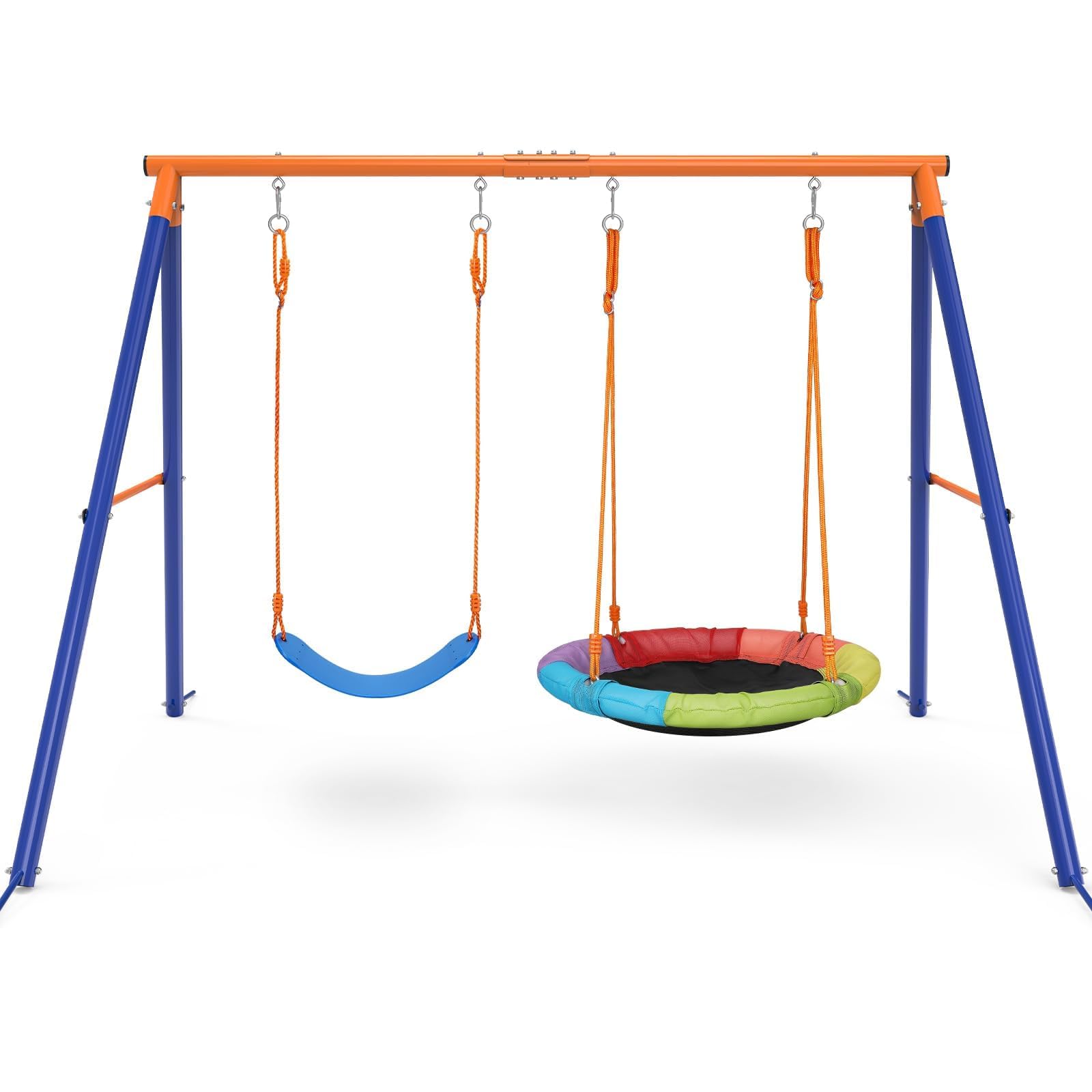
Amictoy Saucer Swing Set
Key Features
- Frame: Metal A-frame
- Assembled size: 60"D x 80"W x 72"H
- Swings included: 32" saucer and 26.2" belt seat
- Price: Budget
Not every yard takes a playset. If the swing set has to live on a patio corner or a strip beside the fence, this is the shape to look for: 60 inches deep, 80 wide and 72 tall, with a 32-inch saucer on one side and a 26.2-inch belt seat on the other. It is the smallest set here that still lets two children swing at the same time.
We found assembly the least painful of the group — clear hardware, no specialist tools — and the A-frame is steadier than its size suggests once it is pegged down. The saucer’s Teslin fabric is quick-drying, which matters more than it sounds in a wet spring.
Be clear about what it is: a set for younger and lighter children. The seat heights suit toddlers and early grade schoolers, and by eight or nine a child will find the saucer small. Within that band it does everything asked of it, and it does not dominate the garden the way a full playset would.
For a first swing set in a tight yard, that is the right trade. You give up growth and station count, and in return you get a set that fits where nothing else here will, goes up in an afternoon, and can be moved when the lawn is mowed.
Pros
- Fits a patio corner at 80 inches wide
- Easy, tool-light assembly
- Quick-drying Teslin saucer fabric
Cons
- Connectors wear with use
The small-yard answer: two swings on an 80-inch frame that fits a patio corner, best for toddlers and early grade schoolers.
Best for Groups of Children
XDP Free N Swing

Key Features
- Play stations: 2 swings, Super Disc, see-saw, 5-ft wave slide
- Assembled size: 168"L x 91"W x 74"H
- Recommended age: 3 to 8 years
- Per-seat capacity: 100 lb
- Price: Midrange
Five stations and seven children on one frame: two adjustable swings, a Super Disc, a Stand ‘R’ Swing, a see-saw and a five-foot wave slide. If your yard is the one the neighborhood ends up in, this is the set that stops the queue at the swings — and at 168 inches long it needs the room to prove it.
The frame is the good part. It is galvanized steel welded at the joints rather than bolted, with a five-year warranty on the structure and a powder coat over the lot. Welded joints are what keep a long frame from loosening into a wobble after a season of six children at once.
Read the capacity honestly. Every station is rated to 100 pounds with a three-to-eight age recommendation, so this is a young children’s set despite the crowd it holds; a ten-year-old is over the limit on the disc and the slide. Build time goes into the accessories rather than the base frame — the see-saw and the disc are the slow part.
We keep coming back to coverage: more seats, more kinds of play and fewer arguments than any other set here for the footprint. Anchor the long frame properly and it will take a summer of six children at once without complaint.
Pros
- Five stations keep a group busy
- Welded galvanized frame with five-year warranty
- Seats up to seven children
Cons
- Chains and seats wear first
- Needs a 14-foot-wide space
The pick for the biggest crowd: five stations and seven seats on one welded, galvanized frame, aimed at children three to eight.
How We Tested These Swing Sets (and What Warped, Wobbled, or Held Up)
We started by pulling every set we could find from the major backyard brands — wooden kits, metal frames, and modular sets you can add to later — then narrowed the list by construction, listed weight limits, footprint, whether replacement swings and slides could be ordered separately, and price relative to how many kids could actually play at once. Seven made the cut, from a compact two-swing frame to a full fort with a slide, and each was built in a tester’s yard and left standing for eight months.
Assembly got its own accounting. We timed every build with one adult and then again with two, followed the instructions step by step and wrote down each point where they skipped a step or contradicted the diagram, kept count of hardware-store runs caused by a missing bolt or a wrong-size bit, and noted whether the box included the tools you actually needed. We also ran hands along every beam and checked moving joints for pinch points and sharp hardware before any kid got near them.
Then we handed the yards over. Testers logged who climbed on and when — after school, weekend mornings, the neighbor kid who never leaves — how many children a frame held before it started to sway, and whether the seats suited a 4-year-old and still hung high enough for a 10-year-old. Once a month we shook the top beam hard, checked every bolt for loosening, and looked for splinters, cracks, rust, and soft wood where the legs meet the ground. We also measured the real footprint against the listed one, because a few sets took up noticeably more lawn than the spec sheet promised.
After eight months, what separated the picks had little to do with brochure features. It came down to whether the wood was still straight, whether the hardware had held its torque, and whether the whole thing had earned its price once you factored in the parts that can be replaced when a swing wears through.
How to Choose a Kids Swing Set
The right set matches your tallest child and your actual lawn; station count comes after both.
Match the Set to the Child
Start with the age band and the per-swing weight limit, not the big number on the box. A 440-pound frame rating is a frame total; the individual swing is what carries a child, and the sets here split from 100 pounds a seat on the XDP to 200 pounds on the Hapfan. A ten-year-old is over the limit on more of these than you’d guess from the marketing.
If your oldest is already eight, a set aimed at ages three to six will disappoint within a year. That is where the Hapfan and the Mount McKinley earn their extra cost, and where a toddler playset becomes money spent twice.
Metal or Wood
Metal A-frames cost less, go up faster and ask almost nothing afterwards, but they move more under a hard swing and need anchoring to stay honest. Wood looks like garden furniture, takes a slide and a deck far better, and holds up well if you seal it — untreated cedar and pine will crack, and thin boards are the recurring weak point in wooden sets.
Our rule: metal for a first set that will be outgrown, wood for a set you plan to keep a decade and are willing to maintain.
Which Stations Actually Get Used
A saucer gets more use than anything else on a set with young children, because two kids can lie on one at once and nobody has to take turns. A slide earns its space from about two to six. Play decks, chalk walls and sandboxes hold attention in the years in between.
Trapeze bars and ring swings are for the child already confident on a belt swing. Treat them as a bonus rather than the reason to buy, and check that the seat heights adjust far enough to keep the swing off the ground as your children grow.
Measure the Footprint and the Swing Arc
Assembled width is only half the number: the arc in front of the swings needs clear space too, and a set pushed against a fence is a set nobody can swing on properly. The range here runs from 80 inches wide on the Amictoy to 186 on the Mount McKinley, so measure the lawn before anything else.
Then find level ground. A slope is what makes a frame walk and lifts one leg off the turf, and no anchor fixes a bad site.
Budget for Anchors, Sealer and a Weekend
The set is rarely the last thing you buy. Ground anchors are extra on most of these and not optional on a light metal frame; a wooden set wants a sealer before its first winter and a fresh coat every year or two.
Assembly on a full playset is a two-adult job measured in hours, not minutes — the Ranger goes up in a morning, the Mount McKinley takes a day. Price all of it in before you compare two sets on the sticker.
Frequently Asked Questions
Can I swap a baby bucket seat onto one of these swing sets?
Usually, yes. Sets that hang their swings from a chain and hook or carabiner — the Trekassy and the Swing-N-Slide Ranger among them — take a bucket seat on the same fitting, and the belt swing goes back on when your child outgrows it.
Match the connector type before you order the seat, and remember the per-swing weight limit applies to the new seat too, not the frame’s total.
At what age can a child use a regular belt swing?
When they can sit upright unaided, hold the chains and keep their balance through a push — usually somewhere around three or four, and later for some children. Until then, a bucket seat with a back does the job.
A set’s age rating describes who the frame, deck and slide are designed for. It says nothing about when a particular child is ready to swing unsupported.
What should go under a swing set?
Grass is what most families use, and it will wear to bare mud under the arc within a season. A loose fill such as wood chips or rubber mulch holds up better and needs topping up as it packs down.
Concrete is firm and unforgiving under a moving swing, and not the surface for a children’s set.
Final Verdict
Buy the Trekassy 440lb set for the ordinary backyard. Two swing styles, a 440-pound frame and a footprint that leaves room to run make it the answer for most families, and it leaves money over for the anchors it needs.
Go wooden with the Swing-N-Slide Ranger if you want timber and a build you finish in a morning. Go big with the Backyard Discovery Mount McKinley if the lawn can take 186 inches and your kids will use a slide, a rock wall and a sandbox for years. If your oldest is already past the weight limits of the smaller sets here, the Hapfan is the one to take.
