This post contains affiliate links. We may earn a small commission when you buy through our links — at no extra cost to you.
The suit that fit in the dressing room in May is a different garment once it’s wet. I watched my kid climb out of a swim lesson last July with the straps hanging off both shoulders and the seat sagging past their hips, with nothing on the size chart to warn me. A good kids swimsuit fixes that moment: it stays put after ten jumps off the wall, it doesn’t go see-through when soaked, and it comes out of a chlorine pool still the color it started.
I’ve spent this summer with 18 suits—one-pieces, bikinis, rash guard sets—through weekly lessons, sprinkler afternoons, and a beach week. Nobody tells you to shop for the body your kid will have in August rather than the one in April, or to check torso length instead of the age on the tag. Color matters more than parents expect: a suit that fades to pastel by mid-July starts a fight with the kid who picked it out, and the shiny finishes some adore feel slick to others. The picks below survived to be handed down; a couple didn’t make it to August.



Best for Everyday Boys’ Swimming
maamgic Boys Swim Trunks
Key Features
- Style: Boys swim trunks
- Waist: Elastic with drawstring
- Length: Above the knee
- Lining: Mesh
- Price: Midrange
A boys’ trunk gets judged on the walk back from the water. If it’s hanging around the knees and stuck to the legs, the day is over. These maamgic trunks land just above the knee and don’t cling when they’re wet — the two things we watched most closely, and the reason this is our top pick rather than a suit with a bigger logo on the waistband.
The mesh liner turned out to matter more than we expected. The holes are fine enough that sand and grit rinse straight through instead of collecting, which is the difference between a shake at the beach and a full change of clothes. The prints carry the rest: sharks, flamingos, bold color blocks, all of them arriving as bright as the listing shows rather than washed out.
Sizing is the one thing to plan around. The waist is elastic with a drawstring, so a generous cut can be cinched in — handy for a slim kid between sizes — but it puts a lot of the fit on that one cord, and the sizes don’t come out consistently. Order what your child wears in shorts and tighten it rather than sizing down.
Pros
- Lands above the knee and doesn’t cling when wet
- Fine mesh liner rinses sand out
- Prints and color match the listing
- Dries quickly between swims
Cons
- Drawstring and pocket seams are the weak points
Our default for boys: a trunk that lands above the knee, dries fast and comes in prints kids ask for by name, with a drawstring that rescues a generous cut.
Best for Toddler Sun Coverage
The Children’s Place Rash Guard Set
Key Features
- Style: Rash guard set
- Sleeves: Short sleeve
- Department: Baby boys
- Price: Midrange
Neon yellow does one job better than any print in this roundup: you can find your kid in a crowded pool. The set pairs a short-sleeve rash guard with matching bottoms, and the fabric is the part that earns its place — light enough that it doesn’t feel like a wetsuit, but it keeps the sun off shoulders and back for a whole afternoon.
For a toddler who spends more time in the water than out of it, we haven’t found a better set here. The neck is roomy, the sleeves stop where arms can still move, and the whole thing washes clean and dries fast enough to wear again the next morning. It holds its color through repeated washing as well, which matters when the suit is in the laundry every other day.
Sizing is the messy part. The top runs roomy — generous at the neck — while the bottoms come up large on a slim toddler, so the two halves don’t always agree in one size. If your child is between sizes, buy the smaller one; there’s enough stretch in the top to see out the season.
Pros
- Sun coverage without a heavy, damp feel
- Bright color you can spot across a pool
- Washes clean and keeps its color
Cons
- Short sleeves leave forearms uncovered
For babies and toddlers in the sun, we haven’t found a better set here: light short-sleeve coverage, a roomy neck and colors that survive the wash.
Best for Girls’ Sun Coverage
Disney Long-Sleeve Rash Guard Set
Key Features
- Style: Two-piece rash guard set
- Prints: Frozen, Stitch, Marvel
- Sleeves: Long sleeve
- Sun Protection: UPF 50+
- Price: Midrange
Two pieces on a toddler sound like extra work — two garments to get on instead of one — but the top here is the easy half: it pulls over the head, and the bottoms go on like shorts. On a wiggly kid, that is the difference between a suit that gets worn and one that gets fought.
The long sleeves do the real work. UPF 50+ coverage to the wrist and a top that covers the torso turn sunscreen into a face-and-legs job, which is far easier to keep on a moving child than a full-body application every ninety minutes. The fabric survives the wash as well: no fading, no pilling, no stretched-out neck after a run of pool days.
Even if your kid couldn’t care less about the characters, this is the set we take to a beach or lake. The print is the hook for them; the coverage and the way it washes are the reason it earns a place here rather than a plain long-sleeve top.
Pros
- UPF 50+ sleeves cover to the wrist
- Top pulls on easily, even on a toddler
- Holds shape and color through washing
Cons
- Bottoms run large next to the top
We like this licensed set even if your kid ignores the characters: UPF 50+ sleeves, a top that pulls on easily and prints that survive a summer of washing.
Best for Modest Girls’ Swim
PROALLO Boyshort Tankini
Key Features
- Style: Two-piece tankini
- Bottoms: Boyshorts
- Department: Girls
- Price: Midrange
Coverage is the whole pitch here, and it’s coverage that doesn’t read as a chore: a tankini top that covers the tummy and boyshorts that cover more of the leg than a standard bikini bottom. For a girl who has started to care about that, or a parent who would rather not negotiate it every morning, this is the girls’ suit we point to first.
The two-piece cut is the practical half. A full one-piece means a wrestling match at every bathroom stop; the boyshorts here pull down and back up in seconds, and the top stays where it is. Anyone who has stood outside a changing cubicle with a damp six-year-old knows what that is worth.
Stitching is tight and the fabric has enough weight to hold its shape when wet instead of going limp, which is more than the construction promises on paper. A suit that keeps its shape also keeps its coverage, and keeping its coverage is the whole reason to buy this one.
Pros
- Tummy and seat coverage without bulk
- Boyshorts make bathroom stops quick
- Tight stitching and fabric with some body
Cons
- Runs small — order a size up
- Colors can bleed onto lighter fabrics
If coverage is the deciding factor, this is the tankini we point to: tummy covered, boyshorts instead of a bikini bottom, and a two-piece that’s quick at a bathroom stop.
Best for Swim Practice
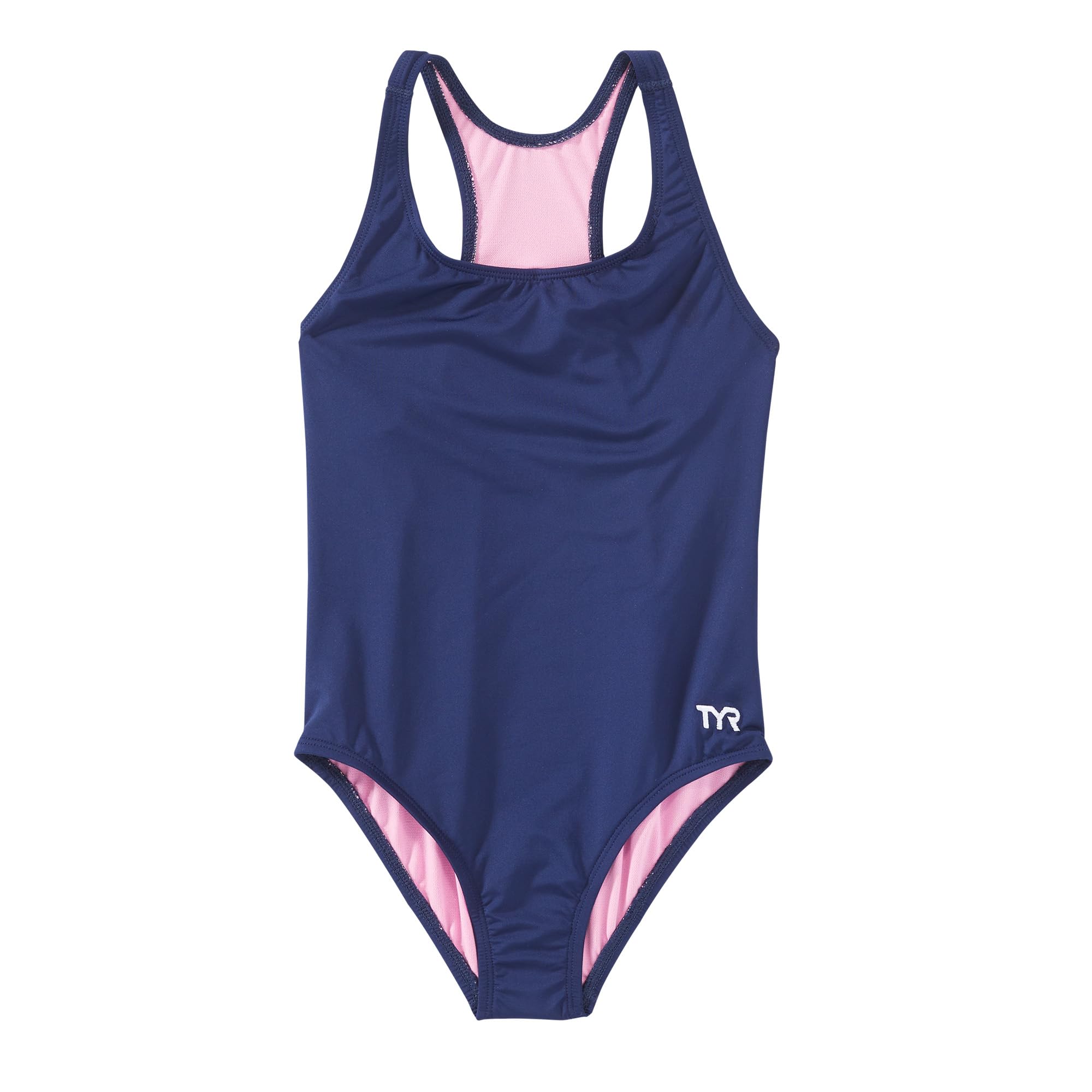
TYR Durafast Lite Ella Maxfit
Key Features
- Use: Competitive swimwear
- Style: One-piece maxfit
- Fabric: Durafast Lite
- Department: Girls
- Price: Midrange
Thin, cheap suit fabric goes transparent the moment it’s wet, which is the quiet reason so many kids’ one-pieces get retired early. The TYR Ella Maxfit is the opposite: a thicker knit that stays opaque in the water, with leg openings cut high enough not to ride up and full enough to cover.
For lessons or a team, this is the suit we hand a kid first. It covers the same ground as the pricier competition suits here — stays put, holds its color, doesn’t need babying — and the cut covers more than a typical racing suit, which matters to a nine-year-old who is not chasing a personal best yet.
Chlorine is what normally ends a practice suit, and this one keeps its navy and its pink through regular pool use. The lining stays where it should instead of bunching, there’s no pilling at the seams, and it rinses clean in cold water after a session.
Pros
- Thick knit stays opaque when wet
- Cut covers more than a racing suit
- Color holds through regular chlorine use
- No riding up at the leg openings
Cons
- Runs a full size small
Our value pick for lessons and practice: a thick, opaque knit that doesn’t ride up, full coverage, and color that survives chlorine.
Best for Cheap Everyday Suit
HONISEN Girls One-Piece
Key Features
- Sizes: 2–12 years
- Style: One-piece
- Department: Girls
- Price: Budget
Adjustable straps are what let a cheap one-piece last more than a season: you take up the slack at the shoulder as the suit loosens instead of buying again in July. This HONISEN suit has them, and they hold where you set them once they’re wet rather than sliding loose mid-swim.
The rest is straightforward. Bright color, standard coverage, a cut that suits a kid who swims rather than poses. It is the cheapest suit here and it doesn’t pretend otherwise: thin fabric, simple construction, no clever panels or linings to speak of.
Where it lands is the summer before a growth spurt, when a suit has one season in it and no more. Loud enough to spot across a pool, adjustable enough to stretch the season, and inexpensive enough that losing it at the beach is an annoyance rather than a loss.
Pros
- Adjustable straps stay put when wet
- Bright color that holds in chlorine
- The lowest price here
Cons
- Straps and stitching are the weak point
- Finish looks duller than the photos
We keep this one for the kid who’ll outgrow a suit before it wears out: the cheapest sensible one-piece here, with adjustable straps that buy extra months.
Best for Competitive Swimming
Speedo Closed Racerback

Key Features
- Use: Competitive swimwear
- Style: One-piece closed racerback
- Department: Girls
- Price: Premium
The closed racerback is built for the kid who has stopped swimming in the shallow end. The back sits high, the straps land on the shoulder blades and stay there, and the leg openings are cut to stay put instead of creeping up mid-length.
It fits like a competition suit, which is to say snugly, and that is the point: the compression is what stops it moving around in the water. The catch is that it’s sized for a racing fit, so order a size up from the street size and expect it to feel tight across the shoulders on the first wear.
The lining does its job — nothing shows through when wet — and the straps don’t wander even in a tumble turn. It’s also the most supportive cut here for a kid who complains that suits feel loose and floppy the moment they get in.
Against the TYR, this is the suit for a swimmer who wants a specific fit and is in the water most days. For once-a-week lessons, the TYR covers the same ground for a good deal less, and that’s the honest trade: the extra money here buys a race cut, not a longer life.
Pros
- Closed back keeps straps on the shoulders
- Lining stays opaque when wet
- Compression fit that doesn’t shift in water
Cons
- Fabric thins with daily chlorine use
A competition-cut suit we recommend for a swimmer who’s in the water most days: the closed back stays put, the straps don’t wander and the lining stays opaque.
Best for Skirted Coverage
Taubow Tankini

Key Features
- Sizes: 3–13 years
- Style: Two-piece tankini
- Bottoms: Skirted
- Price: Midrange
A skirted bottom is either the whole reason a kid agrees to wear a swimsuit or an instant no, and there isn’t much middle ground. This one’s skirt is short and swings when they spin, which is the entire pitch for the four-to-eight crowd.
The crossed straps are the better design detail. They sit in a V on the back, so the shoulders can’t slide them down, and the top stays over the tummy through a whole session of cannonballs. Coverage without a rash guard is why this one earns a place.
It also lasts. The fabric came through a summer of pool and beach use without shrinking or going thin at the seat, and the seams held where the skirt attaches, which is the spot that usually goes first.
For the kid who wants a skirt, this is the one. The straps do more for the fit than the skirt does, and the coverage means less tugging at the top between swims — which is what a parent actually notices.
Pros
- Crossed back straps stay on the shoulders
- Skirted bottom with real coverage
- Survives a summer of pool and beach
Cons
- Top runs small — order up
- Skirt fades before the rest of the suit
The skirted tankini we come back to: crossed straps that stay on the shoulders and coverage that holds through a session of cannonballs.
How We Tested Kids Swimsuits Through a Full Summer
We started with the suits parents actually buy—the big swim labels, department-store lines, and UPF-rated rash guard sets—then narrowed by size range, price, and fabric. We favored suits sold in 2T through at least a size 10, and we read the fabric content instead of the front of the package, looking for chlorine-resistant spandex rather than plain nylon.
Testing ran from late May through August, about three months, and every suit went through the same routine: weekly swim lessons, two chlorinated pool afternoons a week, a beach vacation, and sprinkler sessions with sunscreen-smeared kids. We washed each one after every wear, following the care tag half the time and machine-washing warm the rest, because that is what happens at home.
Along the way we measured each suit flat on day one and again after ten washes, since two suits labeled the same size fit nearly a full size apart. We noted how hard each was to pull on dry versus soaking wet, whether straps stayed on the shoulders after ten jumps into the pool, and whether the seat sagged or rode up during a full length of swimming. Every wet suit got held up to a window to see whether a hand behind it showed through, and we photographed each one on arrival so we could compare color after five, ten, and fifteen washes. We checked crotch and underarm seams for popped stitches and asked the kids which suits felt slippery or scratchy enough that they refused to put them back on. Value, in the end, came down to whether a suit was still decent enough to hand down to a younger sibling in September.
How to Choose Kids’ Swimsuits
Buy for the kid you have in June, not the one you hope to have in August — a suit that’s too big drags in the water, rides up and lets cold water in, which is worse than one that fits snugly.
Fit: Snug Beats Roomy
Swimwear should feel slightly tight when it’s dry, because it loosens in the water; a suit that feels comfortable on the hanger is usually baggy by the second swim. For a one-piece, shop by torso height rather than age. For boys’ trunks, an elastic waist with a drawstring handles a generous cut, and in a racing-cut suit, order up a size, because those are built to compress. Between sizes in a two-piece set, buy the smaller one and let the stretch do the rest.
One-Piece, Tankini, or Rash Guard Set
Match the style to the outing rather than the photo. A one-piece is the least fuss for laps and lessons; a tankini or two-piece earns its place at a beach or water park where bathroom stops come every hour; a long-sleeve rash guard set buys sun coverage you don’t have to reapply. If your kid is in and out of the water all day, a covered two-piece dries faster than a one-piece and comes off a damp child in half the time.
What Sun Coverage Actually Buys You
A long-sleeve top with a high neck turns sunscreen into a face-and-legs job, which is a fight you can win. What it doesn’t do is cover hands, shins, or the back of the neck below the collar, so the lotion still travels with you. A UPF rating describes the fabric, not the fit — a suit stretched tight or worn thin protects less than one that fits properly.
Lining, Thickness, and Chlorine
Hold a suit up to the light before you buy it. Thin, single-layer knits go transparent when wet; a lined suit doesn’t, and that’s the difference between a suit that lasts a season and a poolside problem in August. Check the seams too — flatlock stitching lies flat against skin and won’t rub under an arm. On boys’ trunks, make sure the elastic is enclosed inside the waistband rather than threaded loosely through a channel, because that and the drawstring are where cheap pairs give out first.
Frequently Asked Questions
How many swimsuits does a child need?
Two is the practical minimum for a child in lessons or a daily swimmer, and three is comfortable. A suit worn two days running never fully dries, and damp elastic is what goes first, so the useful number is however many your laundry cycle can keep up with.
For a week away, pack three: one on, one drying, one spare.
Should kids wear underwear under a swimsuit?
No. Cotton underwear soaks up water, stays heavy and chafes where a suit is designed to sit smooth, and lined one-pieces and trunks are already built for direct contact.
If your child is uncomfortable, a liner short in the same swim fabric is the better answer than cotton.
Are long-sleeve swimsuits too hot for summer?
In the water, no — a wet long-sleeve top is cooler than bare skin in direct sun, and it means less sunscreen reapplying. Out of the water, a wet sleeve can chill a small kid once the wind picks up.
Pack a dry T-shirt for the walk home and the trade works in your favor.
Why do swimsuits fade so fast?
Sun, chlorine and heat, roughly in that order. Colors go first in suits left in direct sun to dry or washed warm, and dark dyes can bleed onto lighter panels in the first few washes.
Rinse in cold water after every swim, wash dark suits separately the first two or three times, and dry them in the shade rather than draped over a chair in the sun.
Final Verdict
Start with the maamgic boys’ trunks unless your child needs coverage a trunk can’t give. They sit above the knee, dry fast and forgive a growth spurt, which is most of what a summer suit has to do.
If sun coverage is the priority, the Children’s Place set puts protective fabric on a toddler’s shoulders and back without a fight. For a swimmer in lessons twice a week, the TYR Ella Maxfit does what the pricier competition suits here do. Whichever you pick, buy two.
