This post contains affiliate links. We may earn a small commission when you buy through our links — at no extra cost to you.
A nursery bookshelf isn’t just a place to corral board books—it’s furniture a toddler will pull on, lean against, and probably try to climb. The best ones earn their spot with a low center of gravity, shelves deep enough for oversized picture books, and hardware that anchors to the wall. Over the past nine months, we assembled, loaded, and lived with 10 nursery bookshelves in real nurseries.
Assembly is where most of these win you over or make you want to quit—we timed how long each took to put together solo and noted whether the instructions assumed a second adult. Capacity matters more than the box suggests: we filled each shelf with board books, picture books, and chunky favorites to see what sagged. Sturdiness and toddler suitability go hand in hand, so we watched how each unit handled a determined 2-year-old pulling books down and leaning on the lower shelf. Value isn’t about the lowest price; it’s whether the build quality and included hardware justify the cost. The picks below passed all of that.


Best for Nursery Floor Display
SpaceAid 3-Tier Scalloped Bookshelf
Key Features
- Shelves: 3 front-facing tiers
- Material: Solid pine
- Mounting: Freestanding
- Dimensions: 10.7"D x 29.6"W x 27.6"H
- Price: Midrange
The scalloped edge gets the attention, but what sold us is where the top tier sits: 27.6 inches off the floor, on a case 29.6 inches wide and 10.7 inches deep. That is low enough for a two-year-old to reach the top row without climbing, and shallow enough to leave a nursery floor walkable. All three tiers face out, so what a child sees is a row of covers rather than a row of spines.
That combination is why this one goes first for a nursery. The frame is solid pine and it stays square — we loaded all three tiers and the case sat flat rather than flexing the way fabric racks do, which matters when the thing steadying it is a toddler leaning on the second shelf. The scalloped sides also round off the corners at exactly the height a crawling baby’s head passes.
Three tiers of this width take a working library rather than a childhood’s worth: fifteen to twenty picture books in rotation, with board books slotted in front of them. There is no bin, no toy storage and no way to hang it, so it does one job and does it. Assembly is a screwdriver and a free half hour, and the pieces line up without persuasion.
The number to check against your room is the width. It wants roughly 30 inches of clear wall and a foot of depth, and it looks undersized on a long empty stretch. Where the wall is shorter than that, a wall-mounted set spreads the same books upward instead.
Pros
- Top tier within toddler reach at 27.6 inches
- Solid pine stays square under a loaded shelf
- Covers face out on every tier
- Straightforward screwdriver assembly
Cons
- Wants about 30 inches of clear wall
This is the nursery shelf we point people to first: solid pine, covers facing out, and every tier low enough that a toddler can help themselves.
Best for First Book Corner
Humble Crew 4-Tier Kids Bookshelf
Key Features
- Frame: Engineered wood and nylon
- Shelves: 4 fabric tiers
- Dimensions: 10.6"D x 25"W x 23.5"H
- Shelf weight limit: 12.6 lb
- Price: Budget
Four tiers of front-facing pockets, a 25-inch footprint, and the lowest price of any shelf here: the Humble Crew is the cheapest way to get covers facing out in a nursery, and for a small room with a modest pile of books that is a fair first shelf rather than a compromise.
The practical case is stronger than the price suggests. At 7 pounds it moves one-handed when you rearrange, the 23.5-inch height puts every pocket inside a one-year-old’s reach, and the nylon holds a dozen board books a tier without drooping. Each shelf is rated to 12.6 pounds — roughly a tier of board books with a couple of picture books on top. Heavier hardbacks pull the pockets out of shape.
Two things to know before ordering. It is smaller in person than the photos imply, so it holds a slice of a real library rather than all of it. And the frame is engineered wood and fabric, built to a price: it copes with a child who sits and pulls books out, but a climber is a different story. Anchor it to the wall and keep the heavy books on the bottom tier.
Pros
- Cheapest front-facing shelf here
- 7 pounds — moves one-handed
- Every pocket at toddler height
- Assembly needs only a screwdriver
Cons
- Holds a slice of a library, not all of it
- Engineered wood and nylon, not furniture-grade
We send budget-minded shoppers here: covers facing out for very little money, in a small light shelf a big library will outgrow.
Best for Wall-Mounted Display
Forbena Floating Nursery Book Shelves
Key Features
- Set: 4 shelves
- Material: Pine
- Dimensions: 4"D x 16.5"W x 3.5"H
- Weight limit: 20 lb
- Price: Budget
What comes in the box matters as much as the wood with wall shelves, and this set includes a drilling ruler, a mini level and the anchors — most of the battle. The shelves themselves are pine, 16.5 inches wide and 4 inches deep, in a walnut finish that suits a nursery that isn’t all pastel.
They mount lip-up as picture ledges or upside down as shallow shelves; the lip is what keeps a book in place when a child yanks the one beside it. Per shelf, expect a handful of picture books, a couple of stuffed animals, a nightlight. Each is rated to 20 pounds, so shelf space runs out long before strength does.
This is the set we pick when floor space is the scarce thing. Four shelves up a wall give you 66 inches of display without spending a square foot of the room, and you choose the heights: the lowest at toddler eye level for the books in rotation, the upper ones for the out-of-season stack and the things you don’t want reached.
Two cautions. The mounting hardware has been the weak link in these sets, so tip the bag out before you drill and buy your own anchors if they look thin. And 4 inches of depth is a real constraint: chunky board books and oversized picture books sit proud of the lip or don’t sit at all. Thin picture books and paperbacks are what these are for.
Pros
- Four shelves, 66 inches of display
- Drill ruler and mini level included
- 20 pounds per shelf
- Frees floor space entirely
Cons
- 4-inch depth won’t take chunky or oversized books
Our pick when the floor is spoken for: four pine ledges that turn a bare wall into a nursery display and give back every square foot.
Best for Playroom Wall
B1 Kids Bookshelf and Toy Storage
Key Features
- Frame: Metal and particleboard
- Storage: 3 wood shelves and 3 sling pockets
- Anti-tip: 2 straps included
- Dimensions: 11.8"D x 48.9"W x 29.5"H
- Price: Midrange
At 48.9 inches wide, this is the only pick here that furnishes a wall rather than a corner, and if the playroom has a long blank stretch, that width is the point: three sling pockets for face-out books, three wooden shelves above them, and an elastic-cord top section for the stuffed-animal pile, all in one footprint.
The mix is what makes it work. Books that face out live low, where a toddler can reach them; the wooden shelves take baskets, puzzles and bigger books; the top holds the soft toys that otherwise colonize the floor. Leveling feet and two anti-tip straps come in the box, and the metal frame is why it can span that width without a middle leg.
It is not solid wood. The shelves are particleboard in a metal frame and the slings are Oxford cloth, which is fine for paperbacks and thin picture books and less convincing for a shelf of heavy board books. At 11.8 inches deep it stands further off the wall than the wall-mounted sets, and a unit this wide dominates a small room. Where the wall exists, though, it replaces three separate pieces of furniture.
Pros
- Books, bins and stuffed animals in one unit
- Anti-tip straps and leveling feet included
- Face-out slings at toddler height
Cons
- Needs a long, clear wall
- Particleboard shelves in a metal frame
We hang this one when books, bins and stuffed animals should be handled by a single wide unit — provided you have the long wall.
Best for Toys and Books
SpaceAid Toy Storage Organizer
Key Features
- Bins: 12 (4 large, 8 small)
- Shelves: 6
- Material: Pine
- Dimensions: 52.3"W x 13.6"D x 31.5"H
- Price: Midrange
Twelve bins — four large, eight small — across six shelves, in a 52.3-inch pine frame. If the nursery floor is currently a layer of toys with books somewhere underneath it, this is the shape of the solution.
The layout does the work: bins at toddler height so a three-year-old can pull one out and put it back, open shelves at the ends for books and bulkier toys, rounded edges, and an extended front base that makes the whole thing harder to tip. It goes together with the included driver, and it is light enough for two people to shift against a wall before loading.
We rate it the best pick here for toys-and-books clutter because it is the only one that assumes the books are the minority. Nothing faces out, so it won’t build the cover-shopping habit a display shelf does — but it gets the floor clear, and a clear floor is what makes a reading corner possible at all.
Do the box check before you build. Panels have turned up cracked, and once it is assembled you have lost the chance to swap one. Beyond that, the only thing it asks for is a wall long enough to take it.
Pros
- Twelve bins plus open book shelves
- Rounded edges and a wide, stable base
- Quick assembly with the included driver
Cons
- No front-facing book display
- Wants 52.3 inches of clear wall
The one we choose when toys outnumber books: twelve bins swallow the clutter and the end shelves keep a few covers in reach.
Best for Small Nurseries
3 Sprouts Recycled Kids Bookshelf
Key Features
- Shelves: 4 sling tiers
- Material: Recycled polyester and engineered wood
- Dimensions: 10"D x 24"W x 24.5"H
- Book capacity: Up to 35 books
- Price: Midrange
At 24 inches wide and 24.5 inches tall, this is the smallest floor case here that still holds a real collection — 35 books across four sling tiers. It slides under a window, into the gap beside a crib, or into the corner where a proper bookcase won’t go.
The sleeves are recycled polyester, and they cradle books rather than standing them on a shelf, so covers stay visible and nothing slides onto the floor when the case is bumped. It weighs 5 pounds and assembles with a screwdriver. Wipe-clean, which matters more than any other feature once a child is eating near it.
A couple of practical notes. The color runs lighter in person than the listing suggests on some finishes, so look at a photo of the actual finish before you commit. And the sleeves are the part that will date — they wipe clean, but fabric holds creases in a way a painted board does not.
Where it earns its place is the small nursery with no spare wall and no spare floor: it is the lightest, smallest full shelf here, and it moves from nursery to playroom without a second pair of hands. What you pay for is the footprint.
Pros
- 24-inch footprint fits where cases won’t
- Holds up to 35 books at kid height
- 5 pounds — easy to move alone
- Recycled fabric sleeves wipe clean
Cons
- Deep sleeves can hide small board books
- 35-book capacity assumes thin picture books
We like it for the small nursery with nowhere to put a bookcase: 35 books in the footprint of a nightstand.
Best for Tight Corners
OOOK Rotating Bookshelf
Key Features
- Tiers: 3, stackable
- Height: 38 in
- Material: Poplar plywood
- Footprint: 18.1"D x 18.1"W
- Price: Premium
A tower that spins changes the arithmetic of a small room: 18.1 inches square of floor, 38 inches tall, with three tiers of books that rotate past you rather than occupying a wall. In a corner that would otherwise hold a lamp, that is a library.
The build is poplar plywood and the tiers stack without tools, so you can run it as one, two or three sections depending on how much height the corner takes. Assembly is closer to a puzzle than to flat-pack furniture — the pieces are marked and fit precisely. Load the bottom tier heavily: the tower turns more slowly the more weight sits up top.
Fit is the thing to check. Standard and tall picture books sit happily; wide horizontal picture books don’t, and nor does anything much past a standard trim size. The top tier at 38 inches is storage rather than something a toddler chooses from, so the books in rotation belong on the lower two.
It sits at the top of the price range here and earns it through footprint rather than materials — plywood, not hardwood, and a mechanism that will want a clean eventually. If you have wall space, a wall shelf does the same job for far less. If you don’t, nothing else here fits a corner this tightly.
Pros
- 18-inch square footprint
- Three stackable, rotating tiers
- Holds a full shelf in a corner
Cons
- Wide picture books don’t fit the tiers
- Top tier sits above toddler reach
We pick it when there’s a corner and no wall: a full library spins out of an 18-inch square, at a premium.
Best for Reading Nook
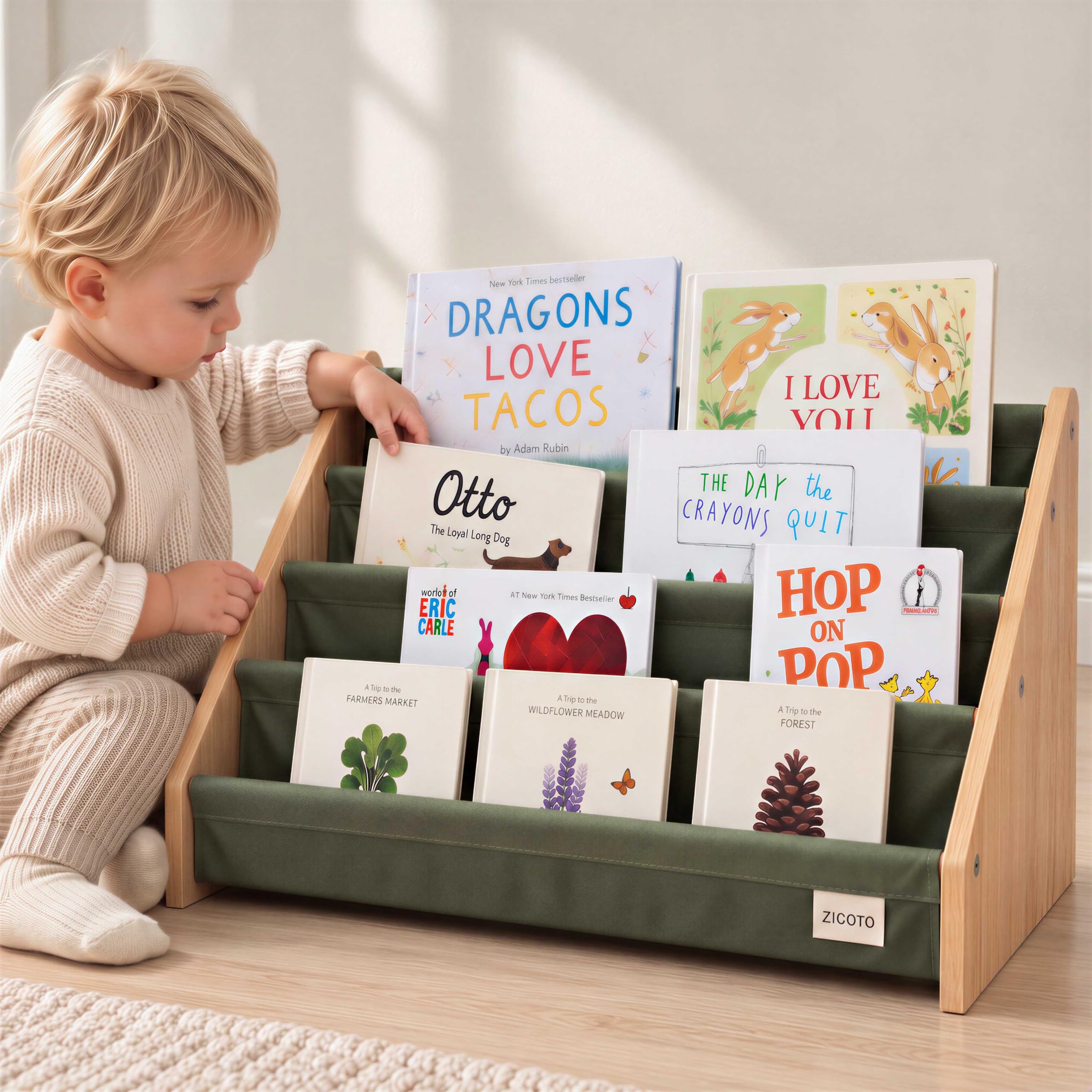
ZICOTO Wooden Montessori Bookshelf
Key Features
- Tiers: 3
- Material: Wood and polyester fabric
- Weight limit: 20 lb
- Book capacity: Up to 20 books
- Price: Budget
Sage green, three tiers, a wooden frame with soft fabric pockets and room for about 20 books. It is the smallest wooden shelf here, and the one that looks most like nursery furniture rather than storage.
It sits low, which is the entire point: a child can see the covers, reach in and pull one out without an adult, and the fabric gives a little when a book is shoved back in. The frame is steady enough for a toddler to hold while standing up. It can slide on a hard floor, so a rug underneath helps.
Build quality is the surprise at this size: a wood frame rather than coated board, square joints, and a matte finish that wipes clean. Assembly is quick and the tools come in the box.
We like it best as a reading-corner shelf, pulled up beside a chair so a child can choose a book without crossing the room. For that it is charming, and it does the one thing that matters — it puts covers at a child’s eye level without asking for a wall.
Pros
- Low stance puts covers in reach
- Steady enough to pull up on
- Wood frame and matte finish for the size
Cons
- Holds a starter collection, not a library
- Deep pockets can hide small board books
We keep this one for reading corners rather than whole libraries — a small, steady shelf that puts covers where a toddler can reach them.
How We Tested Nursery Bookshelves
We started by pulling together a shortlist of nursery bookshelves from our own research and real customer reviews, then narrowed it by size, price, and the specs that matter in a small room—shelf depth, footprint, and whether wall-anchoring hardware was included. That left us with 10 bookshelves to test over nine months.
Assembly came first. We put each one together solo, timed the process, and noted whether the instructions were clear enough to follow without a second adult. We counted every piece of included hardware, checked whether a screwdriver or Allen wrench came in the box, and flagged any unit that required a trip to the hardware store. Once built, we loaded each shelf with a realistic mix: board books on the bottom, picture books in the middle, and a few oversized favorites up top. Over the next several weeks, we checked whether shelves bowed or joints loosened under that weight.
Then we brought in the toughest critics: toddlers. We watched how each bookshelf handled a 2-year-old pulling books down, leaning on the lower shelf, and reaching for a favorite on tiptoe. We checked for sharp corners, tested stability with a gentle bump, and noted which units felt solid only after anchoring. Durability got a real-life workout too—damp cloths, moved furniture, and the occasional tossed toy. We measured footprint and shelf depth against actual nursery walls, compared open shelves to cubbies for functionality, and weighed build quality against price to judge value. The 10 that made the cut are the ones that held up to all of it.
How to Choose a Nursery Bookshelf
A nursery bookshelf is decided by two measurements — how high the books sit and how much floor the case takes — long before finish or brand.
Front-facing or spine-out
Toddlers choose by picture, not by title, which is why front-facing tiers do something a normal bookcase can’t: they let a two-year-old shop. The cost is capacity — a sling or a ledge holds five to eight picture books where a flat shelf holds twenty.
Under about three, we spend the space on display; after that a mix works, with covers low and the long tail of the collection stored spine-out above. If the library is already large, a small display shelf plus a plain bookcase beats one oversized display unit.
Measure the child, then the wall
The number that matters is the height of the top tier, not the width of the case. Our floor picks run from 23.5 inches to 38 inches; anything much above 30 starts becoming adult storage, and a determined child will climb to reach it.
Put the tier you want them to use at shoulder height or below, keep the tallest and heaviest books on the bottom, and treat the top as overflow. Width comes second — it decides how much of the collection lives in the nursery rather than in a closet.
Floor space or wall space
A wall set buys back every square foot, and a 4-inch-deep ledge holds more thin picture books than it looks like it should. What it can’t do is grow: the footprint stays fixed and everything sits above floor level, which suits an older toddler better than a crawler.
A floor case takes 24 to 52 inches of wall plus about a foot of depth, and in exchange the books come to the child. The mistake is hanging wall shelves at adult eye level, where they look best in photographs and sit out of reach in practice.
Anchor it before you load it
A loaded bookshelf is a tip-over risk the moment a toddler uses the top tier as a handhold. Anchor freestanding cases to a stud rather than drywall alone, and test the fixing by leaning your weight on the top shelf before the books go on.
Keep heavy books low so the center of gravity stays down, and place the case where it can’t be climbed from a sofa arm or a crib rail. Several picks here include anti-tip straps; use them even when the shelf feels steady.
What the capacity number means
Book counts assume thin picture books. Board books are several times thicker, so a shelf advertised at 35 books may hold a dozen once the toddler library arrives, and fabric slings stretch in ways a wooden tier doesn’t.
Work from your thickest books rather than your average one, and buy for the collection you’ll have in a year. The picks here run from about 20 books to a wall-length unit, which is the real spread in this category.
Frequently Asked Questions
Will a nursery bookshelf fit under a window?
The short floor cases can tuck under a sill; the tall ones can’t. Ours run from 23.5 inches for the Humble Crew to 38 inches for the OOOK tower, so measure floor to the underside of the sill and compare before you choose.
Leave a few inches of clearance above the tallest book as well — a front-facing tier needs room for small hands to reach over the top edge and pull a cover out.
Can I hang wall book shelves in a rental?
Yes, with a plan for the holes. The wall sets here come with anchors, screws and a drill template, which is enough for thin picture books on drywall, but anything a child pulls on wants at least one screw into a stud.
Budget for the patch on move-out: spackle, sand, and a match to the wall paint. Hang the shelf once and leave it — repeated removal is what enlarges the holes.
How do I clean a fabric or sling bookshelf?
Wipe the sleeves with a damp cloth and let them dry fully before reloading; fabric pockets hold moisture against book covers. A vacuum with a brush head gets crumbs and dust out of the seams.
The care instructions on these shelves are wipe-clean, not machine washable, so treat a spill as something to deal with immediately rather than a laundry job for later.
Final Verdict
The SpaceAid three-tier is the one we point a new parent toward, because it answers the actual nursery question — can my child reach the books, and can the shelf survive them doing it — with solid pine and a 27.6-inch top tier. Everything else here is a variation on that trade.
Change the requirement and the pick changes. No floor left: the Forbena wall set. Toys outnumbering books: the SpaceAid bin organizer. A corner and nothing else: the OOOK tower. That is the whole decision.
