This post contains affiliate links. We may earn a small commission when you buy through our links — at no extra cost to you.
A faint second line can feel like the most important answer of your life—or the start of days of anxiety. Pregnancy tests are simple in theory, but the difference between an early indicator and an evaporation line isn’t always obvious, especially when you’re testing before a missed period. The right test depends on when you test, how many you’ll take, and your tolerance for interpreting faint lines. This guide matches each testing style to the correct format: midstream sticks for fast one-shot reassurance, high-sensitivity strips for tracking line progression over days, and digital readouts for a final written answer. You’ll see which early-detection claims hold up under real-world use, which budget strips earn their keep, and when a second brand confirmation is the smarter move—so you can trust your result and move forward.

Best for One-Shot Certainty
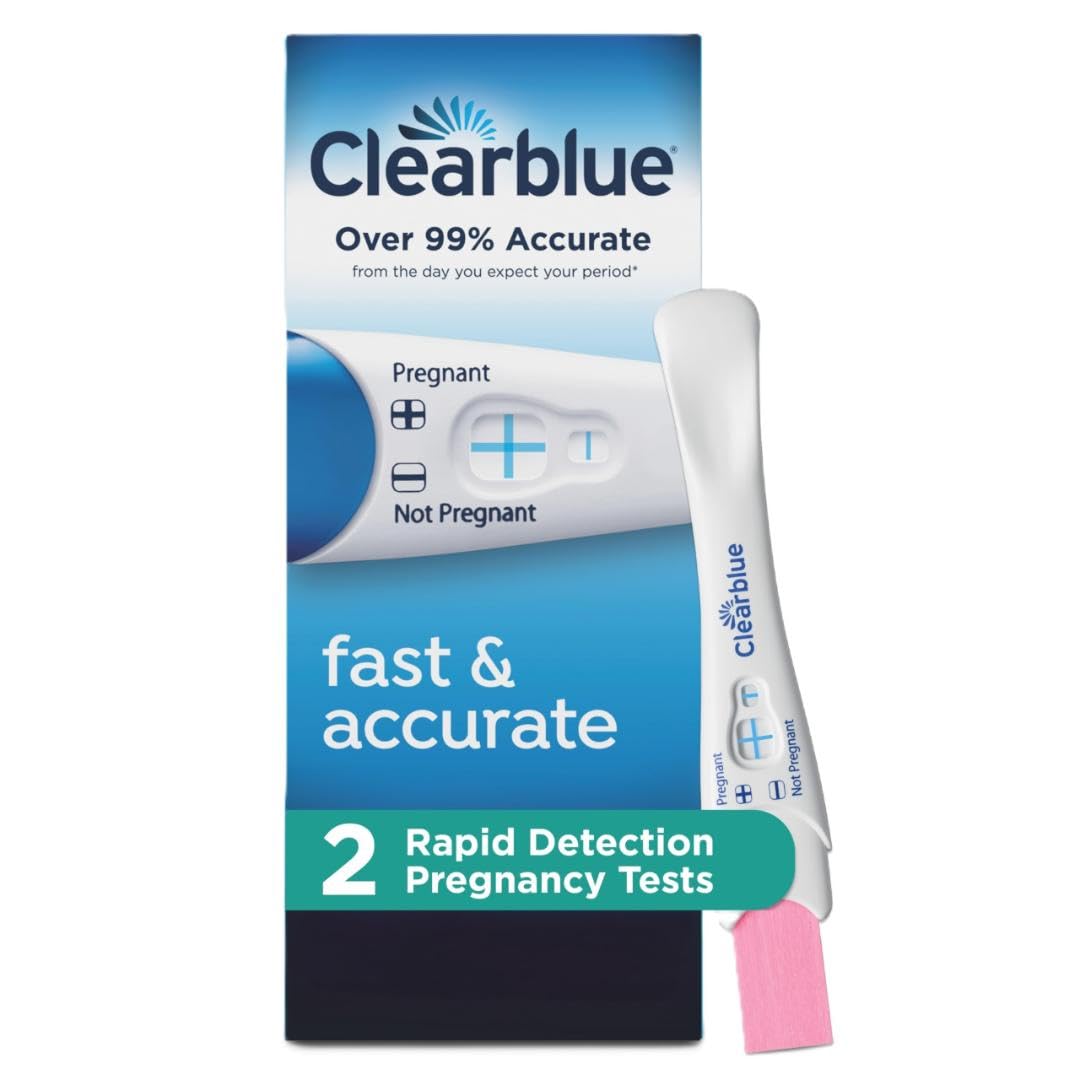
Clearblue Rapid Detection
Key Features
- Test Format: Midstream stick
- Result Type: Plus / Minus lines
- Early Detection: Up to 5 days before missed period
- Pack Size: 2
- Price: Mid-Range
The Clearblue Rapid Detection’s Floodguard tip turns pink to confirm sufficient urine contact, eliminating the biggest source of user error among midstream tests. The wide, curved handle provides a secure grip, and results appear as a clear plus or minus within 1 minute—removing ambiguity that plagues line-only strips. A control line verifies the test is valid, and accuracy aligns with lab tests from the day of your expected period. Some users report faint blue test lines, but reading the result within the recommended time window under bright light resolves most uncertainty.
This test suits anyone who wants a fast, definitive answer without deciphering multiple cheap strips. The two-test pack costs more than bulk dip strips, but the hassle-free midstream experience justifies the price for a single, clear result. It’s not intended for those tracking line progression over days or who insist on a digital readout. The blue dye line can appear faint, so if you’re prone to reading anxiety, a pink-dye alternative might reduce doubt. For one-shot confidence with minimal chance of user error, the Rapid Detection remains the top midstream option.
Pros
- Color-changing tip confirms correct usage at a glance, eliminating guesswork.
- Plus/minus symbols deliver unambiguous results in as little as 1 minute.
- High accuracy from the day of expected period, frequently confirmed by doctor follow-ups.
Cons
- Blue test lines may appear faint, creating reading uncertainty in suboptimal lighting.
Buy this if you want a fast, unambiguous result with the lowest chance of user error. Skip it if you need bulk strips for progression tracking or prefer a digital readout.
Best for Budget Bulk Testing
Pregmate 50‑Pack Strips
Key Features
- Test Format: Dip strip (wide)
- Result Type: Two pink lines
- Early Detection: Before missed period
- Pack Size: 50
- Price: Budget
The Pregmate 50‑pack prioritizes volume and per‑test cost over the instant, foolproof certainty of the Clearblue Rapid Detection top pick. It lacks the app‑based line tracking of the competing Easy@Home strips, but reports indicate a notably low false‑positive rate—a critical advantage for avoiding unnecessary anxiety. High‑volume testers and budget‑conscious TTC couples will appreciate the wide, easy‑to‑read strips, though initial lines tend to be faint and do not reliably darken with rising hCG levels. For confirmation of an early positive, a digital test is a prudent next step.
Pros
- Unmatched per‑test economy makes this the most budget‑friendly bulk pregnancy test option.
- Wide, easy‑to‑read strips and a low false‑positive rate reduce confusion and anxiety.
- Straightforward dip‑and‑read process with fast results, praised for simplicity.
Cons
- First‑positive lines are often faint, which can make early reading uncertain.
- Progression tracking is inconsistent; lines may not darken predictably as hCG rises.
Buy this if you want to test frequently and value per‑strip cost above all else. Skip it if you need undeniable first‑response certainty or app‑guided line progression tracking.
Best for App Tracking
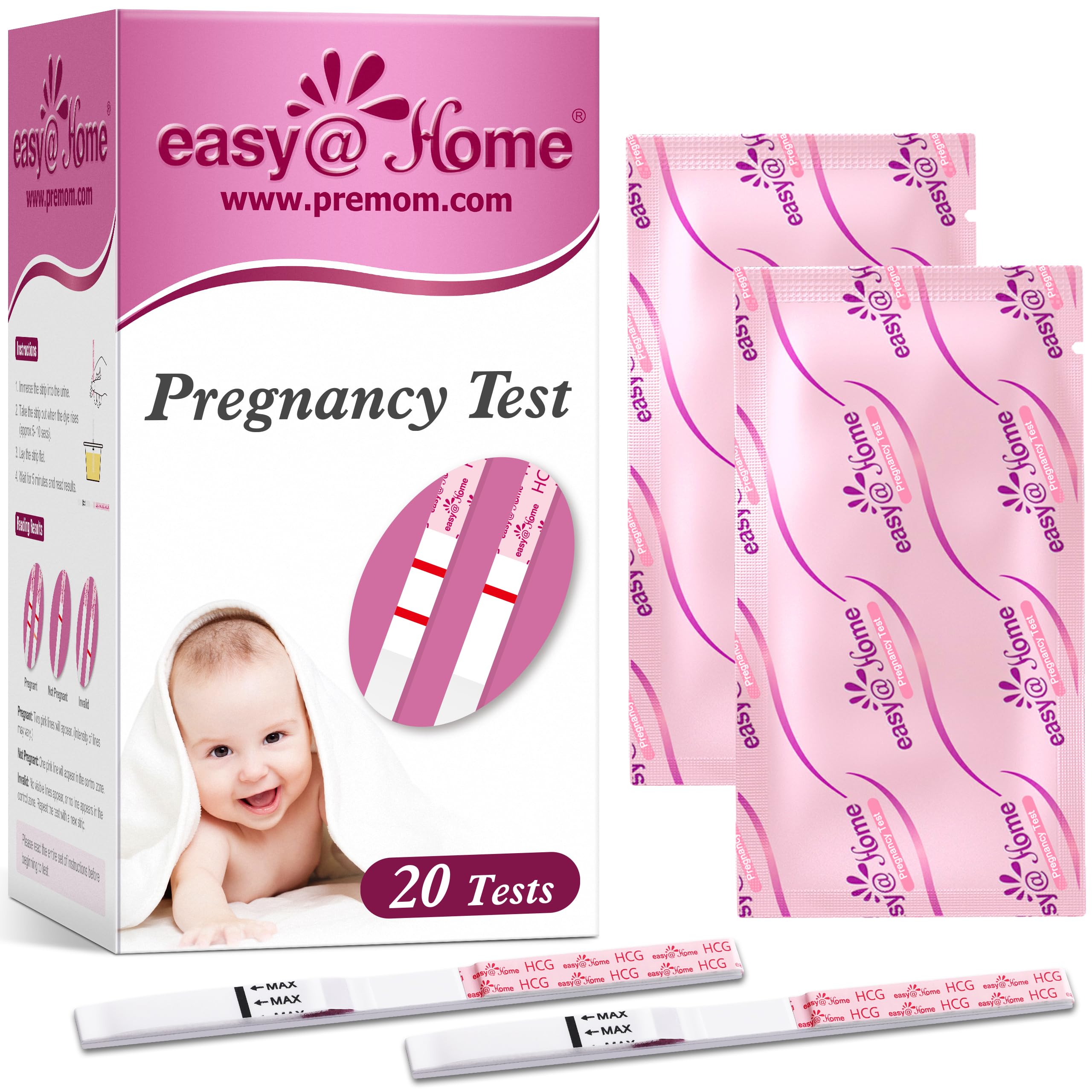
Easy@Home 20‑Pack Strips
Key Features
- Test Format: Dip strip
- Result Type: Two pink lines
- Early Detection: 7-10 DPO
- Pack Size: 20
- Price: Budget
Unlike bare-bones bulk packs, these strips pair with the Premom app to photograph and log line progression, giving daily testers a quantified timeline of hCG rise. The pink dye and 25 mIU/mL sensitivity catch pregnancy as early as seven days past ovulation, though lines are often faint initially. That ambiguity can fuel anxiety, and a few batches have produced false positives, so the app’s progression charts are your best guard against misreading a single strip. This kit suits TTC trackers comfortable with dip strips and data, not anyone seeking a quick plus-or-minus answer.
Pros
- Extremely cost-effective for daily testing and progression tracking.
- Clear dip-and-wait method with quick, readable results.
- Detects pregnancy early, often before a missed period.
Cons
- Faint lines cause reading anxiety and occasional false positives.
- Sensitivity sometimes trails premium midstream tests for very early results.
Buy this if you’re tracking line progression with the Premom app and prefer bulk strips for daily testing on a budget. Skip it if faint lines cause you more anxiety than insight, or you need a one-and-done clear result.
Best for Early Progression Tracking
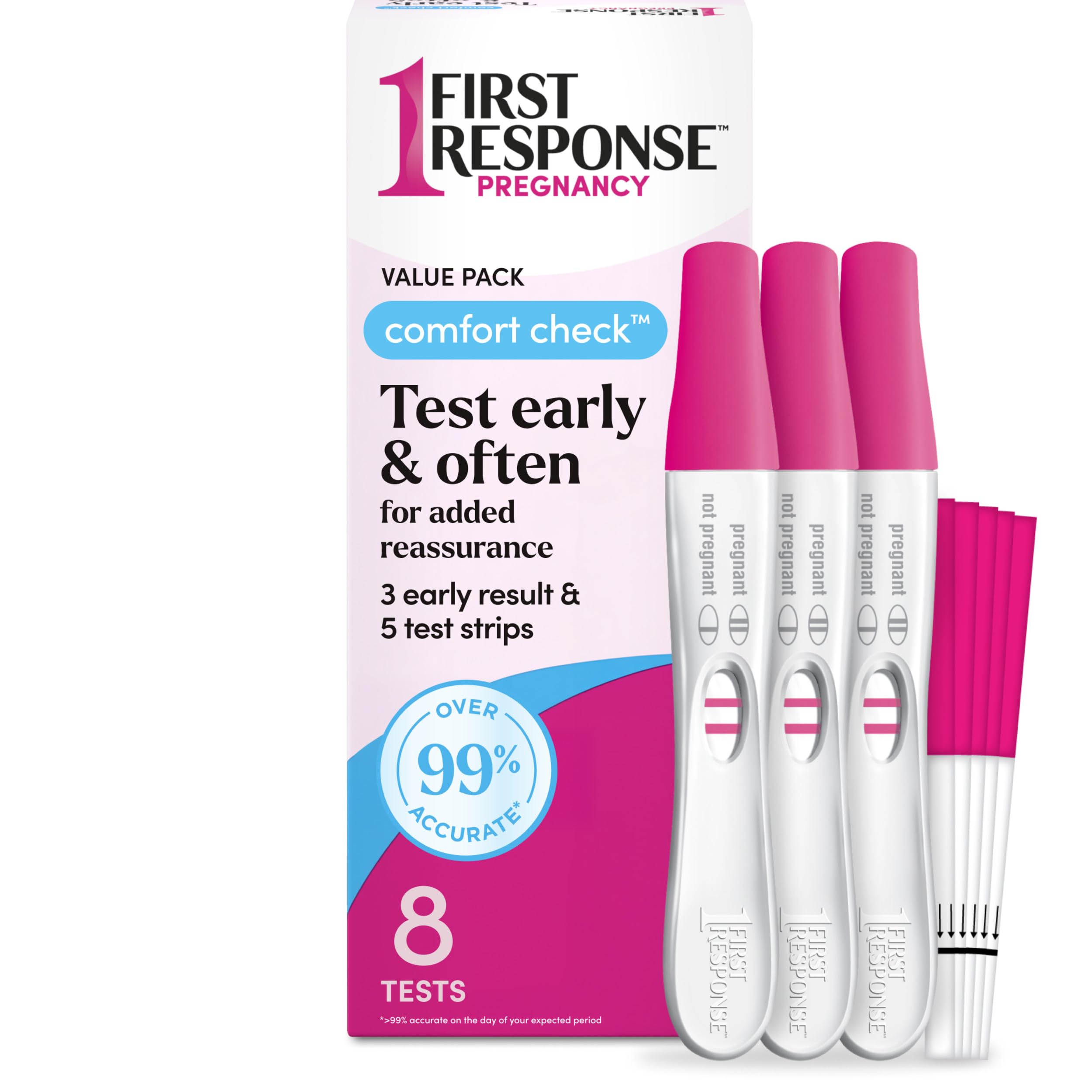
FRER Comfort Check
Key Features
- Test Format: Midstream stick + dip strips
- Result Type: Pink lines
- Early Detection: Sticks: 6 days; Strips: after missed
- Pack Size: 8 (3+5)
- Price: Mid-Range
Unlike digital confirmation bundles that prioritize unambiguous yes/no results, this kit combines three First Response Early Result sticks—sensitive enough for detection up to six days before a missed period—with five dip strips that make daily progression tracking affordable. The sticks produce pink lines within three minutes; strips require five minutes and are designed for use after the missed period. Bulk, discreet packaging removes the stress of reordering, and you get everything in one box. The dip strips can occasionally exhibit dye bleeding or faint lines that cause reading anxiety, so treat them as supportive evidence rather than definitive answers. This mix squarely serves early-detection fans who want to monitor line progression without overspending on multiple packs.
Pros
- Sensitive sticks and affordable strips enable early detection and daily progression tracking in one box.
- Discreet, bulk packaging gives peace of mind for frequent re-testing without extra orders.
Cons
- Strip results can exhibit dye bleeding or faint lines, causing anxiety during early interpretation.
- Some units arrive with a non-standard cap (missing pink cap), causing brief confusion.
Buy this if you want an all-in-one early-testing kit that pairs ultra-sensitive midstream tests with economical strips for daily line progression. Skip it if you prefer digital yes/no results or can’t tolerate any reading uncertainty from dip strips.
Best for Early Detection (Pink Dye)
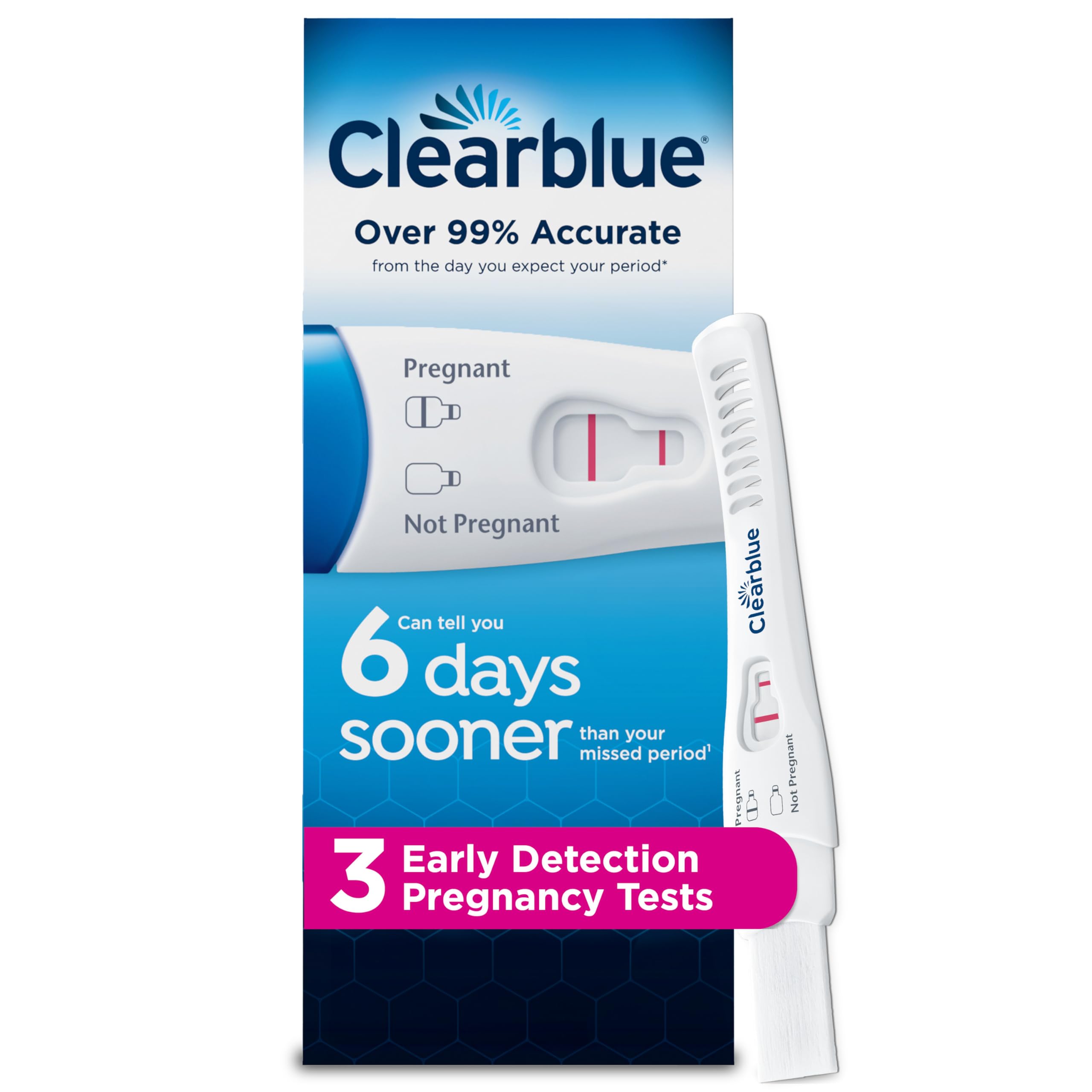
Clearblue Early Detection
Key Features
- Test Format: Midstream stick
- Result Type: Two pink lines
- Early Detection: Up to 6 days before missed period
- Pack Size: 3
- Price: Mid-Range
For those who test before a missed period, this Clearblue kit combines pink dye and DualSense technology to deliver early positives that rarely leave room for doubt. Unlike the top pick’s rapid plus/minus result and Floodguard tip, you’ll wait a full three minutes for two distinct lines, and the foil wrappers can be stubborn to tear open. But if you value the clarity of pink lines over speed and don’t mind a minor packaging inconvenience, these sticks fit the narrow window between early curiosity and certainty.
Pros
- Pink-dye lines deliver early positives without the faint indent confusion common in other early tests.
- Comfort-grip handle and bold lines make reading results within 3 minutes effortless.
- DualSense technology suppresses rare false positives that other sensitive tests can trigger.
Cons
- Foil packaging requires more effort to tear open than typical test wrappers.
Buy this if early detection with confident pink-dye lines is your priority and you’re willing to trade a faster result for fewer ambiguous lines. Skip it if you prefer a one-minute digital yes/no and unobtrusive packaging.
Best for Digital Confirmation
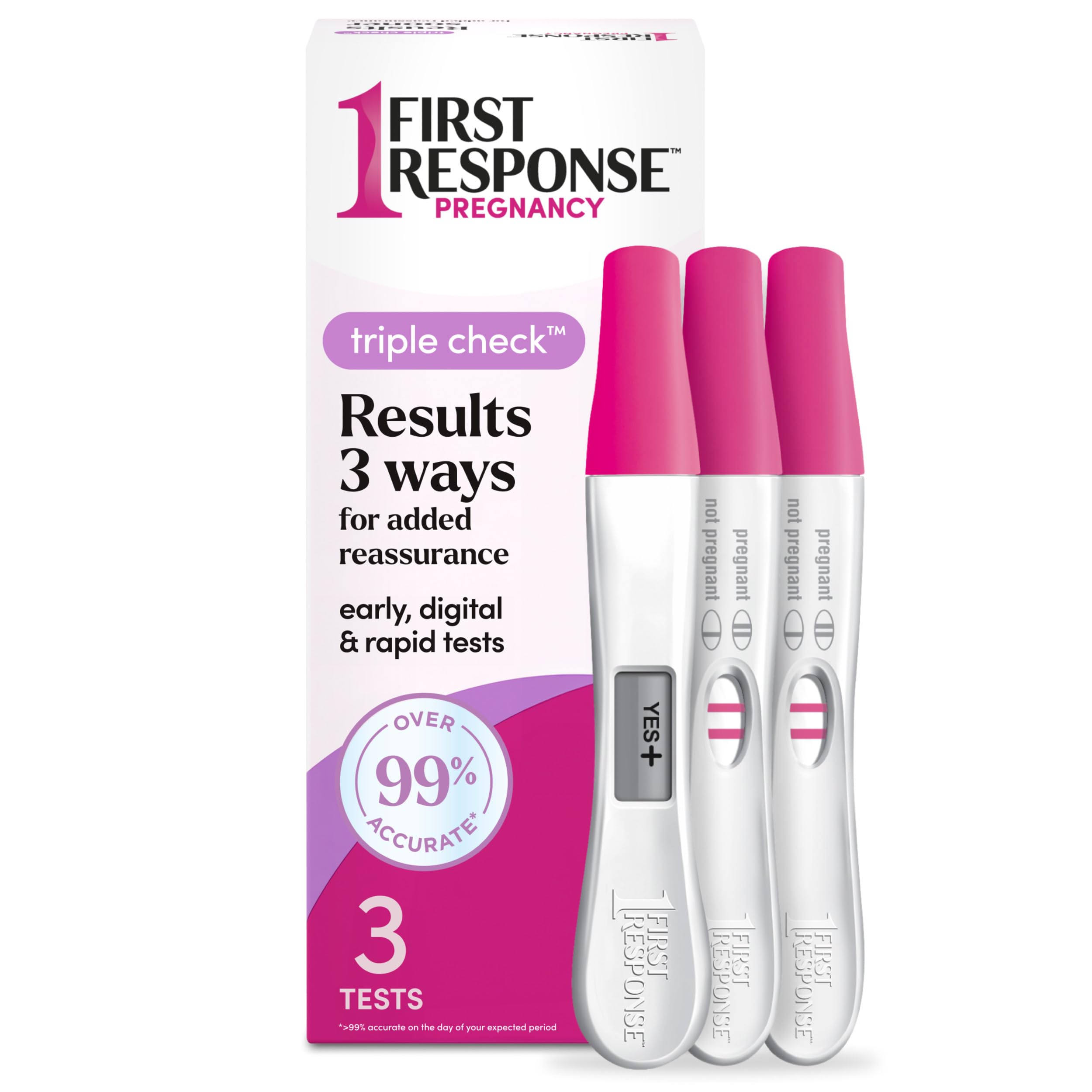
FRER Triple Check
Key Features
- Test Format: Three stick types (line, rapid, digital)
- Result Type: Mixed (lines & digital)
- Early Detection: Early Result: 6 days before
- Pack Size: 3
- Price: Mid-Range
The Triple Check gives you three progressively more definitive answers — Early Result lines for early sensitivity, Rapid Result for a one-minute check, and a digital ‘YES+/NO-’ for final peace of mind — all in one box. Compared to the top-pick Clearblue with its foolproof tip and clear plus/minus, this kit leans on its line tests for early detection; the digital isn’t as sensitive and can read ‘NO-’ if urine is dilute or hCG is low, increasing the risk of a false negative for early testers. Still, for those who want to cross-check with multiple methods rather than a single high-confidence stick, this offers a methodical confirmation path. The Rapid Result occasionally produces faint shadow lines, so interpret with care. Skip it if you’re testing before 14 DPO and expect the digital to match the Early Result’s sensitivity.
Pros
- Progressive confirmation: Early Result line, then digital ‘YES+/NO-’ for final peace of mind.
- Rapid Result delivers a one-minute answer during anxious waits.
Cons
- Digital test can show ‘NO-’ with diluted urine; needs concentrated sample and precise dip timing.
- Rapid Result may show faint grey or pink shadow lines, leading to confusion.
Buy this if you want progressive confirmation with line tests and a digital readout in one box. Skip it if you’re testing early and need the digital to match the sensitivity of a line test.
Best for Late-Period Testing
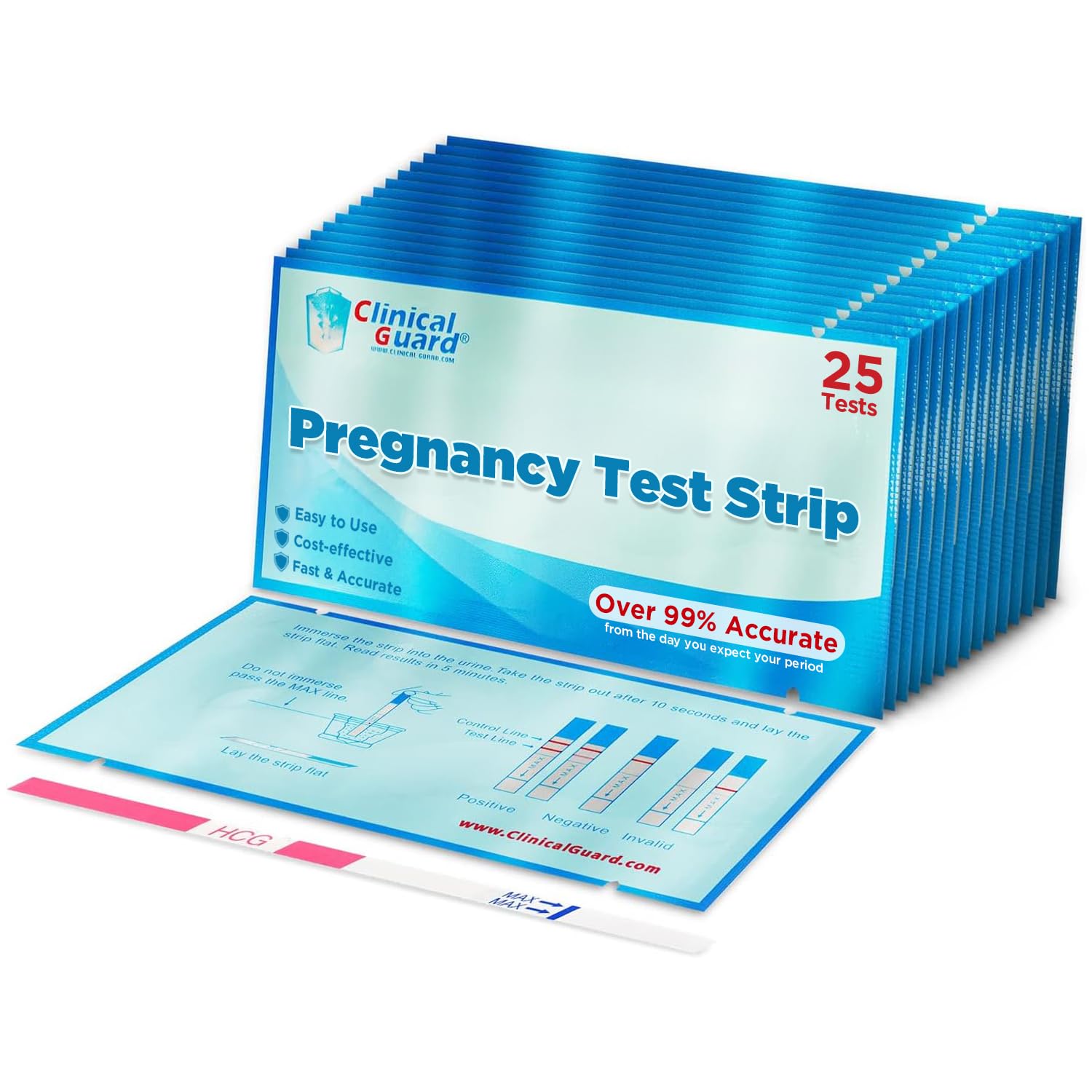
Clinical Guard 25‑Pack
Key Features
- Test Format: Dip strip
- Result Type: Two pink lines
- Pack Size: 25
- Price: Budget
The 25‑pack delivers the lowest entry price for bulk strip testing, but sensitivity can vary between batches. Users testing well after a missed period when hCG levels are high get the clearest results. Early testers risk faint or missing lines, so this kit serves best as a confirmatory tool, not a first‑response detector.
Pros
- Impressive per‑strip value for budget‑minded shoppers.
- Clear instructions and simple dip‑strip format.
Cons
- Some batches struggle to detect early pregnancy, missing positives other brands catch.
- Faint lines on certain lots create reading uncertainty and anxiety.
Worth considering if you need affordable bulk strips for testing late in your cycle and can live with occasional faint lines or missed early positives.
Best for Late-Period Backup
AccuMed 25‑Pack Strips

Key Features
- Test Format: Dip strip
- Result Type: Two pink lines
- Pack Size: 25
- Price: Budget
These AccuMed strips offer bare‑bones affordability and simple dip‑and‑read testing. However, many users report false‑positive results and faint evaporation lines that can mimic real positives, creating uncertainty. They are not suitable for early testing; they work only as a late‑period verification tool for those who will immediately confirm any positive with a more accurate brand.
Pros
- Good value with 25 individually wrapped strips at a budget‑friendly price.
- Straightforward dip‑and‑read process, easy for first‑time users.
Cons
- Some batches produce false‑positive lines, and faint evaporation lines are common, causing confusion.
Worth considering if you need a dirt‑cheap backup for testing well after a missed period and will immediately confirm any positive with a digital or pink‑dye test.
How to Choose
Your test’s accuracy hinges less on brand and more on matching the test format and sensitivity to your cycle day—and your willingness to wait.
Test Format
Midstream stick tests require no cup and reduce the chance of user error, making them ideal for quick, one-time confidence. Dip strips are far cheaper per test but demand a clean cup and careful timing; they shine when you plan to test daily and compare lines over several days.
Result Type
Line-based and plus/minus tests react to lower hCG levels earlier than digital readouts, so they’re preferred for early detection. Digital tests trade sensitivity for clarity, displaying ‘Pregnant’ or ‘Not Pregnant’ but may return a false negative if urine is dilute or hCG is still rising.
Early Detection Window
Tests claiming detection up to 6 days before a missed period rely on highly sensitive assays. Testing that early can capture very early chemical pregnancies that might otherwise be mistaken for false positives. If you choose to test early, expect faint lines and retest two days later to confirm progression.
Sensitivity and Line Interpretation
Most strips use a 25 mIU/mL cutoff, reliable from the day of a missed period onward. Pink dye tests tend to produce fewer evaporation lines than blue dye alternatives. Any line—no matter how faint—that appears within the reading window is a positive; a line that shows up after the time limit is likely an evaporation artifact.
How Many Tests You Need
A 2- or 3-pack midstream test is sufficient for a one-time confirmation after a missed period. Trying-to-conceive users who start testing early often benefit from 5-20 strips to track line darkening across consecutive days. A multi-day progression provides more actionable confidence than any single test.
FAQ
Why is my pregnancy test line so faint?
A faint line within the reading window usually indicates that hCG is present but still at low levels, often because you tested early or used diluted urine. Pink dye tests typically show clear, faint lines while blue dye tests can leave confusing shadows. The best next step is to test again with first-morning urine after 48 hours—the line should darken as hormone levels rise.
Can a pregnancy test give a false positive?
True false positives are rare outside of certain medical conditions or recent pregnancy loss. What many users call a false positive is actually a chemical pregnancy—a fertilized egg that implants briefly and produces hCG but does not develop. Highly sensitive tests can detect this fleeting hormone, leading to a positive that turns negative days later. To reduce confusion, confirm any positive with a second test 2-3 days later and consider a digital test after your missed period.
How early can a Clearblue Rapid Detection test show positive?
Clearblue Rapid Detection is designed to detect pregnancy up to 5 days before your missed period. For strongest results, use a concentrated first-morning urine sample. Testing earlier than 5 days before a missed period often yields a negative even if pregnancy has occurred, so if you get a negative and your period doesn’t arrive, retest on the expected day.
Why did my digital test say ‘Not Pregnant’ but the line test was positive?
Digital tests require a higher concentration of hCG to trigger a positive reading than most line tests. If your urine is diluted or you’re testing very early, a line test may show a faint positive while the digital remains negative. Use first-morning urine and wait 1-2 days to try the digital again; the word-based result will catch up as hCG rises.