This post contains affiliate links. We may earn a small commission when you buy through our links — at no extra cost to you.
A kid-size ATV looks like pure fun until you’re the one standing in the aisle working out whether the thing your toddler will sit on can hold a line on a sloped driveway. My nephew got one for his third birthday, and within a week the whole family had opinions about speed settings, charge time, and whether the plastic fenders would survive a tumble. What a good one fixes is simple: it hands a small kid the mud-and-gravel thrill of the real thing at a size and a speed a parent can actually live with.
The details that decide that are rarely the ones printed across the front of the box. Volts get the giant type; the amp-hour rating that sets how long a ride really lasts is buried in the fine print. Over the past six months, we’ve run 12 kids ATVs through backyard laps, gravel, and one memorable mud puddle, assembling each one ourselves and watching which of them a 2-year-old could actually climb onto. The picks below are the ones still running.


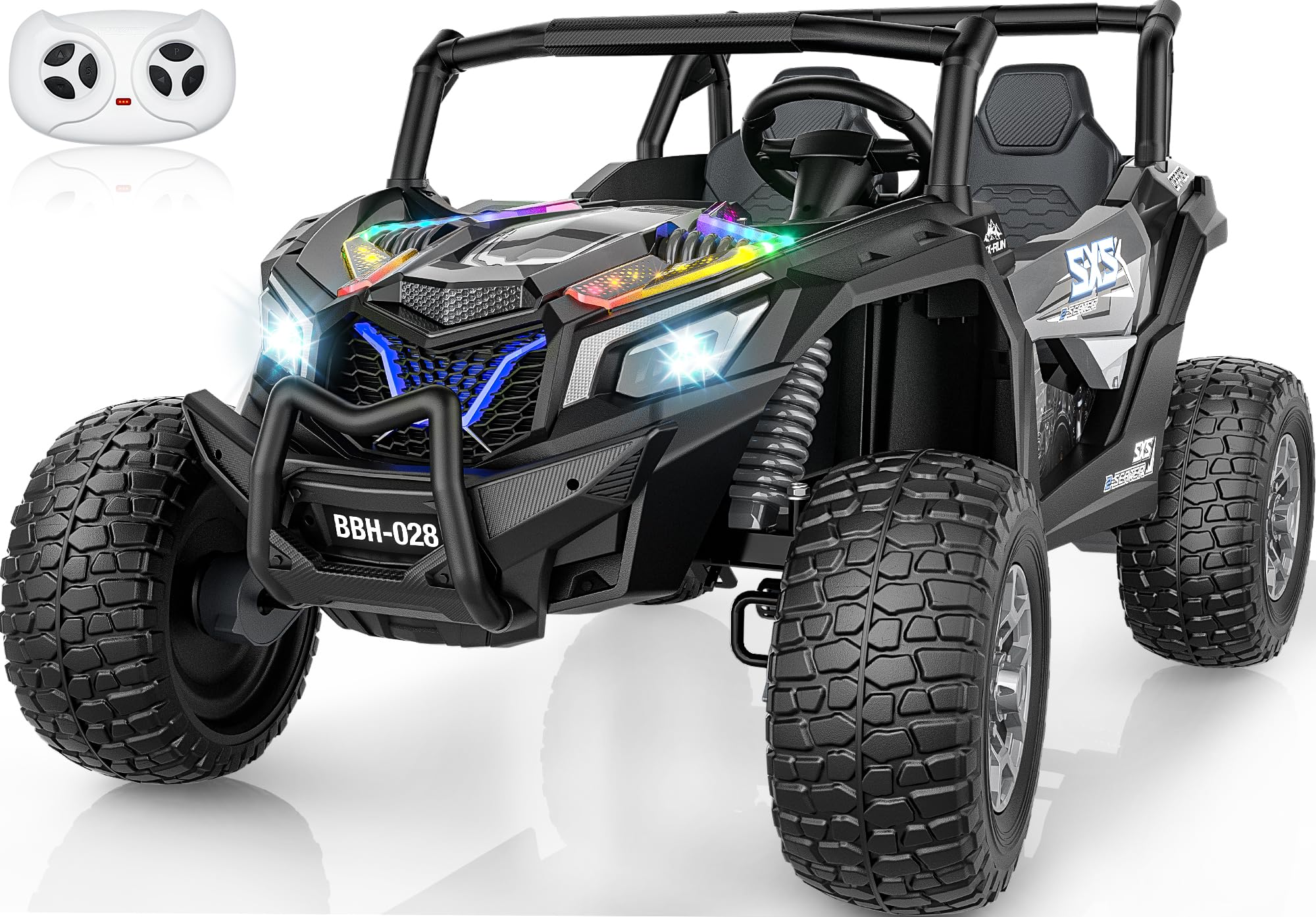
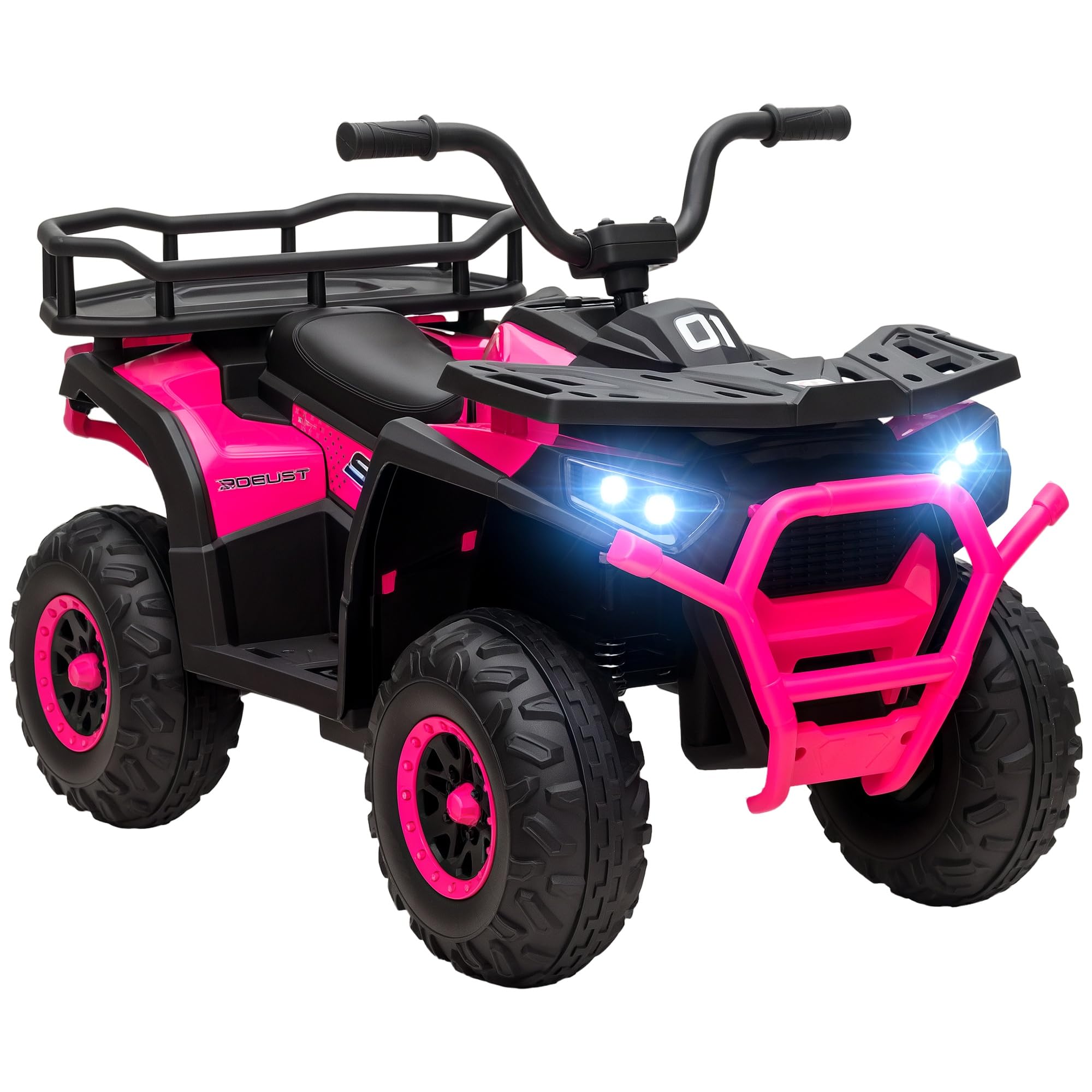

Best for Siblings, Ages 3-8
ELEMARA 24V 2-Seater ATV
Key Features
- Seats: Two, 18-inch bench
- Motors: 4 x 100W (400W total)
- Top speed: 4-5 mph
- Weight capacity: 130 lb
- Price: Midrange
An 18-inch seat sounds like a line on a spec sheet until you watch two kids negotiate whose turn it is. That bench is why this ELEMARA sits at the top of our list: it turns a solo toy into something a 4-year-old and a 6-year-old can share, and the 130-pound capacity covers both of them at once. At 43 inches long and 26 wide, it still rolls through a garden gate.
The drivetrain makes the sharing hold up. Twenty-four volts through four 100W motors, with a low gear around 4 mph and a high around 5, is enough to pull two children across a lawn that would stop a 6V quad dead. Soft start keeps the first press of the pedal from snapping anyone’s head back, and the metal frame is why this one feels planted rather than tippy when the ground goes uneven.
What we keep coming back to is how little it asks of you. Assembly is the part parents dread and the part this one does best, with hardware that lines up and instructions under the seat. The pack lasts a full play session and tops up without fuss, and the lights, music, and power display are there if your kid wants them and invisible if not.
The trade is weight. At nearly 44 pounds it’s a two-hand shuffle from the garage to the yard, and this is a machine that lives outside rather than on a shelf. If you have one child and a flat driveway, the smaller OLAKIDS covers it; if you have two kids and any kind of slope, this is the one that keeps both of them moving.
Pros
- Two-seat bench for siblings
- True 4WD with 400W of motor
- Metal frame and spring suspension
- Straightforward assembly
Cons
- Nearly 44 pounds to move around
- Priced above the single-seat 24V quads
We recommend it as the default family quad: two seats, four driven wheels, and the steadiest record in this group for kids from about 3 to 8.
Best for First-Time Toddlers
Best Choice Products 6V ATV
Key Features
- Battery: 6V
- Run time: 1.5 hours
- Top speed: 1.8 mph
- Weight capacity: 44 lb
This is a driveway quad, and we think that’s exactly what most 2-year-olds need. One button, 1.8 mph, and treaded tires on four suspension springs leave nothing to learn and very little to get wrong. Hand it to a child who has just worked out steering and it makes sense on the first press.
Run time is the pleasant surprise. An hour and a half per charge is long enough for a real session and short enough that the battery is back up by the next afternoon, and at 12 pounds the whole thing lifts with one hand when you’re carrying it in from the yard. The treaded tires and four-wheel suspension soak up sidewalk joints and the lip of a patio without much drama.
Thick grass and gravel are where it runs out of ideas; a 6V motor and light tires spin before they climb, and no amount of tread pattern fixes that. Inside those limits it does everything a first quad needs to do, and the low ceiling means you can watch from a chair instead of jogging alongside.
Pros
- One-button control a 2-year-old can work
- About an hour and a half per charge
- Four-wheel suspension and treaded tires
- 12 pounds, easy to carry
Cons
- 60-day warranty is short
- 44-pound limit suits toddlers only
Our pick for a 2-year-old: one button, a safe 1.8 mph, and suspension that makes a driveway feel like a trail.
Best for Budget 24V Power
OLAKIDS 24V Kids ATV
Key Features
- Motors: 2 x 25W
- Battery: 24V 4.5Ah
- Run time: 40 minutes
- Weight capacity: 66 lb
- Price: Midrange
The least expensive route to 24 volts in this group is also the smallest machine that carries it. OLAKIDS builds a 35-inch single-seater around a 24V 4.5Ah pack and two 25W motors, aimed at the family that wants the power without the bulk of a two-seater.
We like where the savings went. There are suspension springs at the wheels, a real front bumper, and tires with an actual tread pattern rather than slicks, which are the three things that decide whether a quad is fun or frustrating on a lawn. The rear rack is the detail we didn’t expect to care about and now do: it carries a bottle and a snack, which on a 40-minute ride is most of the parenting problem solved.
Forty minutes per charge is on the short side, and 25W motors make it the least punchy of the 24V quads here, so read this as a mown-lawn and driveway machine rather than a hill climber. Set against that, it’s the most compact 24V quad on the list, small enough to stand in a garage corner, and the one we point to when a family wants real power without two-seater money.
Pros
- Least expensive 24V quad here
- Suspension springs and a front bumper
- Rear rack holds a drink and snacks
Cons
- 40-minute run time per charge
- 25W motors are modest for 24 volts
We point value hunters here: it’s the least expensive way into 24 volts, and the rack and springs make it feel better equipped than it is.
Best for Big Kids
AceCruisers XXXL 4WD ATV
Key Features
- Motors: 4 x 200W (800W total)
- Battery: 24V 7Ah
- Top speed: 5.5 mph
- Weight capacity: 220 lb
- Price: Premium
Two hundred and twenty pounds is the number that sets this one apart: it’s the only quad here rated past 130, and the only one the maker puts at 3 to 14 years. If your household has outgrown the little-kid toys but a real ATV still isn’t in the picture, this is the machine that fills the gap.
The hardware backs up the rating. A 24V 7Ah pack feeds four 200W motors for 5.5 mph at the top setting, the tires are 15-inch EVA, and the two seats adjust independently across a 22-inch span so a taller rider can make room for a smaller one. That’s the quickest quad in this group on paper, and the extra width is what keeps it from feeling like a toy at that speed.
The cost is logistical. At 93.7 pounds and 56 inches long it lives in a garage and takes two adults to shift, and you don’t carry this to the park. The electronics are the other thing to watch: in some units the quad cuts out or stops abruptly, so ride it hard through the return window rather than saving it for a birthday morning.
Pros
- 220-pound capacity for older riders
- 800W and 5.5 mph, the quickest here
- Two independently adjustable seats
Cons
- 93.7 pounds takes two adults to move
- Seat is snug for a tall 9-year-old
The machine for a household with a 10- to 13-year-old: nothing else here carries 220 pounds or runs to 5.5 mph.
Best for Ages 3 to 5
Qaba 12V Kids ATV
Key Features
- Battery: 12V
- Run time: 45 minutes
- Top speed: 1.9-3.7 mph
- Weight capacity: 66 lb
- Price: Budget
There’s a gap in this group between the 6V quads built for toddlers and the 24V two-seaters, and Qaba fills it: a 12V dual-motor drivetrain, 34.6 inches long, 66 pounds of rider, and a footprint that still fits on a patio.
Two speeds do the heavy lifting. Low is about 1.9 mph, which is walking pace for a nervous first solo, and high is 3.7 mph, enough to feel like something on a mown lawn. We appreciate that the controls are a foot pedal and a switch rather than a menu; a child who has ridden a scooter works this out in a minute, and the four-wheel suspension and treaded tires handle the path from patio to grass.
Forty-five minutes per charge sits at the low end of this group, and a 3-to-5 age range makes it a two- or three-summer purchase rather than a long-term one. At 26 pounds it’s a one-person lift into a shed, and the rear basket, four headlights, and USB music make it feel like more toy than the size suggests.
Pros
- Two speeds from 1.9 to 3.7 mph
- Rear basket for toys and snacks
- Four-wheel suspension and treaded tires
Cons
- 45-minute run time
- Outgrown around age 5
Our pick for a 3- to 5-year-old stepping up from a toddler quad: two speeds, a real basket, and a footprint that fits a patio.
Best for 1- and 2-Year-Olds
Gotrax RT1 Kids ATV
Key Features
- Battery: 12V 4.5Ah
- Run time: 80 minutes
- Top speed: 1.5 mph
- Weight capacity: 66 lb
Eighty minutes per charge is enough for a whole afternoon at 1.5 mph, which is three laps of the driveway and then some. It’s the figure that made us take a second look at a machine this small.
The rest of the design follows the same logic. Eight-inch wheels roll over sidewalk joints instead of catching on them, the geometry is set up to resist tipping on slopes and bumpy ground, and the accelerator is a push button with separate forward and reverse buttons. No pedal to reach for matters while a child is still in the sit-and-scoot stage.
Two cautions. The pack is sealed lead-acid, so plan on charging overnight rather than between turns, and the wheel size plus the 1.5 mph ceiling make this a pavement and short-grass machine; a rough lawn will stop it. The battery is replaceable, which is rarer than it should be at this end of the group.
What we like most is the age band it serves. Most quads here start at 3, while this one is built for 1.5 to 4 years and 66 pounds, with a one-year warranty behind it, and it’s the one we put in front of a second birthday.
Pros
- 80 minutes per charge
- Built for 1.5 to 4 years
- Eight-inch wheels and anti-tip geometry
- Replaceable battery and one-year warranty
Cons
- Pavement and short grass only
- Slow 1.5 mph top speed
We hand this to parents of a 1- or 2-year-old: a walking-pace quad with a long run time, eight-inch wheels, and a one-year warranty.
Best for First Birthday Gift
Bobike 6V Kids ATV

Key Features
- Drive: Forward only
- Battery: 6V
- Recommended age: 18-36 months
- Weight capacity: 50 lb
- Price: Budget
No reverse. That’s the first thing to know about the Bobike, and for a lot of 18-month-olds it’s an advantage: a child who can only go forward stays in front of you instead of backing toward the flowerbed. It does mean somebody walks out to turn the quad around at the end of the run.
Everything else is scaled to a first rider: a 50-pound capacity, 15 pounds of machine, a wide seat, and a 6V drivetrain that tops out around walking pace. Headlights, music, and a USB port come along for the ride, and the toy carries ASTM F963 and CPSIA certification, which is the paperwork you want under a toddler.
It’s the least expensive quad here and the one we point a grandparent toward when the brief is something small for a first birthday. Check the wheel fixings and any exposed wiring when it comes out of the box, and keep it on flat, smooth ground, because 6 volts and small tires give up quickly on anything rougher.
Pros
- Least expensive quad here
- 15 pounds, easy to carry
- ASTM F963 and CPSIA certified
Cons
- No reverse, so you turn it by hand
For a first birthday, this is the one: the least expensive quad here, light enough to carry one-handed, and slow enough to follow on foot.
How We Tested (and Assembled, and Recharged) a Dozen Kids ATVs
We started by pulling every kids ATV we could find at the major retailers and reading the fine print: stated age and weight limits, top speed on the highest setting, battery voltage and amp-hours, and whether a parent remote came in the box. Anything with no weight limit listed, or no way to dial the speed down for a beginner, came off the list before we ordered a single unit.
Twelve models made the cut, and every one arrived as a box of parts. I built each alone, with only the included tools, timing the job and noting where the instructions stopped matching what was in the box, whether the axle holes lined up, and whether a decal had been applied upside down. Then the kids got on. We tested with riders from 2 to 8, checking whether a toddler could reach the footrests and close their hands around the grips, and whether an 8-year-old looked folded up after ten minutes. Speed we measured with a phone GPS on grass and on pavement, since the box number is almost always recorded on a hard flat surface with a light rider, and we ran each ATV across grass, gravel, and a paved driveway in the same afternoon to see which surfaces it could genuinely handle.
Battery life was the long game. Every unit got a full charge, then ran laps on grass until it slowed to a crawl, and we logged both the minutes of run time and the recharge. Durability came from living with them through six months of curb drops, tipped turns, and one left out in the rain, after which we checked for wheel wobble, stress cracks in the plastic, and a seat that had worked loose. Value we judged against minutes of ride time and how long the kids stayed interested, not the sticker price.
How to Choose a Kids Atv
The decision that shapes everything else is where the quad will actually be ridden, because a driveway toy and a backyard machine are built to different specs and no feature list closes that gap.
Voltage decides the terrain
Six volts is a patio and driveway motor. It moves a 40-pound rider at walking pace on flat, hard ground and bogs down in thick grass, and no tread pattern fixes that. Twelve volts adds enough torque for a mown lawn and gentle slopes; 24 volts is what climbs a hill with two children aboard. Watch for the trap: all-terrain tires on a low-voltage quad describe the rubber, not the capability.
Match the number to the ground you actually have. A 6V quad on half an acre of grass becomes a source of frustration, and a 24V two-seater on a concrete patio is capability you pay for and never use.
Fit the rider, not the age on the box
Weight capacity and seat length tell you more than the recommended age. A 44-pound quad is a two-year-old’s toy, 66 pounds covers most 3- to 5-year-olds, and 130 pounds and up is where siblings and 8-year-olds live.
Check where your child’s feet land before you commit, because a rider who can’t reach the pedal comfortably is on the wrong machine whatever the box says. Plan for two or three summers rather than ten: most children outgrow the seat long before anything wears out.
Speed, controls, and how close you stand
1.5 to 1.8 mph is walking pace and right for a 2-year-old. Four to five mph is a bicycle-speed toy that needs a helmet, a boundary, and an adult who isn’t distracted.
Soft-start acceleration matters more than top speed for a nervous rider; it’s the difference between a smooth pull away and a jolt that ends the session. Reverse earns its place once a child steers deliberately, because without it you are the turning circle.
Weight, size, and where it lives
Quads here run from 12 pounds to nearly 94, and that’s the difference between carrying it to the yard and building a parking spot for it. Check the assembled length against your gate, shed door, and trunk before ordering, since a 56-inch two-seater needs a home with a door wide enough for it.
If two children will share the quad, look at seat length rather than the two-seater label on the page, because an 18-inch bench and a 22-inch one are different propositions on a Tuesday afternoon.
Frequently Asked Questions
Where can my kid actually ride one of these?
Backyards, driveways, and mown lawns are the realistic answer. These are toys rather than registered off-road vehicles, so public roads, ATV trails, and steep or rocky ground are out.
Pick a flat area away from the street and from any slope that ends at a fence, and walk the route once for hoses, toys, and garden edging before the first ride.
How long does the battery last, and can it be replaced?
Expect 40 minutes to an hour and a half per charge depending on the machine, and noticeably less on grass or hills. The packs are sealed lead-acid and they do fade after a few seasons.
Before you buy, confirm the battery is replaceable rather than sealed into the body, and plan on charging overnight instead of between turns.
How much assembly is involved?
Most of these go together in under an hour with the tools in the box. Wheels, handlebars, and a handful of bolts account for nearly all of it.
Build it the night before a birthday rather than the morning of, put the battery on charge while you work, and keep the packaging until the first ride has gone well.
Final Verdict
Start with the ELEMARA 24V two-seater. It covers the most families: four driven wheels for a real lawn, an 18-inch bench so siblings ride together, and a metal frame that takes the knocks two kids deliver. Nothing else here balances capability and day-to-day hassle as well.
Two situations change the answer. A 2-year-old needs 1.8 mph and one button, which is the Best Choice Products quad rather than any 24V machine. And if your rider is 10 or older, the AceCruisers is the only quad here rated to carry them.
