This post contains affiliate links. We may earn a small commission when you buy through our links — at no extra cost to you.
A kids electric bike is the kind of purchase that looks simple until you’re standing in the driveway on a school morning, wondering whether the battery will survive the hill this time. The worries tend to be the same three: it’ll be too fast for a rider who only just figured out hand brakes, it’ll be dead in the garage by July, or the novelty will wear off by the second week. Get the throttle tuning, the build quality, and the honest battery range right, and none of that happens — instead the ride to school turns into the best part of your kid’s day, and the begging for one more lap moves off the screen and onto the street.
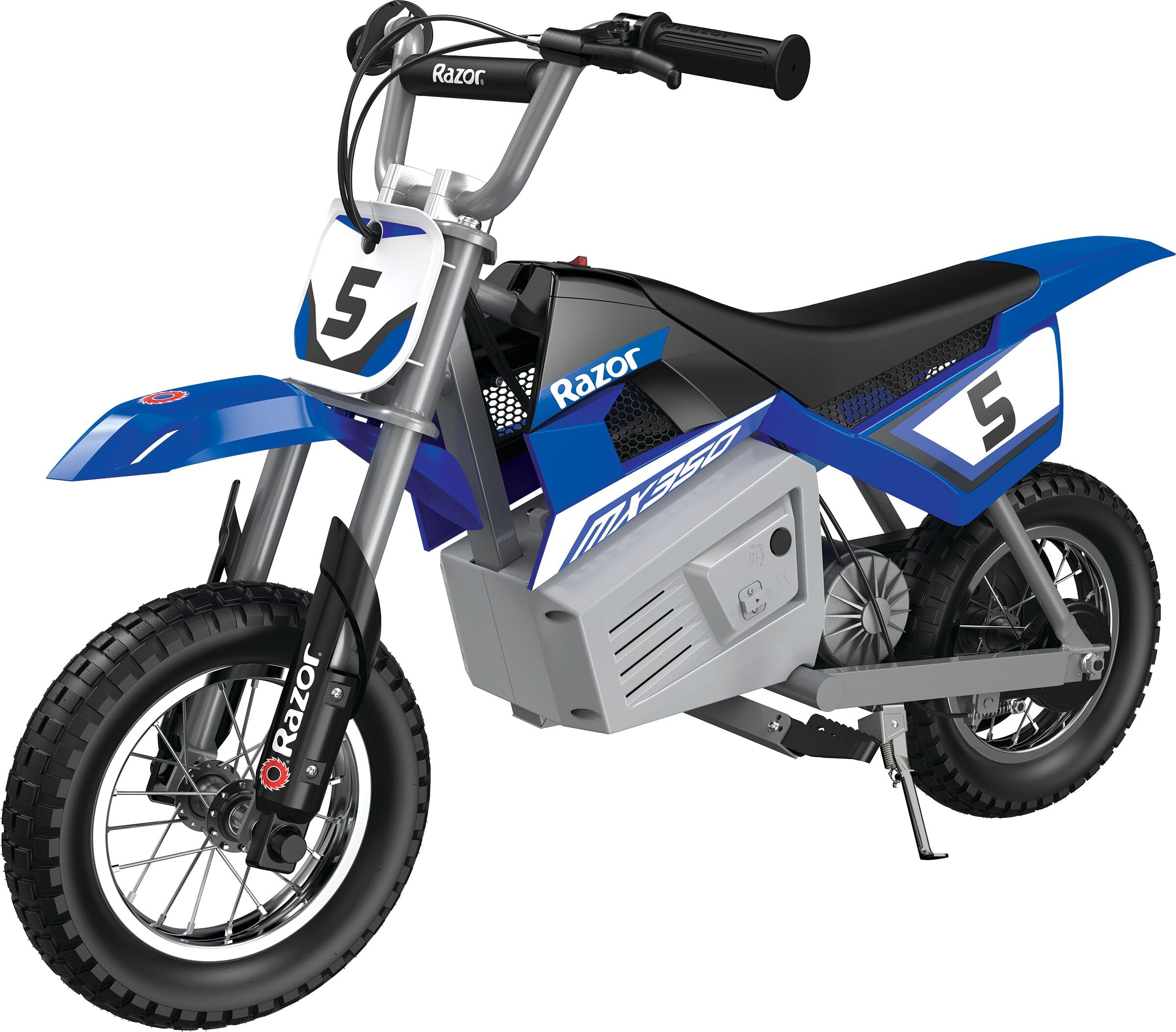


Best for School-Age Riders
Razor MX350 Dirt Rocket
Key Features
- Battery: 24V sealed lead-acid
- Ride time: Up to 60 minutes (low speed)
- Top speed: 14 mph
- Max rider weight: 200 lb
- Price: Midrange
The 200-pound weight limit is the number that decides this one. Most kids’ bikes in this group stop between 66 and 110 pounds, which a tall nine-year-old approaches faster than you expect; the MX350 carries a rider up to 200 pounds on 12-inch spoked wheels, so it is the bike that stays when everything else has been outgrown and sold on.
Razor’s geometry is the rest of it. Riser handlebars, a twist throttle, a retractable kickstand and a hand brake on the rear wheel are the real thing scaled down, and the high/low switch lets a cautious rider start slow and open it up a summer later. We have one reservation, and it is the brake: with only the rear wheel slowed by hand, the bike is at its least reassuring pointed down a slope, so walk the first hill together. That is a small caveat on an otherwise well-sorted machine.
The 24V sealed lead-acid pack gives up to 60 minutes in low mode, which is on the short side here, and it is the heaviest part of a 55-pound bike. The lithium machines in this group run longer and charge faster for more money. For a bike that lives in a garage and gets ridden in bursts after school, we think the trade is a fair one, and the steel frame and pneumatic tires are why it feels like equipment rather than a toy.
If you want the same bike for a smaller rider, the MX125 is the one to look at; if the rider is five and needs a 5 mph ceiling, the Hiboy DK1 is the better buy.
Pros
- 200-pound capacity leaves years of growing room
- Real MX geometry on 12-inch pneumatic tires
- High/low switch eases a new rider in
Cons
- Rear-only brake is weak pointing downhill
- Lead-acid pack is heavy and short-running
The one we reach for first for a school-age rider: a 200-pound capacity that lasts for years, 14 mph on high, and real dirt bike hardware rather than a plastic shell.
Best for Ages 5 to 10
Hiboy DK1 Electric Dirt Bike
Key Features
- Battery: 36V lithium
- Ride time: Up to 90 minutes
- Speed modes: 3 (5, 7.5, 15.5 mph)
- Max rider weight: 140 lb
- Price: Midrange
A 5 mph low mode is what makes the DK1 the easy recommendation for a family with mixed ages. Low is capped at 5 mph, medium at 7.5, high at 15.5, and the spread is the whole argument: a five-year-old putters on the lawn today while an older sibling opens it up on the same machine next summer. The switch feels like a designed feature rather than a restrictor plate bolted on afterward.
The 36V lithium pack is the other half of the case. Hiboy quotes up to 90 minutes with an 88-pound rider at 9.3 mph, so treat that as a best case; even discounted, it runs longer than the 24V lead-acid bikes here without the weight penalty. We came away impressed by the hydraulic front fork, which is the difference between a driveway lip jolting a kid’s arms and not.
Where it gives ground is build and terrain. The chain guard is the part that cracks early, and this is a paved-road bike by design, so loose gravel will find the tires and the frame before long. Neither flaw is unusual in this band, and the mode spread is worth more day to day than a heavier fender.
At 38 pounds it is also a bike one adult can lift onto a truck bed or hang on a garage hook, which is more than the MX350 can say at 55.
Pros
- Three speed modes from 5 to 15.5 mph
- 36V lithium pack runs up to 90 minutes
- Hydraulic front fork handles yard bumps
- 38 pounds, light enough for one adult to lift
Cons
- Chain guard can crack early on
- Paved-road bike, not a gravel one
We think the DK1 is the one that fits a whole household: three modes from 5 to 15.5 mph, a 36V lithium pack, and a hydraulic fork that earns its keep.
Best for First Bike
Hiboy BK1 Balance Bike
Key Features
- Battery: 21.6V 2.6Ah
- Top speed: 9 mph
- Bike weight: 20.1 lb
- Max rider weight: 77.2 lb
- Price: Budget
Twenty pounds is light enough for a four-year-old to pick up off the grass, and that matters more than any other figure on this page. A bike a small kid can right alone gets ridden; a 50-pound machine that needs an adult to lift it stays parked. The 12-inch tires and a low frame keep the BK1 within a preschooler’s reach, and the 77-pound rider limit gives it two or three summers.
The kick-off start is what we appreciate most about the design. The throttle does nothing until the bike is already rolling, so a child pushes, coasts and balances before the motor joins in, which is the balance-bike progression with a 9 mph ceiling waiting at the end. Two speed modes and a front V-brake finish the picture, and the brake is worth practicing in a driveway before the first real ride.
The BK1 carries UL 2272 certification, and on anything with a lithium pack and a child aboard that is the first thing we look for. The 21.6V 2.6Ah battery is small and takes three to four hours to refill, which is the honest trade for a bike this light; a long afternoon at the park will want a top-up. The certification and the weight together are what tip it over the toy-grade bikes.
The STACYC is 3 pounds lighter with a five-year frame warranty; the BK1 answers with a front V-brake and a good deal less money. Both are the right shape for a first powered two-wheeler.
Pros
- 20 pounds, light enough for a preschooler
- Kick-off start teaches balance before power
- UL 2272 certified electrical system
- Front V-brake and two speed modes
Cons
- No kickstand
- Best kept to pavement and short grass
We hand this one to a three- to five-year-old first: 20 pounds, a 9 mph ceiling, and a kick-off start that keeps the throttle out of the way until they are rolling.
Best for Premium Starter
STACYC 12eDRIVE
Key Features
- Ride time: Up to 60 minutes
- Bike weight: 17 lb
- Speed modes: 3 plus unpowered
- Max rider weight: 75 lb
- Price: Premium
The price is the first thing to discuss, and the warranty is the answer. STACYC covers the frame and fork for five years and the electrical components for 90 days, which is a longer commitment than anything else in this group. On a bike a three-year-old will outgrow long before it wears out, that coverage is the part that holds its value.
At 17 pounds with the battery in, the 12eDRIVE is the lightest bike we tested, and the aluminum frame is why. That is not a numbers exercise: a 40-pound rider can pick it up, right it after a tip-over and ride without an adult trailing behind. We were struck by how much a 3-pound difference changes the way a small kid handles a bike.
The mode progression is the smartest part of the design. It begins unpowered, so the first weeks are pure balance bike; then training, standard and advanced modes open up as the rider is ready. Sixty minutes of run time and a 30- to 60-minute charge keep it available, and the drum brake is gentle enough for a bike this light.
Set against the Hiboy BK1, the premium buys 3 pounds, five years of frame cover and a softer brake, and gives up a front V-brake and a good deal of money. That is a fair trade for a bike headed through two or three kids, and a harder one for a single rider.
Pros
- 17 pounds with the battery installed
- Starts unpowered, then three progressive modes
- Five-year frame and fork warranty
- Recharges in 30 to 60 minutes
Cons
- Electrical parts covered for only 90 days
We think the premium is worth it for one reason: 17 pounds, a five-year frame warranty, and a progression that starts unpowered before it hands over any power.
Best for Small Beginners
Razor MX125 Dirt Rocket

Key Features
- Wheels: 12-inch pneumatic knobby
- Top speed: 8 mph
- Bike weight: 29.7 lb
- Max rider weight: 110 lb
- Price: Midrange
Spoked 12-inch knobby tires, a twist throttle, a high/low switch and a hand brake on the rear wheel, in a package that weighs under 30 pounds and tops out at 8 mph. That is about right for a five- or six-year-old on a driveway, and it is the reason this one exists alongside the bigger Razor.
The high/low switch matters more here than on the larger bike. Low mode is genuinely slow, the kind of slow that lets a nervous first rider get used to the throttle without a lurch, and the step up to high is small enough that it does not feel like a different machine.
The trade is power, and it is worth being straight about it. On pavement, a driveway or packed dirt the MX125 is a happy bike; on grass or a slope it runs out of steam, so buy it for the first kind of ground. We kept coming back to the size for a small rider: a 30-pound machine a kindergartener can pick up is worth more than a faster one they cannot.
The plastic fenders are the first thing to give in a real spill, and they are also the cheapest thing to replace. That is the trade for a bike this light at this end of the range.
Pros
- 8 mph is right for a first-time rider
- Under 30 pounds, manageable for a small kid
- Same knobby tires and twist throttle as the MX350
Cons
- 110-pound rider limit is outgrown fast
Our shorthand for the MX125 is the MX350 with the volume down: 8 mph, 30 pounds, and the same knobby-tired stance for a rider who is not ready for 14 mph.
Best for Apartment Storage
AIII Lightweight Dirt Bike
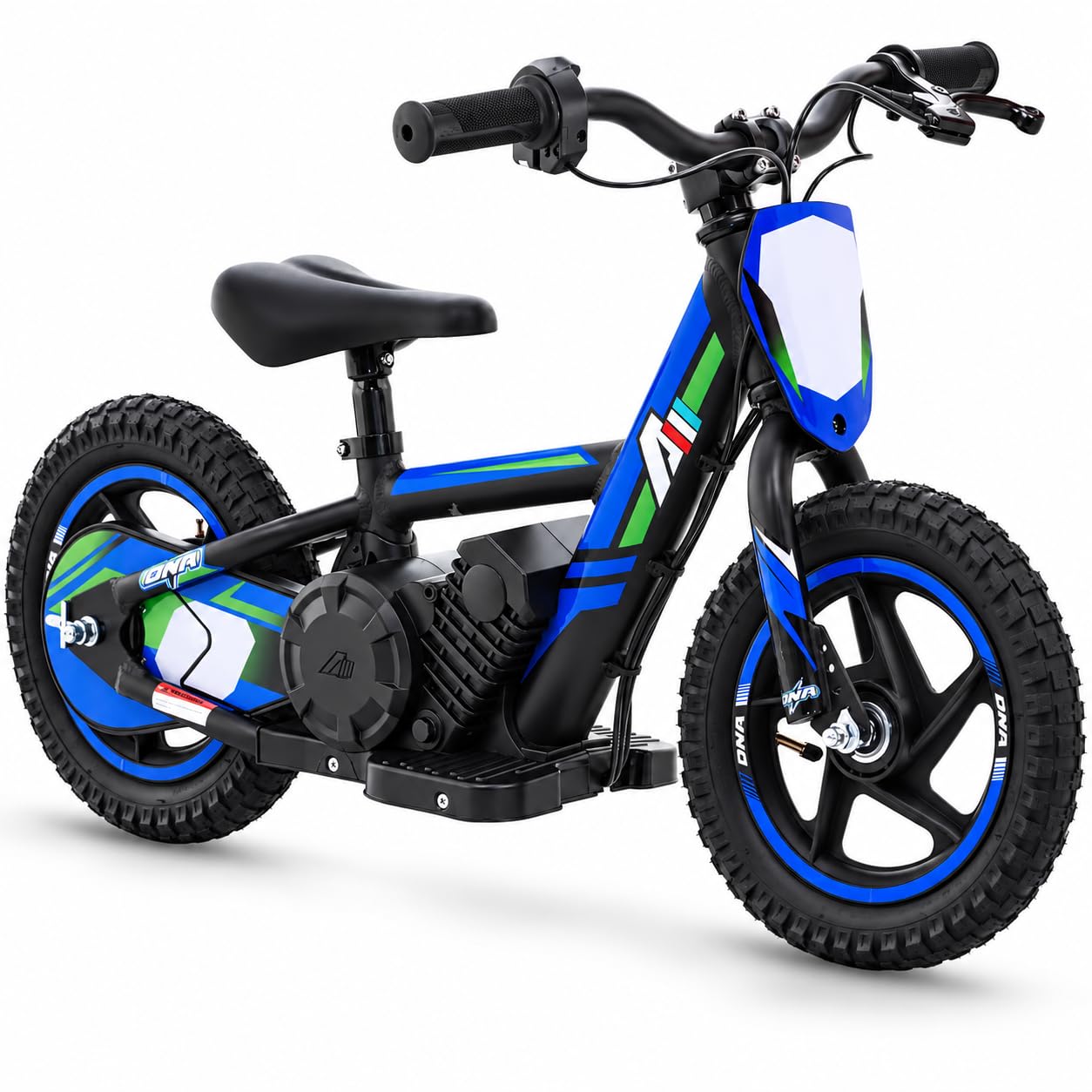
Key Features
- Wheels: 12-inch inflatable
- Battery: 24V 2.6Ah lithium
- Ride time: 40-60 minutes
- Bike weight: 23.2 lb
- Price: Midrange
The battery comes out, and once you have lived with a kids’ electric anything you understand why that is the detail that matters. The AIII’s 24V pack lifts out of the frame with its own charging port, so it charges on a kitchen counter instead of an extension cord run to a garage, and the bike is not tied to a wall outlet while it refills.
At 23.2 pounds it is the lightest dirt bike here, a real advantage for a five- or six-year-old who has to pick it up after a tip-over, and the adjustable seat height lets it grow a couple of inches with the rider. The variable-speed twist throttle ramps in progressively rather than switching on, and the rear drum brake lever is sized for small hands.
Speed is the part to check before ordering. The AIII comes in two power outputs with different top speeds, 10 and 12 mph, so confirm which variant is on the page; the 24V battery, the 40-60 minute run time and the 12-inch inflatable tires are the same either way.
Comfort comes from those inflatable tires rather than a fork, which is fine on pavement and packed dirt and less so on roots and rocks; if your rider wants rougher ground, the Hiboy DK1’s hydraulic fork is the step up. For a family storing the bike in a hallway and charging it on a counter, that is the trade we take.
Pros
- Battery lifts out to charge on a counter
- 23 pounds, the lightest dirt bike here
- Adjustable seat grows with the rider
- Progressive throttle and kid-sized brake lever
Cons
- Check which power variant you are ordering
- 40-60 minute run time is on the short side
We like it for small homes: 23 pounds, a battery that lifts out for countertop charging, and an adjustable seat that buys a season or two.
Best for Pre-Teens
KOOZ HP112E Dirt Bike
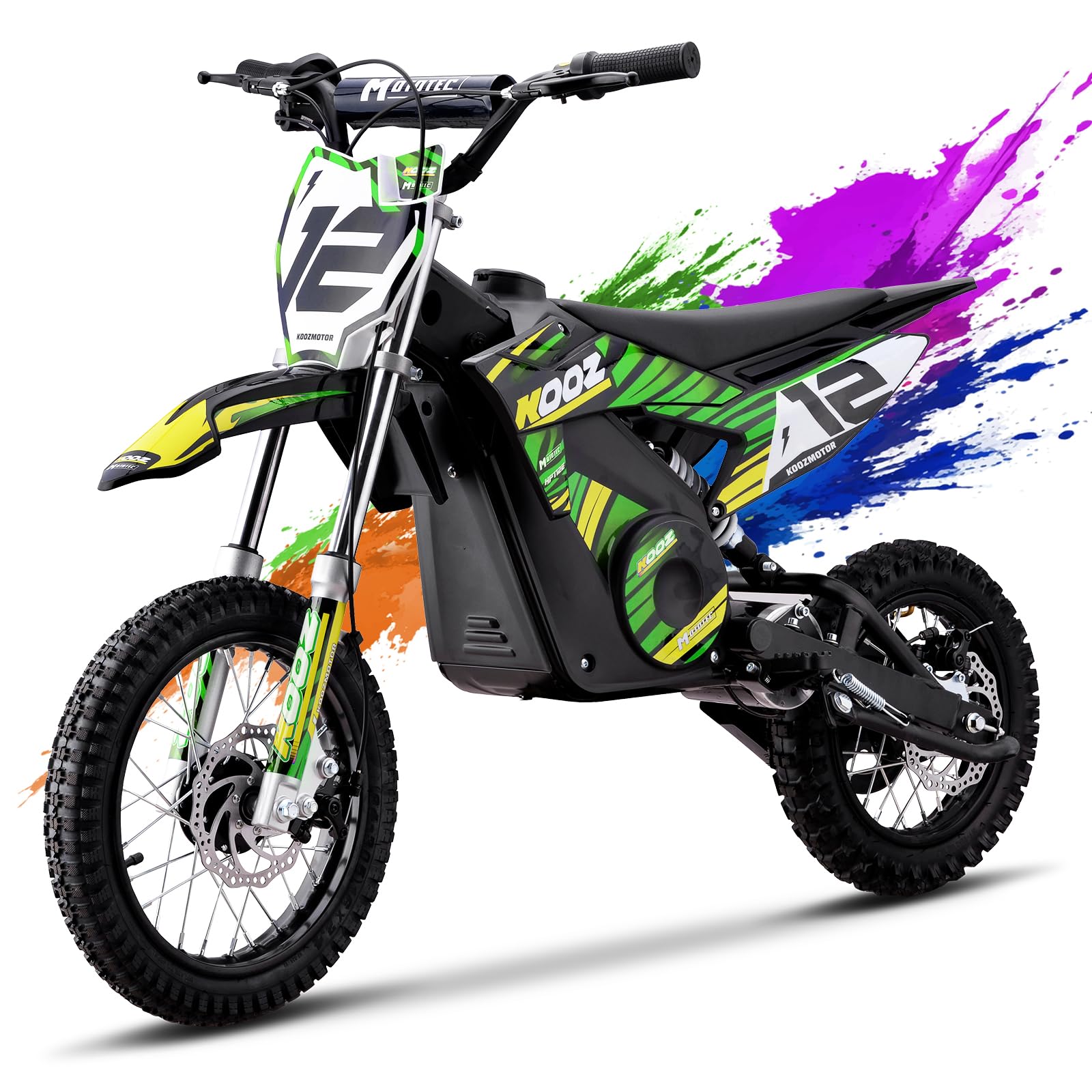
Key Features
- Motor: 1000W
- Wheels: 16-inch pneumatic
- Top speed: 18 mph
- Max rider weight: 150 lb
- Price: Premium
There is a point where a kid stops being a kid on a toy and starts being a rider, and the KOOZ is the bike we point to when that happens. Sixteen-inch pneumatic tires, dual shocks, disc brakes, three speed modes from 6.5 to 18 mph, and a 150-pound limit that covers most ten- to twelve-year-olds.
The 1,000-watt motor and 36V battery make it the quickest thing in this group, and quick is the operating word. Eighteen miles an hour on a 49-pound machine is a serious step up from the 8 mph bikes, and the low and medium modes are what keep it usable for a rider still learning. A helmet and a watching adult are not optional on this one. They are not optional on any of them.
UL 2272 certification is on the bike, which we care about more as the voltage and the speed climb. At 49 pounds it stays where it is parked and needs two people to lift into a truck, and the assembly instructions are the weak point: the box can arrive without a printed set, so plan an evening with the online video. That is the compromise we accept for the power and the 16-inch wheels.
Against the DK1 it is a bigger, faster, more expensive bike, and it wants a rider who has already spent a season on something smaller.
Pros
- 18 mph and 1000 watts for older riders
- 16-inch pneumatic tires and dual shocks
- UL 2272 certified
- Three speed modes down to 6.5 mph
Cons
- 49 pounds needs two adults to lift
- Assembly instructions can be missing
We point to the KOOZ when a rider has outgrown an 8 mph mini bike: 18 mph, 16-inch tires, dual shocks and a 150-pound limit.
How We Tested the Kids Electric Bikes
To build the shortlist, I pulled every kids e-bike I could find from brands that actually stock replacement batteries and brake pads, then filtered by weight, wheel size, battery capacity, top speed, and price. Anything that couldn’t be serviced or whose size chart topped out below a typical nine-year-old got cut. Eight bikes made it into my garage, and they’ve been there for six months.
Each one ran the same rounds. We rode a fixed two-mile loop from the driveway to the park and back until the battery quit, logging miles on an odometer instead of trusting the spec sheet, and noting whether the last quarter of the charge felt noticeably slower. We clocked top speed on a flat stretch in both throttle and pedal-assist modes, then handed the bars to kids ranging from about three feet tall to four and a half and watched them mount, stop short, and put a foot down. Traction got checked on wet grass, loose gravel, and a damp sidewalk, with an eye on rear-wheel slip under acceleration and how the tires held a hard stop.
Durability and reliability came from living with them: dropped in the driveway, leaned on kickstands that were never quite sturdy enough, hosed off after muddy afternoons, and stored in a cold garage. We checked brakes and kickstands after every ride and logged every bolt that worked loose. Fun and looks were the kids’ department — they rated each bike after week one and again at the end, which is how we caught the ones that were a thrill for three days and the ones that got ridden until the charge ran out.
How to Choose a Kids Electric Bike
The right kids’ electric bike is the one your child can hold up, stop and climb onto without help; everything after that is a spec-sheet argument.
Size the bike to the rider, not the age on the box
Age ranges on these bikes are loose. One model here is described as suitable for riders of seven and up in its own copy and five to twelve in its specifications, so trust weight and reach instead. A rider should get both feet flat on the ground at a standstill and be able to pick the bike up after a fall, which is why a 17- or 20-pound balance bike suits a four-year-old and a 55-pound dirt bike does not.
Weight capacity decides how long the bike lasts. Anything in the 66- to 77-pound range is a two- or three-summer machine, while 150 to 200 pounds will see a child into their teens. That difference is the main argument for the Razor MX350 over a smaller starter.
Speed modes and throttle control beat top speed
Fifteen miles an hour with a 5 mph low mode is a safer bike for a beginner than 8 mph with a single setting, because a new rider never hits the ceiling, they hit the throttle. Look for a twist grip that ramps in gently, a low/medium/high switch, and on balance bikes a kick-off start that keeps the motor out of the picture until the child is already rolling.
Training wheels and a soft-start throttle are the toddler equivalent, and worth having if the rider cannot yet hold a two-wheeler upright on their own.
Battery: chemistry, run time and charging
Lithium packs are lighter and quicker to charge; sealed lead-acid is cheaper and much heavier, which is most of why the Razor MX350 weighs 55 pounds. Quoted run times are best cases. One 36V bike claims 90 minutes with an 88-pound rider at 9.3 mph, and a heavier kid on grass will see less than that.
Charging runs from 30 minutes on the STACYC to three or four hours on the Hiboy BK1, so a full charge the night before is the habit that keeps a Saturday from ending early.
Brakes, suspension and tires: buy for the surface
A hand brake on the rear wheel alone is fine on flat pavement and unnerving on a slope, so if your yard has a hill, look for a bike with two brakes. Suspension earns its keep on grass and gravel: the Hiboy DK1’s hydraulic fork and the KOOZ’s dual shocks are the most substantial setups in this group.
Check the tire spec as carefully as the motor. Pneumatic tires with real tread grip and absorb, and they are what makes a bike usable off pavement rather than confined to a driveway.
Where it can be ridden, and what it costs to keep running
None of these is a road vehicle. They are toys and off-road machines, so keep them on your property, driveways and trails where local rules allow, and put a helmet on for every ride, motor on or off.
Running costs are tires, tubes and the occasional chain: small money, but only if replacements exist for the model you choose, which is worth confirming before you order. We look for UL 2272 certification on the electrical system first, because it is the one label that tells you the battery and charger were tested as a pair.
Frequently Asked Questions
How much assembly is required?
Most arrive with the handlebars, front wheel and footpegs off. Budget an evening rather than ten minutes: fit the wheel, check the brake pads meet the rim or disc squarely, inflate the pneumatic tires to the pressure on the sidewall, and charge the battery fully before the first ride.
Keep the carton until that first ride is done. A bike that will not power on is far easier to send back in the box it arrived in.
Can these bikes handle rain and wet grass?
Only one bike here states a water-resistance rating, the Hiboy BK1 at IPX4, so treat the rest as dry-weather machines. Damp grass on a short ride is fine; standing water, a hose-down and charging a wet battery are not.
Wipe the bike down, let it dry fully and charge it indoors. If your winters are wet, storing it inside is the single best thing you can do for the electronics.
What should I check in the first week?
Charge it fully, ride it yourself at low speed, and check four things: chain tension, the brake reaching a firm stop before the lever touches the grip, tires holding pressure overnight, and the motor not cutting out under load on a slope.
Do all of it inside the return window. The faults that end a bike’s first season tend to show up early, and one found in week one is a return rather than a repair.
Final Verdict
For a school-age rider, the Razor MX350 is the bike we recommend: 14 mph on high, a 200-pound capacity that will still fit in three years, and hardware that feels like a scaled-down dirt bike rather than a ride-on. The rear-only brake is the trade, and on flat ground it is a small one.
If the rider is younger, buy the Hiboy DK1. Its 5 mph low mode and 36V pack suit a five-year-old today and a ten-year-old later, which is the hardest thing to get right in this category.
