This post contains affiliate links. We may earn a small commission when you buy through our links — at no extra cost to you.
A kids BMX bike has to survive two things at once: the kid riding it and the kid not riding it. It needs to be light enough for a 7-year-old to muscle up the curb and back into the garage, and tough enough to get dropped on that same curb every afternoon for a year. That’s the tradeoff that sinks most bikes in this category — the light ones feel flimsy, and the sturdy ones weigh so much that the fun drains out of them. Get it right and you’ve got a bike that actually gets ridden; get it wrong and it leans against the wall while your kid asks for a scooter instead.
Over the last eight months, my family and my colleagues’ families have had 10 kids BMX bikes in and out of garages, up and down driveways, and over more than a few plywood ramps. Here’s what nobody tells first-time buyers: nearly every one of these arrives mostly assembled, and the small remainder left to you — brakes, headset, stem bolts — is exactly what decides whether the bike feels solid or sketchy on the first ride. The picks below are the ones that held up to all of it, sorted so you can match a bike to your kid’s size and how hard they ride.

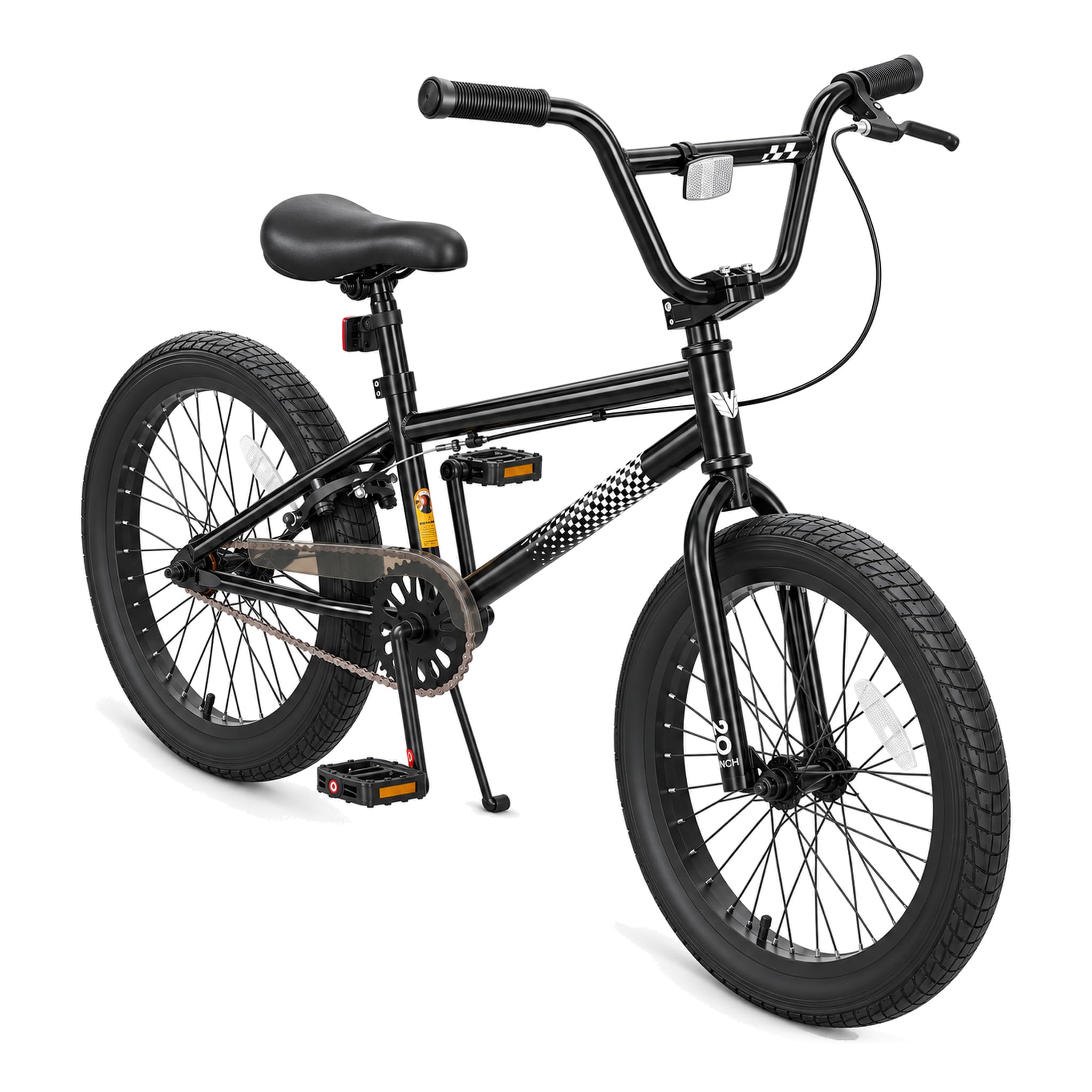

Best for Park and Street
WEIZE Freestyle BMX 20
Key Features
- Brake: Rear V-brake
- Wheel size: 20 inches
- Rider height: 4’0"–5’8"
- Freestyle kit: 360° rotor, 4 pegs
- Price: Midrange
The 360-degree rotor and four pegs are what separate a real freestyle BMX from a bike that only looks like one, and this WEIZE is the only bike in this group that gives you both. We like what the rotor does in practice: the rear brake cable runs through the stem instead of looping around the bars, so when a kid spins the handlebar a full turn in the driveway, nothing winds up and the brake still works. On a bike whose entire appeal is trying tricks, that is the feature that counts.
Sizing is the other reason it earns the top spot. Twenty-inch wheels with a listed range of 4’0" to 5’8" cover a kid from about eight into their early teens, which is a long stretch of riding from one purchase. The 20 x 2.40-inch tires are wide enough to soften curb cuts and hold a line on packed dirt, and the single-speed 32T/16T drivetrain has nothing to shift or knock out of alignment. Rigid, single-speed, no fuss — the right formula for a bike that will get dropped a lot.
Our one real reservation is the brake. The rear V-brake is the part that most often needs attention out of the box, and a brake that rubs or grabs makes a new rider hesitant, so set the cable tension and pad alignment properly before the first ride or let a shop do the final adjustment. The steel frame is also honest about its limits: the maker’s guidance rules out big jumps and high drops, so treat this as a street, driveway and pump-track bike rather than a skate-park machine.
Under four feet tall, skip it. A 20-inch BMX is a lot of bike for a seven-year-old, and the KORIMEFA below covers that rider properly.
Pros
- 360-degree rotor and four pegs for learning tricks
- Wide 20 x 2.40-inch tires for grip and cushioning
- Single-speed drivetrain with nothing to adjust
- Height range spans 4’0" to 5’8"
Cons
- Starts at four feet tall; smaller kids need a smaller wheel
We recommend it as the best all-round kids BMX here: a working rotor, four pegs and a height range that lasts years, on a budget that still leaves room for a helmet.
Best for Younger Riders
KORIMEFA Freestyle 18
Key Features
- Brake: Rear U-brake
- Assembly: 90% pre-assembled
- Wheel size: 18 inches
- Rider height: From 43 inches
- Price: Midrange
An 18-inch BMX is the size that puts a six-to-nine-year-old on a real freestyle frame without handing them something they can barely hold upright, and the RUCKUS is built around exactly that window: a 43-inch minimum rider height, 152 mm cranks scaled to shorter legs, and 18-inch wheels. It also arrives 90 percent assembled, which is more of the job done than most bikes here.
Nothing about it feels like a toy. The high-tensile steel frame, 32T chainring and rear U-brake mirror the adult layout, and we think the U-brake is the right call — a kid who learns to stop with a hand brake at seven does not have to relearn it at ten. Two years of coverage on parts, not just the frame, is real reassurance on a bike that gets ridden hard.
Order the right version. The Classic trim we looked at has no pegs and no rotor; the Full Setup adds four pegs and a 360-degree gyro, and that is the one to buy if tricks are the point rather than just getting around. Assembly is straightforward, but the printed manual is thinner than the bike deserves — lean on the maker’s assembly video for the brake and handlebar instead of guessing from the diagrams.
Pros
- Proper freestyle frame and U-brake in an 18-inch size
- 90% pre-assembled with tools included
- Two-year warranty covers parts, not just the frame
Cons
- Classic trim ships without pegs or a rotor
We point families with a six-to-nine-year-old here: a genuine freestyle frame in a size a young rider can control, with more of the assembly done before it ships.
Best for Park Progression
Retrospec Sesh BMX 20
Key Features
- Brake: U-brake
- Weight: 25.5 lb
- Wheel size: 20 inches
- Cranks and gearing: 3-piece chromoly, 25x9T
- Price: Premium
Three-piece chromoly cranks and a 25x9T gear ratio are the specs that tell you the Sesh was designed by people who ride BMX rather than people who style kids’ bikes to look like them. Those are the parts that survive repeated hops and grinds, and they are why this bike sits at the top of the price range here.
At 25.5 pounds it is light enough for a kid to pick up off the ground without help, and the frame is built for park abuse: reinforced dropouts, threadless steering that keeps the front end tight, and a snag-free U-brake that will not catch on a spinning bar. The axle pegs are removable, so you can run it clean for street riding and bolt them on when grinding starts. We liked that — one bike that grows with the riding instead of being replaced.
The catch is that a beginner will not feel most of this. If your kid is still working out standing on the pedals, the WEIZE does the same job for considerably less and the parts difference will not show up for a year or two. Buy the Sesh when the rider already spends Saturdays at the skate park and has started snapping the cheap stuff — that is when chromoly cranks stop being a spec line and start being the reason you are not replacing cranks in the spring.
Pros
- Three-piece chromoly cranks with 25x9T gearing
- 25.5 lb, light enough for a kid to handle
- Removable pegs and threadless steering
Cons
- Premium price for parts a beginner will not use
For a kid already riding park and starting to break parts, we think the Sesh justifies the premium: chromoly cranks, real BMX gearing and a weight they can throw around.
Best for First Bike
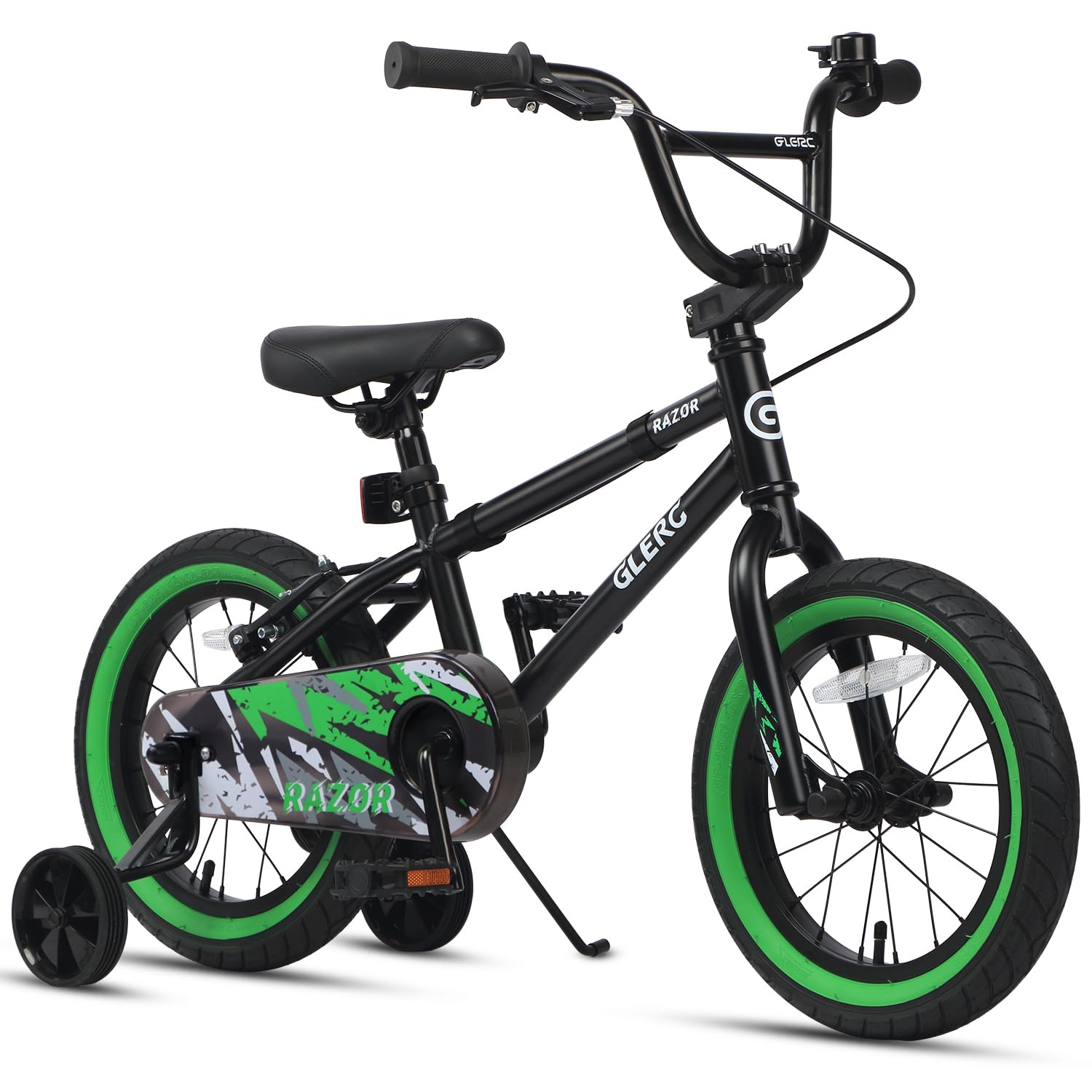
Glerc Kids BMX 14
Key Features
- Brakes: Coaster and front V-brake
- Weight: 22 lb
- Wheel size: 14 inches
- Rider height: 35–43 inches
- Price: Budget
Two brakes on a 14-inch bike is unusual, and it is why we keep this one at the front of the group for a four-year-old: a coaster brake that engages when they pedal backward, plus a front V-brake on the lever. The coaster is forgiving while they learn to pedal and stop, and the hand brake builds the lever habit early, so moving up to a bigger bike later is not a restart.
The rest of the package is sized for the age. It weighs 22 pounds, which a small rider can manage in a driveway, and it ships with training wheels, a bell and reflectors. The frame carries a lifetime warranty with two years on the other parts — worth having on a bike that will spend a fair amount of time lying on its side.
Expect a short learning curve with the coaster. A kid coming off a balance bike will try to backpedal and get a stop instead, so give them a flat stretch of pavement and a few minutes to connect the two. The other thing to plan for is growth: this is a 35-to-43-inch bike, so most kids move past it in a couple of years and a 16- or 18-inch takes over.
Pros
- Coaster and hand brake on one small bike
- 22 lb, light enough for a four-year-old
- Training wheels, bell and tools included
Cons
- Short fit window at roughly 35 to 43 inches
We hand this to preschoolers: two braking options, training wheels and a 22-pound frame make a first BMX-style bike far less intimidating than a 20-inch.
Best for Peg-Ready Starter
vollsch Ruckus 20

Key Features
- Warranty: 2 years
- Wheel size: 20 inches
- Rider height: 4’3"–5’4"
- Freestyle kit: 4 pegs
- Price: Midrange
Four pegs and a two-year manufacturer warranty are the two things the RUCKUS brings that the cheaper bikes here do not, and that is really its case: a high-carbon steel 20-inch with colored tires, an adjustable saddle and handlebar, and the pegs already in the box rather than sold as an extra.
The fit window is 4’3" to 5’4", and that is the number to check first, because taller kids will run out of bike sooner here than they would on the WEIZE. A 36T chainring is the largest in this group, paired with 165 mm cranks and 20 x 2.35-inch tires on 48-hole rims. As configured here there is no rotor, so a full barspin winds the brake cable — this is a peg bike for hops and grinds, not a barspin bike.
Give the rear brake and the chain tension a careful look before the first ride; we found those the two places that ask for attention, and both settle down once they are set properly. Otherwise it is a good bike that is simply outclassed: the WEIZE gives you a rotor and pegs for less, and the KORIMEFA fits younger riders better. The RUCKUS makes sense when you want pegs and a two-year warranty in a single order.
Pros
- Four pegs included with the bike
- Two-year manufacturer warranty
- Adjustable saddle and handlebars
Cons
- Rider range stops at 5’4" tall
A solid mid-price 20-inch with four pegs and a two-year warranty; choose it when pegs matter and a rotor does not.
Best for Toddler First Bike
cubsala Starry 12

Key Features
- Brake: Coaster
- Warranty: Lifetime frame, 2-year parts
- Wheel size: 12 inches
- Rider height: 33–37 inches
- Price: Budget
A 12-inch BMX-style bike is really a first pedal bike in BMX clothing, and the Starry is the most complete version of that idea here: coaster brake, full chain guard, training wheels and a high-tensile steel frame that shrugs off being dropped in the driveway. For a two-to-four-year-old between 33 and 37 inches, that is the right set of priorities.
We appreciated how little stands between the box and the first ride. Most of the bike arrives put together, the tools are included, and the instructions are clear enough to follow without hunting for a video. The coaster brake is the right choice at this size, too: a small hand that cannot reach a lever properly can still stop by pushing back on the pedals, and the wide tires help on grass and gravel.
Two things to plan around. It is heavy for a 12-inch bike — cubsala lists it at 10.73 kg, and it feels like it when you are the one carrying it up the driveway — and the training wheels are worth checking for looseness whenever you check the tires. Neither is unusual at this size, and neither changes the verdict for a first bike.
Pros
- Coaster brake a small hand can actually use
- Training wheels and full chain guard included
- Mostly assembled with tools in the box
Cons
- Heavy for a 12-inch bike at 10.73 kg
We recommend it as a toddler’s first BMX-style bike: the coaster brake, chain guard and training wheels suit a two-to-four-year-old, though you will be the one carrying it.
How We Tested the Best Kids BMX Bikes
We started with more than 30 kids BMX bikes sold at bike shops and big-box stores, then filtered by wheel size, standover height, frame material, brake setup, and price. Anything without a published geometry chart, or with a coaster brake as the only way to stop, came off the list. That left 10 bikes, which we bought at full price and had shipped to our own homes so we could judge the purchase experience itself — packaging, delivery condition, and whether every bolt listed on the parts sheet actually showed up in the box.
Assembly happened in garages after bedtime, solo, with a timer running. We counted each piece of hardware against the parts list, noted whether the right tools were included, and checked whether the brake levers could be dialed in close enough for small hands to reach comfortably. A week later we re-torqued every stem bolt and checked the headset, since that’s when loose hardware usually announces itself.
Over the next eight months the kids rode them down driveways, along the sidewalk to school, around the block, and at a local dirt track. We weighed each bike on a luggage scale and compared it to the rider’s body weight, because anything over roughly half a kid’s weight turns into a wrestling match at the end of the ride. For braking, we chalked a line on wet pavement and measured how far each bike rolled after the levers were squeezed. The bikes were dropped, laid down, and left out in the rain; we checked welds, paint chips, spoke tension, and fastener tightness every couple of months.
At the end we judged value on what came in the box — pegs, kickstand, tools — and on how each bike looked after a season of scuffs, which the kids had stronger opinions about than we did.
How to Choose a Kids Bmx Bike
The bike that fits your kid’s height and stops when they squeeze the lever matters far more than how many pegs come in the box.
Size the Bike to the Rider, Not the Age Chart
Wheel size is the first decision and height is the number that settles it. The 12-inch bike here is for riders around 33 to 37 inches tall, 14-inch for 35 to 43 inches, 18-inch from about 43 inches up through the six-to-nine years, and 20-inch from roughly four feet into the mid fives. Age ranges printed on a listing are loose: a tall seven-year-old often fits an 18-inch that the chart assigns to a nine-year-old.
Measure your child in shoes against a wall, then check standover — they should be able to straddle the frame with both feet flat on the ground. If they are between sizes, take the smaller wheel. A bike they can control builds confidence; one they have to muscle around sits in the garage.
Brakes Matter More Than Anything Else on the Spec Sheet
There are two families. Coaster brakes stop when the pedals are pushed backward and suit riders under six, but they teach nothing about levers. Hand brakes — a rear U-brake on freestyle bikes, V-brakes on the BMX-styled kids’ bikes — are what a rider needs as soon as they start standing on the pedals. On a freestyle bike, check whether the rear brake runs through a rotor: without one, spinning the bars a full turn wraps the cable around the stem and pulls the brake on.
Whatever you buy, plan on adjusting the brake before the first ride rather than judging it in the box. A poorly bedded brake is the single most common reason a new kids’ bike feels worse than it is.
Pegs, Rotors and What Freestyle Hardware Buys
Pegs are the cylinders that bolt onto the axles for standing and grinding, and removable pegs let one bike cover street riding and park practice. A rotor, or gyro, lets the handlebar spin without tangling the brake cable, and it only earns its place if your kid is genuinely trying barspins; otherwise it is extra hardware to keep adjusted.
Frame and crank material follows the same logic. Chromoly costs more and takes harder landings; high-tensile and high-carbon steel are fine for driveway, street and pump-track riding. Buy the hardware for the riding your kid does now, not the riding you hope they will do next summer.
Assembly, Tools and What the Warranty Covers
Most bikes in this group arrive 85 to 90 percent assembled, which means the front wheel, handlebar, brake and sometimes the pedals are your job. Set aside an evening, recheck every bolt after the first week, and keep the included tools — you will need them again.
Warranties split the same way across the category: frames are covered for life or several years, parts get a year or two, and wear items like tires, tubes and pads are excluded. Read that split before you order, because the parts that actually break on a kids’ bike are usually on the shorter list.
Frequently Asked Questions
Is a BMX bike a good first bike for a young child?
Only the small BMX-styled ones. If your child still needs training wheels, a 12- or 14-inch bike with a coaster brake and a full chain guard is the sensible start — the Glerc 14 is the one we point to. A real 18- or 20-inch freestyle bike is a second bike: it assumes your child can already balance, pedal and squeeze a hand brake, and it comes with no training wheels or chain guard.
Will a single-speed BMX handle hills?
Check the gearing before you buy if your route is not flat. The freestyle bikes here run a 32T chainring with a 16T rear sprocket, a moderate ratio a kid can turn on a slope. The park-oriented Retrospec runs a taller 25x9T setup built for acceleration out of a bowl, which is noticeably more work uphill. If the ride to school climbs, favor the 32T bikes.
What else do I need to buy with a kids BMX bike?
A helmet that fits now, a pump with a gauge, and a spare tube in the correct wheel size — 12- through 20-inch tubes are not interchangeable. Add a lock if the bike travels to school, and a set of Allen keys if you do not already own them, because you will be adjusting the seat, the bars and the brake.
Can an adult ride a kids BMX bike?
Briefly, and only inside the weight rating. The 20-inch bikes we recommend are rated around 150 to 155 pounds, which rules out most adults, and the saddle tops out well below adult fit. Treat a child’s BMX as a child’s BMX — if you want to ride along, bring your own bike.
Final Verdict
Most families should buy the WEIZE Freestyle 20. It is the only bike here with a working rotor and pegs, the listed height range covers a kid from four feet to five-foot-eight, and nothing else in this group gives a young rider that much freestyle capability.
Two exceptions are worth planning around. If your rider is six to nine and on the small side, the KORIMEFA 18 fits properly where a 20-inch would overwhelm them. And if they already spend weekends at the skate park, step up to the Retrospec Sesh — the chromoly cranks and 25x9T gearing are the parts a progressing rider actually feels.
