This post contains affiliate links. We may earn a small commission when you buy through our links — at no extra cost to you.
A walk on a crushed-stone path sounds idyllic until your stroller’s wheels dig in and your toddler’s snack cup goes flying. Gravel is where ordinary strollers go to die. A stroller built for gravel isn’t just about bigger tires; it’s about suspension that absorbs the washboard, a frame that doesn’t flex when you push one-handed, and a fold you can manage while holding a squirming kid. I’ve pushed my share of wobbly wagons down park trails, and the difference between a stroller that handles gravel and one that doesn’t is a daily walk versus a daily wrestling match.
Over the past eight months, we’ve tested eight all-terrain strollers on a gravel loop, plus muddy detours to check wheel alignment. The best ones felt sturdy without being tanks, folded with one hand, and didn’t punish you for choosing a trail over a sidewalk. They also stayed light enough to lift into a trunk and narrow enough for a grocery aisle. Some cost more, but the best earned it on every trail walk—below are the ones that made the cut.



Best for Rough Gravel Trails
BOB Gear Revolution Flex 3.0
Key Features
- Stroller weight: 28.5 lb
- Max child weight: 75 lb
- Rear tire diameter: 16 inches
- Front tire diameter: 12 inches
- Price: Premium
The first thing that sold us on the Revolution Flex 3.0 is the wheel-and-suspension package: 16-inch rear air tires, a 12-inch front, and mountain-bike-style suspension. On loose gravel and washboard paths, that combination does more for a sleeping baby than any padded seat insert. The 75-pound weight limit also means it can stay in service well past toddlerhood, which takes some of the sting out of the premium.
What we appreciate about the Flex is that it does not ask you to fold the handle into one fixed position. The adjustable handlebar spans a useful range, so a taller parent and a shorter one can trade pushes without hunching. Six storage pockets and a large cargo basket give trail days somewhere to put water, snacks, and a diaper bag; we found that practical rather than decorative.
The Flex is a trail-first stroller. It wants a garage or a generous trunk, and it is happiest when the route includes dirt or stone rather than polished floors. If your week is mostly pavement and tight parking, the extra trail hardware is harder to justify. The seat and canopy have enough adjustment for long outings, and the ride stays composed when the surface turns uneven.
For runners and trail walkers, though, the Flex is the one we trust most in this group for loose stone and rough ground. The steering stays predictable at a walking pace, and the big tires roll over obstacles instead of getting caught on them. We accept the lift because the stroller earns it on the surface that matters.
Pros
- Big air tires smooth loose gravel
- Mountain-bike-style suspension
- Adjustable handlebar fits different parents
- 75-pound seat limit grows with child
Cons
- Heavy at 28.5 pounds
- Long folded package needs trunk space
We recommend the Revolution Flex 3.0 as the gravel default because its big air tires and suspension keep rough paths calmer, provided you can manage the bulk.
Best for Trail Running Value
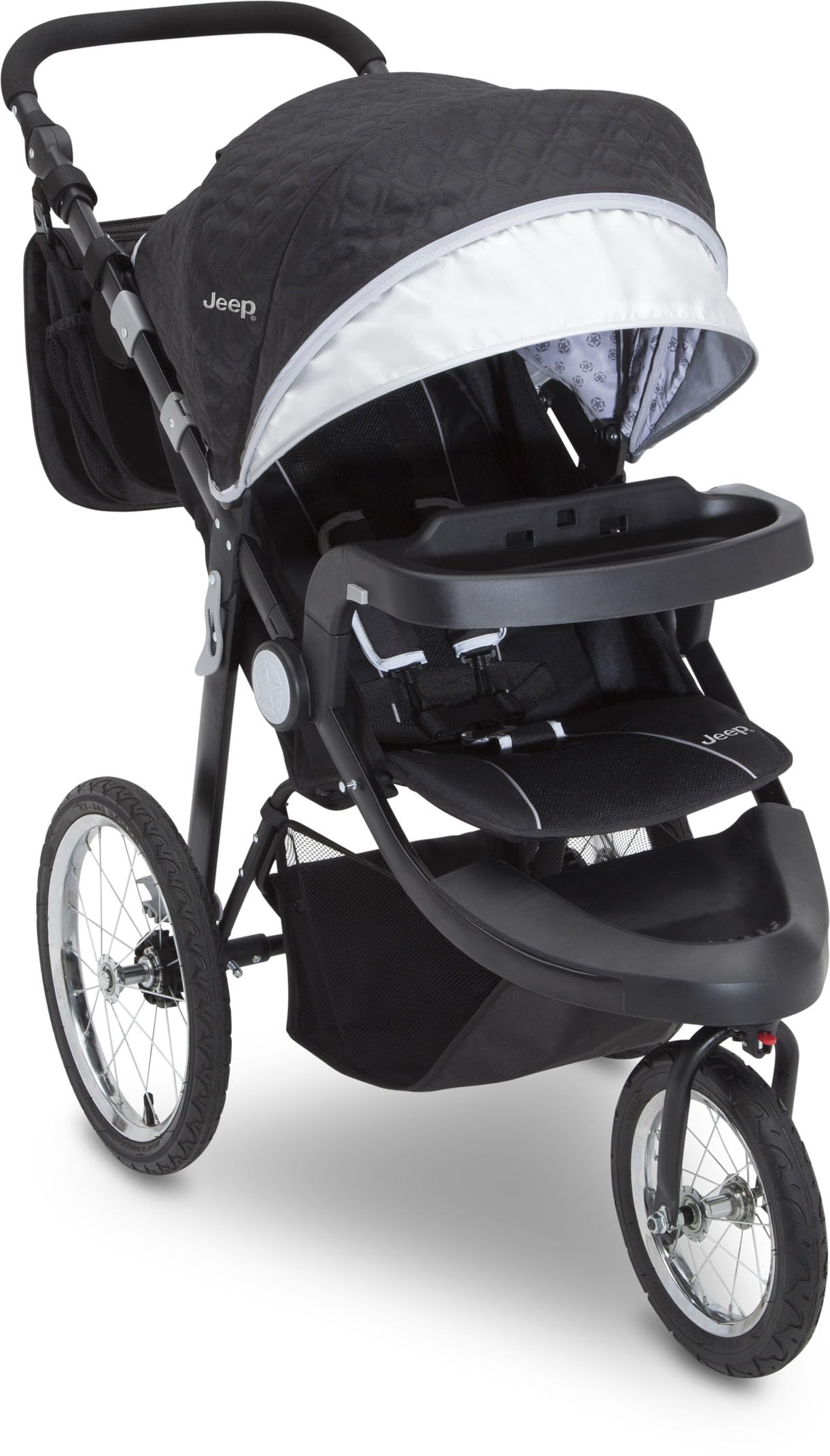
Jeep Cross-Country Sport Plus
Key Features
- Stroller weight: 26 lb
- Max child weight: 45 lb
- Rear wheel diameter: 16 inches
- Front wheel diameter: 12 inches
- Price: Midrange
The Cross-Country Sport Plus looks like a lot of trail stroller for the money: 16-inch rear air-spoke wheels, a 12-inch front swivel wheel, a steel frame, and a 45-pound seat limit. It is the closest thing here to the top pick’s air-tire recipe without the premium. The front wheel’s swivel-and-lock arrangement is the detail that makes it useful on both a gravel path and a grocery aisle.
We came away thinking this is the value pick for a family with one toddler rather than a long-term do-everything stroller. The air tires and steel frame give it a planted feel that the budget strollers cannot match, and the front wheel’s lock makes the transition from path to pavement easy. For the money, the trail hardware is the point.
We like the swing-away child tray for loading, and the extendable UPF 50+ canopy gives good coverage when the trail is exposed. The package feels like a trail stroller, not a car stroller, and it rewards a family that can leave it assembled in the garage. If your gravel is mostly a short park loop, the Apollo does the same job with less fuss for less money.
Pros
- 16-inch rear air tires for trails
- Locking front wheel aids control
- Swing-away child tray
- UPF 50+ canopy coverage
Cons
- 45-pound seat limit
- Front wheel can lose alignment
We see the Cross-Country Sport Plus as the smart trail-value pick for smaller toddlers, with real air tires and a price that leaves room for a pump.
Best for Budget Gravel Walks
Delta Children Apollo
Key Features
- Stroller weight: 33 lb
- Max child weight: 50 lb
- Rear wheel diameter: 16 inches
- Front wheel diameter: 12 inches
- Price: Budget
The Apollo is the gravel stroller we point to when the budget is real but the terrain is not negotiable. Its 12-inch front and 16-inch rear wheels are paired with puncture-proof tires and a shock-absorbing aluminum frame, so you get the big-wheel stance without the maintenance of air tires. For dirt roads, park paths, and packed gravel, that is a sensible combination.
We appreciate the details aimed at actual family use: a swing-out child tray, a parent organizer with two cup holders, a large undercarriage basket, and an included adapter for Graco SnugRide Click Connect and Evenflo Nurture or Embrace seats. The seat reclines, the canopy has UPF 50+ protection and a peek-a-boo window, and the safety tether is included. Those are the things that make a stroller live in the car rather than the garage.
The puncture-proof wheels are the compromise. They will not leave you hunting for a pump, but they also do not soak up washboard the way the BOB’s air tires do. If your gravel is loose and deep, we prefer the BOB; if it is a maintained trail or a dirt road, the Apollo is the easier ownership proposition. Just plan your trunk space before you commit.
Pros
- Puncture-proof 16- and 12-inch tires
- Shock-absorbing aluminum frame
- Included car-seat adapter
- Large basket and parent organizer
Cons
- 33 pounds is a heavy lift
We rate the Apollo our budget pick for gravel walks, as long as you accept a heavy frame in exchange for a cushioned, car-seat-ready ride.
Best for Everyday Trail Budget
Baby Trend Expedition
Key Features
- Tire type: All-terrain bicycle tires
- Stroller weight: 23.6 lb
- Max child weight: 50 lb
- Front wheel diameter: 16 inches
- Price: Budget
The Expedition is the stroller we recommend when the question is how much gravel capability you can get for a budget price. It has all-terrain bicycle tires, a lockable front swivel wheel, a 50-pound seat limit, and a parent tray with two cup holders and covered storage. At 23.6 pounds, it is lighter than most of the air-tire joggers here, which makes the car-to-trail transition less of a chore.
The child tray, four cup holders, and infant-car-seat compatibility make it feel more family-friendly than its price suggests. We also like that the seat reclines and the canopy is generous enough for sunny walks. The lockable front wheel is the feature that keeps it pointing straight when the surface gets loose, and the 50-pound seat limit gives it room to grow.
That makes the Expedition a walking and light-jogging stroller first. We keep it on the list because it handles gravel and dirt paths without asking for premium money, and because it is light enough to move between car and trail without a second person. If you want to run regularly on rough ground, step up to the Jeep or the BOB; if you want a capable second stroller for weekend trails, this one earns its place.
Pros
- Light at 23.6 pounds
- Lockable front swivel wheel
- All-terrain bicycle tires
- Four cup holders and child tray
Cons
- Fold can take two hands
- Front end can shimmy at running pace
We keep the Expedition on our list for budget-minded walkers who want a lockable front wheel and trail tires without paying premium money.
Best for Premium Modular Trails
Veer Switch&Jog
Key Features
- Tire type: Pneumatic
- Frame weight: 21.2 lb
- Max child weight: 50 lb
- Price: Premium
The Switch&Jog is built around a clever idea: the Switchback seat clicks off the jogger frame, so the same seat can face forward or backward on the stroller and then serve elsewhere in the Veer system. The three-wheel frame has large pneumatic tires, a locking front swivel wheel, and neoprene grips that are meant to stay secure when your hands get sweaty. If you are already buying into the Veer ecosystem, that modularity is the attraction.
We think the ride quality is the part that justifies the premium. The pneumatic tires and shock-absorbing frame give it a planted feel on gravel, and the seat has several recline positions that make it usable from alert toddler to nap time. The Switchback seat is the reason to choose it over a standard jogger, and the hose-washable fabric is the reason it can live through mud season.
We also appreciate the neoprene grips, which are a small detail that makes a difference when your hands are sweaty. The 50-pound limit is lower than the BOB’s. For a family that wants one premium system for trail walks and modular seating, it makes sense. For everyone else, the Jeep and BOB deliver more gravel performance for less.
Pros
- Switchback seat clicks off frame
- Pneumatic tires and locking swivel
- Hose-washable seat
- Forward- and rear-facing seat options
Cons
- Premium price tier
- Long folded package
We point well-funded trail families to the Switch&Jog when the seat’s modularity matters as much as the pneumatic tires.
Best for Packed Paths
Graco Outpace LX

Key Features
- Fold: One-hand, self-standing
- Tire type: Never-flat rubber
- Stroller weight: 19 lb
- Max child weight: 50 lb
- Price: Midrange
The Outpace LX is the one we reach for when the gravel is packed, the errands are many, and the trunk is small. At 19 pounds it is the lightest stroller here, and the one-hand self-standing fold is the kind of feature you notice every single time you load the car. The three-wheel layout, in-seat suspension, and never-flat rubber tires handle park paths and packed gravel without the fuss of air pressure.
The trade-off is written into the tires. They are rubber rather than pneumatic, and the wheels are smaller than the 16-inch air tires on the trail-focused picks, so loose stone and washboard transmit more vibration to the seat. The stroller also has a 50-pound limit and a compact footprint that favors pavement and groomed paths. We like the removable dishwasher-safe snack tray and the magnetic buckle, but we do not pretend this is a running stroller.
We recommend it as the all-terrain companion for a family whose gravel is a canal towpath or a crushed-stone rail trail, not a mountain trail. It maneuvers easily, folds small, and asks less of your back than the big joggers. If you want one stroller for the mall, the park, and the occasional gravel path, this is the most livable compromise here.
Pros
- Light at 19 pounds
- One-hand self-standing fold
- In-seat suspension
- Never-flat rubber tires
Cons
- Not built for loose gravel or running
We recommend the Outpace LX for packed gravel and errands, not serious trail running, because its light frame and one-hand fold are the real wins.
Best for Compact City Gravel
Baby Jogger City Mini GT2

Key Features
- Wheel diameter: 8 inches
- Stroller weight: 22.4 lb
- Max child weight: 65 lb
- Number of wheels: 4
- Price: Midrange
The City Mini GT2 is the stroller we choose when the word gravel comes with an asterisk. Its four wheels are 8 inches in diameter and use forever-air rubber tires, with all-wheel suspension and a hand-operated parking brake. That is a different class from the 16-inch air-tire joggers here. On packed gravel, crushed stone, and uneven pavement it rolls well; on loose, deep gravel it has to work much harder.
What it gives up in trail capability it returns in daily usability. The one-hand fold is genuinely compact, the seat is roomy for a growing toddler, and the 65-pound weight limit is the highest in this group. The adjustable handlebar and hand brake add control on slopes. We also like that it takes accessories for a car seat, pram, or glider board, though those are separate purchases.
The ride is not harsh, but the small wheels cannot bridge stones the way the BOB’s air tires do. If you are walking a rail trail with a packed surface, that is fine. If your route includes fist-sized gravel or tree roots, you will feel the difference in the handlebar. The 22.4-pound weight is manageable for most parents, and the folded shape is easier to store than the joggers.
We keep the GT2 on our list as the compact all-terrain choice, not as a gravel runner. It is the stroller for a family that wants one machine for the farmer’s market, the park, and a groomed trail, and has limited trunk space. For serious gravel, choose the BOB or the Jeep. For everything else, this one is easier to live with.
Pros
- One-hand compact fold
- All-wheel suspension
- 65-pound seat limit
- Four-wheel stability for packed paths
Cons
- Eight-inch wheels limit loose gravel
- Car seat and pram accessories sold separately
We like the City Mini GT2 for packed paths and tight spaces, though its eight-inch wheels keep it out of loose-gravel duty.
How We Tested Gravel Strollers
We started with a list of 28 all-terrain strollers and narrowed it to eight by filtering for tire size, suspension type, and whether the manufacturer actually recommends gravel. We also ruled out models that weighed more than 35 pounds or folded larger than a typical car trunk, since a stroller you can’t lift or store is a stroller you won’t use. Our testers ranged from 5’2" to 6’1", so we paid attention to handlebar height and seat fit for both tall and short parents.
For eight months, we pushed each stroller over the same half-mile loop of crushed limestone, packed dirt, and loose river rock. We loaded each with a 25-pound sandbag and a diaper bag, then noted whether the front wheel shimmied or tracked straight, how much the frame flexed when we pushed one-handed, and whether the seat stayed upright on a side slope. We folded and unfolded each stroller ten times in a row, timed it, and then lifted it into the back of a hatchback to judge portability and weight.
We also weighed every stroller on a luggage scale, stomped the brake while holding a coffee cup, and threaded each one through a tight grocery aisle to see how the wheelbase handled turns. At the end, we compared price against what you actually get, because a stroller that costs twice as much should feel twice as sturdy, roll twice as smooth, and fold twice as easily.
How to Choose a Stroller for Gravel
The gravel stroller that works for your family is the one whose tires, weight, and fold match the surface you actually walk and the car you actually drive.
Start with the tires, not the label
All-terrain is the most overused phrase in stroller listings. For loose gravel, what matters is tire diameter and whether the tire is air-filled or solid. A 16-inch rear with a 12-inch front gives you a roll-over advantage; an 8-inch four-wheel stroller is a pavement and packed-path tool. Air tires cushion best but need pressure checks; puncture-proof and never-flat versions trade some cushioning for zero flats. We choose air tires for real trail use and solid tires for maintained paths.
Suspension and a front wheel that tracks
Suspension does not make a stroller float, but it takes the edge off roots and washboard. Just as important is front-wheel control: a swivel wheel makes tight turns easy, while a lock keeps the stroller straight when you pick up speed. Check that the lock engages firmly and that the wheel runs true before you buy. A shimmy at running pace is usually a pressure or alignment issue, but it is easier to avoid than to chase.
Weight and folded size are daily costs
Joggers here run from 19 to 33 pounds, and the difference is most obvious when you lift one into a trunk with a sleeping child nearby. The folded shape matters as much as the number: big wheels and a long frame can crowd a small hatchback even when the stroller is not especially heavy. Measure your trunk opening and test the lift you will actually make. A one-hand fold is worth paying for if you frequently load the stroller alone.
Seat, canopy, and cargo for the whole outing
A gravel walk is still a family outing, so look at the seat recline, harness adjustment, canopy coverage, and storage. A deep recline helps naps; a UPF 50+ canopy with a peek-a-boo window helps you keep moving; a large basket and parent tray keep water and snacks off your shoulders. If you use an infant car seat, confirm the adapter fits your exact model before buying. A stroller that fits your car seat but not your daily route is the wrong trade.
Frequently Asked Questions
Can you jog with a baby in a gravel stroller?
Only when the child is old enough for the seat and can hold their head and neck steady. Start by walking the route, then add short jogs once the stroller’s manual allows it. Use the five-point harness, tether, and locked front wheel every time, and keep the pace easy on loose stone.
What is the difference between a jogging stroller and an all-terrain stroller?
A jogger has three wheels, a locking front wheel, a safety tether, and usually larger air tires; an all-terrain stroller can have four smaller wheels and is meant for walking. If you plan to run on gravel, choose the jogger. If you only walk packed paths and want a smaller trunk footprint, the all-terrain is the easier daily tool.
Can I take a gravel stroller on an airplane?
Plan to gate-check it. Most three-wheel joggers are too bulky for the overhead bin, and airlines set their own folded-size limits. Check the carrier’s rules before you fly, remove quick-release wheels if the stroller has them, and use a travel bag to protect the fabric, brake, and handlebar.
Final Verdict
We recommend the BOB Gear Revolution Flex 3.0 for gravel because its big air tires and suspension turn loose stone and washboard into a calmer ride, and its 75-pound limit gives it a long run. If the budget or trunk is tighter, the Jeep Cross-Country Sport Plus is our value trail pick; if your gravel is packed and your car is small, the Graco Outpace LX is the easier daily stroller. Buy for the surface you walk most, not the one you see once a summer.
