This post contains affiliate links. We may earn a small commission when you buy through our links — at no extra cost to you.
An all-terrain stroller is a small act of optimism: it’s the version of the weekend where you load the car, drive to a trailhead, and walk somewhere with actual trees. What you’re really buying is the ability to keep going once the pavement runs out. The catch is that the features that make a stroller good on dirt — big tires, a wide stance, real suspension — make it clumsy everywhere else; you still have to fold it, lift it into the trunk, and steer it through a coffee shop. I’ve spent the past eight months pushing seven of them over gravel, roots, and wet grass, and the keepers were the ones that stayed easy to live with after the trail ended.
Here’s what the spec sheet won’t tell you: the front wheel is the whole ballgame. A fixed wheel tracks straight on gravel and fights you in every tight turn, while a swivel wheel with a lock gives you both — which is why most of the picks below run one. What I was really grading by the end was the third mile: still rolling smoothly, still tracking straight, still something you’d willingly push again the next day. Every stroller here clears that bar; they just clear it in different ways.



Best for Everyday Trails
Baby Trend Expedition Jogger
Key Features
- Car seat: Adapter included
- Front wheel: 16-inch, lockable swivel
- Stroller weight: 23.6 lb
- Child weight limit: 50 lb
- Price: Budget
Of everything we took out on the trail, this is the one that surprised us. The Expedition is the least expensive stroller on this page, and it rolled over packed dirt, gravel, and the shallow roots of a county-park loop without the constant correction we brace for from a budget jogger. The 16-inch front wheel and the all-terrain tires do that work — there’s no suspension here, just big tires and a stiff frame — and the front wheel locks straight when the ground turns loose.
At 23.6 pounds it’s the lightest stroller in this roundup, which matters more than any line on a spec sheet once you’re lifting it over a fallen branch or into a hatchback. The seat carries a child to 50 pounds, the canopy extends, and there are four cup holders, a parent tray, a child tray, and a deep basket underneath. An infant car seat adapter comes in the box, so it doubles as a travel system for the first year.
Where it gives ground is refinement: running with it feels jerky at speed, so treat this as a walking and hiking stroller that can jog rather than a running stroller. That’s a boundary rather than a fault. On a trail the big front wheel and the lock are what you’re using, and both hold up.
Set it beside the BOB below and it gives up suspension and 25 pounds of seat capacity, and we felt that on washboard gravel. Set it beside everything else here and it’s the one we reach for first.
Pros
- Lightest stroller here at 23.6 lb
- 16-inch front wheel with a locking swivel
- Infant car seat adapter included
- Deep basket, trays, and four cup holders
Cons
- Canopy can snap back instead of holding position
- Bulky folded package for a small trunk
This is the one we tell most hiking families to buy: the lightest stroller here, steady on gravel and roots, and the least expensive of the group.
Best for Rough Trails
BOB Gear Revolution Flex 3.0
Key Features
- Wheels: 12-inch front, 16-inch rear, air-filled
- Suspension: Mountain-bike style
- Frame warranty: 5 years
- Child weight limit: 75 lb
- Price: Premium
Air-filled tires, mountain-bike-style suspension, and a 75-pound seat limit: the Revolution Flex 3.0 is the only stroller here built like a trail tool rather than a stroller that happens to have big wheels. On roots and loose gravel it tracked straight and soaked up the chatter, and the adjustable handlebar let us set the height so the push came from our legs instead of our wrists.
We think the ride is the reason to spend here. Where the budget picks transmit every rock through the frame, this one floats over washboard, and the front wheel locks for the stretches where you’re pushing hard. The 75-pound limit and the listed 44-inch height mean a tall five-year-old still fits, which is more than we can say for the 45- and 50-pound strollers on this page.
None of that comes cheap, and it’s more stroller than a paved loop needs. But when the trail is the point — roots, rock, a sustained climb — the ride is the difference between a stroller you push and one you fight.
Pros
- Air-filled tires and real suspension
- 75 lb seat limit, the highest in this group
- 5-year frame warranty
- Adjustable handlebar and easy one-hand push
Cons
- 28.5 lb with a 38-inch folded length
- Harness takes patience to buckle
For families on rough ground most weekends, we think the Flex 3.0 earns its premium: real suspension, air tires, and a 75-pound seat that outlasts every other pick here.
Best for Hills and Running
Chicco Activ3
Key Features
- Brakes: Hand-operated parking brake
- Wheels: 12-inch front and rear, foam
- Suspension: Adjustable FlexCore rear
- Child weight limit: 50 lb
- Price: Premium
The Activ3 is the only stroller here with a hand-operated brake on the handlebar, and on a downhill stretch of rooty trail that lever changed how we walked: behind the stroller instead of hanging off it. The front wheel locks from the handle as well, so you can go from swivel for tight corners to straight-line tracking without stooping.
Foam tires front and rear mean no pump, no tubes, and no flats to fix at the trailhead. The trade is diameter — 12 inches all round, against the 16-inch rear wheels on the Jeep and the BOB — so sharp-edged rock and deep gravel ask for a bit more steering. Adjustable FlexCore suspension at the rear takes the sting out of washboard, and the seat reclines far enough for a nap on the way back.
Weight is the other cost: 27.5 pounds, and the fold isn’t a one-hand job. It’s a stroller you keep by the door rather than toss in a trunk every morning. For hills, nothing else in this group gives you that brake, and we noticed its absence on every other stroller afterwards.
Pros
- Hand-operated brake on the handlebar
- Foam tires that cannot go flat
- Front wheel locks from the handle
- Adjustable FlexCore rear suspension
Cons
- 27.5 lb and a two-handed fold
- 12-inch wheels all round limit rock clearance
If your trails have hills, we point you to the Activ3: the hand brake and handlebar wheel lock make descents manageable, and the foam tires never leave you fixing a flat.
Best for Budget Air Tires
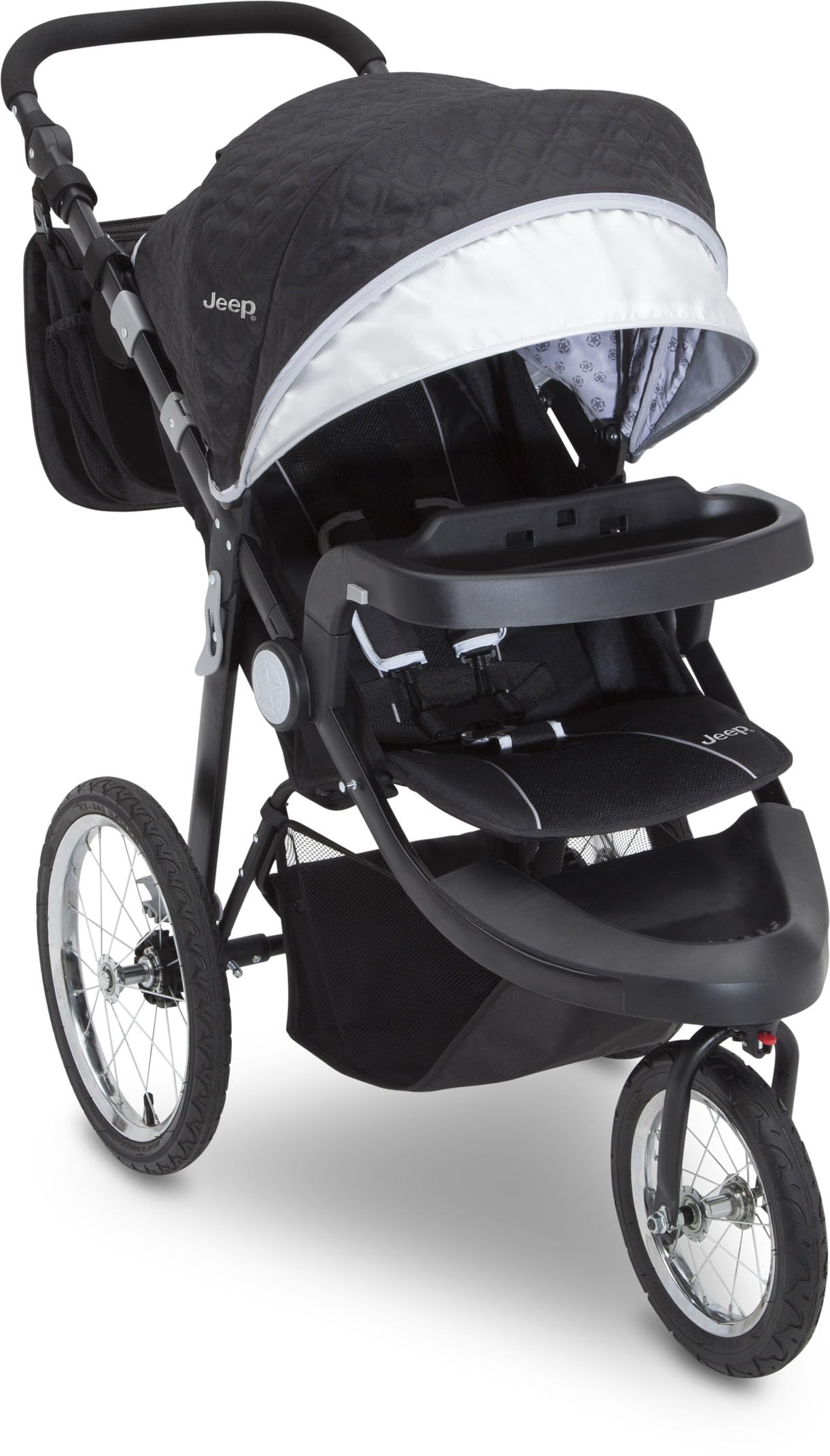
Jeep Cross-Country Sport Plus
Key Features
- Wheels: 16-inch rear air-spoke, 12-inch front
- Folded size: 19 x 24 x 36 in
- Stroller weight: 26 lb
- Child weight limit: 45 lb
- Price: Midrange
Air-spoke 16-inch rear wheels on ball bearings, a locking 12-inch front, and 26 pounds to lift — the Cross-Country Sport Plus is the least expensive way here to get proper trail wheels. The quick-release rear axles pull out for the trunk, and it folds to 19 by 24 by 36 inches, which is a size you can plan around.
On grass, hills, and gravel it holds a line, and the extendable quilted canopy with its peek-a-boo window is one of the nicer ones in this group. The child tray swings away for loading, a safety tether comes with it, and the undercarriage bin swallows a day pack.
Two things to know before you choose it. The seat is rated to 45 pounds, the lowest here, so this is the stroller for one child up to about preschool rather than the one you keep until kindergarten. And the front-wheel lock can stick when the stroller is new, so work it a few times before you trust it on a slope. Neither stopped us enjoying the climbs, where the big rear wheels earn their keep.
Pros
- 16-inch air-spoke rear wheels on bearings
- 26 lb, lighter than the premium picks
- Quick-release rear wheels for the trunk
- Safety tether and lockable front wheel
Cons
- 45 lb seat limit, the lowest here
- Front-wheel lock can stick when new
This is the pick for real air-filled trail wheels without premium money: 26 pounds, a locking front, and a 45-pound seat for the preschool years.
Best for Infant Travel System
Delta Children Apollo
Key Features
- Frame: Shock-absorbing
- Wheels: 12-inch front, 16-inch rear, puncture-proof
- Stroller weight: 33 lb
- Child weight limit: 50 lb
- Price: Budget
The Apollo is the pick for the first year, when a hike is really a walk and the baby is still in a bucket seat. An infant car seat adapter comes in the box and takes Graco SnugRide Click Connect, Evenflo Nurture, and Evenflo Embrace seats; Britax B-Safe 35 parents need a separate adapter. The child tray swings out, and we found that loading a sleeping baby doesn’t turn into a wrestling match.
Puncture-proof wheels and a shock-absorbing frame are the two reasons it earns its place. There are no flats to fix at a trailhead, and the frame has enough give that washboard gravel doesn’t rattle the whole stroller. With 16-inch rear wheels and a 12-inch front it covers the packed-dirt and crushed-gravel trails most families actually use, and the basket and parent organizer carry a day’s snacks and water.
It is, however, the heaviest stroller here at 33 pounds, and lifting it into a tall wagon is a two-hands-and-a-hip operation. If the stroller lives in the garage and comes out for weekend walks, that’s fine. If you’re carrying it up three flights, it will wear on you.
Pros
- Infant car seat adapter in the box
- Puncture-proof tires with 16-inch rear wheels
- Shock-absorbing frame softens gravel
- Large basket and parent organizer
Cons
- Heaviest stroller here at 33 lb
- Short 90-day warranty
For a family with an infant, we like the Apollo: the included car seat adapter, puncture-proof tires, and 16-inch rear wheels make it the easiest trail stroller to live with in year one.
Best for Park Paths
Graco FastAction LX Jogger

Key Features
- Fold: One-hand, one-second FastAction
- Car seat: Graco Click Connect
- Stroller weight: 28.2 lb
- Child weight limit: 50 lb
- Price: Midrange
One pull, one hand, one second: the FastAction fold is why this stroller made the list, and it holds up in a parking lot with a toddler on your hip. It’s the only pick here that collapses without a second thought.
The rest is sensible family transport. A Graco Click Connect infant seat clicks straight on, the child tray has a cup holder, the basket is big, the seat pad lifts out for washing, and the seat reclines in multiple positions with a three-position handle for taller pushers. At 28.2 pounds and rated to 50 pounds, it does the everyday job.
The ride is where it slides to the back of this group. On gravel and roots it felt busy and bumpy, and there isn’t much suspension to calm it down; the canopy also lets low morning sun under the front edge. As a greenway and park-path stroller that folds in a second and takes an infant seat, it makes sense. For actual hiking, the picks above earn their places.
Pros
- One-hand, one-second fold
- Graco Click Connect car seat compatibility
- Big basket, child tray, and removable seat pad
Cons
- Bumpy on gravel and roots
- Heavy at 28.2 lb to lift
We recommend the FastAction LX to families who mostly walk paved paths: the one-hand fold and the Click Connect seat are genuinely useful, but rough trails are not its territory.
How We Tested Hiking Strollers on Real Trails
We started by rounding up every stroller marketed for trails and filtering hard on the things that matter off-road: air-filled or large-foam tires, a lockable front wheel, a hand brake, and a seat that reclines far enough for a nap on the way back. From that group we picked seven that spanned the range of weights and folded footprints, then used each one as our only stroller for eight months — school runs, grocery aisles, and weekend trail days included.
Testing happened where these strollers actually live. Each one covered the same half-mile gravel rail trail, a root-crossed wooded loop, and a wet grass hill, plus daily pavement, curb cuts, and the trunk of a compact car. We folded and unfolded every model one-handed while holding a toddler on a hip, weighed each on a luggage scale and then hoisted it into the hatch, and rolled them down an empty stretch of flat pavement with no hands to see whether they tracked straight or drifted.
What we watched for was specific. Smooth ride meant strapping a half-full water bottle to the frame and seeing how much it sloshed on gravel. Sturdiness meant loading the basket with a jug of water and rocking the handlebar side to side. Ease of use came down to brake pedals we could find without looking and harness buckles we could manage in gloves. By the end we also had eight months of wear to inspect — flattened tires, stretched brake cables, faded fabric, squeaky joints — and a clear sense of which strollers gave you the most for what they cost and which charged for details that never came up on the trail.
How to Choose a Hiking Stroller
Wheel size and tire type decide almost everything about how a stroller behaves on a trail, so start there and work back to the extras.
Air, Foam, or Puncture-Proof Tires
Air-filled tires give the best grip and the softest ride over roots and rock, because the tire itself is the first layer of suspension. They also go flat, and a stroller with a flat is a stroller you carry. Foam and puncture-proof wheels trade some of that compliance for never having to think about pressure — the Chicco Activ3 runs foam all round, and the Delta Apollo uses puncture-proof wheels.
The trap is assuming a firmer tire is a safer one. Puncture-proof does not mean the ride is as plush, and air tires are not maintenance-free. If you’ll check pressure before a hike, choose air. If you won’t, choose foam and accept a slightly busier push over loose rock.
Wheel Size and the Front Lock
Sixteen-inch rear wheels are the trail standard in this group, and the difference is real: a bigger wheel rolls over a root instead of stopping against it. Twelve-inch wheels all round, as on the Chicco Activ3, are fine on packed gravel and boardwalk and noticeably busier on loose rock and washed-out dirt.
Every pick here has a lockable front swivel wheel, and the lock is the part people forget. Leave it swiveling for maneuvering in a parking lot; lock it for running and for anything steep or loose, where a free front wheel follows the terrain instead of your hands.
Brakes and the Wrist Tether
Every stroller here has a rear foot brake for parking. A hand-operated brake, which only the Chicco Activ3 has in this group, lets you hold speed from the handlebar on a descent — worth having when the trail drops away and the stroller is heavier than you expected. Use the wrist tether on any slope, whatever you buy. It’s the piece of safety equipment most often left dangling.
Seat Limits and How Long It Lasts
Seat ratings here run from 45 to 75 pounds, and that number decides how many years you get. A 45- or 50-pound limit covers most preschoolers; if you want a stroller a tall five-year-old can still ride, look for 75 pounds and a height limit around 44 inches, which is the BOB. Check the recline too if you hike at nap time — a seat that lies back is worth more on a long walk than another cup holder.
Frequently Asked Questions
How old should a child be before riding in a hiking stroller?
Our picks list age ranges from newborn to toddler, but the newborn ratings assume either a full recline or an infant car seat clicked in, and an adapter is for walking rather than jogging. Wait until your child can sit up with head control and the harness holds them upright before you take on uneven ground. Before that, a car seat adapter on a flat, packed path is the sensible ceiling.
Will a jogging stroller fit in my car trunk?
Check the folded dimensions rather than the footprint. The Delta Apollo folds to 18.5 by 15.5 by 31.5 inches, the tightest package here; the Jeep Cross-Country Sport Plus is 19 by 24 by 36; the BOB Revolution Flex 3.0 is 38 by 25 by 16, so it needs a long, flat load floor. If your trunk opening is shallow, quick-release rear wheels buy back the difference.
How heavy is too heavy to lift into a car?
The strollers here run from 23.6 to 33 pounds, so the spread is roughly a large diaper bag. Add a 25-pound toddler and a 33-pound stroller is about 58 pounds in and out of a trunk. If you have a tall SUV, back trouble, or a daily haul, stay near 25 pounds and let the trail wheels be a little smaller.
Final Verdict
The Baby Trend Expedition is the stroller we point most hiking families to. It’s the lightest of our picks at 23.6 pounds, its lockable 16-inch front wheel handles gravel and roots, and it costs less than anything else here.
Spend more only for a specific reason: the BOB Revolution Flex 3.0 if you’re on rough ground often and want a seat that lasts to 75 pounds, or the Chicco Activ3 if your trails have hills worth braking for.
