This post contains affiliate links. We may earn a small commission when you buy through our links — at no extra cost to you.
Baby jumpers are one of those purchases where the marketing promises a lot more than the actual experience delivers. Many parents discover squeaky springs, stiff rotation, or seats that don’t fit younger babies only after unboxing. The real choice comes down to matching the jumper type to your lifestyle—portable standalone, doorway clamp, or stationary activity center—each with clear trade-offs in portability, noise, and usable age range.
The most reliable options today prioritize straightforward design over flashy features. Portable models fold small enough for a diaper bag but trade longevity for convenience. Doorway jumpers offer unbeatable price and simplicity, yet often introduce noise that carries through the house. Understanding these boundaries upfront is the quickest way to avoid regret—and the only way to land a jumper that actually fits how your family moves.
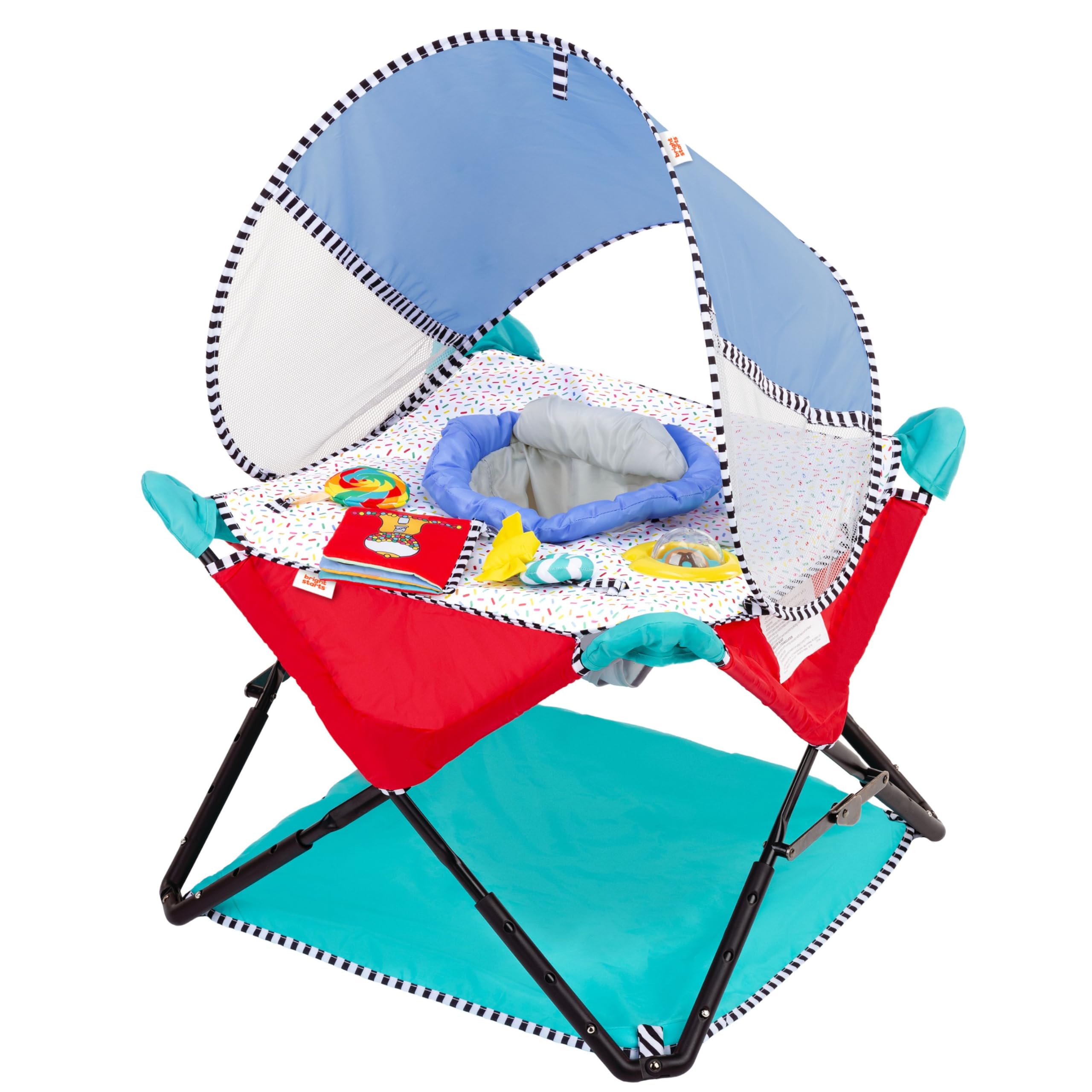


Best for On-The-Go Families
Bright Starts Pop ‘N Jump
Key Features
- Type: Portable standalone
- Portability: Pop-and-fold, carry bag
- Toys: 4 sensory toys
- Height & Weight: 3 positions, 25 lbs
- Price: $$
The pop-and-fold mechanism works like a camping chair: unfold, lock, and it’s ready. A carry bag and removable sun canopy make it genuinely easy to take to the park, beach, or campsite. Babies engage with four sensory toys while the three height positions accommodate growth. Build quality holds up to daily use — the fabric seat and frame show no early wear.
This jumper fits families who need compact storage or travel-friendly gear. It sets up in seconds on grass, sand, or tile. The trade-off is a short usable window: most babies outgrow it by 11 months, and some get only 2–3 months of use. It solves portability, not longevity.
Pros
- Folds into a carry bag for true grab-and-go portability
- Robust frame and seat fabric resist wear from regular use
- UV canopy lets baby bounce outside without direct sun exposure
Cons
- Limited age window — babies typically outgrow it around 11 months
Buy this if you need a portable jumper for travel, camping, or a small apartment. Skip it if you want a jumper that stays relevant past the first birthday.
Best for Budget Families
Evenflo Johnny Jumper
Key Features
- Type: Doorway jumper
- Portability: Lightweight 2.9 lbs
- Toys: Limited
- Height & Weight: Adjustable straps, 24 lbs
- Price: $
The Evenflo Johnny Jumper is the lowest-priced doorway jumper we tested, with a lightweight 2.9-pound frame and tool-free clamp that installs without tools. The seat is machine-washable, and babies find the interactive owl design entertaining. However, the spring squeaks loudly — a complaint noted by many users — and the bounce is less vigorous than some expect. These are predictable trade-offs for a budget model. Despite the noise, it carries a 4.5-star rating from over 14,000 reviews, reflecting its value for the price. It suits families who need a cheap, portable jumper and can accept noise, but not those who want quiet or high-energy bouncing. Adjustable straps accommodate infants from 6 months to 24 pounds.
Pros
- Good quality construction overall
- Babies find it fun and entertaining
Cons
- Loud squeaky spring; noise carries through the house
- Bounce quality is inconsistent; many find it not bouncy enough
Buy this if you want the cheapest doorway jumper and can tolerate a noisy spring and mild bounce. Skip it if you need quiet operation or a more bouncy experience.
Best for Older Babies
Bright Starts Door Jumper
Key Features
- Type: Doorway jumper
- Portability: Lightweight 2.14 lbs
- Toys: Taggies & link loops
- Height & Weight: Adjustable strap, 26 lbs
- Price: $
Unlike the top pick’s pop-and-fold portability, this Bright Starts model is a no-frills door jumper that prioritizes low cost and easy installation. The seat, however, is designed for larger babies; infants 6–9 months old tend to slouch sideways due to excessive seat depth. Best reserved for babies 10 months and older who can sit upright and fill out the seat properly, making it a budget-friendly option if you can wait for your child to grow into it.
Pros
- Great value for the low price
- Assembles quickly without tools
- Babies enjoy the attached toys and bouncing motion
Cons
- Seat is overly large for younger infants, causing them to flop sideways
- Stability can be shaky as babies lean despite the adjustable strap
Buy this if you need the most affordable doorway jumper and your baby is at least 10 months old. Skip it if you have a younger infant or need a portable travel-friendly model.
How to Choose
The most important decision is picking between a portable standalone jumper, a doorway clamp model, or a stationary activity center, because each serves a different daily routine and space constraint.
Jumper Type
Portable standalones offer the most flexibility for travel and small apartments but have a shorter usable window (typically 6–11 months). Doorway jumpers are cheaper and easy to install but rely on a door frame and can be noisy. Stationary activity centers provide more toys and 360-degree rotation but take up floor space and often have durability concerns.
Seat Rotation
Many stationary jumpers advertise 360-degree rotation, but actual performance varies. Look for models with consistently positive feedback on rotation smoothness—stiff or non-functional rotation is a common complaint. Doorway jumpers do not offer rotation, which is fine for simple bouncing.
Portability & Storage
If you move between rooms or travel often, a jumper that folds flat or includes a carry bag is essential. Portable models trade sturdiness for compactness, so check the fold mechanism’s ratchet straps or clips. Doorway jumpers are inherently portable but require a door frame.
Toys & Activities
More toys don’t always mean more engagement—babies can get overwhelmed or ignore cheap plastic. Focus on quality: removable toys, music with volume control, and machine-washable fabric are practical features. Simpler setups often hold attention longer.
Height Adjustability & Weight Limit
Most jumpers offer multiple height positions to accommodate growing babies, but weight limits max out around 25–26 lbs. Check the adjustability range against your baby’s current height—some seats are too deep for 6-month-olds, causing flopping.
FAQ
Why does my baby’s doorway jumper squeak so much?
The spring mechanism in most doorway jumpers is metal-on-metal and lacks lubrication. A quick fix is to apply a small amount of silicone spray or dry lubricant to the spring coils. If the noise persists, the spring may be defective—some models are simply louder than others, so check reviews for ‘squeak’ before buying.
How long can a baby use a portable jumper?
Most portable jumpers are designed for babies 6 to 12 months, but many children outgrow them by 11 months. The weight limit (usually 25 lbs) and height restrictions limit use. If you want a jumper that lasts longer, a stationary activity center with adjustable height is a better choice.
Are baby jumpers safe for hip development?
Pediatricians recommend limiting jumper use to 20-minute sessions per day and ensuring the baby’s feet touch the floor flat when seated. Jumpers do not cause hip dysplasia on their own, but they can delay walking if overused. Always follow the weight and age guidelines, and stop use once the baby can stand independently.
Do baby jumpers help with walking?
Jumpers strengthen leg muscles but do not teach walking skills. They can actually delay walking if used excessively because the bouncing motion is different from stepping. The American Academy of Pediatrics advises using jumpers as a short-duration entertainment tool, not a walking aid.