This post contains affiliate links. We may earn a small commission when you buy through our links — at no extra cost to you.
A newborn in water is a slippery, wriggling bar of soap, and the first baths I gave my daughter were less about getting her clean than about not dropping her. A good infant tub doesn’t bathe the baby for you, but it does give you somewhere to put both hands: a sloped seat that holds a slumping newborn, water up to the waist instead of the chin, and a drain you can pull one-handed. The wrong one announces itself fast — a tub that skates across a wet counter, a seam that starts weeping, a basin that no longer fits the kitchen sink by week six.
Four months and 14 tubs later — inflatable sink inserts, hard plastic basins, full-size convertibles — the pattern is clear. The ones parents actually love are rarely the priciest or the most feature-stuffed; they fit the sink you have, drain without a wrestling match, and leave one hand free. Everything below earned its spot next to the faucet.



Best for Newborn to Toddler
Skip Hop Wave 4-in-1
Key Features
- Stages: 4, newborn to sit-up
- Dimensions: 28.1"L x 19"W x 12.2"H
- Max weight: 25 lb
- Sling care: Machine wash cold, hang dry
- Price: Midrange
Four stages out of one molded tub sounds like a line from the box, so we counted what actually changes: a mesh sling with a cushioned headrest for a newborn, two sling heights as your baby puts on weight, a sit-up support insert for the wobbly months, and then a bare basin for a toddler up to 25 pounds. The figure that matters most is the wall, 12.2 inches at the rim, which is several inches more tub than the shallow Fisher-Price gives you. Deeper water stays warmer, and far less of it ends up on the bathroom floor once your baby discovers kicking.
That combination is why this is the one we recommend to most families. The sling is mesh, so it goes in the machine on cold and hangs to dry, and the support pieces come apart without tools. What we appreciated more than we expected is where the pieces go when they are not in use: the sit-up support snaps into the front of the tub, and a hook on the back hangs the whole thing from a shower curtain rod or a towel bar, so a wet tub is not sitting on the bathroom floor between baths.
The footprint is the honest caveat. At 28.1 inches long this is a tub that lives in the bathroom rather than one you tuck into a cupboard, and on a smooth countertop it can skid when a baby kicks — keep it inside the adult tub or set it on a rubber mat. If you want to buy once and be finished, it is still the one we point to.
Pros
- Four stages from newborn sling to toddler basin
- Higher walls keep water deeper and splashes in
- Machine-washable sling and a built-in drying hook
Cons
- Printed decals can flake with repeated washing
- The storage hook is the first part to break
Our default for good reason: four stages that genuinely carry a baby from the first bath to toddler splashing, with deeper walls and a sling you can machine wash.
Best for Playful Bath Times
Fisher-Price 4-in-1 Tub
Key Features
- Stages: 4, with Sit-Me-Up insert
- Includes: Tub, sling, Sit-Me-Up support, rinse bottle, scoop
- Dimensions: 29.8"L x 17.6"W x 7.5"H
- Max weight: 25 lb
- Price: Midrange
The rim on the Fisher-Price sits 7.5 inches up, low enough to reach over without stretching and shallow enough that the tub slides under a kitchen faucet or sits inside an adult tub without a fight. At 29.8 inches long and 17.6 wide it is a long, narrow shape, and it is stated to fit most sinks and adult bathtubs — worth checking against your own spout before you commit, because a low faucet is the whole point of buying it.
Four stages carry it from a mesh sling for a newborn to the Sit-Me-Up insert for a baby learning to balance, then to an open basin rated to 25 pounds. A drain plug saves you tipping the whole thing over, and a hook on the end hangs it to dry. Ours came with a rinse bottle, a scoop and two toys; the toys would not sell us a tub on their own, but a scoop that doubles as a pourer does keep a sitting baby occupied while you get the shampoo done.
Where it gives ground to our top pick is depth. The shallow walls mean less water around a toddler who likes to soak, so a bigger baby sits in a puddle rather than a bath — the flip side of a rim you can reach over without leaning. For a family bathing in a small sink, a shower-room basin or an apartment tub with low clearance, that trade is worth making.
Pros
- Low 7.5-inch rim fits under faucets and in adult tubs
- Drain plug and hanging hook built in
- Rinse bottle, scoop and two toys included
Cons
- Sit-Me-Up insert is stiff to pull out for cleaning
Buy this if your sink spout or tub surround is low — the shallow rim is easier to reach over than anything else here, and the extras keep a sitter busy.
Best for Travel and Hotels
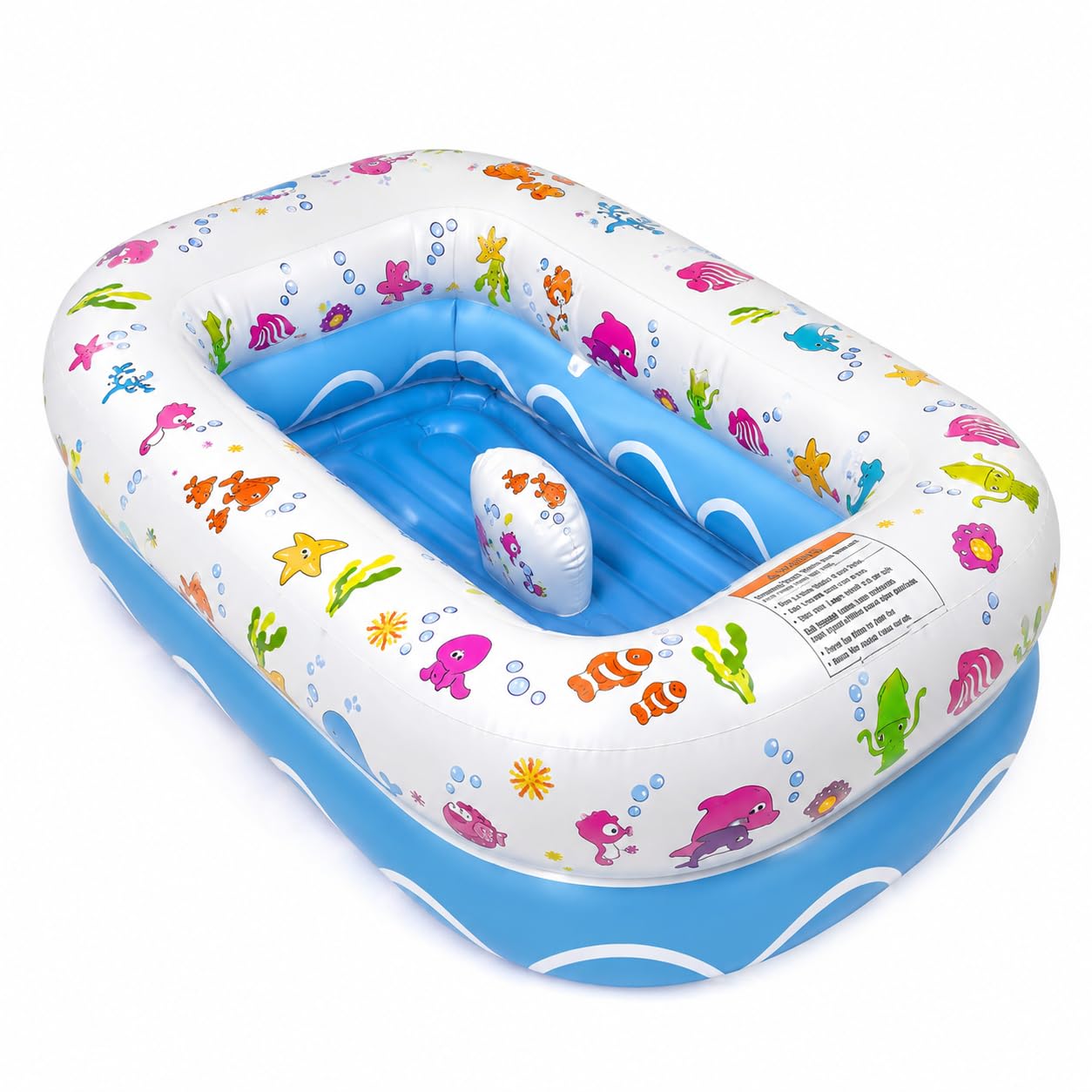
Mommy’s Helper Inflatable
Key Features
- Ages: 6 to 24 months
- Type: Inflatable with saddle horn
- Max weight: 27.5 lb
- Packed weight: 15.7 oz
- Price: Budget
Fifteen and a half ounces, deflated and folded into the corner of a suitcase, is the number that makes sense of this tub. It is the one we pack for a weekend at the grandparents’ house or a hotel room with nothing but a shower stall, and it takes up about as much room as a folded sweater.
What we did not expect is how well it holds a sitter. The inflatable saddle horn between the legs stops a baby sliding forward, and the walls are soft enough that a sudden backward flop ends in a bounce rather than a crack against hard plastic. It is sized for 6 to 24 months and rated to 27.5 pounds, so it is a second tub rather than a first one — the newborn months belong to a tub with a sling.
Air is the running cost. Inflating takes a few minutes and a pump makes it painless, so inflate it the night before rather than at bath time with a tired baby on your arm. For the space it takes up in a bag and the way it props up a wobbly sitter, nothing else here travels as easily.
Pros
- Packs to just over fifteen ounces
- Saddle horn keeps a sitter upright
- Soft inflatable walls suit a wriggling baby
Cons
- Starts at 6 months, so no newborn use
- Seams can leak over months of folding
The travel tub we pack without thinking about it: fifteen ounces deflated, and a saddle horn that keeps a sitting baby from sliding forward in a strange bathroom.
Best for Tight Budgets
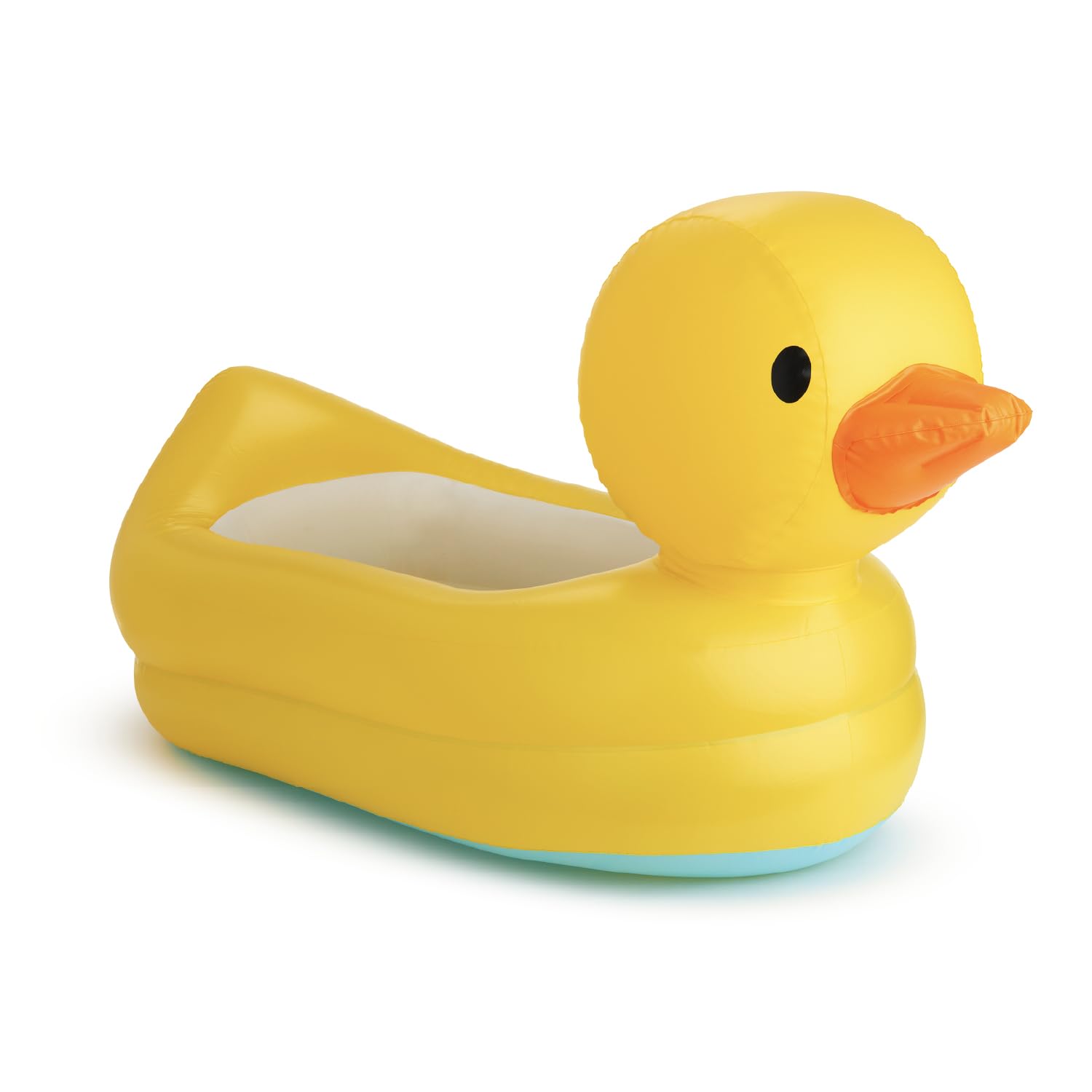
Munchkin Duck Tub
Key Features
- Ages: 6 to 24 months
- Type: Inflatable duck
- Safety features: White-hot disc, textured bottom, suction-cup hook
- Price: Budget
The duck is the least expensive way into a proper bath here, and it is what we suggest to anyone who wants a tub for the sitting months and nothing more. It is a rubber duck at bath scale: 6 to 24 months, soft inflatable walls, and a textured floor so a wriggling baby has something to push against.
What earns it a place beyond the price is the safety disc set into the base. It turns white when the water is too hot, which is a second opinion you can see from across the bathroom while you are holding a baby on one arm. The suction cup on the side hangs it on the tile to dry, and the curved shape gives a sitter somewhere to lean back.
Allow ten minutes and a pump for inflation, because blowing this one up by mouth is slow work. Treat it as a seasonal tub rather than an heirloom — it lives in a cupboard, comes out nightly for a year or so, and then becomes a beach toy. At this price, that is a fair deal rather than a compromise.
Pros
- Lowest price of any tub here
- White-hot disc flags water that is too hot
- Suction cup hangs it up to dry
Cons
- Seams can give out after a few months
The cheapest route to a safe sitting bath, and the only one here with a hot-water disc built in — buy it for the toddler months and expect a season or two.
Best for Kitchen Sink
Boon Soak
Key Features
- Ages: 0 to 18 months and up
- Stages: 3 support positions
- Dimensions: 25.38"L x 8.84"W x 15.72"H
- Temp check: Color-changing drain plug
- Price: Midrange
A color-changing drain plug sounds like a gimmick until you are filling a tub one-handed with a baby on your hip. The plug shifts color as the water warms, so the check happens at the drain while you are still running the tap, rather than after you have already set the baby down and reached for a thermometer.
The shape is what we like most. The Soak is a long, narrow rigid tub built to drop into a double sink or sit inside a full-size bath, and once it is in place it stays where you put it. The bump on the floor slides between positions — low and flat for a newborn, raised for a baby learning to sit — and the contoured back with non-slip foam gives a small baby something to settle against. It is also the easiest tub here to rinse out, because a drain plug means you never lift a full basin of water.
It does its best work in the first year. Bigger babies end up leaning on the sides once they want to sit straight up, and the slanted back stops being the right shape for them. For a kitchen-sink family with a baby under a year, that limitation arrives at about the same time the tub stops being useful anyway.
Pros
- Drops into a double sink and stays put
- Sliding bump adjusts for newborn through sitter
- Color-changing plug doubles as a temperature check
Cons
- Babies can slide toward the sides as they grow
The best fit for a kitchen sink and the first year: a narrow rigid tub with a sliding support bump and a drain plug that tells you when the water is too warm.
Best for Small Bathrooms
MoreFeel Collapsible Tub

Key Features
- Ages: 0 to 36 months
- Includes: Hooded towel, floating cushion, thermometer
- Dimensions: 27"L x 17"W x 9"H
- Folded thickness: Under 4 inches
- Price: Midrange
Folded, this tub is under four inches thick, and it folds in half again on top of that. That is the entire argument for it in a flat with one bathroom and no cupboard to spare: it slides behind a door or into a gap, and it comes back up in two moves when you need it.
The extras carry more weight than we expected. There is a hooded towel, a soft floating cushion for a newborn, and a temperature readout built into the side that updates as you fill — easier than fishing a separate thermometer out of the water with one hand. The cushion is the piece that does the newborn work, and it is also the piece that needs the most attention afterwards.
Where it asks for patience is the fold. Press each joint until it seats before you add water, because a half-locked side flexes under a kicking baby, and set the whole thing on a flat surface rather than a towel on a sloped counter. Do that and it earns its cupboard-free existence; skip it and you will not trust it.
Pros
- Folds under four inches, then folds in half
- Built-in temperature readout and hooded towel
- Foldability praised for small-space storage
Cons
- Thermometer can fail and has no off switch
- Soft cushion needs thorough drying to stay fresh
For a bathroom with no storage: it folds to under four inches and in half, though you need to seat the fold properly before every bath.
Best for Simple Daily Baths
Frida Baby 4-in-1

Key Features
- Extras: Removable seat and backrest, drain plugs, no-slip feet
- Stages: 4
- Capacity: 25 liters
- Dimensions: 28"L x 18.25"W x 8.63"H
- Price: Midrange
Twenty-five liters is the only capacity figure anyone states in this group, and it translates to a basin a toddler can actually splash in rather than a molded puddle. Around it: a removable seat and backrest for the newborn stage, drain plugs at the low end, a drying hook, and no-slip feet.
The detail we rate highest is the least glamorous. Most tubs here rely on shape and gravity to stay put on a wet surface; this one grips the floor of the bath, which matters when you are reaching for a washcloth with one hand. Setup is a seat and a backrest to click in, both of which come out for washing — welcome, and also two more pieces to keep track of.
Two things to balance against that. It is a shallow tub at 8.63 inches, so a toddler who likes to soak sits in less water than in the Skip Hop, and the removable parts need rinsing and drying separately. For a plain, roomy basin that stays where you put it, that is a fair trade.
Pros
- 25-liter basin has room for a splashing toddler
- No-slip feet grip a wet tub floor
- Drain plugs and a drying hook built in
Cons
- Removable seat and backrest add parts to wash
A roomy, plain tub with the best grip on a wet bath floor — worth a look if you want a big basin and simple parts rather than extra stages.
Best for Newborn Sink Baths
Skip Hop Soft Sink Bath

Key Features
- Ages: 0 to 6 months
- Care: Machine wash and dry
- Dimensions: 19"L x 12.75"W x 10.5"H
- Max weight: 20 lb
- Price: Midrange
For the first three months, this is the answer if your kitchen sink has a flat bottom and a little room: a terry-covered foam cradle that holds a newborn at counter height in a couple of inches of water, without you bending over a bathtub. We rate it well above a full-size tub for that stage, because everything happens at hip height and you keep both hands free.
The mesh panel in the base lets water drain straight through when you lift the baby out, and the whole thing goes in the washing machine and the dryer — which matters more than it sounds on the night a diaper leaks mid-bath. A hook-and-loop strap hangs it from a tap or a rail to dry, and the foam stays soft rather than going crunchy at the edges.
The limits are built in. It is a newborn purchase rather than a convertible one, and it needs a sink basin flat enough and a spout high enough to clear the foam; a deep farmhouse sink or a shallow bar sink will not give you what this design assumes. Check the sink before you buy, because the sink is doing half the work.
Pros
- Holds a newborn at counter height in the sink
- Machine washable and quick to dry
- Mesh base drains without lifting the baby
Cons
- Only suits newborns, up to 20 pounds
- Can slide in a sink with a smooth base
The nicest way to bathe a newborn in a kitchen sink, as long as your basin has a flat bottom — it stops being useful well before the first birthday.
How We Tested the Best Infant Bath Tubs
I started by gathering roughly 40 tubs from the major baby-gear brands and narrowing to 14 that covered the real spread: sink inserts, inflatables, hard plastic basins, and convertibles that grow into a toddler seat. The cut came down to price tier, footprint, and the age range each tub claimed to cover, so the lineup held budget picks alongside the more expensive seats. Each one then lived in my house for four months of actual bath duty — the 6 p.m. wash after dinner, the mid-diaper-blowout rinse, the deeper soak in the big bathroom tub, and a weekend trip to my mother’s house.
Size was measured, not eyeballed. I checked each tub’s footprint against my kitchen counter and a standard sink basin, and noted which ones stopped fitting as my daughter grew. Every portable model got packed into a diaper bag and carried across the house, weighed dry and again right after a bath, and the air-filled ones were timed with a hand pump, then left inflated overnight to see which sagged by morning. For stability, I bumped each tub with a hip while reaching for a towel and watched what happened when a baby kicked. Seating got the closest look: whether a newborn slid down the slope, whether the shoulder bumps actually held, and what changed once the newborn insert came out.
Convenience came down to single-handed handling — pulling the drain, dumping the water, hanging the tub to dry without mildew settling into the folds. I ran a thumb along every edge and seam looking for roughness, and kept an eye on drain plugs and suction cups over the four months to see which loosened or cracked. Value was the last call: what a tub actually gave us for the money, not what the box promised.
How to Choose an Infant Bath Tub
The tub that suits a two-week-old is not the tub that suits a ten-month-old, so most families either buy one that changes stages or buy cheap and buy twice — both work, as long as you know which you are doing.
Match the stage, not the age on the box
The figure to check first is the weight band attached to each stage, not the range printed on the front. A sling rated to 15 pounds is the piece that keeps a newborn’s head clear of the water, and a tub with only one lying position gets outgrown while your baby still needs help sitting.
Look for three stages — a newborn sling, a supported sitter, and an open basin — each with its own limit. The full-size tubs here top out at 25 pounds, which usually lands somewhere in the second year.
Measure the place you will actually bathe
Where the tub sits decides more than any feature list. A sink bath needs a basin with a flat bottom and a spout high enough to clear the rim; counter bathing needs a surface that will not slide; an adult tub needs a baby tub small enough to sit inside it.
Most full-size tubs here run 27 to 30 inches long, so none of them drops into a kitchen sink. If the sink is the plan, buy a sink-shaped tub or a soft sink bather and accept the shorter useful life; otherwise plan on the bathroom floor or the big tub.
Rigid, folding or inflatable
Rigid plastic is the easiest to clean and the steadiest in use, and it takes the most floor space between baths. An inflatable packs to the size of a folded sweater and costs the least, but most start at six months and every one of them needs inflating before every bath.
A collapsible tub folds to a few inches and suits a bathroom with no storage, at the cost of walls that flex and a fold you have to seat properly each time. Choose by where the tub will live, not by which one looks best in a product photo.
Draining and drying decide how long it lasts
Water trapped in a folded sling or under a foam cushion is what turns a tub musty. A drain plug saves tipping a full tub into the bath, a hook lets it hang instead of sitting in a puddle, and a removable sling is the difference between rinsing and scrubbing.
Rinse and hang the tub after every bath, and dry the cushion fully before it goes back in. It is the least interesting part of the purchase and the one that determines whether you are still happy with the tub in six months.
Frequently Asked Questions
Is an infant tub worth buying if we already have a bathtub?
Usually, yes, for the first six months. A full-size tub means kneeling over a hard rim, and filling it deep enough for a small baby uses far more water than a few inches in a small tub.
A counter-height tub saves your back; an inflatable saves space. If neither bothers you, a clean bathtub and a hand behind the head are perfectly safe.
Are inflatable tubs safe for newborns?
Most are not designed for them. The inflatables here start at six months, because soft walls that give way do not hold a newborn upright or keep the head clear.
For the newborn stage, use a tub with a sling or a sink bather that cradles the head, then move to an inflatable once your baby sits with support. Check the stated age and weight floor before the first bath.
Can the mesh sling and cushions go in the washing machine?
Mesh slings generally can: cold water, gentle cycle, no bleach, hang to dry. The Skip Hop sink bather’s terry cover is machine wash and dry. Foam cushions and inflatable tubs are not — wipe those with a damp cloth and dry them fully before storing.
Follow the tub’s own care label; a sling that shrinks will not clip back onto its frame.
How warm should the bath water be?
Comfortably lukewarm. Test it with the inside of your wrist or your elbow, where the skin is thin, and it should feel neither warm nor cool.
Treat a tub’s indicator — a white-hot disc or a color-changing plug — as a backup rather than the only check, and run the hot tap last so nothing hot is left within reach.
Final Verdict
Buy the Skip Hop Wave if you want one tub that covers the whole first year: four stages, higher walls than the shallow tubs here, and a sling that goes in the washing machine. It is the one we hand to most families, and the one least likely to be replaced by month six.
If you are bathing in a shower stall or packing for a trip, the Mommy’s Helper inflatable folds to fifteen ounces and holds a sitter upright. That is a second purchase for a specific job, not a substitute for the tub at home.
